SrI: SrImathE SatakOpAya nama: SrImathE rAmAnujAya nama: SrImath varavaramunayE nama:
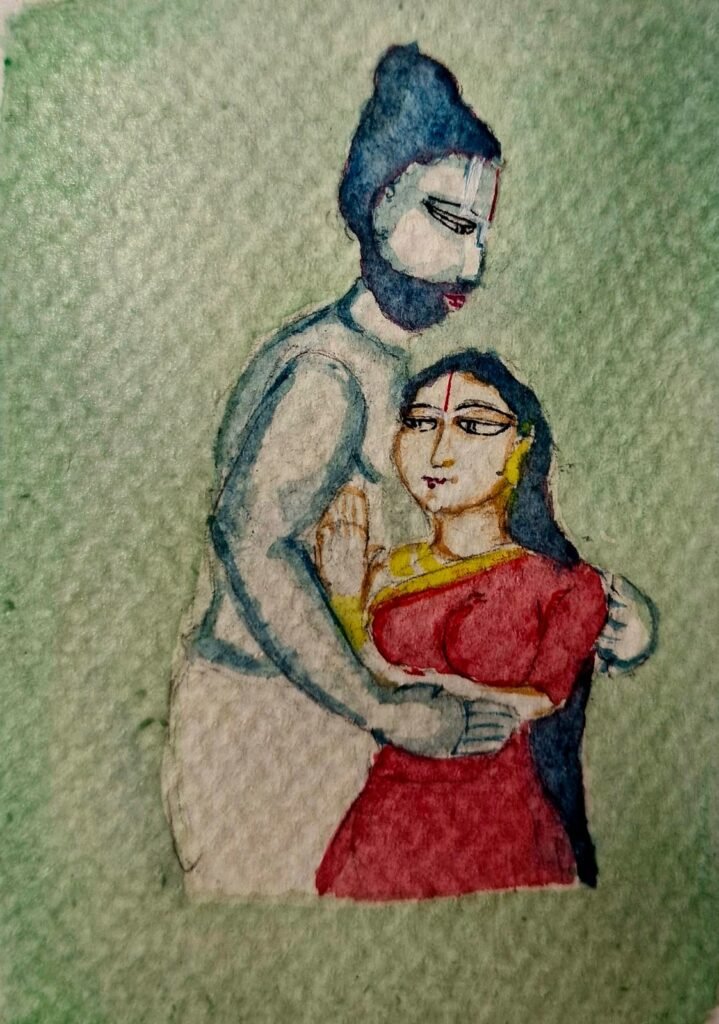
perumAL’s thirumEni after destroying kara, dhUshaNa and the 14,000 rakshasas, was covered with wounds by the arrows of those rAkshasas. At this juncture, pirAtti embraces perumAL very firmly. We are enjoying this SlOkam that describes the above situation.
tham dhrushtva SathruhanthAram maharshINAm sukhAvaham I
babhUva hrushtA vaidhEhI bharthAram parishasvajE II
The avathArikai (introduction) and word-by-word meaning for this SlOkam were explained in the previous article.
Simple meaning
sIthAp pirAttti felt alive only after seeing SrI rAma and embraced SrI rAma nicely.
Notes from periyavAchchAn piLLai’s vyAkhyAnam
tham – that SrI rAma, who was spoken of angrily by sIthAp pirAtti
When perumAL said that he was scared to take her along to the forest inhabited by many rAkshasas, sIthAp pirAtti uttered the following SlOkam.
- SrI rAmAyaNam ayOdhyA kANdam 30-3 “sthriyam purushavigraham” (What will my father think about having a son-in-law who is a woman in a man’s body?)
After destroying the rAkshasas, sIthAp pirAtti embraces that SrI rAma to whom she had spoken angrily earlier.
tham – that SrI rAma, who showed to sIthAp pirAtti, the gory scene of the rAkshasas lying destroyed in the battlefield
sIthAp pirAtti’s angry words (sthriyam purushavigraham – Though sIthAp pirAtti had not thought of, in her divine mind, when she spoke the words “You are a woman in a man’s body)” SrI rAma kept the words in his divine mind. After he severed the rAkshasas’ heads and bodies separately, their dead bodies floated in a flood of blood; perumAL held pirAtti’s hand and showed her that scene as though implying to her – “Could you see this battle scene done by a woman in a man’s body?”
tham – that SrI rAma, who stands, unparalleled in his prowess
When attempting to count valorous people, one would not be able to go beyond counting the first person (i.e., when counting with fingers, there would not be anyone to count beyond counting the first person with their little finger) since SrI rAma is the only person to be counted in this regard.
- SrI rAmAyaNam sundhara kANdam 34-28 “Adhithya iva thEjasvI” (SrI rAma who has the radiance like the sun).
tham – that SrI rAma, who has a very delicate thirumEni [divine form]
SrI rAma’s thirumEni is very soft, such that even if the loose petals from the flowers fall on him while he is on his bed, his thirumEni would turn red.
tham – that SrI rAma whose thirumEni turns red even when stared at, lovingly
SrI rAma’s tender thirumEni would turn red even by the shine emitted from the eyes or an intimate gaze with love!
tham – that SrI rAma, who is resolute
That SrI rAma who was determined to fulfil the promises he made to the rishis that he will “annilate rAvaNa with his friends and relatives” such that the words do not remain as meaningless sounds of an ocean
tham – that SrI rAma, whose auspicious thirumEni was marked by the wounds of the arrows
SrI rAma’s thirumEni which was identified with the wounds from the arrows of the rAkshasas, similar to an adornment with a golden garland embellished with the red gems.
sIthAp pirAtti sees that SrI rAma whose thirumEni was covered with wounds from arrows.
dhrushtva – saw; sIthAp pirAtti saw SrI rAma’s thirumEni with her cooling and fragrant glance
Like immersing a delicate flower garland (made of karumugai flowers [malabAr jasmine]) in rose essence, sIthAp pirAtti with her divine glance – cooling and fragrant as rose essence itself – drenched the tiresome and perspiring thirumEni of SrI rAma.
dhrushtva – saw; sIthAp pirAtti saw SrI rAma and bathed him in the cool pond of her vision
Like people, tired out by the sun’s heat, enter a pond to relieve their weariness, sIthAp pirAtti with her cool vision, bathed SrI rAma’s divine thirumEni that was fatigued by the arrows of the rAkshasa chieftains.
SathruhanthAram – one who was radiant due to the annihilation of his enemies
- bhagavath gIthA 9-29 “samO’ham sarvabhUthEshu’ (To all beings, I am the same).
So, if perumAL is the same to all, how can SrI rAma, sarvESvaran, have enemies to be destroyed?
- bhagavath gIthA 7-18 “gyAnI thvAthmaiva” (As for the gyAnI (one who is wise), I deem him as my own self (or soul) viz., he sustains me).
- mahAbhAratham 74-27 “mama prANA hi” (krishNa says this to dhuryOdhana – ‘You have enmity towards pAdavAs, the pAndavas are like my life).
The above pramANams show that the enemies of perumAL’s servitors are enemies of perumAL. The rishis were perumAL’s servitors, hence, SrI rAma considered the rAkshasas who caused harm to the rishis as his enemies and destroyed them.
maharshINAm sukhAvaham – one who provides happiness to the sages who were worried about SrI rAma in the battle
From the time the battle started, the rishis were worried; they thought, “kim bhavishyathi” (what’s going to happen?)
Not knowing the outcome, the rishis being mangaLASAsanaparars [wishing well for SrI rAma], were worried about SrI rAma fighting the battle. SrI rAma, annihilated all the rAkshasas, relieved their worries and gave them protection.
maharshINAm sukhAvaham – one who brought joy to his family and established his svarUpam [ basic nature, of protecting his followers]
- SrI rAmAyaNam AraNya kANdam 1-20 “thE vayam bhavathA rakshyA bhavadhvishaya vAsina:” (You alone have to protect us as we are the subjects living in your kingdom).
perumAL, by protecting the rishis, who were to be protected as members of his family, brought happiness to the rishis and established. his basic nature
babhUva – felt her existence upon seeing SrI rAma’s thirumEni
Like a soft garland and its inherent fragrance, perumAL, with his tender thirumEni and gentle nature, fought the rAkshasas, who had rough bodies and rude demeanour. Overwhelmed by her extreme love for SrI rAma, sIthAp pirAtti lost consciousness when the war began, and regained her consciousness only upon seeing SrI rAma’s thirumEni unharmed.
sIthAp pirAtti became happy upon gaining consciousness.
hrushtA – became happy
perumAL is the embodiment of blissfulness; hence, upon seeing him, pirAtti experiences joy. As she looks at his beauty, her mind is completely engaged in perumAL and she feels happy.
(Note from kAlakshEpam: perumAL is described both as happiness and also as one with happiness; both as svarUpam and guNam.)
sIthAp pirAtti, then realises her identity – daughter of king janaka.
vaidhEhI – one who is fortunate to be king janaka’s daughter
sIthAp pirAtti thinks, “If I were not born as his daughter, I would not have been fortunate”.
vaidhEhI – one who is fortunate to be in king janaka’s lineage
sIthAp pirAtti thinks, “If I were not born in this clan, I would not have had the fortune of marrying SrI rAma”.
vaidhEhI – one who is born in vidhEha dhESam
sIthAp pirAtti thinks, “It is only because I was born in vidhEha dhESam that I had the opportunity to grow up in the proximity of the dhanuS. And it is only because of the presence of this dhanus that I was given in marriage, as a reward for SrI rAma’s valour by breaking the dhanuS”.
vaidhEhI – one who is daughter of king janaka who surrendered to perumAL upon breaking the dhanus
sIthAp pirAtti thinks, “My father submitted his entire clan to perumAL and also gave me in marriage to him upon seeing him break the dhanus (bow). Oh, how would he have suffered if he sees this bravery of perumAL, single-handedly destroying fourteen thousand rAkshasas!”
vaidhEhI – one who thinks of her father and wishes for him to be present with her to see SrI rAma’s valour
sIthAp pirAtti thinks, “How I wish my father were here to see this sight! A sight that would captivate everyone on this earth, without any difference between men and women. Oh, I am alone here, seeing this sight of SrI rAma, without my father!”.
- SrI rAmAyaNam ayOdhyA kANdam 3-29 “pumsAm dhrushtichiththApahAriNam” (SrI rAma, one who captivates even the eyes and minds of men by his beautiful form, strength, and auspicious qualities).
bharthAram – husband, one who protects
From the time sIthAp pirAtti held perumAL’s hand in marriage, she thought of only her husband (bharthAram ), in her mind. The word bharthAram became meaningful when SrI rAma destroyed the rAkshasas. (bharthAram, with the root word ‘bhru’, means one who protects).
parishasvajE
sasvajE – she embraced; parishasvajE – she embraced perfectly – completely and firmly
parishasvajE – she embraced to her satisfaction
sIthAp pirAtti embraced to her satisfaction, her embrace not only healed the wounds but also made the scars from the wounds disappear. pirAtti soothed with her divine bosoms, the wounds which were caused by the arrows and made all the scars from the wounds disappear by her embrace.
Isn’t her embrace the only remedy!
In-depth meaning – Divine embrace is the only remedy – whether one is suffering from the discomfort of the wounds of 500 arrows or suffering from the misery of the 5 senses.
The five senses in our body cause wounds, which are internal. perumAL’s embracing provides remedy for all those internal wounds. But the wounds caused by the rAkshasas’ hundreds and hundreds of arrows are external wounds on perumAL’s thirumEni. Therefore, it is needless to say that pirAtti’s embracing cured the external wounds on perumAL’s thirumEni.
A creeper will always embrace (parishasvajE) its support (bharthAram), hence bharthAram parishasvajE – pirAtti embraced perumAL.
bharthAram parishasvajE.
In-depth meaning: barthAram – A pathni (wife) by existing together with her husband thrives with his support. Being together and providing support eternally is the real nature for a husband (bharthAram). A pole always remains as a support for the creeper, when such a pole is available, the creeper fully embraces it and thrives, bringing out the essential characteristic and greatness of its support.
- “bharthAram avalambyaiva bhAryAyA: sthithirishyathE I avalambya dhrumam vallee sthIyathE na vinA dhrumam II” (the nature of a wife is to live in the support of her husband; like a creeper that holds constantly to a tree trunk for support and growth, losing its ability to survive when removed from its support).
tham – (that SrI rAma). This word brings out many divine attributes of perumAL such as his valour, his nature to provide protection to those who seek his refuge etc.,
dhrushtvA – This word explains pirAtti’s nature, always nurturing and upholding perumAL’s divine attributes, by standing along with him and seeing those qualities in him.
SathruhanthAram maharshINAm sukhAvaham
- One who destroyed the enemies and brought happiness to the maharishis.
perumAL has a father and child relationship with all jIvAthmAs, he removes all the obstacles and fulfils the desires of all jIvAthmAs, and only upon doing this, a jIvAthmA is able to see him.
babhUva – felt her existence
perumAL is hailed as Sriya:pathi – divine consort of SrI mahAlakshmi; hence by gaining her existence she brought glory to that perumAL.
dhrushtvA
- “sathidharmiNi dharmAchchinthyanthE” (Only when dharmi [the substrate] is present, the qualities can be seen). As such, sIthAp pirAtti first regains her existence, and with her existence, there is happiness automatically.
vaidhEhi – princess of vidhEha dhESam, remembers her father king janaka who was responsible for her union with perumAL.
bharthAram – one who supports. sIthAp pirAtti, mother of all beings, is happy that perumAL has supported her by rescuing and protecting the rishis – her children.
- vasishta 13-2 “pithurdhaSa guNam mAthA” (A mother’s love is ten times more than the love of a father).
parishasvajE – manifestation of happiness
pirAtti is extremely happy when perumAL protects her children; she embraces him to display her feeling of happiness. perumAL is also happy by that embrace, because it is for her joy that he does everything.
tham dhrushtva SathruhanthAram maharshINAm sukhAvaham I
babhUva hrushtA vaidhEhI bharthAram parishasvajE II
This concludes the vyAkhyAnam for this SlOkam.
AzhwAr emperumAnAr jIyar thiruvadigaLE SaraNam
periyavAchchAn piLLai thiruvadigaLE SaraNam
Source – SrI rAmAyaNa thani SlOkam – 31 – AraNya kANdam 30.39 – tham dhrushtvA – Part 2 Audio Video
adiyEn chithrA rAmAnuja dhAsi
Proofreading/Curating done by – kOsalEndhra rAmAnuja dhAsan, krishNan rAmAnuja dhAsan
Artwork – namperumAL rAmAnuja dhAsan
Related Links
SrI rAmAyaNa thani SlOkam – 30 – AraNya kANdam 19.14 – tharuNau – Part 6, 30.39 – tham dhrushtvA – Part 1 Audio Video
SrI rAmAyaNa thani SlOkam – 29 – AraNya kANdam 19.14 – tharuNau – Part 5 Audio Video
SrI rAmAyaNa thani SlOkam – 28 – AraNya kANdam 19.14 – tharuNau – Part 4 Audio Video
SrI rAmAyaNa thani SlOkam – 27- AraNya kANdam 19.14 – tharuNau – Part 3 Audio Video
SrI rAmAyaNa thani SlOkam – 26 – AraNya kANdam 19.14 – tharuNau – Part 2 Audio Video
SrI rAmAyaNa thani SlOkam – concise english meanings
archived in https://granthams.koyil.org
pramEyam (goal) – https://koyil.org
pramANam (scriptures) – https://granthams.koyil.org
pramAthA (preceptors) – http://acharyas.koyil.org
SrIvaishNava education/kids portal – http://pillai.koyil.org