SrI: SrImathE SatakOpAya nama: SrImathE rAmAnujAya nama: SrImath varavaramunayE nama:
In this series, we are continuing to enjoy the vyAkhyAnam mercifully given to us by periyavAchchAn piLLai along with puthUr swAmy’s explanation. Currently, we are enjoying this SlOkam uttered by thArA (vAli’s wife), after her husband’s death.
thvam apramEyaScha dhurAsadhaScha jithEndhriyaScha uththamadhArmikashcha I
akshyya kIrthiScha vichakshaNaScha kshithikshamAvAn kshathajOpamAksha II
In this vyAkhyAnam, periyavAchchAn piLLai first explains how SrI vAlmeeki bhagavAn establishes SrIman nArAyaNa’s parathvam (absolute supremacy) in SrI rAmAyaNam. He begins by noting that other SAsthrams contain certain statements which suggest that all dhEvathAs as equal and some statements which even describe different dhEvathAs as superior, raising doubts about bhagavAn’s parathvam. He then demonstrates how SrI vAlmeeki bhagavAn establishes the supremacy of SrIman nArAyaNa specifically through the words of thArA and angadhan. By communicating through a woman monkey (thArA) and a small child (angadhan), neither of whom is well versed in vEdhantham, periyavAchchAn piLLai highlights that SrI vAlmeeki bhagavAn has explained a very significant concept in simple terms.
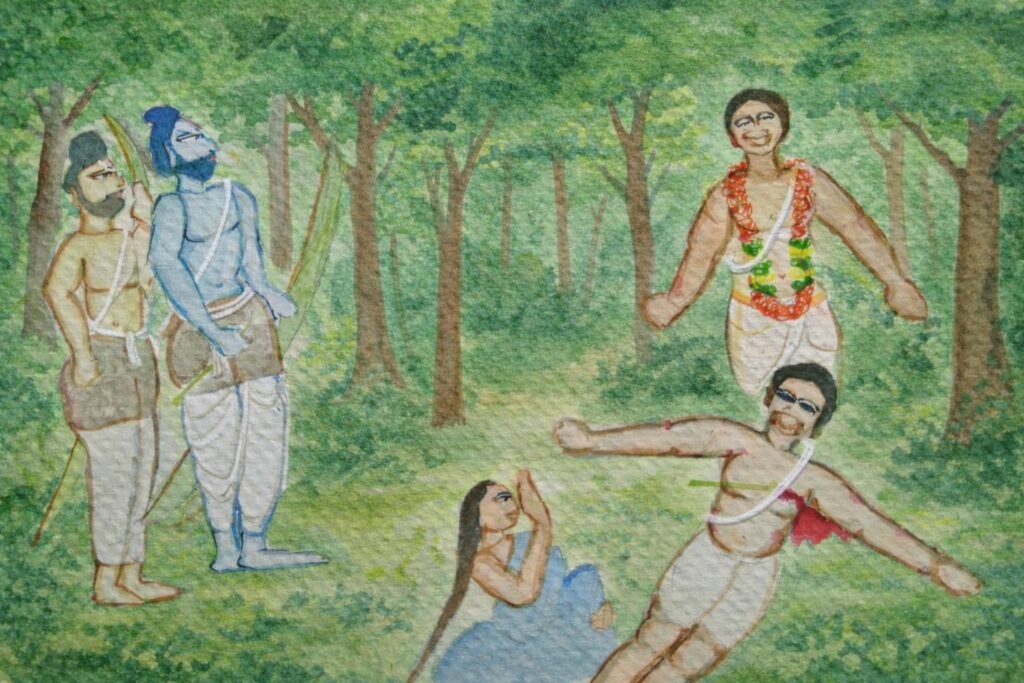
This SlOkam brings out perumAL’s simplicity and supremacy. thArA approaching and conversing with the supreme lord, show perumAL’s simplicity, while his divine eyes, his valour, and the way he stands reveal his supremacy.
avathArikai (Introduction)
This was discussed in the previous article.
Word-by-Word meaning
kshathajOpamAksha – Oh, SrI rAma pirAn, with eyes as red as blood!
thvam – you (dhEvarIr)
apramEya: cha – one who is immeasurable, also
dhurAsadha: cha – one who is difficult to be approached, also
jithEndhriya: cha – one who has conquered the senses, also
uththamadhArmika: cha – one who is most virtuous, also
akshyyakIrthi: cha – one who has imperishable glory, also
vichakshaNa: cha – one who is very wise, also
kshithikshamAvAn – one who is forgiving like the earth
Notes from periyavAchchAn piLLai’s vyAkhyAnam
thvam – you, the son of an emperor
- thirukkuraL 55 “dheyvam thozhAL kozhunan thozhudhezhuvAL” (A wife who worships only her husband and not god)
thArA’s devotion towards her husband is evident here. Her devotion is such profound that she addresses perumAL, the son of an emperor as ‘thvam’ (you) – using the singular form without hesitation [while addressing those who are superior to oneself, the samaskrutha term bhavAn, honorific representation of ‘you’ is used].
thvam – you, one who is incomprehensible
The word ‘thvam’ – you – shows her intent in implying a connection between the addressee and the description following that. ‘thvam’ – you, the one who is incomprehensible (apramEya:).
thvam – you, one who is simple
- SrI rAmAyaNam kishkindhA kANdam 15-21 “guNAnAmAkarO mahAn” (Like the mountains housing the minerals, all the auspicious virtues find their home in SrI rAma).
The wonderful, auspicious qualities of bhagavAn are limitless and immeasurable. But perumAL, out of his compassion in order for us to enjoy those auspicious qualities, has manifested those limitless qualities – as though like a handful taken from the ocean, on his thirumEni.
thArA, by addressing perumAL as ‘thvam’ (you), has shown perumAL’s simplicity.
thvam – you, one who looks effortless even after killing the brave vAli
Ego of entities such as rAvaNa, dhundhubhi et al was destroyed by vAli. But such a valorous vAli was killed by perumAL effortlessly.
thAra says, looking at perumAL, “Even after killing the brave vAli, you stand there as if you have done nothing. Oh, how remarkable!”
thvam – you, SaraNAgatha vathsalan
As thArA saw SrI rAma, she saw him as an embodiment of compassion and providing protection for all those who seek his refuge. She saw SrI rAma standing there displaying his vathsalyam [forbearance] towards sugrIva mahArAja, who was driven by fear to live in seclusion in the mountain caves.
thvam – you, one who is approachable by all
thArA says to perumAL, “Because of your simplicity, even a woman like me and a child like angadhan are able to come to you without thinking of either our smallness or your greatness”.
thvam – you, one who is capable of transforming things
thArA says to perumAL, “I came to rebuke you, but like changing some object from one kind to another, you have changed me; and now I find myself praising you”.
periyavAchchAn piLLai continues the vyAkhyAnam, assuming that perumAL asks a question here, “thArA, if you are desirous of praising me, why don’t you start to praise me?”- and so thArA continues.
apramEya: – one, who is incomprehensible (Cannot be understood using a pramANam).
thArA says, “Without knowing about your greatness or about my smallness, I came to experience you with my senses, but I could not experience you”.
apramEya: – one, whose greatness cannot be measured
thArA continues, “I am not the only one incapable of knowing you. Even the vEdham, that started to claim “vEdhAham” (I know), could not tell anything beyond describing you as “mahAntham” (the supreme). Your greatness remains beyond measure. Your glory is such immeasurable that it (vEdham) could only withdraw from its attempt at describing you”.
- purusha sUktham “vEdhAham” (I understand)
- purusha sUktham “mahAntham” (supreme)
- katavallee 2-25 “ka iththA vEdha” (Is there anyone who understands his nature?)
apramEya: – one, who cannot be understood
“pramA vishayam pramEyam” (that which is the object of true knowledge is pramEyam)
pramEya: – that, which can be understood. apramEya: – that, which cannot be understood,
pramEyam refers to true experience – the knowledge that is gained through prathyaksham (by seeing things directly), or anumAnam (by inferring), or Agamam (vEdham). (This experience through prathyaksham, anumAnam, Agamam is called ‘samyakhanubhavam’)
But perumAL is beyond comprehension by any of these three – prathyaksham, anumAnam and Agamam.
(Note from kAlakshEpam: “It should not be misunderstood that nothing about perumAL could be understood. The inference is that he cannot be completely understood. He can be understood as – one with limitless auspicious qualities and without flaws, different from other entities which are seen and that the extent of his infinite greatness makes it impossible to understand everything about him.)
- thaiththirIya upanishadh 1-10 “na sandhruSE thishtathi rUpamasya na chakshushA paSyathi kaSchanainam” (His form will not be present before anyone; no one sees him with their eyes).
- thiruvAimozhi 7-2-3 “katkilee” (one who is difficult to be seen by the eyes)
As such, we understand that emperumAn cannot be see in prathyaksham, viz. he is difficult to be perceived with the external eyes. If so, one may ask, is it then possible to know him through anumAnam? (anumAnam is learning through inference).
anumAnam can be viSEshathO dhrushtAnumAnam and sAmAnyathO dhrushtAnumAnam
- viSEshathO dhrushtAnumAnam – Understanding through anumAnam using the information that is already known in this material world.
- sAmAnyathO dhrushtAnumAnam – Understanding something that is not already known through anumAnam.
But using either of these two anumAnams, perumAL cannot be understood. Let us look at an example to understand this further.
viSEshathO dhrushtAnumAnam means understanding by inference based on a specific observed connection – that is already known. For example, if one sees smoke on a mountain, that person could immediately infer the presence of fire because of the known, invariable relationship between smoke and fire.
Now, let us see some of the terminologies which are used in explaining this example – to infer there is fire on top of a mountain.
- paksham (the subject) – mountain (This is the location where the object is present)
- sAdhyam (the object of inference) – fire (This is what we are trying to prove in the example)
- hEthu (the reason) – smoke
- vyApthi – connection (relation that is already well known in the world – where there is smoke, there is fire).
In the above example, one may understand the existence of fire, even when he does not see it because he has already seen fire and smoke together (their connection) either at his home or elsewhere. Hence, even though he sees only smoke and does not see fire on the mountain, he understands it due to the connection between smoke and fire.
Similarly, is it possible for anyone to use an information that is already known by him to understand about perumAL?
While it is possible to recall things such as smoke-fire relationship, inferring from past experience about ‘perumAL’ is impossible, as we haven’t seen him before, unlike smoke and fire.
Since he has never been seen before, could one attempt to understand him by making a comparison with someone who has already been seen/known?
From the upanishadhs and AzhwAr pAsurams we understand that it is not possible to make such comparison since there is no one comparable to him.
- SvEthASvathara upanishadh 6-8 “na thathsamaSchAbhyadhikaScha dhruSyathE” (There is no one who is equal to or greater than that sarvESwaran).
- thiruvAimozhi 2-3-2 “oththAr mikkArai ilaiyAya mA mAya” (Oh, the spectacular one! One, who does not have anyone equal to or greater than him).
Therefore, we can summarise that as seen in worldly matter either by recollecting from past experience or by comparable examples, perumAL cannot be understood. So, we understand that through visEshathO dhrushtAnumAnam (understanding by inference using the information that is already known in this material world), perumAL cannot be known.
Next, let’s look at sAmAnyathO dhrushtAnumAnam. That is, trying to understand something that we have not seen before, for example, if we desire to understand about AthmA, can we look at something that is created in the world to understand AthmA?
When we observe the variety of human-created objects in the world, we can infer that, similar to those objects, the world itself must also have a creator. This leads one to the understanding that a supreme being created the world.
Following the same line of reasoning, can one understand the nature of the supreme lord who created the world by observing a person who creates objects within it? Let us examine an example to see if this can be accomplished.
Consider a person making pottery. A potter is born due to his karma and engages in work driven by that same karma. Because of his physical birth, he is subjected to suffering and weariness (stemming from fatigue or boredom). At times, his efforts are futile, failing to produce the desired result. He may also face external obstacles or personal limitations while executing his craft.
These characteristics of a potter – birth and action bound by karma, susceptibility to suffering, exhaustion, the possibility of failure, and the presence of obstacles – definitely cannot be reconciled with the nature of the supreme lord.
Suppose we need an analogy to understand a concept (like inferring fire with smoke) emperumAn, being eternal, flawless and virtuous, can be understood through the support of vEdham. Through vEdham, it is understood that bhagavAn himself is all the three causes [for creation] viz nimiththa kAraNam (efficient cause), upAdhAna kAraNam (material cause) and sahakAri kAraNam (instrumental/ancillary cause). This nature, where the same person acts as all three causes, is unmatched in worldly examples (In the potter example, nimiththa kAraNam – potter; upAdhAna kAraNam – clay; sahakAri kAraNam – wheel and handle). Therefore, we can understand that he is different and incomparable to anything in this world; in other words, his nature cannot be understood through inference from material things.
As such, we learn that it is not possible to understand about perumAL through anumAnam.
- thaiththirIya upanishadh Anandhavalli 9 “yathO vAchO nivarthanthE aprApya manasA saha” (The mind, along with other sense organs, returns from that supreme lord without having the ability to experience and understand the supreme lord).
- bruhadhAraNyaka upanishadh 4-3-6 “nEthi nEthi” (The supreme lord is not of this nature, not of this nature).
- “yathO na vEdha manasA sahainamanupraviSanthi thathaiva maunam” (The wise ones, not being able to understand with their mind and other sense organs, become silent when they think about him).
As such, we understand that even through the vEdham he cannot be fully understood.
So, we can summarise that the supreme lord is beyond comprehension – he cannot be understood through prathyaksham or anumAnam or Agamam.
apramEya: – with his infinite glories, he cannot understand himself
It is said that emperumAn himself does not know about his endless glories. That being said, it is needless to say that he cannot be known through any of the three pramANams (prathyaksham or anumAnam or Agamam).
apramEya: cha
- thaiththirIya upanishadh 2-8-9 “sO anga vEdha yadhi vA na vEdha” (Oh we do not know, whether or not that supreme lord understands his endless greatness).
- thiruvAimozhi 8-4-6 “thanakkum than thanmai aRivu ariyAnai” (even for himself (who is sarvagya (omniscient) his greatness is difficult to know).
Oh, the one who is sarvagya (omniscient), even you cannot understand all of your glories!
apramEya: cha
One, who cannot be limited by – time (he is eternal), space (he is all-pervading), form (sarIra/sarIri bhAvam – everything has bhagavAn as the common substratum).
One, who cannot be defined by nithyar (those who never get affected by karma and are eternally with perumAL), mukthar (those who get liberated from this kArmic cycle of rebirths by perumAL’s grace), or badhdhar (those who get birth inside a body again and again, due to karma).
One, who cannot be experienced by mind, speech or action.
One, who cannot be defined/ restricted in time – past, present or future.
thvamapramEya:
thvam – you, one who is in front of me, apramEya: you are unattainable!
- thiruvAimozhi 2-9-2 “eydhA nin kazhal” (your divine feet are difficult to attain).
thArA says, “Your greatness is such that even though you are right in front of my eyes, I cannot reach you”.
thvamapramEya:
thArA says, “Even though you are in front of me right now, I am not able to understand you; you seem as incomprehensible as someone from a distant time period”.
apramEya:
- vyAsa smruthi “na chakshushA gruhyathE manasA thu viSudhdhEna” (one, who cannot be perceived by the eyes; one, who can be seen only by the pure mind).
pramANams say you cannot be perceived by the external eyes; but, thArA says, “Oh what a wonder, to my eyes, you seem simple, yet when I attempt to contemplate you, you become incomprehensible”.
thvamapramEya:
- SrI rAmAyaNam kishkindhA kANdam 19-25 “avashtabhya cha thishtantham dhadharSa dhanurUrjitham” (thAra saw that SrI rAma, who stood there with a firm grip on his bow).
- SrI rAmAyaNam yudhdha kANdam 114-15 “thamasa: paramO dhAthA SankhachakragadhAdhara:” (mandhOdharI says: You are vishNu, one who is different from and beyond the primordial matter, one who is the support for all, one who is holding the Sankham, [conch], chakram [disc] and gadhai [mace]).
thvamapramEya:
thArA says, “We thought it was impossible to understand your parathvam – supremacy, but now you have made us realise that even your simplicity cannot be understood by us”.
thvamapramEya:
thAra says, “You are standing here alone without being surrounded by your army or your royal entourage, but yet appear as one who possesses infinite support. I am not able to understand you”.
- raghuvamSam 1-37 “anubhAvaviSEshAth thu sEnAparivruthAviva” (They both (perumAL and iLaiya perumAL) appeared radiant as though they were surrounded by their armies).
thvamapramEya: – one, whose thoughts and actions cannot be predicted
thArA says, “Your thoughts and action are unpredictable, you came to the forest by the orders of your father, but while in the forest you destroyed virAdhan, kharan, kabandhan, vAli”.
vyAkhyAnam for this SlOkam will be continued in the next article.
AzhwAr emperumAnAr jIyar thiruvadigaLE SaraNam
periyavAchchAn piLLai thiruvadigaLE SaraNam
Source – SrI rAmAyaNa thani SlOkam – 35 – kishkindhA kANdam 24.31 – thvam apramEScha – Part 3 Audio Video
adiyEn chithrA rAmAnuja dhAsi
Proofreading/Curating done by – krishNan rAmAnuja dhAsan
Artwork – namperumAL rAmAnuja dhAsan
Related Links
SrI rAmAyaNa thani SlOkam – 34 – kishkindhA kANdam 24.31 – thvam apramEScha – Part 2 Audio Video
SrI rAmAyaNa thani SlOkam – 33 – kishkindhA kANdam 24.31 – thvam apramEScha – Part 1 Audio Video
SrI rAmAyaNa thani SlOkam – 32 – AraNya kANdam 63.12 – asmin mayA, kishkindhA kANdam 1.71 – padhmakEsara, 1.115 – padhma saugandhika vaham Audio Video
SrI rAmAyaNa thani SlOkam – 31 – AraNya kANdam 30.39 – tham dhrushtvA – Part 2 Audio Video
SrI rAmAyaNa thani SlOkam – 30 – AraNya kANdam 19.14 – tharuNau – Part 6, 30.39 – tham dhrushtvA – Part 1 Audio Video
SrI rAmAyaNa thani SlOkam – concise english meanings
archived in https://granthams.koyil.org
pramEyam (goal) – https://koyil.org
pramANam (scriptures) – https://granthams.koyil.org
pramAthA (preceptors) – http://acharyas.koyil.org
SrIvaishNava education/kids portal – http://pillai.koyil.org