SrI: SrImathE SatakOpAya nama: SrImathE rAmAnujAya nama: SrImath varavaramunayE nama:
In this series, we are continuing to enjoy periyavAchchAn piLLai’s vyAkhyAnam. Through this vyAkhyAnam we are able to understand the deeper meanings found in SrI rAmAyaNam – SAsthra artham and SaraNAgathi thathvam as explained by periyavAchchAn piLLai.
When thArA comes to rebuke SrI rAma for killing her husband, her anger subsides instantly upon having dharSan of perumAL’s thirumEni; and she attains sathva guNam. Hence, she gains clarity in her thoughts and with this she begins to praise perumAL. This is described in the following SlOkam that is currently being enjoyed.
thvam apramEyaScha dhurAsadhaScha jithEndhriyaScha uththamadhArmikaScha I
akshayya kIrthiScha vichakshaNaScha kshithikshamAvAn kshathajOpamAksha II
avathArikai (Introduction)
This was discussed previously.
Word-by-Word meaning
kshathajOpamAksha – Oh, SrI rAma pirAn with eyes as red as blood!
thvam – you (dhEvarIr)
apramEya: cha – one who is immeasurable, also
dhurAsadha: cha – one who is difficult to be approached, also
jithEndhriya: cha – one who has conquered the senses, also
uththamadhArmika: cha – one who is most virtuous, also
akshayyakIrthi: cha – one who has imperishable glory, also
vichakshaNa: cha – one who is very wise, also
kshithikshamAvAn – one who is forgiving like the earth
Notes from periyavAchchAn piLLai’s vyAkhyAnam
So far we have seen the vyAkhyAnam for words up to uththamadhArmika:. Let us now continue with the vyAkhyAnam for the remaining SlOkam.
thArA says, “I was under the impression that you are yet to achieve greatness, though you have all the virtues that demonstrate greatness. But now it has become apparent to me that your greatness is eternal”.
akshayyakIrthi: cha
- thaiththirIya upanishadh 1-9 “thasya nAma mahadhyaSa:” (Only that supreme lord has all the glories).
- thiruvAimozhi 6-10-10 “nigaril pugazhAy” (One with matchless qualities (the quality which cannot be simply counted along with other qualities, due to ignoring the faults of the devotees), pugazhAy – having great vAthsalyam (motherly forbearance)).
- nAchchiyAr thirumozhi 5-1 “mannu perum pugazh” (Having auspicious qualities, which are permanent and without limits).
thArA says, “Your greatness is permanent and such greatness cannot be found anywhere else”.
akshayyakIrthi: cha – your glories cannot be destroyed by anyone
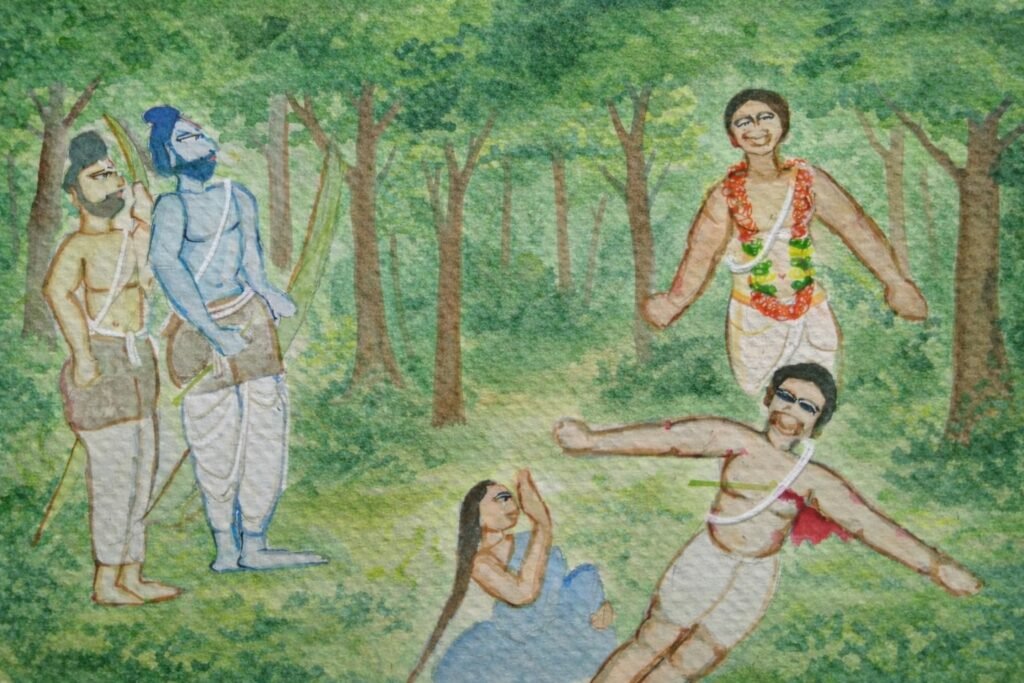
thAra says, “Your greatness was seen by everyone when you killed the brave vAli, but immediately after that, you were blamed for killing him. They criticised such as – ‘You killed him by hiding’, ‘You killed an innocent animal’, ‘You killed him in vain’. Even though you were inculpated, your greatness could not be destroyed by those accusations. You responded to all of them aptly”.
(Following are the responses given by SrI rAma to the accusations: ‘You killed him by hiding’ – It is permissible for kings to hunt and attack animals by hiding, hence, this act is not a wrong; ‘You killed an innocent animal’ – vAli committed wrong to sugrIva mahArAja who is a well-wisher for perumAL and one who has taken perumAL’s refuge, hence vAli is not innocent; ‘You killed him in vain’ – It is customary for kings to kill animals which are harmful to protect their subjects and since vAli was engaged in unrighteous acts which were harmful, it can be said that vAli was dealt justly)
thArA is awestruck, “What is the reason for your preeminence? – Your intelligence!”.
vichakshaNa: cha – your wisdom that results in excellence
thArA says, “You are always continuously assessing situation and making decisions and then you carry out those decisions – and because of this – there is excellence”.
vichakshaNa: cha
- muNdaka upanishadh 1-1-10 “yassarvagyA: sarvavith” (The nature and characteristics of all the entities are known by the supreme lord).
- SvEthASvathara upanishadh 6 “svAbhAvikI gyAnabalakriyA cha” (Knowledge, strength and actions of the supreme lord – all are very natural to him).
thArA says, “Considering how you are praised in the SAsthram, calling you as ‘vichakshaNa:’ (intelligent) is an understatement”.
vichakshaNa: cha
thArA says, “You are naturally omniscient, so it is not a surprise that you have the intelligence to respond to the allegations regarding killing vAli. Even if we are able to find fault with your responses, you are sagacious enough to provide counter arguments to navigate through any number of allegations”.
- SrI rAmAyaNam ayOdhyA kANdam 1-17 “uththarOththarayukthO cha vakthA vAchaspathiryathA” (Like bruhaspathi, his eloquent speech contained strategies to suppress the objections).
vichakshaNa: cha
thArA says, “Because of vAli and sugrIva mahArAja’s resemblance in appearance, to prevent any errors, you garlanded sugrIva mahArAja to target and kill vAli. What a shrewdness!”.
vichakshaNa: cha
thArA is stunned and says, “No one can understand you, but you understand everything”.
vichakshaNa: cha
thArA says, “rAvaNa being your enemy, you made friendship with sugrIva mahArAja, understanding that he will support you since rAvaNa was his enemy also; this is so since vAli was rAvaNa’s friend and you knew that he would not be your friend; hence, you decided to make a pact with sugrIva mahArAja and killed vAli”.
- periya thirumozhi 4-9-6 “nallAr aRivIr thIyAr aRivIr namakku ivvulagaththu ellAm aRivIr” (you know the nature of those who have the goodness of being unable to bear the separation of your highness; you know the nature of those who have the bad quality of being able to bear the separation of your highness; you know everything in this world).
thArA says, “We thought, being prudent, you may finish us (including angadhan)”.
- “SathrO: SEsham na SEshayEth” (No one in the enemy clans should be spared).
- SrI rAmAyaNam bAla kANdam 15-27 “saputhrapauthram sAmAthyam samithragyAthi bAndhavam I hathvA” (Killing rAvaNa along with his sons, grandsons, ministers, friends, paternal relatives, and all other relatives).
thArA says with reverence, “But you are forebearing like this earth”.
kshithikshamAvAn
thArA says, “You stand with anger that still lingers after killing vAli, while angadhan and I stand before you, instead of having the impulse to crush us like a louse on the forehead, you tolerated us!”
kshithikshamAvAn
thArA says, “You have in you the patience of this entire earth that is 500 crore square miles vast”.
- SrI rAmAyaNam bAla kANdam 1-18; sundhara kANdam 35-90 “kshamayA pruthivIsama:” (Like the earth, you are very patient).
kshithikshamAvAn
thArA says, “It is not that after seeing our faults you forgave us because of your compassion; you never saw any fault in us from the beginning, you were patient with us like the earth that is an embodiment of patience”.
kshithikshamAvAn
thArA says, “Oh what a wonder! The patience that you show with this entire earth, you chose to show all of it on me alone”.
kshithikshamAvAn
thArA says, “The amount of patience you showed with me is as enormous as the earth itself, sufficient to tolerate the entire earth”.
thArA asks in admiration, “Oh, the patience you show towards me; I do not understand its reasons”.
kshathajOpamAksha:
thArA says, “These eyes, they reflect the wealth of your nature to protect everyone”.
- periya thirumozhi 7-1-9 “uyirkkellAm thAyAy aLikkinRa thaNdAmaraikkaN” (The cool, comforting eye, which is like a cool lotus, which looks at all creatures like a mother).
kshathajOpamAksha:
thArA says, “The redness (in the eyes) born out of rage of killing vAli has not changed, yet you did not show that anger towards me”.
thArA says, “We were told that you killed vAli with just one arrow, but when we look at you – the reddishness that is visible from your sideglances, does not show your fury, rather they seem to show your love for us”.
- SrI rAmAyaNam bAla kANdam 1-69 “SarENaikEna” (He killed vAli with a single arrow).
- SrI rAmAyaNam yudhdha kANdam 21-13 “rAmO rakthAnthalOchana:” (SrI rAma with blood-reddish eyes)
kshathajOpamAksha:
As per sAmudhrika lakshaNam (an ancient science that defines the body features along with the characteristics for those features), if the eyes, mouth, and hands of a person are reddish, they have the ability to control and rule the world.
thArA says, “Since the redness in the eyes is sAmudhrika lakshaNam, it shows that you will continue to rule as an emperor for many more years”.
- “rakthAsya nEthrapANi:” (One who has reddish mouth, eyes, and hands).
- SrI rAmAyaNam sundhara kANdam 35-17 “thrithAmra:” (One who has mouth, eyes, and hands, the three reddish).
kshathajOpamAksha:
kshatham refers to the wounds caused by weapons and such. The blood caused by the kshatham is kshathajam – is not natural, it happens due to a reason (weapon, here it refers to perumAL’s anger). Similarly, for the supreme lord who has eyes which are like the blossomed white lotus flower, the reddishness of the eyes are not natural. They are caused by anger.
- chAndhOgya upanishadh 1-7 “yathA kapyAsam puNdarIkamEvamAkshiNI” (That supreme lord has two eyes which are like the while lotuses blossomed by the sun).
As such thArA says, “You eyes are not naturally red, the redness is imposed on your eyes due to anger”.
kshathajOpamAksha:
thArA says, “Why have your eyes turned red? Is it the tears of sorrow due to separation from sIthAp pirAtti that has turned your eyes red? Or is it the anger towards vAli that has turned your eyes red? Or is it due to the nurturing motherly love towards sugrIva mahArAja that has turned your eyes red? Or is it all of these reasons together which have turned your eyes red? Oh, I wonder, what is the reason!”.
apramEyaScha dhurAsadhaScha jithEndhriyaScha
What is the reason to have a suffix ‘cha’ [also] after each word?
- Each of perumAL’s guNams (qualities) individually is so vast, on its own it is sufficient to show perumAL’s greatness. The suffix ‘cha’ is added to emphasise this wonder – the extent of his greatness (which cannot be comprehended and measured).
- Even if the entire universe is explored, it is impossible to find a person who possesses at least one of these guNams. To find a person who possesses all these guNams together is a wonder! Hence, it has been accentuated with ‘cha’.
That being said, the words “kshithikshamAvAn – kshathajOpamAksha” are seen without the suffix ‘cha’. Will having suffix in a few places and leaving out others without suffix lead to an error in the general rhythm of the SlOkam? No, this omission is not considered as an error. The reasons are:-
apramEyaScha dhurAsadhaScha jithEndhriyaScha – perumAL being the repository for these guNas, thArA wanted to express the existence of these guNas in perumAL. (apramEyaScha – one who is immeasurable, also). Hence the suffix –’cha’ was added to show that. But in kshithikshamAvAn, she is not trying to say that he has patience, but she wants to express that perumAL is an embodiment of patience (just as the earth). The entire patience of the 500 crore square mile earth is present in perumAL. His patience is such colossal that it could not be restrained within him, it overflows.
It can also be said that seeing this tremendous amount of patience, it made thArA forget about other guNas in perumAL. And hence, it can be also be said that being bewildered in his immense patience, she forgot to include the suffix . His patience is such enormous that it has taken up everything and there is no place for the other guNas.
It can also be thought as: thArA, as she uttered kshithikshamAvAn, was prompted to think that whether or not she added the suffix, perumAL, whose patience is so immense, would not reproach her for such an omission, and hence, she did not add ‘cha’ after saying – kshithikshamAvAn.
kshathajOpamAksha:
What are the reasons for not adding the suffix – ‘cha’ after kshathajOpamAksha?
All the guNas of perumAL said so far, are his svarUpa guNas, but kshathajOpamAksha is the quality of his rUpam (thirumEni). So it belongs to a separate category and hence (not added along with the svarUpa guNas), it is said separately without a suffix – ‘cha’.
thvam apramEyaScha – dhurAsadhaScha – jithEndhriyaScha – uththamadhArmikaScha –
akshayya kIrthiScha – vichakshaNaScha
It can also be understood as a subject of the sentence. If it is understood as a vocative word, then while addressing as apramEyaScha dhurAsadhaScha – one who is immeasurable and one who is difficult to be approached ( dhurAsadhaScha – jithEndhriyaScha – uththamadhArmikaScha – akshayya kIrthiScha – vichakshaNaScha), each word requires the use of ‘cha’ (and).
But when saying thvam kshathajOpamAksha:, along with ‘thvam’ (you), it addresses the person who is standing across/ in front, (you – the one with eyes as red as the blood). Hence, it does not entail the usage of ‘cha’.
In this SlOkam, vAlmeeki bhagavAn, through thArA’s words has shown a very special meaning.
- SrI vishNu purANam 6-5-79 “gyAna Sakthi balaiSvarya vIrya thEjAmsyaSEshatha:” (The word bhagavAn implies one with these six opulences – knowledge, power, strength, supremacy, valour and effulgence respectively).
Similar to the opulences (showing perumAL’s parathvam) as described by SrI parASara bhagavAn in vishNu purANam, vAlmeeki bhagavAn shows perumAL’s simplicity (saulabhyam) in ayOdhyA kANdam.
- SrI rAmAyaNam ayOdhyA kANdam 33-12 “AnruSamsyam anukrOSa: Srutham Seelam dhama: Sama: I rAghavam SObhayanthyEthE shadguNA: purushOththamam II” (One who does not hurt others, kindness, listening to sufferings of others, being affable, controlling external sense organs, controlling the mind).
- chAndhOgya upanishadh 8-7-1 “apahathapApmA, vijarO, vimruthyu:, viSOka:, vijighathsa:, apipAsa:, sathyakAma:, sathyasankalpa:” (Free from sin, free from old age, free from death, free from sorrow, free from hunger and thirst, having infallible intentions, and unfailing resolve).
Similarly, to show the eight guNas mentioned in the vEdham, vAlmeeki bhagavAn has shown the eight guNas such as apramEya: in this SlOkam.
thvam apramEyaScha dhurAsadhaScha jithEndhriyaScha uththamadhArmikaScha I
akshayya kIrthiScha vichakshaNaScha kshithikshamAvAn kshathajOpamAksha II
This concludes the vyAkhyAnam for this SlOkam.
AzhwAr emperumAnAr jIyar thiruvadigaLE SaraNam
periyavAchchAn piLLai thiruvadigaLE SaraNam
Source – SrI rAmAyaNa thani SlOkam – 37 – kishkindhA kANdam 24.31 – thvam apramEyaScha – Part 5 Audio Video
adiyEn chithrA rAmAnuja dhAsi
Proofreading/Curating done by – kOsalEndhra rAmAnuja dhAsan, krishNan rAmAnuja dhAsan
Artwork – namperumAL rAmAnuja dhAsan
Related Links
SrI rAmAyaNa thani SlOkam – 36 – kishkindhA kANdam 24.31 – thvam apramEyaScha – Part 4 Audio Video
SrI rAmAyaNa thani SlOkam – 35 – kishkindhA kANdam 24.31 – thvam apramEyaScha – Part 3 Audio Video
SrI rAmAyaNa thani SlOkam – 34 – kishkindhA kANdam 24.31 – thvam apramEyaScha – Part 2 Audio Video
SrI rAmAyaNa thani SlOkam – 33 – kishkindhA kANdam 24.31 – thvam apramEyaScha – Part 1 Audio Video
SrI rAmAyaNa thani SlOkam – 32 – AraNya kANdam 63.12 – asmin mayA, kishkindhA kANdam 1.71 – padhmakEsara, 1.115 – padhma saugandhika vaham Audio Video
SrI rAmAyaNa thani SlOkam – concise english meanings
archived in https://granthams.koyil.org
pramEyam (goal) – https://koyil.org
pramANam (scriptures) – https://granthams.koyil.org
pramAthA (preceptors) – http://acharyas.koyil.org
SrIvaishNava education/kids portal – http://pillai.koyil.org