SrI: SrImathE SatakOpAya nama: SrImathE rAmAnujAya nama: SrImath varavaramunayE nama:
We continue to enjoy the vyAkhyAnam mercifully bestowed upon us by periyAvAchchAn piLLai. We are deeply grateful to both periyavAchchAn piLLai and puththUr swAmy for graciously publishing this grantham and providing such a lucid explanation.
The following text has been transcribed from ‘grantha kAlakshEpam’ lecture series on this topic by SrI u vE sArathy thOthAthri swAmy. We are grateful to swAmy for enabling us to have this opportunity through his kAlakshEpams series.
Let us now continue with the vyAkhyAnam.
pirAtti advises rAvaNa for the sake of his well-being, telling him, “Your thoughts are inappropriate and you are going to face destruction because of them”.
So she instructs, “It is emperumAn alone who has the empowerment to provide both ishta prApthi and anishta nivruththi. So, it is only befitting that you make SrI rAma your friend”.
(Note: ishta prApthi/attainment of desired goals – rAvaNa desiring to have a place to live; anishta nivruththi/removal of undesired events – rAvaNa not desiring to have a horrific death).
avathArikai (Introduction)
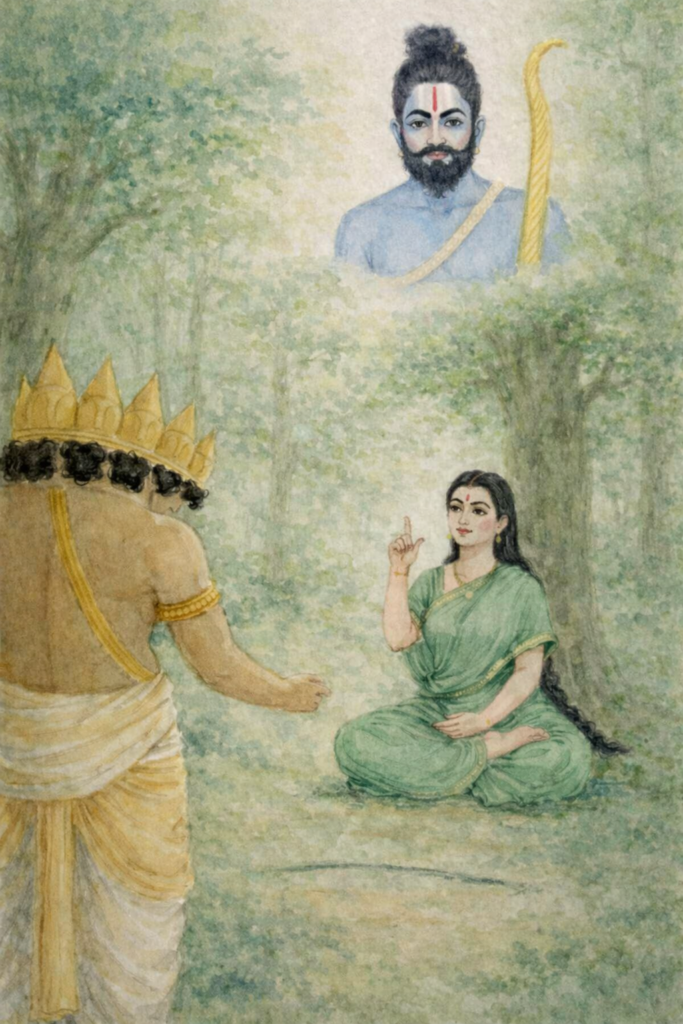
rAvaNa approaches sIthAp pirAtti in asOka vanam and boasts about his superiority in high birth, knowledge and talent. He promises to grant her various types of land, treasures, gems, garments, ornaments, and numerous attendants for her service, including women companions, male servants, and female servants, several accessories to be used for service (such as fan etc) and praises her with the intention to entice her.
pirAtti does not pay heed to any of his blaberrings; instead, she thinks only of the danger that is about to befall him. She thinks, “There is no one to offer him words of wisdom and hence he utters such inappropriate things”. As the paramAchArya – the highest limit of the AchArya paramparai who leads jIvAthmAs to bhagavAn – she speaks for his well-being. Before she spoke, she placed a blade of grass between them and spoke.
- SrI rAmAyaNam sundhara kANdam 21-3 “thruNamantharatha: kruthvA” (placed a blade of grass in-between). She placed a blade of grass. Why did she place a blade of grass?
- Is it because that one should not look at a parapurushan (a man who is not her husband) in the face and speak to him?
- Is it because she thought of him as equal to a blade of grass?
- Is it because she thought, ‘just as this achEthana – a blade of grass does not listen to what I say, similarly, he too would not listen”.
- vishNu purANam 1-9 “yam thvam dhEvi nirIkshasE-sa kuleena: sa budhdhimAn” (Oh, dhEvi! One who receives your divine glances, he is of high birth, he only is wise). Is it because of the thought that those who receive her blessings will become bestowed with intelligence, even if they were an achEthana like a blade of grass?
- Is it because she thinks of warding him off, just as SrI rAma used a blade of grass to ward off kAkAsura?
- Could it be that she thought of him as a creature like a fox or rabbit and that he might enjoy the blade of grass?
- SrI rAmAyaNam sundhara kANdam 53-29…32 “SIthO bhava hanUmatha:” (Oh, agni! Treat hanumAn with coolness). Is it because she intends to transform the blade of grass into a sentient being, just like she is going to change the nature of the scorching fire to coolness?
- Is it because she intended to create a barrier between him and her?
- Is it because she wanted to convert the grass into a pillar and invoke lord rAgavasimham to appear from within it?
- SrI rAmAyaNam sundhara kANdam 21-19 “mithramaupayikam-anichchathA” (It is fitting for you to make friendship with SrI rAma). Could it be that, as a wife of a brave man, she placed the grass while thinking, ‘Bow down, eat this grass, and fall at the feet of that brave man’?
- Perhaps, could it be to tell him – ‘You, the one who praised me very highly, and all the wealth, treasures, gems, garments, and other things that you piled up with your words’ – are like this grass to me?
- SrI rAmAyaNam sundhara kANdam 21-6 “nAhamaupayikI bhAryA parabhAryA sathI thava” (It is not appropriate for me, as I am another man’s wife, to become your wife).
pirAtti says, “You will see that this inappropriate thought is not good for you”.
- SrI rAmAyaNam sundhara kANdam 21-8 “svEshu dhArEshu ramyathAm” (Be happy with your wives).
pirAtti says, “Live with your wives in such a way that they do not become envious and feel resentment”.
- SrI rAmAyaNam sundhara kANdam 21-9 “iha santhO na vA santhi” (Aren’t there any virtuous people here?)
pirAtti asks, “In this vast land inhabited by lowly people, if a person is brought to ruin by his evil actions, is there not even one good person to advise him, ‘Do not do such unrighteous acts’ and reform him?
- SrI rAmAyaNam sundhara kANdam 21-9 “vA santhi “ (No; there are some).
She replies to her question, “Since virtuous people like vibhIshaNAzhwAn are present, it cannot be said that there are no good people; good people are present here too”.
- “sathO vA nAnuvarthasE” (Don’t you engage in serving the virtuous people?)
- SrI bhagavath gIthA 4-34 “praNipAthEna paripraSnEna sEvayA I upadhEkshyanthi” (The gyAnis / virtuous wise men will impart words of wisdom if you fall at their feet, serve, and listen to them).
pirAtti enquires, “Wise men offer their advice only to those who seek them with reverence and serve them; have you not bowed down at their feet?”
rAvaNa retorts, “You have not lived in this city; you just come here yesterday. How did you know that I do not bow down at the feet of good people?”
pirAtti replies, “It is because your thoughts are perverted”.
- “thathA hi viparIthA thE budhdhi:” (Your ignorance reveals that you do not prostrate at the feet of the righteous).
rAvaNa continues to retort, “How do you know about my thoughts? Are you within me as antharyAmI?”
- “AchAravarjithA” (Your mind is not disciplined).
pirAtti says, “I inferred that as a result of your misconduct”.
His disgusting actions were so unspeakable that people like vibhIshaNa who witnessed his actions spoke out in resentment. pirAtti says in this SlOkam, “You do not need to bow down to anyone; I shall tell you what is good for you without expecting any service in return; just follow what is told”.
mithramaupayikam karthum rAma: sthAnam parIpsathA I
vadham chAnichchathA ghOram thvayAsau purusharshabha: II
Word-by-word meaning
asau – this
purusharshabha: – supreme among the humans
rAma: – SrI rAma
sthAnam parIpsathA – if you care about your place of existence
ghOram vadham anichchathA – not having an inclination to have a cruel death
thvayA – by you
mithram karthum aupayikam – he is apt to be befriended
Simple Meaning
sIthAp pirAtti tells rAvaNa – SrI rAma, the supreme among the humans, is apt to be befriended by you. If you care to have a place to reside and do not wish to have a cruel death, seek SrI rAma’s friendship.
Notes from periyavAchchAn piLLai’s vyAkhyAnam
Assuming that rAvaNa tells her to tell him that which is good for him and that if possible, he would follow it, pirAtti, in a manner that is beneficial to rAvaNa, begins to speak, “It is befitting to have SrI rAma as your friend”.
mithramaupayikam karthum rAma:
pirAtti says, “There is no goodness in hostility with SrI rAma. It is best to seek his friendship”.
mithram karthum aupayikam
It is imperative that rAvaNa takes refuge in SrI rAma’s divine feet, after all the offences which were committed by him. But why is it interpreted as ‘SaraNam pugavENum’ – seek his refuge, when pirAtti had only told him to seek SrI rAma’s friendship (mithram karthum)?
This is because in the next SlOkam pirAtti explains about perumAL’s compassion towards those who seek his refuge. Hence, the word maithrI’ (though it denotes friendship) should be inferred as ‘surrender’ following the same lines.
- SrI rAmAyaNam sundhara kANdam 21-20 “vidhitha: sahi dharmagya: SaraNAgathavathsala: I thEna maithrI bhavathu thE” (Everyone knows him as a righteous person and as a compassionate person to those who have taken his refuge; may you have friendship with him)
(Note from kAlakshEpam: perumAL is full of vAthsalyam to those who have surrendered to him. “vAthsalyam” is treating blemishes as blessings. Just like the mother cow happily cleans out and licks the impurities from the body of its calf).
- SrI bhAgavatham 7-5-23 “archanam vandhanam dhAsyam sakhyam Athma nivEdhanam” (Offer worship, obeisances, services, friendship, self (AthmA)).
As such, it can be understood that seeking krishNa’s friendship is explained as one of the forms of bhakthi. Hence, friendship is also a component of total surrender (prapaththi).
- SrI bhagavath gIthA 18-62 “thamEva SaraNam gachcha sarvabhAvEna bhAratha” (Oh, one born in the bharatha clan! Surrender to that supreme lord by all means).
Just like pirAtti, the most compassionate bhagavAn has also instructed to surrender unto him. While krishNa explicitly commanded, ‘surrender to me’, why did pirAtti convey the same intent by saying ‘seek his friendship’?
It is because only lowly people try to exalt themselves by disparaging others; but pirAtti, true to her divine nature, asks him to seek friendship in lieu of surrender.
Not only pirAtti, perumAL also has said similar words – to vibhIshaNa (who belongs to the rAkshasa clan) when he came to surrender to him, to sugrIva mahArAja and to the boatsman (guhaperumAL).
- SrI rAmAyaNam yudhdha kANdam 18-3 “mithrabhAvEna”‘ (One who approaches me with friendship, I shall not abandon him at anytime).
- “sakhA cha mE” (He is my friend).
- SrI rAmAyaNam yudhdha kANdam 128-4 “Athmasama: sakhA” (My friend who is dear to me as AthmA).
- periya thirumozhi 5-8-1 “ugandha thOzhan nI” (You are an affectionate friend to me).
Another interpretation for ‘mithra’. pirAtti thinks, “He is full of pride, if I tell him to surrender, he will not agree”. And hence she asks him to seek friendship.
- SrI rAmAyaNam yudhdha kANdam 36-13 “na namEyam” (I will not prostrate/show obeisance to anyone).
mithram karthum aupayikam
Definition for a friend is – “mithAth thrAyatha ithi mithram” (He is called a friend because he protects one from danger). Since “gnimidhA snEhanE” is the root word, it can also be said – Since SrI rAma is the protector from all dangers, it is appropriate to have him as a friend. In other words, it means – ‘May you not become the object of SrI rAma’s hatred, but rather become the object of his friendship’.
rAvaNa says, “I am his direct enemy and much stronger than he is; so, rather than antagonising him, why would I seek his refuge and friendship?”
mithram karthum aupayikam
pirAtti emphasises, “Since you have committed many offences, there is no other way than to seek his friendship”.
rAvaNa asks, “What is the benefit of attaining his friendship?”
mithram karthum aupayikam
pirAtti says, “You will be able to save your life. This friendship will be the means to do so”.
aupayikam means upAyam (a means). According to grammatical rules, the word upAyam undergoes several transformations to become aupayikam. As upAyam has become aupayikam – friendship is suggested as befitting / means for survival. This meaning is also evident because pirAtti explains subsequently the benefit of following the upAyam (means) by saying, “If you desire a place to reside and do not wish to have a cruel death”.
rAvaNa says, “But, after I chose to have his friendship, if he refuses to look me in the face, avoids speaking to me, and casts me aside without letting me approach – then, what shall I do?”
vyAkhyAnam for this SlOkam will be continued in the next article.
AzhwAr emperumAnAr jIyar thiruvadigaLE SaraNam
periyavAchchAn piLLai thiruvadigaLE SaraNam
Source – SrI rAmAyaNa thani SlOkam – 43 – sundhara kANdam 21.19 – mithram aupayikam karthum: – Part 1 Audio Video
adiyEn chithrA rAmAnuja dhAsi
Proofreading/Curating done by – kOsalEndhra rAmAnuja dhAsan, krishNan rAmAnuja dhAsan
Artwork – namperumAL rAmAnuja dhAsan
Related Links
SrI rAmAyaNa thani SlOkam – 42 – sundhara kANdam 21.3 – thruNamantharatha: – Part 4 Audio Video
SrI rAmAyaNa thani SlOkam – 41 – sundhara kANdam 21.3 – thruNamantharatha: – Part 3 Audio Video
SrI rAmAyaNa thani SlOkam – 40 – sundhara kANdam 21.3 – thruNamantharatha: – Part 2 Audio Video
SrI rAmAyaNa thani SlOkam – 39 – sundhara kANdam 16.4 – rAmasya, 16.30 – himahathanaLinIva, 21.3 – thruNamantharatha: – Part 1 Audio Video
SrI rAmAyaNa thani SlOkam – 38 – kishkindhA kANdam 3.28 – nAnrigvEdha, sundhara kANdam 15.23 dhuskaram kruthavAn Audio Video
SrI rAmAyaNa thani SlOkam – concise english meanings
archived in https://granthams.koyil.org
pramEyam (goal) – https://koyil.org
pramANam (scriptures) – https://granthams.koyil.org
pramAthA (preceptors) – http://acharyas.koyil.org
SrIvaishNava education/kids portal – http://pillai.koyil.org