SrI: SrImathE SatakOpAya nama: SrImathE rAmAnujAya nama: SrImath varavaramunayE nama:
We are deeply grateful to periyAvAchchAn piLLai for mercifully bestowing upon us the vyAkhyAnam for SrI rAmAyaNam (SrI rAmAyaNa thaniSlOkam). We are also grateful to puththUr swAmy for graciously publishing this grantham and providing a lucid explanation for the vyAkhyAnam. Furthermore, we are also grateful to SrI u vE sArathy thOthAthri swAmy for giving us an opportunity to listen to those vyakhyAnams through his grantha kAlakshEpam in thamizh. The following article is a transcription from this thamizh lecture series.
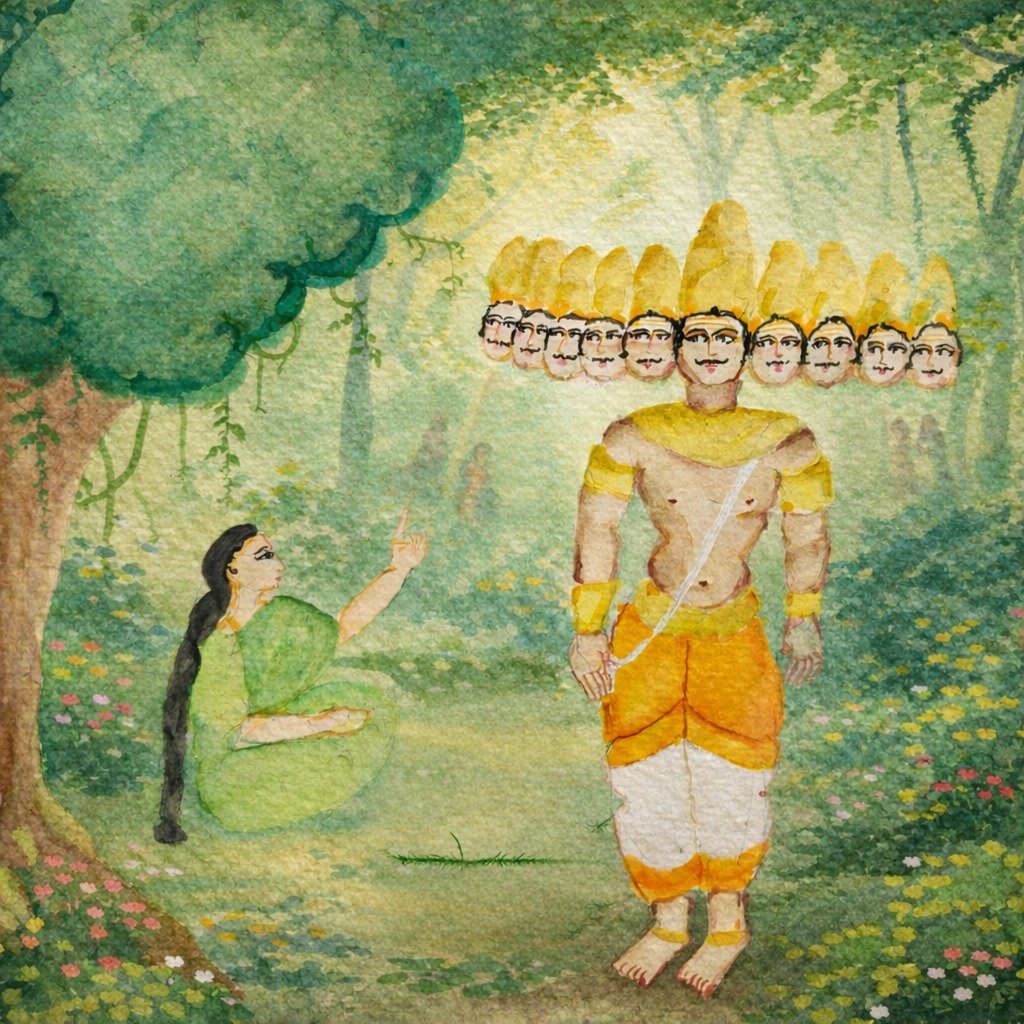
We are currently enjoying the vyAkhyAnam for SlOkams describing pirAtti’s advice to rAvaNa in sundhara kANdam.
pirAtti asks rAvaNa, “Are there no virtuous people? Or do such righteous people (even) live here? It appears that even if there are virtuous people, you do not take their advice. This is evident from your thoughts and actions; they are contrary to the SAsthram and lack virtue”.
avathArikai (Introduction)
After hearing rAvaNa’s inappropriate words, pirAtti feels both angry and merciful towards him. Thinking, ‘Maybe he will extricate himself from this situation, if we tell him agreeable words’, she asks, ‘In your city, are there any virtuous people to stop you from doing unrighteous things? Or is it that the wise do not show you compassion because you do not serve them? Your lack of association with wise men is clearly reflected in your knowledge and conduct’.
iha santhO na vA santhi sathO vA nAnuvarthasE I
thathAhi viparIthA thE budhdhirAchAravarjithA II
Word-by-word meaning
iha – in this lankA
santha: – virtuous people
na – are they not present?
vA – or
santhi – are they present?
sathO vA na anuvarthasE – or, is it that you don’t follow the advice of the virtuous people?
thathAhi – it is because
thE – your
budhdhi – mind/intellect
viparIthA – (is) contrary to the SAsthrams (spiritual injunctions)
AchAravarjithA – (also) devoid of good conduct
Simple meaning
pirAtti asks rAvaNa, “Are there no virtuous people here? Or is it that in spite of their presence, you do not follow their advice? This doubt arises because It appears this way from your thoughts and actions”.
Notes from periyavAchchAn piLLai’s vyAkhyAnam
iha – in this lankA, a nation that is occupied by rAkshasas
This city is not conducive to virtuous people to living there since it is inhabited by a large number of rAkshasas.
iha – in this lankA, where ten crore lowly citizens live
iha – in this lankA, which has a vast expanse of land, there are arsenals both inside and outside the city, military tents, and armies everywhere.
The above three interpretations for the word iha, provide answer to the question (iha santhO na) – Are they (virtuous people) not present here?
The following four interpretations for the word iha, provide answer to the question (vA santhi) – Are they (virtuous people) present here?
iha – in this lankA, those who eat, those who wear clothes, those who apply scented sandalpaste, and those who wear flowers do so with knowledge of good and bad.
iha –
- “agnihOthraScha vEdhAScha rAkshasAnAm gruhE gruhE” (One finds fire ritual and vEdhic recitation in every rAkshasa’s house)
- SrI rAmAyaNam sundhara kANdam 18-2 “SuSrAva brahmaghOshAmScha virAthrE brahmarAkshasAm” (thiruvadi (hanumAn) heard the vEdhic chanting of the brAhmaNas among the rAkshasas).
Thus, these scenes of lankA – some chanting/studying the vEdhas and some others teaching the vEdhas – reveal that there is no breach in the vEdhic traditions.
iha –
- SrI rAmAyaNam sundhara kANdam 51-25 “thapassanthApalabdhasthE sOyam dharmaparigraha:” (These are the fruits/results due to your penance).
- SrI rAmAyaNam sundhara kANdam 51-29 “prAptham dharmaphalam thAvadhbhavathA” (They are the fruits of your penance (fruits/results – enjoyment of the kingdom of lankA)).
Therefore it can be inferred that the people of lankA knew the benefits of penances and hence performed them.
iha –
lankA is highly celebrated for being a land with kings, ministers, priests, practitioners of vEdhic rituals, worshippers, and those who practise austerities.
What brought down the greatness of this city (lankA)?
santhO na – are there no good people?
Like a useless patch of weeds, many here have studied the vEdhic literature, yet lack its essential knowledge; true wise men are nowhere to be found.
santhO na – righteous people are not found in this city
Only people like prahasthan, dhUmrAkshan, vajradhamshtran, who cause harm to others are seen everywhere. The righteous, who bring goodness to others, are nowhere to be seen.
santhO na santhi
- thaiththirIya upanishadh Anandha vallee – 6 “asthi brahmEthi chEdhvEdha santhamEnam thathO vidhu:” (One is known as righteous due to his knowledge of brahmam).
Through their knowledge of the supreme existence, the righteous people are able to sustain their lives. (Without this knowledge, any entity is considered as non-existent). These individuals not only sustain themselves through the supreme knowledge but also provide sustenance to others. Such virtuous people are nowhere to be seen in this city.
santhO na – are there no virtuous people here?
- SrI rAmAyaNam yudhdha kANdam 16-15 “thvAm thu dhikkulapAmsanam” (You, the one who brought destruction to our clan, be gone (get lost)).
When vibhIshaNAzhwAn offers advice, rAvaNa treats him with disdain. Even if there are any virtuous people, will the people of lankA drive them out and close the door? This often happens when there are not many righteous people. In other words, if a society drives out its few virtuous people, it shows that righteousness is scarce in that place.
- raghuvamSam 1-10 “tham santha: SrOthumarhanthi sadhasadh vyakthihEthava:” (This kAvyam (literary work) is to be heard by many virtuous men).
In the above pramANam also, santha: – referring to ‘good people’ has been used in plural. Hence, it is be understood that it is important to have many people following the righteous path. Thus, pirAtti asks, “Aren’t there wise people who are capable of distinguishing between good and the bad?”
vA – or
pirAtti, after asking, ‘Aren’t there any virtuous people?’ says, ‘or’ and then she asks, ‘Are there any?’
It is not that lankA is completely devoid of virtuous people; there must be at least a few.
santhi – virtuous people – are they here? Yes.
santhi – considering the prosperity in lankA, there must be some good people.
In this lankA, there is a profusion of victory, wealth, and progeny. All these opulences indicate the existence of some righteous deeds and wise men who facilitate such activities; for, without such merit, this richness would not have been possible. Otherwise, it would imply that an effect occurred without a cause (that the richness came to existence without any righteous effort).
santhi – virtuous people – they are not a separate class or species
Those who speak or do justice are considered virtuous and those who speak or do injustice are considered evil. Even the rAkshasas can be regarded as virtuous when they offer righteous counsel. rAkshasas like akampanan, mArIcha, mAlyavAn, kumbhakarNa, and vibhIshaNAzhwAn have provided wise advice to rAvaNa, so it is apparent that there are virtuous people in lankA.
santhi – Wise people are present in lankA but their presence did not have any impact on rAvaNa
Will wise people remain silent without offering good advice?
sathO vA nAnuvarthasE
- manusmruthi 2-110 “nAprushta: kasyachidh brUyAth” (Provide advice only when it is asked for).
- SrI bhagavath gIthA 4-34 “praNipAthEna paripraSnEna sEvayA upadhEkshyanthi” (Know (from gyAnis (wise)) that transcendental knowledge by offering obeisances properly, by asking questions with proper attitude and by performing service; those gyAnis, who have realised the knowledge about self (being pleased by your worship etc), will instruct the knowledge about self to you).
pirAtti asks rAvaNa, “Have you not learnt from the wise by approaching them reverently?”
sathO vA nAnuvarthasE – have you not performed service to the wise men?
- Apasthamba 1-14-13 “thrivarshapUrva: SrOthriyO’bhivAdhanamarhathi” (One who is an expert in vEdhic literature and is three years older (than oneself) is worthy of respect).
- “gyAnavigyAnasampannA bhakthimanthO janArdhanE I praNanthavyA viSEshENa sAthvikair dharmachAribhi: II (Those who possess both wisdom and the supreme knowledge with devotion to bhagavAn are worthy of being respected by those who follow the righteous path).
- periya thirumozhi 7-4-1 “thaN sERai emperumAn thAL thozhuvAr kANmin en thalai mElArE” (See! Those who worship the divine feet of the lord, who resides in the cool thiruchchERai, step on my head with their divine feet and roam around).
pirAtti says, “It is ordained in the SAsthram to approach and serve the virtuous people; have you not followed that?”
sathO vA nAnuvarthasE – Do you not serve the righteous people?
- SrI rAmAyaNam yudhdha kANdam 26-21 “apriyasya thu pathyasya vakthA SrOthA cha dhurlabha:” (It is rare to find people who speak and listen to words which even if they are not sweet, are spoken for well-being).
- SrI bhAgavatham 11-2-29 “dhurlabhO mAnushO-manyE vaikuNtapriyadharSanam” (To get a human body that has fleeting existence is rare; rarer than that is to find the servitors of the supreme lord (in vaikuNtam)).
pirAtti asks, “Have you not approached those with such supreme devotion and performed service to them?”
vyAkhyAnam for the remaining SlOkam will be continued in the next article.
AzhwAr emperumAnAr jIyar thiruvadigaLE SaraNam
periyavAchchAn piLLai thiruvadigaLE SaraNam
Source – SrI rAmAyaNa thani SlOkam – 45 – sundhara kANdam 21.9 – iha santhO – Part 1 Audio Video
adiyEn chithrA rAmAnuja dhAsi
Proofreading/Curating done by – kOsalEndhra rAmAnuja dhAsan, krishNan rAmAnuja dhAsan
Artwork – namperumAL rAmAnuja dhAsan
Related Links
SrI rAmAyaNa thani SlOkam – 44 – sundhara kANdam 21.19 – mithramaupayikam karthum: – Part 2 Audio Video
SrI rAmAyaNa thani SlOkam – 43 – sundhara kANdam 21.19 – mithramaupayikam karthum: – Part 1 Audio Video
SrI rAmAyaNa thani SlOkam – 42 – sundhara kANdam 21.3 – thruNamantharatha: – Part 4 Audio Video
SrI rAmAyaNa thani SlOkam – 41 – sundhara kANdam 21.3 – thruNamantharatha: – Part 3 Audio Video
SrI rAmAyaNa thani SlOkam – 40 – sundhara kANdam 21.3 – thruNamantharatha: – Part 2 Audio Video
SrI rAmAyaNa thani SlOkam – concise english meanings
archived in https://granthams.koyil.org
pramEyam (goal) – https://koyil.org
pramANam (scriptures) – https://granthams.koyil.org
pramAthA (preceptors) – http://acharyas.koyil.org
SrIvaishNava education/kids portal – http://pillai.koyil.org