SrI: SrImathE SatakOpAya nama: SrImathE rAmAnujAya nama: SrImath varavaramunayE nama:
We are deeply grateful to periyavAchchAn piLLai for mercifully bestowing upon us the vyAkhyAnam for SrI rAmAyaNam (SrI rAmAyaNa thaniSlOkam). We are also grateful to puththUr swAmy for graciously publishing this grantham and providing a lucid explanation for the vyAkhyAnam. Furthermore, we are grateful to SrI u vE sArathy thOthAthri swAmy for giving us an opportunity to listen to those vyakhyAnams through his grantha kAlakshEpam in thamizh. The following article is a transcription from this thamizh lecture series.
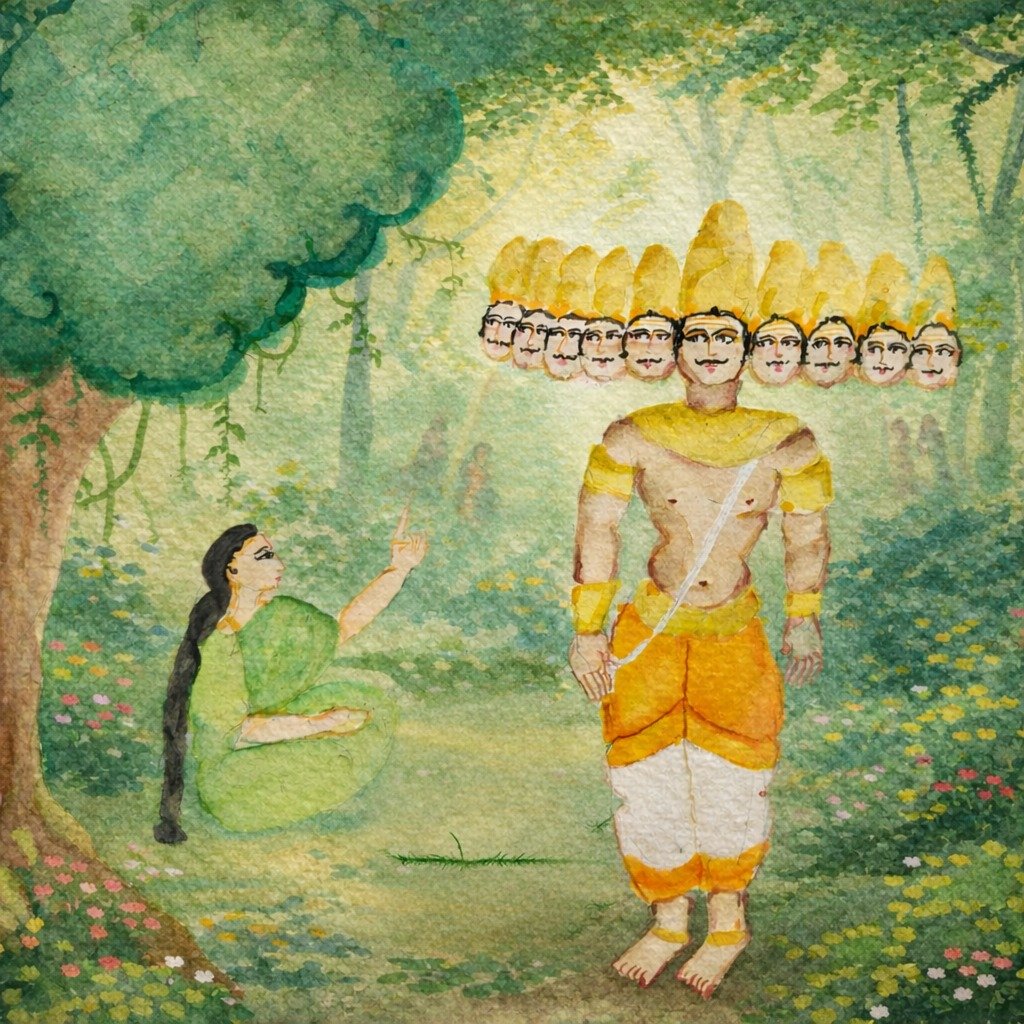
We are currently enjoying the SlOkam in sundhara kAndam where sIthAp pirAtti asks rAvaNa – “Are righteous people present in lankA or not? If they are present, do you not serve those righteous people, seek their advice and act accordingly?” She says further, “I ask you these because your thoughts are immoral and contrary to what is ordained in the SAsthram”.
iha santhO na vA santhi sathO vA nAnuvarthasE I
thathAhi viparIthA thE budhdhirAchAravarjithA II
Notes from periyavAchchAn piLLai’s vyAkhyAnam
sathO vA nAnuvarthasE – Do you not serve the virtuous people?
periyavAchchAn piLLai provides a beautiful explanation of the word ‘SuSrUshA’. He emphasises that before receiving upadhESam from an AchArya, one must first invoke his compassion by prostrating before him and performing service to him.
The following SlOkam from vishNu purANam provides insight regarding how to approach and receive upadhESam from the wise.
- vishNu purANam 1-1-1 “praNipathyAbhivAdhya cha” (Sage maithrEya bowed down and offered his respectful obeisances and asked parASara muni, the supreme among the sages).
(Note from kAlakshEpam: SuSrUshA – This is an important topic to be understood by all. When compared to the current times, it was very rare to pose questions to learned people and ask for clarifications in earlier days. Nowadays, due to the availability of several online platforms and a gradual decline in reverence, many pose questions without any hesitation. In SrI bhagavath gIthA, SrI krishNa explains to arjuna the importance of serving the AchArya to receive his guidance. Hence, it can be seen that it is important to serve the AchArya and wait for an opportune moment to express one’s thoughts. When wise people speak, a wealth of knowledge can be obtained from their conversation. Due to the grace of bhagavath rAmAnujar, we are fortunate to receive many upadhESams without much effort (i.e., without providing extensive service). When sage maithrEya and sage parASara conversed, vishNu purANam was bestowed. When parIkshith mahArAja and sage Sukabrahmam conversed, SrI bhAgavatham was bestowed. When arjuna and SrI krishNa conversed, SrI bhagavath githA was bestowed. When mahArAja dharmaputhra and bhIshmAchArya conversed, SrI vishNu sahasranAmam was bestowed. In our sampradhAyam, when we look at our pUrvAchAryas’ history, we can know about many samvAdham (dialogue/conversation): the samvAdham between madhurakavi AzhwAr and nammAzhwAr led to a firm establishment of our sampradhAyam; samvAdham between emperumAnAr and thirukkOshtiyUr nambi, periya nambi, thiruvarangap perumAL araiyar provided many treasures for our sampradhAyam; similarly, many conversations such as between bhattar and nanjIyar, and between nanjIyar and nampiLLai have all provided us with significant knowledge. Hence, asking questions is important and is very well welcomed and encouraged by our pUrvAchAryas. But, when posing questions, it has to be done with utmost humility and sincerity.
Upon receiving the upadhESam after performing service, one should be grateful. Be mindful that one’s knowledge is entirely due to the mercy of one’s AchArya, and be thankful for receiving such grace through one’s entire life.
This gratitude must be felt and put into practice when receiving supreme knowledge – such as artha panchakam, rahasya thrayam and sampradhAya knowledge from the AchArya/AchAryas who impart it).
- vishNu purANam 1-1-2 “thvaththO hi vEdhAdhyayanamadhIthamakhilam” (The entire vEdham has been studied by me from you).
- thiruvAimozhi 2-7-8 “ennaith thI manam keduththAy unakken seygEn?” (You reformed my evil mind which was focused on worldly pleasures; what can I do for you in return?)
To summarise, before asking questions, one needs to show humility and sincerity; after receiving upadhESam, one needs to show gratitude and surrender to the AchArya.
Hence, it is important to perform service. Therefore, pirAtti asks rAvaNa, “Have you not performed service to the wise men to receive their upadhESams?”
nAnuvarthasE – Do you not serve?
(1st interpretation)
An AchArya must be praised directly (in person) when receiving supreme knowledge.
- “prathyakshE gurava: sthuthyA:” (Those who impart wisdom are worthy of being praised directly (right in their presence)).
- SrI rAmAyaNam yudhdha kANdam 17-16 “sO’ham parushithasthEna dhAsavachchAvamAnitha:” (Words of vibhIshaNAzhwAn: I was lambasted by rAvaNa. I was humiliated like a servant).
pirAtti asks, “Instead of performing service, will you berate those who advise you like this?”
nAnuvarthasE – Do you not serve? (Without prostration and other acts of service)
(2nd interpretation)
- thaiththirIya upanishadh 11 “yathA thE thEshu varthEran thathA thEshu varthEthA:” (You shall conduct yourself in the same way as the wise men conduct themselves in those matters).
(Note from kAlakshEpam: The thaiththirIya upanishadh describes how one should serve and receive upadhESam from an AchArya. This important upanishadh is recited in temples and mutts during thirumanjanam for emperumAn. It contains many sampradhAya arthams, describing bhagavAn’s bliss as well as the necessity of serving one’s AchArya and following their conduct and teachings).
- SrI bhagavath gIthA 3-21 “yadhyadhAcharathi SrEshta: thaththadhEvEtharE janA:” (Whatever a wise man does is to be followed by all other people).
- thirumAlai 22 “pEsiRRE pEsalallAl” (We can repeat only whatever the vEdhas (scriptures) and vaidhika purushas (those who follow vEdham) have spoken).
Hence pirAtti asks, “Did you not seek the wise men and obey their command?”
It can also be interpreted as – pirAtti asks, “Have you not followed the words of the wise men, seeing those words as beautiful and worthy of pursuit?”
sathO vA nAnuvarthasE – Do you not follow the righteous people?
pirAtti says, “When virtuous men are present, they never fail to offer upadhESam; it is your shortcoming that you do not follow them”.
(Assuming a question arises) “Since pirAtti only recently has arrived in lankA, how did she know whether or not rAvaNa obeyed the commands of wise men?”
thathA hi – It was in that manner!
thathA hi – because of that – rAvaNa’s thoughts and actions (indicate that)
hi – this word indicates that rAvaNa’s thoughts and actions (which are immoral) are known to all.
pirAtti says, “It very clear from your actions that you do not follow the words of the virtuous people. Since it is evident, there can be no misunderstanding about it. There is nothing to be said by me specifically; your evil actions are known to all”.
Hitherto, periyavAchchAn piLLai had explained that rAvaNa did not follow the advice of the wise men and hence his actions were immoral.
i.e., not following the advice is shown as the reason.
Now, periyavAchchAn piLLai provides an inverse interpretation and explains that rAvaNa’s actions are unrighteous and hence he did not obey the commands of the wise men.
i.e., his actions being immoral is shown as the reason.
thathA hi – therefore, the reason (for not following the wise) is his immoral conduct
(Note from kAlakshEpam: When making inferences, the following four are noted – paksham, hEthu, sAdhyam and vyApthi. In the example of inferring the existence of fire on top of a mountain from the smoke, existence of fire – that which is to be proved is sAdhyam, smoke – the reason for that is the hEthu; mountain – the place where it is seen is the paksham; relationship between fire and smoke – the connection is the vyApthi. Here, through smoke (hEthu) and the connection between them (vyApthi), the existence of fire is established (sAdhyam). This example can be kept in mind to understand the interpretation that is given below.)
As per samskrutha vyAkaraNam, ‘hi’ functions as a reason or the cause (hEthu) to establish the point (sAdhyam) that rAvanA does not follow the advice of wise men. (Just as how smoke is the reason to establish the existence of fire)
hi – hEthu – rAvaNa’s conduct is the reason, the hypohesis – not following the advice of wise men – is established.
Hence it can be understood as pirAtti stating the reason for rAvaNa not following the words of the wise with the word ‘hi’.
thathAthvAth – since you are like this
thath (samskrutham) – means ‘it/that’. The word ‘it/that’ is often used to point to something that was mentioned in the previous statement. Hence, it refers to the previous statement (sAdhyam) – “You do not follow virtuous people”. Therefore, it means ‘‘since you do not follow the virtuous”. In that case, wouldn’t hEthu (reason) and sAdhyam (that which it to be proven) become one and the same? No, such a flaw will not arise. Even if ‘thath’ refers to the previously mentioned statement (prakrutham), this flaw (both hEthu and sAdhyam becoming the same) will not arise (as described below).
prakrutham (the subject/topic) is of two types – ‘that which was said before’ and ‘that which was already present in the intellect’. Here, since ‘that’ refers to what was said subsequently, pointing to that which is in the intellect – ‘your intellect is in an inappropriate state’, hence, there is no flaw.
viparIthA thE budhdhi:
The (viparIthA thE budhdhi:) statement – ‘You do not follow the virtuous; because your intellect is perverted’ – has no flaw due to the following reason: This inference uses ‘lack of following’ as sAdhyam and ‘lack of intelligence’ as the hEthu. Therefore, it can be seen that they are not the same.
thathA hi – because of that
The broad meaning: Since there is a reason (hEthu) to prove that you do not follow the words of the righteous people. In other words, since ‘thathAthvAth’ (because it is so) refers to a reason existing in the intellect, let us see what that reason is.
viparIthA thE budhdhi: Your intellect is contrary to the SAsthram.
The following has been spoken by pirAtti in kAvya linga anumAnam (a figure of speech in samskrutham / poetic inference).
- kuvalayA nandham “samartha nIyasyArthasya kAvyalingam samarthanam” (kAvya linga is a figure of speech where a statement is proved with a reason (hEthu)).
pirAtti says, “Your intellect is perverse (viparIthA thE budhdhi:); it is contrary to the SAsthram. This itself is proof that your intellect does not function properly. Just as one infers that it has rained in the mountain valley (source of the river) upon seeing the floods in the river, your impaired judgement is clear evidence that you no longer follow the virtuous people”.
viparIthA budhdhi: Your knowledge is contrary to what is ordained in the SAsthram.
viparIthA – contrary to what is ordained in the SAsthram
pirAtti says, “Taking others’ wives, seizing their possessions, and causing harm to others are lowly deeds prohibited by the SAsthram. Yet, you seem to have a desire for those very deeds”.
viparIthA budhdhi:
The intellect consists of eight limbs: 1. The thinking to listen (SuSrUshA), 2. Listening/Hearing (SravaNam), 3. Comprehending/grasping (grahaNam), 4. Retaining and storing what was learnt (dhAraNam), 5. Making inferences/reasoning (Uha), 6. Negation/ Eliminating what is incorrect (apOha), 7. Understanding the meaning of words (artha vigyAnam), and 8. Knowing the truth (thathvagyAna). These eight are the qualities of the intellect. angadhan [son of vAli] has the intellect with all these eight limbs. (Note from kAlakshEpam: This is not ashtAnga yOgam)
- SrI rAmAyaNam kishkindhA kANdam 54-2 “budhyA hyashtAngayA yuktha:” (Indeed endowed with eight folds of wisdom).
- SrI rAmAyaNam ayOdhyA kANdam 1-13 “budhdhimAn madhurAbhAshI” (SrI rAma is wise; he speaks very sweetly).
pirAtti says, “Your intellect lacks the qualities that lead to liberation and service”.
viparIthA – it is cause for destruction
- SrI bhagavath gIthA 2-63 “budhdhinASAth praNaSyathi” (Due to destruction of intelligence, he himself perishes (by drowning in this samsAram -material realm)).
viparIthA – it is perverse
- “parIthanthu dhinam prOktham” (The word ‘parItham‘ refers to ‘day’).
Since the word parItham means day (completed day/end of the day), the word viparIthA can be understood as ‘a day that has been wasted’.
pirAtti say, “Your days are wasted, thus, it is essentially destroying your life span”.
thE budhdhi: – Your intellect
pirAtti says, “Your intellect does not follow the words of wise men”
- “nIthimAn budhdhisampannO dhIrO dhaksha: Suchirnrupa:” (A king must be lawful, wise, courageous, clever, and moral).
pirAtti says, “A king must possess qualities to uphold the law, ability to distinguish good from evil, the courage to face challenges, the cleverness to act wisely, and a virtuous character. But your mind does not possess these qualities”.
thE budhdhi: viparIthA – Your wisdom was contrary/dangerous
- SrI rAmAyaNam yudhdha kANdam 17-25 “prakruthyA rAkshasO hyEsha:” (He inherently belongs to the asura clan).
- vishNu dharmam 109-74 “viparIthasthathAsura:” (In this world there are two types of creation – dhEvAs and asuras. Those engaged in devotion to lord vishNu are dhEvas and those who are averse to vishNu bhakthi are asuras).
pirAtti says, “Your impaired intellect is inherent due to your birth” .
(Assuming rAvaNa asks) “How did you know that my intellect is ruined? Your are not my antharyAmi (inner witness) to understand that”.
AchAravarjithA
pirAtti says, “Just as non-adherence to the wise was inferred by using your impaired intellect as the reason (hEthu), this impaired knowledge too can be inferred by me by looking at the improper conduct – non-conformity to the SAsthram (effect)”.
AchAravarjithA
pirAtti says, “AchAram is the disciplined conduct of life adhering to the varNam and ASramam as ordained in the Sruthi and smruthis. I do not see those AchArams in you”.
AchAravarjithA
pirAtti says, “Your immoral conduct such as having desire for wives of other men, treacherous behaviour to the supreme deity are evident just by looking at you”.
(Assuming rAvaNa asks) “You tell me that my knowledge is not disciplined according to the Sruthi and smruthis. But the intellect is an internal activity, whereas, AchAram (discipline) involves external conduct, how can the two come together in agreement?”
- “yadhdhi manasA dhyAyathi thathkarmaNA karOthi” (Whatever is thought by the mind is executed in action).
- “gyAthE hIchchA ishtE hi pravruththi:” (Desire is born from knowledge; due to desire an action is born).
pirAtti says, “Without intellect, an action (such as AchAram) cannot be performed, and to be steadfast in AchAram is not possible without knowledge.”
pirAtti reflects on this inseparable bond between knowledge and action. Due to this connection, she tells that his intellect is void of discipline (AchAram).
budhdhirAchAravarjithA
pirAtti says, “Since you have abducted another man’s wife, I could only see the evil mind that caused it and not any wisdom. Your intellect does not have any virtuous conduct. From such misconduct of yours, I have inferred your evil mind; and from that evil mind, I have realised that you do not seek the association of the virtuous who impart true knowledge”.
AchAravarjithA
- SrI rAmAyaNam bAla kANdam 15-10 “nainam sUrya: prathapathi pArSvE vAthi na mArutha: I chalOrmimAlee tham dhrushtvA samudhrO’pi na kampathE” (The sun does not burn him, the wind does blow near him, the ocean with the garland of waves remains still upon seeing him).
- SrI rAmAyaNam yudhdha kANdam 14-3 “thrasayathyapi purandhara:” ((Upon seeing rAvaNa) indhran is also fearful).
Since all the dhEvathAs were fearful of rAvaNa right from his birth, he did not have any virtuous conduct right from the beginning. Hence, his AchAram was completely non-existent.
AchAravarjithA
Even though a virtuous conduct has never existed for rAvaNa, will that change anytime in the future? No, there is absolutely no way for his conduct to become virtuous (athyanthAbhAvam).
[athyanthAbhAvam – absolute non-existence.]
How can it be said that virtuous conduct was completely absent? rAvaNa performed penance towards brahmA and rudhra; does such penance not show his good conduct?
budhdhirAchAravarjithA – the intellect was devoid of virtuous conduct
- raghuvamSam 5-54 “Saithyam hi yathsA prakruthirjalasya” (The inherent nature of water is to be cool, it becomes hot only due its contact with heat).
Coolness is intrinsic to water, while heat is acquired by it through contact with fire. Just as heat is acquired for a reason, rAvaNa’s penance (good conduct) came to him due to his desire for wealth, immortality, and weapons. It is not his natural quality. In other words, the impairment in rAvaNa’s intellect is inherent.
- anargharAghavam 3-41 “sandhrushtE thisruNAm purAmathi ripau kaNdUladhOrmaNdalakrIdAkruththa puna: prarUdaSirasO vIrasya lipsOrvaram I yAnchAdhainyaparAnchi yasya kalahAyanthE mithasthvam vruNu thvam vruNvithyabhithO mukhAni sa dhaSagrIva: katham kathyathE II” (When he beheld Siva (the destroyer of three cities), his hands, which were itching for challenge, playfully plucked his own head, which sprouted back. rAvaNa, who possessed such heads, a warrior, one desirous of boons, his lowly heads nudge each other and implore ‘You ask for boon’, ‘You ask for boon’ – that rAvaNa, how could that rAvaNa be described?).
After completing his penance, even in the peaceful state, rAvaNa remained delusional and desired for boons. His faces looked at one another; his intellect was clouded with flaws and tainted.
This concludes the vyAkhyAnam for this SlOkam.
AzhwAr emperumAnAr jIyar thiruvadigaLE SaraNam
periyavAchchAn piLLai thiruvadigaLE SaraNam
Source – SrI rAmAyaNa thani SlOkam – 46 – sundhara kANdam 21.9 – iha santhO – Part 2 Audio Video
adiyEn chithrA rAmAnuja dhAsi
Proofreading/Curating done by – kOsalEndhra rAmAnuja dhAsan, krishNan rAmAnuja dhAsan
Artwork – namperumAL rAmAnuja dhAsan
Related Links
SrI rAmAyaNa thani SlOkam – 45 – sundhara kANdam 21.9 – iha santhO – Part 1 Audio Video
SrI rAmAyaNa thani SlOkam – 44 – sundhara kANdam 21.19 – mithramaupayikam karthum: – Part 2 Audio Video
SrI rAmAyaNa thani SlOkam – 43 – sundhara kANdam 21.19 – mithramaupayikam karthum: – Part 1 Audio Video
SrI rAmAyaNa thani SlOkam – 42 – sundhara kANdam 21.3 – thruNamantharatha: – Part 4 Audio Video
SrI rAmAyaNa thani SlOkam – 41 – sundhara kANdam 21.3 – thruNamantharatha: – Part 3 Audio Video
SrI rAmAyaNa thani SlOkam – concise english meanings
archived in https://granthams.koyil.org
pramEyam (goal) – https://koyil.org
pramANam (scriptures) – https://granthams.koyil.org
pramAthA (preceptors) – http://acharyas.koyil.org
SrIvaishNava education/kids portal – http://pillai.koyil.org