SrI: SrImathE SatakOpAya nama: SrImathE rAmAnujAya nama: SrImath varavaramunayE nama:
We are currently enjoying the vyAkhyAnam for SlOkams in SrI rAmAyaNam mercifully given by periyavAchchAn piLLai, along with the support of puththUr swAmy’s explanation.
This article is a transcription of the thamizh kAlakshEpam of periyavAchchAn piLLai’s vyAkhyAnam by SrI u vE sArathy thOthAthri swAmy. We are grateful to SrI sArathy swAmy for enabling us with this opportunity.
In the previous article, we enjoyed the SlOkam that described sIthAp pirAtti’s upadhESam to rAvaNa. She asks him, “In this lankA, are righteous people present or are they not present? Or, is it that you do not listen to the words of those virtuous people present in lankA?” She further says, “I ask this because your actions are contrary to SAsthram”.
Due to her compassion and desire to transform rAvaNa despite his inappropriate behaviour, sIthAp pirAtti advises him; but he ignores her advice. Because of the colossal amount of his sins, rAvaNa is unable to divert himself from the path of destruction even when blessed with upadhESam from sIthAp pirAtti. Consequently, rAvaNa sets a deadline, anticipating that she would have a change of mind.
When rAvaNa leaves the scene, the rAkshasis threaten and torment her. sIthAp pirAtti, looking at their behaviour, provides upadhESam (words of guidance) to them. After that, pirAtti feels her suffering is unbearable and cries; she no longer sees the necessity of sustaining her life and decides to take her own life.
At this juncture, thrijatA approaches sIthAp pirAtti and tells her about her dream. She says that in her dream, she saw perumAL victorious and rAvaNa defeated. Upon hearing that, the rAkshasis are alarmed. sIthAp pirAtti consoles them and assures them that, in spite of their mistakes, she shall protect them. pirAtti then sees some good omen. At that point, thiruvadi, seated on top of a tree branch and looking at pirAtti’s precarious state, contemplates his next course of action. He decides to recite SrI rAma’s charithram (life-story). sIthAp pirAtti is startled, thinking, “Who is this narrating SrI rAma’s charithram in lankA?” She doubts, ‘Is he someone sent by rAvaNa?’
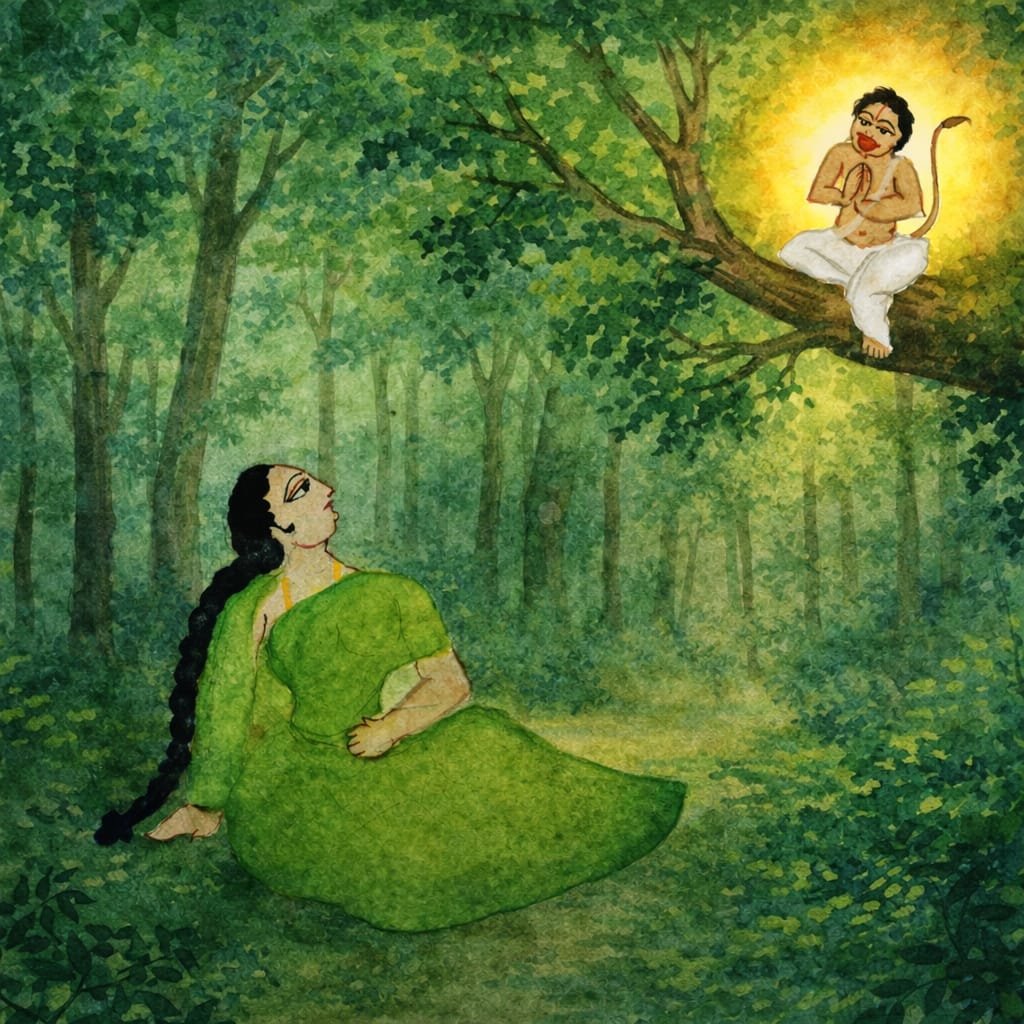
Upon hearing SrI rAma’s charithram, she first looks on both sides, up and down, and then upon looking up again, she sees thiruvadi. His form looked like a rising sun.
avathArikai (Introduction)
periyavAchchAn piLLai describes the scene (pirAtti’s state of distress) where thiruvadi sees sIthAp pirAtti in the middle of aSOka vanam. The rAkshasis induced by rAvaNa, intimidate and threaten pirAtti (rebuking, coercing, and bullying her). Unable to bear these atrocities, and due to the extreme agony of separation from SrI rAma, she holds the branch of the SimSupA tree having formed a resolute mind to sacrifice her life. Upon seeing all the exceptional auspicious qualities described earlier by perumAL in her divine body, thiruvadi confirms her identity – ‘She is sIthAp pirAtti’.
He thinks, “If I narrate all the events which have happened so far, pirAtti may even lose her life out of panic; but if I return without saying anything, she might die without knowing that SrI rAma is coming to lankA”.
Since sIthAp pirAtti had been constantly meditating on SrI rAma, hearing of unexpected occurrences might shock her and cause her to lose her life. Therefore thiruvadi – a scholar in ‘aindhra vyAkaraNam’ (aindhra, an old school of grammar), carefully reasoned within himself. He then, decided to speak to her in a way that would gradually alleviate her pain.
Just as one who treats a person suffering from a gastric ailment by laying the person down and pouring a stream of liquid from above, thiruvadi, seated on a branch of SimSupA tree, began to recite like a shower of nectar – the story of SrI rAma – starting with “A king named dhaSaratha”.
- SrI rAmAyaNam sundhara kANdam 31-2 “rAjA dhaSarathO nAma” (A king called dhaSaratha).
This SlOkam describes pirAtti, who had held her head bowed in deep sorrow for a very long time. With great effort, she lifted her divine neck – which had become stiff from prolonged immobility – and beheld thiruvadi on top of the SimSupA tree with her divine eyes.
sA thiryagUrdhvam cha thathApyadhasthAn nirIkshamANA tham achinthya budhdhim I
dhadharSa pingAdhipathE: amAthyam vAthAthmajam sUryam iva udhayastham II
Word-by-word meaning
sA – that sIthAp pirAtti
thiryak – (on the) sides
Urdhvam – up
thathA adhasthAth api – and, in the same way, down
nirIkshamANA – looking
achinthya budhdhim – one with inconceivable intelligence
pingAdhipathE: – king of monkeys [sugrIva mahArAja]
amAthyam – as minister
tham vAthAthmajam – that hanumAn (thiruvadi) who is vAyu dhEvathA’s son
udhayastham sUryAm iva – like the rising sun
dhadharSa – (she) saw
Simple meaning
pirAtti turned her divine neck from side to side, looking up and down, but could see nothing. Looking up again, she saw a figure like the sun on top of the udhayagiri mountain – it was sugrIva mahArAja’s minister, hanumAn, the son of vAyu dhEvathA.
Notes from periyavAchchAn piLLai’s vyAkhyAnam
sA – she
She (sA) – The one who had made up her mind to sacrifice her life, just a moment ago.
sA – she
She – The one who is suffering greatly, unaware of the events that transpired since mArIcha’s deception in the guise of an illusory deer.
sA – she
She – the one whose mind became agitated and whose heart palpitated even upon hearing a slight sound like a rustle of dry leaves nearby, wondering, ‘Oh, is it rAvaNa coming?’
sA – she
She – the one whose eyes had remained closed since the day she was abducted by rAvaNa; unwilling to see him, she had even forgotten how to open them.
thiryak – on the sides
She turned her divine neck from side to side. Having kept her head bowed and motionless for a long time, she now brought her neck under control, allowing it to move from side to side.
thiryak – on the sides
Since only women would be unable to tolerate the sorrow of other women, she wondered whether she heard the personifications of directions (who were female), who, unable to endure her decision to sacrifice her life, uttered these words. Thinking thus, she looked in both directions with desire.
Urdhvam – up
Recalling how SachI (indhra’s wife, indhrANi) and other celestial women had once contemplated ending their lives after being abducted by rAvaNa (but were later reunited with their husbands), she wondered if they were calling out to her to prevent a similar fate. With this thought, she looked up.
Urdhvam – up (above)
“AkASaguNa: Sabdha:” – Sound is the quality of space. Hearing a resounding roar above her, she wondered whether the tree, embodying space itself, had borne a ripened fruit: a delightful sound. With this thought, she looked upward, as if those fruits of sound, so sweet to the ear, were dropping straight into her ears.
sA thiryak Urdhvam cha – she looked again on the side due to nervousness.
‘cha’ is a conjunction [such as: and, also etc]. But grammatically, ‘cha’ is also used to represent a ‘collection’ (samuchchayArtha). That is, including something that is not mentioned. When ‘cha’ is used in this context, there is no necessity to mention the directions ‘above’ and ‘below’ again. So, it can be interpreted as: she looked again at the sides (which were already seen) and up, due to her agitation.
thathA api adhasthAth – in the same way (similar to how she looked up), she looked down
Why did pirAtti look down, even though there was no possibility of anyone speaking from under her feet? She thought about the time when rAvaNa abducted pirAtti and flew through the sky. While looking down, she saw jatAyu and several other beings on the ground, trying to convey something. Because these beings had already shown her that they were capable of offering consolation through their cries and words, remembering that, she looked down.
- SrI rAmAyaNam AraNya kANdam 52-45 “avEkshamANAm bahuSO vaidhEhIm dharaNI thalam” (sIthAp pirAtti (vaidhEhI), who was looking often at the ground).
- SrI rAmAyaNam AraNya kANdam 50-2 “khagOththama: vanaspathigatha: SrImAn vyAjahAra SubhAm giram” (The king of eagles, the blessed jatAyu mahArAja who was on top of the tree, spoke auspicious words).
- SrI rAmAyaNam AraNya kANdam 52-42 “ithi sarvANi bhUthAni gaNaSa: paryadhEvayan” (In this manner, all sorts of beings, many groups of them, wept together, and spoke).
adhasthAth – looking down
pirAtti looked down, wondering if she heard her mother bhUmip pirAtti, seeing her extreme suffering, spoke these words in anguish.
api – again (looked up again)
If the word ‘api’ – is used as an implied conjunction, meaning – ’again’, then it is interpreted as – after looking down, she again looked up.
Since usage of the word ‘again’ would imply repeating a previous action, one might ask: why is it interpreted as ‘she again looked up’, instead of ‘she again looked at both sides and upwards’. (because previously pirAtti had looked on both sides and upwards)? This is because, in the next part, it is mentioned that pirAtti saw thiruvadi seated on a branch, on top of the SimSupA tree. Hence, the description (she again looked at both sides and upwards) would not make sense unless pirAtti, who was previously looking down, had specifically looked up again. thiruvadi was seen only on top of the tree, and not on the ground. Therefore, the word, ‘api’, acts as ‘anuktha samuchchaya’, again – implying an action that was already stated – ‘again, she looked up’
nirIkshamANA – she, one who is seeing
nirIkshamANA – ‘seeing’ is in present tense. The significance of the present tense word is explained here. Due to her overwhelming affection, pirAtti’s eyes remained fixed upon thiruvadi.
For someone to say such words which were pleasing to the ears is like having a water-shed in a desert! By using the present tense, it signifies that pirAtti was unable to turn her eyes away from thiruvadi due to her overflowing affection. It is can also be understood as ‘Looking up again, she saw hanumAn’.
tham – him
The word ‘tham’, denotes pirAtti looking at the entire thirumEni of thiruvadi (hanumAn).
achinthya budhdhim – one with an inconceivable intelligence
As per the vEdha vAkyam “rUpamEvAsyaithan mahimAnam vyAchashtE” (His form itself explains his greatness), the glory of his expansive divine heart, shines brilliantly on his divine form (thirumEni).
dhadharSa
pirAtti saw him with her divine eyes, healing all his tiredness from crossing the ocean with her divine glance.
pingAdhipathE: amAthyam – the minister of sugrIva mahArAja
His natural form divulged his humility, revealing his identity as a minister bound by the command of a great king.
pingAdhipathE: amAthyam – The one who received perumAL’s first katAksham (divine grace) and gained elevation, and the one who united SrI rAma and sugrIva mahArAja, which gave sugrIva mahArAja his status as mahArAja, is none other than thiruvadi (pingAdhipathE: amAthyam).
vAthAthmajam – the son of vAyu
When pirAtti was at the brink of death, thiruvadi’s arrival and consolation gave life to her; hence, sage vAlmeeki describes thiruvadi as the calf of the breeze (vAyu) (breeze is the metaphor of life-force). (puththUr swAmy’s note: When pirAtti was at the brink of death, thiruvadi gave life to her by consoling her; hence, sage vAlmeeki describes thiruvadi as the calf of kAmadhEnu, vitalising air).
sUryAm iva – like the sun
As thiruvadi’s valour surged and spread in all directions, striking fear into the enemies, he appeared like the sun emerging in the darkness.
vAthAthmajam – son of vAyu
Why is thiruvadi described as vAthAthmajam?
According to the vEdha vAkyam, “AthmA vai puthra nAmAsi” (A son is as good as the father himself).
If the wind (vAyu) appeared directly without taking the disguise as a son, it would be impossible to look at the wind which is both formless and unbearable to those suffering from separation. In other words, if the wind appeared formless without wearing a ‘cloak’, it would be difficult to even look it. Therefore, the wind that provides vitality, came wearing the ‘shirt’ (guise) of a son.
udhayastham – like the rising sun
thiruvadi appeared like the rising sun.
The ‘sun’ in this context refers specifically to a sun who was fearless of rAvaNa, rather than the ‘sun’ that was fearful of him. The sun that feared rAvaNa lacked the tenacity to remain in a fixed position or follow a steady course; it would rise and rush across the sky. Therefore, the description ‘udhayastham’ (like the rising sun) refers to a hypothetical sun that, having risen, remains steady and unmoving, free from the fear of rAvaNa. This manner of explaining, using a simile to compare to a non-existing entity is known as abhUthOpama in samaskrutham and as ilporuL uvamai in thamizh literature.
This concludes the vyAkhyAnam for this SlOkam.
SrI rAmAyaNa thani SlOkam – sundhara kANdam 34.23 – svapnE’pi
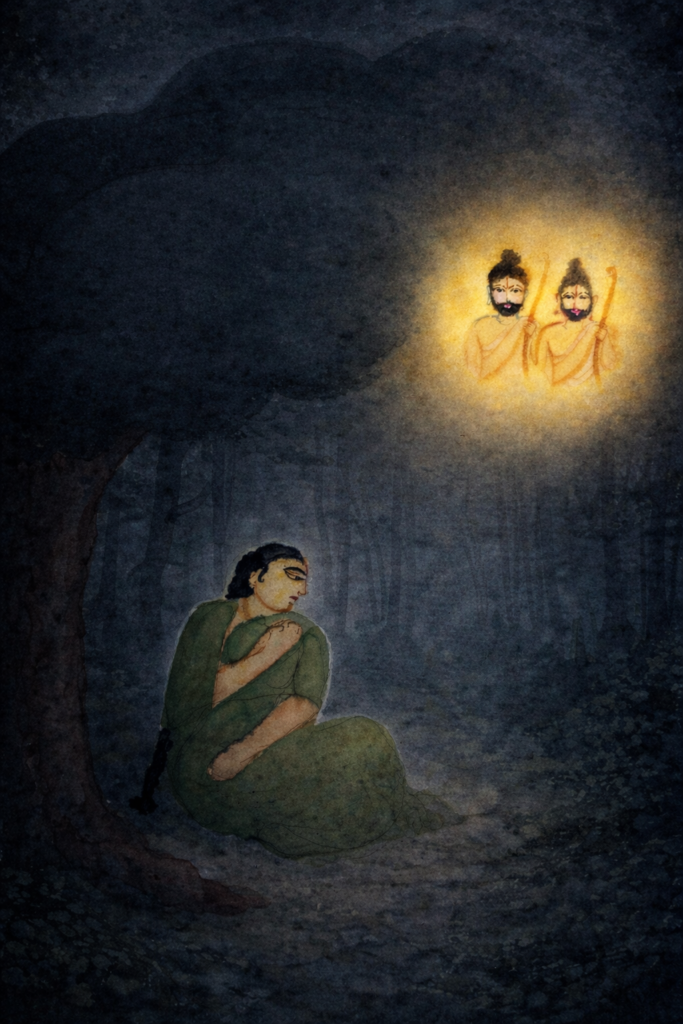
This is a SlOkam uttered by pirAtti in extreme grief. She laments, “I am unable to see perumAL and iLaiya perumAL in person, nor can I see them in my dreams. It is as if even my dreams have become my enemy”.
avathArikai (Introduction)
After seeing thiruvadi, pirAtti doubts, ‘Is it a dream?’ and speaks the following SlOkam.
svapnE’pi yadhyaham vIram rAghavam sahalakshmaNam I
paSyEyam yadhi jIvEyam svapnO’pi mama mathsarI II
Word-by-Word meanings
aham – I
sa lakshmaNam – along with lakshmaNa (iLaiya perumAL)
vIram – one who is brave
rAghavam – SrI rAma
svapnE api – at least in a dream
paSyEyam yadhi – if i could see them
jIvEyam – I would be able to sustain my life
svapna: api – even the dream
mama – (for) me
mathsarI – has become my enemy
Simple Meaning
pirAtti laments, “If only I could see perumAL and iLaiya perumAL at least in my dreams, I might survive. But alas, even dream has turned against me!”
Notes from periyavAchchAn piLLai’s vyAkhyAnam
svapnE’pi yadhyaham vIram
The valorous SrI rAma eliminates all sufferings, even when he is seen in dream.
rAghavam sahalakshmaNam
sIthAp pirAtti wishes to see both perumAL and iLaiya perumAL together. Since she had seen them together when she was separated from them, she desires to see them together again. Furthermore, when they chased the illusory deer (mArIcha), perumAL and iLaiya perumAL were separated; she wondered, ‘Did they find each other and reunite after that incident?’ Because of this doubt too, she longed to see both of them together.
paSyEyam yadhi jIvEyam svapnO’pi mama mathsarI – if I could see him at least in my dream, I would live, but even dream has become my enemy.
pirAtti thinks, “SrI rAma knows my suffering, yet he hides his face to me. As if that were not enough, why does even dream torment me?”
This concludes the vyAkhyAnam for this SlOkam.
AzhwAr emperumAnAr jIyar thiruvadigaLE SaraNam
periyavAchchAn piLLai thiruvadigaLE SaraNam
Source – SrI rAmAyaNa thani SlOkam – 47 – 31.19 – sA thiryagUrdhvancha, 34.23 – svapnE’pi Audio Video
adiyEn chithrA rAmAnuja dhAsi
Proofreading/Curating done by – kOsalEndhra rAmAnuja dhAsan, krishNan rAmAnuja dhAsan
Artwork – namperumAL rAmAnuja dhAsan
Related Links
SrI rAmAyaNa thani SlOkam – 46 – sundhara kANdam 21.9 – iha santhO – Part 2 Audio Video
SrI rAmAyaNa thani SlOkam – 45 – sundhara kANdam 21.9 – iha santhO – Part 1 Audio Video
SrI rAmAyaNa thani SlOkam – 44 – sundhara kANdam 21.19 – mithramaupayikam karthum: – Part 2 Audio Video
SrI rAmAyaNa thani SlOkam – 43 – sundhara kANdam 21.19 – mithramaupayikam karthum: – Part 1 Audio Video
SrI rAmAyaNa thani SlOkam – 42 – sundhara kANdam 21.3 – thruNamantharatha: – Part 4 Audio Video
SrI rAmAyaNa thani SlOkam – concise english meanings
archived in https://granthams.koyil.org
pramEyam (goal) – https://koyil.org
pramANam (scriptures) – https://granthams.koyil.org
pramAthA (preceptors) – http://acharyas.koyil.org
SrIvaishNava education/kids portal – http://pillai.koyil.org