SrI: SrImathE SatakOpAya nama: SrImathE rAmAnujAya nama: SrImath varavaramunayE nama:
periyavAchchAn piLLai provides three different reasons behind SUrpaNakhA’s description of perumAL and iLiaya perumAL. First, captivated by their beauty, she describes them as youthful, beautiful, tender, and strong. Second, being resentful, due to her predicament, she describes them with disdain. Third, being fearful of their chivalry, she describes them with contempt.
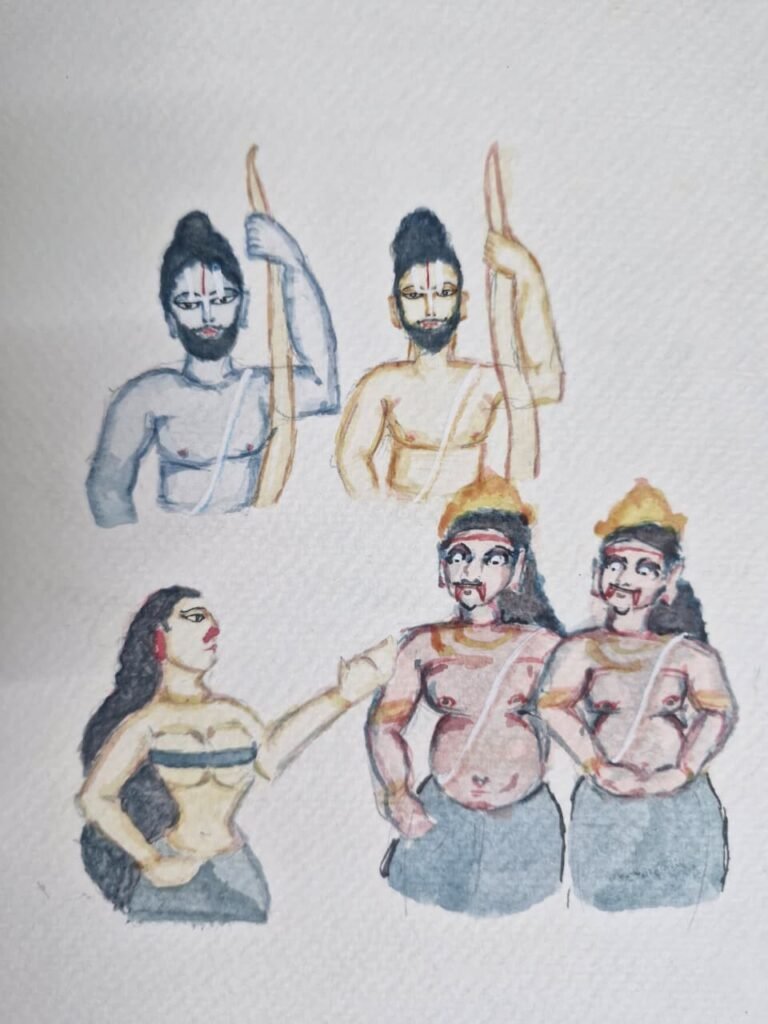
Notes from periyavAchchAn piLLai’s vyAkhyAnam
mahAbalau puNdareekaviSAlAkshau – they are not only strong but also have beautiful eyes
perumAL may defeat someone by displaying his valour, but they will surrender to him only after being captivated by his beautiful eyes.
- jithanthE 1-1 “jithanthE puNdarIkAksha” (Oh the lotus eyed one! You won me over with your beautiful eyes).
- thiruvAimozhi 2-6-3 “thAmaraik kaNNanai viNNOr paravum thalai maganai” (emperumAn is having lotus like eyes; (due to that beauty) he is eternally glorified by nithyasUris).
mahAbalau puNdareekaviSAlAkshau – they are not only strong but also have eyes which show mercy
It is the coolness and the compassion, which are shown in the eyes of perumAL and iLaiya perumAL, which help those who desire them to approach them, without being scared by their might.
- vishNu purANam 1-20-16 “avalOkanadhAnEna bhUyO mAm pAlaya” (achyuthanE! Protect me by glancing at me again mercifully).
- mahAbhAratham sabhA parva 96 “puNdarIkAksha raksha mAm” (oh lotus eyed one! Protect me).
- thiruvAimozhi 9-2-1 “thAmaraik kaNgaLAl nOkkAy” (glance at us mercifully with your lotus like divine eyes).
puNdareekaviSAlAkshau – eyes which captivate
By the word sukumArau, it was shown that perumAL and iLaiya perumAL are the two kAma dhEvas of the earth. Like kAma dhEva, who has his flower arrows, the lotus-eyes of perumAL and iLaiya perumAL are similar to those flower arrows.
- nAchchiyAr thirumozhi 13-3 “kadaikkaN ennum siRaikkOlAl nenju Uduruva vEvuNdu nilaiyum thaLarndhu naivEnai” (I am suffering after being shot at my heart fully, by the winged arrow of the glance of kaNNapirAn). Through this pAsuram we can see that emperumAn’s eyes are the flower arrows, and hence he is appropriately called kAma dhEva.
perumAL and iLAiya perumAL not only captivate us by their divine features, but also with their adornments.
chIrakrishNAjinAmbarau – adorned in tree-barks and deer skin
- periya thirumozhi 8-1-7 “sevvaraththa udai Adai adhan mEl Or sivaLikaik kachchu” (He is wearing a red garment, tied with a belt).
He wears the barks of the tree, and on top of that, he adorns himself with a deer skin.
chIrakrishNAjinAmbarau – not just an adornment but a receptacle for all his attractiveness
The ‘kachchu’ (belt) that is adorned on the top serves as a pouch holding all of emperumAn’s attractiveness such as youthfulness, beauty and other divine features.
tharuNau rUpasampannau sukumArau mahAbalau puNdareekaviSAlAkshau chIrakrishNAjinAmbarau
- SAkunthalam 1-19 “kimivahi madhurANAm maNdanam nAkruthInAm” (Is there anything that cannot adorn a body which is already beautiful?).
By wearing the tree-barks and deerskins, perumAL and iLaiya perumAL made those tree-barks and deerskins appear beautiful. The beauty of perumAL and iLaiya perumAL along with these adornments affected even the rishis, who are stoic.
chIrakrishNAjinAmbarau – anything that perumAL uses for his adornment will automatically become beautiful
Enchanted by the beauty of his garments, the women cry out loud. This is elucidated in the following pAsurams.
- SrI bhAgavatham 10-32-2 “thAsAmAvirabhUchchouri: smayamAnamukhAmbhuja: I pIthAmbaradhara: sragvI sAkshAnmanmathamanmatha:” (SrI krishNa appeared with the gopis with a sweet smile on his divine face, with a golden yellow garment, decorated with vanamAlai -garland, as a manmatha of the manmatha).
- nAchchiyAr thirumozhi 14-5 “pIdhaga Adai udai thAzhap perungAr mEgak kanRE pOl vIdhiyAra varuvAnai virundhAvanaththE kaNdOmE” (We saw perumAn, wearing the divine yellow coloured dress such that it was flowing down, like a little cloud which has grown huge and is dark, mercifully coming, filling up the entire street, in SrI brindhAvanam).
- perumAL thirumozhi 6-7 “seyya udaiyum thirumugamum sengani vAyum kuzhalum kaNdu” (looking at your beautiful dress, divine face, reddish lips and beautiful locks).
chIrakrishNAjinAmbarau – The tree-bark and deerskins – which are desired by people with svarUpa gyAnam.
Why is there a desire for his garments? People who have the svarUpa gyAnam (knowledge about true nature of self), desire for the things which are enjoyed by perumAL. Similar to ANdAL, the women who desire enjoyment have liking only for the divine cloth that perumAL adorns around his waist.
- thiruppallANdu 9 “uduththuk kaLaintha nin pIdhaga Adai uduththu” (We are amongst those who pray for (to receive) such yellow cloth worn by you and discarded).
- nAchchiyAr thirumozhi 13-1 “perumAn araiyil pIdhaga vaNNa Adai koNdu ennai vAttam thaNiya vIsIrE” (Bring the divine yellow dress, which kaNNa pirAn is wearing on his divine waist, and fan me with that so that my distress of being in separation is removed).
(Note from kAlakshEpam: This is an important principle in our sampradhAyam – a devotee enjoys everything, only after it is enjoyed and experienced by perumAL; he enjoys that as prasAdham from perumAL. The reasoning behind this is: the activity of enjoying anything will create puNyam and pApam, but when enjoyed as prasAdham, there is only emperumAn’s grace in it, and there is no attachment of puNyam and pApam. Accumulation of puNyam and pApam will bind one in this material world, and to be liberated, one has to be free of such puNyam and pApam. Hence, anyone interested in mOksham should stay away from anything that has not been offered to perumAL. Importantly, this conduct is appropriate for our svarUpam, and is not done only with the intention of removing the puNyam and pApam.).
chIrakrishNAjinAmbarau – The tree-barks and deerskins – which are seen with astonishment by the rishis.
Even those rishis who meditate only upon perumAL’s svarUpam were enchanted by the divine attributes of his thirumEni, so much so that they were completely overwhelmed. If perumAL’s thirumEni can mesmerise the rishis, it is needless to say that the women (here, SUrpaNakhA) were immersed in perumAL’s thirumEni.
If the rishis are mesmerised by perumAL’s thirumEni, it is needless to say that the women (here, SUrpaNakhA) were engrossed in perumAL’s thirumEni.
- SrI rAmAyaNam AraNya kANdam 1-13 “rUpasamhananam lakshmeem saukumArya suvEshathAm I dhadhruSurvismithAkArA:” (The rishis saw with astonishment, SrI rAma’s divine form, his chivalry, his tenderness, and his adornments).
- subhAshitha “kanyA kAmayathE rUpam” (the young bride loves the beauty of her bridegroom) (subhAshitha means a ‘saying’ that was prevalent).
- periya thirumozhi 8-1-8 “peRRakkAl avanAgam peN pirandhOm uyyOmO” (Born as women, could we not have the fortune of embracing his divine chest?).
SUrpaNakhA, having a desire for perumAL and iLAiya perumAL, praises their youthfulness, beauty, tenderness and chivalry. The above explanations bring out this intention of hers. But she was also angry at them for being rejected and humiliated. So, she speaks of them in a belittling way to lower their reputation in the eyes of kara and dhUshaNa. This lowliness of hers is captured in the following explanations. This highlights the simplicity of perumAL and iLaiya perumAL.
tharuNau
SUrpaNakhA looks at her brothers and says, “Their youth is merely about appearance; don’t mistake them as having any strength or valour. And I am not the only one saying this”.
This refers to king dhaSaratha’s words about SrI rAma, indicating SrI rAma to be young without much qualification to fight. (These words are spoken by king dhaSaratha to sage viSwAmithra).
- SrI rAmAyaNam bAla kANdam 20-2 “na yudhdhayOgyathAmasya paSyAmi” (I don’t see him to have the competency to fight in a battle).
- SrI rAmAyaNam bAla kANdam 20-7 “bAlO hyakruthavidhyaScha na cha vEththi balAbalam I na chAsthrabalasampannO na cha yudhdhaviSAradha: II” (King dhaSaratha talks about SrI rAma: SrI rAma has not undergone instructions in archery; he does not have ability to anlayse either his own strengths and weaknesses or of his opponent; he does not have many weapons with him; he also does not have the military prowess”.
tharuNau
SUrpaNakhA looks at kara and dhUshaNa and says, “At a young age, it is normal to have other distractions than to be engaged in warfare”.
SUrpaNakhA by identifying them as young (tharuNau), implies that perumAL and iLaiya perumAL in their youth may be interested in material enjoyment and not have the strength to fight.
- raghuvamSam 1-8 “yauvanE vishayaishiNAm” (The descendants of raghu, when young, are engaged in enjoyment of material things).
kara and dhUshaNa ask SUrpaNakhA in response, “Are you saying that they cannot fight because they are young?”.
rUpasampannau – beautiful form
SUrpaNakhA replies, “Their body is beautiful to captivate women, but I don’t see them as masculine enough to make men surrender”.
- subhAshitha “kanyA kAmayathE rUpam” (the young bride is interested in the beauty of her bridegroom; the bride’s mother is interested in his wealth; the bride’s father is interested in his education; the bride’s relatives are interested in his lineage; while others are interested in the feast) (subhAshitha means a ‘common saying’ that was prevalent in ancient times).
- “rUpENa vanithAjanam” (Women have to be attracted by beauty).
rUpasampannau
SUrpaNakhA says, “A bamboo looks lush, green and strong from outside but it is hollow on the inside. Similarly, their skin appears young and vibrant, but they don’t have any strength inside them”.
kara and dhUshaNa enquire, “What is the reason for that?”
sukumArau – they are children with wealth.
SUrpaNakhA says, “They are children who are brought up delicately. They are sons of king dhaSaratha who grew up as princes”.
sukumArau
SUrpaNakhA continues, “They will perish with a single glance from your reddish eyes. How could they possibly withstand your terrifying weapons?”
- SrI rAmAyaNam AraNya kANdam 22-5 “pAraSvadha hathasyAdhya mandhaprANasya bhUthalE” (karan says: You will drink the hot blood of that SrI rAma who is naturally weak and killed by me with my weapon).
They don’t appear to be strong, but how about their ability in execution?
mahAbalau – They are so weak that they ran away and came to the forest without ruling the kingdom that belonged to them, and they are living in isolation fearing a woman (refers to kaikEyip pirAtti).
(mahAbalau means very strong but SUrpaNakhait has used it in a negative connotation, as mockery).
mahAbalau – Another interpretation – Even though they are strong, they are only two of them; they do not have any other support.
- SrI rAmAyaNam AraNya kANdam 20-17 “dhrushtA thathra mayA nArI thayOrmadhyE sumadhyamA” (in between the two of them, a woman with a beautiful waist was seen by me).
SUrpaNakhA further describes their strength to kara and dhUshaNa, “It is as though their feet are tied, having a woman who is dependent on them for protection. How can they fight carrying her on their back?”
kara and dhUshaNa ask SUrpaNakhA, “How are you sure that they will not fight?”
puNdareekaviSAlAkshau – eyes which show their imprudence
SUrpaNakhA says to kara and dhUshaNa, “I could see it in their pale eyes, they are incapable of fighting. They looked aghast, not knowing the consequence of disfiguring me”.
According to ‘amarakOSa:’, Sanskrit thesaurus, “puNdarIkam sithAmbhOjam” means white lotus. Here SUrpaNakhA describes their eyes as puNdarIkam, implying that eyes were white (Paleness is a sign of fear in the eyes).
puNdareekaviSAlAkshau – eyes which show their discomfort in an unfamiliar setting
SUrpaNakhA says to kara and dhUshaNa, “A lotus pulled out of water will dry and wilt, being alien to the land. Similarly, they might be impregnable inside their kingdom, but I could see in their eyes that they are uncomfortable in the forest. Because of this, they will not fight”.
SUrpaNakhA adds, “You don’t have to worry that they may use wealth and influence and bring troops to fight. Looking at their garments, you can be assured that they are incapable of such a thing”.
chIrakrishNAjinAmbarau – they are wearing tree-barks and deer skins
SUrpaNakhA explains further, “They don’t even have proper garments to wear. They are using the tree-bark and deer skins found in the forest. They do not have funds to gather a troop by; therefore, they will not fight”.
chIrakrishNAjinAmbarau – their two garments do not even match (antharIyam – dhoti and uththarIyam – upper garment/waist or shoulder cloth)
SUrpaNakhA says further to indicate their insufficiency, “Even their inner garment does not match their outer garment, one is made of tree-barks and the other one is deer skin”.
chIrakrishNAjinAmbarau – garments which were obtained by requesting the plants and animals
SUrpaNakhA says further, “Even the clothes they are wearing have been obtained from others. I don’t see them fit to fight a war in this situation”.
vyAkhyAnam for the remaining SlOkam will be continued in the next article.
AzhwAr emperumAnAr jIyar thiruvadigaLE SaraNam
periyavAchchAn piLLai thiruvadigaLE SaraNam
Source – SrI rAmAyaNa thani SlOkam – 29 – AraNya kANdam 19.14 – tharuNau – Part 5 Audio Video
adiyEn chithrA rAmAnuja dhAsi
Proofreading/Curating done by – kOsalEndhra rAmAnuja dhAsan, krishNan rAmAnuja dhAsan
Artwork – namperumAL rAmAnuja dhAsan
Related Links
SrI rAmAyaNa thani SlOkam – 28 – AraNya kANdam 19.14 – tharuNau – Part 4 Audio Video
SrI rAmAyaNa thani SlOkam – 27- AraNya kANdam 19.14 – tharuNau – Part 3 Audio Video
SrI rAmAyaNa thani SlOkam – 26 -AraNya kANdam 19.14 – tharuNau – Part 2 Audio Video
SrI rAmAyaNa thani SlOkam – 25 – AraNya kANdam 19.14 – tharuNau – Part 1 Audio Video
SrI rAmAyaNa thani SlOkam – 24 – ayOdhyA kANdam 99.12 – subhagaSchithrakUta:, AraNya kANdam 16.29 – bhavagyEna Audio Video
SrI rAmAyaNa thani SlOkam – concise english meanings
archived in https://granthams.koyil.org
pramEyam (goal) – https://koyil.org
pramANam (scriptures) – https://granthams.koyil.org
pramAthA (preceptors) – http://acharyas.koyil.org
SrIvaishNava education/kids portal – http://pillai.koyil.org