SrI: SrImathE SatakOpAya nama: SrImathE rAmAnujAya nama: SrImath varavaramunayE nama:
In this series, we are continuing to enjoy periyavAchchAn piLLai’s vyAkhyAnam. puththUr swAmy has further explained this along with the pramANams. Using this SrI kOSam, we are enjoying this vyAkhyAnam.
thvam apramEyaScha dhurAsadhaScha jithEndhriyaScha uththamadhArmikaScha I
akshayya kIrthiScha vichakshaNaScha kshithikshamAvAn kshathajOpamAksha II
In this SlOkam, thArA is looking at perumAL and praising him, “Oh one with the reddish eyes, when I look at you – I see that you are incomprehensible, unattainable, as one who has conquered his senses, as one who is the most virtuous, with immortal fame, one with extreme abilities, and with the patience of the earth”.
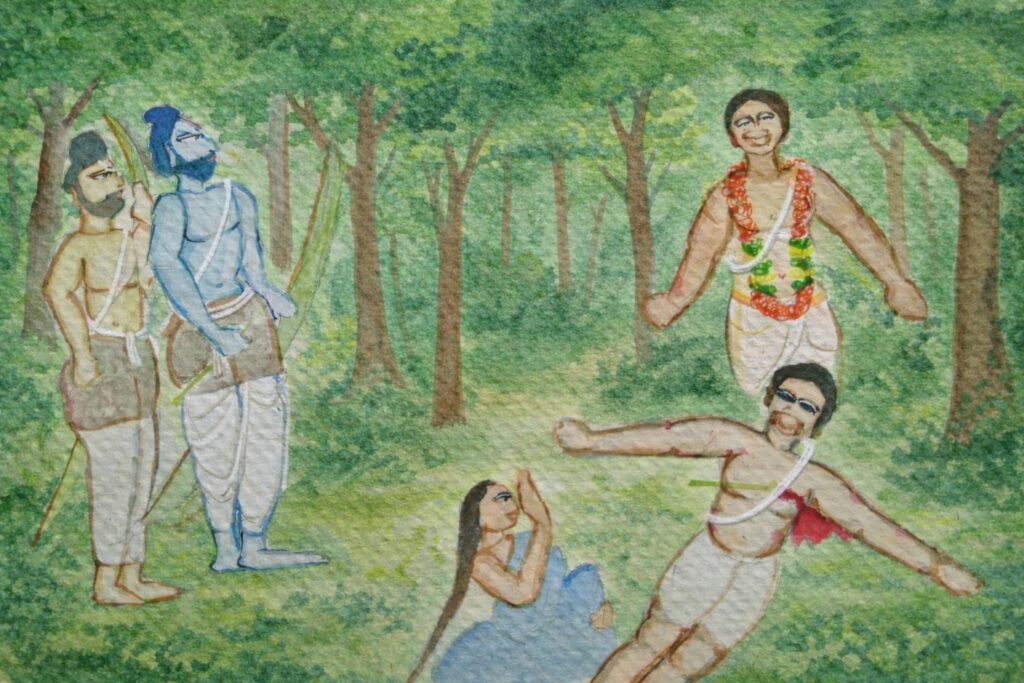
avathArikai (Introduction)
This was discussed in the previous article.
Word-by-Word meaning
kshathajOpamAksha – Oh, SrI rAma pirAn, with eyes as red as blood!
thvam – you (dhEvarIr)
apramEya: cha – one who is immeasurable, also
dhurAsadha: cha – one who is difficult to be approached, also
jithEndhriya: cha – one who has conquered the senses, also
uththamadhArmika: cha – one who is most virtuous, also
akshayyakIrthi: cha – one who has imperishable glory, also
vichakshaNa: cha – one who is very wise, also
kshithikshamAvAn – one who is forgiving like the earth
Notes from periyavAchchAn piLLai’s vyAkhyAnam
So far in this SlOkam, we have seen the vyAkhyAnam up to apramEya: cha.
apramEya: cha – one who cannot be perceived with our intelligence (either using prathyaksham, anumAnam or Sabdham). Let us continue with the vyAkhyAnam for the remaining SlOkam.
dhurAsadha: cha – one who cannot be attained
perumAL is apramEya:, he cannot be perceived by our intelligence; but is it possible to attain him with our external organs?
thArA says, “dhurAsadha: cha – one who cannot be attained”.
But how can one attain that which is beyond the comprehension of the mind?
dhurAsadha:
bhagavAn cannot be attained by those who have fallen off from the virtuous path; he can be attained only by those who trust him and those who follow the footsteps of the wise men.
- vishNu purANam 3-8-9 “vishNurArAdhyathE panthA:” (The supreme lord, vishNu is worshipped by one who practices varNAshramam; there is nothing else that would bring joy to him).
- mahAbhAratham 314-19 “mahAjanO yEna gatha: sa panthA:” (The path that is traversed by wise men is the path to attain dharmam).
- sthOthra rathnam 49 “padha: skhalitham” (I am falling off from virtuous path due to the darkness of rainy season in samsAram, I have lost my direction clouded by ignorance, I am suffering continuously due to the sorrows pouring down continuously in many ways; bless me with your kind glance).
- thiruvAimozhi 3-2-9 “pAviyEn pala kAlam vazhi thigaiththu alamaruginREn” (Being very sinful, I am being confused about the way (to escape), toiling and staying here for a long time).
dhurAsadha: – one cannot attain him in order to crush him to pieces or to push him far away or to destroy him.
asAdha means invincible; “shadhlu- viSaraNagathyavasAdhanEshu”. The root word ‘shadhlu’ means 3 types of activities – to be crushed/powdered, to make it go away, or to destroy. Let us take each meaning separately to understand this further.
Crushed into pieces (viSaraNa). Let’s us take this meaning and ask this question – Can the supreme lord be crushed into pieces?
- muNdaka upanishadh 1-1-6 “susUkshmam” (He is subtle in size).
Because he is extremely subtle (minute), he cannot be powdered like gross (physical) objects.
Make him go away (gathi). Let us take the second meaning and ask this question – Can the supreme lord be pushed far away?
- muNdaka upanishadh 1-1-6 “vibhum” (all-pervading).
The supreme lord exists everywhere; he cannot be pushed to a place where his existence is not there.
To destroy (avasAdhana). Let us take the third meaning and ask the question – Since he cannot be pushed away, can the supreme lord be destroyed?
- muNdaka upanishadh 1-1-6 “nithyam” (eternal).
Being eternal, he can never be destroyed.
Therefore, as muNdaka upanishadh says, he cannot be crushed or pushed away or completely destroyed.
- muNdaka upanishadh 1-1-6 “nithyam vibhum sarvagatham susUkshmam” (eternal, all-pervading, omni present, extremely subtle).
thArA says, “How can those who are enraged by vAli’s death fight or even hope to defeat you? They cannot even get near you (dhurAsadha:)”.
dhurAsadha:
Can those who defy vEdham and those who provide wrong interpretations of the vEdham rebuke him? It is not possible from them to even near him (dhurAsadha:).
- mahAbhArathm 314-19 “tharkO’prathishta: shruthayO vibhinnA na chAnrushErdharSanamasthi kinchith I dharmasya thathvam nihitham guhAyAm” (Use of logic and reasoning are fluid, vEdham is vast; philosophies of many have been criticised by different rishis, hence the real truth of dharmam is preserved in a cave in the mountain of vEdham).
- thiruvAimozhi 1-1-7 “uLan sudarmigu surudhiyuL” (He is the main object of the most radiant vEdham).
He is protected inside the vEdham; therefore, his existence is firm and cannot be troubled or disturbed by anyone. Hence, he is not susceptible to superfluous logic/reasoning or to Sruthi and smruthi statements which provide partial understanding.
thArA says, “Oh I was wrong to think that being unfathomable and invincible (apramEyaScha dhurAsadhaScha), caught in pride, you annihilated vAli to control his wife and his kingdom”.
jithEndhriyaScha – one who has controlled senses – detached from material possessions
thArA says, “After defeating vAli, you gave his kingdom to sugrIva. This shows that you are not attracted to the materialistic things (such as kingdom or women)”.
jithEndhriya: – one who has restrained his sense organs
thAra says, “You are not like those who are unable to control their senses, allowing their senses to be engaged in any way they desire; you are able to rule and subdue your sense organs such that they submit under you”.
jithEndhriya: – one who is dispassionate
thArA says, “SrI rAma! In this world, it is natural for a man to be attracted to a woman. But even though I have been standing here all this time, you did not even lift your head to look at me. What an extraordinary sense of determination (vairagyam) you possess!”.
- SrI rAmAyaNam ayOdhyA kANdam 72-49 “na rAma: paradhArAmScha chakshurbhyAmapi paSyathi” (SrI rAma never looks at other people’s wives).
jithEndhriyaScha –
- SvEthASvathara upanishadh 3-19 “paSyathyachakshu: sa shruNOthyakarNa:” (One who sees without having eyes; one who hears without having ears).
- SvEthASvathara upanishadh 3-19 “apANipAdhO javanO gruhIthA” (Even without his legs and hands, he walks fast; he grasps everything).
- “sarvEndhriyairapi vinA sarvE sarvathra paSyathi” (Even without any sense organs, he is able to see everything).
Even though you have sense organs like the people of this world, your actions are not ordained by the sense organs.
- “dhurgraham manasApyanyairindhriyairapi dhurjayam” (He cannot be perceived by the mind; he cannot be conquered by other sense organs too).
- thiruvAimozhi 1-1-2 “mananuNarvu aLavilan poRiyuNarvu avaiyilan” (bhagavAn is immeasurable by gyAnam which is felt in the heart/mind through the practice of yOga and thus distinct from chith (jIvathmA); distinct from achith (matter) which is experienced/understood through the external senses).
thArA says, “You have conquered the senses of others too and hence they cannot perceive you, either with their mind or with their other senses. Therefore, you remain beyond anyone’s perception”.
thvam jithEndhriya: there are not many like you, who have controlled their senses
- prabhOdha chandhrOdhaya nAtakam “ahalyAyai jAra: surapathirabhUdhAthmathanayAm prajAnAthOyAsIdhabhajatha gurOrindhurabalAm” (dhEvEndhran (indhra) became the lover of gauthama rishi’s wife ahalyA; brahmA even desired his own daughter; chandran united with his AchAryan – bruhaspathi’s wife).
thArA says, “My father-in-law indhra was captivated by ahalyA, brahmA who is superior to him, was attracted to his daughter, chandhra was attracted to his guru’s wife, both the sun god’s son sugrIva mahArAja and indhra’s son vAli endured lot of suffering for my sake, and viSwAmithra was attracted to mEnakA. Like this, most people in the world lack control of their senses. But you alone remain as one with controlled senses”.
- SrI rAmAyaNam kishkindhA kANdam 17-33 “indhriyai: kAmavruththa: san krushyasE manujESvara” (Oh king! He behaves as per his heart’s desire, being pulled by his senses).
thArA says, “I thought you came here to take someone else’s wife and kingdom since you lost your own, but you seem to have no interest in them”.
thArA questions herself, “He seems to be detached from everything, then, why did he put us through this suffering?”.
uththamadhArmika: – he is most virtuous
thArA says, “He did not do it for his sake, he did for the goodness of sugrIva mahArAja”.
uththamadhArmika: –
adhaman – one who does things for his own goodness, he is the lowest of the dhArmikas; madhyaman – one who does things for the goodness of both others and self; uththaman – one who does things exclusively for the goodness of others.
perumAL’s actions are always exclusively for the benefit of his servitors. He is uthman.
dhArmika: – one who follows dharmam
A person who follows dharmam can be classified as four types.
dhArmika: – The first level, those who are close to dharmam (being righteous).
- vishNu purANam 3-8-9 “varNASramAchAravathA-ArAdhyathE” (Only the one who follows the varNASrama dharmam worships the supreme lord, vishNu).
A person who is engaged in varNASrama dharmam is following dharmam, and he pleases perumAL by such actions. When perumAL becomes joyful by accepting the worship of those who follow varNASrama dharmam, he is dhArmika:.
uth dhArmika: – This is the second level.
- purusha sUktham “thamEvam vidhvAnamrutha iha bhavathi nAnya: panthA” (The one who has devotion to that supreme lord, in this birth itself attains salvation; there is no other way to attain salvation).
A person who is engaged in bhakthi yOgam to attain bhagavAn worships the supreme lord to attain him. When perumAL gives mOksham as a result for those performing bhakthi yOgam, he is uthdhArmika:.
The next level, which is higher than the previous is uththara dhArmika:.
- SvEthASvathara upanishadh 6-18 “SaraNamaham prapadhyE” (I take the supreme lord as my refuge).
For all beings, the supreme lord is the refuge. When he is refuge for all beings, he is uththaradhArmika:.
The highest level is uththama dhArmika:.
- “thEnAnugruhIthO brahmalOkam gachchathi” (Blessed by an AchAryan, he attains paramapadham – the supreme abode).
- “upAyO gururEva syAth” (To take the refuge of a guru to attain mOksham – salvation).
When perumAL accepts a jIvAthmA through a purushakAram (AchAryan), he is uththama dhArmika:.
Also, dhArmika: can be explained as sAmAnya dharmam [regular path of righteousness], and uththama dhArmika: as asAdhAraNa dharmam [distinguished path of righteousness].
- SrI rAmAyaNam sundhara kANdam 38-14 “AnruSamsyam parO dharma:” (Compassion is the highest virtue).
To cry out ‘Alas!’ when seeing a person in distress is sAmAnya dharmam.
asAdhAraNa dharmam, is above sAmAnya dharmam; it is not just feeling sympathetic but acting for the protection of those who are suffering. SrI rAma, realising sugrIva maharAja’s suffering, killed vAli to protect him, hence it is said that he followed asAdhAraNa dharmam. He is also called as uththamadhArmika:.
- SrI rAmAyaNam ayOdhyA kANdam 1-16 “kulOchithamithi kshAthram dharmam svam bahumanyathE” (SrI rAma held kshathriya dharmam in high esteem since it was befitting his clan).
- “vadhaScha dharmayudhdhEna svarAjya paripanthinAm I kshathriyANAmayam dharmO yath prajA paripAlanam II” (kshathriya dharmam is protecting his subjects and fighting righteous battle with the enemies of his kingdom).
uththama dhArmika:
thArA says, “You not only protected sugrIva mahArAja who was suffering, but by killing vAli, who deserved to go to hell for committing unrighteous acts, you made him pure”. Hence, uththamadhArmika:”.
- SrI rAmAyaNam kishkindhA kANdam 18-32 “rAjabhirdhruthadhaNdAsthu kruthvA pApAni mAnavA: I nirmalA: svargamAyAnthi santhassukruthinO yathA II” (When the people who commit sins are punished by kings, they are absolved of their sins, they reach the heavenly planet like the ones who do righteous deeds).
- SrI rAmAyaNam kishkindhA kANdam 13-23 “thasya dhaNdO vadha: smrutha:” (Killing him is the right punishment for one who took his brother’s wife).
vyAkhyAnam for this SlOkam will be continued in the next article.
AzhwAr emperumAnAr jIyar thiruvadigaLE SaraNam
periyavAchchAn piLLai thiruvadigaLE SaraNam
Source – SrI rAmAyaNa thani SlOkam – 36 – kishkindhA kANdam 24.31 – thvam apramEyaScha – Part 4 Audio Video
adiyEn chithrA rAmAnuja dhAsi
Proofreading/Curating done by – kOsalEndhra rAmAnuja dhAsan, krishNan rAmAnuja dhAsan
Artwork – namperumAL rAmAnuja dhAsan
Related Links
SrI rAmAyaNa thani SlOkam – 35 – kishkindhA kANdam 24.31 – thvam apramEyaScha – Part 3 Audio Video
SrI rAmAyaNa thani SlOkam – 34 – kishkindhA kANdam 24.31 – thvam apramEyaScha – Part 2 Audio Video
SrI rAmAyaNa thani SlOkam – 33 – kishkindhA kANdam 24.31 – thvam apramEyaScha – Part 1 Audio Video
SrI rAmAyaNa thani SlOkam – 32 – AraNya kANdam 63.12 – asmin mayA, kishkindhA kANdam 1.71 – padhmakEsara, 1.115 – padhma saugandhika vaham Audio Video
SrI rAmAyaNa thani SlOkam – 31 – AraNya kANdam 30.39 – tham dhrushtvA – Part 2 Audio Video
SrI rAmAyaNa thani SlOkam – concise english meanings
archived in https://granthams.koyil.org
pramEyam (goal) – https://koyil.org
pramANam (scriptures) – https://granthams.koyil.org
pramAthA (preceptors) – http://acharyas.koyil.org
SrIvaishNava education/kids portal – http://pillai.koyil.org