SrI: SrImathE SatakOpAya nama: SrImathE rAmAnujAya nama: SrImath varavaramunayE nama:
We are continuing to enjoy periyavAchchAn piLLai’s SrI rAmAyaNa thani SlOka grantham. This has been published by puththUr swAmy, who has also published a simple explanation in thamizh along with this. We are learning the in-depth meanings for SlOkams in SrI rAmAyaNam through this grantham in this series, with the support of puththUr swAmy’s explanations.
This SlOkam (kishkindhA kANdam 3.28) shows the greatness of thiruvadi (hanumAn) who is seen as an AchArya in our sampradhAyam. AchAryan is one who unites jIvAthmA and paramAthmA (this known as kataka kruthyam). thiruvadi unites pirAtti (who mercifully takes the role of a jIvAthmA) with perumAL (paramAthmA) when they were suffering in separation.
He is celebrated highly in our sampradhAyam; AzhwArs have celebrated him in their pAsurams; our AchAryas have also celebrated thiruvadi in many of their compositions.
thiruvadi is also celebrated as ‘nava vyAkaraNa paNditha’ – one who has profound mastery over samaskrutha vyAkaraNam [sanskrit grammar]. His AchArya is sUrya bhagavAn. thiruvadi (being vAyu’s son), travels with sUrya bhagavAn at his pace and receives his upadhESam. He is also bestowed with many boons from the dhEvathAs. brahmA also gives him a boon – the ability to recognise the supreme lord upon seeing him.
thiruvadi (hanumAn), who is thus widely celebrated, is celebrated by perumAL himself for his eloquence and articulation in this SlOkam.
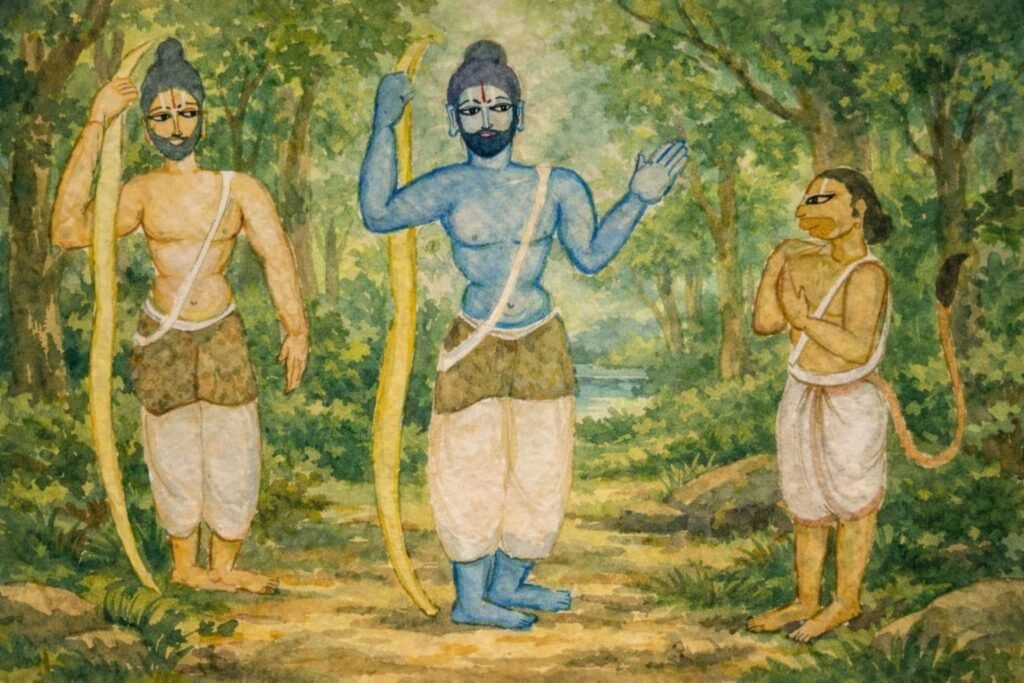
When perumAL and iLaiya perumAL approach lake pampA, sugrIva mahArAja, jAmbavAn and thiruvadi see them from a mountain top. sugrIva mahArAja, who is fearful of vAli, feels suspicious upon seeing them. Hence, he sends thiruvadi to find out about their identities. thiruvadi initially approaches them in disguise as a thapasvI (ascetic). He praises perumAL and iLaiya perumAL; he says, “Your radiance tells me that you are a dhEvan; but you appear adorned in treebarks and deer skin with matted hair like a thapasvI”. And he asks, “Who are you?” perumAL then looks at iLaiya perumAL and asks him to respond to thiruvadi. This SlOkam is uttered by perumAL at this juncture.
perumAL says, “Who can talk like this? Only one who is a pundit in rig vEdham, an expert in yajur vEdham, and one well-versed in the intricacies of sAma vEdham”.
avathArikai (Introduction)
During SrI rAma’s first meeting with thiruvadi, he is astonished by thiruvadi’s oratorical abilities and utters the following pAsuram.
nAnrugvEdhavinIthasya nAyajurvEdhadhAriNa: I
nAsAmavEdha vidhusha: SakyamEvam prabhAshithum II
Word-by-Word meaning
anrugvEdhavinIthasya – one who has not received instructions of rig vEdham (i.e to learn and act as per it)
Evam – like this
prabhAshithum – to speak
na Sakyam – not possible
ayajurvEdhadhAriNa: – one who does not live as per the learnings of yajur vEdham
na – not possible
asAmavEdha vidhusha: – one who does not have the knowledge of sAma vEdham
na – not possible (to speak like this)
Simple meaning
perumAL says: One who has not learnt the rig vEdham, one who has not understood yajur vEdham, one who is not an expert in sAma vEdham, cannot speak in this manner.
Notes from periyavAchchAn piLLai’s vyAkhyAnam
nAnrugvEdhavinIthasya
perumAL says “Except for one who has received upadhESam of rig vEdham under an AchArya and has been disciplined by him, none will be able to speak like this”.
(rig vEdham shows the practices which are to be followed by those desirous of leading a virtuous life.)
nAyajurvEdhadhAriNa:
perumAL says, “None except someone who has learnt yajur vEdham and understood its meaning can speak these words”.
(Mastery of yajur vEdham is extraordinary; its content is substantial and complex with numerous branches.)
nAsAmavEdha vidhusha:
perumAL says, “None except one who has learnt the nuances of sAma vEdham can speak like this”.
(sAma vEdham has various specialised melodic chants and many internal divisions such as Uham, rahasyam and so on, which are difficult to understand.)
SakyamEvam prabhAshithum
perumAL says, “Only one who has mastered all three vEdhams can come before us and speak in this manner”.
(Note from kAlakshEpam: This SlOkam has an in-depth meaning. thiruvadi’s words are always well-spoken. When he meets sIthAp pirAtti, she is under profound hardship; being driven to the brink of despair, she contemplates to end her life. With his clear articulation, eloquent and expressive words, he talks to sIthAp pirAtti in such a situation to provide solace to her. This skill is also very necessary for AchAryas. He must understand what to speak, how to speak, and when to speak and communicate accordingly. thiruvadi, possessed all these qualities)
This concludes the vyAkhyAnam for this SlOkam; this also concludes the vyAkhyAnam for kishkindhA kANdam.
Next, we will proceed to the SlOkams in sundhara kANdam.
SrI rAmAyaNa thani SlOkam – 38 – sundhara kANdam 15.23 dhuskaram kruthavAn
sundhara kANdam is embedded with many beautiful SlOkams. The entire kANdam is exquisite. It is said that this kAndam is called sundharam (beautiful), referring to thiruvadi (hanumAn) as sundharam. It is also said to demonstrate – the greatness of pirAtti, greatness of thiruvadi, the elegant words of thiruvadi – as such there are many reasons for this kANdam to be called as sundhara kANdam.
Before having dharSan of sIthAp pirAtti, thiruvadi is baffled about perumAL’s behaviour – perumAL’s intense longing, relentless grief, and emotional outpours due to separation from sIthAp pirAtti. But her katAksham (divine grace) transforms thiruvadi.
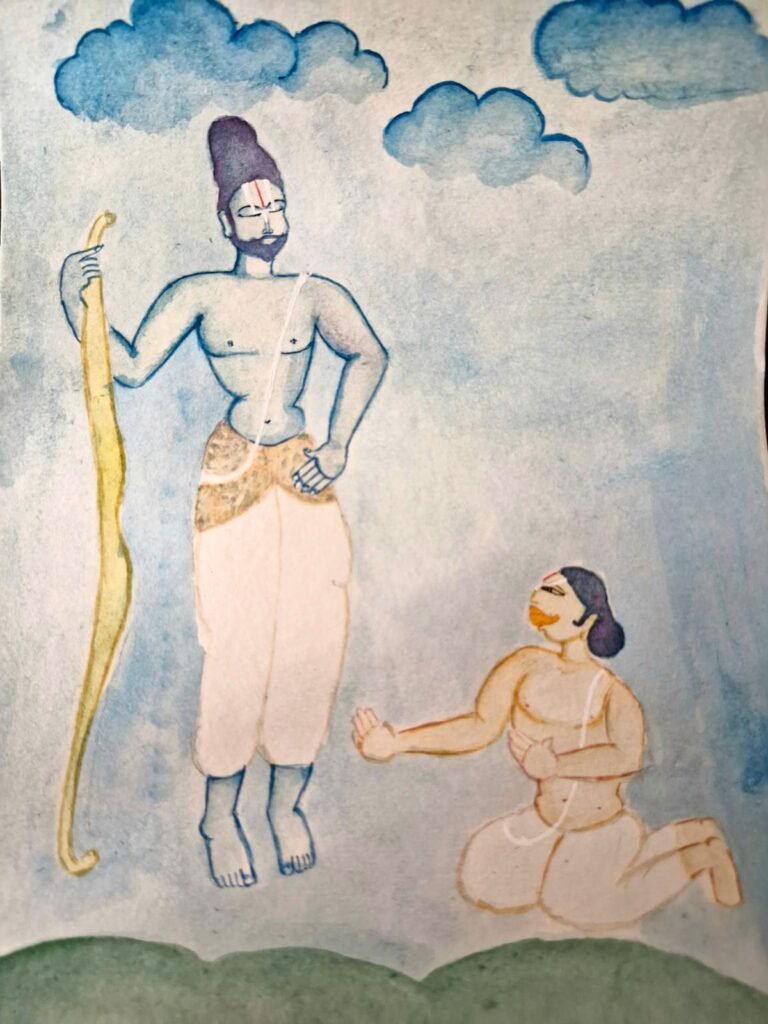
This SlOkam is spoken by thiruvadi, after sIthAp pirAtti’s dharSan. He looks at her beauty, her greatness, her hapless situation. Feeling poignant, thiruvadi thinks, “How could perumAL sustain himself after being separated from this pirAtti?”.
avathArikai (Introduction)
“anyathra bhIshmAdh gAngEyAdh anyathra cha hanUmatha: I hariNIkhura mAthrENa charmaNA mOhitham jagath II” (Everyone in this world except for bhIshma, son of gangA, and hanumAn, will succumb to and be attracted to women’s beauty).
(Note from kAlakshEpam: Examples of bhIshma and thiruvadi have also been used while highlighting ponnadikkAl jIyar’s vaibhavam – in vAnamAmalai jIyar’s mangaLASAsanam).
thiruvadi, who is thus unperturbed, notices pirAtti’s beauty, and is distressed looking at her emaciated appearance, and says in disappointment, “How can he (perumAL) put her in this situation?”
(Note from kAlakshEpam: Two things are explained through this – 1. It is AchArya’s responsibility to correct when he sees a mistake. Similar to when pirAtti does purushakAram – she corrects the chEthanas with her upadhESam and conveys the same to perumAL with her beauty – gyAna, bhakthi, and vairAgyam. Here, thiruvadi, in the role of an AchArya, feels the same way when he looks at pirAtti and hence is disappointed with perumAL. 2. Our pUrvAchAryas in many places have placed the burden on perumAL even for the mistakes of jIvAthmAs. perumAL too feels the same way, just like a farmer who tirelessly works to get his yield, perumAL, takes many steps to inculcate bhakthi in jIvAthmAs. While doing so, he puts the onus on himself. thiruvadi’s expression of disappointment reflects the same.)
dhushkaram kruthavAn rAmO hInO yadhanayA prabhu: I
dhArayathyAthmanO dhEham na SOkEnAvasIdhathi II
Word-by-Word meaning
rAma: – perumAL (SrI rAma)
dhushkaram – a monumental feat
kruthavAn – he did
anayA hIna: – even when separated from sIthAp pirAtti
prabhu: – lord (not understanding pirAtti’s sorrow)
Athmana: dhEham – his thirumEni (divine form)
dhArayathi yAth – that he has the ability to sustain himself
SOkEnA – in sorrow
na vasIdhathi yath – that he has not succumbed (is a monumental feat)
Simple meaning
thiruvadi thinks, “Lord SrI rAma, being separated from sIthAp pirAtti, has done an impossible task of still preserving his body”.
Notes from periyavAchchAn piLLai’s vyAkhyAnam
dhushkaram kruthavAn rAma:
rAma: – He is known to everyone as the one with only one beloved wife – sIthAp pirAtti. It is truly tormenting for such a beloved entity to endure his dear wife’s separation. Yet, he did the impossible!
thiruvadi: “Oh, I thought that I had executed an incredible task by crossing the vast expanse of ocean; now I know that what SrI rAma is doing is even more staggering”.
dhushkaram – the impossible
Separating from pirAtti was not possible for him, so he even brought her along with him to the forest. Unable to do such a thing (dhushkaram ) – did he give up on this impossible task?
kruthavAn – he achieved the insurmountable (he separated from her)
rAma: – one who is beautiful, even after separating from pirAtti, his beauty remained unchanged.
rAma:
thiruvadi: When separated from pirAtti, shouldn’t his radiance dwindle, his beauty diminish? Shouldn’t his face turn pale and his body become thin? Shouldn’t he remain motionless?
- thiruvAimozhi 7-2-4 “itta kAl itta kaiyaLAy” (leg and hand remain [unmoved] wherever they were placed).
- SrI rAmAyaNam sundhara kANdam 37-28 “kachchinna thadhdhEmasamAna varNam thasyAnanam padhmasamAna gandhi” (Does his divine face shine like gold and smell like a lotus flower?).
rAma:
thiruvadi: He (perumAL) looks beautiful but there is no compassion in his heart; how could he bring her to the forest and leave her there in the middle of the forest?
thiruvadi: Anyone who knows about her will not do such a thing – was she left in the forest because of her own actions?
- SrI rAmAyaNam sundhara kANdam 38-48 “mama eva dhushkrutham kinchith mahath asthi na samSaya:” (There is no doubt that I have committed a great sin).
hInO yadhanayA
thiruvadi: This happened only because perumAL left her alone and went after the deer, and that is how rAvaNa was able to abduct her.
anayA hIna:
- thiruvAimozhi 6-10-10 “agalagillEn iRaiyum” (will not separate, even for a moment).
thiruvadi: But why would anyone want to separate from pirAtti? Especially when pirAtti has said that she will never separate from perumAL even for a moment.
anayA hIna:
In dhvayam “SrImannArAyaNa” it means nArAyaNa who is always with SrI mahAlakshmi.
thiruvadi: Oh, has he destroyed the eternal union that is elucidated in SrIman nArAyaNa!
anayA hIna:
- SrI rAmAyaNam ayOdhyA kANdam 27-22 “ananyabhAvAm anurakthachEthanAm vihInAm maraNAya niSchithAm” (pirAtti says: (Take) me, one who does not have any thoughts other than you, one who is always engaged only in you, one who vows to end her life if separated from you, (to the forest)).
thiruvadi: Oh, she made such a declaration! Yet, he separated from her.
anayA hIna:
- yajur vEdham 3-3 “SradhdhayA dhEvO dhEvathvamaSnuthE” (dhEvan nArAyaNan attains his divine nature (being a dhEvan) through SrIdhEvi, who is known as SradhdhA).
- SrI rAmAyaNam AraNya kANdam 37-18 “apramEyam hi thaththEjO yasya sA janakAthmajA” (The radiance attained by king janaka by having pirAtti as his divine daughter is immeasurable).
- SrI rAmAyaNam sundhara kANdam 21-16 “ananyA rAghavENAham bhAskarENa prabhA yathA” (pirAtti says: Like the rays of the sun which do not leave the sun, I am inseparable from SrI rAma).
thiruvadi: She is the one who brings greatness to him in all ways; why would he leave her?
prabhu:
thiruvadi: May be he remains ignorant about her misery since he is the lord.
It is also seen in the world about leaders who are oblivious of the sufferings of others.
prabhu:
thiruvadi: He has the superiority of being a lord but he is not commiserating with her unfortunate circumstances.
prabhu:
thiruvadi: He seems to have learnt to ride horses and elephants, to command the army, to ask for income and expenditure reports, to handle weapons, but he appears to be a novice as a lover.
prabhu:
- nAchchiyAr thirumozhi 13-1 “peNNin varuththam aRiyAdha perumAn” (perumAL, who does not know the distress of those who were born as women).
- purusha sUktham “bahudhA vijAyathE” (He incarnates in many forms).
- SrI bhagavath gItha 4-5 “bahuni mE vyathIthAni janmAni” (krishNa says: for me too, countless births have passed).
- thiruvAimozhi 2-9-5 “piRappil pal piRavip perumAn” (perumAL, who is born in many forms though he has no reason to take birth).
thiruvadi: In this flood of many births (incarnations), if he had taken at least one incarnation as a woman, he would have truly understood the state of being utterly destitute, the immense suffering that women endure.
What is it that he (prabhu:) did as a lord?
dhArayathyAthmanO dhEham (sustaining his body).
thiruvadi: Shouldn’t lord SrI rAma, having been separated from pirAtti, have plunged into the ocean and ended his life and earned commendation?
dhArayathi
thiruvadi: Instead, he is continuing to prevail without losing his existence!
May be is sustaining himself because it is not possible to destroy – his svarUpam is eternal.
thiruvadi: But perumAL could have destroyed his rUpam – form (AthmanO dhEham).
- vishNu purANam 6-5-84 “ichchAgruhIthAbhimathOrudhEha:” (emperumAn has as his thirumEni – the forms which are taken as per his desire, they are mammoth and desired by him).
thiruvadi: Unlike the svarUpam, his body, as SrI rAma, has been taken by him for incarnation – is it not possible to discard it?
- sAthvadham “nithyam nithyAkruthidharam” (One who is eternal and paramAthmA with an eternal thirumEni).
Like his svarUpam, his rUpam (thirumEni) is also eternal! It cannot be discarded.
- thiruvAimozhi 3-5-5 “AdhiyanjOdhi uruvai angu vaiththu ingup piRandhu” (he was born with his primordial spiritual form which is having divine splendour as in paramapadham).
His thirumEni in vaikuNtam and the thirumEni he takes during avathAras are both aprAkrutha thirumEni (not of prakruthi – outside of material elements) – aprAkrutha thirumEni in vaikuNtam cannot be discarded. But can he discard his incarnated thirumEni?
rAma: AthmanO dhEham – The thirumEni that he has taken as SrI rAma is also aprAkrutham but it can be discarded since it is taken only for this incarnation.
AthmanO dhEham
thiruvadi: Then, why did he not discard his body? May be he thought that it was not within his control to discard his form. Or, may be he thought he was dependent and hence he assumed that he did not have the right to discard it.
- “parAdhInA: sthriya: sarvA:” (women are meant to be under the guidance of others (father, husband, son)).
- thiruvAimozhi 5-4-3 “mAyum vagai aRiyEn val vinaiyEn” (I, who am having great sins, don’t know the ways to finish myself).
thiruvadi: But he is svathanthran; he could leave his body if he wanted to.
AthmanO dhEham
- jithanthE 1-5 “na thE rUpam – bhakthAnAm” (Your form is not yours; it belongs to your devotees).
thiruvadi: Why is he enduring to preserve the body that does not belong to him?
May be, he does not have any tools/weapons to put an end to his body? But it is not possible to destroy with any weapon.
thiruvadi: But, why does he need a weapon?
na SOkEnAvasIdhathi – the sorrow from his separation, isn’t that sufficient?
na SOkEnAvasIdhathi
- “SOkAgni: pradhakshyathi” (When there is a great fire of sorrow, what other instrument is needed to discard the body?).
thiruvadi: If there were sorrow due to separation, the fire of sorrow would have destroyed him.
(Note from kAlakshEpam: It is thiruvadi’s affliction upon seeing pirAtti’s predicament that he puts the onus on perumAL for pirAtti’s suffering. Thus he utters this SlOkam.)
This concludes the vyAkhyAnam for this SlOkam.
AzhwAr emperumAnAr jIyar thiruvadigaLE SaraNam
periyavAchchAn piLLai thiruvadigaLE SaraNam
Source – SrI rAmAyaNa thani SlOkam – 38 – kishkindhA kANdam 3.28 – nAnrigvEdha, sundhara kANdam 15.23 dhuskaram kruthavAn Audio Video
adiyEn chithrA rAmAnuja dhAsi
Proofreading/Curating done by – kOsalEndhra rAmAnuja dhAsan, krishNan rAmAnuja dhAsan
Artwork – namperumAL rAmAnuja dhAsan
Related Links
SrI rAmAyaNa thani SlOkam – 37 – kishkindhA kANdam 24.31 – thvam apramEyaScha – Part 5 Audio Video
SrI rAmAyaNa thani SlOkam – 36 – kishkindhA kANdam 24.31 – thvam apramEyaScha – Part 4 Audio Video
SrI rAmAyaNa thani SlOkam – 35 – kishkindhA kANdam 24.31 – thvam apramEyaScha – Part 3 Audio Video
SrI rAmAyaNa thani SlOkam – 34 – kishkindhA kANdam 24.31 – thvam apramEyaScha – Part 2 Audio Video
SrI rAmAyaNa thani SlOkam – 33 – kishkindhA kANdam 24.31 – thvam apramEyaScha – Part 1 Audio Video
SrI rAmAyaNa thani SlOkam – concise english meanings
archived in https://granthams.koyil.org
pramEyam (goal) – https://koyil.org
pramANam (scriptures) – https://granthams.koyil.org
pramAthA (preceptors) – http://acharyas.koyil.org
SrIvaishNava education/kids portal – http://pillai.koyil.org