SrI: SrImathE SatakOpAya nama: SrImathE rAmAnujAya nama: SrImath varavaramunayE nama:
periyavAchchAn piLLai, who is highly acclaimed in our sampradhAyam, has blessed us with vyAkhyAnams for SrI rAmAyaNam, 4000 dhivya prabhandham, and various pUrvAchAryas’ sthothrams. He has also mercifully composed several rahasya granthams. We are currently enjoying his vyAkhyAnams for SlOkams in sundhara kANdam.
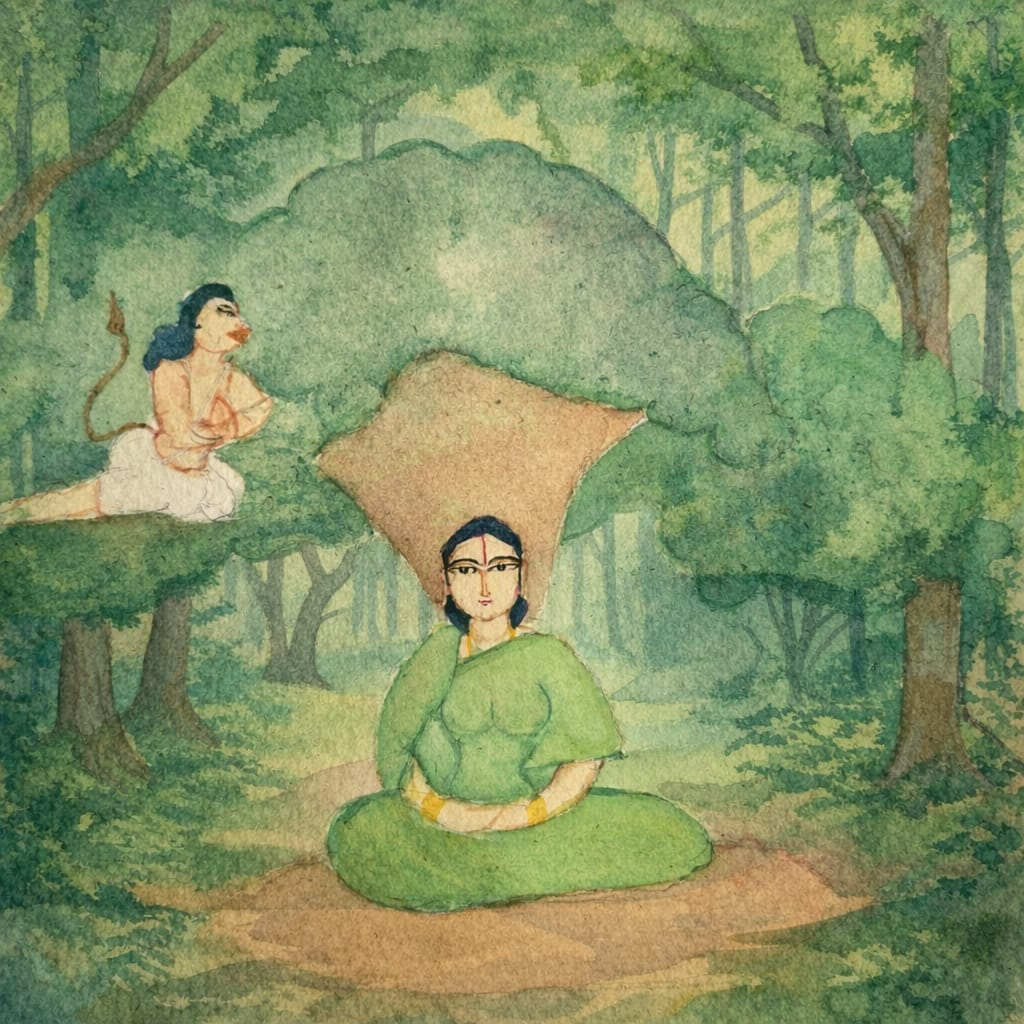
Upon seeing sIthAp pirAtti, thiruvadi thinks about her poised demeanour; the following SlOkam is a description of those thoughts.
He thinks: “Though she is separated from perumAL, she stays calm – like the river ganga that remains unchanged even after a heavy rain. What could be the reason?”. He then understands that her conviction in the determination of perumAL and (the intelligent) iLaiya perumAL is the sole reason for her calmness”.
avathArikai (Introduction)
thiruvadi (hanumAn) filled with grief, utters this SlOkam after looking at sIthAp pirAtti’s miserable state in aSOka vanam (forest).
rAmasya vyavasAyagyA lakshmaNasya cha dhImatha: I
nAthyartham kshubhyathE dhEvI gangEva jaladhAgamE II
Word-by-Word meaning
rAmasya – SrI rAma’s
dhImatha: – intelligent
lakshmaNasya cha – lakshmaNa’s (and iLaiya perumAL’s)
vyavasAyagyA – she who has understood the determination of them
dhEvI – sIthAp pirAtti
jaladhAgamE – in rainy season
gangA iva – like the river gangA [ganges]
athyartham – excessively
na kshubhyathE – is not disturbed
Simple meaning
Cognizant of the determination of perumAL and the intelligent iLaiya perumAL, sIthAp pirAtti remains calm – like the river ganges, that remains untroubled during the rainy season.
Notes from periyavAchchAn piLLai’s vyAkhyAnam
rAmasya vyavasAyagyA
- SrI rAmAyaNam yudhdha kANdam 18-33 “Ethadhvratham mama” (This is my promise; I will provide protection from everything to one who has surrendered to me).
- SrI rAmAyaNam yudhdha kANdam 5-9 “avagAhyArNavam svapsyE” (Because of this body heat caused by the agony of separation, I am going to lie down on this ocean).
thiruvadi thinks: “sIthAp pirAtti being aware of all these is able to sustain herself despite her circumstances. She prevails because she knows that perumAL does not relinquish anyone; even when a person shows only the slightest desire for him, he does not give up on that person”.
- SrI rAmAyaNam yudhdha kANdam 18-3 mithrbhAvEna samprAptham na thyajEyam kathanchana” (I shall not abandon a person who comes to me in the pathos of a friend, even if his intentions are not completely truthful).
thiruvadi continues to think: “She has also heard from perumAL before about his stance on protecting those who surrender to him. She is aware that perumAL would not survive when separated from her”.
- SrI rAmAyaNam sundhara kANdam 66-10 ‘na jIvEyam kshaNamapi” (I shall not live even for a moment (separated from pirAtti)).
- SrI rAmAyaNam AraNya kANdam 10-19 “apyaham jIvitham jahyAm” (sIthA dhEvi! I shall give up my life, I shall even give up you, including lakshmaNa, I shall not give up my vow, especially those promises made to the brahmaNas (to destroy the enemies of those surrendered to me)).
lakshmaNasya cha dhImatha:
thiruvadi reasons: “pirAtti is well aware of iLaiya perumAL’s acumen; even when perumAL pursued the deceptive deer at her urging, iLaiya perumAL had the discernment to warn him against it. Hence, she remains unagitated”.
nAthyartham kshubhyathE dhEvI
thiruvadi ponders: “She knows that perumAL cherishes her – carries her on his head, being his queen consort (symbolising perumAL’s deep affection for her) and that this separation would cause him sorrow. Hence she remained undisturbed and sustained herself even when her life was under threat”.
gangEva jaladhAgamE
thiruvadi thinks: “Just as the river gangA remains clear and undisturbed even when rain falls incessantly in heavy torrents, pirAtti remained unperturbed and calm”.
This concludes the vyAkhyAnam for this SlOkam. Let us continue with the next SlOkam from sundhara kANdam – 16.30.
SrI rAmAyaNa thani SlOkam – 39 – sundhara kANdam 16.30 – himahathanaLineeva
thiruvadi thinks about pirAtti’s condition – What a miserable condition has she attained! – Like a lotus that is stressed by dew, like a pair of chakravAka birds which suffer due to separation.
avathArikai (Introduction)
pirAtti’s sorrow due to separation from perumAL was apparent in her appearance. thiruvadi describes her plight by making a comparison to a lotus (stressed by the dew drops) and chakravAka bird anguished by the pain of separation.
himahathanaLineeva nashtaSObhA vyasanaparamparayA athipIdyamAnA I
sahachararahithEva chakravAkI janakasuthA krupaNAm dhaSAm prapannA II
Word-by-Word meaning
janakasuthA – pirAtti, king janaka’s daughter
himahathanaLinee iva – like a lotus wilted by the dew
nashtaSObhA – she, who has lost her beauty
vyasana paramparayA – because of the series of misfortunes that came one after another
athipIdyamAnA – one who has been tormented very much
sahachararahithA chakravAkI iva – like the chakravAka bird that has lost its male companion
krupaNAm dhaSAm prapannA – attained a miserable condition
Simple meaning
King janaka’s daughter (pirAtti), like a lotus stressed by dew drops, has lost her beauty due to a series of misfortunes that came one after another. She is tormented like the chakravAka bird that has lost its male companion; she has attained a miserable condition.
Notes from periyavAchchAn piLLai’s vyAkhyAnam
himahathanaLineeva nashtaSObhA
pirAtti, who possesses all these qualities found in a lotus – fragrance, softness, distinction, coolness, reddish tone, freshness, and the state of being fully blossomed – possesses a beauty so captivating that it is hard to take one’s eyes off of her. She, like the lotus, that was beautiful before it was stressed by the dew, was also tormented.
vyasana paramparayAthi pIdyamAnA
Due to her separation, sorrow fell upon pirAtti incessantly (who is tender like a lotus) and tormented her.
saha chararahithEva chakravAkI
- thiruvAimozhi 1-4-1 “nin anjiRaiya sEvalumAy” (Your beautiful partner whose wings/feathers are shining due to the union with you).
Like the chakravAka bird, with its inherent nature to deeply mourn the separation of its partner, pirAtti was seen in solitude.
janaka suthA – daughter of one, who was not agonised
- “pradhIpthAyAm mithilAyAm namE kinchith pradhahyathE” (King janaka says: In this mithilA that is caught in fire, there is nothing that is mine).
King janaka was never perturbed by any distress; his daughter, sIthAp pirAtti, suffered in separation.
janaka suthA – daughter who inherited tolerance by birth (in janaka’s clan)
She did not acquire this ability to endure because of her marriage to perumAL, this endurance to withstand this predicament has come to her due to her birth in king janaka’s clan.
krupaNAm dhaSAm prapannA – attained a miserable condition
She experienced every suffering that a woman could experience. The suffering experienced by the lotus and female chakravAka bird mentioned here are cited as metaphors merely to show a glimpse (of the magnitude of suffering). It can also be said that she experienced every single suffering that all beings in this world undergo, without a single sorrow being diminished.
This concludes the vyAkhyAnam for this SlOkam. Let us continue with the next SlOkam from sundhara kANdam – 21.3.
SrI rAmAyaNa thani SlOkam – 39 – sundhara kANdam 21.3 – thruNamantharatha: – Part 1
Upon hearing rAvAna convey his malicious intentions, pirAtti not only responded to him but also spoke up, advising him with his own well-being in mind.
avathArikai (Introduction)
- SrI rAmAyaNam sundhara kANdam 18-4 “srasthamAlyAmbaradharO vaidhEhIm anuchinthayan I bhruSamniyukthasthasyAncha madhanEna madhOthkata: II” (His garments and garlands slid, with an inflated sense of pride, thinking of vaidhEhi (sIthAp pirAtti), he was set in motion by manmAdhan to approach pirAtti).
rAvaNa, having woken from sleep and induced by manmadhan, goes to see sIthAp pirAtti.
- SrI rAmAyaNam sundhara kANdam 18-10 “anganASathamAthram thu tham vrajantham anuvrajath | mahEndhramiva paulasthyam dhevagandharvayOshitha ||” (Like the dhEva and gandharva women following indhran, hundred women followed that rAvaNa as he walked).
- SrI rAmAyaNam sundhara kANdam 18-11 “dhIpikA: kAnchanI: kASchidh jagruhus thathra yOshitha: | vAlavyajanahasthAScha thAlavrunthAni chAparA: ||” (Some women carried lamps made of gold; some others carried chowries; some others carried fans made of palm leaves).
- SrI rAmAyaNam sundhara kANdam 18-12 “kAnchanairapi bhrungArairjahru: salilamagratha: | maNdalAgAn brusImSchApi gruhyAnyA: prushtathO yayu: ||” (Some women carried water in small vessels of gold; some others followed with knives and blankets).
- SrI rAmAyaNam sundhara kANdam 18-13 “kAchidh rathnamayIm sthAleem pUrNA pAnasya brAjatham | dhakshiNA dhakshINEnaiva thadhA jagrAha pANinA ||” (One beautiful woman held a gold vessel that was filled with beverage).
- SrI rAmAyaNam sundhara kANdam 18-14 “rAjahamsaprathIkASam chathram pUrNaSaSiprabham | sauvarNadhaNdamaparA gruhIthvA prushtathO yayau ||” (Another woman followed him carrying an umbrella with a golden handle that looked like a royal swan, with the radiance of the full moon).
Hundred women followed rAvaNa carrying golden lamps, fans, fans made of palm leaves, water in golden vessel, beautiful umbrella, and so on, to serve him.
- SrI rAmAyaNam sundhara kANdam 18-15 “nidhrAmadha parIthAkshyO rAvanasyOththamA: sthriya: | anujagmu: pathim vIram ghanam vidhyullathA iva ||” (rAvaNa’s primary consorts with sleepy eyes, followed their brave husband like streaks of lightning which follow the clouds).
rAvaNa’s primary consorts, dull with drowsiness, also followed him.
- SrI rAmAyaNam sundhara kANdam 19-2 “thathO dhrushtva vaidhEhI rAvaNam rAkshasAdhipam” (pirAtti saw that rAvaNa, king of the rAkshasa).
pirAtti on seeing rAvaNa, trembled like a cloth hung on a pole being whipped by the wind.
- SrI rAmAyaNam sundhara kANdam 19-3 “UrubhyAmudharam chAdhya bAhubhyAncha payOdharO | upavishtA viSAlAkshee” (The wide eyed sIthAp pirAtti, covered her stomach with thighs and bosoms with divine hands, and her eyes with tears).
Like the chaste women in the world who cover their breasts to prevent the wicked eyes of the oglers from seeing them; pirAtti prevented rAvanA’s wicked eyes from seeing, the divine stomach, divine navel, divine bosoms, divine eyes which are meant for the enjoyment of perumAL. She covered them with her thighs, hands and her tears.
- SrI rAmAyaNam sundhara kANdam 19-7 “sankalpahayasamyukthair yAnthImiva manOrathai:” (With desires as chariot, tied to thoughts as horses).
Upon seeing rAvaNa, pirAtti, immediately wishes to be with perumAL. With this desire as her chariot and her thoughts about perumAL as the horses driving it, she rapidly ties the horses (thoughts) to her chariot (mind) and tries to reach perumAL.
- SrI rAmAyaNam sundhara kANdam 19-23 “samIkshamANAm rudhathIm anindhithAm supakshmalAmAyatha padhmalOchanAm I anuvrathAm rAmamathIva maithileem pralObhayAmAsa vadhAya rAvaNa: II” (She, who is flawless, with beautiful eyebrows, with eyes wide like a lotus, one who is always following SrI rAma, cries, looks in all directions; rAvaNa tries to persuade her with his threats).
rAvaNa attempts to lure the one: she who is always behind SrI rAma every step of the way, and eternally engaged with perumAL. She is blemishless with beautiful eyebrows; she cries and with her wide lotus eyes searches for perumAL everywhere.
- “sthimitha vikasithAnAmullasadh bhrUlathAnAm” (The eyebrows are raised in shock).
Being born in a noble clan (daughter of king janaka) – it is her AbhijAthyam, she remained there as a pathivrathA (the only one who can be celebrated as such by all). Her eyebrows shoot up as she desperately searched for perumAL far and wide all the way up to mAlyavAn.
rAvaNa, stymied in his attempts, looking at her suffering, tries to wheedle his way through flattery and insults; and makes promises to give ‘this and that’ to persuade her. He continues to engage in self-destruction (manipulative behaviour) – making promises to offer status and wealth, hoping to beguile her.
pirAtti watches him blabbering.
- mUnRam thiruvandhAdhi 88 “podhu ninRa ponnangazhalE thozhumin” (He has such divine feet that everyone, without any distinction, will worship them).
- SrI rAmAyaNam sundhara kANdam 38-35 “vadhArhamapi kAkuthstha: krupayA paryapAlayath” (SrI rAma, treats everyone equally -whether one is devoted to him or not, even if one is worthy to be killed, he protects them by his compassion).
- SrI rAmAyaNam sundhara kANdam 16-4 “rAmasya vyavasAyagyA” (She who is aware of the intentions of SrI rAma).
- vishNu purANam 1-9-126 “thvam mAthA sarvalOkAnAm” (You are the mother for all the worlds).
- SaraNAgathi gadhyam 1 “akhila jaganmAtharam” (Being the mother of all worldly beings).
- SrI pAncharAthram “upAyabhUthasya vallabhA prApthiyOginI” (She is the beloved for the bhagavAn who is the upAyam (means), and she is the purushakAra bhUthai (one who recommends jIvAthmAs to bhagavAn) to attain that bhagavAn).
- SrI pAncharAthram “lakshmee: purushakArathvE nirdhishtA paramarshibhi:” (The sages establish her as the one performing the purushakAram).
Upon seeing rAvaNa’s detrimental acts, despite her suffering, pirAtti not only replies to him but also offers words of advice for his own well-being.
avathArikai to be continued in the next article.
thruNamantharatha: kruthvA prathyuvAcha SuchismithA I
nivarthaya manO maththa: svajanE prIyathAm mana: II
Word-by-Word meaning
thruNam – a grass
antharatha: – in-between (herself and rAvaNa)
kruthvA – kept it (placed)
SuchismithA – with a pure smile
prathyuvAcha – (pirAtti) replied
maththa: – from me
mana: – the mind
nivarthaya – turn away
svajanE – your wives
mana: – (let) your heart
prIyathAm – desire (them)
vyAkhyAnam for this SlOkam will be continued in the next article.
AzhwAr emperumAnAr jIyar thiruvadigaLE SaraNam
periyavAchchAn piLLai thiruvadigaLE SaraNam
Source – SrI rAmAyaNa thani SlOkam – 39 – sundhara kANdam 16.4 – rAmasya, 16.30 – himahathanaLinIva, 21.3 – thruNamantharatha: – Part 1 Audio Video
adiyEn chithrA rAmAnuja dhAsi
Proofreading/Curating done by – kOsalEndhra rAmAnuja dhAsan, krishNan rAmAnuja dhAsan
Artwork – namperumAL rAmAnuja dhAsan
Related Links
SrI rAmAyaNa thani SlOkam – 38 – kishkindhA kANdam 3.28 – nAnrigvEdha, sundhara kANdam 15.23 dhuskaram kruthavAn Audio Video
SrI rAmAyaNa thani SlOkam – 37 – kishkindhA kANdam 24.31 – thvam apramEyaScha – Part 5 Audio Video
SrI rAmAyaNa thani SlOkam – 36 – kishkindhA kANdam 24.31 – thvam apramEyaScha – Part 4 Audio Video
SrI rAmAyaNa thani SlOkam – 35 – kishkindhA kANdam 24.31 – thvam apramEyaScha – Part 3 Audio Video
SrI rAmAyaNa thani SlOkam – 34 – kishkindhA kANdam 24.31 – thvam apramEyaScha – Part 2 Audio Video
SrI rAmAyaNa thani SlOkam – concise english meanings
archived in https://granthams.koyil.org
pramEyam (goal) – https://koyil.org
pramANam (scriptures) – https://granthams.koyil.org
pramAthA (preceptors) – http://acharyas.koyil.org
SrIvaishNava education/kids portal – http://pillai.koyil.org