SrI: SrImathE SatakOpAya nama: SrImathE rAmAnujAya nama: SrImath varavaramunayE nama:
We are enjoying the vyAkhyAnam mercifully given by periyavAchchAn piLLai with the support of puththUr swAmy’s commentaries.
sIthAp pirAtti places a blade of grass between herself and rAvaNa and replies to him. In the previous article, we enjoyed the vyAkhyAnam (with 26 astonishing interpretations) for thruNamantharatha: kruthvA. Let us now continue with the vyAkhyAnam for the remaining SlOkam.
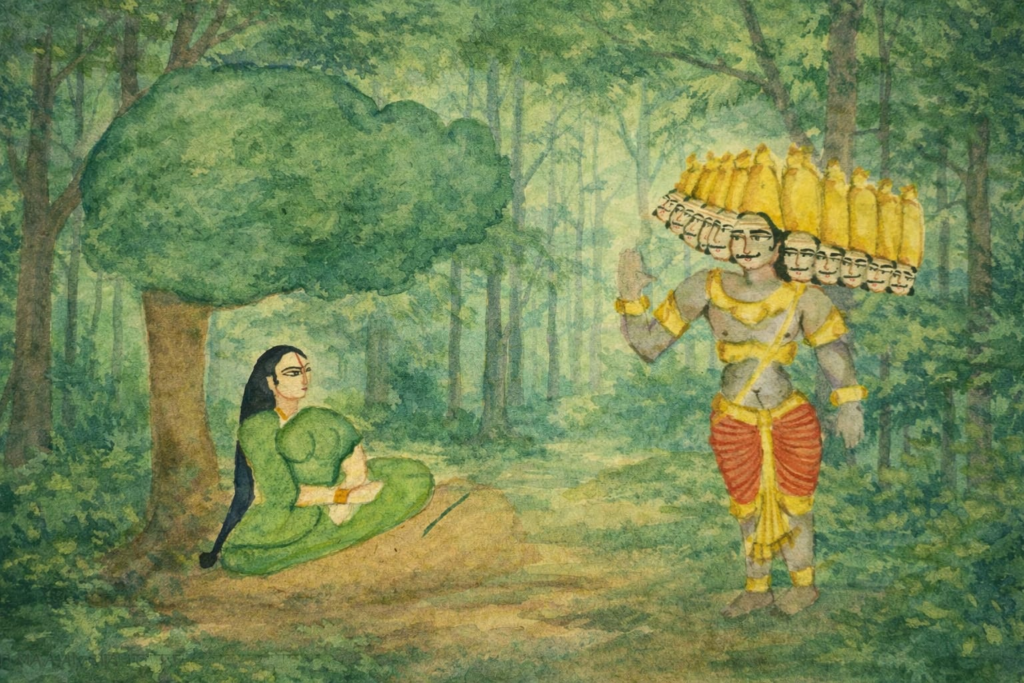
thruNamantharatha: kruthvA prathyuvAcha SuchismithA I
nivarthaya manO maththa: svajanE prIyathAm mana: II
Notes from periyavAchchAn piLLai’s vyAkhyAnam
What did pirAtti do after she placed the grass? prathyuvAcha – She replied to rAvaNa’s questions.
How did she reply? Even if she acknowledged his words by saying ‘Exactly’ (or something similar), that too could be counted as an answer; is that how she replied?
prathyuvAcha – she refuted
When rAvaNa said, “You have to become my wife”, she repudiated by saying, “It is not appropriate for me to be your wife”.
- SrI rAmAyaNam sundhara kANdam 21-6 “nAhamaupayikI bhAryA” (I am not the right woman to be your wife).
- SrI rAmAyaNam sundhara kANdam 21-4 “na mAm prArthayithum yuktham susidhdhimiva pApakruth I akArya na mayA kAryam” (Like a sinner who aspires to attain a good state, it is unfitting for you to desire me. I too cannot indulge in unvirtuous act).
prathyuvAcha – she voiced her disapproval scathingly
The sound prathi indicates adversity. She not only refused, but also spoke adversely in a way that made his heart burn with anger and distress.
- SrI rAmAyaNam sundhara kANdam 21-33 “prANAnAdhAsyathE Sarai:” (SrI rAma, the sun, is going to drink your life with his arrows (the rays)).
- SrI rAmAyaNam sundhara kANdam 21-27 “rAkshasEndhra mahAsarpAn sa rAma garudO mahAn I udhdharishyathi vEgEna” (Like garuda carrying away the serpents, SrI rAma is going to annihilate the rAkshasas very soon).
Thus, she replied in a manner that caused pain and irritation to rAvaNa.
uvAcha
vacha means‘to speak’, paribhAshaNE means – speaking clearly. Since vacha paribhAshaNE is the root for the word uvAcha, uvAcha means ‘she spoke well’. Thus, it can be said that pirAtti did not reply in one or two words, but she replied in detail.
paritha: she replied in a detailed manner
- SrI rAmAyaNam sundhara kANdam 21-7 “sAdhu dharmamavEkshasva sAdhu sAdhuvratham chara” (Observe the acts of virtuous people; follow austerities).
- SrI rAmAyaNam sundhara kANdam 21-7 “yathA thava thathAnyEshAm dhArA rakshyA niSAchara” (Oh, rAkshasa! Aren’t other people’s wives also worthy of protection as yours?)
(Note from kAlakshEpam: sAma, dhAna, bhEdha, dhaNda are strategies used for resolving conflicts. To convince somebody, certain strategies may be employed- such as these. First, listening to them patiently, then, telling them about the consequences and after that expressing anger. If these do not help in achieving the desired result, then, using force to make them listen.)
pirAtti, followed the strategy of patiently replying to him (sAma).
- SrI rAmAyaNam sundhara kANdam 21-14 “Evam thvAm pApakarmANam vakshyanthi nikruthA janA: I dhishtyaithadh vyasanam prApthO raudhra ithyEva harshithA: II” (The people who were deceived by you, are going to enjoy your suffering saying ‘this wicked person attained this cruel fate by the god’s rage’, they are going to call you a sinner).
Thus, pirAtti tries to bring about a change of heart in him through these words.
- SrI rAmAyaNam sundhara kANdam 21-22 “mAnchAsmai prayathO bhUthvA niryAthayithum arhasi” (Control your senses and unite me with SrI rAma).
- SrI rAmAyaNam sundhara kANdam 21-20 “vidhitha: sahi dharmagya: SaraNAgatha vathsala: I thEna maithrI bhavathu” (SrI rAma is the knower of righteousness, he is affectionate towards people who have surrendered to him; have friendship him).
By saying these words, she educated him – offered her advice.
- SrI rAmAyaNam sundhara kANdam 21-23 “anyathA thvam hi kurvANO vadham prApsyasi” (If you do otherwise, you will attain death).
- SrI rAmAyaNam sundhara kANdam 21-33 “prANAnAdhAsyathE Sarai:” (He is going to take your life away with his arrows).
Finally, pirAtti uses words of punishment. Thus, she replied to him using all the four strategies – sAma, dhAna, bhEdha and dhaNda.
When she replied in this manner, how was her expression? SuchismithA, she had a pure gentle smile.
SuchismithA
1 – One can show intense emotions such as anger etc to an enemy who is righteous, brave, and strong. Since rAvaNa is not a formidable enemy, pirAtti smiled. She smiled knowing that – “He is a lowly person who is going to be destroyed by his own evil deeds”.
SuchismithA
2 – Kings smile even when pronouncing judgements for beheading criminals – “hasanniva nrupO hanthi” (A king kills with a smile).
- SrI rAmAyaNam ayOdhyA kANdam 26-4 “abhigyA rAjadharmANAm” (sIthAp pirAtti, who is knowledgeable about royal conducts/virtues).
It is natural that she is cognisant of royal conduct and duties, given that she is king janaka’s daughter and a rAjamahishi (queen).
But did she smile because rAvaNa promised her wealth, treasure, and gems – out of women’s natural enthusiasm towards these?
SuchismithA – she had a pure smile
3 – This smile is not because of attachment towards material wealth, but it is due to her austerity. This can be understood by looking at the purity of her smile.
SuchismithA – she had a pure smile
4 –
- SrI rAmAyaNam sundhara kANdam 21-30 “ASramam thu thayO: SUnyam praviSya narasimhayO: I gOcharam gathayOr bhrAthrOrapanIthA thvayAdhama II” (Oh, you lowly-one! I was brought by you from the hermitage in the absence (while they were very far away) of two brothers who are supreme among the humans).
She replied, “You have kept me in custody without confronting those two brave men face-to-face, oh, aren’t you a timorous one?”
- SrI rAmAyaNam sundhara kANdam 21-33 “na rAmasthapasA dhEvi na valEna na vikramai: I na dhanEna mayA thulya:” (rAma is not a match for me in austerity, strength, and bravery; not even in opulence).
Thus, pirAtti laughed at the irony of rAvaNa believing SrI rAma lacked the strength that he (rAvaNa) himself possessed.
SuchismithA – she had a pure smile
5 –
- SrI rAmAyaNam sundhara kANdam 21-23 “vadham prApsyasi” (You are going to die).
- SrI rAmAyaNam sundhara kANdam 20-26 “SankE jIvathi vA na vA” (Is rAma alive or not?)
She laughed as she thought, “You are going to lie there while the eagles and vultures prey upon you; but oh, the audacity! To wish ill upon SrI rAma’s thirumEni (divine form)”.
SuchismithA – she had a pure smile
6 –
- SrI rAmAyaNam yudhdha kANdam 116-13 “vibhIshaNa vidhEyam hi lankaiSvaryamidham krutham” (This treasure of lankA was made to belong to vibhIshaNa).
- SrI rAmAyaNam yudhdha kANdam 28-27 “SrImathA rAjarAjEna lankAyAmabhishEchitha:” (vibhIshaNa, who was crowned as the king of lankA by the king of all kings, the one who has SrI mahAlakshmi).
SrI rAma gave the entire wealth of lankA to vibhIshaNa.
- SrI rAmAyaNam sundhara kANdam 20-25 “rudhdhim mamAnupaSya thvam Sriyam bhadhrE” (rAvaNa says: Oh, auspicious one! Look at my wealth, treasures, and fame).
She laughed (SuchismithA), watching him boast about his possessions in delusion, and babble in bewilderment.
SuchismithA – she had a pure smile
7 –
- SrI rAmAyaNam sundhara kANdam 21-16 “upadhAya bhujam thasya lOkanAthasya sathkrutham I katham nAmOpadhAsyAmi” (Having rested on the divine shoulders worshipped by all, the lord of all universes, shall I ever rest on the shoulder of another?)
- SrI rAmAyaNam sundhara kANdam 20-33 “mAm cha bhunkshva” (Enjoy me too).
While she thought, ‘I am eternally engrossed in my lord’, she couldn’t help but laugh at the words be babbled.
SuchismithA – she had a pure smile – melancholic smile
8 –
- SrI rAmAyaNam sundhara kANdam 36-13 “kuSalee yadhi kAkuthstha: kinnu sAgaramEkhalAm I mahIm dhahathi” (If SrI rAma is safe, why is this world, surrounded by ocean, not yet burnt?)
- SrI rAmAyaNam sundhara kANdam 36-6 “thatha: sA hrImathI” (pirAtti who was bashful, became joyful on hearing the news about her lord).
pirAtti thought, “There are no changes in perumAL due to separation, but I am suffering in distress”. Hence, she smiled regretfully.
SuchismithA – she had a pure, pale smile
9 –
- SrI rAmAyaNam sundhara kANdam 15-18 “thathO malinasamvIthAm” (thiruvadi saw pirAtti in a garment that was worn out).
- nAchchiyAr thirumozhi 1-8 “mAsudai udambodu thalaiyulaRi vAyppuRam veLuththu” (With dust settled on the physical form, with hair in disarray, lips having become pale).
Suffering due to separation, without relishing the betel leaves, her teeth remained white and reflected when she smiled (SuchismithA – Suchi – refers to the whiteness of the teeth).
SuchismithA – she had a pure smile
10 –
- SrI rAmAyaNam AraNya kANdam 52-13 “krutham kAryamithi SrImAn vyAjahAra pithAmaha:” (brahmA, who became satisfied, said ‘our work has been accomplished’).
When brahmA heard that rAvaNa had abducted pirAtti, he felt happy due to a sense of accomplishment. Upon hearing rAvaNa’s words pirAtti felt – He was finished the instant he committed those offences against me by uttering those words. So, she smiled faintly in contentment.
What did she say with a gentle smile?
nivarthayEthyAthi
She replied, “Avoid the activities which are prohibited and carry out the activities which are virtuous. Turn your heart away from me; let your heart desire your wives”.
nivarthaya mana: – withdraw the mind
The likes and dislikes of the mind are within the control of AthmA, so she said, “Turn your mind away from me”.
manO nivarthaya
She said, “Just like a good horseman uses his whip to turn his horse, try to retrieve your mind”.
manO nivarthaya
- “manO hi hEthu: sarvashOmindhriyANAm pravarthanE” (The mind is the cause of both the activity and inactivity of the sense organs).
- kata upanishadh 1-3 “mana: pragrahamEva cha indhriyANi hayAnAhu:” (Use the mind as reins to control the senses, which are the horses).
When the mind that is the controller of all sense organs is retrieved, the external organs will also return. Hence, she said, “Turn your mind away”.
nivarthaya mana:
She replied, “Retrieve your mind and save your life without making it a prey to SrI rAma’s arrows”.
- SrI rAmAyaNam sundhara kANdam 21-33 “prAnAnAdhAsyathE Sarai:” (SrI rAma is going to take away your life with his arrows).
nivarthaya mana:
- SrI bhagavath gIthA 6-5 “Athmaiva hyAthmanO bandhur Athmaiva ripur Athmana:” (The mind that is favourable to detach from worldly pleasures is AthmA’s relative/friend; and the mind that is unfavourable is an enemy).
She replied, “Try to conquer the mind that is your enemy”.
manO nivarthaya
The mind is so swift that it is often used as a metaphor – ‘speed of the mind’ to describe the speed of rapidly moving objects. If it goes out of control, it is hard to recover.
- SvEthASvathara upanishadh 6 “karaNAdhipAdhipa:” (jIvAthmA is the master of his senses and the supreme lord is the controller of jIvAthmA).
- SrI rAmAyaNam ayOdhyA kANdam 59-1 “mama thvaSvA nivruththasya na prAvarthantha varthmani” (sumanthara says: The horses refused to tread the path when returning after leaving SrI rAma).
sumanthara who was an expert with horses said his horses strayed since they were separated from perumAL; but rAvaNa’s senses -horses wandered off the path due to his evil intentions.
But how can it be prevented from straying when the mind traverses the rugged path of royal responsibilities?
maththO nivarthaya
pirAtti replied, “You are the master of your senses, so try to take them away from me”.
maththO nivarthaya
- SrI rAmAyaNam sundhara kANdam 51-23 “panchAsyAmiva pannagIm” (pirAtti who is like five-headed serpent).
pirAtti warns, “Withdraw your mind for me; like a poisonous snake that causes destruction, I am the cause of your destruction”.
maththO nivarthaya
- SrI rAmAyaNam sundhara kANdam 21-9 “nayanthi nikruthipragyam paradhArA: parAbhavam” (Those idiotic men who approach the wives of other men will be put to shame by them).
Those who desire another man’s wife deserve to be degraded in all possible ways. Therefore, pirAtti says, “Stop those thoughts which flow towards me”.
rAvaNa says: If the mind is diverted without any thoughts of you, won’t it become devoid of thoughts? So pirAtti replies, “No. Those thoughts should be turned towards your wives (svajanE prIyathAm)”.
svajanE prIyathAm
Desire to find happiness with those women who were destined to be your wives.
svajanE prIyathAm
- SrI rAmAyaNam sundhara kANdam 20-30 “svEshu dhArEshu rathim nOpalabhAmyaham” (rAvaNa says: After seeing you, I do not see any joy in my wives).
pirAtti says, “Change this thought”.
- SrI rAmAyaNam sundhara kANdam 21-8 “svEshu dhArEshu ramyathAm” (pirAtti’s words: Be happy with your wives).
Aspire to find happiness with your wives, the ones whose hands were held by you in front of the sacrificial fire.
(Note from kAlakshEpam: Inner meaning, here ‘agni’ (in the witness of fire) is mentioned to indicate that he will be destroyed by that fire itself)
svajanE prIyathAm
pirAtti says, “I am human. Seek happiness with the ones who belong to your own clan (rAkshasa women)”.
rAvaNa says: But these are mutual desires between a man and a woman that arise out of affection, how can that be created by compulsion? prIyathAm – Hence, she bestows her grace.
prIyathAm – she blesses
Thus, she replies (not an order) and showers her blessing – prIyathAm.
mana: prIyathAm
pirAtti says, “If you think that inspite of your aspiring your wives, your heart does not desire them, I bestow my divine grace for your mind to be content in happiness with your wives”.
svajanE – your women
- SrI rAmAyaNam sundhara kANdam 20-32 “thAsthvAm paricharishyanthi” (rAvaNa says: The women who are greatest in all the three worlds will serve you).
- SrI rAmAyaNam sundhara kANdam 20-31 “yAvathyO mama sarvAsAmaiSvaryam kuru jAnaki” (rAvaNa says: Oh, janaki! You will be the master for all the women in royal courtyard).
pirAtti says, “Since you said that your royal courtyard women would serve me, they have become frustrated. Engage with them in a such way as to remove their resentment and cool their hearts, then they may desire you”.
svajanE mana: prIyathAm – let your wives feel happiness in their hearts
- “paribhUthA vishaNNA chEth bhAryA bharthA vinaSyathi” (If a wife regrets due to humiliation by her husband, he shall face destruction).
pirAtti says, “You have ignored and abandoned your wives, their resentment will not do any good for you. Without letting that destroy you, please them by turning your mind away from me and cool their hearts”.
maththO manO nivarthaya – turn your mind away from me
- mahAbhAratham anuSAsana parva “dhyEyO nArAyaNassadhA” (nArAyaNa is the one worthy of being mediated upon always).
- nArasimha purANam “dhyEyassadhA savithrumaNdala madhyavarthI nArAyaNa:” (The one who is in the centre of the solar planet, nArAyaNan, is the one who should always be meditated upon).
- vishNu purANam 1-17-78 “smruthO yachchathi SObhanam” (If bhagavAn is thought of, he shall bestow goodness).
- SrI rAmAyaNam sundhara kANdam 33-11 “rAmEthi rAmEthi sadhaiva budhyA vichinthya” (Incessantly thinking SrI rAma! SrI rAma! in his mind).
- SrI rAmAyaNam sundhara kANdam 15-54 “jAgAma manasA rAmam” (thiruvadi thought of SrI rAma with his mind).
- periyAzhwAr thirumozhi 5-4-8 “ninaindhthirundhE siramam nIrnthEn” (Thinking of you constantly, I have relieved myself of all my troubles).
- periya thirumozhi 2-6-10 “adigaL tham adiyE ninaiyum adiyavar” (The servitors who think about the divine feet of the lord).
pirAtti says, “Contemplate upon bhagavAn as a means for your uplift; do not think of me in inappropriate ways and thus become the cause for your own adversity”.
nivarthaya – turn away
pirAtti says, “Being engaged in worldly matters and trying to attain bhagavAn through pravruththi dharmam will not take you towards bhagavAn. Instead, follow nivruththi dharmam – inaction/path of renunciation – this will truly uplift you”.
manO nivarthaya
prAtti instructs, “Stay away from those actions which are unrighteous. Be engaged only in those activities ordained by the SAsthram. So, turn your mind away from me and find pleasure in your wives”.
In this SlOkam, it is seen that pirAtti, even though she is suffering, is unable to bear the suffering of others, and hence instructs rAvaNa for his well-being. This reveals her saulabhyam and karuNA [ease of attainment and compassion].
This concludes the vyAkhyAnam for this SlOkam.
AzhwAr emperumAnAr jIyar thiruvadigaLE SaraNam
periyavAchchAn piLLai thiruvadigaLE SaraNam
Source – SrI rAmAyaNa thani SlOkam – 42 – sundhara kANdam 21.3 – thruNamantharatha: – Part 4 Audio Video
adiyEn chithrA rAmAnuja dhAsi
Proofreading/Curating done by – kOsalEndhra rAmAnuja dhAsan, krishNan rAmAnuja dhAsan
Artwork – namperumAL rAmAnuja dhAsan
Related Links
SrI rAmAyaNa thani SlOkam – 41 – sundhara kANdam 21.3 – thruNamantharatha: – Part 3 Audio Video
SrI rAmAyaNa thani SlOkam – 40 – sundhara kANdam 21.3 – thruNamantharatha: – Part 2 Audio Video
SrI rAmAyaNa thani SlOkam – 39 – sundhara kANdam 16.4 – rAmasya, 16.30 – himahathanaLinIva, 21.3 – thruNamantharatha: – Part 1 Audio Video
SrI rAmAyaNa thani SlOkam – 38 – kishkindhA kANdam 3.28 – nAnrigvEdha, sundhara kANdam 15.23 dhuskaram kruthavAn Audio Video
SrI rAmAyaNa thani SlOkam – 37 – kishkindhA kANdam 24.31 – thvam apramEyaScha – Part 5 Audio Video
SrI rAmAyaNa thani SlOkam – concise english meanings
archived in https://granthams.koyil.org
pramEyam (goal) – https://koyil.org
pramANam (scriptures) – https://granthams.koyil.org
pramAthA (preceptors) – http://acharyas.koyil.org
SrIvaishNava education/kids portal – http://pillai.koyil.org