SrI: SrImathE SatakOpAya nama: SrImathE rAmAnujAya nama: SrImath varavaramunayE nama:
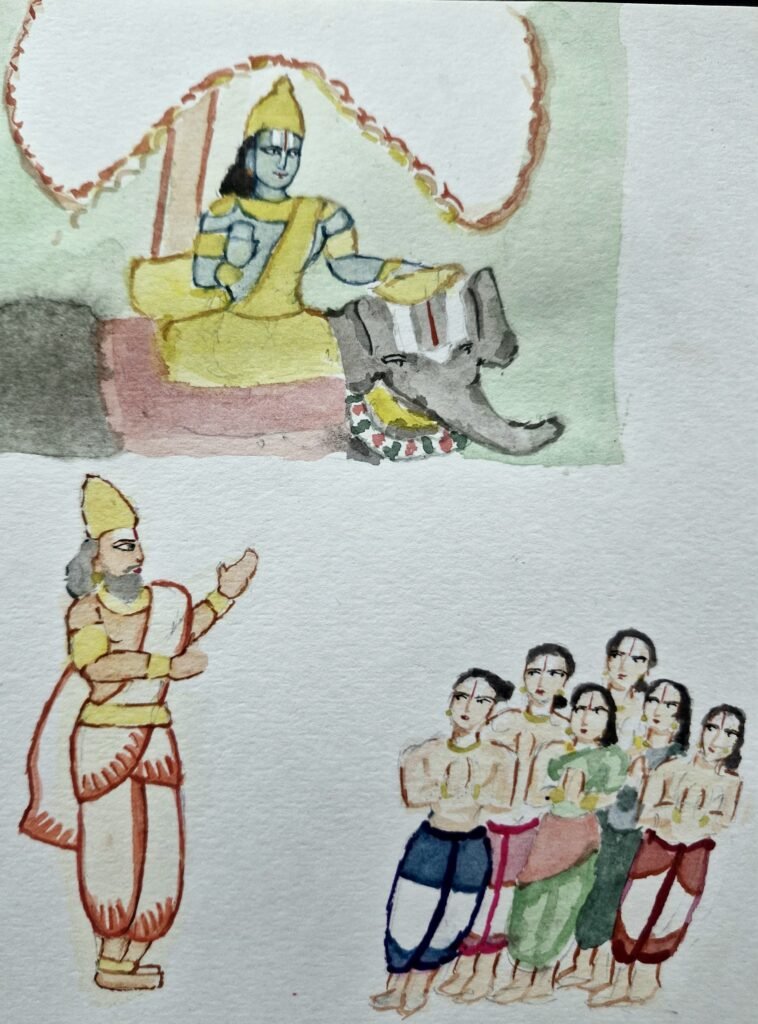
While SrI rAma, sIthAp pirAtti and lakshmaNAzhwAn are in ayOdhyA, bharathAzhwAn visits his maternal uncle’s house accompanied by SathrughnAzhwAn. This was explained in ayOdhyA kANdam SlOkam 1.1 – “gachchathA”. periyavAchchAn piLLai highlights many values which are upheld in our sampradhAyam, in the vyAkhyAnam for this SlOkam, such as the following.
- SathrughnAzhwAn’s pArathanthryam to bharathAzhwAn.
- The distinction of bhAgavatha kainkaryam over bhagavath kainkaryam.
- emperumAn’s thiruvuLLam (divine heart) – bhagavAn’s wish for his devotees to serve his servitors.
- The importance of bhAgavatha kainkaryam in receiving bhagavAn’s grace.
Following that, king dhaSartha communicates his intention to crown Sri rAma and the people of ayOdhyA express their desire and utter the following SlOkam.
ichchAmO hi mahAbAhum raghuvIram mahAbalam l
gajEna mahathAyAntham rAmam chathrAvruthAnanam ll
avathArikai and vyAkhyAnam for “ichchAmO hi” were discussed in the previous article. We shall now continue to look at the vyAkhyAnam for the remaining SlOkam.
Notes from periyavAchchAn piLLai’s vyAkhyAnam
King dhaSaratha after hearing affirmative responses from the people, informs them of his willingness to crown SrI rAma. But he poses a question to them, seeking their opinion about SrI rAma’s competence to rule the kingdom.
So the people reply as follows.
mahAbAhum (one with long arms)
- “SrI rAma, he is ‘mahAbAhum’. When compared to the broad shoulders of SrI rAma, even the proportion of this earth’s terrain seems tiny. He rules all the three worlds. Therefore, it is needless to say that he is competent to rule this kingdom”.
- SrI rAmAyaNam ayOdhyA kANdam 2-45 “SakthasthrailOkyamapyEsha bhOkthum kinnu mahImimAm” (It is immaterial to say that he has the ability to rule this land).
- Here, periyavAchchAn piLLai adds, “His shoulders are not only capable of taking over kOsala dhESam (kingdom) but also capable of controlling the reigns of lankA”.
mahAbAhum (one with long arms)
- They continue, “Even by sAmudhrikA lakshaNam one can understand that SrI rAma is an ideal man, hence there is no need to enquire from others”. (sAmudhrikA lakshaNam is a system that was in practice in ancient India to describe the bodily features of man and woman. As per sAmudhrikA lakshaNam, an ideal man’s arm extends from his shoulders all the way up to his knee. These can be referred through the following pramANams).
- SrI rAmAyaNam kishkindhA kANdam 3-14 “AyathAScha” (long arms).
- SrI rAmAyaNam ayOdhyA kANdam 17-7 “AjAnubAhUm” (arms that are extended up to the knee).
- nAchchiyAr thirumozhi 11.3 “pongOdham sUzhndha buvaniyum viNNulagum angAdhum sOrAmE ALginRa” (emperumAn is capable of ruling effortlessly both – this world that is surrounded by ocean with turbulent waves and parama padham).
- SrI rAmAyaNam sundhara kANdam 34-31 “bAhuchchAyAmavashtabdha:” (on whose shoulders’ shadow the entire world rests)
- They further add, “His shoulders support both nithya vibhUthi and leelA vibhUthi; therefore, to protect us, just the shadow of those shoulders will be sufficient”.
raghuvIram
- King dhaSaratha, after hearing their words, added “Bravery alone will not be enough to protect the people, one should also be righteous. Will SrI rAma protect you just by his chivalry, will he not protect by his righteousness?”.
- In response, the people say, “SrI rAma is both chivalrous and righteous”.
- SrI rAmAyaNam kishkindhA kANdam 1-128 “rarakshadharmENa balEna chaiva” (He protected with his valour and righteousness).
- SrI rAmAyaNam yudhdha kANdam 1-12 “dharmatha: parirakshithA:” (They were well protected just by his righteousness).
raghuvIram
- The people continue, “He is a descendant of raghu. He is righteous just by being born in such a lineage”.
- SrI rAmAyaNam ayOdhyA kANdam 12-29 “dhInAn dhAnEna rAghava:” (rAghava conquers poor people through charity).
raghuvIram
- SrI rAma not only possesses virtues such as compassion and mercy, but has also preached it to many; and in due course those teachings were echoed to him. This can be seen from the conversation between sIthAp pirAtti and SrI rAma in the forest, when sIthAp pirAtti reminds SrI rAma about his promise to protect the rishis. These words were told by sIthAp pirAtti to SrI rAma “AnruSamsyam parO dharmasthvaththa Eva mayA Srutha:” (Showing mercy/ compassion- is the highest virtue, this was heard by me from you) . This can be interpreted in two ways,
- SrI rAma has preached such high virtue for others to follow or
- SrI rAma has preached such high virtue so that it can be preached by those who heard it to others.
raghuvIram
- SrI rAma has an eminent place for himself within the raghu dynasty in upholding moral values. raghu was a prominent king in sUrya vamSam, even the dynasty (raghu kulam) was named after him. SrI rAma’s distinguished position in raghu dynasty surpasses even that of raghu’s prominence. This can be understood from an incident that happened during King raghu’s reign. King raghu was not only notable but also very righteous. During his reign, a famished rAkshasa once questioned him as king. The rAkshasa said, “I am a subject in your kingdom who is suffering because of starvation, won’t that sin of letting your subject suffer in hunger befall you?” King raghu, in spite of being well known for his fairness, benevolence and compassion did not provide a response to that rAkshasa.
- But unlike king raghu, who remained actionless to the rAkshsa’s appeal, SrI rAma did not waver in his vow to protect the rishis. He was committed and determined to fulfil his promise even at the cost of forsaking sIthAp pirAtti and lakskmaNAzhwAn (who were dearer to him than his prANan).
- SrI rAmAyaNam AraNya kANdam 10-19 “apyaham jIvitham jahyAm thvAm vA sIthE salakshmaNAm” (In order to fulfil my promise to the rishis, I will even sacrifice my life. I do not mind sacrificing you too, or forgo lakshmaNa).
- SrI rAmAyaNam AraNya kANdam 10-22 “prANEbhyOpi garIyasI” (sIthAp pirAtti is dearer to me than my prANan).
mahAbalam
- People of ayOdhyA continue to talk about SrI rAma, “He is steadfast in his commitment; he will not step back in his endeavour even if someone were to stop him by force”.
- SrI rAmAyaNam ayOdhyA kANdam 21-12 “vadhyathAm badhyathAm” (to be killed, to be restrained/ fastened)
- “Even by forsaking the people who are always by his side, SrI rAma will protect those who surrender and come to him for refuge. Even if all his people oppose his actions, he will not retract from his commitments”.
- SrI rAmAyaNam AraNya kANdam 10-19 “na thu prathigyAm samSruthya brAhmaNEbhyO viSEshatha:” (I will not withdraw from the promise, especially made to the brAhmaNas).
- SrI rAmAyaNam yudhdha kANdam 18-34 “Ethadh vratham mama” (this is my vow / pledge).
- SrI rAmAyaNam yudhdha kANdam 18-3 “na thyajEyam kathanchana” (I will not abandon anyone who has surrendered to me).
mahAbalam – will-power and fortitude
- Here, periyavAchchAn piLLai explains ‘mahAbalam’ as mental determination / tenacity.
- The people of ayodhyA continue to talk about SrI rAma’s perseverance. They say, “SrI rAma is always firm in his execution, he does not deter from his path of accomplishment for any reason”.
- muNdaka upanishath 3-2-4 “nAyamAthmA balahInEna labhya:” (This paramAthma cannot be attained by one who does not have the mental strength/fortitude or one who does not have the mental strength/fortitude does not deserve to attain this paramAthma).
- SrI rAmAyaNam bAla kANdam 1-17 “dhairyENa himavAniva” (He is firm and strong in his fortitude like himAlaya mountain).
King dhaSaratha then responded, “If you think he is capable of shouldering the responsibilities, I will do as per your wishes. But, why do you want him on the elephant? Is it not enough if he sits on the throne where I am seated right now and takes care of the responsibilities as a king”.
gajEna mahathAyAntham
- The people replied, “Just being seated in your throne will not suffice for us, we want to see him wearing his crown and riding on Sathrunjayan – the royal elephant that is adorned with garland. Being seated in the throne and executing royal obligations might provide relief to you as a king, but we will feel happy only if we see him coming in procession on an elephant”.
- King dhaSaratha asked again, “Is it not enough if he comes in a decorated chariot? Why do you want him to come on an elephant?”.
- SrI rAmAyaNam ayOdhyA kANdam 3-28 “maththamAthanga gAminam” (his walk is majestic as that of a fierce elephant).
- The people replied, “For the one with a majestic walk, it is more fitting for SrI rAma to come on an elephant”.
- King dhaSaratha asked again, “Will you not be satisfied if SrI rAma was just seated on any ordinary elephant, does it have to be the royal elephant?”.
gajEna mahathA
- mahathA – exceptional attributes/ characteristics
- The people answered, “perumAL is supreme and omnipotent; therefore, the elephant that he rides should also complement his supremacy. Since the royal elephants are trained and have majestic and formidable appearance, it would be more fitting for SrI rAma to come on a royal elephant”.
- King dhaSaratha says, “I will do as per your wishes and make him seated on the royal elephant”.
yAntham
- But the people say, “(yAntham) That is not enough, we want to see him parade through the streets on the royal elephant. If he does not come on a procession, only the people gathered in and around the royal palace/assembly will be able to see him. Therefore, he should come through the streets so that everyone will be able to experience the moment and enjoy”.
- raghuvamSam 4-3 “nanandhussaprajA: prajA:” (All the people along with their children should also experience this happiness).
yAntham AyAntham – moving back and forth
- The people respond again, “As he moves to and fro, we want to be blessed with the vision of his benevolent divine face with a divine smile and divine kasthUri thirunAmam (tilak) on his forehead”.
- King dhaSaratha wanted to know without a doubt. So to be absolutely clear he asks them again, “Who do you all aspire to see like this?”.
rAmam
- The people assured, “ramayathIthi rAma:” (one who makes everyone happy, brings joy to everyone.) “We want to see SrI rAma, the one who brings enthusiasm and joy to everyone because of his auspicious qualities”.
rAmam
- SrI rAma’s presence brings pleasure and exuberance to everyone around him.
- “ramu-krIdAyAm” (the root, ramu means one who is sportive, filled with fun and joy).
chathrAvruthAnanam (under the royal white umbrella)
- The people persisted and said that they wanted to see SrI rAma just the same way – on a par/ in equivalent position as other kings in the lineage.
- SrI rAmAyaNam ayOdhyA kANdam 2-7 “pANdarasyAthapathrasya chAyAyAm jaritham mayA” (I grew old under the shade of the big white royal umbrella).
The people of ayOdhyA said, “We want to see SrI rAma, his divine face being protected from the sun under the royal umbrella, the royal umbrella that all the kings in the lineage have coveted”.
AzhwAr emperumAnAr jIyar thiruvadigaLE SaraNam
periyavAchchAn piLLai thiruvadigaLE SaraNam
vyAkhyAnam for the next SlOkam will be continued in the next article.
Source – SrI rAmAyaNa thani SlOkam – 12 – ayOdhyA kANdam – 2.22 – ichchAmO – Part 2 Audio Video
adiyEn chithrA rAmAnuja dhAsi
Proofreading/Curating done by – kOsalEndhra rAmAnuja dhAsan, krishNan rAmAnuja dhAsan
Artwork – namperumAL rAmAnuja dhAsan
Related Links
SrI rAmAyaNa thani SlOkam – 11 – ayOdhyA kANdam – 2.22 – ichchAmO – Part 1 Audio Video
SrI rAmAyaNa thani SlOkam – 10 – ayOdhyA kANdam 1.1 – gachchathA Audio Video
SrI rAmAyaNa thani SlOkam’ – 9 – bAla kANdam 17.26 – iyam sIthA Audio Video
SrI rAmAyaNa thani SlOkam’ – 8 – bAla kANdam 6.8 – dhrashtum Sakyam, 23.2 – kausalyA suprajA rAma Audio Video
SrI rAmAyaNa thani SlOkam – concise english meanings
archived in https://granthams.koyil.org
pramEyam (goal) – https://koyil.org
pramANam (scriptures) – https://granthams.koyil.org
pramAthA (preceptors) – http://acharyas.koyil.org
SrIvaishNava education/kids portal – http://pillai.koyil.org