SrI: SrImathE SatakOpAya nama: SrImathE rAmAnujAya nama: SrImath varavaramunayE nama:
In this series, we are enjoying the vyAkhyAnam mercifully given to us by periyavAchchAn piLLai along with the support of commentaries provided by puththUr swAmy.
perumAL, in search of pirAtti, comes towards the region where sugrIva mahArAja is stationed. It is perumAL’s desire that sugrIva mahArAja help him in his search for sIthAp pirAtti. vAli had taken away sugrIva mahArAja’s kingdom and his wife. He, left alone in distress after being chased away by vAli, is living in isolation in rushyamUka parvatham (mountain) along with only four other vAnaras.
At this juncture, perumAL and iLaiya perumAL come there in search of sugrIva mahArAja. From a distance, sugrIva mahArAja notices both of them and suspects them to be associates of vAli. He calls his minister – thiruvadi (hanumAn) and asks him to find out about their details.
thiruvadi disguises as a brAhmaNa and approaches them. Instantly, on seeing perumAL, thiruvadi feels a bliss in his heart. He then recollects the words spoken by brahmA to him. (brahmA had once told him that he would experience a supreme bliss when he sees the supreme lord.) Realising that he has seen the supreme lord, thiruvadi immediately reveals his true identity in front of perumAL. He then makes his introduction and takes perumAL and iLaiya perumAL to sugrIva mahArAja.
sugrIva mahArAja is happy to meet them and they make a friendship bond with fire as witness and promise to help each other. sugrIva mahArAja thought of vAli to be extremely strong and brave. He also knew about vAli’s boon, a boon that gave vAli the ability to absorb half the strength of his opponent. Hence, sugrIva mahArAja was not convinced about perumAL’s ability to defeat vAli. To eliminate this doubt in sugrIva mahArAja’s mind, perumAL, kicks away a huge skeleton of a rAkshasa – dhundhubhi, with a slight nudge of his divine feet. Realising that sugrIva mahArAja was still not convinced, he then, with a single arrow uproots seven sAla [ebony] trees. The arrow not only penetrates the trees but it also penetrates through the pAthAla lOkam (subterranean planes beneath earth) and returns to his quiver. sugrIva mahArAja upon seeing this, is awestruck and submits himself to SrI rAma.
perumAL then tells sugrIva mahArAja to challenge vAli; he also promises to protect sugrIva mahArAja. vAli is surprised about sugrIva mahArAja’s challenge but agrees to fight him. vAli strikes sugrIva mahArAja severely. perumAL not being able to differentiate between sugrIva mahArAja and vAli, does not attack vAli. Unable to bear the assault, sugrIva mahArAja retreats from the fight and expresses his displeasure to SrI rAma for not helping him. perumAL sends sugrIva mahArAja to fight again and this time he makes him wear a garland, so that he could be identified correctly. At that time, perumAL attacks vAli from behind with an arrow and kills him.
At this juncture, vAli poses many questions to SrI rAma. vAli’s wife thArA, upon hearing about her husband’s condition, arrives there in anger. But once she beholds perumAL, her anger subsides and she utters the following SlOkam.
thvamapramEyaScha dhurAsadhaScha jithEndhriyaSchOththama dhArmikaScha l akshyyakIrthiScha vichakshaNaScha kshithikshamAvAn kshathajOpamAksha II
avathArikai (Introduction)
- SrI rAmAyaNam kishkindhA kANdam 17-1 “thatha: SarENAbhihathO rAmENa raNakarkaSa: I papAtha sahasA vAlee nikruththa iva pAdhapa: II” (Subsequently, vAli, a capable warrior, fell down like a chopped tree when SrI rAma’s arrow hit him).
perumAL did not have any desire in his divine heart to hit vAli. But due to the wicked nature of vAli, the arrow from perumAL’s divine hands pierces through his body. vAli falls down, but is furious and begins to talk to SrI rAma angrily.
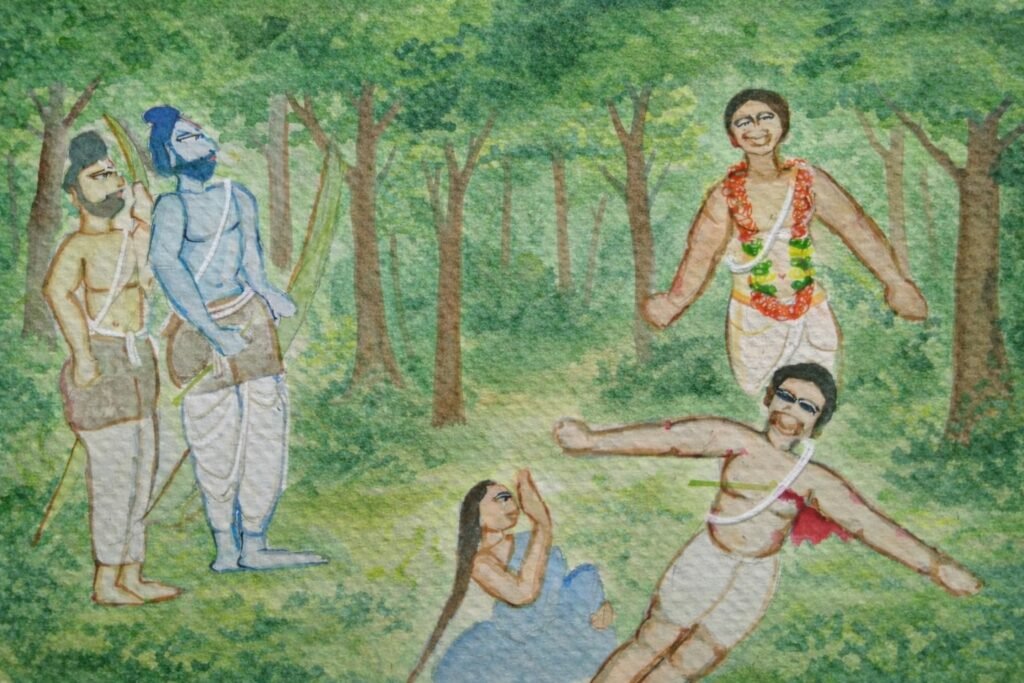
- SrI rAmAyaNam kishkindhA kANdam 17-21 “jAnE pApasamAchAram thruNai: kUpamivAvrutham I sathAm vEshadharam pApam prachchannamiva pAvakam II” (I see you as – a fire that is covered by ashes, a well that is concealed by grass, one who is disguised as a virtuous person but engaged in sinful acts).
vAli asks perumAL in a rage, “Why are you dressed in the most sacred tree bark? You look like a sage but hide like a sinner – like a well concealed by grass that swallows those who tread upon it, like a fire masked by ashes that burns those who come near it?”.
He fumes with many questions, “What dispute do we have between us? We have no dispute over any piece of land, small or large. I have not crossed any borders, nor have I caused any disputes. I have no dispute regarding your residence. There is neither short-term hostility nor long-standing enmity between us. There is no family feud between us. There is no clash between us, just as between two clans. I have neither kept any of your cows under my custody nor have I stolen your cows. There is neither any regional dispute nor a dispute over water between us. I have not stolen any of your property. I have not abducted your women”.
- SrI rAmAyaNam kishkindhA kANdam 17-22 “vishayE vA purE vA thE yadhA nApakarOmyaham” (I have not done any thing wrong – neither in your kingdom nor in any of your cities).
vAli continues to rant, “Why did you kill me? I don’t even know who you are. How can you enter the land occupied by us, who have not committed any sins? ”
- SrI rAmAyaNam kishkindhA kANdam 17-23 “na cha thvam prathijAnE’ ham kasmAnmAm hamsyakilbisham” (I don’t even know you, how can you kill one who has not done anything wrong?).
He continues scornfully, “Why did you kill me? The battle was not between you and me; and I was in a duel with someone else. Who will do this kind of an act, disguised as a virtuous person?”.
- SrI rAmAyaNam kishkindhA kANdam 17-24 & 25 “mAmihAprathiyudhyantham anyEna cha samAgatham…….dharmalingaprathichchanna: krUram karma samAcharEth II” (On one who is not engaged with you in a fight and who is engaged in a fight with another person, who can do such a cruel act masked as a righteous person?).
vAli continues his grievances, “We are all forest dwellers; you are all city dwellers; we are all animals; you are all humans; we eat fruits and vegetables; you eat red rice; we are citizens; you are all kings”.
- SrI rAmAyaNam kishkindhA kANdam 17-28 “vayam vanacharA rAma mrugA mUlapalASanA: I EshA prakruthirasmAkam purushasvam narESvara:” (SrI rAma! We live in the forest; we are animals; we eat roots and fruits; (it is our nature to fight each other); but you are human; that too, a king).
vAli continues his questions to perumAL, “Did you come here to hunt? Unlike the skins of deer and tiger, the skins of our kind (monkey) are not preferred by those who perform sacrifices. It is also not useful as a body cover. Our hair and bones are not useful like elephant tusks and tiger nails, they are not useful for decorative or ornamental purposes. Unlike the meat of porcupine, deer, lizard (reptile), rabbit and tortoise which are enjoyed for consumption, our meat is forbidden”.
- SrI rAmAyaNam kishkindhA kANdam 17-37 & 38 “adhArya charma mE sadhbhI rOmANyasthi vivarjitham I abhakshyANi cha mAmsAni thvadhvidhairdharmachAribhi: II” (Virtuous people do not prefer to use our skin; usage of our hair, bones are prohibited; ascetic like you are forbidden from eating our meat; like deer skin our skin is not useful for the ones performing sacrifices, it is also not useful like the tiger skin, our hair is not useful for making fans, our nails and bones are not useful like the elephant tusks and tiger nails; unlike the meat of porcupine, deer, lizard (reptile), rabbit and tortoise, our meat is forbidden).
vAli further adds, listing numerous faults and speaking harsh words, “For committing sinful acts such as killing a king like me, people like you will attain hell”.
- SrI rAmAyaNam kishkindhA kANdam 17-35 “rAjahA brahmahA gOgna: chOra: prANivadhE ratha: I nAsthika: parivEththA cha sarvE nirayagAmina: II” (One who kills a king; one who kills a brAhmaNa; a thief; one who engages in animal cruelty; one who does not believe in the existence of god; one who marries while his elder brother remains unmarried – all these people will attain hell).
After hearing the words spoken (without analysing) by vAli, perumAL begins to talk. He says, “You know neither the principles mentioned in the vEdham nor the general rules of the world. Without such understanding, you are finding fault with me for adhering to ethical conduct”.
- SrI rAmAyaNam kishkindhA kANdam 18-4 “adhikshipthasthadhA rAma: paSchAdhvAlinam avraveeth I dharmamarthancha kAmancha samayanchApi laukikam I avigyAya katham bAlyAnmAmihAdhya vigarhasE II” (SrI rAma, who was condemned by vAli, began to say the following – with your childish mentality, without knowing neither about the highest goals such as virtue, wealth and pleasure as said in the vEdham nor about the laws of the land, why are you insulting me?).
perumAL begins to answer all of his questions, saying, “I have not wronged you”.
- SrI rAmAyaNam kishkindhA kANdam 18-6 “ikshvAkUNAmiyam bhUmi: saSailavanakAnanA” (This entire earth including the mountains, small forest areas and large forest lands are under the control of ikshvAku dynasty).
perumAL continues, “You said that we do not have any dispute with regard to any small or large area of land. This whole world with the mountains, small and large forest areas, belongs to us. Hence, this area that is occupied by you is also our land. Therefore, how can you say that there are no disputes between us regarding boundaries and residential areas?”.
- “bhUmi: kshEthram kaLathrancha” (The word ‘bhUmi is used to refer to both land and wife).
perumAL says, “We now share our joy and sorrow with sugrIva as we both have become friends”.
- SrI rAmAyaNam kishkindhA kANdam 5-18 “thvam vayasyaScha hrudhyO mE hyEkam dhu:kham sukhancha nau” (You are my friend; a dear one, we share our happiness and sadness).
perumAL continues, “It is not just a territorial dispute, you snatched away sugrIva’s kingdom and separated him from all his friends and relatives except a few like hanumAn, and left him with only four companions”.
- SrI rAmAyaNam kishkindhA kANdam 10-27 “thEnAham prathishidhdhaScha hrutharAjyaScha” (My kingdom was taken away from me and I was chased away from it).
perumAL says, “You claimed that there was neither short-term hostility nor long-standing enmity between us. However, you showed hostility to sugrIva; even though he fell at your feet, you did not accept him; not only that, you chased him away with just a single piece of cloth. Therefore, hostility does exist between us”.
- SrI rAmAyaNam kishkindhA kANdam 9-23 “yathAvachchAbhyavAdhayam I ukthAScha nASishasthEna II” (I submitted to vAli in good faith, in spite of that, he did not wish well for me).
- SrI rAmAyaNam kishkindhA kANdam 10-26 “vasthrENaukEna vAnara: I thadhA vidhrAvayAmAsa vAlee” (vAli chased me away with only a single piece of cloth).
perumAL explains further, “You also said that there are no family feuds; but since you showed hatred to your brother, there is also a family dispute between us”.
- SrI rAmAyaNam kishkindhA kANdam 10-15 “ayam bhrAthA sudhAruNa:” (My cruel brother).
perumAL continues, “You said that we do not have any any regional disputes, disputes regarding the custody of cows, or disputes over water between us. However, you have taken control of the cattle that sugrIva used for cultivating, herding, and conducting his business. You have also seized the regions, including the water bodies, that rightfully belong to sugrIva. This act of yours creates a dispute between us”.
perumAL says, “You said there are no disputes between us in matters regarding women and land. But you have taken your brother’s wife and the land that belongs to him. This creates a dispute between us”.
- SrI rAmAyaNam kishkindhA kANdam 18-18 “bhrAthurvarthasi bhAryAyAm” (You have taken possession of your brother’s wife).
perumAL continues, “You also claimed that you do not know me and that I attacked you coming to your place without any reason, despite your innocence. We are representatives of king bharathan; to make sure there is justice and righteousness, we destroy those who do evil. Because you have violated many laws, we have come here to punish you”.
- SrI rAmAyaNam kishkindhA kANdam 18-7 & 9 “thAm pAlayathi dharmAthmA bharatha: sathyavAgruju: I thasya dharmakruthAdhESAdhvayamanyE cha pArthivA: I charAmO vasudhAm kruthsnAm II” (bharathan, an embodiment of virtue, who is truthful and righteous is protecting this land. All the kings under his rule and I are going around to uphold his righteous orders).
- SrI rAmAyaNam kishkindhA kANdam 18-24 “thvAncha dharmAdhathikrAntham katham SakyamupEkshithum” (Your actions are unrighteous, so how can I abstain from punishing you?).
perumAL adds, “You said that I attacked you even though you were not engaged in a combat with me, but were fighting someone else. A king, while hunting, can kill animals even when they are running away from him; there is nothing wrong with such an act. Aren’t you a monkey? Why are you talking like a king?”.
- SrI rAmAyaNam kishkindhA kANdam 18-40 & 42 “vadhyanthi vimukhAmSchapi na cha dhOkshO’thra vidhyathE I ayudhyan prathiyudhyan vA yasmAchchAkhAmrugO hyAsi II” (Why did you attack and kill me when I did not come to fight you, and while I was already engaged in a fight with another? Kings kill animals even when they are fleeing; there is nothing wrong with that act. Since you are an animal – a monkey with the nature of swinging from one tree to another – you were killed by me while you were engaged in a fight with another, even though you were not confronting me).
perumAL says to vAli, “All these words you have spoken are unsuitable. You claimed: ‘We are forest dwellers; you are a city dweller. We are animals; you are human. We eat fruits and vegetables; you eat red rice. We are citizens; you are a king.’ These are not appropriate for you to speak”.
- SrI rAmAyaNam kishkindhA kANdam 18-25 “bharatha: kAmavruththAnAm nigrahE paryavasthitha:” (bharathan is determined to punish the people who act on their own will (i.e without following the SAsthram)).
- SrI rAmAyaNam kishkindhA kANdam 18-6 “mrugapakshimanushyANAm nigrahapragrahAvapi” (bharathan is knowledgeable about the ways in which animals, birds, and humans need to be punished or rewarded).
perumAL says to vAli, “Animals like you may wander wherever you wish. You may belong to any classification of animals. You may eat whatever you desire. However, even if you act in subordination by accepting the authority of kingship, it remains the duty of a king to punish wrongdoers.”
perumAL continues, “You deprecated my act as pointless since your hair, bones, and meat did not have any purpose or function. Kings can hunt animals even when they are not interested in their hair, bones, or meat. Kings have authority to kill animals for the sake of protecting the people of their country from the dangers of animals; to hunt them by spreading a net, setting up traps, by luring them into a trap by using a bait, by digging a pit to catch them, or by ambushing them”.
- SrI rAmAyaNam kishkindhA kANdam 18-39 “vAgurAbhiScha pASaiScha kUtaiScha vividhairnarA: I prathichchannAScha dhruSyAScha nighnanthi sma bahUn mrugAn II’ (The kings hunt animals using various techniques such as nets, ropes, attacking from a hideout or confronting them face-to-face).
perumAL continues to talk to vAli, “Your statement that those who kill kings will go to hell is not relevant. You are a monkey. You are being punished because you forcefully took your brother’s wife”.
- SrI rAmAyaNam kishkindhA kANdam 18-23 “aurasIm bhaginIm vApi bhAryAnchApyanujasya ya: I pracharEdh vAnara: kAmAth thasya dhaNdO vadha: smrutha:” (Killing a monkey that keeps his daughter, sister, or brother’s wife for its own pleasure is considered an appropriate punishment).
perumAL thus explains through his beautiful words to vAli, and says, “If I do not punish you, the sin of that unrighteous act will fall upon me”.
- SrI rAmAyaNam kishkindhA kANdam 18-33 “rAjA thvaSAsnAth pApam thadhavApnOthi kilbisham” (If a king fails to punish his subjects for their sins, he inherits the consequences of those sins).
Upon hearing perumAL’s merciful words, vAli accepted everything that perumAL said and became subdued.
- SrI rAmAyaNam kishkindhA kANdam 18-47 “prathyuvAcha thathO vAkyam prAnjalii: vAnarESvara: I yaththvamAththa naraSrEshta thadhEthannAthra samSaya: II” (vAli, the leader of monkeys, replied by saying the following – Oh the leader of all humans! Everything you said is true; there is not a doubt in my mind).
vAli grew calm, conquered by perumAL’s mighty arms, and his truthful, sweet words.
- thiruchchandha viruththam 56 “senRu konRu venRi koNda” (One who became victorious, who went to his dwelling place and destroyed him).
As perumAL stood there, thArA, grieved and enraged by the death of her husband, approached him with the intent to berate perumAL. But perumAL’s presence exalted her sathva guNam, and she became peaceful. Looking at perumAL and realising his greatness, thArA, who had come with the intention to rebuke perumAL’s act, began to praise him.
- SrI rAmAyaNam kishkindhA kANdam 24-30 “sA tham samAsAdhya viSudhdhasathvA” (thArA’s heart became purified upon seeing SrI rAma).
- SrI bhagavath gIthA 14-17 “sathvAthsanjAyathE gyAnam” (Knowledge is born only by sathva guNam)
- muNdaka upanishadh 2-2-9 “thasmin dhrushtE parAvarE-bhidhyathE hrudhayagranthi: chidhyanthE sarvasamSayA: I kshIyanthE chAsya karmANi II” (When the supreme lord is seen, the knots (likes and dislikes) in one’s mind are unravelled, his doubts are shattered; and the effects of his past actions (karma) are destroyed).
Hence, thArA, who arrived in a state of great anger, became pacified upon experiencing the presence of perumAL.
Word-by-Word meaning
kshathajOpamAksha – oh, SrI rAma pirAnE, with eyes as red as blood!
thvam – you (dhEvarIr)
apramEya: cha – one who is immeasurable, also
dhurAsadha: cha – one who is difficult to be approached, also
jithEndhriya: cha – one who has conquered the senses, also
uththama dhArmika: cha – one who is most virtuous, also
akshyyakIrthi: cha – one who has imperishable glory, also
vichakshaNa: cha – one who is very wise, also
kshithikshamAvAn – one who is forgiving like the earth
vyAkhyAnam for this SlOkam will be continued in the next article.
AzhwAr emperumAnAr jIyar thiruvadigaLE SaraNam
periyavAchchAn piLLai thiruvadigaLE SaraNam
Source – SrI rAmAyaNa thani SlOkam – 33 – kishkindhA kANdam 24.31 – thvam apramEyaScha – Part 1 Audio Video
adiyEn chithrA rAmAnuja dhAsi
Proofreading/Curating done by – krishNan rAmAnuja dhAsan
Artwork – namperumAL rAmAnuja dhAsan
Related Links
SrI rAmAyaNa thani SlOkam – 32 – AraNya kANdam 63.12 – asmin mayA, kishkindhA kANdam 1.71 – padhmakEsara, 1.115 – padhma saugandhika vaham Audio Video
SrI rAmAyaNa thani SlOkam – 31 – AraNya kANdam 30.39 – tham dhrushtvA – Part 2 Audio Video
SrI rAmAyaNa thani SlOkam – 30 – AraNya kANdam 19.14 – tharuNau – Part 6, 30.39 – tham dhrushtvA – Part 1 Audio Video
SrI rAmAyaNa thani SlOkam – 29 – AraNya kANdam 19.14 – tharuNau – Part 5 Audio Video
SrI rAmAyaNa thani SlOkam – 28 – AraNya kANdam 19.14 – tharuNau – Part 4 Audio Video
SrI rAmAyaNa thani SlOkam – concise english meanings
archived in https://granthams.koyil.org
pramEyam (goal) – https://koyil.org
pramANam (scriptures) – https://granthams.koyil.org
pramAthA (preceptors) – http://acharyas.koyil.org
SrIvaishNava education/kids portal – http://pillai.koyil.org