SrI: SrImathE SatakOpAya nama: SrImathE rAmAnujAya nama: SrImath varavaramunayE nama:
In this series, we are continuing to enjoy periyavAchchAn piLLai’s commentaries (vyAkhyAnam) along with puththUr swAmy’s lucid explanations for SrI rAmAyaNa SlOkams. We are grateful to periyavAchchAn piLLai and puththUr swAmy for their mercy.
This article is a translation of SrI u vE sArathy thOthAthri swAmy’s thamizh kAlakshEpam of periyavAchchAn piLLai’s vyAkhyAnam. We are grateful to SrI sArathy swAmy for providing us with this opportunity.
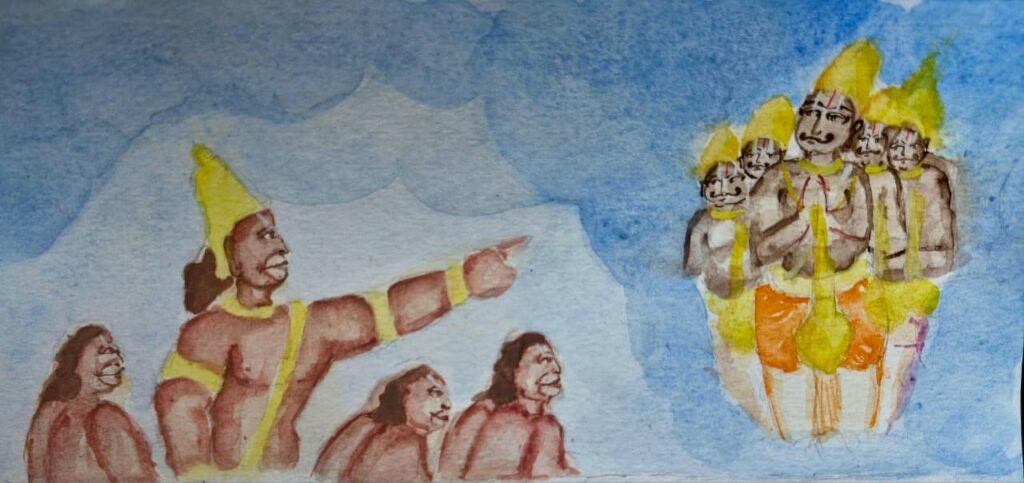
In the previous article, we saw that vibhIshaNAzhwAn arrived along with his four trusted companions at the shore where perumAL was present. Upon seeing vibhIshaNAzhwAn with his four companions, sugrIva mahArAja and the other monkeys were struck with fear.
Stalwarts like sugrIva mahArAja, jAmbhavAn, thiruvadi (hanuman), angadhan, nalan, and so many others, disregarded the strength of their own army. Beyond that, they even became forgetful of perumAL’s and iLaiya perumAL’s invincible strength. They trembled in fear due to their compassion for perumAL.
Due to this fear, sugrIva mahArAja consulted with the others expediently and determined that vibhIshaNAzhwAn along with his companions should be killed. The following SlOkam was uttered by sugrIva mahArAja at this juncture.
avathArikai (Introduction)
Having paused to ‘think for a brief moment’ (chinthayithvA muhUrthanthu), he conveyed his decision and the rationale behind it.
Esha sarvAyudhOpEthaS chathurbhissaha rAkshasai: I
rAkshasO’bhyEthi paSyadhvamasmAn hanthum na samSaya: II
Word-by-word meaning
sarvAyudhOpEtha – along with all the weapons
Esha: – this
rAkshasa: – vibhIshaNan, the demon
chathurbhi: rAkshasai: saha – along with four demons
asmAn – us
hanthum – to kill
abhyEthi – approaching us
na samSaya: – there is no doubt
paSyadhvam – (all of of you) see
Simple meaning
sugrIva mahArAja says, “All of you, look! This demon, accompanied by four demons and armed with all weapons, is approaching us. Surely, he has come to kill us.”.
Notes from periyavAchchAn piLLai’s vyAkhyAnam
Esha – this
sugrIva mahArAja says, “His maliciousness – the cruelty that is within him – is very obvious even on the outside”.
(Note from kAlakshEpam: Though vibhIshaNAzhwAn’s appearance is not actually such, it appears so to sugrIva mahArAja because he is a mangaLASAsanaparar).
sarvAyudhOpEtha – equipped with all the weapons
While there is cruelty in his heart, he is also seen with his companions and weapons – all the paraphernalia needed to facilitate his intentions.
- SrI rAmAyaNam yudhdha kANdam 16-16 “uthpapAtha gadhApANi:” (He soared into the sky with a mace in his hand).
- Even though the previous sargam mentions that vibhIshaNAzhwAn arrived only with a mace, why does sugrIva mahArAja claim he arrived ‘with all his weapons’ (sarvAyudhOpEtha)?
- One interpretation is that because sugrIva mahArAja misconstrued vibhIshaNAzhwAn, a well-wisher, to be an ill-wisher, his fear caused a single weapon to appear as many.
- Another interpretation is more subtle: just as the mark of an earring remains even after it is removed, the way the mace appeared well-fitted in his hands, showed his mastery and familiarity with all forms of weaponry.
- Ultimately, to win over perumAL, the greatest weapon is anjali mudhrA (the gesture of surrender). By bringing this powerful brahmAsthram of SaraNAgathi, vibhIshaNAzhwAn truly arrived ‘with all the weapons’, even if only a single mace was visible to the eye.
rAkshasa:
- vishNu purANam 6-7-7 “sarpajAthiriyam krUrA” (kAliyan says: The serpent class that I am born in, is very cruel).
sugrIva mahArAja’s concern – and the cruelty that he suspects – stem from vibhIshaNAzhwAn belonging to the rAkshasa clan. Just as a serpent is defined by its inherent nature, sugrIva mahArAja suspects vibhIshaNAzhwAn.
chathurbhissaha rAkshasai: – along with four demons
sugrIva mahArAja says, “He has arrived along with four other demons, with an intent to fight. A big army may prove to be an impediment – obstructing progress; a single person could be easily defeated by the monkey army. Therefore he has come along with a modest number: four demons”.
rAkshasai: – his associates were also rAkshasas
sugrIva mahArAja says, “He has intentions to fight; hence, he has brought those who belong to his clan, who are like-minded rAkshasas”.
abhyEthi – coming face-to-face
sugrIva mahArAja says, “With no intention to turn back, like a serpent entering its hole, he has arrived without regard for any of us. We must act quickly to stop him”.
paSyadhvam – Look! As you can see, it is evident.
sugrIva mahArAja says, “Do I have to say this explicitly? Is it not apparent to your eyes? You may observe this firsthand!”
asmAn hanthum – to kill all of us
sugrIva mahArAja says, “If he were to torture us, some might survive; but by intending to destroy our underlying support – perumAL – he seeks to destroy us all. Without that supreme person, we do not have any existence. Yet, so long as he exists, we can be regenerated even if everyone one of us is destroyed”.
(Note from kAlakshEpam: This happens later on in the battle. When the monkeys die, perumAL asks for their bodies to be preserved. Conversely, by rAvaNa’s orders, the rAkshasas’ dead bodies are destroyed to hide the casualties to others. When indhra provides boon to bring back the dead to life, the monkeys are restored.)
na samSaya: – without a doubt
sugrIva mahArAja says, “He is armed and has come with companions. He cannot be a messenger, as a messenger does not carry a weapon nor travel in a group. Therefore, there is no doubt that he has come to cause harm”. Thus, it is determined that vihIshaNAzhwAn is a threat.
Esha sarvAyudhOpEthaS chathurbhissaha rAkshasai: I
rAkshasO’bhyEthi paSyadhvamasmAn hanthum na samSaya: II
Thus concludes the vyAkhyAnam for this SlOkam.
SrI rAmAyaNa thani SlOkam – yudhdha kANdam 17.6 – sugrIvasya
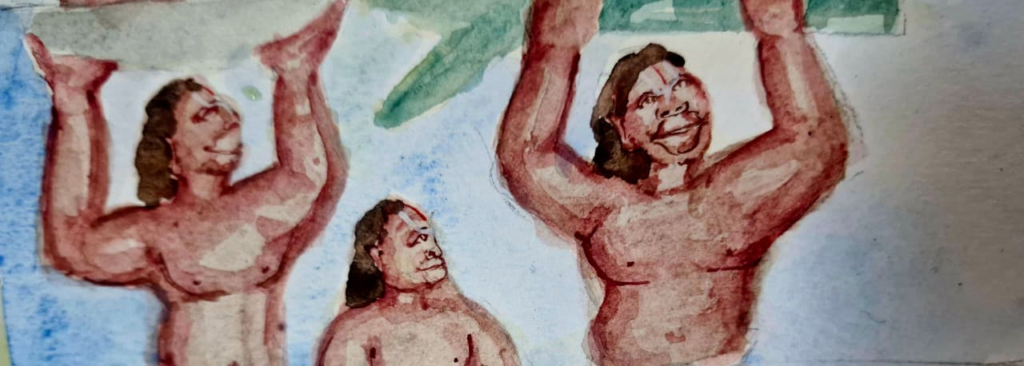
Hearing sugrIva mahArAja’s words, all the monkeys immediately seized mountains and trees, ready for assault, and spoke.
avathArikai (Introduction)
When sugrIva mahArAja uttered these words in fear – “asmAn hanthum na samSaya:” (there is no doubt that they have come to destroy us) – the monkey leaders took up trees and mountains to attack vibhIshaNAzhwAn and began to speak in order to eliminate his fear.
sugrIvasya vacha: SruthvA sarvE thE vAnarOththamA: I
sAlAnudhyamya SailAmScha idham vachanamabruvan II
Word-by-word meaning
sarvE thE vAnarOththamA: – all those great monkeys
sugrIvasya – sugrIva mahArAja’s
vacha: – words
SruthvA – having heard
sAlAn – trees
SailAn cha – and mountains
udhyamya – having lifted
idham vachanam – these words
abruvan – spoke
Simple meaning
Having heard sugrIva mahArAja’s words, all those foremost vAnaras lifted up trees and mountains and spoke these words.
Notes from periyavAchchAn piLLai’s vyAkhyAnam
sugrIvasya vacha: SruthvA
Upon hearing sugrIva mahArAja’s words, the monkeys’ felt that their resolve to kill vibhIshaNAzhwAn was sanctioned.
sarvE thE
There was no difference between the monkey leaders and the other monkeys in their zeal to kill vibhIshaNAzhwAn, along with his companions.
sarvE vAnarOththamA:
What is the intention behind using ‘thE’ (those)? Since no other word could adequately capture their zeal, the pronoun serves to highlight their specific, indescribable ardour. Because their enthusiasm and fervency were beyond description, the text specifies them as ‘sarvE thE vAnarOththamA:‘ (all those best of monkeys).
vAnarOththamA:
The compassion of these monkeys even surpasses sugrIva mahArAja’s compassion towards perumAL. One’s greatness or lowliness is not defined by being a leader or a subordinate; rather, the real reason for greatness is one’s bhakthi, devotion to perumAL.
(Note from kAlakshEpam: From a situation like this, we can understand our philosophy beautifully. For instance, in a gOshti, there are specific mannerisms or orderliness followed among the SrIvaishNavas present. In a group, someone standing in the front row should not take pride in being in such a position; his excellence arises from his bhagavath, bhAgavatha propensity. Similarly, a priest stands next to perumAL to offer flowers and thuLasi, while others may stand below worshiping. Their individual greatness is due to dispositions and is not connected to where they stand. In the same vein, all services performed to emperumAn are equally important and cannot be discriminated as high or low.)
sAlAnudhyamya SailAmScha
They grabbed whatever they could carry. Driven by intense desire: ‘I should kill them’, each one of them snatched up a tree and a mountain. Just as iLaiya perumAL who performed all services for perumAL while in the forest, held both the veNchAmaram [white coloured fly-flapper] and veNkudai [whie coloured regal umbrella] in kainkaryam [while back in ayOdhyA], the monkeys were eager to perform their own kainkaryam by destroying the enemy.
idham vachanam – these words
To maintain their loyalty to sugrIva mahArAja, they should have waited for his permission; despite that, because of their eagerness to kill the enemies, they did not wait for his consent; they began to speak.
abruvan – they spoke
The monkeys, being subordinate to sugrIva mahArAja, should have followed the protocol between a leader and his subordinates. As such, they should have spoken only after being given permission by sugrIva mahArAja. Ignoring such protocols, all the monkeys voiced their thoughts together, nudged by the enthusiasm of sugrIva mahArAja’s speech and their compassion for perumAL.
sugrIvasya vacha: SruthvA sarvE thE vAnarOththamA: I
sAlAnudhyamya SailAmScha idham vachanamabruvan II
Thus concludes the vyAkhyAnam for this SlOkam.
SrI rAmAyaNa thani SlOkam – 17.7 – SIgram vyAdhiSa
All the monkeys speak simultaneously, ‘“They do not look very powerful; quickly order us, we want to knock them down to the ground’.
avathArikai (Introduction)
The monkeys say: We are not going to capture and tie them just to bring shame to our enemy, rAvaNa nor are we going to attack him with arrows and set him free without killing him. sugrIva mahArAja! “Give us your permission to kill him right here”.
SIghram vyAdhiSa nO rAjan vadhAyaishAm dhurAthmanAm I
nipathanthu hathA yAvadhdharaNyAmalpathEjasa: II
Word-by-word meaning
rAjan – sugrIva mahArAja!
EshAm – these
dhurAthmanAm – the wicked ones
vadhAya – for killing
na: – us
SIghram – swiftly
vyAdhiSa – order
alpathEjasa: – ones with inferior strength
yAvadh cha – all those present
hathA – attacked (by us)
dharaNyAm – to the ground
nipathanthu – let them fall
Simple meaning
O sugrIva mahArAja! Quickly command us to kill these wicked, weak ones, so that, slain by us, they may fall to the ground.
Notes from periyavAchchAn piLLai’s vyAkhyAnam
SIghram vyAdhiSa
We are determined to kill them. If there is a delay in your command, it may appear as though we acted independently. This would contradict our nature as your subordinates. Please, give the order quickly so that our actions do not amount to insubordination.
na: – us
We are standing prepared, holding a tree and mountain in our hands to kill him.
Assuming, sugrIva mahArAja asks, “Why do you ask for my permission when you have already decided?”
rAjan – king
The monkeys say, “You are our king. We want to be commended for following the orders of the king. Hence, we need your approval”.
vadhAya
They continue, “Suppose we just tie them up without killing, being demons, they may create problems just by their presence. Therefore, we need your consent to kill them”.
EshAm dhurAthmanAm
Their wickedness is obvious in their appearance.
nipathanthu hathA yAvadh
The monkeys say, “Consider all five of them to be dead, only your order is pending”.
- amarakOSam 3-3-246 “yAvaththAvaScha sAkalyE” (This phrase is used to refer to something in its entirety). Therefore, consider all of them to be dead.
dharaNyAm
We will not let them escape aerially just by attacking them with arrows; we will ensure that they fall to the ground.
- SrI rAmAyaNam sundhara kANdam 37-55 “avyavasthau hi dhruSyEthE yudhdhE jaya parAjayau” (In a battle, victory and defeat are perceived as uncertain). sugrIva mahArAja asks, “How can victory or defeat in a battle be determined so easily, without a doubt?”
alpathEjasa:
Weak, without much strength
The monkeys say, “Compared to our strength, theirs is like a green leaf caught in an elephant’s mouth. They will be easily defeated”. This comparison highlights their total weakness.
SIghram vyAdhiSa nO rAjan vadhAyaishAm dhurAthmanAm I
nipathanthu hathA yAvadhdharaNyAmalpathEjasa: II
This concludes the vyAkhyAnam for this SlOkam.
AzhwAr emperumAnAr jIyar thiruvadigaLE SaraNam
periyavAchchAn piLLai thiruvadigaLE SaraNam
Source – SrI rAmAyaNa thani SlOkam – 53 – yudhdha kANdam 17.5 – Esha sarvAyyudhOpEtha:, 17.6 – sugrIvasya, 17.7 – SIgram vyAdhiSa Audio Video
adiyEn chithrA rAmAnuja dhAsi
Proofreading/Curating done by – kOsalEndhra rAmAnuja dhAsan, krishNan rAmAnuja dhAsan
Artwork – namperumAL rAmAnuja dhAsan
Related Links
SrI rAmAyaNa thani SlOkam – 52 – yudhdha kANdam – 16.1 – sunivishtam, 17.1 – ithyukthvA Audio Video
SrI rAmAyaNa thani SlOkam – 51 – yudhdha kANdam – 16.1 – sunivishtam, 17.1 – ithyukthvA Audio Video
SrI rAmAyaNa thani SlOkam – 50 – yudhdha kANdam – abhaya pradhAna sAram – pravESam (Introduction) Audio Video
SrI rAmAyaNa thani SlOkam – 49 – sundhara kANdam 51.38 – sathyam rAkshasa rAjEndhra Audio Video
SrI rAmAyaNa thani SlOkam – 48 – sundhara kANdam 38.33 – sa pithrA cha Audio Video
SrI rAmAyaNa thani SlOkam – 47 – 31.19 – sA thiryakUdhvancha, 34.23 – svapnEpi Audio Video
SrI rAmAyaNa thani SlOkam – concise english meanings
archived in https://granthams.koyil.org
pramEyam (goal) – https://koyil.org
pramANam (scriptures) – https://granthams.koyil.org
pramAthA (preceptors) – http://acharyas.koyil.org
SrIvaishNava education/kids portal – http://pillai.koyil.org