SrI: SrImathE SatakOpAya nama: SrImathE rAmAnujAya nama: SrImath varavaramunayE nama:
We are enjoying the profound, in-depth meanings of SlOkams in SrI rAmAyaNam with the help of commentaries (vyAkhyAnams) given by the merciful periyavAchchAn piLLai along with the vivid explanations published by puththUr swAmy.
periyavAchchAn piLLai has provided detailed commentaries for many SlOkams from sargam 17 in yudhdha kANdam, explaining perumAL bestowing protection (abhayapradhAnam) to vibhIshaNAzhwAn.
vibhIshaNAzhwAn, along with four of his trusted rAkshasas, departed from lankA via an aerial route and arrived at the shores where perumAL was stationed. The events, which transpired there at this juncture, are explained in detail in sargam 17 by vAlmeeki bhagavAn.
Let us now enjoy the second SlOkam in this sargam.
avathArikai (Introduction)
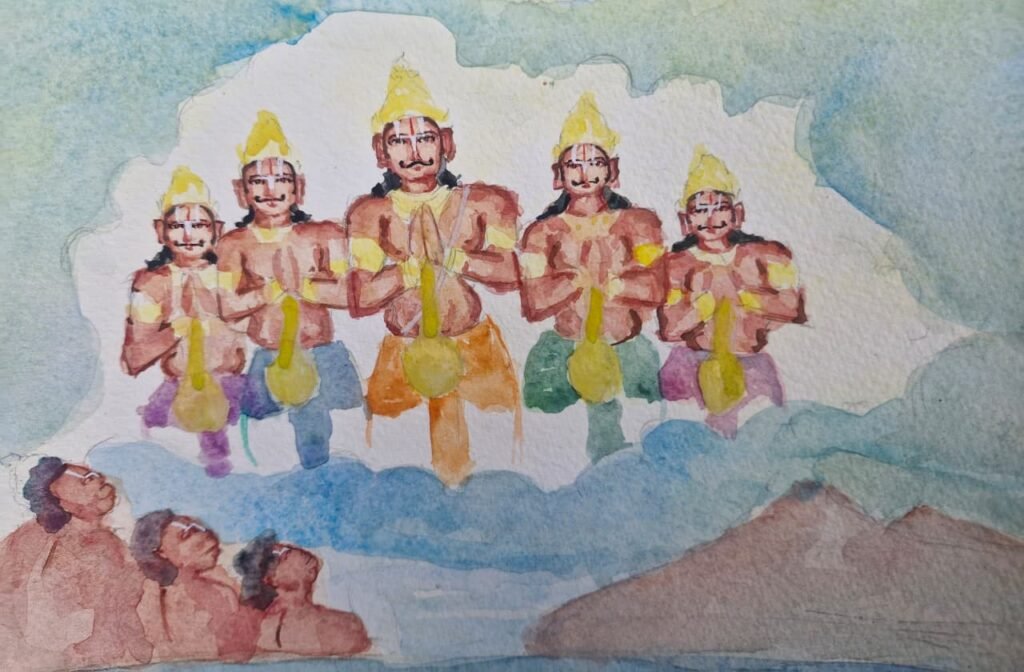
vAlmeeki bhagavAn says, the vAnara mudhaligaL [leaders in the army of monkeys] saw vibhishaNAzhwAn, who had left rAvaNa’s company, standing in the sky.
tham mEruSikharAkAram dhIpthAmiva SathahradhAm I
gaganastham mahIsthAs thE dhadhruSurvAnarAdhipA: II
Word-by-word meaning
mEruSikharAkAram – the one looking like the peak of mEru mountain ([a celestial mountain] looking radiant)
dhIpthAm – burning
SathahradhAm iva – like a lightning
gaganastham – standing in the sky
tham – that vibhIshaNAzhwAn
mahIsthA: – those who stood on the ground
thE vAnarAdhipA: – those monkey leaders
dhadhruSu: – saw
Simple meaning
The vAnara mudhaligaL saw vibhIshaNAzhwAn appearing in the sky, looking like the mEru mountain peak.
Notes from periyavAchchAn piLLai’s vyAkhyAnam
tham
Like someone plunging into a body of water to escape a forest fire, vibhIshaNAzhwAn was seen; his desire to be rescued from the scorching pain was obvious, and it manifested in his expression.
(Note from kAlakshEpam: We previously encountered a similar analogy in a pramANam in the previous article: ‘Being in the presence of those who do not meditate upon the supreme is as torturous as being inside a burning cage’. Similarly, for vibhishaNAzhwAn, finding himself in the presence of the vAnara mudhaligaL, who were immersed in devotion, provided a profound sense of relief).
mEruSikharAkAram – one looking like the peak of mEru mountain
The attributes of the peak of mount mEru – firmness, luminosity, dependence (on the mountain) – were all visible in vibhIshaNAzhwAn as he left rAvaNa to seek refuge in perumAL.
Upon leaving rAvaNa, he became resolute in this goal, and with all obstacles eliminated, he appeared radiant. Because he reached perumAL to express his servitorship, his pArathanthriyam (absolute dependence, like a peak depending on its mountain) was established. Therefore, vAlmeeki bhagavAn describes his form as being like that of a peak of mount mEru.
When vibhIshaNAzhwAN approached perumAL to surrender it was like adding a crown to perumAL, further glorifying his greatness. Conversely, when vibhIshaNAzhwAn left rAvaNa, it was a profound loss for him – as if the crown (or the peak) had been destroyed. Thus, vAlmeeki bhagavAn compares him to the peak of mount mEru.
puththUr swAmy’s explanation:
- thiruviruththam 88 “thirumAl uruvokkum mEru” (The divine form of the consort of SrI mahAlakshmi, is equivalent to the mEru mountain).
Since vibhIshaNAzhwAn is the servitor (SEshabhuthan) for perumAL, whose divine form is like a mEru mountain, vAlmeeki bhagavAn compares him to the peak. vAlmeeki bhagavAn views SrI rAma, the mEru mountain, as having earned a peak (a significant feature of a mountain) and rAvaNa as having lost a peak.
dhIpthAmiva SathahradhAm –
As vibhIshaNAzhwAn looked upon the mudhaligaL’s devotion towards SrI rAma, he trembled, wondering: “Will I ever be able to approach the divine feet of perumAL?” He was urged by that intense desire to reach perumAL because he knew that he could not sustain himself without him, and so he suffered. That pulsating urge to reach perumAL together with his radiance resembling the peak of mount mEru, vAlmeeki bhagavAn describes as dhIpthAmiva SathahradhAm or burning lightning. Further, as the lightning’s luminosity was nothing compared to his radiance, vAlmeeki bhagavAn accentuates this comparison by calling him as ‘burning lightning’.
A burning lightning attached to something is not seen in the world, so a comparison is made with a non-existent entity. This is known as ‘ilporul uvamai’ (in thamizh) and abhUthOpama (in samskrutham).
(Note from kAlakshEpam: This descriptive accentuation is common, especially when describing perumAL – ‘sendhAmaraik kaN’ – reddish lotus eye, accentuating the beauty by specifying a red lotus instead of just a lotus).
In the phrase ‘mEru SikarAkAram’, the meaning that it is radiant, was derived through inference due to its being golden and shining. However in the phrase, ‘dhIpthAmiva SathahradhAm’ – a clinging, burning lightning, the luminosity of the object is directly conveyed by the word itself.
gaganastham – standing firmly in the sky
He came so quickly that it appeared to them that they saw him the instant he left lankA.
- SrI rAmAyaNam yudhdha kANdam 16-16 “uthpapAtha gadhApANi:” (he soared into the sky, holding a mace in his hand).
As such, it describes them seeing him the instant he left rAvaNa’s assembly and soared into the sky. Using the phrase ‘dhIpthAmiva SathahradhAm’, he is compared to a brilliant bolt of lighting in the sky.
mahIsthA:
mahIsthA or those on the ground normally watch for hazards surrounding them in the immediate vicinity on the ground. However, these guards went further by also monitoring for threats from the sky. Although they were primarily entrusted with terrestrial protection, they engaged in aerial protection as well. Thus, their exceptional vigilance is illustrated here; it was as if they spotted him the moment he left lankA.
thE dhadhruSu: – they saw
They all saw, suggesting that everyone was attentive. It was not a matter of one person seeing and then notifying the rest. Everyone saw his appearance in the sky at once simultaneously. Everyone was vigilant.
puththUr swAmy’s explanation: All of the devotees (bhAgavathas) of SrI rAma saw him. This suggests bhAgavatha katAksham (blessings of bhAgavathas) for vibhIshaNAzhwAn’s SaraNAgathi to become successful later on.
vAnarAdhipA:
Even before those in the lower ranks saw him, the leaders – who typically receive protection rather than providing it – were monitoring and spotted him from their secured positions the moment he departed.
Leaders like sugrIva mahAraja, though accustomed to delegating tasks, were moved by their compassion for perumAL to engage directly in sentinelling. Just as sandhyAvandhanam must be performed by oneself regardless of one’s scholarship, they took up this duty personally. Safeguarding perumAL was of paramount importance to them; it was their very lifeline.
vAnarAdhipA:
vAlmeeki bhagavAn celebrates the compassion they exhibit and offers a different perspective. Seeing the profound devotion of the monkeys, vAlmeeki bhagavAn is delighted by their service and honours each one as a leader.
Thus, in addition to the benefit of leaving the enemy, vibhIshaNAzhwAn also became the recipient of bhagavatha katAksham.
tham mEruSikharAkAram dhIpthAmiva SathahradhAm I
gaganastham mahIsthAs thE dhadhruSurvAnarAdhipA: II
Thus concludes the vyAkhyAnam for this SlOkam.
SrI rAmAyaNa thani SlOkam – yudhdha kANdam 17.3 – thamAthmapanchamam
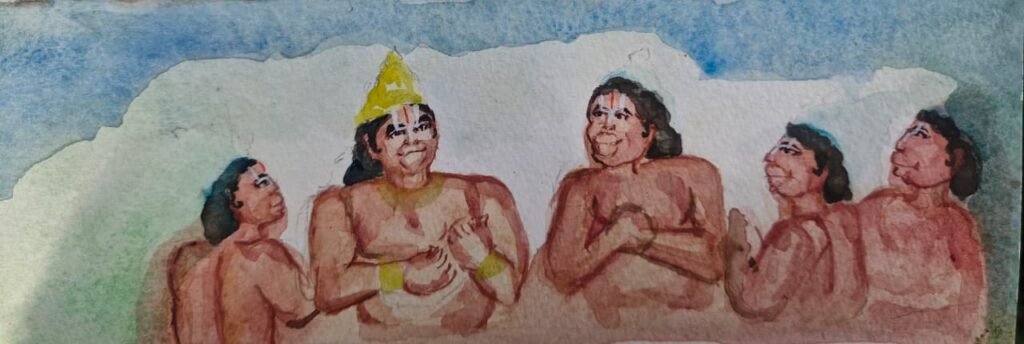
sugrIva mahAraja, seeing all five of them (vibhIshaNAzhwAn and the four rAkshasas accompanying him), discussed a plan of action with others.
avathArikai (Introduction)
Because of immense devotion towards perumAL, sugrIva mahArAja is unable to recognise vibhIshaNAzhwAn’s gestures which reveal him to be a favourable person. Therefore, he thinks with apprehension, “Who might this be?’ and engages in counsel with other leaders and elders present.
thamAthmapanchamam dhrushtvA sugrIvO vAnarAdhipa: I
vAnaraissaha dhurdharshaSchinthayAmAsa budhdhimAn II
Word-by-word meaning
vAnarAdhipa: – monkey king
dhurdharsha: – one who cannot be defeated
budhdhimAn – intelligent
sugrIva: – sugrIva mahArAja
Athmapanchamam – (along with four others accompanying him), being the fifth one
tham – that vibhIshaNAzhwAn (who was one among the five)
dhrushtvA – having seen
vAnarai: saha – along with the monkeys
chinthayAmAsa – he discussed and analysed ( along with others)
Simple meaning
The unconquerable and astute sugrIva mahArAja, having seen vibhIshaNAzhwAn, the fifth among them – along with his four companions, engaged in thoughtful discussion with the leaders.
Notes from periyavAchchAn piLLai’s vyAkhyAnam
tham – him (vibhIshaNAzhwAn who came with a desire)
Oh, alas, sugrIva mahArAja doubted him (tham)! His suspicions towards vibhIshanAzhwAn, a well-wisher who arrived with such intense desire, expressing his inability to sustain otherwise – were unwarranted.
Athmapanchamam – one in the group of five
vibhIshaNAzhwAn appeared as one among the others in the group. This suggests that he did not show off as a leader; instead, he blended in without discrimination, reflecting his humility and closeness with the rest of them.
- SrI bhagavath gIthA 18-14 “adhishtAnam thathA karthA karaNam cha pruthagvidham | vividhAS cha pruthak chEshtA dhaivam chaivAthra panchamam ||” (The body, the soul, the karmEndhriyams (five faculties along with the mind), similarly, the prANa (vital air) with five different functions and fifth and the most important cause among the causes for the karmas, the paramAthmA).
When any action happens, there is involvement of five entities in it. 1 – Body, 2 – jIvAthmA, 3 – karmEndhriyams (the five faculties along with the mind), 4 – the five prANas (vital air with 5 different functions), 5 – paramAthmA. Among these, the most essential is paramAthA (the antharyAmI). Herein, puththUr swAmy has highlighted emperumAnAr’s gIthA bhAshyam vAkyam to explain this further. “athra dhaivam panchamam – paramAthmA antharyAmi karmanishpaththau pradhAnahEthur ithyartha:” (In this context, the fifth (reason) is the supreme – paramAthmA who dwells within (antharyAmI) and is the primary cause in the accomplishment of any action).
As such, though vibhIshaNAzhwAn appears to be just one of the group, the others are subservient to him. Their existence depends on him, making him the most important among the five.
sugrIva: dhrushtvA – sugrIva saw them
In this regard, piLLai thirunaRaiyUr araiyar provides a fascinating explanation for sugrIva: dhrushtvA. While sugrIva: means ‘one with a beautiful neck’, he interprets, “sugrIva mahArAja quickly tilted his head to look up at vibhIshaNAzhwAn, who was standing in the sky”; observing the beauty of sugrIva maharAja’s neck as it turned swiftly upward in the direction of vibhIshaNAzhwAn, vAlmeeki bhagavAn celebrated him as sugrIva (beautiful neck).
(Note from kAlakshEpam: piLLai thirunaRaiyUr araiyar is very well known in our sampradhAyam. He sacrificed his life to protect the archa thirumEni of emperumAn in thottiyam thirunArAyaNapuram. We can also see references about him in many vyAkhyAnams.)
vAnarAdhipa:
Why was sugrIva mahArAja anxious when he saw vibhIshaNAzhwAn? Since he had the entire army of monkeys in his subordination, he showed great compassion to the princes – SrI rAma and iLaiya perumAL.
- SrI rAmAyaNam yudhdha kANdam 27-1 “rAghavArthE parAkrAnthA: – na prAnE kuruthE dhayAm” (The monkeys were in the battle due to their devotion for perumAL and iLaiya perumAL; even though they suffered, they did not care about it or attempt to save their own lives).
- SrI rAmAyaNam yudhdha kANdam 27- 47 “rAmapriyArtham prANAnAm dhayAm” (Because of the devotion towards SrI rAma, he did not show any pity on his life).
As such, all the monkeys had immense devotion for perumAL and iLaiya perumAL, and sugrIva mahArAja was their leader, who displayed utmost compassion towards perumAL and iLAiya perumAL.
dhurdharsha: – one who cannot be defeated
He was invincible, yet, upon seeing vibhIshaNAzhwAn, he wanted to discuss this predicament with others.
“thasmAdh apivadhyam prapannam na prathiprayachchaththi” (Even if one is worthy of being killed, if he surrenders, he should not be exposed or betrayed).
Even a person who cannot be punished because of his surrender (as said in the SAsthram), would hesitate upon seeing sugrIva mahArAja’s invincibility. Yet, he was suspicious upon seeing vibhIshaNAzhwAn.
chinthayAmAsa
Even though he was invincible, apprehension flared within him due to his devotion for perumAL. His compassion – fearing ’Oh, what might happen to SrI rAma?’ took over, completely obscuring his indomitable strength. Lost in this concern, he began to contemplate.
budhdhimAn vAnaraissaha chinthayAmAsa – He, who was intelligent, engaged in discussion with other monkeys
Though he was sagacious and intelligent enough to devise a strategy independently, he gathered all the chiefs and deliberated with them, given the profound responsibility of protecting perumAL.
(Note from kAlakshEpam: Sometimes the significance of performing a kainkaryam is forgotten when it becomes a part of a routine. We may lose sight of the fact that it is performed for emperumAn, the sarvESvaran of billions of universes, who has taken an archA form, or for the AzhwArs and AchAryas who are so dear to him. In this context, sugrIva mahAraja, being wise, remained deeply mindful of the magnanimity of his service for perumAL and iLaiya perumAL. Recognising its importance, he gathers everyone to discuss the path forward.)
budhdhimAn chinthayAmAsa
sugrIva mahArAja thought: Has he come as a messenger? Or as a person in distress? Or perhaps is he an enemy who has come to attack? Having a brilliant mind praised by everyone, sugrIva mahArAja did not ignore these possibilities; instead, he engaged in careful deliberation.
He was such discerning that he could instantly identify a person’s favourable and unfavourable qualities simply by interpreting their expressions and facial movements. In spite of these capabilities, he still analysed the situation and consulted with others. Due to his immense devotion (mangaLASAsanaparar), his intellect – though sharp – became clouded by concern.
A mind that is constantly anxious – thinking “Oh, what harm might come to my supreme master?” – is only worthy of being praised as brilliant. As such, sugrIva mahAraja engaged in deliberation with others.
(Note from kAlakshEpam: Although the mudhalAzhwArs were the first AzhwArs, thirumazhisai AzhwAr lived for a long time, nammAzhwAr and thirumangai AzhwAr composed many pAsurams, thiruppAnAzhwAr and thondaradippodi AzhwAr dedicated their pAsurams to only periya perumAL, none is called ‘periyAzhwAr’. Only periyAzhwAr is known by such an honorofic title because he was, at all times, a mangaLASAsanaparar.)
- mahAbhAratham udhyOga parva “samspruSannAsanam SaurErmahAmathirupAviSath” (Touching the seat of krishNa, the brilliant minded one, (vidhurAzhwAn) sat down).
After offering a seat to krishNa, vidhurAzhwAn thinks, ‘What if I am influenced by dhuryOdhana’s evil intentions, since I have until now survived by working in his royal court?’ Suspicious of himself, he checks to see if there are any imperfections in the seat he offered. This example of the intellectual vidhurAzhwAn (mahAmathi:) is cited to explain sugrIva mahArAja’s brilliant, yet cautious mind. Similarly, sugrIva mahArAja became suspicious, even though vibhIshaNAzhwAn was a well-wisher.
thamAthmapanchamam dhrushtvA sugrIvO vAnarAdhipa: I
vAnaraissaha dhurdharshaSchinthayAmAsa budhdhimAn II
Thus concludes the vyAkhyAnam for this SlOkam.
SrI rAmAyaNa thani SlOkam – yudhdha kANdam 17.4 – chinthayithvA
avathArikai (Introduction)
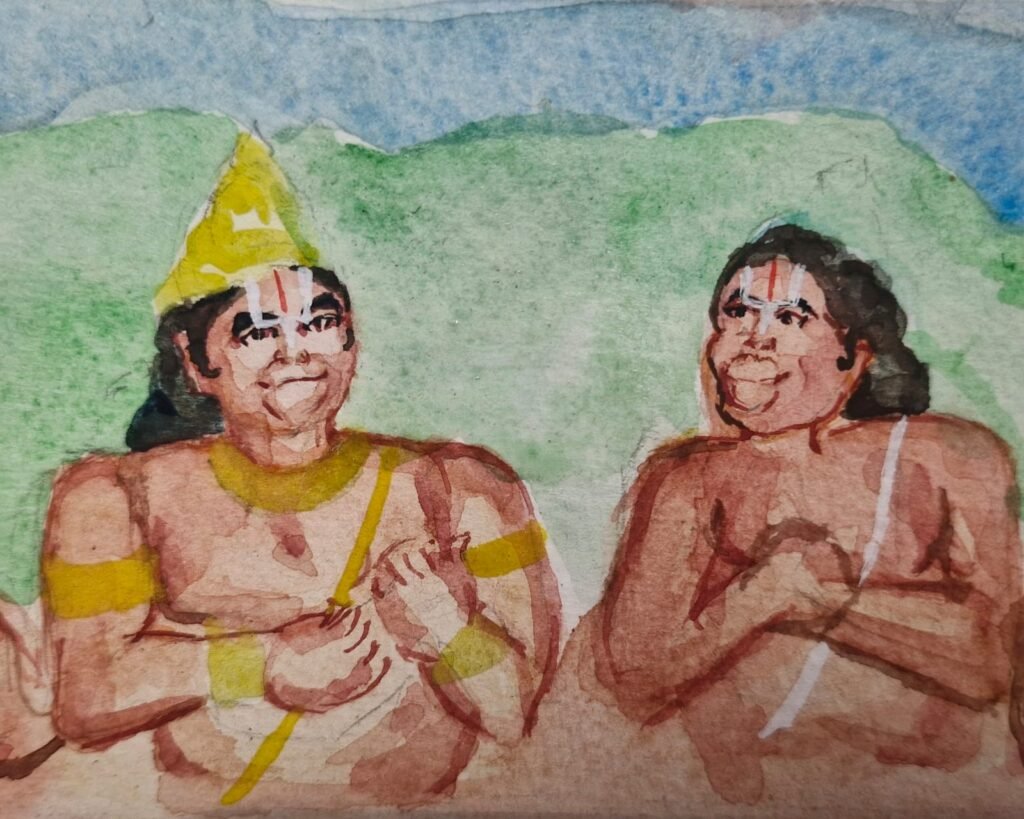
Upon seeing SrI vibhIshaNAzhwAN come with his four servitors very quickly from lankA, sugrIva mahArAja knew it was not possible to be engrossed in discussion for a long time, so he decided quickly and conveyed his decision to the monkey leaders.
chinthayithvA muhurthanthu vAnarAmsthAnuvAcha ha I
hanUmathpramukhAn sarvAnidham vachanamuththamam II
Word-by-word meaning
muhurtham thu – very quicky
chinthayithvA – decided
hanUmathpramukhAn – thiruvadi and others
sarvAn thAn – all of them
idham – this
uththamam – extremely good/excellent
vachanam – words
uvAcha ha – spoke
Simple meaning
sugrIva mahArAja, upon deciding very quickly, spoke these extreme good words to thiruvadi and other monkey leaders.
Notes from periyavAchchAn piLLai’s vyAkhyAnam
chinthayithvA – after deciding
Since the process of thought (chintha) leads to a conclusion, chinthayithvA is used here to mean ‘arrived at a decision’. As referenced in the previous SlOkam by the term ‘bhudhdhimAn’, sugrIva mahArAja – being of brilliant mind – clears his doubts and resolves the matter. After observing that vibhIshaNAzhwAn has arrived with his weapon (gadhA) and his companions, sugrIva mahArAja determines that he is neither a person in distress nor a messenger; instead, he reaches the consensus that vibhIshaNAzhwAn has come to cause suffering.
muhurtham
While lankA on the opposite shore was naturally protected by water, forests, mountains, and massive fortress, perumAL remained on this side in an open arena without any fortification. Consequently, vibhIshaNAzhwAn was perceived as someone sent by rAvaNa to cause harm.
sugrIva mahArAja concluded that if a great amount of time was spent in analysing, vibhIshaNAzhwAn might begin his attack; he therefore decided to act swiftly.
thu – if
Concluding that vibhIshaNAzhwAn was an enemy, the fear that already existed increased manyfold.
thAn vAnarAnuvAcha
The monkeys and the monkey leaders were all extremely compassionate towards perumAL.
In a drama, the importance is placed on the actors; even when kings attend such events, the focus remains on the performers. Similarly, while considering the devotion and compassion shown towards perumAL, sugrIva mahArAja, like a king who remained a spectator, spoke to the most compassionate monkeys about his decision.
ha
vAlmeeki bhagavAn celebrates, ‘Ah! What a wonder, The beauty of swAmy (leader – perumAL) and his servitors!
hanUmath pramukhAn – thiruvadi and others
Why is sugrIva mahArAja looking at thiruvadi and addressing him, even though there are many others present?
Based on seniority, sugrIva mahArAja should have addressed the assembly as ‘jAmbavAn and others’. Otherwise, following the order of succession, he should have said ‘angadha and others’. However, sugrIva mahArAja addressed his speech as ‘hanumAn and others’. In times of peril, he prioritised capability, considering thiruvadi’s capabilities, he addresses the group as hanUmathpramukhAn.
sarvAn – all of them
Since everyone – whether it be the monkeys or the chiefs – had immense compassion towards perumAL, he addressed them all without distinction.
idham vachanam
Oh, such marvelous words! vAlmeekin bhagavAn, celebrates sugrIva mahArAja’s words (just structure of it) as he begins to speak even before getting into its meaning.
uththamam – very meaningful words
(Note from kAlakshEpam: In SrI vachanabhUshanam it is explained that the fear that we display for material matters is inferior, whereas the fear felt by mangaLASAsanaparars with regard to perumAL is superior)
Looking at the content of sugrIva mahArAja’s sentences, his words were superior/deeply meaningful. The words stem from both fear – ‘The one who has arrived is not a well-wisher, he is an enemy’ and compassion – ‘What harm might he cause to perumAL?’ Because they arise from compassion, these fears are considered ‘uthkrushtam’ or superior.
However, not all the fears are of the same level. Fearing that vibhIshaNAzhwAn is simply unfavourable is ‘uthkrushtam’. A higher level of fear is worrying that he has come not just to gauge the strength but to become forgetful of their own strength and fear that he has come to kill everyone. This is beyond just being suspicious about vibhIshaNAzhwAn’s qualities and becoming doubtful of one’s own capabilities.
The highest level of fear, however, occurs when one forgets not only one’s own strength but also the strength of SrI rAma – who killed vAli with a single arrow. To fear that someone could cause harm to all and to SrI rAma, the source of ultimate support for all, is the most superior fear. As the intensity of fear increases, the underlying reason – compassion increases as well. Therefore, a word that conveys this peak intensity of fear is called ‘uththam’ (excellent). It is in this sense that sugrIva mahArAja’s words are referred to as ‘uththam’.
- SrI rAmAyaNam bAla kANdam 1-69 “SarENaikEna rAghava:” (SrI rAma killed vAli with one arrow).
(Note from kAlakshEpam: In our sampradhAyam, sugrIva mahArAja is highly celebrated as a mangaLASAsanaparar. During the battle, upon seeing perumAL on the ground while rAvaNa stood on top of a hill, he jumped all the way to rAvaNa, knocked his crown off and returned to perumAL’s side. This act, among others, reveals his extreme compassion towards perumAL. These instances are highlighted to show that one must focus on the gyAnam, bhakthi, vairAgyam, and compassion of a prapannan, SaraNagathan, mangaLASAsanaparar, rather than dwelling on petty worldly flaws they may display. It is for this reason that our pUrvAchAryas always reverently refer to him as sugrIva mahArAja.)
chinthayithvA muhurththanthu vAnarAmsthAnuvAcha ha I
hanUmathpramukhAn sarvAnidham vachanamuththamam II
This concludes the vyAkhyAnam for this SlOkam.
AzhwAr emperumAnAr jIyar thiruvadigaLE SaraNam
periyavAchchAn piLLai thiruvadigaLE SaraNam
Source – SrI rAmAyaNa thani SlOkam – 52 – yudhdha kANdam – 16.1 – sunivishtam, 17.1 – ithyukthvA Audio Video
adiyEn chithrA rAmAnuja dhAsi
Proofreading/Curating done by – kOsalEndhra rAmAnuja dhAsan, krishNan rAmAnuja dhAsan
Artwork – namperumAL rAmAnuja dhAsan
Related Links
SrI rAmAyaNa thani SlOkam – 51 – yudhdha kANdam – 16.1 – sunivishtam, 17.1 – ithyukthvA Audio Video
SrI rAmAyaNa thani SlOkam – 50 – yudhdha kANdam – abhaya pradhAna sAram – pravESam (Introduction) Audio Video
SrI rAmAyaNa thani SlOkam – 49 – sundhara kANdam 51.38 – sathyam rAkshasa rAjEndhra Audio Video
SrI rAmAyaNa thani SlOkam – 48 – sundhara kANdam 38.33 – sa pithrA cha Audio Video
SrI rAmAyaNa thani SlOkam – 47 – 31.19 – sA thiryakUdhvancha, 34.23 – svapnEpi Audio Video
SrI rAmAyaNa thani SlOkam – 46 – sundhara kANdam 21.9 – iha santhO – Part 2 Audio Video
SrI rAmAyaNa thani SlOkam – concise english meanings
archived in https://granthams.koyil.org
pramEyam (goal) – https://koyil.org
pramANam (scriptures) – https://granthams.koyil.org
pramAthA (preceptors) – http://acharyas.koyil.org
SrIvaishNava education/kids portal – http://pillai.koyil.org