SrI: SrImathE SatakOpAya nama: SrImathE rAmAnujAya nama: SrImath varavaramunayE nama:
We are currently enjoying the in-depth meanings of SrI rAmAyaNa SlOkams from the yudhdha kANdam, based on periyavAchchAn piLLai’s commentaries (vyAkhyAnam) and puththUr swAmy’s lucid explanations.
We express our gratitude to periyavAchchAn piLLai and puththUr swAmy for their mercy, and to SrI u vE sArathy thOthAthri swAmy for providing us with this opportunity through his thamizh kAlakshEpam of periyavAchchAn piLLai’s vyAkhyAnam.
This article is a translation of SrI sArathy swAmy’s thamizh kAlakshEpam.
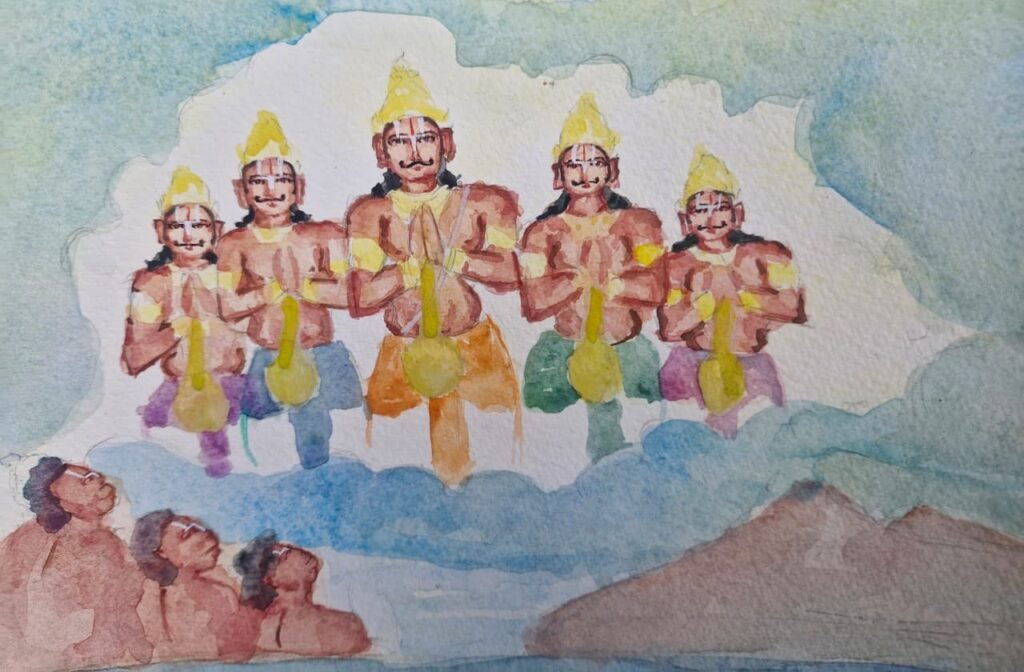
In the 17th sargam, vibhIshaNAzhwAn expresses his disagreement with rAvaNa and leaves lankA. He travels through the sky and arrives on the shore where perumAL is present. sugrIva mahArAja and other monkeys see vibhIshaNAzhwAn along with his companions. After examining them, sugrIva mahArAja determines them to be enemies. They look at vibhIshaNAzhwAn and his companions with the intention of killing them. This is what we enjoyed in the previous article. Now, we shall continue with eight SlOkam.
avathArikai (Introduction)
This SlOkam says that though vibhIshaNAzhwAn knew they were discussing his annihilation, he ignored them, and approaced the northern shore (of the ocean) and sustained himself, since that was the location to be attained due to the merciful presence of SrI rAma, just like a calf approaches its mother’s udder.
- mudhal thiruvandhAdhi 30 “thAy nAdu kanRE pOl thaNduzhAyAn adikkE pOy nAdikkoLLum purindhu” (Like a calf that approaches its mother, affectionately seek and join the divine feet of sarvESvaran, who adorns a cool thuLasi garland).
thEshAm sambhAshamANAnAm anyOnyam sa vibhIshaNa: I
uththaram thIram AsAdhya khastha Eva vyathishtatha II
Word-by-word meaning
sa vibhIshaNa: – that vibhIshaNAzhwAn
anyOnyam – among one another
sambhAshamANAnAm thEshAm – while they (monkeys) were talking
uththaram thIram – on the northern shore (of the sea)
AsAdhya – reached
khastha Eva – indeed standing in the sky
vyathishtatha – remained firm
Simple meaning
As they were conversing with one another, vibhIshaNAzhwAn reached the northern shore and stood firmly, there, in the sky.
Notes from periyavAchchAn piLLai’s vyAkhyAnam
thEshAm – All of them
Here, thEshAm has been used in a possessive case as ‘their speech’. He remained negligent of their mutual conversation – a conversation aimed at his destruction.
anyOnyam sambhAshamANAnAm – At that time, they were speaking with one accord; the leader sugrIva mahArAja, and his subordinates (all the monkeys) were in complete agreement.
(sambhAshamANAnAm – samyak bhAshamANAnAm – when they were speaking well). It is referred to as ‘right speech’ since it reflects a unified purpose without a distinction between the leader and his subordinates.
Even though their conversation was about him (vibhIshaNAzhwAn), why did he deliberately ignore it? His thoughts were pure, and had an immense urge to attain perumAL. Hence, he did not care about their words.
vibhIshaNa: – one who possessed thoughts free from malice – he simply disregarded their dialogues.
vibhIshaNan – vigathabhIshaNan: Fearless even towards those who intended to kill him. What is purity of his thoughts? Though a brotherly relationship is not to be abandoned, vibhIshaNAzhwAn left rAvaNa because he could not live amicably in the assembly of rAvaNa since rAvaNa was inimical towards SrI rAma and he could live amicably in the assembly of SrI rAma’s followers, despite their intention to kill him, since they were following the path of righteousness.
vibhIshaNAzhwAn felt intense anxiety and an urgent desire to reach SrI rAma immediately. He felt such restlessness that he believed he could not sustain himself without arriving at the place where SrI rAma was present.
- SrI rAmAyaNam yudhdha kANdam 17-1 “AjagAma muhUrthEna” (He came in a moment).
Consequently, he did not pay attention to their words.
uththaram thIram AsAdhya
Having reached the northern shore (uththaram thIram AsAdhya), vibhIshaNAzhwAn showed a greater inclination towards the shore than perumAL. This is because perumAL’s abode is considered more significant than the supreme lord himself.
(Note from kAlakshEpam: Just as for SrIvaishNavas, being in a dhivyadhESam and engaging in kainkaryam there is most important. This highlights the importance of residing in a dhivyadhESam. Being in a dhivyadhESam will nourish us by engaging in kainkaryam and sath vishayam, while improving our qualities. Staying in places away from dhivyadhESams without any AzhwAr/AchArya connection will not serve us any good. These are known as SishtAchAram – that is, following what the elders did.
Though the entire vibhUthi is perumAL’s possession, it is important and suitable to our real nature to be in places where there is a direct connection with the supreme lord. In “uNNum sORu” padhigam commentary, the following anecdote is mentioned. ananthAzhwAn visits a village and asks a person farming there, “Where do you belong to?” The SrIvaishNava replies, “I am from thirukkOLUr, but I am in this village to take care of my livelihood”. In response, ananthAzhwAn says, “It is better to stay in a dhivyadhESam, even if one has to sustain himself by herding a donkey, than to live outside”. This principle and the importance of staying in dhivyadhESam is shown in many places.)
Rather than being crowned and enjoying life in lankA, it is better to stay within the boundaries of perumAL’s divine abode – even if it means being killed there by the monkeys.
When he entered the northern shore, it was as if he had entered an area marked by a thiruvAzhikkal. (kal is a thamizh word meaning stone, and thiruvAzhi refers to sudharSanAzhwAn.) This signifies that he had crossed into the boundary of a land under the direct protection of bhagavAn.
When he entered the northern shore, he felt fearless, it was like moving from a place of fear into a fortress, escaping a forest fire to dive into the ocean.
khastha Eva vyathishtatha
Only when he was accepted by all the monkey leaders would he put his feet on the ground; until then, he stood firmly in the sky. Had he stood on the ground then, it would have meant that he was relying on it – that he had a place to stand. To show that he had nothing to depend on, he stood in the sky, revealing his destitution (this meaning is shown by piLLAn).
thEshAm sambhAshamANAnAm anyOnyam sa vibhIshaNa: I
uththaram thIram AsAdhya khastha Eva vyathishtatha II
Thus concludes the vyAkhyAnam for this SlOkam.
SrI rAmAyaNa thani SlOkam – yudhdha kANdam 17.9 – uvAcha cha
vibhIshaNAzhwAn began to talk to sugrIva mahArAja and the other monkeys.
avathArikai (Introduction)
vibhIshaNAzhwAn looked at sugrIva mahArAja and his army, who were getting ready to kill him, and spoke in a voice that revealed his grief.
uvAcha cha mahAprAgya: svarENa mahathA mahAn I
sugrIvam thAmScha samprEkshya khastha Eva vibhIshaNa: II
Word-by-word meaning
mahAprAgya: – one with a good intellect
mahAn – a great person
vibhIshaNa: – vibhIshaNAzhwAn
khastha: Eva – while standing in the sky
mahathA – (in a) loud
svarENa – voice
sugrIvam – sugrIva mahArAja
thAn cha – and the monkeys
samprEkshya – looked at them
uvAcha cha – and also spoke a word
Simple meaning
The great and highly intelligent vibhIshaNAzhwAn, standing in the sky, saw sugrIva mahArAja and the monkeys and spoke to them in a loud voice.
Notes from periyavAchchAn piLLai’s vyAkhyAnam
uvAcha
To be the target of SrI rAma’s mercy, while it was sufficient to reach the place where he was staying, he also spoke a word, says the SlOkam.
- SrI rAmAyaNam ayOdhyA kANdam 50-41 “archithA: chaiva hrushtA: cha bhavathA sarvathA vayam I padhbhyAm abhigamAch chaiva snEha sandharSanEna cha II” (SrI rAma tells guhap perumAL: By walking towards us and by showing your affection, we have been worshiped through these actions of yours, I am pleased).
As such, for perumAL – who considered the mere gesture of arrival at his abode to be substantial – vibhIshaNAzhwAn’s words beyond that action were like applying salt water to a wound.
mahAprAgya: – great profound knowledge
gya: means knowledge that provides the ability to distinguish between what should be abandoned and what should be adopted.
prAgya: means profound knowledge that provides the ability to discard actions which should be avoided and the awareness of what to hold onto.
mahAprAgya: means possessing deep, insightful knowledge that grants the ability to abandon what is forbidden and know the infallible means to attain that which is worthy of attachment. In other words, it means recognising the lowliness of rAvaNa, who must be abandoned, and the greatness of perumAL, who must be attained, understanding that rAvaNa has to be abandoned before one can reach perumAL, and relying entirely on perumAL’s divine feet as the unerring path to attain him. vibhIshaNAzhwAn is of such a nature, and hence he is celebrated as mahAprAgya:.
svarENa mahathA – the greatness of a loud voice
The profound impact of this loud voice is beautifully illustrated by AzhwAr:
- thiruvAimozhi 6-5-9 “marangaLum irangum vagai maNivaNNavO! enRu kUvumAl” (Even the trees, which are insentient, melt in pity as she calls out “Oh, the one who is having the form like a beautiful blue gem!)
The moment his voice was heard, it did not just reach perumAL, the ultimate goal to be attained. Even the passive passersby were instinctively moved to reveal their sympathy.
mahAn – a great person
The distress of vibhIshaNAzhwAn was so immense that the anguish revealed by his voice seemed a mere fraction of it. His distress was such that if his svarUpam [basic nature] and his distress, which is one part of his svabhAvam [characteristic] were weighed, his entire svarUpam would equal his distress.
mahAmanA: – large hearted
- bhagavath gIthA 7-19 “vAsudhEva: sarvam ithi sa mahAthmA sudhurlabha:” (The one who thinks ‘vAsudhEva is everything to me’ is a great soul; he is difficult for me to attain).
As said above, for vibhIshaNAzhwAn, perumAL’s divine feet served as ‘every kind of relative’. As he abandoned all of his worldly relatives, those divine feet of SrI rAma became everything to him, vibhIshaNAzhwAn was one with a great heart.
sugrIvam thAmScha samprEkshya – looked intently at sugrIva mahArAja and his army
- SrI rAmAyaNAm yudhdha kANdam 17-5 “asmAn hanthum na samSaya:” (There is no doubt that he has come to kill us).
- SrI rAmAyaNAm yudhdha kANdam 17-6 “sAlAnudhyamya SailAmScha” (lifting the trees and mountains)
vibhIshaNAzhwAn observed those who were ready to kill him with deep reverence. What was the reason for vibhIshaNAzhwAn’s veneration? He respected them because those who were compassionate towards perumAL were dear to him; and he saw them as potential purushakAram – the ones to help him attain perumAL.
- SrI bhagavath gIthA 7-18 “gyAnI thvAthmaiva mE matham” (The gyAni is the one who sustains me – this is my philosophy).
As such, vibhIshaNAzhwAn thought, while he stood in the sky, “perumAL sees his servitors as those who sustain him, without thinking of their flaws. He does not deny their words. These monkeys may show resentment towards me, but perumAL will accept their words”. Thus, he stood in the sky and spoke.
uvAcha cha mahAprAgya: svarENa mahathA mahAn I
sugrIvam thAmScha samprEkshya kastha Eva vibhIshaNa: II
Thus concludes the vyAkhyAnam for this SlOkam.
SrI rAmAyaNa thani SlOkam – yudhdha kANdam 17.10 – rAvaNO nAma
A person seeking SaraNAgathi, when approaching perumAL, should confess all his flaws, praise perumAL’s glories and declare that perumAL is his sole refuge. All these are followed here by vibhIshaNAzhwAn.
avathArikai (Introduction)
In all the five SlOkams beginning with this Slokam, vibhIshaNAzhwAn expresses the important aspects of SaraNAgathi – describing his lowliness, identifying what should be abandoned and adopted, and seeking refuge – surrendering to perumAL.
AnukUlyasya sakalpa: prAthikUlyasya varjanam I
rakshishyathIthi viSvAsO gOpthruthva varaNam thathA II
AthmanikshEpa: kArpaNyE shadvidhA SaraNAgathi: II
The six aspects of SaraNAgathi:
AnukUlyasya sakalpa: – resolve to engage only in actions favourable to emperumAn
prAthikUlyasya varjanam – resolve to avoid everything that is unfavorable to emperumAn
rakshishyathIthi viSvAsO – firm faith and conviction that he will protect
gOpthruthva varaNam – surrendering to the ultimate protector
AthmanikshEpa: – offering oneself
kArpaNyE – expressing one’s lowliness
shadvidhA SaraNAgathi: – six aspect of SaraNAgathi
pitharam mAtharam dhArAn puthrAn bhandhUn sakIn gurUn I
rathnAni dhanadhAnyAni kshEthrANi cha gruhANI cha II
sarvadharmAmScha santhyajya sarvakAmAmScha sAksharAn I
lOkavikrAntha charaNau SaraNam thE’vrajam vibhO II
Oh, lord! abandoning everything – father, mother, children, relatives, friends, AchAryas, gemstones, wealth, lands, houses, all means, including kaivalyam, leaving everything even without a trace of those subconscious impressions, I surrender unto your divine feet which protect this world.
Thus, declaring his relinquishment of all relatives, vibhIshaNAzhwAn surrenders to SrI rAma in five SlOkams.
In the first SlOkam, vibhIshaNa describes his lowliness – [a] lowliness arising due to being enslaved to the adversary, rAvaNa, [b] lowliness arising due to being related to rAvaNa as a brother; and [c] his inherent lowliness being born as a rAkshasa.
rAvaNO nAma dhurvruththO rAkshasO rAkshasESvara: I
thasyAhamanujO bhrAthA vibhIshaNa ithi Srutha: II
Word-by-word meaning
dhurvruththa: – one with immoral conduct
rAkshasESvara: – king of rAkshasas [demons]
rAkshasa: – rAkshasa
rAvaNa: nAma – famously known as rAvaNa
aham – I
thasya – to him
anuja: – who am born after him
vibhIshaNa: ithi Srutha: – known as vibhIshaNan
bhrAthA – his brother
Simple meaning
There is a rAkshasa of immoral conduct, the king of the rAkshasas, famously known as rAvaNa. I am his younger brother, known as vibhIshaNa.
Notes from periyavAchchAn piLLai’s vyAkhyAnam
rAvaNa: nAma
True to the etymology “rAvayathi ithi rAvaNa:” (rAvaNa is one who makes the all the worlds cry), he is known by that name due to the fear and suffering he inflicted – the name that best describes his character.
nAma
A name that is well known to all; he is recognised even outside his group as ‘one who harms others’.
dhurvruththa:
vruththam means abiding by the rules of varNASramam [AchAram, conduct in line with one’s class such as brAhmaNa, kshathriya etc and one’s stage in life such as brahmacharya (bachelorhood), gruhastha (marital life) etc); dhurvruththam means not adhering to the moral code of conduct (that is, not following rules or limitations) with regard to food, sleep, fear and mating.
In sthOthra rathnam, ALavandhAr says that he has lowly conduct and that he is an animal in the garb of a human. (ALavandhAr says so in naichyam – humility).
- sthOthra rathnam 58 “nihInAchArO’ham nrupaSu:” (The one with adharmAchAra – practice of adharmam (immoral or unrighteousness), the only difference between him and animal (since animals do not follow any regulation in eating, sleeping, defending, and mating) is, he has two legs and animals have four legs).
- SrI rAmAyaNam sundhara kANdam 21-9 “bhudhdhirAchAra varjithA” (pirAtti says, “Your intellect is without AchAram – virtues”).
rAkshasa:
rAvaNa is a rAkshasa. As a rAkshasa, this is his natural disposition; therefore, his characteristics cannot be eliminated simply by calling them out as dhOsham (faults). If a person is born into a noble family yet has a shortcoming in his anushtAnam (conduct), he can be made to realise his mistakes by pointing out his incongruent conduct. And in this way, his flaws can be corrected. However, the flaws of a person born into a lowly clan cannot be resolved by preaching about his defects. He may not realise his defects since they are inherent to his clan and practiced by many within it. Thus, by specifying him as a rAkshasa, it is described that it is impossible to exclude him from his flaws.
rAkshasESvara: – ISvara- one who controls; refers to rAvaNa as the leader of rAkshasas. The term ISvaran implies that he is completely independent (svathanthran). Because of this absolute freedom, he ignores and refuses to listen to any good counsel. As their leader, he is the cause for the sins committed by other rAkshasas too. Thus, he serves as a refuge for those who engage in robbery and follow unethical paths, living entirely according to their own selfish desires.
Thus, vibhIshaNAzhwAn describes rAvaNa’s nature in the first part of the SlOkam.
Assuming sugrIva mahArAja and others ask, “What is the reason for you to describe his lowliness?” (This is answered in the later part of the SlOkam)
thasyAham – I am his
This word, thasyAham, has been used in this context to mean that he is a servitor – SEshabhUthan. The nature of a servitor (Seshan) is to enhance the greatness of his leader.
vibhIshaNAzhwAn says, “Until now, I was his (rAvaNa) subordinate”.
- SrI rAmAyaNam ayOdhyA kANdam 82-12 “rAjyanchAhancha rAmasya” (bharathAzhwAn says this refusing to accept the crown: This kingdom and I belong to perumAL).
The true nature of jIvAthmA is to be the servitor of the supreme lord, so vibhIshaNAzhwAn says, “Instead of being a servitor to perumAL, I have been a slave to rAvaNa”.
anujO bhrAthA – brother
vibhIshaNAzhwAn says, “I was born in the same womb that was polluted by rAvaNa. Like his body, I have been helpful in all his evil actions”.
- manu dharma SAsthram 2-226 “bhrAthA svA mUrthirAthmana:” (A brother is like one’s body).
vibhIshaNa ithi Srutha:
My flaws are not only because I am rAvaNa’s brother, I am known in the world as vibhIshaNa. As per etymology, “vividham bhIshayathIthi vibhIshaNa:” (One who creates different kinds of fear is vibhIshaNa).
vibhIshaNAzhwAn says, “rAvaNa’s flaws arise only from him, but my flaws are two fold: flaws which are mine, and those which have been acquired because of rAvaNa’s association”.
- SrI rAmAyaNam AraNya kANdam 1-24 “vibhIshaNasthu dharmAthmA” (vibhIshaNAzhwAn, one who walks in the path of righteousness does not have the conduct of a rAkshasa)
Finally, periyavAchchAn piLLai is struck with wonder by vibhIshaNAzhwAn’s naichyam (humility) – Despite being hailed by the world as ‘vibhIshaNasthu dharmAthmA’, the great vibhIshaNAzhwAn still holds himself in such low regard.
rAvaNO nAma dhurvruththO rAkshasO rAkshasESvara: I
thasyAhamanujO bhrAthA vibhIshaNa ithi Srutha: II
This concludes the vyAkhyAnam for this SlOkam.
AzhwAr emperumAnAr jIyar thiruvadigaLE SaraNam
periyavAchchAn piLLai thiruvadigaLE SaraNam
Source – SrI rAmAyaNa thani SlOkam – 54 – yudhdha kANdam 17.8 – thEshAm, 17.9 – uvAcha cha, 17.10 – rAvaNO nAma Audio Video
adiyEn chithrA rAmAnuja dhAsi
Proofreading/Curating done by – kOsalEndhra rAmAnuja dhAsan, krishNan rAmAnuja dhAsan
Artwork – namperumAL rAmAnuja dhAsan
Related Links
SrI rAmAyaNa thani SlOkam – 53 – yudhdha kANdam 17.5 – Esha sarvAyyudhOpEtha:, 17.6 – sugrIvasya, 17.7 – SIgram vyAdhiSa Audio Video
SrI rAmAyaNa thani SlOkam – 52 – yudhdha kANdam – 16.1 – sunivishtam, 17.1 – ithyukthvA Audio Video
SrI rAmAyaNa thani SlOkam – 51 – yudhdha kANdam – 16.1 – sunivishtam, 17.1 – ithyukthvA Audio Video
SrI rAmAyaNa thani SlOkam – 50 – yudhdha kANdam – abhaya pradhAna sAram – pravESam (Introduction) Audio Video
SrI rAmAyaNa thani SlOkam – 49 – sundhara kANdam 51.38 – sathyam rAkshasa rAjEndhra Audio Video
SrI rAmAyaNa thani SlOkam – 48 – sundhara kANdam 38.33 – sa pithrA cha Audio Video
SrI rAmAyaNa thani SlOkam – concise english meanings
archived in https://granthams.koyil.org
pramEyam (goal) – https://koyil.org
pramANam (scriptures) – https://granthams.koyil.org
pramAthA (preceptors) – http://acharyas.koyil.org
SrIvaishNava education/kids portal – http://pillai.koyil.org