SrI: SrImathE SatakOpAya nama: SrImathE rAmAnujAya nama: SrImath varavaramunayE nama:
periyavAchchAn piLLai, in his grantham – SrI rAmAyaNa thaniSlOkam, has mercifully given detailed explanation for many important SlOkams in SrI rAmAyaNam. We are currently enjoying his vyAkhyAna grantham, with the support of explanations given by puththUr swAmy for it.
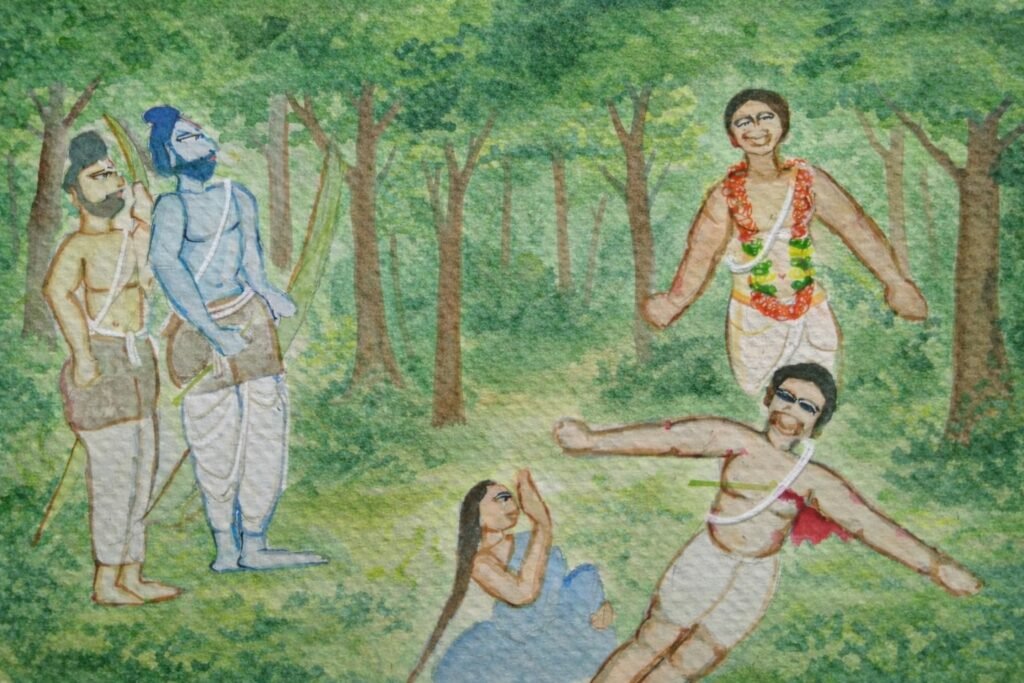
In the previous article, vAli vadham was discussed. vAli falls down like a chopped tree after perumAL’s arrow pierces through him. He poses several questions to perumAL furiously. perumAL answers all his questions; and vAli accepts everything that was said by perumAL. At this juncture, vAli’s wife thArA comes there with an intent to rebuke perumAL for his act. But after seeing perumAL, she gains clarity on account of sathva guNam becoming dominant in perumAL’s presence; her anger subsides and she begins to praise SrI rAma in the following SlOkam.
thvamapramEyaScha dhurAsadhaScha jithEndhriyaSchOththama dhArmikaScha I
akshayya kIrthiScha vichakshaNaScha kshithikshamAvAn kshathajOpamAksha II
avathArikai (Introduction)
(Note from kAlakshEpam:
In SrI rAmAyaNam, SrI vAlmeeki bhagavAn explains thathva nirNayam – that is – establishes SrIman nArAyaNan’s supremacy (parathathva nirNayam) and his incarnation as SrI rAma. He explains this through the words of thArA and angadhan.
periyavAchchAn piLLai has explained in detail, the reasons as to why SrI vAlmeeki bhagavAn chose thArA and angadhan to explain this fundamental principle. Even pramANams like vEdham, SrI bhagavath gIthA, and mahAbhAratham, when describing about emperumAn, do not describe the supremacy of emperumAn with much clarity. But in SrI rAmAyaNam, emperumAn’s glories and his parathvam are told by a female monkey and her child – thArA and angadhan. By explaining through the words of a monkey and a small child, SrI vAlmeeki bhagavAn is making his explanation simple enough to be understood by everyone.
By highlighting this aspect of SrI vAlmeeki bhagavAn’s narration – establishing the supremacy of perumAL through the words of thArA and angadhan, periyavAchchAn piLLai celebrates the greatness of SrI vAlmeeki bhagavAn.)
- mahAbhAratham anuSAsana parva 178-11 “AlOdya sarvaSAsthrANi vichArya cha puna: puna: I idhamEkam sunishpannam dhyEyO nArAyaNassadhA II” (Upon analysing after reading all the SAsthrams and using all the logical reasoning, only this is established firmly – that is, only nArayaNa is apt to be meditated upon, constantly).
- nAradhIya purANam 18-33 “vEdhaSAsthrAthparam nAsthi na dhaivam kESavAthparam” (I vow three times with raised hands; there is no SAsthram higher than the vEdham; there is no other god higher than kESavan).
- hari vamSam 3-32 “nAsthi nArAyaNasamO na bhUthO na bhavishyathi” (In all the three worlds, no one comparable to nArAyaNa has existed in the past and neither will one come to exist in the future).
- SrI bhagavath gIthA 11-43 “na thvathsamO’sthyabhyadhika: kuthO’nya:” (There is neither anyone equal to you in the three worlds nor there exists anyone greater than you).
- thaiththirIya upanishadh 5-1 “agnirvai dhEvAnAmavamO vishNu: parama:” (agni dhEva is the lowest of all the dhEvas; vishNu is the most supreme).
- SvEthASvathara upanishadh 6 “na thathsamaSchAbhyadhikaScha dhruSyathE” (No one equal to him or greater than he could be seen).
- thaiththirIya upanishadh 10-20 “yasmAthparam nAparamasthi kinchith” (There is nothing higher than he).
- thaiththirIya upanishadh 1-9 “na thasyESE kaSchana” (He is not controlled by anyone).
From the above pramANams it can be understood that the other rishis and the vEdham which describe SrIman nArAyaNa’s parathvam have some words which cause ambiguity and raise doubts such as ‘Are the three gods – brahmA, vishNu, rudhra – equal?”, ‘Are the three gods – brahmA, vishNu, rudhra – same?”, etc.
- vishNu purANam 1-2-2 “namO hiraNyagarbhAya harayE SankarAya cha” (I bow to brahmA, vishNu, and Siva).
- SrI bhagavath gIthA 10-23 “rudhrANAm SankaraSchAsmi” (krishNa says, Among the 11 rudhras, I am Siva).
- thaiththirIya upanishadh 11 “sa brahmA sa SivassEndhra:” (He is also brahmA; he is also Siva; he is also indhra).
SrI rAmAyaNam erases these doubts and shows very clearly through the words of thArA and angadhan that SrIman nArAyaNa is the supreme lord.
- “viSvAdhikam rudhram brahmakAraNakAraNam” (rudhran is the biggest in the world, the cause for brahmA and the cause for the one who is the cause for brahmA).
- thaiththirIya upanishadh 10-19 “viSvAdhikO rudhrO maharshi:” (The wise one and the one superior to all in the world, rudhran, at the time of his birth, blesses brahmA).
- rig vEdham 3 “na kirindhra thvadhuththarO na jyAyO asthi vruthrahan” (Oh indhira! There is no one superior to you; the one who killed vruthran! There is no one bigger than you).
- chAndhOgya upanishadh 1-9-1 “AkASa EbhyO jyAyAn AkASa: parAyaNam” (The sky is greater than everything; it is the ultimate goal).
- atharvaSikai 2-20 “Siva EkO dhyEya: Sivankara:” (Abandoning everyone else, only the auspicious Sivan is worthy of being meditated upon).
As such, by these words, the SAsthrams raise doubts about parathvam (supremacy) – whether indhra, brahmA, or even the sky is supreme. Here, periyavAchchAn piLLai explains the approach to interpret these statements to understand the true intent behind those statements.
- Analysing the preceding and succeeding statements to identify who is being referred to.
- When reading the statements which describe the qualities such as – being luminous (space), being auspicious (Siva), it should be understood that those qualities are most fitting for the paramapurushan (supreme lord), and hence should be read as referring to SrIman nArAyaNa.
- sAmAnAdhikaraNam – For example, when looking at statement that says – ”He is brahmA; He is Siva”, such statements should be analysed along with the statements before them and read ‘brahmA and rudhran’ as referring to the antharyAmi (mentioned in the previous statements) nArAyaNa who is within all of them.
- Statements which glorify the greatness of the dhEvathAs, can be understood using the following example. “krayyEyam gau: bahukshIrA sAdhvI cha” (This cow that is sold by me will produce a lot of milk). Just as a person who sells his cow will say good things about the cow, statements such as these glorify the dhEvathas to instill faith in them.
- chAndhOgya upanishadh 1-9-1 [AkASa EbhyO jyAyAn AkASa: parAyaNam” (The sky is greater than everything; the sky is the ultimate goal)].
(vEdham is for all people – people in sathva, rajas, and thamO guNa. Hence, for the benefit of people with material desires, in certain places, the vEdham highlights and glorifies many dhEvathAs for people to have trust in them and worship them to fulfil their material desires.)
- By the principle of thulya nyAyam, in chAndhOgya upanishadh 1-11-5 “sarvANi ha vA imAni bhUthAni prANamEvApisamviSanthi” (It is the prANan that is being attained by all them), the term ‘prANan’ refers to the supreme lord – SrIman nArAyaNa, where the pramANam says that all jIvAthmAs attain prANan – it should be understood as ‘attain SrIman nArAyaNa’ who is the supporter of ‘prANan’.
Also, vAmadhEva rishi says bruhadhAraNya upanishadh.
- bruhadhAraNya upanishadh 3-4-10 “aham manurabhavam sUryaScha” (I become manu and sUryan).
indhra also says the following in kaushIthaki upanishadh.
- kaushIthaki upanishadh “mAmupAssva mAmEva vijAnIhi” (indhira says: Worship me and known only me). ‘me’ – should be understood as bhagavAn, who is the antharyAmi of indhran.
It is also said by prahlAdhAzhwAn in vishNu purANam as follows.
- vishNu purANam 1-19-89 “maththas sarvamaham sarvam” (It is only from me everything manifested; I am everything). This is said by prahlAdhAzhwAn who sees nothing except bhagavAn in everything.
vAmadhEva rishi, indhra and prahlAdhAzhwAn make such statements because they have realised bhagavAn and understood that he is everything. Having attained this realisation, they perceive nothing other than bhagavAn. Therefore, they speak from a state of total identification with him.
- thiruvAimozhi 5-6-1 “kadal gyAlam seydhEnum yAnE” (I am the one who created the earth surrounded by ocean).
However, after reading the above statements, none will agree that Akasam, prANan, vAmadhEvar, indhiran, or prahlAdhan have parathvam (supremacy). Likewise, statements which are spoken by rudhran or brahmA, cannot be considered to establish parathvam of brahmA and rudhran. These statements are said to mainly honour the dhEvathas.
As such, statements which may lead to erroneous understanding have to be thoroughly analysed and understood properly. But in SrI rAmAyaNam, women and children, who are not accustomed to understanding vEdham through logical analysis – thArA and angadhan, have understood and spoken about perumAL’s parathvam. SrI vAlmeeki bhagavAn is establishing supremacy through the words of thArA, angadhan, madhOdharI, SUrpaNakhA et al.
- SrI rAmAyaNam kishkindha kANdam 24-28 “susamvrutham pArthiva lakshaNaiScha tham chArunEthram mrugaSAbanEthrA I adhrushta pUrvam purusham pradhAnamayam sa kAkuthstha ithi prajagyE II’ (One who has all the qualities of a king, one who has beautiful eyes, one who has not been seen before, one who is supreme, seeing him, thArA, one who has beautiful eyes like a deer, understood him to be kAkuthsthan who had killed her husband).
- SrI rAmAyaNam sundhara kANdam 35-8 “rAma: kamalapathrAksha:” (SrI rAma has eyes like the petals of a beautiful lotus flower).
(Note from kAlakshEpam: perumAL’s greatnesses has been celebrated in this SlOkam with 2 intentions – to glorify perumAL’s saulabhyam (simplicity/easy to attain) and to glorify perumAL’s parathvam (supremacy). thArA, knowing both these qualities of perumAL, speaks about him.)
perumAL’s saulabhyam –
Although thArA had never seen perumAL before, she immediately understands he was the one who killed her husband upon seeing the natural majesty in perumAL’s thirumEni and his extraordinarily beautiful eyes.
Due to perumAL’s simplicity, though the identifications for a king were not outwardly visible “susamvrutham pArthiva lakshaNaiScha” (With all the hidden characteristics of a king), his divine eyes and the way he stood revealed his supremacy.
- chAndhOgya upanishadh 2-6-7 “yathA kapyAsam puNdarIkamEvamakshiNI” (That supreme lord has two eyes which look like the lotus that bloom by the rays of the sun).
- thiruvAimozhi 4-5-10 “kaNdavARRAl thanadhE ulagena ninRAn” (His activities showcase that the whole world is subservient to him, he stood praised by all the worlds).
- SrI rAmAyaNam kishkindha kANdam 24-28 “ayam sa kAkuthstha ithi prajagyE” (She understood that kAkuthsthan, (standing before her), is that supreme lord).
- periyAzhwAr thirumozhi 1-1-7 “Ayar puththiran allan arum dheyvam” (He is not a herd-boy but the most-difficult-to-attain deity).
Both these aspects of perumAL – simplicity and supremacy are shown in this SlOkam.
vyAkhyAnam for this SlOkam will be continued in the next article.
AzhwAr emperumAnAr jIyar thiruvadigaLE SaraNam
periyavAchchAn piLLai thiruvadigaLE SaraNam
Source – SrI rAmAyaNa thani SlOkam – 34 – kishkindhA kANdam 24.31 – thvam apramEyaScha – Part 2 Audio Video
adiyEn chithrA rAmAnuja dhAsi
Proofreading/Curating done by – krishNan rAmAnuja dhAsan
Artwork – namperumAL rAmAnuja dhAsan
Related Links
SrI rAmAyaNa thani SlOkam – 33 – kishkindhA kANdam 24.31 – thvam apramEScha – Part 1 Audio Video
SrI rAmAyaNa thani SlOkam – 32 – AraNya kANdam 63.12 – asmin mayA, kishkindhA kANdam 1.71 – padhmakEsara, 1.115 – padhma saugandhika vaham Audio Video
SrI rAmAyaNa thani SlOkam – 31 – AraNya kANdam 30.39 – tham dhrushtvA – Part 2 Audio Video
SrI rAmAyaNa thani SlOkam – 30 – AraNya kANdam 19.14 – tharuNau – Part 6, 30.39 – tham dhrushtvA – Part 1 Audio Video
SrI rAmAyaNa thani SlOkam – 29 – AraNya kANdam 19.14 – tharuNau – Part 5 Audio Video
SrI rAmAyaNa thani SlOkam – concise english meanings
archived in https://granthams.koyil.org
pramEyam (goal) – https://koyil.org
pramANam (scriptures) – https://granthams.koyil.org
pramAthA (preceptors) – http://acharyas.koyil.org
SrIvaishNava education/kids portal – http://pillai.koyil.org