SrI: SrImathE SatakOpAya nama: SrImathE rAmAnujAya nama: SrImath varavaramunayE nama:
We are deeply grateful to periyAvAchchAn piLLai for mercifully bestowing upon us this grantham, the vyAkhyAnam for SrI rAmAyaNam (SrI rAmAyaNa thaniSlOkam). We are also grateful to puththUr swAmy for graciously publishing this grantham and providing a simple explanation for our understanding. We are indeed grateful to SrI u vE sArathy thOthAthri swAmy for his kAlakshEpam on this grantham.
The following text is a translation from ‘grantha kAlakshEpam’ lecture series (in thamizh) on this topic by SrI u vE sArathy thOthAthri swAmy.
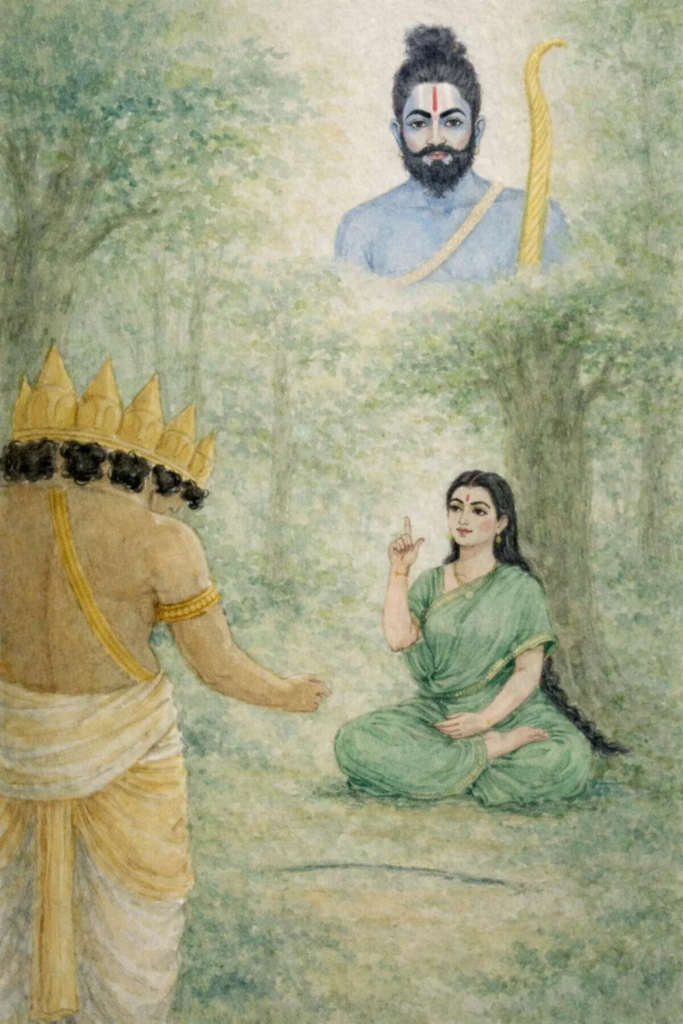
In this series, we are currently enjoying sIthAp pirAtti’s upadhESam to rAvaNa. Realising that rAvaNa is too stubborn to accept the advice of virtuous people like vibhIshaNAzhwAn, pirAtti decides to instruct him herself. She advises him to seek SrI rAma’s friendship.
mithramaupayikam karthum rAma: sthAnam parIpsathA I
vadham chAnichchathA ghOram thvayAsau purusharshabha: II
In the previous article, we have enjoyed the vyAkhyAnam for the words ‘mithramaupayikam karthum’.
Let us now continue with the vyAkhyAnam for the remaining SlOkam.
Notes from periyavAchchAn piLLai’s vyAkhyAnam
(Assuming) rAvaNa says, “What if rAma denies me access when I approach him?”
rAma:
‘ramayathIthi rAma:’ SrI rAma is one who brings happiness
pirAtti says, “He can be approached easily. SrI rAma delights everyone through his quality of sauSeelyam. He mingles and interacts with the common people as one among them, without any limitations”.
rAma: – SrI rAma is one who is joyful
pirAtti says, “SrI rAma delightfully made friendship with the boatman (guhap perumAL), kAkam (crow), the monkey (sugrIva mahArAja). Oh, you, the son of viSravas, you recite the vEdham and possess abundant knowledge, strength, and power – with such high qualifications, why would he reject your friendship?”
rAma: – one who cares about your well being.
pirAtti says, “SrI rAma will call you, even when you do not intend to approach him”.
- SrI rAmAyaNam yudhdha kANdam 18-35 “yadhi vA rAvaNa: svayam-Anayainam” (Even if rAvaNa himself has come, bring him to me).
She continues, “When the situation becomes fatal and you are rendered powerless, instead of killing you, he would let you go and hope ‘Maybe he will change his ways at least now’”.
- SrI rAmAyaNam yudhdha kANdam 59-143 “gachcha” (Go now and come back later).
pirAtti says, “If SrI rAma is willing to even let you go of you, without killing you, would he ever abandon you if you approached him seeking his friendship?”
rAmO mithram karthum aupayikam – seek friendship with SrI rAma
pirAtti says, “Sever ties with people like prahastha who is evil-minded and gives you bad advice”. (prahastha – chief commander in rAvaNa’s army)
- SrI bhagavath gIthA 5-29 “suhrudham sarvabhUthAnAm” (I am a friend for all entities).
- subAla upanishadh “nivAsa: SaraNam suhruth” (nArAyaNa is present as a place to reside, as a means/refuge, and as a friend).
pirAtti says, “Make friendship with SrI rAma who is a friend of everyone”.
rAma: – ‘ramayathIthi rAma:’ – one who give happiness to others
- SrI rAmAyaNam sundhara kANdam 43-25 “nEyamasthi purI lankA na yUyam na cha rAvaNa:” (This city of lankA, all the rAkshasas, and rAvAna have all been destroyed).
pirAtti says, “Your destruction is certain because of your hostility towards SrI rAma. Is he not the only one who can bring you joy by reuniting you with the life and relatives you have lost?”
(Assuming) rAvaNa asks, “Since my life and relatives are already mine, why must he reunite them with me?”
sthAnam parIpsathA vadhanchAnichchathA – one who is desiring for a place to reside and not wishing to face death
pirAtti says, “Although these once belonged to you, now that you are an enemy of SrI rAma, your life and your home are no longer yours. If you wish to retain them, it is best to seek his refuge”.
sthAnam parIpsathA – if you want a place to stay
1st interpretation – sthAnam means ‘a place to stay’.
- SrI rAmAyaNam bAla kANdam 1-85 “abhishichya cha lankAyAm rAkshasEndhram vibhIshNam” (Crowning vibhIshaNAzhwAn as the rAkshasa king of lankA).
pirAtti says, “SrI rAma is going to crown your brother vibhIshaNa. So, if you wish to continue to rule, it is best for you to seek his friendship”.
2nd interpretation – sthAnam parIpsathA – if you want to have stability
According to amara kOSa “avakASa sthithau sthAnam”, the word sthAnam means stability.
- SrI rAmAyaNam sundhara kANdam 38-33 “threenlOkAn samparikramya” (After going around the three worlds fully, [the crow came to SrI rAma for refuge]).
pirAtti says, “If you like to have a stable place to stay without having to wander aimlessly like kAkAsura, you have to seek SrI rAma’s friendship”.
3rd interpretation – sthAnam parIpsathA – if you want to have your domain intact
pirAtti says, “If you wish for your four divisions of army and yourself to remain unimpaired, you must seek SrI rAma’s friendship”.
4th interpretation – sthAnam parIpsathA – if you want to have a place that you can rely on to support yourself
According to vaijayanthi [lexicon], sthAnam refers to a foundation for a person to stand.
According to amara kOSa 2-8-17, sthAnam refers to kingdom. For a kingdom, the king, ministers, friends, treasury, protective forts, and army are the limbs.
pirAtti says, “If you wish for your group of ministers like prahastha, your brother kumbhakarNa, your son indhrajith and other relatives, your treasury that contains all your accumulated wealth, your kingdom that you have ruled for a long time, the forts, armies – all of which are your foundation – to remain undestroyed, you must seek SrI rAma’s friendship”.
(Assuming) rAvaNa says, “I have found an alternative place to go if my present place is destroyed”.
5th interpretation – sthAnam parIpsathA –
paritha: sthAnamIpsathA – the prefix (upasarga) pari means fully/completely. It implies in all four directions.
- SrI rAmAyaNam yudhdha kANdam 19-20 “rasAthalam vA praviSEthpAthalam vApi rAvaNa: I pithAmahasakASam vA mE jIvan hi mOkshyathE II” (I will not leave him alive even if rAvaNa goes to rasAthalam, pAthAlam, or to brahmA).
pirAtti says, “You can hide within a mountain cave of this earth or go to pAthAlam – your birthplace, or even go to brahmA who gave you the boons to live this kind of life; you shall not be able to stand alive in any of those places. Wherever you decide to live, it is indispensable to have his friendship”.
(Assuming) rAvaNa says, “Maybe I need to seek his friendship if I decide to live in a place known to everyone. Do I need to seek his friendship even if I decide to live in an undisclosed location, away from everyone’s knowledge?”
vadham anichchathA – one who does not want to die
pirAtti says, “Only if your life is spared you will be able to live in hiding. If you desire to live, you must seek his friendship”.
vadham anichchathA – if you do not want to be killed
pirAtti says, “Death due to an ailment is different, but if an enemy enters your city and forcibly beheads you, oh, the ignominy you would face!”
(Assuming) rAvaNa says, “For a brave warrior, isn’t it better to die at the hands of an enemy than to surrender to him?”
ghOram vadham anichchathA – if you do not want a gruesome death
pirAtti says, “If you want an ordinary death like others in this world, you must seek his friendship”.
ghOram vadham – horrific destruction
pirAtti says, “Do you think that he will kill you easily, in a simple manner?”
“First, he will send his messenger to your city. Through that messenger, he will raze the aSOka vanam (forest) to the ground and kill your son akshayakumAran. He will enter your assembly disregarding your position, praise SrI rAma’s glories and tell your lowliness. He will turn your city into ashes by setting it ablaze until sparks and smoke arise. SrI rAma will then ensure that the messenger returns to give him the message. He will then arrive with countless army of monkeys and reveal himself to your brother vibhIshaNa, who yearns to see him. Just like burdening your heart with a heavy stone, he will place the stones upon the ocean – your supposed water fortress – to build a dam. He will create a long path for the monkeys to cross on foot, forcing you to shut your fortress gates. He shall extirpate all the wealth that you enjoy. He shall cut the nose, sever the shoulder, break the leg, cutoff the head of your relatives. Like shedding fruits from a tree, he shall knock down all your heads, rip your shoulders off, and pierce your body. Then he shall say, ‘Go; I give you permission to leave now’ (to show yourself with the blood-soaked garments to your wives)” (SrI rAmAyaNam yudhdha kANdam 59-143)
pirAtti says, “He will let you go and then torture you before killing you. If you do not want to face such a cruel death, you must seek his friendship”.
(Assuming) rAvaNa asks, “Has anyone else, who was disliked by SrI rAma, suffered like this before?”
thvayA – (by) you
pirAtti says, “No one has committed an offence of this kind that you have; hence, no one has suffered to this extent. This is apposite for a great sinner like you, who has committed an intolerable offence and deserves to be tortured”.
sthAnam parIpsathA vadhanchAnichchathA thvayA – by you, who desires a place to stay and does not wish to die
pirAtti says, “If you desire to remain as you are now, you must seek him. If you desire to have a normal death like the people of the world, you must seek him”.
(Assuming) rAvaNa says, “For me to seek him, does he need to be nearby?”
asau – here (he is here)
pirAtti says, “He is here”.
asau
- SrI rAmAyaNam sundhara kANdam 16-25 “rAmamEvAnupaSyathi” (she, pirAtti, is always seeing only SrI rAma everywhere).
- SrI rAmAyaNam sundhara kANdam 32-11 “rAmEthi rAmEthi sadhaiva budhdhayA vichinthya” (In her mind, she eternally thinks rAma! rAma!).
Because pirAtti always has perumAL in her divine heart, she feels proximity to him even when he is away; hence, she says, ‘He is here’. Since rAvaNa has not had acquaintance with SrI rAma yet and since he does not have devotion towards SrI rAma which is preceded by affection, as mentioned in the verse “snEhapUrva anudhyAnam bhakthirithyabhIdhIyathE” (meditating with affection is termed as devotion), he is unable to see him. Furthermore, he does not contemplate SrI rAma out of love but instead indulges in worldly matters; due to this, SrI rAma is not seen by him.
Unlike rAvaNa, mArIcha saw SrI rAma everywhere that he turned.
- SrI rAmAyaNam AraNya kANdam 39-14 “vrukshE vrukshE hi paSyAmi” (I see SrI rAma in every tree).
Later, when rAvaNa encountered SrI rAma on the battle field and his chest was pierced by SrI rAma’s arrows, he too was constantly reminded of SrI rAma due to the persistent pain of his wounds.
- SrI rAmAyaNam yudhdha kANdam 60-3 “smaran rAghavabANAnAm” (rAvaNa thought of SrI rAma’s arrows and grieved).
asau – (uvar – thamizh word) – he who is neither far nor near, somewhere in the middle
ivar (thamizh word) can be used to refer to a person who is nearby or to indicate a person in present tense. SrI rAma is close to pirAtti in her thoughts, but in terms of a place he is neither very far nor near her, pirAtti says, asau – (uvar).
asau – ivar –
- SrI rAmAyaNam sundhara kANdam 15-52 “asyA dhEvyA manasthasmin thasya chAsyAm prathishtitham” (pirAtti’s heart eternally remains with perumAL, and perumAL’s heart eternally remains with pirAtti).
- periyAzhwAr thirumozhi 5-4-8 “unnaikkoNdennuL vaiththEn ennaiyum unnilittEn” (I have taken you and placed you in my heart and kept myself in you).
Since both their hearts have changed places, pirAtti always feels his presence close to her.
(Assuming) rAvaNa asks, “When I approach him closely and try to seek his friendship, he will likely be angry thinking about my offences and hostility. Would he still accept my friendship?”
purusharshabha: – he is the supreme among men who overlooks the flaws
pirAtti says, “A common man dwells on the harms which were caused to them by ill-wishers. Oh, SrI rAma is not such an ordinary man! He is the supreme lord who knows no fault, he is the leader among men”.
purusharshabha: – one who is ignorant of jIvAthmA’s offences
- SrI vishNu sahasranAmam “avigyAthA” (One who is ignorant towards the mistakes of the surrendered souls).
- SrI rAmAyaNam ayOdhyA kANdam 1-11 “na smarathyapakArANAm SathamapyAthmavaththayA” (Because SrI rAma has controlled his mind, he does not think of or remember of any of the offences done to him (even if they are hundreds – infinite in number)).
- “aparAghAnabhigyassan sadhaiva kuruthE dhayAm” (Brushing aside the offences of the surrendered souls, he constantly showers his compassion).
pirAtti says, “He is so ever-merciful that many people have aptly praised his nature of disregarding the shortcomings of the submissive jIvAthmAs and bestowing his mercy. He shall accept your friendship if you approach him”.
purusharshabha:
- SrI rAmAyaNam yudhdha kANdam 18-3 “dhOshO yadhyapi thasya syAth” (He not only overlooks the mistakes; he says, ‘It is very good if he has many afflictions, I shall accept him even then’’).
- mudhal thiruvandhAdhi 41 “kunRu anaiya kuRRam seyyinum guNam koLLum” (Even if one had done sins to the extent of a mountain, he will only look at the good deeds).
- thiruchchandha viruththam 111 “seydha kuRRam naRRamAgavE koL gyAla nAdhanE” (One who is the lord for the entire universe! Please consider the faults carried out by me as good qualities).
pirAtti says, “Oh, behold this supreme among the humans, who treats even the offences committed against him as good deeds”.
purusharshabha:
- SrI rAmAyaNam yudhdha kANdam 18-35 “yadhi vA rAvaNa: svayam” (Even if rAvaNa himself has come, bring him to me).
- SrI rAmAyaNam yudhdha kANdam 59-143 “gachchAnujAnAmi” (You have my permission to go now and return later).
pirAtti says, “Even though you are his enemy, to bestow his grace on you, he commands that you be brought to him, hoping – ‘Maybe he will transform himself from now onwards’. And when you are hurt, he lets you go to return later. Would SrI rAma, who was thoughtful of your well-being even when you were malevolent, abandon the now-benevolent you!”
purusharshabha:
One who sees the flaws in others is called ‘adhaman’; one who does not see the flaws of others is called ‘madhyaman’; one who sees the flaws in others as their good qualities is called ‘uththaman’.
pirAtti says, “You are the lowliest among men but perumAL is supreme among the humans (uththaman); hence, he shall not abandon you”.
purusharshabha:
While some keep the wrong done by others in their memory, they are known as adhaman. Others tolerate those wrongs over time; they are known as madhyaman. But there are few others who think – ‘What is the goodness in identifying the faults and then forgetting them?’. These individuals do not see the mistakes of others at all; they are uththaman.
purusharshabha: one who is like a bull among men
There are 2 interpretations to this.
- pirAtti says, “If you continue to be detrimental, you shall certainly face death. SrI rAma, who is like a bull – youthful and strong, shall destroy you with his SArngam (divine bow)”.
- pirAtti says, “If you continue to be detrimental, you shall certainly face death. SrI rAma, who is like a bull – with his sheer power, shall destroy you with the Sringam (horn)”.
purusharshabha: – one who is like a bull among men
Two interpretations are given here for horn – 1. bull’s horn, 2. Bow
1st interpretation:
pirAtti says, “Bear in mind that you will meet your death by his horn (bull’s horn). If you want to avoid this, you must seek his friendship”.
2nd interpretation:
pirAtti says, “Bear in mind that you will meet your death by his bow. If you want to avoid this, you must seek his friendship”.
Thus, through this SlOkam, the greatness of pirAtti’s mercy and the magnitude of rAvaNa’s sins are explained. Her compassion was such that she offered advice even to a lowly person like rAvaNa. However the extent of rAvaNa’s sins was such that, in spite of having the benefit of pirAtti’s divine words, he could not deviate from his path of destruction. His sins were so great that he could not be saved, even by such compassion.
This concludes the vyAkhyAnam for this SlOkam.
AzhwAr emperumAnAr jIyar thiruvadigaLE SaraNam
periyavAchchAn piLLai thiruvadigaLE SaraNam
Source – SrI rAmAyaNa thani SlOkam – 44 – sundhara kANdam 21.19 – mithramaupayikam karthum: – Part 2 Audio Video
adiyEn chithrA rAmAnuja dhAsi
Proofreading/Curating done by – kOsalEndhra rAmAnuja dhAsan, krishNan rAmAnuja dhAsan
Artwork – namperumAL rAmAnuja dhAsan
Related Links
SrI rAmAyaNa thani SlOkam – 43 – sundhara kANdam 21.19 – mithramaupayikam karthum: – Part 1 Audio Video
SrI rAmAyaNa thani SlOkam – 42 – sundhara kANdam 21.3 – thruNamantharatha: – Part 4 Audio Video
SrI rAmAyaNa thani SlOkam – 41 – sundhara kANdam 21.3 – thruNamantharatha: – Part 3 Audio Video
SrI rAmAyaNa thani SlOkam – 40 – sundhara kANdam 21.3 – thruNamantharatha: – Part 2 Audio Video
SrI rAmAyaNa thani SlOkam – 39 – sundhara kANdam 16.4 – rAmasya, 16.30 – himahathanaLinIva, 21.3 – thruNamantharatha: – Part 1 Audio Video
SrI rAmAyaNa thani SlOkam – concise english meanings
archived in https://granthams.koyil.org
pramEyam (goal) – https://koyil.org
pramANam (scriptures) – https://granthams.koyil.org
pramAthA (preceptors) – http://acharyas.koyil.org
SrIvaishNava education/kids portal – http://pillai.koyil.org