SrI: SrImathE SatakOpAya nama: SrImathE rAmAnujAya nama: SrImath varavaramunayE nama:
We are currently enjoying the in-depth meanings of SrI rAmAyaNa SlOkams from the yudhdha kANdam, based on periyavAchchAn piLLai’s commentaries (vyAkhyAnam) and puththUr swAmy’s lucid explanations. We are presently in the thani SlOka vyAkhyAnam for the fifth SlOkam in sargam 17 that describes vibhIshaNAzhwAn’s request to sugrIva mahArAja and others to quickly inform perumAL of his arrival.
nivEdhayatha mAm kshipram vibhIshaNam upasthitham I
sarva lOka SaraNyAya rAghavAya mahAthmanE II
Before proceeding with the vyAkhyAnam, we express our gratitude to periyavAchchAn piLLai and puththUr swAmy, as well as to SrI u vE sArathy thOthAthri swAmy. This article is a translation of periyavAchchAn piLLai’s thaniSlOka vivaraNam with the support of SrI sArathy swAmy’s thamizh kAlakshEpam series.
In our previous article, we have enjoyed the vyAkhyAnam for nivEdhayatha mAm. nivEdhayatha means ‘inform’. What is being asked here? It is vibhIshaNAzhwAn’s request to inform perumAL of his arrival. How does he want them to inform him? He says, ‘inform quickly’. In this article, we will enjoy the vyAkhyAnam for this.
Notes from periyavAchchAn piLLai’s vyAkhyAnam
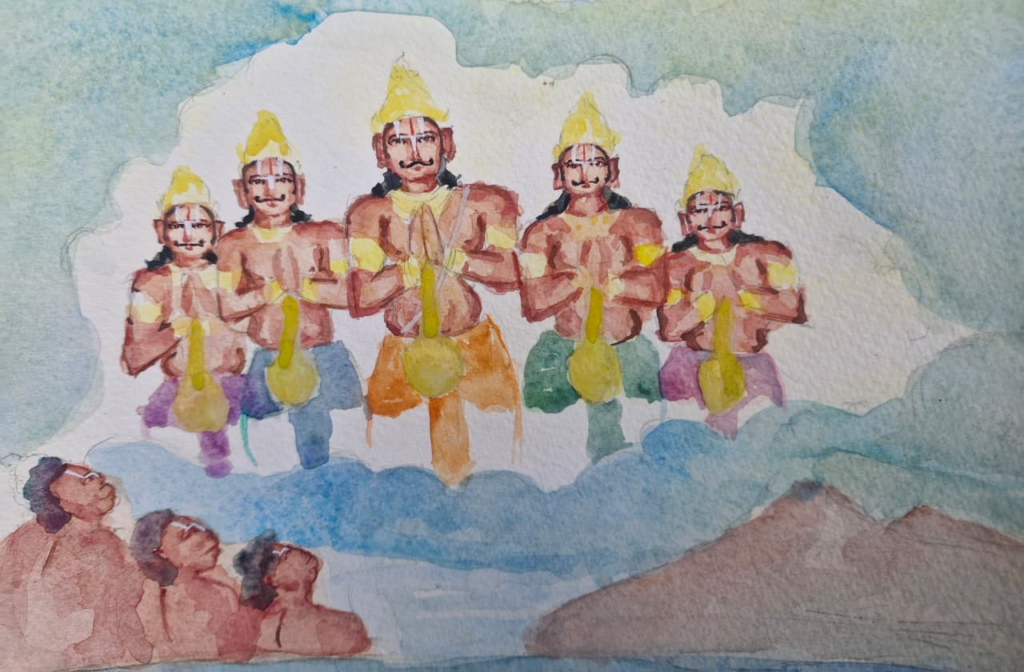
“Alright; you have informed us of your desire. We shall now wait and patiently inform perumAL of your arrival”. vibhIshaNAzhwAn, perceiving these to be the thoughts of sugrIva mahArAja and others, continues to speak.
- kshipram
Sensing their procrastination, vibhIshaNAzhwAn said, “No, this is not acceptable; you have to inform perumAL right away”. They asked him, “Why are you panicking”?
- kshipram
vibhIshaNAzhwAn asks them, “Have you not heard the [thamizh] proverb, ‘viraiyum kAryam thUngEl; thUngum kAryam viraiyEl’? (Do not delay things that need to be expedited; do not rush things that need time). They asked him to provide a reason, “Why are you asking us to expedite”?
- kshipram
[Note from kAlakshEpam: Why does vibhIshaNAzhwAn compel them to inform perumAL quickly? What is his intention?
It is commonly said that perumAL is always ready and waiting to protect us, but our minds are not always in the same receptive state. Therefore, a person must perform SaraNAgathi without any delay. This urgency is exactly what vibhIshaNAzhwAn is trying to accomplish. He thinks, “perumAL has come all the way to accept my SaraNAgathi, and I have only taken a few steps forward to arrive here. I want to surrender before my mind changes”.
arjuna speaks to krishNa about this exact volatility, noting, “chanchalam hi mana:” (the mind is restless). Similarly, thirumangai AzhwAr expresses this sentiment in periya thirumozhi. Their states of mind are remarkably alike. arjuna also spoke to krishNa while in deep distress, and thirumangai AzhwAr, overcome with profound sadness, described his own as anguish “vAdinEn vAdi” (suffered, having suffered)].
- SrI bhagavath gIthA 6-34 “chanchalam hi mana:” (Because the mind is (naturally) wavering).
- SrI rAmAyaNam ayOdhyA kANdam 4-20 “chalA hi prANinAm mathi:” (Are not the minds of living entities unstable)?
- periya thirumozhi 1-1-4 “ninRavA nillA nenjinai” (Having a heart that is not firm on anything).
Because the intellect constantly wavers, vibhIshaNAzhwAn says, “Before my devotion to perumAL drifts away, inform perumAL of my arrival”.
- kshipram
[Note from kAlakshEpam: When rAvaNa abducted pirAtti, she prayed to the forest deities to inform perumAL that she was forcibly taken. Unfortunately, none of them conveyed her message to perumAL].
- SrI rAmAyaNam AraNya kANdam 48-30 “kshipram rAmAya Samsadhvam sIthAm harathi rAvaNa:” (Quickly inform SrI rAma that sIthA is being abducted by rAvaNa).
Because the vana dhEvathAs did not inform perumAL immediately upon pirAtti requesting them, she became a captive of the ten-headed rAkshasa, rAvaNa. vibhIshaNAzhwAn therefore pleads, “In the same manner, before I am trapped by the rAkshasa, the terrifying mind with its ten senses as its ten heads, inform perumAL”.
- “dhaSEndhriyAnanam ghOram yO manO rajanIcharam” (The rAkshasa, a terrifying mind that has ten heads representing the ten sense organs).
- kshipram
Just as periyAzhwAr and ANdAL nAchchiyAr have called upon emperumAn’s devotees, “Get up quickly and join our gOshti immediately’, vibhIshaNAzhwAn asks, “You ought to invite and urge me to come quickly. Why, then, are you making me plead”?
- thiruppallANdu 4 “vandhollaik kUduminO” (come immediately and join our gOshti).
- thiruppAvai 15 “ollai nI pOdhAy” (You get up quickly).
- kshipram mAm nivEdhayatha
- SrI rAmAyaNam sundhara kANdam 39-9 “jIvanthIm mAm yathA rAma: sambhAvayathi kIrthimAn | thath thvayA hanuman vAchya:” (Oh, hanuman! While I am alive, you have to speak a word that would make SrI rAma celebrate me). [pirAtti requests thiruvadi to convey her message to SrI rAma that she wanted to hear SrI rAma talk about her while she is alive].
Just like pirAtti’s requests to thiruvAdi, vibhIshaNAzhwAn says, “Inform perumAL and give him the glory of accepting me while I am still able to sustain my life”.
- kshipram nivEdhayatha
- SrI rAmAyaNam yudhdha kANdam 17-14 “thyakthvA puthrAmScha dhArAmScha” (Having abandoned children and wife).
- thirumAlai 16 “mAdharAr kayal kaN ennum valaiyuL pattu azhundhuvEnaip pOdharE enRu sollip pundhiyuL pugundhu thanpAl Adharam peruga vaiththa” (I was sinking, caught in the beautiful fish-like eyes of women, but he called out to me ‘come here’ and entered my heart, creating a flood of affection towards him).
- SrI rAmAyaNam yudhdha kANdam 18-35 “dhaththam asya abhayam” (Protection has been granted to him).
Just as described by Azhwar, vibhIshaNAzhwAn says that he was previously caught in the net of the eyes of his wife and children (valaiyuL pattu azhundhuvEnai). However, he has now relinquished them all because perumAL had entered his mind (pundhiyuL pugundhu) and redirected his desires towards him (thanpAl Adharam peruga vaiththa). Therefore, he says to sugrIva mahArAja and others, “perumAL will undoubtedly offer me protection (dhaththamasyAbhayam). Yet, even before he declares it, if you perform your purushakAram [recommending me to him], you can receive greatness by doing so”.
- kshipram nivEdhayatha
perumAL vows to bestow protection when a jIvAthmA surrenders just once (sakrudhEva prapannAya). Similarly, the dhvayOpanishadh states that dhvayam is to be uttered only once (thadhdhvayam sakrudhuchchArO bhavathi). As such, vibhIshaNAzhwAn says that performing SaraNAgathi a second time out of his suffering would destroy the true nature of total surrender (prapaththi svarUpa hAni). Therefore, he requests, “Before such a destruction happens, please inform perumAL of my arrival”.
- dhvayOpanishadh “thadhdhvayam sakrudhuchchArO bhavathi” (It is ample if the dhvayam is uttered once).
- SrI rAmAyaNam yudhdha kANdam 18-33 “sakrudhEva prapannAya” (To anyone who surrenders unto me only once and asks for protection, I grant him protection against all entities).
[Note from kAlakshEpam: In this context, although it is said that the dhvayam needs to be recited only once, we constantly meditate upon it. The reason for this is described in detail in mumukshuppadi (sUthram 116-120). The dhvaya mahA manthram is such sweet that a jIvAthmA feels immense happiness through continuous mediation of it. Because of its sweetness, and because a prapanna (a surrendered AthmA) cannot perform anything as an upAyam, he repeatedly practices dhvaya anusandhAnam. Consequently, repeated recitation or mediation upon it – without the intention of performing it as an upAyam – is considered correct.
Furthermore, we see that AzhwArs have performed SaraNAgathi many times. nammAzhwAr performed SaraNAgathi in several padhigams – nORRa nOnbilEn, ArAvamudhE, mAnEy nOkku, piRandhavARum, and finally agalagillEn.
Why does AzhwAr repeatedly perform SaraNAgathi, even though it is said that SaraNAgathi should only be performed once? Can one do SaraNAgathi multiple times?
Our pUrvAchAryas have provided profound explanations for this. If SaraNAgathi is viewed strictly as an upAyam, even his first SaraNAgathi was not truly a means of surrender, because emperumAn had already accepted nammAzhwAr even before his formal surrender. This demonstrates emperumAn’s svAthanthryam (absolute independence) and his love for AzhwAr. This being the case, there was no independent necessity for AzhwAr to perform SaraNAgathi.
Instead, because AzhwAr remained in this material realm, despite gaining true knowledge bestowed by bhagavAn, he repeatedly demonstrates his intense desire to attain perumAL through these padhigams. Ultimately, all of AzhwAr’s actions are expressions of his vAchika kainkaryam and not an upAyam. Thus, there is no contradiction in his repeated surrender].
- kshipram nivEdhayatha
- lakshmee thanthram 17-75 “upAyO’yam chathurthasthE prOktha: Seeghrapalapradha:” (This fourth path [SaraNAgathi] that is taught to you yields results quickly).
- vishNu purANam 1-9-73 “thAvadhArthisthathA vAnchA thAvanmOhas thathA’sukham I yAvanna yAthi SaraNam” (Until there is total surrender unto the one who obliterates all the sins, only until such time there is unhappiness over lost wealth; only until such time there is longing to acquire wealth; only until such time there is bewilderment due to lack of AthmaprApthi (self-realisation), only until such time there is anguish due to the non-attainment of bhagavAn. (For all four types of devotees – Arthan, arthArthi, kaivalyanishtan, and bhagavathprApthan, total surrender (prapaththi) serves as ‘palasAdhanam’. This is the core essence).
vibhIshaNAzhwAn says, “Given the nature of the SaraNAgathi upAyam (Seeghrapalapradha:, yielding results fast), my desire to attain perumAL will surely be fulfilled. However, before that happens, you could show AnukUlyam (friendliness) towards me by informing perumAL”.
- kshipram mAm nivEdhayatha
- SrI rAmAyaNam yudhdha kANdam 18-35 “yadhi vA rAvaNa: svayam” (SrI rAma says to sugrIva, “Even if rAvaNa himself has come to surrender, don’t hesitate to bring him to me”).
vibhIshaNAzhwAn states that SrI rAma intends to reform rAvaNa, even if it requires searching for and capturing him. If that happens, there will be no punishment to rAvaNa, the ultimate sinner. Before that occurs, if you quickly inform perumAL of my arrival, upon hearing the news, he will feel satisfied thinking, ‘At least I secured his brother’. Therefore, he says, “Inform perumAL of my arrival quickly”.
- mAm nivEdhayatha
- SrI bhagavath gIthA 18-62 “thamEva SaraNam gachcha” (krishNa says: Follow me – surrender (to the supreme lord) in all manner).
vibhIshaNAzhwAn says, “You have revealed the ultimate protector to us. Now, please inform perumAL about us, who are surrendering to him”.
[Note from kAlakshEpam: A guru identifies bhagavAn to his Sishya (disciple), vibhIshaNAzhwAn tells sugrIva mahArAja and others, ‘Just as you have informed me about perumAL, please inform perumAL about me’].
They reply, “Okay, we shall do it, but who should we inform about you? Should we inform thiruvadi, with whom you were acquainted in lankA, or the leader of all the armies, sugrIva maharAja”?
- rAghavAya
vibhIshaNAzhwAn tells them, “Inform perumAL, who protects all – thiruvadi, sugrIva mahArAja, mAlyavAn, mountains such as chithrakUdam, without any distinction between sentient and insentient entities and without any shortcoming”.
- SrI rAmAyaNam kishkindhA kANdam 18-6 “ikshvAkUNAmiyam bhUmi: saSailavanakAnanA” (SrI rAma tells vAli – This earth along with the mountains, water bodies, forests, belongs to ikshvAku dynasty).
- nAchchiyAr thirumozhi 11-3 “pongOdham sUzhndha buvaniyum viNNulagum angAdhum sOrAmE ALginRa emperumAn” (emperumAn, who is SrImAn, without any shortcoming, is capable of ruling both this world, which is surrounded by ocean with agitating waves and parama padham).
- rAghavAya
vibhIshaNAzhwAn says, “Inform perumAL – who is born into a lineage celebrated as protectors of those who seek refuge (SaraNAgatha rakshakargaL) – of this SaraNAgathan”.
- rAghavAya
vibhIshaNAzhwAn says, “Inform perumAL, who has taken a pledge to grant protection (dhIkshitha, kAppuk kattinavan) to whoever surrenders to him”.
- SrI rAmAyaNam yudhdha kANdam 18-33 “sakrudhEva prapannAya – abhayam dhadhAmi – Ethadh vratham mama” (SrI rAma says: I bestow protection to the one who surrenders, even once. This is my vow).
[The idiom ‘kAppu (kangaNam) kattinavan’ means being firmly committed to a task].
- rAghavAya
vibhIshaNAzhwAn says, “Please inform the lord, SrI rAma, who, by virtue of his birth in the raghu clan, possesses the glory of granting all desires to those who seek them”.
- SrI rAmAyaNam bAla kANdam 21-2 “rAghavANAmayukthO’yam kulasyAsya viparyaya:” (This is not befitting for the descendants of raghu; this (breaking a vow) is contradictory to the nature of this lineage).
- raghuvamSam 11-2 “apyasupraNayinAm raghO: kulE na vyahanyatha kadhAchidharthithA” (In the dynasty of raghu, the requests of even those who begged for their lives have not become futile).
[Note from kAlakshEpam: perumAL eternally has all these glories; he is well-known as ‘sakala pala pradhO hi vishNu:’ (Lord vishNu is indeed the bestower of all rewards), his greatness shines even more prominently and beautifully in this birth, in the raghu lineage].
- rAghavAya
- SrI rAmAyaNam AraNya kANdam 10-19 “apyaham jIvitham jahyAm-na hi prathigyAm samSruthya” (SrI rAma says to pirAtti: I may give up my life, but will not give up my vow).
As declared by SrI rAma to pirAtti, vibhIshaNAzhwAn says, “Inform the lord – he who would sacrifice even his life to protect those who surrender to him”.
- rAghavAya mAm nivEdhayatha
- thiruvAimozhi 6-1-10 “mARil pOr arakkan madhiL nIRezhach cheRRugandha ERu sEvaganArkku” (To the majestic and exceedingly gallant lord, who rejoiced in destroying and reducing to ashes, the fortress of the incomparable rAkshasa king (rAvaNa)).
[Note from kAlakshEpam: In thiruvaNvaNdUr padhigam 6-1-10, AzhwAr says, “Tell the lord” (ERu sEvaganArkku) – “ennaiyum uLaL enmingaLE” (Tell him that she too still exists). AchAryas explain that just as a hunter easily recognises a deer by his own arrow, the lord will instantly identify parAnkuSa nAyaki simply by hearing them say ‘she still exists’, without her name even being mentioned. Similarly, this mirrors vibhIshaNAzhwAn’s request to sugrIva mahArAja and the other monkeys].
As such vibhIshaNAzhwAn says, “Please inform the lord – he who is ERu sEvaganAr – exceedingly gallant lord, about me”.
- rAghavAya mAm kshipram nivEdhayatha
- SrI rAmAyaNam sundhara kANdam 37-57 “rAghavasya yaSO hIyEth” (The glory of the lord, rAghavan, will diminish)
vibhIshaNAzhwAn says, “The lord is going to lose the fame earned through his active pursuit of protecting the rishi conglomerate, sugrIva mahArAja, kAkAsuran, and many others if I am not protected. Before he loses it, quickly inform him”.
“sathi dharmiNi dharmA:” (As long as the dharmi exists only, dharma can exist). That is, the attributes (dharma) can only exist when a fundamental subject exists (dharmi, in whom the attribtes are anchored). puththUr swAmy’s explanation: According to the popular convention [tamil proverb], “suvarai vaiththE chiththiram ezhudha vEndum” [You must have a wall to paint a picture], only if he (perumAL) exists, his glory shall exist.
[Note from kAlakshEpam: sugrIva mahArAja and others say to vibhIshaNAzhwAn, “suvarai vaiththE chithiram ezhudha vEndum” – “Only when there is a wall, a painting can be drawn on it, but by informing perumAL about you, if he is destroyed, all of his glories will also be lost”].
“prAptha: Sathruratharkitha:” – sugrIva mahArAja and others said, “We have not investigated you. You have come to cause us suffering and you are an enemy. How can we inform perumAL? We cannot permit you to join us in the pursuit of glory”.
- SrI rAmAyaNam yudhdha kANdam 17-26 “prAptha: Sathruratharkitha:” (An unexamined enemy, who has come to harm).
His greatness is such that even when the entire expanse is filled with enemies, not one person can even conceive of harming him.
- mahAthmanE
- “marthyAnAm maraNAdhbhayam” (Humans are fearful of death).
- “uththamAnAm thu marthyAnAm avamAnAth param bhayam” (But the noble people are fearful of dishonour).
vibhIshaNAzhwAn says, “You all fear mortality, but the supreme entity fears humiliation. Therefore, inform the lord who possesses such greatness – glory that makes him fear the disgrace that might befall him if a SaraNAgathan is not protected”.
[Note from kAlakshEpam: Previously, sugrIva mahArAja and others expressed concern that vibhIshaNAzhwAn might harm perumAL. Hence, vibhIshaNAzhwAn tells them that perumAL would not fear danger itself, rather he fears the disgrace that would occur if he fails to offer his protection].
- mahAthmanE
[In this context, “AthmA” refers to jIvAthmA, and paramAthmA is the one who is proximate to him].
- thaiththirIya upanishadh Anandhavalli 6 “thadhEvAnuprAviSath I thadhanupraviSya saScha thyachchAbhavath” (The supreme entity initially created the world. It pervaded the world. After pervading, it became both ‘chith’ (entities with power to think) and ‘achith’ (entities without power to think)).
[Note from kAlakshEpam: This explains anupravESam – bhagavAn’s pervasion into all matters. After pervading, it becomes both ‘chith’ and ‘achith’ means – bhagavAn has those sentient and insentient entities as his SarIram (body). Similarly, anupravESam should also be understood correctly. anupravESam literally means ‘entering into’. However, since paramAthmA is already the indweller of everything, how should this be understood?
One can only enter a place if they are absent from it. Since there is no place where perumAL is not already present, ‘pervading’, ‘entering into’ or anupravESam should instead be understood as the revelation of his existence. Through this pervasion, his existence – previously unknown – is made known. Thus, when he pervades, he has all substances as his body, establishing the SarIra SarIri bhAvam].
puththUr swAmy’s explanation:
The supreme entity thinks “If I incarnate, matching with jIvan, who has inferior knowledge and clan of birth, the jIvan may think ‘He (one, who has incarnated as human species) is like me’ and may retreat from surrendering”. The supreme entity, therefore, decides that the word ‘gyAnasvarUpan’ [embodiment of knowledge], which denotes the jIvan, would also indicate him, who has pervaded everywhere and remains as ‘antharyAmi’ [indwelling soul] of all. vibhIshaNAzhwAn says, “Inform that antharyAmi” of my arrival.
- mahAthmanE
[The word AthmA has several meanings].
In the following explanation AthmA refers to courage or determination – “Apadhyapi svakAryEshu karthavyathva sthithir dhruthi:” (Even in adversity, remaining firm in fulfilling one’s duties is courage).
“perumAL, the ultimate protector, remains firm in his protectorship (rakshakathvam), even in a perilous enemy territory. He will not abandon me”. One could also understand vibhIshaNAzhwAn’s words in this manner.
- mahAthmanE
Referring to AthmA as dhEham or body. “mahAdhEhAya” (One with a massive form). That is, perumAL’s thirumEni is extraordinary (vilakhshaNam). It is divine – not of material nature (aprAkrutham).
- vishNu purANam 6-7-70 “thadh viSvarUpa vairUpyam rUpamanyadhaharEr mahath” (The supreme lord, hari’s divine form is exceptional, transcendental, and massive).
- varAha purAnam 14-41 “na thasya prAkruthA mUrthir mAmsa mEdhOsthi sambhavA” (emperumAn’s divine form (thirumEni) is not material; it is not of flesh, fat or bone).
- vAyu purANam 4-40 “nithyam nithyAkruthidharam” (Existing eternally, with an eternal divine form).
As stated in the purANams, even when one intends to harm him, it will result in one destroying oneself in the process (like someone who bites a stone and breaks his own teeth), he exists eternally, possessing an exceptional divine form!
- mahAthmanE – This explanation refers to AthmA as svabhAvam (an inherent nature)
In matters related to those who have surrendered to him, his nature (svabhAvam) is to naturally remove the undesired (suffering)/ anishta nivruththi and bestow the desired (eternal service)/ ishta prApthi. These qualities are inherent, rather than extraneous or acquired. Furthermore, he grants all of these naturally, without expecting anything in return.
nivEdhayatha mAm kshipram vibhIshaNamupasthitham I
sarvalOkaSaraNyAya rAghavAya mahAthmanE II
vyAkhyAnam for this SlOkam will be continued in the next article.
AzhwAr emperumAnAr jIyar thiruvadigaLE SaraNam
periyavAchchAn piLLai thiruvadigaLE SaraNam
Source – SrI rAmAyaNa thani SlOkam – 60 – yudhdha kANdam 17.15 – nivEdhayatha – Part 4 Audio Video
adiyEn chithrA rAmAnuja dhAsi
Proofreading/Curating done by – kOsalEndhra rAmAnuja dhAsan, krishNan rAmAnuja dhAsan
Artwork – namperumAL rAmAnuja dhAsan
Related Links
SrI rAmAyaNa thani SlOkam – 59 – yudhdha kANdam 17.15 – nivEdhayatha – Part 3 Audio Video
SrI rAmAyaNa thani SlOkam – 58 – yudhdha kANdam 17.15 – nivEdhayatha – Part 2 Audio Video
SrI rAmAyaNa thani SlOkam – 57 – yudhdha kANdam 17.14 – sO’ham, 17.15 – nivEdhayatha – Part 1 Audio Video
SrI rAmAyaNa thani SlOkam – 56 – yudhdha kANdam 17.12 – thamaham hEthubhi:, 17.13 – sa cha na Audio Video
SrI rAmAyaNa thani SlOkam – 55 – yudhdha kANdam 17.11 – thEna sIthA Audio Video
SrI rAmAyaNa thani SlOkam – concise english meanings
archived in https://granthams.koyil.org
pramEyam (goal) – https://koyil.org
pramANam (scriptures) – https://granthams.koyil.org
pramAthA (preceptors) – http://acharyas.koyil.org
SrIvaishNava education/kids portal – http://pillai.koyil.org