SrI: SrImathE SatakOpAya nama: SrImathE rAmAnujAya nama: SrImath varavaramunayE nama:
The extremely merciful periyavAchchAn piLLai has selected and provided vyAkhyAnam for important SlOkams from SrI rAmAyaNam in SrI rAmAyaNa thaniSlOka grantham. Specifically, he has chosen many SlOkams from yudhdha kANdam and explained vibhIshaNa SaraNAgathi in detail. puththUr swAmy has published this grantham along with an exquisite thamizh commentary. Through these granthams, we are learning the indepth meanings of the SlOkams in SrI rAmAyaNam.
In this series, we have so far learnt that vibhIshaNAzhwAn has come from lankA and, while standing in the sky, requests sugrIva mahArAja and others to inform perumAL that he has come seeking perumAL’s refuge. sugrIva mahArAja informs perumAL about vibhIshaNAzhwAn with much anxiety. He conveys his perspective that vibhIshaNAzhwAn is an enemy who has come with an intent to spy and cause harm, and who might even attack at an opportune moment. He conveys emphatically to perumAL that vibhIshaNa must be killed.
However, perumAL’s divine will is to offer protection and accept vibhIshaNAzhwAn. Therefore, upon hearing this, perumAL intends to make sure sugrIva mahArAja and others understand his intentions. We are right now enjoying this juncture where perumAL begins to speak in order to convince them.
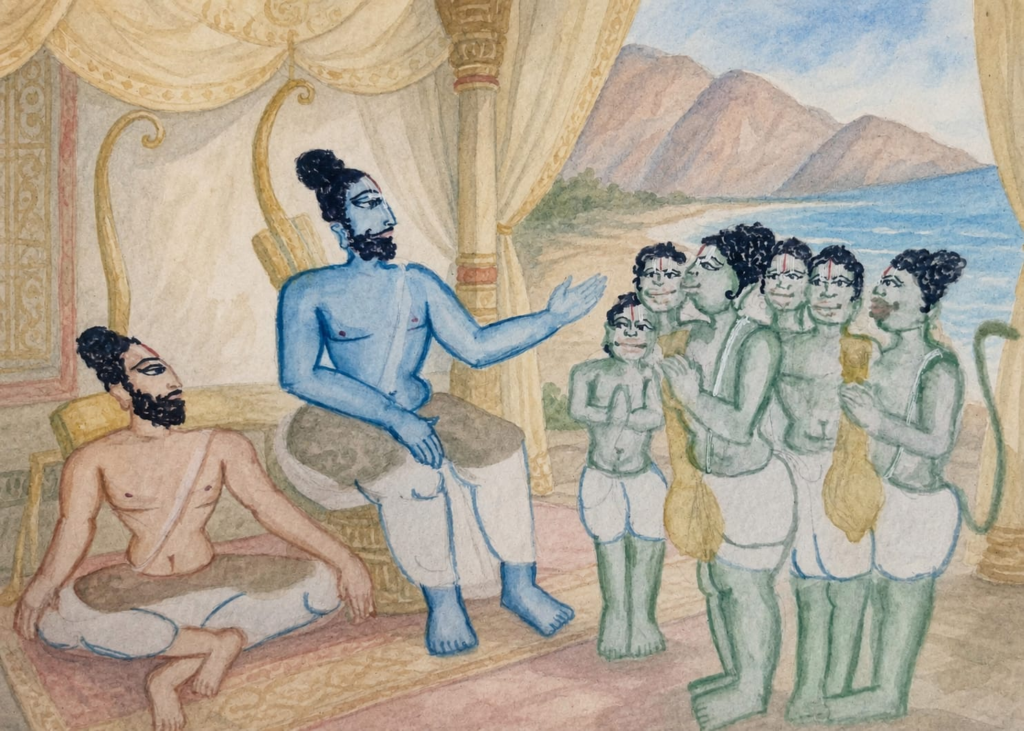
perumAL addressed thiruvadi and others and said, “sugrIva mahArAja has thus spoken what was necessary to be heard about vibhIshaNa, along with valid reasons. You all have heard it too. What are your intentions?”
Before proceeding with the vyAkhyAnam, we express our gratitude to periyavAchchAn piLLai and puththUr swAmy, as well as to SrI u vE sArathy thOthAthri swAmy. This article is a translation of periyavAchchAn piLLai’s thaniSlOka vivaraNam with the support of SrI sArathy swAmy’s thamizh kAlakshEpam series.
avathArikai (Introduction)
In the previous SlOkam, perumAL asked thiruvadi and other monkeys, “bhavathbhirapi thachchrutham?” Anticipating a definite response, perumAL asked, “Haven’t you all heard sugrIva mahArAja’s words?” However, the monkeys, aware of their subordination to both sugrIva mahArAja and perumAL, did not deem it appropriate to make a decision. Realising their ubhaya pArathanthryam [dependence on perumAL as well as on sugrIva] , perumAL says, “Since you are all well-wishers, it is suitable for you to counsel”. perumAL conveys this in the following SlOkam.
suhrudhA hyarthakruchchrEshu yuktham budhdhimathA sathA I
samarthEnApi sandhEshtum SASvathIm bhUthimichchathA II
Word-by-word meaning
arthakruchchrEshu – in difficult matters
budhdhimathA – as an intelligent person
sathA – virtuous
samarthEna – competent
SASvathIm – constant
bhUthim – prosperity
ichchathA – as one desiring for it
suhrudhA hi – by friend
sandhEshtum api – to instruct
yuktham – appropriate
Simple meaning
[perumAL says] An intelligent and competent person desiring prosperity of his friends should instruct appropriately during difficult times. Therefore, tell your opinion.
Notes from periyavAchchAn piLLai’s vyAkhyAnam
suhrudhA hi
suhruth means a well-wisher. “SObhanam ASamsathIthi suhruth” – One who is interested in your well-being, is a friend or is a well-wisher. Even when they are not present nearby, or when they have not seen you in a long time, they desire nothing but their friend’s well-being. And in times of difficulty, they feel their friend’s pain.
[puththUr swAmy’s explanation
suhrudhA hi – by a friend or well-wisher
According to the etymological derivation of the word suhruth, “One who is genuinely interested in your wellness is your well-wisher”, even when they are not present with you, they only desire your well-being. In other words, upon seeing the distress, they instantly grieve for you, thinking, “Alas!” ]
What should a friend do during a dilemma – arthakruchchrEshu, or when there is an obstacle in deciding whether or not to do something? Such as when vibhIshaNAzhwan sought refuge in rAghava, but sugrIva mahArAja believed he should be killed. vibhIshaNAzhwAn would not survive if he were denied protection, yet sugrIva mahArAja would not endure if vibhIshaNAzhwAn went unpunished.
[puththUr swAmy’s explanation
arthakruchchrEshu – a state of extreme quandary
- SrI rAmAyaNam yudhdha kANdam 17-14 “rAghavam SaraNam gatha:” (I have surrendered to rAghavan). vibhIshaNAzhwAn revealed his inability to survive if he were not accepted by perumAL.
- SrI rAmAyaNam yudhdha kANdam 17-24 “thasyA’ham nigraham manyE” (Killing him is most appropriate). sugrIva mahArAja could not prevail if vibhIshaNAzhwAn was not killed].
When unable to decide on a resolution during such a dilemma, what is the role of a friend?
budhdhimathA – by a wise person, who is competent to determine what is righteous; and what is unrighteous.
samarthEna – by a person capable of assertively conveying an irrefutable decision.
SASvathIm bhUthimichchathA refers to one who desires the everlasting prosperity of another
What is considered ‘eternal wealth’ here? perumAL has taken a supreme vow to protect anyone who surrenders to him, and the fulfilment of this divine vow represents permanent wealth for perumAL. Therefore, SASvathIm bhUthim ichchathA means one who desires for perumAL’s divine will to prevail. perumAL considers his body of glory to be eternal; therefore, he feels that sugrIva mahArAja is focusing on impermanent wealth by worrying about potential harm to perumAL’s divine form.
[Note from kAlakshEpam: perumAL thinks, “Having come thus far to accept vibhIshaNa, killing him will destroy my glory. Even my existence will not prevail if I do not protect the one who came to surrender to me”].
sathA – by the virtuous
His whole purpose must always be to desire his friend’s prosperity.
SASvathIm bhUthimichchathA sathA
[When it is interpreted together] that is, one who desires permanent wealth for his friend, and upon its attainment by his friend, feels his own existence.
api sandhEshtum yuktham – it is appropriate to offer counsel
It is indeed essential that you offer your counsel. This absolute requirement to offer counsel is conveyed by the word api. As said, “AkESagrahaNAn mithram” (Until you are pushed away by being held your hair, it is appropriate to offer advice to a friend) – it is the proper duty of a friend to offer beneficial advice.
[puththUr swAmy’s explanation
The word api is used here as an emphatic particle/suffix. “One should continue to offer advice to a friend until they are literally grabbed by the hair and pushed away” – based on this saying, it is absolutely appropriate for such a friend to offer counsel].
Even when his servitors do not act according to his will and cause him displeasure, perumAL rectifies all anomalies through them, without any feeling of anger towards them. Thus, this SlOkam demonstrates perumAL’s ASritha pArathanthryam, a divine quality where the supreme lord, by his own will, chooses to be subservient to his devotees.
[puththUr swAmy’s explanation
Even when his servitors do not follow his intentions, display resistance, and cause perturbation, SrI rAma surrenders to their choice, and decides to remove all the perturbations through them. Thus, SrI rAma’s ASritha pArathanthryam – a state of the supreme lord being subject to the will of his devotees – is illustrated in this SlOkam].
suhrudhA hyarthakruchchrEshu yuktham budhdhimathA sathA I
samarthEnApi sandhEshtum SASvathIm bhUthimichchathA II
Thus concludes the vyAkhyAnam for this SlOkam.
SrI rAmAyaNa thani SlOkam yudhdha kANdam 17.32 – ithyEvam
The monkeys expressed their opinions.
avathArikai (Introduction)
Upon SrI rAma asking the monkeys, they reverently spoke their respective opinion in this SlOkam.
ithyEvam pariprushtAs thE svam svam matham athandhrithA: I
sOpachAram thadhA rAmam Uchur hitha chikIrshava: II
Word-by-word meaning
ithi – saying that
Evam – in this manner
pariprushtA: – asked/ questioned
thE – those monkeys
athandhrithA: – with attentiveness
hitha chikIrshava: – desiring to do good (for SrI rAma)
thadhA – at that time
rAmam – to SrI rAma
sOpachAram – with respect along with praises
svam svam matham – their respective opinion
Uchu: – spoke
Simple meaning
Enquired by SrI rAma, the attentive monkeys, desiring to do good, humbly spoke their respective opinion and offered their praises to SrI rAma at that time.
Notes from periyavAchchAn piLLai’s vyAkhyAnam
ithyEvam
ithyEvam combines the particles ithi (“thus”) and Evam (“in this manner”), which share closely related meanings. Through their juxtaposition, they highlight both the expressive delivery of the words and the tone (of gentle persuasion).
pariprushtAsthE –
paripraSna – paritha: praSna – asking in a roundabout manner; pari sthithvA praSna – asking in a surrounding manner.
paritha: praSna – Instead of directly asking the monkeys whether they accept or do not accept vibhIshaNa, just like sugrIva mahArAja, perumAL wanted them to be convinced and accept his opinion on their own terms. As said in “suhrudhA sandhEshtum yuktham”, he asks them subtly because it is befitting for one who desires the well-being of a friend to offer counsel.
pari sthithvA praSna – Since the word api is used, it can be interpreted as asking in an accommodative manner that it cannot be denied.
Thus, it can be understood that perumAL did not question in a manner displaying his superiority; rather, he asked in a manner like a Sishya asking his AchArya.
[puththUr swAmy’s explanation
pariprushtAsthE – those who were questioned
paripraSna – can mean either paritha: praSna – roundabout questioning or pari sthithvA praSna – surrounding and questioning.
Round about questioning – This refers to not asking directly – that is, talking in circles to gain support for one’s perspective. For instance, if perumAL were to ask directly, “Just like sugrIva, do you also dislike accepting vibhIshaNa, or do you like it?” the monkeys, out of their respect for sugrIva, might reply, “We also dislike it”. Therefore, instead of questioning them directly, he asks hanuman and others in a roundabout manner to understand their support. SrI rAmAyaNam yudhdha kANdam 17-31 “suhrudhA sandhEshtum yuktham” (Friends must indeed offer their good counsel) – this is paritha: praSna.
pari sthithvA praSna – surrounding and asking. The word api indicates that it is a question posed in a tone of gentle persuasion, as if saying, “You heard it too, didn’t you”? Thus, he enquired in a way that accommodated their opinion.
Therefore this signifies that perumAL did not assert his superiority and command them authoritatively. Instead, he enquired with humility like a Sishya asking his AchArya].
thE – they
Who are they? They are those who understood the nature of his enquiry and possessed the intellect to arrive at a conclusion.
svam svam matham – each expressing their respective opinion
sugrIva mahArAja had earlier said, “thEshu jAthu na viSvasEth” – one must never place trust in them. Therefore, even if the monkeys were to agree with his contentions, the matter must still be investigated along with their reasons. [In other words, without blindly accepting sugrIva mahArAja’s decision, they must analyse and express their opinions only after reasoning].
- SrI rAmAyaNam yudhdha kANdam 17-19 “thEshu jAthu na viSvasEth” (Never place your trust in them).
athandhrithA: – diligent
They were highly diligent in all matters pertaining to SrI rAma.
sOpachAram – with reverence and praise
Along with praising perumAL’s greatness.
thadhA – at that time
Then, when perumAL was waiting to hear their favourable words.
hitha chikIrshava:
Although they wished to please perumAL on one hand, they were more concerned with his welfare.
rAmam Uchu: – spoke to SrI rAma
ithyEvam pariprushtAs thE svam svam matham athandhrithA: I
sOpachAram thadhA rAmam Uchur hitha chikIrshava: II
Thus concludes the vyAkhyAnam for this SlOkam.
SrI rAmAyaNa thani SlOkam yudhdha kANdam 17.33 – agyAtham
The monkeys say, “SrI rAma! You are of supreme nature, yet you elevate your own exaltedness by asking for our opinion, celebrating our friendship”.
avathArikai (Introduction)
In the previous SlOkam it was described that the monkeys spoke to SrI rAma accompanied by their praises for him (sOpachAram). The respectful manner in which they spoke to perumAL is explained in this SlOkam and in the one following.
Through the first SlOkam, the monkeys highlight perumAL’s greatness, “dhEvarIr (Your highness) is omniscient, yet dhEvarIr asks our opinion. This can only signify that dhEvarIr chooses to fulfil what is desired by your devotees. Does this not add to dhEvarIr’s greatness”?
agyAtham nAsthi thE kinchith thrishulOkEshu rAghava I
AthmAnam pUjayan rAma pruchchasyasmAn suhruththayA II
Word-by-word meaning
rAghava – SrI rAma, the shining jewel of raghu dynasty!
thE – to you
thrishulOkEshu – in the matters of people of three types
agyAtham – the unknown
kinchith – even a little
na asthi – does not exist
AthmAnam – you
pUjayan – glorifying
suhruththayA – through friendship
asmAn – us
pruchchasi – you are asking
Simple meaning
SrI rAma! There is nothing unknown to you regarding the three types of people. You are consulting us, honouring our friendship.
Notes from periyavAchchAn piLLai’s vyAkhyAnam
thrishulOkEshu thE’gyAtham kinchith nAsthi
perumAL who is naturally omniscient regarding the innumerable entities – whether they are anukUlar (well-wishers), prathikUlar (ill-wishers), madhyasthar (those indifferent to others’ welfare). He is fully knowledgeable of their true nature and inherent dispositions. He knows who is noble and who is lowly, and he understands as to what must be embraced and renounced by each entity; indeed, there is nothing he is unaware of.
[The word ‘naturally’ differentiates him from nithyars and mukthars. Although nithyars and mukthars are also omniscient, their omniscience is attained through emperumAn’s grace. Only perumAL is inherently omniscient].
Instead of saying he is knowledgeable of everything, “agyAtham – nAsthi (i.e, unknown – does not exist) two negatives have been used. This is to firmly establish the fact that there is nothing emperumAn does not know.
[puththUr swAmy’s explanation
thrishulOkEshu thE’gyAtham kinchith nAsthi – there is nothing unknown to you [perumAL] in all the three worlds.
In this context, the word ‘lOkEshu’ refers to sentient entities. You naturally know everything about all the three types of sentient entities – well-wishers, enemies, and neutrals. There is nothing you do not know about their true nature, inherent dispositions, the disparities, and the demarcation between what is to be possessed and what is to be rejected. By stating ‘there is nothing unknown’ using double negatives, rather than saying ‘Knows everything’, the words highlight the certainty and validity of this statement.]
rAghava
The monkeys address perumAL as rAghava here, to indicate that his being omniscient and possessing the auspicious qualities are all by his birth in the supreme raghu dynasty. He is glorious and wise, “yaSasvI gyAnasampanna:”.
- SrI rAmAyaNam bAla kANdam 1-12 “yaSasvI gyAnasampanna:” (Glorious and wise).
rAma suhruththayA AthmAnam pUjayan asmAn pruchchasi – SrI rAma! By consulting us and considering us as your friends, you only elevate your own greatness
The monkeys say, “SrI rAma! You have brought to light this great virtue of yours – a divine will that solely desires the well-being of those who seek your refuge. For the world to celebrate this eminence – that perumAL will not do anything other than that said by the devotees, and it is for this very reason, the omniscient, is consulting with us, who belong to species of animals with no recourse to dhEvarIr’s level of knowledge.
agyAtham nAsthi thE kinchith thrishulOkEshu rAghava I
AthmAnam pUjayan rAma pruchchasyasmAn suhruththayA II
Thus concludes the vyAkhyAnam for this SlOkam.
SrI rAmAyaNa thani SlOkam yudhdha kANdam 17.34 – thvam hi
avathArikai (Introduction)
What dhEvarIr has to do for the sake of those surrendered to you, you do not have to ask anyone, dhEvarIr can do it independently
While dhEvarIr is independent and has no need to ask anyone to do the needful for the sake of those surrendered to you, why have you placed this decision making responsibility upon us? How can one explain this disposition of dhEvarIr? Out of their extreme affection for perumAL, the monkeys convey thus, in the following SlOkam.
thvam hi sathyavratha: SUrO dhArmikO dhruda vikrama: I
parIkshya kArI smruthimAn nisrushtAthmA suhruthsu cha II
Word-by-word meaning
thvam hi – only you (dhEvarIr)
sathyavratha: – one whose resolve never fails
SUra: – one who possesses magnificent bravery
dhArmika: – righteous
dhruda vikrama: – steadfast in accomplishing the deeds
parIkshya kArI – one who executes any deed only after thorough investigation
smruthimAn – one who remembers (past deeds)
suhruthsu – towards well-wisher
nisrushtAthmA cha – one who has entrusted one’s own self
Simple meaning
dhEvarIr alone is the one whose resolve never fails, who posesses magnificent bravery, who is righteous, who is steadfast in accomplishing the deeds, who takes actions only after proper investigation, who remembers everything. You surrender yourself to your good friends.
Notes from periyavAchchAn piLLai’s vyAkhyAnam
thvam
This conveys the greatness of the lord, in whom all the virtues mentioned here reside. [In other words, perumAL is the repository for these virtues reside, and they achieve glory because they reside within him]. For those other than bhagavAn, their excellence is dependent upon their qualities. [For instance, a person is described as a virtuous or unvirtuous person based on qualities like their servitude, devotion, knowledge, etc]. However, for bhagavAn, his own divine form constitutes his greatness, and these auspicious qualities gain their auspiciousness solely because they belong to bhagavAn. kUrathAzhwAn has also described the same as “guNAyaththam lOkE” (Among the people in this world, their glory is dependent upon a person’s qualities).
[puththUr swAmy’s explanation
thvam – you (dhEvarIr) – abode for the qualities which are mentioned
They convey the greatness of the divine form of the supreme lord, the abode of the qualities mentioned herein. Except for bhagavAn, the excellence of all others is derived from their virtues. In contrast, for bhagavAn, the qualities themselves derive their excellence from their association with the supreme lord.
kUraththAzhwAn has also described the same in SrI varadharAja sthavam 11, “guNAyaththam lOkE guNishu hi matham mangaLapadham viparyastham hasthikshithidharapathE thath thvayi puna: I guNA: sathyagyAnaprabhruthaya utha thvathgathathayA sUbhIbhUyam yAthA ithi hi niraNaishma SruthivaSAth II” (In this world, the phrase “They are virtuous” is attained because of qualities they possess. Oh, the lord of aththigiri! In your case, this is reversed. Because, we understand from the vEdham that qualities such as sathyam and gyAnam attained their auspiciousness only upon attaining you).]
hi – indeed
Indeed, as indicated in the previous SlOkam – suhruththayA – out of friendliness.
sathyavratha: Unfailing resolve. “abhayam sarvabhUthEbhyO dhadhAm yEthadhvratham mama” – This is perumAL’s vow to protect everyone who seeks his refuge. This vow is infallible.
- SrI rAmAyaNam yudhdha kANdam 18-33 “abhayam sarvabhUthEbhyO dhadhAmi Ethadhvratham mama” (I shall give him assurance of safety from all entities. This is my vow).
[Here, we can notice that the description of each quality connects with the quality that is said before it].
SUra:
Possessing the acumen to destroy the obstacles that impede his rakshkathvam, or protectorship is SUrathvam.
[Since he possesses SUrathvam, will he resort to any means to destroy his obstacles?]
dhArmika:
He acts strictly in accordance with righteousness. Alternatively, dhArmika: can also be understood as one who possesses the virtue of protectorship entirely for protection of his devotees rather than for any personal gain.
dhruda vikrama: – one whose actions are firm and well-determined. His action cannot be undone or destroyed by anyone; that is, no one – not even his own devotees – can undo what he has done.
[puththUr swAmy’s explanation
dhruda vikrama: – a person of decisive action
His actions are indestructible by anyone. In other words, even if his devotees intended to destroy it, neither they nor anyone else – including brahmA, rudhra,indhra et al – could destroy them].
parIkshya kArI – one who deliberates thoroughly before taking action.
When waging a battle for the benefit of those surrendered to him, perumAL executes his actions with deliberate care. That is, through his bravery, he destroys the external hostility that threatens his devotees. On the other hand, he destroys the afflictions that a devotee brings upon himself through committed sins with his compassion and patience. “dhAsyam aiSvaryavAdhEna” (Acting as a servant, while holding the position of master). “yasyAmruthAmalayaSa: SravaNAgAha:” (Hearing the uncontaminated glories which are sweeter than nectar).
[puththUr swAmy’s explanation
parIkshya kArI – one who performs an action only after thorough analysis.
In matters concerning the protection of his devotees, perumAL is highly deliberate in how he acts. To destroy the external enemies of his devotees, he resolves to annihilate them through his bravery. However, regarding the internal enemies of his devotees, such as the shortcomings or offences arising from within them, he analyses the situation and acts with a different mindset – ‘we shall eliminate this through patience’.
- mahAbhAratham SAnthi parvam 81-5 “dhAsyam aiSvaryavAdhEna gyAthInAncha karOmyaham I ardhabhOkthA cha bhOgAnAm vAgdhurukthAni cha kshamE II” (Calling myself as ISwaran, I engage in services to my relatives. I enjoy only a portion of the pleasures. And tolerate their harsh words too).
- SrI bhAgavatham 3-16-6 “yasyAmruthAmalayaSa: SravaNAvagAha: sadhya: punAthi jagadhASvapachAdhvikuNta: I sO’ham bhavadhbhya upalabdha suthIrtha kIrthi: chindhyAm svabAhumapi va: prathikUlavruththim II” (When bathed in the form of hearing, one whose flawless glories, which are sweeter than nectar, purifies no matter how lowly the person is (even if he is living by cooking and eating the flesh of a dog), I, vaikuNtanAthan, glorified by you as that supreme purifier, will not hesitate to severe connection with my hands if it is hostile towards you). Oh, indeed, he said it himself!]
smruthimAn – someone who possesses flawless memory
Knowledge born earlier becomes the subject of memory. Consequently, even when his devotees knowingly commit errors, he recalls their surrenderance unto his divine feet and tolerates their mistakes.
nisrushtAthmA suhruthsu cha – he entrusts himself to his devotees
Although perumAL is the ultimate protector in every aspect, he nevertheless submits himself to his devotee and allows them to dictate his actions. Even if one were [hypothetically] able to experience and relish to its fullest some of the auspicious qualities of perumAL, this supreme divine quality – wherein perumAL entrusts his own self to his devotees – remains beyond anyone’s comprehension.
Further, the word cha indicates a collection, implying that many other unstated divine qualities of perumAL are also included here.
thvam hi sathyavratha: SUrO dhArmikO dhruda vikrama: I
parIkshya kArI smruthimAn nisrushtAthmA suhruthsu cha II
Thus concludes the vyAkhyAnam for this SlOkam.
AzhwAr emperumAnAr jIyar thiruvadigaLE SaraNam
periyavAchchAn piLLai thiruvadigaLE SaraNam
Source – SrI rAmAyaNa thani SlOkam – 67 – yudhdha kANdam 17.31 – suhruthA, 17.32 – ithyEvam, 17.33 – agyAtham, 17.34 – thvam hi Audio Video
adiyEn chithrA rAmAnuja dhAsi
Proofreading/Curating done by – kOsalEndhra rAmAnuja dhAsan, krishNan rAmAnuja dhAsan
Artwork – namperumAL rAmAnuja dhAsan
Related Links
SrI rAmAyaNa thani SlOkam – 66 – yudhdha kANdam 17.28 – EvamukthvA , 17.29 – sugrIvasya, 17.30 – yadhuktham Audio Video
SrI rAmAyaNa thani SlOkam – 65 – yudhdha kANdam 17.24 – rAvaNO praNihitham, 17.25 – rAkshasO jihmayA , 17.26 – pravishta: Sathrusainyam, 17.27 – vadhyathAmEsha Audio Video
SrI rAmAyaNa thani SlOkam – 64 – 17.20 – praNidhI rAkshasEndhrasya, 17.21 – athavA svayamEvaisha, 17.22 – mithrAtavI balam, 17.23 – prakruthyA Audio Video
SrI rAmAyaNa thani SlOkam – 63 – yudhdha kANdam 17.16 – Ethaththu vachanam, 17.18 – manthrE vyUhE, 17.19 – anthardhAnagathA Audio Video
SrI rAmAyaNa thani SlOkam – 62 – yudhdha kANdam 17.15 – nivEdhayatha – Part 6 Audio Video
SrI rAmAyaNa thani SlOkam – concise english meanings
archived in https://granthams.koyil.org
pramEyam (goal) – https://koyil.org
pramANam (scriptures) – https://granthams.koyil.org
pramAthA (preceptors) – http://acharyas.koyil.org
SrIvaishNava education/kids portal – http://pillai.koyil.org