SrI: SrImathE SatakOpAya nama: SrImathE rAmAnujAya nama: SrImath varavaramunayE nama:
The extremely merciful periyavAchchAn piLLai has selected important SlOkams from SrI rAmAyaNam and provided us with a vyAkhyAna grantham known as SrI rAmAyaNa thani SlOkam.
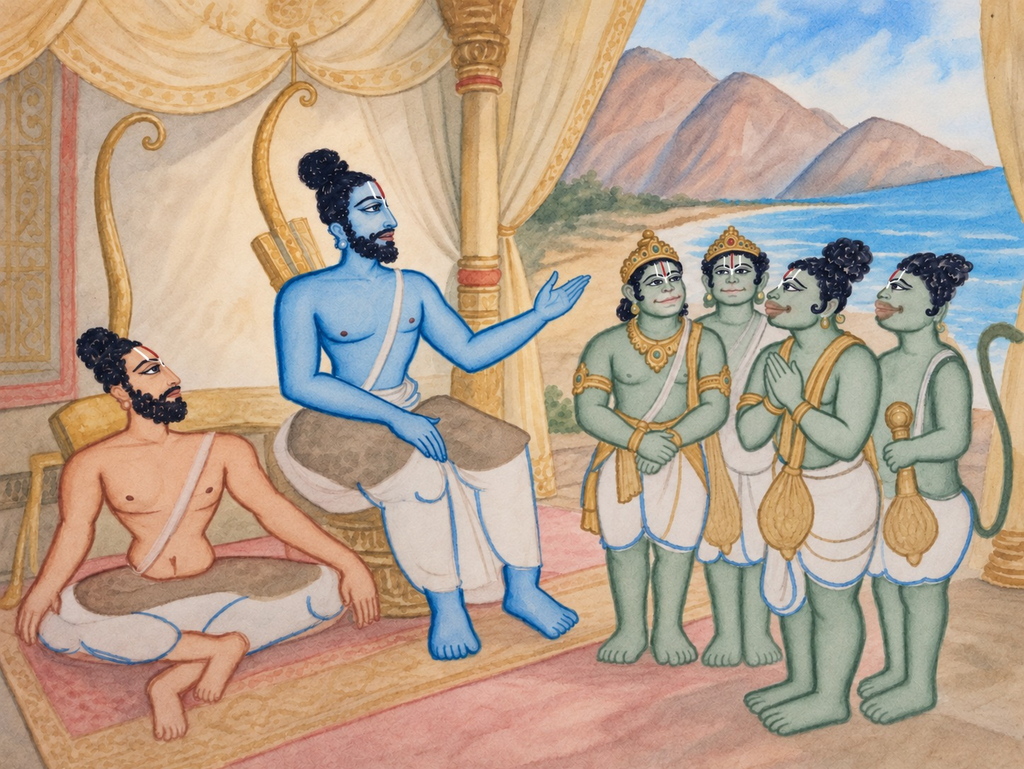
We are currently enjoying the yudhdha kANdam in this series. vibhIshaNa surrenders to perumAL. sugrIva mahArAja and others suspect his motives, describe him to be untrustworthy, and express their concerns. perumAL responds to them in a pacifying manner and declares his divine will to accept vibhIshaNa – who has surrendered to him – irrespective of whether he has faults or not. He explains to them that those who seek refuge must be protected even at the cost of one’s own life.
perumAL explains in this SlOkam that even if vibhIshaNa had arrived posing as a friend, or even if he is suspected of bearing defects and prone to being dangerous, we must still protect him. The virtuous will not reproach for accepting him in spite of his faults.
mithrabhAvEna samprAptham na thyajEyam kathanchana I
dhOshO yadhyapi thasya syAth sathAmEthadhagarhitham II
Furthermore, periyavAchchAn piLLai explains that vibhIshaNAzhwAn’s surrender possesses all of the essential attributes of SaraNAgathi.
Similar to krishNa charama SlOkam, prapatthi – the charama upAyam – the ultimate means, is declared here. Therefore, this SlOkam bestowed by perumAL is celebrated as a charama SlOkam.
All of this has been published by puththUr swAmy along with a beautiful thamizh commentary. We are learning the meanings of these SlOkams through these granthams. We express our gratitude to periyavAchchAn piLLai and puththUr swAmy. We also express our gratitude to SrI u vE sArathy thOthAthri swAmy. This article is a translation of periyavAchchAn piLLai’s commentary, summarised with the support of SrI sArathy swAmy’s thamizh kAlakshEpam series.
In this SlOkam, perumAL says, ‘Whether one surrenders consciously with complete awareness of their action, or otherwise, if they surrender unto me with firm conviction, I will not abandon them, even if they have faults’.
Notes from periyavAchchAn piLLai’s vyAkhyAnam
perumAL speaks, realising that a question may arise in sugrIva’s thoughts –
Shouldn’t dhEvarIr accept vibhIshaNa in spite of his faults, only if he considers dhEvarIr to be all of his relations and surrenders to dhEvarIr?
[1] mithrabhAvEna samprAptham – he arrived as a friend. [perumAL speaks] Did you see his plight? He abandoned rAvaNa, who was born from the very same womb as he, and sought refuge in me.
[2] mithrabhAvEna samprAptham – he arrived as a friend. [perumAL speaks] He did not come with the mindset of an enemy. Our friend, sugrIva mahArAja, incorrectly assumed that vibhIshaNa is a foe. Notice that he has indeed come as a friend.
- SrI rAmAyaNam yudhdha kANdam 17-26 “prAptha: Sathruratharkitha:” ([sugrIva mahArAja says] The enemy has approached us, and he has not yet been examined).
[3] mithrabhAvEna – as a friend. [perumAL speaks] He did not arrive as a spy, as pointed out by you; he indeed came as a friend.
[4] mithrabhAvEna – as a friend. According to the definition “mithAth thrAyatha ithi mithram”, a friend is one who evaluates a favour received and offers protection by returning that favour. However, this definition does not seem appropriate in this context. By killing rAkshasas such as thAtakA, subAhu, mArIcha, virAdhan, khara, dhUshaNa, thriSiras, kabandhan – and completely vanquishing the pride of the rAkshasas – perumAL brought nothing but adversity to the rAkshasas. Therefore, vibhIshaNa does not owe, nor does he need to return, any favour to perumAL [to fit this definition of a friend]. Thus, vibhIshaNa’s mere arrival suffices for him to be considered as a friend; he cannot be called a friend by the aforementioned definition.
Suppose, however, vibhIshaNa were to return a matching favour to perumAL – is such a thing even a possibility? When perumAL bestows his grace, he gives everything – not only both the material and spiritual realms but also his very self.
- SrI rAmAyaNam yudhdha kANdam 1-14 “Esha sarvasvabhUthasthu parishvanga:” (perumAL embraced hanumAn, and this embrace provided all the satisfaction to hanumAn). [Note from kAlakshEpam: The satisfaction hanumAn received was so immeasurable that when perumAL was ready to ascend to paramapadham, he invited hanumAn to come with him. hanumAn replied, “The scent of dhEvarIr’s embrace is still present with me. I do not wish to let go of it. Therefore, I desire to remain here and experience it eternally”].
- periya thirumozhi 5-8-5 “bOgam nI eydhip pinnum nammidaikkE pOdhuvAy enRa ponnaruL” (It is your befitting mercy that you said, ‘After experiencing the pleasure of this world, subsequently, you can come to me’).
Since it is impossible for anyone to return a matching favour to the supreme lord, in what true manner can vibhIshaNa be called a friend?
Apart from the aforementioned definition for a friend, there is also rUdyartham [widely accepted meaning, not related to the etymology] for the term ‘mithran’. According to that definition – mithrabhAvam represents the true characteristics and thoughts of a friend – a genuine, selfless interest in the welfare of others, and a purified intellect that accepts a friend’s happiness as one’s own. Achieving this mindset – without feeling jealous upon seeing a friend’s glory and prosperity – defines mithrabhAvam. [perumAL says] This characteristic is present in vibhIshaNa. Seeing the glories I attained after killing many rAkshasas, he tolerated the honours that came to me and accepted them without envy or jealousy. This is vibhIshaNa’s mithrabhAvam.
[5] mithrabhAvEna – friendly disposition. This can also be interpreted by considering the word ‘mithra’ to have its origin from the root “gyimidhA snEhanE” (in the sense of snEham (affection)). Thus, it could also be understood as – ‘Due to his friendly disposition, vibhIshaNa came to help’.
- vaijayanthI dhvayaksharakANdam 1-43 “bhAvO leelA kriyA chEshtA bhUthyabhiprAya janthushu” – the word bhAva is used to convey meanings such as pastime, action, gesture, prosperity, purpose, an existing entity, (or paramAthmA, true nature).
Thus, mithrabhAvEna can be understood in the light of these varied meanings.
[6] First, when mithrabhAvEna is interpreted using the meaning of bhAva: as a ‘mood or disposition’, it can be understood as – In the mood of a friend.
While previous interpretations of mithrabhAvEna are explained in the light of vibhIshaNa’s mindset, [perumAL says] for us, it is sufficient if he approaches us merely appearing to be a friend; he does not need to exhibit deep affection.
[7] When mithrabhAvEna is interpreted using leelA as the meaning for bhAva:
– ‘sport or pastime’, it can be understood as – intending to be a friend merely as a pastime.
Since leelA refers to activities performed primarily for the sake of joy, [perumAL says] even if vibhIshaNa is putting on the disguise of a friend and acting like one merely for his own amusement – out of arrogance of being a king’s brother, for that very reason, I will not abandon him’.
[8] When mithrabhAvEna is interpreted using kriyA as the meaning for bhAva:
kriyA refers to an action – an action that occurs accidentally. [perumAL says] Even if he engages in this action of being a friend unintentionally – just like the random movement of a stick triggered by air or water – I will not abandon him.
[9] When mithrabhAvEna is interpreted using chEshtA as the meaning for bhAva:
chEshtA refers to a mere physical effort with no associated thought or emotional intent. [perumAL says] Even if he approaches as a friend without any real affection, acting merely as out of a physical effort to gain a kingdom, I will still not abandon him.
- SrI rAmAyaNam yudhdha kANdam 15-13 “rAjyakAnkshI” (vibhIshaNa, one who desires the kingdom).
Alternatively, the word bhAva: could also carry the meaning of bhUthi: – wealth.
[10] When mithrabhAvEna is interpreted using bhUthi as the meaning for bhAva:. Interpreted this way, it means that vibhIshaNa approached perumAL with the intention of acquiring all kinds of wealth for him.
[11] mithrabhAvEna – spirit of friendship. Alternatively, if bhU is understood as existence or being, it describes “mithrabhAvEna” as ‘existence as a friend’. Therefore, similar to the usage ‘adhyayanEna vasathi’ (he resides for the sake of study), the phrase “mithrabhAvEna samprAptham” implies the reason for vibhIshaNa’s arrival. Thus, it is interpreted as ‘vibhIshaNa arrived because of his existence as a friend’.
[12] mithrabhAvEna – for the sake of friendship or for the existence of his friend.
According to the lexicon vaijayanthi, the word bhAva: also carries the meaning of ‘existence’; in this context, ‘existence’ refers to perumAL’s own existence. As such, it could also be interpreted as perumAL saying, ‘For the sake of our existence, he arrived’.
[13] When the word bhAva: is understood as abhiprAya – intention, mithrabhAvEna is interpreted as ‘with the intention that perumAL is everything’.
Therefore, it is also understood that vibhIshaNa did not arrive with the desire for the kingdom because he had no other option. Instead, he relinquished everything and came with the sole intention that perumAL is his everything.
- SrI rAmAyaNam yudhdha kANdam 19-5 “parithyakthA mayA lankA mithrANI cha dhanAni cha I bhavadhgatham mE rAjyancha jIvithancha sukhAni cha II” ( lankA, friends and wealth have been relinquished by me; my kingdom, life, happiness, everything rest in dhEvarIr).
[14] When the word bhAva: is understood as janthu – entity, mithrabhAvEna is interpreted as ‘As a friend along with others’. vibhIshaNa did not just arrive alone, he brought four others with him. If his intention is to act as a spy, he should not come with companions. This highlights the fact that vibhIshaNa has not come as a spy.
- SrI rAmAyaNam yudhdha kANdam 17-17 “chathurbhi: saha rakshObhir bhavantham SaraNam gatha:” (I, along with four rAkshasas, surrender to you).
[15] mithrabhAvEna – with a sweet disposition. When he left rAvaNa, vibhIshaNa did not speak harsh words in anger, nor did he leave him in a bitter mood.
- SrI rAmAyaNam “sa thvam bhrAthA’si mE rAjan brUhi mAm yadhyadhichchasi I jyEshtO mAnya: pithrusamO na cha dharmapathE sthitha: II” (Oh, king! you are my brother, therefore, you can speak to me as you wish, a brother is equivalent to one’s father, hence he is to be revered, (however), you are not in the path of righteousness).
vibhIshaNa said, “I have a relationship with you; you are my brother and my elder, hence you deserve my respect. You may say whatever comes to your mouth; I do not abhor it. However, you are not treading in the path of righteousness, which is incompatible with me since I am virtuous. Therefore, I am leaving you”.
- SrI rAmAyaNam yudhdha kANdam 16-25 “AthmAnam sarvathA raksha” (Save yourself by all means).
- SrI rAmAyaNam yudhdha kANdam 16-25 “svasthi thE’sthu gamishyAmi sukhI bhava mayA vinA” (May auspiciousness come to you; I shall depart; be happy without me).
Thus, vibhIshaNa did not leave rAvaNa in anger; he offered his well-wishes, departed from rAvaNa and surrendered to SrI rAma. In accordance with this, if vibhIshaNa has come in the capacity of a SaraNAgathan, why is it described as mithrabhAvEna – with a friendly disposition?
- SrI rAmAyaNam yudhdha kANdam 17-14 “rAghavam SaraNam gatha:” (I surrender to SrI rAma).
mithrabhAvEna
Only the lowly and insignificant individuals demean and belittle others to elevate themselves through their thoughts, words, and actions. vibhIshaNa approached perumAL seeking refuge, but perumAL did not diminish his worth due to his surrender. Rather, he elevated vibhIshaNa to the status of a friend. The supreme lord, instead of asserting his elevated status as a protector, spoke modestly and said, ‘He is my friend’. Including the hunter, guhap perumAL, perumAL said, “You are my beloved friend”, would he forsake vibhIshaNa, a noble, of royal descent? It is a friendship that is celebrated by vAlmeeki bhagavAn, lauded by everyone, esteemed by vibhIshaNa and guhap perumAL. sIthAp pirAtti too has mercifully spoken of SrI rAma’s friendship.
- periya thirumozhi 5-8-1 “ugandhu thOzhan nI” (affectionately said, you are my friend).
- SrI rAmAyaNam ayOdhyA kANdam 50-33 “Athmasama: sakhA” (He is SrI rAma’s friend, a friend who is sweeter and dearer than SrI rAma’s own life).
- SrI rAmAyaNam ayOdhyA kANdam 50-6, 86-7 “sO’ham priyasakham rAmam” (I shall protect my dear friend, SrI rAma).
- SrI rAmAyaNam sundhara kANdam 21-21 “thEna maithrI bhavathu thE” ( [sIthAp pirAtti says]May you have friendship with SrI rAma).
- SrI rAmAyaNam sundhara kANdam 21-19 “mithram aupayikam karthum” ([sIthAp pirAtti says] It is appropriate to have SrI rAma as your friend).
mithrabhAvEna samprAptham na thyajEyam kathanchana I
dhOshO yadhyapi thasya syAth sathAmEthadhagarhitham II
vyAkhyAnam for this SlOkam will continue in the next article.
AzhwAr emperumAnAr jIyar thiruvadigaLE SaraNam
periyavAchchAn piLLai thiruvadigaLE SaraNam
Source – SrI rAmAyaNa thani SlOkam – 78 – yudhdha kANdam 18.3 mithra bhAvEna – Part 4 Audio Video
adiyEn chithrA rAmAnuja dhAsi
Proofreading/Curating done by – kOsalEndhra rAmAnuja dhAsan, krishNan rAmAnuja dhAsan
Artwork – namperumAL rAmAnuja dhAsan
Related Links
SrI rAmAyaNa thani SlOkam – 77 – yudhdha kANdam 18.3 mithra bhAvEna – Part 3 Audio Video
SrI rAmAyaNa thani SlOkam – 76 – yudhdha kANdam 18.3 mithra bhAvEna – Part 2 Audio Video
SrI rAmAyaNa thani SlOkam – 75 – yudhdha kANdam 18.1 – 18.3 mithra bhAvEna – Part 1 Audio Video
SrI rAmAyaNa thani SlOkam – 74 – yudhdha kANdam 17.60 – 17.66 Audio Video
SrI rAmAyaNa thani SlOkam – 73 – yudhdha kANdam 17.53 – 17.59 Audio Video
SrI rAmAyaNa thani SlOkam – concise english meanings
archived in https://granthams.koyil.org
pramEyam (goal) – https://koyil.org
pramANam (scriptures) – https://granthams.koyil.org
pramAthA (preceptors) – http://acharyas.koyil.org
SrIvaishNava education/kids portal – http://pillai.koyil.org