SrI: SrImathE SatakOpAya nama: SrImathE rAmAnujAya nama: SrImath varavaramunayE nama:
The extremely merciful periyavAchchAn piLLai has selected important SlOkams from SrI rAmAyaNam and provided us with a vyAkhyAna grantham known as SrI rAmAyaNa thani SlOkam. This portion is also described as abhaya pradhAna sAram. We are currently enjoying a very significant portion – perumAL offering protection to vibhIshaNa.
All of this has been published by puththUr swAmy along with a beautiful thamizh commentary. We are learning the meanings of these SlOkams through these granthams. We express our gratitude to periyavAchchAn piLLai and puththUr swAmy. We also express our gratitude to SrI u vE sArathy thOthAthri swAmy. This article is a translation of periyavAchchAn piLLai’s commentary, summarised with the support of SrI sArathy swAmy’s thamizh kAlakshEpam series.
This SlOkam bestowed by perumAL is celebrated as one of the charama SlOkams.
mithrabhAvEna samprAptham na thyajEyam kathanchana I
dhOshO yadhyapi thasya syAth sathAmEthadhagarhitham II
perumAL declares his divine will – vibhIshaNa who has approached me as a friend, shall by no means be abandoned by me. Even if he has flaws, a person who has sought refuge must be offered protection; this is not condemned by the virtuous.
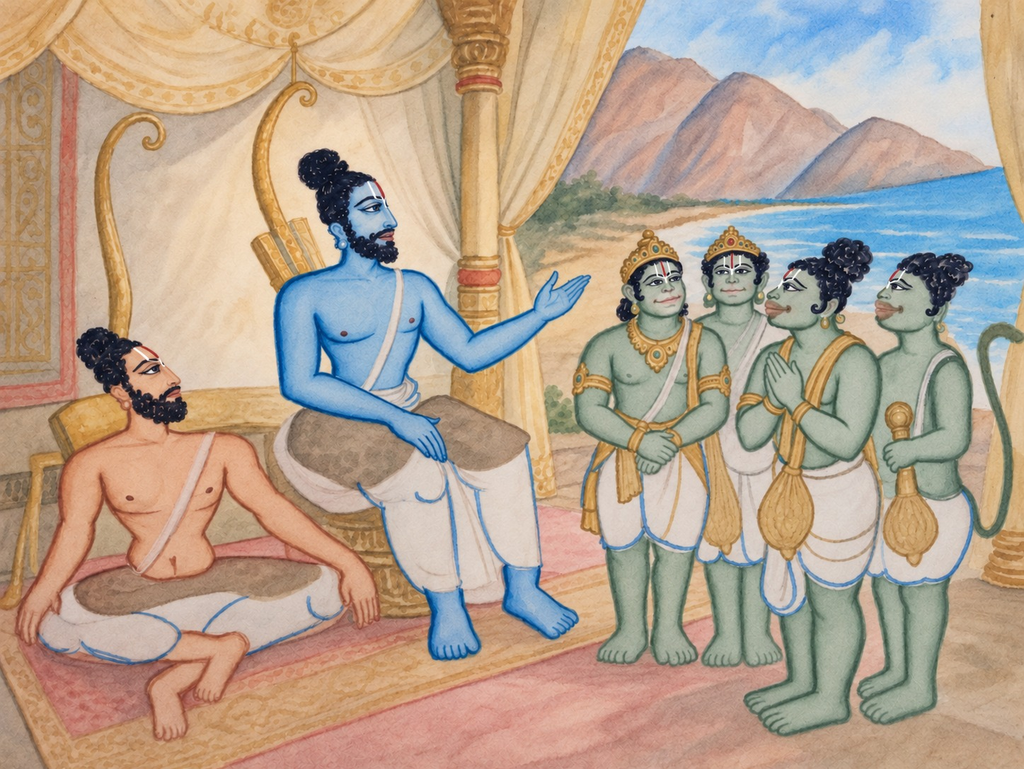
We have enjoyed the commentary on this SlOkam from the abhaya pradhAna sAra vyAkhyAnam in the previous articles. Currently, we are enjoying the thaniSlOka commentary for this SlOkam.
avathArikai (Introduction)
[In this avathArikai, periyavAchchAn piLLai summarises the events which have transpired until this juncture. It is very helpful to remind ourselves of many events that occurred in rAvaNa’s assembly – vibhIshaNa’s conversation and his subsequent departure from lankA, his approach and surrender to SrI rAma, his dialogues with the monkeys, and the conversation between the monkeys and perumAL regarding vibhIshaNa.
After being enquired by SrI rAma, the monkeys conveyed their respective opinions. However, their perspectives distressed SrI rAma; he felt as though his very existence was lost, only regaining himself after hearing the words of hanumAn. Purely out of his innate simplicity, SrI rAma expressed his desire, ‘I too have certain thoughts to convey about vibhIshaNa; I would like for you all to listen to them’. He stated that he would accept vibhIshaNa even if he were not virtuous, thereby explaining his divine intentions and helping others understand his divine will].
- ahirbudhnya samhithai (pAncharAthra Agamam) 36-38 “aham asmi aparAdhAnAm Alaya: akinchanOnanyagathi: I thvamEva upAyabhUthO mE bhavEthi prArthanAmathi: SaraNAgathi: II” (SaraNAgathi is the intellect that prays, ‘I am a repository of sins; utterly destitute; without any other refuge; you alone are the sole means’). In this way, the scriptures describe the attributes of SaraNAgathi.
[Note from kAlakshEpam: ahirbudhnya samhithai contains instructions of emperumAn to rudhran, who in turn instructs them to sage nAradha and others].
Does vibhIshaNa’s SaraNAgathi have the attributes mentioned above? vibhIshaNa’s surrender vividly illustrates these characteristics. periyavAchchAn piLLai explains this further below highlighting the attributes described in ahirbudhnya samhithai.
The first SaraNAgathi attribute seen above, aham asmi aparAdhAnAm Alaya: – I am the abode of all faults, is demonstrated by vibhIshaNa when he introduces himself. He clearly states that he is filled with defects by saying, ‘I am vibhIshaNa, one who causes terror to others’. Apart from this, by declaring himself as rAvaNa’s brother, he also illustrates the offence arising from this relationship as well.
- SrI rAmAyaNam yudhdha kANdam 17-10 “rAvaNO nAma dhurvruththO rAkshasO rAkshasESvara: I thasyAhamanujO bhrAthA vibhIshaNa ithi Srutha: II” (There is a rAkshasa of immoral conduct, the king of the rAkshasas, famously known as rAvaNa. I am his younger brother, known as vibhIshaNa).
The next attribute – akinchana: – one who possesses nothing. perumAL did not send an invitation to vibhIshaNa requesting his support for the war; vibhIshaNa came on his own accord with the intention of acquiring a kingdom. Although he arrived requesting a kingdom, he had nothing with him to offer to perumAL. This illustrates akinchana: (possessing nothing).
- SrI rAmAyaNam yudhdha kANdam 17-65 “rAjyam prArthayamAnaScha budhdhipUrvam ihAgatha:” (Desiring a kingdom, he has come here whole-heartedly, knowing his intentions well).
[Note from kAlakshEpam: Although in many scriptures, vibhIshaNa’s desire for a kingdom is described as the primary intent of his arrival, in SrIvachana bhUshaNam, it is explained differently. Many people have performed SaraNAgathi seeking varied rewards. piLLai lOkAchAryar explains (in sUthram 33) that yudhishtira sought a kingdom, dhraupadhi sought garment, and vibhIshaNAzhwAn sought to attain SrI rAma. From this, we understand that vibhIshaNa’s true intent was to attain perumAL.
Thus, two perspectives exist regarding this matter. It could be interpreted that those who spoke about vibhIshaNa’s intent merely perceived it as a desire for a kingdom. Furthermore, the inner depth of ‘wealth of the kingdom’ could be interpreted as ‘wealth of kainkaryam’].
- SrI rAmAyaNam yudhdha kANdam 17-14 “sO’ham parushithasthEna dhAsavachchAvamAnitha: I” ([vibhIshaNAzhwAn says] I, who was spoken to harshly and humiliated by him [rAvaNa] like a servant).
- SrI rAmAyaNam yudhdha kANdam 16-16 “thvAm thu dhik kulapAmsanam” (You have to be burnt, you are a disgrace to your own clan).
Having been insulted and chased away by rAvANa, vibhIshaNa declared himself unfit even for rAvaNa and his associates. In doing so, he demonstrated the next attribute of SaraNAgathi – agathi:, the state of having no refuge.
- SrI rAmAyaNam yudhdha kANdam 17-14 “rAghavam SaraNam gatha:” (I have surrendered to SrI rAma).
vibhIshaNa, by declaring his surrender, reveals the next core aspect of SaraNAgathi – “thvamEva upAyabhUthO mE bhava ithi prArthanAmathi: I SaraNAgathi:” – the intellect that prays to perumAL to be his means, is SaraNAgathi’.
Therefore, vibhIshaNa’s surrender encompasses all aspects of SaraNAgathi.
Just like krishNa charama SlOkam in SrI mahAbhAratham, this particular SlOkam serves as the charama SlOkam of SrI rAmAyaNam because it declares perumAL’s ultimate divine intent.
However, one might wonder – how could a SlOkam uttered in the middle of the text be considered ‘charamam’, or conclusive. Here, ‘charamathvam’, or conclusiveness lies in finality of the thought and does not depend on whether a SlOkam is found in the beginning or at the end. In SrI bhagavath gIthA, after explaining karma, gyAna and bhakthi yOgam in detail, declaring prapaththi as the ultimate means at the very end was the final, conclusive thought – hence, it is charamam.
Similarly, in this SrI rAmAyaNa charama SlOkam – after angadhan, Sarabhan and others conveyed their respective opinions that vibhIshaNa must not be accepted, perumAL finally declared his divine intent. Because it represents his ultimate will, it is also revered as a charama SlOkam. In this manner, many similarities can be observed between these two charama SlOkams.
While SrI krishNa charama SlOkam aided arjuna in regaining his lost kingdom, the SrI rAmAyaNa charama SlOkam bestowed the wealth of lankA upon vibhIshaNa, who had left all his riches behind.
- SrI rAmAyaNam yudhdha kANdam 19-5 “parithyakthA mayA lankA” (The kingdom of lankA has been abandoned by me).
SrI krishNa charama SlOkam was uttered in the middle of the battlefield; similarly, SrI rAma’s charama SlOkam was spoken by SrI rAma while standing in the midst of the monkey army.
- SrI bhagavath gItha 1-21 “sEnayOrubhayOr madhyE” (in between the line ups of both armies).
Again, in both instances, the charama SlOkam was uttered to relieve sorrow – krishNa spoke to relieve arjuna’s grief, and SrI rAma spoke to relieve vibhIshaNa’s distress.
- SrI bhagavath gItha 18-66 “mA Sucha:” (do not grieve).
While SrI krishNa charama SlOkam was uttered by gOpAlan, the cowherd boy, this SrI rAmAyaNa charama SlOkam is also uttered by the gOpAlan – the protector of earth [as the word ‘gO’ also means ‘earth’ in this context].
Finally, just as arjuna requested krishNa to instruct him on what was determined as beneficial for him, perumAL here tells everyone, ‘You all desire in my well-being, listen to what I have to convey’.
- SrI bhagavath gIthA 2-7 “yachchrEya: syAn niSchitham brUhi thanmE” (Please tell me that which is determined as good for me by you).
- SrI rAmAyaNam yudhdha kANdam 18-2 “Srutham ichchAmi thath sarvam bhavadhbhi: SrEyasi sthithai:” (I want all these to be heard by you, who are firmly established in my welfare).
In spite of all these similarities, SrI rAma charama SlOkam is given a higher status than SrI krishNa charama SlOkam.
Since krishNa spoke from an elevated position on his chariot to arjuna, his words could perhaps be considered as spoken superficially. But because SrI rAma spoke while firmly seated on the ground, his words are considered well-established and unfailing.
Furthermore, krishNa spoke of his own desire to arjuna when he said, ‘Hold onto me alone as your refuge’. This implies that krishNa offered refuge regardless of whether arjuna sought it at that moment or not.
- SrI bhagavath gItha 18-66 “mAm Ekam SaraNam vraja” (consider me as your only means). Conversely, vibhIshaNa – who came from the enemy camp – attained perumAL with intense desire and firmness, as described by the term samprAptham (completely surrendered).
krishNa charama SlOkam speaks of renouncing dharmam (the actions or attributes); here, vibhIshaNa speaks about renouncing the dharmis (those one who observe the dharma or possess a particular attribute).
- SrI bhagavath gItha 18-66 “dharmAn parithyajya” (fully renounce the means).
- SrI rAmAyaNam yudhdha kANdam 19-5 “parithyakthA mayA lankA mithrANi cha dhanAni cha” (The kingdom of lankA, friends and wealth have all been totally renounced by me).
krishNa charama SlOkam are the words of krishNa, who married sixteen thousand and one hundred and eight women; in contrast, the SrI rAma charamam are words of of EkadhAra vrathan – one who vowed to have only one wife.
- vishNu purANam 5-31-18 “jagrAha vidhivath pANin pruthak kEhEshu dharmatha: I shOdaSasthrIsahasrANi SathamEkam thathO’dhikam I thAvanthi chakrE rUpANi bhagavAn madhusUdhana: II” (emperumAn, madhusUdhanan, took the hands of sixteen thousand and one hundred women in marriage; he then assumed as many distinct divine forms so that he could reside in each of their abodes separately, with each of his wives at the same time).
- SrI rAmAyaNam ayOdhyA kANdam 72-48 “na rAma: para dhArAma: cha chakshurbhyAm api paSyathi” (SrI rAma does not even look with his eyes, the wives of others).
- perumAL thirumozhi 6-3 “karumalark kUndhal oruththi thannaik kadaikkaNithth(u) AngE oruththi thanpAl maruvi manam vaiththu maRRoththikk(u) uraiththoru pEdhaikkup poy kuRIththu puri kuzhal mangai oruththi thannaip puNardhi avaLukkum meyyanallai marudhiRUththAy! un vaLarththiyUdE vaLarginRadhAl unRan mAyaidhAnE” (You were glancing at a girl with dark locks and flowers. You kept your mind firmly on another girl. To an ignorant girl you said “I am your servitor”. To a fourth girl, you indicated a place, asking her to wait for you there. You united with a young girl having beautiful hair, but to her too, you spoke only lies. Oh one who pulled down two marudha trees while being very young! Along with your growing years, your deceptiveness is growing too).
- periyAzhwAr thirumozhi 5-3-2 “oruvarkkum meiyan allai” (You are not true to any one).
These are words of the untruthful krishNa. However, SrI rAma is always truthful
- SrI rAmAyaNam bAla kANdam 1-2 “sathyavAkya:” (One who speaks the truth).
- SrI rAmAyaNam ayOdhyA kANdam 18-30 “rAmO dhvirnAbhibhAshathE” (SrI rAma does not say two words which are contradictory).
[Note from kAlakshEpam: bhagavath rAmAnujar has also expressed the same when speaking to perumAL in chUrNai 22, SaraNAgathi gadhyam – “rAmO dhvirnAbhibhAshathE” ].
krishNa charama SlOkam represents the words of the charioteer who holds a ploughstaff in his hand, while SrI rAma charama SlOkam represents the words of dhASaratha’s (one who drives the chariot in ten directions) son who holds a bow.
krishNa says, ‘Fully renouncing all means, consider me as your only means; I will free you from all sins; do not grieve”; whereas SrI rAma says, ‘I will never abandon the surrendered’.
Thus, the krishNa charama SlOkam illustrates the determination of the SaraNAgathan, while the SrI rAma charama SlOkam, illustrates the determination of the SaraNyan (the protector) in protecting the surrendered.
krishNa charama SlOkam states, ‘I will free the sinner’ [SrI bhagavath gItha 18-66], whereas SrI rAma charama SlOkam states, “I will not abandon the surrendered, even if he possesses faults”.
krishNa charama SlOkam highlights the attainment of mOksham – an event occurring in the distant future – SrI rAma charama SlOkam emphasises the imminent acceptance of vibhIshaNa.
krishNa charama SlOkam depicts the protection offered to arjuna which faced no objection, but SrI rAma charama SlOkam speaks about protection offered to vibhIshaNa, which was offered despite objections from many.
In this SlOkam, perumAL says, ‘Whether one surrenders consciously with complete awareness of their action, or perhaps otherwise, I will not abandon them once they have surrendered, even if they have faults’.
vyAkhyAnam for this SlOkam will continue in the next article.
AzhwAr emperumAnAr jIyar thiruvadigaLE SaraNam
periyavAchchAn piLLai thiruvadigaLE SaraNam
Source – SrI rAmAyaNa thani SlOkam – 77 – yudhdha kANdam 18.3 mithra bhAvEna – Part 3 Audio Video
adiyEn chithrA rAmAnuja dhAsi
Proofreading/Curating done by – kOsalEndhra rAmAnuja dhAsan, krishNan rAmAnuja dhAsan
Artwork – namperumAL rAmAnuja dhAsan
Related Links
SrI rAmAyaNa thani SlOkam – 76 – yudhdha kANdam 18.3 mithra bhAvEna – Part 2 Audio Video
SrI rAmAyaNa thani SlOkam – 75 – yudhdha kANdam 18.1 – 18.3 mithra bhAvEna – Part 1 Audio Video
SrI rAmAyaNa thani SlOkam – 74 – yudhdha kANdam 17.60 – 17.66 Audio Video
SrI rAmAyaNa thani SlOkam – 73 – yudhdha kANdam 17.53 – 17.59 Audio Video
SrI rAmAyaNa thani SlOkam – 72 – yudhdha kANdam 17.50 – Part 3, 17.51,17.52 Audio Video
SrI rAmAyaNa thani SlOkam – concise english meanings
archived in https://granthams.koyil.org
pramEyam (goal) – https://koyil.org
pramANam (scriptures) – https://granthams.koyil.org
pramAthA (preceptors) – http://acharyas.koyil.org
SrIvaishNava education/kids portal – http://pillai.koyil.org