SrI: SrImathE SatakOpAya nama: SrImathE rAmAnujAya nama: SrImath varavaramunayE nama:
The extremely merciful periyavAchchAn piLLai has selected important SlOkams from SrI rAmAyaNam and provided us with a vyAkhyAna grantham known as SrI rAmAyaNa thani SlOkam. This portion is also described as abhaya pradhAna sAram. We are currently enjoying a very significant portion – perumAL offering protection to vibhIshaNa.
All of this has been published by puththUr swAmy along with a beautiful thamizh commentary. We are learning the meanings of these SlOkams through these granthams. We express our gratitude to periyavAchchAn piLLai and puththUr swAmy. We also express our gratitude to SrI u vE sArathy thOthAthri swAmy. This article is a translation of periyavAchchAn piLLai’s commentary, summarised with the support of SrI sArathy swAmy’s thamizh kAlakshEpam series.
In the previous article, we enjoyed the commentary provided under ‘abhaya pradhAna sAram’. We shall now continue with the commentary provided as part of the thaniSlOka vyAkhyANam.
mithrabhAvEna samprAptham na thyajEyam kathanchana I
dhOshO yadhyapi thasya syAth sathAmEthadhagarhitham II
perumAL declares his divine will – ‘Even if he has approached me posing as a friend, I will not abandon him. He must be protected despite his faults. The virtuous will never condemn his acceptance.
avathArikai (Introduction)
[periyavAchchAn piLLai begins the avathArikai by reminding us of all the important incidents which have happened until this juncture].
vibhishaNa waits [in lankA] patiently but with anxiety for perumAL, knowing that perumAL was still far away in dhaNdakAraNyam. Thereafter, perumAL reaches the shores of lankA and begins strategising his plan of actions with his ministers .
While perumAL is on his way, rAvaNa, instead of remaining inactive thinking that perumAL is far away, gathered his relatives, ministers, his subordinate kings, his priests and AchAryas to analyse their next steps. The ministers – prahasthan and mahApArsvan, his son, indhrajith and the rest of them, speak the very words which delight rAvAna because they depend on him for their sustenance. Upon hearing them praise his glories, rAvaNa becomes hubristic, puffed up with a sense of pride. At this juncture, vibhIshaNa begins to speak.
- SrI rAmAyaNam yudhdha kANdam 14-1 “niSAcharEndhrasya niSamya vAkyam sa kumbhakarNasya cha garjithAni I vibhIshaNO rAkshasa rAjamukhyam uvAcha vAkyam hitham arthayuktham” (vibhIshaNa, after hearing the speech of rAkshasa king [rAvaNa] and the roars of kumbhakarNa, spoke, looking the rAkshasa king, words which were both beneficial and meaningful).
Bound by his relationship with rAvaNa, vibhIshaNa views his brother’s misfortunes as his own, and resolves to avert the danger quickly. To convince rAvaNa, he first describes the life-threatening dangers that might befall them.
- SrI rAmAyaNam yudhdha kANdam 14-4 “yAvanna gruNanthi SirAmsi bANA” (Before the arrows shot by SrI rAma sever (or effortlessly pluck) the heads of all the rAkshasa kings).
- SrI rAmAyaNam yudhdha kANdam 14-4 “prathIyathAm dhASarathAya maithilee” (Let sIthAp pirAtti be given back to SrI rAma)
vibhIshaNa says, “There is nothing for a petty, weak person such as yourself to give to SrI rAma, who is Sriya:pathi , with all his desires fulfilled. pirAtti is SrI rAma’s wealth – it will suffice if you simply accept this and not oppose it’.
Upon hearing this, indhrajith said, “Why are your (sweet) words unfavourable and fearful”?
- SrI rAmAyaNam yudhdha kANdam 15-2 “kim nAma thE thAtha kanishta vAkyamanarthakam chaiva subhIthavaScha: I asminkulE yO’pi bhavEnna jAthO sOpIdhruSam naiva vadhEnna kuryAth II” (Oh, youngest uncle! Your lowly words are meaningless and resemble those of an apprehensive person. It manifests immaturity explicitly. Even a person who is not born in this brave clan would never speak or act in such a manner).
He continued with his mortifying words, “Your words are childish and shallow. Even those who entered this clan without being born into it would not say such things”.
vibhIshaNa responds, “Is perumAL really rAvaNa’s enemy? Cloaked like a cow but possessing the nature of a tiger, you, who are his son in name only, are bringing destruction upon your father. You should be the first in the list of enemies whose heads deserve to be severed.”.
- SrI rAmAyaNam yudhdha kANdam 15-10 “puthrapravAdhEna hi rAvaNasya thvamindhajin mithramukhO’si Sathru:” (indhrajith! Under the disguise of his son you are actually an enemy to rAvaNa).
- SrI rAmAyaNam yudhdha kANdam 15-11 “thvamEva vadhyaScha sudhurmathiScha” (You alone are evil-minded, and fit to be killed”.
Upon hearing vibhIshaNa’s words, rAvaNa becomes furious, and begins to speak supporting indhrajith’s mortifying words.
- SrI rAmAyaNam yudhdha kANdam 16-1 “abhravIth parusham vAkyam rAvaNa: kAlachOdhitha:” (rAvaNa, provoked by kAla (yama), spoke harsh words to vibhIshaNAzhwAn).
- SrI rAmAyaNam yudhdha kANdam 16-3 “jAnAmi Seelam gyAthInAm sarva lOkEshu rAkshasa I hrushyanthi vyasanEshvEthE gyAthInAm gyAthaya: sadhA II” (Oh, rAkshasa! I know the conduct of kinsmen all over the world. These people always rejoice at the calamities of their kinsmen).
- SrI rAmAyaNam yudhdha kANdam 16-4 “pradhAnam sAdhakam vaidhyam dharma Seelam cha rAkshasa I gyAthayO hyanamanyanthE SUram paribhavanthi cha II” (Oh, rAkshasa! The relatives indeed criticise and (when opportunity presents) even humiliate their relatives, who is an effective leader, great achievers, a scholar, a brave warrior and one who treads in the path of righteousness).
- SrI rAmAyaNam yudhdha kANdam 16-5 “nithyam anyOnya samhrushtA vyasanEshvAthathAyina: I prachchanna hrudhayA ghOrA gyAthayas thu bhaya AvahA: II” (The cruel kinsmen conceal their intentions, outwardly cherish the friendship and betray in times of adversities; they are dreadful).
rAvaNa says, “Don’t I know the temperaments of my relatives”?
- SrI rAmAyaNam yudhdha kANdam 16-6,7, 8 “SrUyanthE hasthibhir gIthA: SlOkA: padhmavanE kvachith” (The SlOkam sung by elephants in a lotus forest, upon observing the humans full of affection is narrated as follows – the fire, or any other weapons, or nets do not arouse fear in us, the kinsmen who are commanded, out of self-interest (to attract us) instill fear in us. There is no doubt that they teach the ways to capture us. Indeed, it is already known to us that among all the fears, the fear of kinsmen is the most painful). To elaborate this, rAvaNa further narrates a few small stories to vibhIshaNa.
- SrI rAmAyaNam yudhdha kANdam 16-15 “yO’nyasthvEvamvidham brUyAdh vAkyamEthanniSAchara I asmin muhUrthE na bhavEth thvAm thu dhik kulapAmsanam” (Oh, rAkshasa! If anyone else had uttered these words, they would have ceased to exist; I have merely left you with these harsh words. Shame upon you! You are indeed a disgrace and destroyer of our clan).
rAvaNa speaks to vibhIshaNa, “If anyone else had uttered these words to me, instantly, I would have destroyed him with my spearhead, or elephant’s tusk, or with a pointed stake”.
- SrI rAmAyaNam AraNya kANdam 1-24 “na thu rAkshasachEshtitha:” (vibhIshaNa follows the righteous path; lacks the conduct of a rAkshasa).
rAvaNa says, “You were born to bring disgrace to our clan. We do not need you. Run away, get out of my sight!”
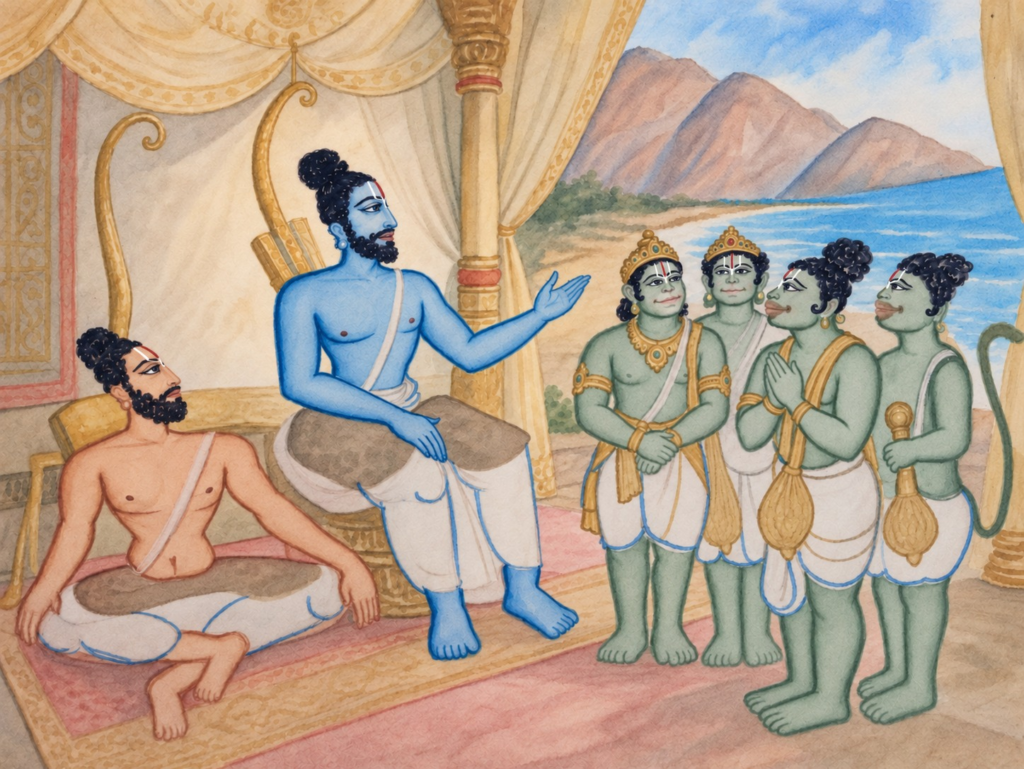
vibhIshaNa, not wanting to disobey the words of his brother, demonstrated his superiority over others by leaving rAvaNa. He soared up into the sky to cross the ocean of samsAram using his mace as a raft, along with the four rAkshAsas who remained close to him as his own hands and legs. As a crucial first step to attaining future prosperity (the wealth of lankA), he held fast to the vishNu padham. The term vishNu padham has two different connotations here – 1. The sky, and 2. the divine feet of supreme vishNu.
- SrI rAmAyaNam yudhdha kANdam 16-16 “uthpapAtha gadhApANiSchathurbhissaha rAkshasai:” (Along with four rAkshasas, he soared into the sky with a mace in his hand).
- SrI rAmAyaNam yudhdha kANdam 16-16 “antharikshagatha: SrImAn” (vibhIshaNa, the opulent, went through the sky).
- SrI rAmAyaNam yudhdha kANdam 17-1 “AjagAma muhUrthEna” (came within a muhUrtham (around 48 minutes)).
- thiruppallANdu 4 “varambozhi vandhollaik kUduminO” (giving up kaivalyam, come and join our ghOshti immediately).
- thiruppAvai 15 “ollai nI pOdhAi” (you come quickly).
Without needing instructions from anyone, vibhIshaNa came quickly to where perumAL was reclining on the divine form of iLaiya perumAL, who is AdhiSEsha – the identifying attribute of perumAL.
- SrI rAmAyaNam yudhdha kANdam 17-1 “yathra rAma: salakshmaNa:” (where SrI rAma was present with lakshmaNa).
- thiruvAimozhi 5-10-11 “nAgaNai misai nampirAn charaNE saraN namakku” (only the divine feet of our lord, resting on AdhiSEsha, are the means for us).
SrI rAmAyaNam yudhdha kANdam 17-2 “gaganastham mahIsthAs thE dhadhruSurvAnarAdhipA:” (Those monkey leaders who stood on the ground, saw that vibhIshaNa standing in the sky).
- SrI rAmAyaNam yudhdha kANdam 17-6 “sAlAnudhyamya SailAmScha” (lifted the trees and mountains).
The guards who were the first line of defense, being vigilant due to their enthusiasm in offering protection, saw vibhIshaNa the very instant he appeared in the sky. They immediately with permission of sugrIva mahArAja took stones and sticks.
- SrI rAmAyaNam yudhdha kANdam 17-9 “uvAcha cha mahAprAgya: svarENa mahathA mahAn” (The great and highly intelligent vibhIshaNAzhwAn, spoke to them in a loud voice).
As the monkeys lifted the trees, vibhIshaNa cried out in a loud voice that evoked compassion in all the trees without any distinction – from the divine tree perumAL, who is the embodiment of all forms, to the other trees.
- thiruvAimozhi 6-5-9 “marangaLum irangum vagai maNivaNNavO! enRu kUvumAl” (Even the trees pity her when she calls out saying “Oh one who is having a beautiful blue gem like form!)
- SrI rAmAyaNam yudhdha kANdam 17-6 “sAlAnudhyamya” (lifted trees).
- “vAsudhEvatharuchchAyA” (The shade of the vAsudhEva tree).
- “brahmatharu” (the divine tree, brahman)
- SrI rAmAyaNam kishkindhA kANdam 15-19 “nivAsavruksha:” (The tree that provides shade to the virtuous).
vibhIshaNAzhwAn expresses all his defects, and says,”Oh, please inform rAghava – who is born into the lineage that protects those who are terrified by the rAkshasas – of my arrival. Inform him quickly, before the affection in my fickle mind changes”.
- SrI rAmAyaNam yudhdha kANdam 17-10 “rAvaNO nAma dhurvruththO rAkshasO rAkshasESvara: I thasyAhamanujO bhrAthA vibhIshaNa ithi Srutha: II” (There is a rAkshasa of immoral conduct, the king of the rAkshasas, famously known as rAvaNa. I am his younger brother, known as vibhIshaNa).
- SrI rAmAyaNam yudhdha kANdam 17-15 “nivEdhayatha mAm kshipram rAghavAya” (Immediately inform SrI rAma, that I, vibhIshaNa, have arrived here).
- SrI bhagavath gIthA 6-34 “chanchalam hi mana:” (the mind is naturally wavering).
- periya thirumozhi 1-1-4 “ninRavA nillA nenjinai” (the heart, not being firm).
vibhIshaNamupasthitham – vibhIshaNa, who has arrived.
- periya thirumozhi 1-9-3 “konREn palluyirai – anRE vandhadaindhEn” (tormented many creatures, right then, I came and surrendered).
vibhIshaNAzhwAn says, “There is no compassion in my heart and my hands are still wet with blood (of the many creatures I have killed), yet I have arrived here”.
- SrI rAmAyaNam yudhdha kANdam 17-16 “Ethaththu vachanam SruthvA sugrIvO laghuvikrama: I lakshmaNasya agrathO rAmam samrabdham idham abravIth II” (After hearing these words, sugrIva mahArAja, walking at a swift pace, hurriedly spoke these words to SrI rAma, in the presence of lakshmaNa).
- SrI rAmAyaNam yudhdha kANdam 17-9 “svarENa mahathA” (in a loud voice).
Before vibhIshaNa’s loud voice could reach SrI rAma, sugrIva mahArAja rushed over. Walking swiftly to stop SrI rAma from accepting vibhIshaNa, he said, “A rAkshasa claiming to be rAvaNa’s brother has arrived. He speaks with deceit, pretending to take refuge. He surely intends to create a rift among us and attack us. His neck and legs must be chained”.
Observing that perumAL remained impassive to his words, sugrIva mahArAja continued, “He and his ministers must be severely punished and killed”.
- SrI rAmAyaNam yudhdha kANdam 17-24 “thasyA’ham nigraham manyE kshamam” (killing is appropriate).
- SrI rAmAyaNam yudhdha kANdam 17-27 “vadhyathAmEsha thIvrENa dhaNdEna sachivai: saha“ (He and his ministers deserve severe punishment, let them be killed).
Upon hearing sugrIva’s words, perumAL asked the other monkeys, “Are you not monkeys who protected the hunter who took your refuge from the tiger? Did you also hear your king’s words to kill vibhIshaNa who has taken refuge?”
[Note from kAlakshEpam: [vyAghra vAnara samvAdham] The conversation between a tiger and a monkey: A hunter, chased by a tiger, climbs a tree. A monkey on the tree welcomes the hunter and gives him refuge. While the tiger waits at the bottom, the monkey and the hunter decide to take turns sleeping and keeping watch over the tiger. When the hunter is asleep, the tiger tries to persuade the monkey to push the hunter down, but the monkey refuses, stating that he cannot abandon someone who had sought refuge. When the monkey sleeps, the tiger convinces the hunter to push the monkey down. However, the monkey climbs to safety. The tiger tries one last time to convince the monkey to betray the hunter, but the monkey refuses, saying ‘I will never abandon the one who has surrendered to me’ – and remains committed to protecting the hunter].
- SrI rAmAyaNam yudhdha kANdam 17-30 “yadhuktham kapirAjEna rAvaNAvarajam prathi I vAkyam hEthumadharthyam cha bhavadhbhirapi thachchrutham II” (Did you also hear the much needed words spoken with reasons by sugrIva, the chief of monkeys, about rAvaNa’s brother?)
yadhuktham kapirAjEna – that which was spoken by the king of monkeys
perumAL did not desire to even utter the words spoken by sugrIva maharAja; instead, he simply said, ‘that which was spoken’. Just as some fear that merely uttering the word ‘fire’ will burn their mouth, perumAL feared that repeating sugrIva’s words – vibhIshaNa must be killed – might cause them to fructify or come true. Therefore, he did not repeat sugrIva’s exact words and merely said, ‘yadhuktham kapirAjEna’.
uktham – said.
[perumAL thought] Alas! My friend sugrIva did not just stop at his thoughts; he even spoke them out loud! kapirAjEna – by the king of monkeys – ‘The wealthy and prominent do not fear to say anything’. Perhaps that is why sugrIva spoke in this manner.
kapirAjEna – by the king of monkeys, who is your protector. [perumAL says apprehensively] So you all genuinely think you can enjoy a happy life under his rule!
[Meaning – If vibhIshaNa is abandoned based on sugrIva mahArAja’s words, perumAL thinks, ‘Even my own existence will be lost if he is not protected’. Ultimately, how do you all think you could live happily under his leadership!]
kapirAjEna – by the monkey king, [perumAL further remarks about the imprudent behaviour] Perhaps it is due to the folly of birth in a monkey species and the folly of wealth from being a king that has instigated your words.
kapirAjEna rAvaNAvarajam prathi – [the words spoken] by the king of monkeys regarding rAvaNa’s brother
[perumAL finds sugrIva mahArAja’s words surprising and disappointing, he says] I can’t believe that you, who were crowned after killing your brother vAli, should criticise rAvaNa’s brother!
- SrI rAmAyaNam yudhdha kANdam 17-32 “ithyEvam pariprushtAs thE svam svam matham athandhrithA: I sOpachAram thadhA rAmam Uchur hitha chikIrshava: II” (Enquired by SrI rAma, the attentive monkeys, desiring to do good, humbly spoke their respective opinion and offered their praises to SrI rAma at that time).
After being enquired by SrI rAma, the monkeys convey their respective opinions. However, their views did not align with SrI rAma’s divine heart. hanumAn intuitively perceived this disagreement. Following this, he highlighted the incompatibility and the flaws in the perspectives offered by others and expressed his thoughts. hanumAn said, ‘vibhIshaNa is free of any defects; therefore, he is worthy of acceptance’.
SrI rAma who regained his existence after hearing the words of vAyu’s son, expresses his desire out of his simplicity, ‘I too have certain thoughts to convey about vibhIshaNa; I would like all of you to listen to them’.
- SrI rAmAyaNam yudhdha kANdam 18-2 “mamApi thu vivakshA’sthi kAchith prathi vibhIshaNam I SruthamichchAmi thathsarvam bhavadhbhi: SrEyasi sthithai: II” ([perumAL says] I, too, want to convey a few things about vibhIshaNa. I desire that you all, who are firmly established in my well-being, listen to all of it).
perumAL declares his divine will, “Whether vibhIshaNa has defects; or is free of defects, I will never abandon anyone who has surrendered unto me”.
vyAkhyAnam for this SlOkam will continue in the next article.
AzhwAr emperumAnAr jIyar thiruvadigaLE SaraNam
periyavAchchAn piLLai thiruvadigaLE SaraNam
Source – SrI rAmAyaNa thani SlOkam – 76 – yudhdha kANdam 18.3 mithra bhAvEna – Part 2 Audio Video
adiyEn chithrA rAmAnuja dhAsi
Proofreading/Curating done by – kOsalEndhra rAmAnuja dhAsan, krishNan rAmAnuja dhAsan
Artwork – namperumAL rAmAnuja dhAsan
Related Links
SrI rAmAyaNa thani SlOkam – 75 – yudhdha kANdam 18.1 – 18.3 mithra bhAvEna – Part 1 Audio Video
SrI rAmAyaNa thani SlOkam – 74 – yudhdha kANdam 17.60 – 17.66 Audio Video
SrI rAmAyaNa thani SlOkam – 73 – yudhdha kANdam 17.53 – 17.59 Audio Video
SrI rAmAyaNa thani SlOkam – 72 – yudhdha kANdam 17.50 – Part 3, 17.51,17.52 Audio Video
SrI rAmAyaNa thani SlOkam – 71 – yudhdha kANdam 50 – Part 2 Audio Video
SrI rAmAyaNa thani SlOkam – concise english meanings
archived in https://granthams.koyil.org
pramEyam (goal) – https://koyil.org
pramANam (scriptures) – https://granthams.koyil.org
pramAthA (preceptors) – http://acharyas.koyil.org
SrIvaishNava education/kids portal – http://pillai.koyil.org