SrI: SrImathE SatakOpAya nama: SrImathE rAmAnujAya nama: SrImath varavaramunayE nama:
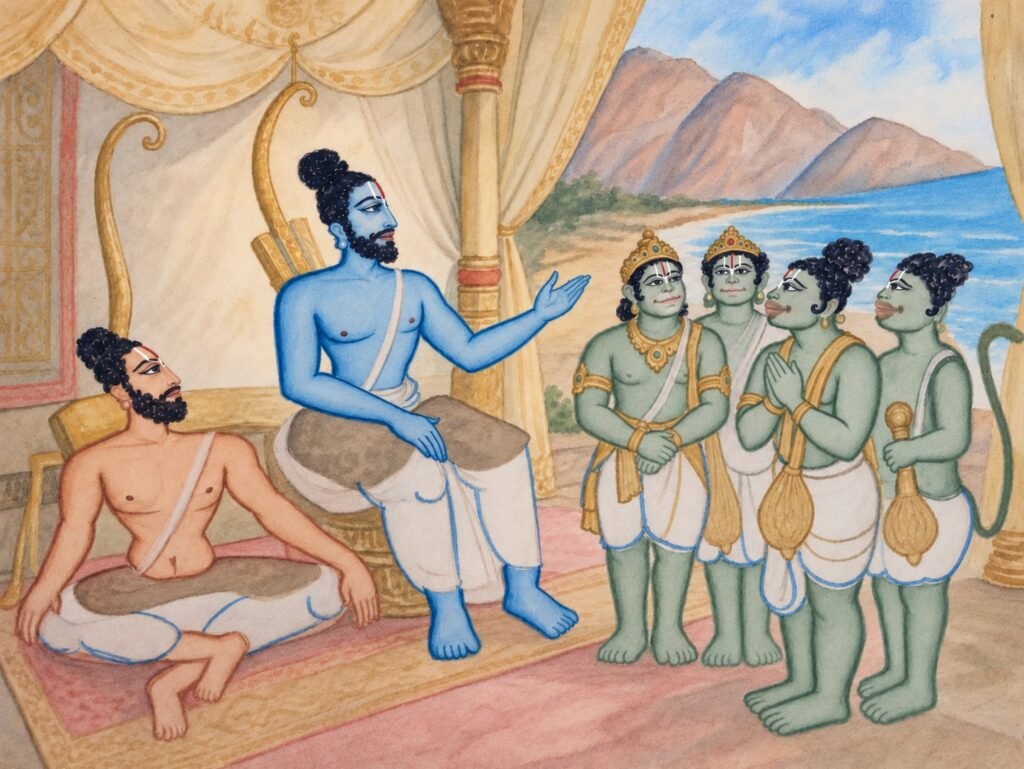
The extremely merciful periyavAchchAn piLLai has selected important SlOkams from SrI rAmAyaNam and provided us with a vyAkhyAna grantham known as SrI rAmAyaNa thani SlOkam. This portion is also described as abhaya pradhAna sAram.
In this segment, the arrival and surrender of vibhIshaNAzhwAn, the anxious speeches of the monkeys, perumAL’s comforting words to pacify them, and the acceptance of vibhIshaNAzhwAn are all explained. So far, we have completed the 17th sargam. We will continue with the next sargam in this article.
All of this has been published by puththUr swAmy along with a beautiful thamizh commentary. We are learning the meanings of these SlOkams through these granthams. We express our gratitude to periyavAchchAn piLLai and puththUr swAmy. We also express our gratitude to SrI u vE sArathy thOthAthri swAmy. This article is a translation of periyavAchchAn piLLai’s commentary, summarised with the support of SrI sArathy swAmy’s thamizh kAlakshEpam series.
SrI rAmAyaNa thani SlOkam – yudhdha kANdam 18.1
avathArikai (Introduction)
This SlOkam conveys that perumAL was initially distressed by sugrIva mahArAja’s words, fearing he might lose vibhIshaNa. However, after listening to thiruvadi’s words, he found profound stability and addressed the monkeys.
atha rAma: prasannAthmA SruthvA vAyu suthasya ha I
prathyabhAshatha dhurdharsha: SruthavAn Athmani sthitham II
Word-by-word meaning
atha – thereafter
dhurdharsha: – the invincible
SruthavAn – the wise
rAma: – SrI rAma
vAyu suthasya – (the words of) hanumAn, vAyu’s son
SruthvA – upon hearing
prasannAthmA – with a clear mind
Athmani – in his mind
sthitham – present
prathyabhAshatha – spoke his response
Simple meaning
After listening to the words of hanumAn, the son of vAyu, the invincible and wise SrI rAma, with a serene and pleasant mind spoke his intent in response.
Notes from periyavAchchAn piLLai’s vyAkhyAnam
atha rAma: – thereafter, perumAL sustained himself. Only after his divine will to accept vibhIshaNa was sustained did SrI rAma truly become SrI rAma. rakshakathvam [protection] is his true nature. This inherent nature of protecting everyone was temporarily lost when vibhIshaNa was not offered protection immediately, as SrI rAma waited to hear the opinions of sugrIva mahArAja and others. However, as he began to express his divine will to accept vibhIshaNa, he regained this true nature.
For entities who are bound in this material realm, their existence or non-existence (akin to achith) is determined by their knowledge, or lack thereof, about the supreme. Similarly, the supreme, who is the ultimate protector, experiences his own existence through the fulfilment of this protectorship and feels a sense of non-existence in its absence. This principle is prevalent in many places across the SAsthram, such as in thathithrIya upanishadh and purusha sUktham.
- thathithrIya upanishadh Anandhavalli “asannEva sa bhavathi | asadhbrahmEthi vEdha chEth | asthi brahmEthi chEdhvEdha | santhamEnam thathO vidhu: ||” (The knowledge about brahmam, the supreme makes one existent, and the lack of it makes him nonexistent).
- purusha sUktham “rucham brAhmam janayantha: I dhEvA agrE thadhabruvan” (Manifesting the divine essence of brahmam, the dhEvas, in the primeval time (during the time when they were distressed by hiraNya and rAvaNa) invoked him by uttering the word ‘nama:’)
Thus, atha rAma: means ‘thereafter, when SrI rAma resolved through his divine will to protect vibhIshaNa”. Alternatively, it could mean, “thereafter when SrI rAma heard hanumAn’s words”. That is to say, SrI rAma who incarnated as king dhaSaratha’s son primarily so everyone could seek his refuge and receive his protection, considered his existence to be nonexistent when he failed to instantly accept vibhIshaNa. He regained his sense of existence, knowing he could protect vibhIshaNa upon hearing thiruvadi’s words.
prasannAthmA – should be understood as prasannamanA:, meaning ‘possessing a clear mind’. Without offering protection to vibhIshaNa, it seemed as though SrI rAma’s existence was temporarily lost. However, upon hearing hanumAn’s words, he regained this sense of existence, which immediately gave rise to the thought in his clear mind that he was going to protect vibhIshaNa. The divine mind that was distressed because of sugrIva mahArAja’s words now attained clarity. Just as devotees gain stability upon attaining the desired [perumAL], perumAL regains clarity upon attaining his servitor.
- thiruvAimozhi 3-2-10 “nilaip peRRen nenjam peRRadhu nIduyirE” (AzhwAr says upon seeing krishNa, ‘My broken heart acquired stability and the AthmA (which was going to be finished due to grief) acquired eternity’). Just as nammAzhwAr sustained his own life and attained stability of heart, perumAL regained his stability.
vAyu suthasya Athmani sthitham SruthavA – hearing that which was in the mind of vAyu’s son, hanumAn.
hanumAn is the son of vAyu, the one who gives the breath of life to everyone. He speaks out of affection toward perumAL, who provides life to all entities. perumAL hears the words of hanumAn, the one who gave life to all by sustaining perumAL’s own life.
Reading the above phrase in the order – svAnAthmani sthitham vAyusuthasya SruthavA, it could be interpreted as ‘hearing hanumAn speak that which was in his [perumAL’s] mind’.
The word “ha” signifies profound amazement. vAlmeeki bhagavAn celebrates hanumAn – he protected the supreme lord – the ultimate protector of all – through his words alone. How extraordinary he is!
dhurdharsha: – invincible. Despite the opinions of others [such as sugrIva mahArAja], perumAL remained invincible and proceeded to establish his own opinion.
SruthavAn – erudite. The knowledge he gained from studying under sages such as vasishta et al aided him in this situation. This context references the legends of kapOtha (the pigeon) and kaNdu rishi [which is going to be mentioned later].
prathyabhAshatha – he replied. He began to convey his answers to his monkey ministers.
Athmani sthitham prathyabhAshatha – he spoke that which was in his divine heart.
He declared to his ministers the divine intentions present in his thiruvuLLam [divine mind].
[Note from kAlakshEpam: This signifies that this was not a mere reply to what was spoken earlier; perumAL, irrespective of what was said by the ministers, declared his divine will].
atha rAma: prasannAthmA SruthvA vAyusuthasya ha I
prathyabhAshatha dhurdharsha: SruthavAnAthmani sthitham II
Thus concludes the vyAkhyAnam for this SlOkam.
SrI rAmAyaNa thani SlOkam – yudhdha kANdam 18.2
perumAL says, ‘Listen to what I have to say, just like I listened to yours’.
avathArikai (Introduction)
perumAL requests that the monkeys listen to his thoughts about vibhIshaNa, just as he had listened to theirs.
mamApi thu vivakshAsthi kAchith prathi vibhIshaNam I
Srutham ichchAmi thathsarvam bhavadhbhi: SrEyasi sthithai: II
Word-by-word meaning
vibhIshaNam prathi – regarding vibhIshaNa
mama api thu – I, too
vivakshA kAchith – something to convey
asthi – have
SrEyasi sthithai: – ones who are firmly grounded in (my) well-being
bhavadhbhi: – by you
thathsarvam – all of it
Srutham ichchAmi – I desire for you to listen
Simple meaning
[perumAL says] I, too, want to convey a few things about vibhIshaNa. I desire that you all, who are firmly established in my well-being, listen to all of it.
Notes from periyavAchchAn piLLai’s vyAkhyAnam
mamApi thu – I, too, indeed. The words ‘api’ and ‘thu’ are significant. They serve to highlight a distinction, demonstrating that his perspective surpasses all others.
kAchith vivakshAsthi – have a desire to convey. perumAL says, ‘I, too, indeed, want to convey’.
vibhIshaNam prathi – regarding vibhIshaNa. perumAL says, ‘I, too, indeed, desire to convey a few things regarding vibhIshaNa’.
thathsarvam Srutham ichchAmi – I would like for you all to listen to everything that I am about to say.
[From the next SlOkam 18.3 ‘mithrabhAvEna’, up to the instructions of kaNdu rishi – the son of kaNva maharishi in SlOkam 18.32, perumAL declares his divine will]. perumAL asks them to listen to everything he is about to say in its entirety, even if they do not intend to follow through with it.
SrEyasi sthithai: bhavadhbhi: – The literal meaning is ‘by you, who are steadfast in my welfare’. However, the underlying meaning is ‘by you, who solely sustain your existence by remaining steadfast in my welfare’. This implies that they survive only because of SrI rAma’s well-being.
mamApi thu vivakshAsthi kAchith prathi vibhIshaNam I
SruthamichchAmi thathsarvam bhavadhbhi: SrEyasi sthithai: II
Thus concludes the vyAkhyAnam for this SlOkam.
SrI rAmAyaNa thani SlOkam – yudhdha kANdam 18.3 – Part 1
perumAL declares his divine will – ‘Even if he has approached me posing as a friend, I will not abandon him. Although he may possess sins, accepting him would not be reproached by the wise’.
avathArikai (Introduction)
Thereafter, on the shores amidst a large gathering of monkeys, he circumstantially reveals his inherent nature, the cause for the survival of all entities.
mithrabhAvEna samprAptham na thyajEyam kathanchana I
dhOshO yadhyapi thasya syAth sathAmEthadh agarhitham II
Word-by-word meaning
mithrabhAvEna – appearing as a friend
samprAptham – he, who has arrived
kathanchana – by any means
na thyajEyam – absolutely, will not abandon
thasya – for him
dhOsha: yathi api – even if there are defects
syAth – let them be so
Ethadh – accepting him
sathAm – the virtuous
agarhitham – not despised
Simple meaning
By no means shall I abandon one who has come to me appearing as a friend, regardless of his defects; the virtuous will not despise for accepting him.
Notes from periyavAchchAn piLLai’s vyAkhyAnam
mithrabhAvEna
“mithrath thrAyathE ithi mithram” – he evaluates the favour that was done to him and offers protection by returning that favour; hence, he is known as a friend. This is the meaning of a friend according to this etymology. However, since it is impossible to evaluate and return the favours bestowed by the supreme lord, this definition is not appropriate here.
[Note from kAlakshEpam: In SrIvachana bhUshaNam – sUthram 432, piLLai lOkAchAryar explains AchArya’s greatness – whose favour cannot be returned in kind – “AchAryanukku sadhruSa prathyupakAram paNNalAvadhu vibhUthi chathushtayamum ISvara dhvayamum uNdAgil” (To respond in kind for the favour done by AchArya is only possible if there exist four vibhUthis (worlds) and two ISvarans). Similarly, in the context of perumAL, we cannot say that vibhIshaNa is a friend based on his favours towards perumAL. Therefore, we cannot interpret that perumAL used the word in this context].
Thus, in this context, it is more suitable to interpret the word mithran as ‘trustworthy’. This is confirmed by the saying, “thanmithram yathra viSvAsa:” (The one in whom we place our trust is a friend). It is evident that vibhIshaNa is trustworthy because he expressed his lowliness and surrendered to SrI rAma.
- SrI rAmAyaNam yudhdha kANdam 17-14 “rAghavam SaraNam gatha:” (I surrender to SrI rAma).
However, is it not possible for individuals with a deceitful nature to also use this strategy?
bhAvEna – indicates the execution of an action. That is, even if vibhIshaNa truly did not possess the intention of a friend, his action (bhAvEna) indicates that he is to be trusted. perumAL says, “The words of a trustworthy person alone are enough. Even if he did not come as a sincere friend, but is merely speaking the words of a dependable person, I will not abandon him”.
- vaijayanthI dhvyakshara kANdam – pullingAdhyAyam 43 “bhAvO leelA kriyA chEshtA bhUthyabhiprAyajanthushu” (This explains that the word bhAva has these five different meanings – pastime, action, gesture, wealth and opinion).
- nAnArtha rathnamAlA “bhAvO leelAsvabhAvayO: janthvabhiprAya chEshtAsu bhUthau vidhvath padhArthayO: kriyAyAm Athmani” (The word bhAva is used to denote pastime, nature, a living entity, intention, gesture, prosperity, a scholar, an object, an action and AthmA). Thus, the multiple meanings of bhAva are well-established across these lexicons.
samprAptham – attained, well reached
Suppose vibhIshaNa had said, “rAghavam SaraNam gatha:” – SrI rAma! I seek your refuge from lankA, perumAL would have rushed to him instantly – with his dress and locks in dishevelled condition – just as he once hastened to the pond to save gajEndhrAzhwAn. Instead, vibhIshaNa came all the way to the shores where perumAL was present. Therefore, perumAL thinks, ‘Instead of my going to him, he has come all the way to me. How wonderful! He has indeed performed my task’.
na thyajEyam – I will never abandon. The use of the ling suffix in the verb thyajEyam provides this special meaning – there is zero probability of abandonment. The dilemma of whether to perform an action or not arises when there is uncertainty. Here, perumAL says, “When even his arrival is a cause for celebration, how could the question of abandoning him ever arise?”
Why is it that there is no probability of abandonment?
Only when there is a chance of survival after abandonment can one analyse whether he should be rejected or not. perumAL says, “I shall not survive if I abandon him, therefore, there is no probability of abandonment”.
Assuming that upon hearing these, the monkeys ask, “Accepting without much examination is risking one’s own life. If dhEvarIr accepts him without caring for dhEvarIr’s own life, will it not result in abandoning us, the ones who cannot survive in dhEvarIr’s absence?” SrI rAma says furrther …
kathanchana – by any means, even if it amounts to doing something arduous or impossible, perumAL says, ‘I will not abandon him’.
The monkeys worry – vibhIshaNa is rAvaNa’s brother, a rAkshasa, and a terror to the entire world – these are widely known facts. He could also kill us, or try to drive a wedge between us. In spite of all these defects, why would dhEvarIr never abandon under any circumstances?
Understanding the monkeys’ concerns, perumAL continues to convey his thoughts.
dhOshO yadhyapi thasya syAth – even if he has defects
There is no restrictive criterion for SaraNAgathi. One does not need to belong to a particular clan, and neither does one need to follow a specific action or conduct. Therefore, perumAL says, “In my opinion, vibhIshaNa has no defects which would prohibit or forbid his surrender”.
thasya yadhyapi dhOsha: thadhApi na thyajEyam – I will never abandon him, even if he has defects. Even if you see faults in him, such as a desire to kill us or divide us, I will never abandon him.
Knowing that he is perceived as an evil person, will the world not condemn his acceptance?
sathAm Ethadh agarhitham – the virtuous would not reproach his acceptance.
As my well-wishers, your minds are clouded by fear due to extreme affection for me. Therefore, you fear even when there is absolutely no reason to fear, and you consider his acceptance reproachable. However, for the sages, due to the clarity of their intellect, his acceptance is irreproachable.
Alternatively, this could be interpreted as follows.
dhOshO yadhyapi – even though they are defects, they are vibhIshaNa’s defects.
syAth – interpreted as prArthanA ling (a verb form expressing a request) – means – ‘May this be my desire as well’. It signifies that even if there are flaws in vibhIshaNa, just as a mother cow desires the scent of her calf, or as lovers desire the scent of one another [which might otherwise be repulsive to outsiders], perumAL says,’vibhIshaNa’s defects, too, will be an object of my liking’.
If a righteous individual is protected, it might appear merely as a reward for his virtues. However, the glory attained by protecting the fallen or the wicked cannot be matched by protecting the already virtuous. Therefore, perumAL says, “I have more desire to protect those with flaws”.
- SrI rAmAyaNam yudhdha kANdam 17-27 “vadhyathAm vibhIshaNa:” (vibhIshaNa should be killed).
- SrI rAmAyaNam yudhdha kANdam 18-37 “mama cha api anthar AthmA ayam Sudhdhim vEththi vibhIshaNa:” (My intellect too perceives him as genuine).
perumAL says, “sugrIva, although you initially wanted vibhIshaNa to be killed, you too have perceived vibhIshaNa as pure”.
Alternatively, a third interpretation describes the above as –
[perumAL says] ‘dhOshO yadhyapi’ – if he truly has defects, meaning even if he said, “I surrender to you’, merely to plot an attack and kill us – ‘thasya syAth’ (let him achieve what he desires, even if I must sacrifice my life). It will only add to my glory. I will be celebrated for protecting a surrendered person at the cost of my life.
- SrI rAmAyaNam yudhdha kANdam 17-14 “rAghavam SaraNam gatha:” (I surrender to SrI rAma).
Furthermore, parASara bhattar (the revered son of kUraththAzhwAn) highlights this as the most appropriate interpretation in the light of kapOtha upAkyaNam (the story of the pigeon) narrated by SrI rAma. This is the story of a hunter who captures a male pigeon during a stormy day. Later, the hunter takes shelter under the very tree where the captured pigeon’s mate lives. Even though the hunter is an enemy who just captured its mate, the female pigeon flies into the fire ignited by the hunter for warmth, sacrificing her life to provide him food. The pigeon does this simply because the hunter took refuge under the tree where she lived.
- yajur samhithai 6-5-20, 29 “thasmAdhapi vadhyam prapannam na prathiprayachchanthi” (Therefore, if a person has surrendered, even if he deserves to be killed, he must not be betrayed and exposed).
Therefore, through these pramANams it is clear that a surrendered person must never be abandoned. So the monkeys ask, ‘Is dhEvarIr offering protection to him because it is a sin to abandon scriptural injunctions? Or to accomplish a goal? Or to eliminate sins?
sathAm Ethadh agarhitham – It is for none of these reasons.
[perumAL says] The virtuous would look down on me if I failed to do this. I must do this so that I am not despised in the circle of good-hearted people. Here, ‘good-hearted people’ refers to exemplars like the pigeon who sacrificed its life to protect the hunter, and others like sage viSwAmithra, who gave up the merits of his penance to protect thriSanku and SunaSSEpan.
vyAkhyAnam for this SlOkam will continue in the next article.
AzhwAr emperumAnAr jIyar thiruvadigaLE SaraNam
periyavAchchAn piLLai thiruvadigaLE SaraNam
Source – SrI rAmAyaNa thani SlOkam – 75 – yudhdha kANdam 18.1 – 18.3 mithra bhAvEna – Part 1 Audio Video
adiyEn chithrA rAmAnuja dhAsi
Proofreading/Curating done by – kOsalEndhra rAmAnuja dhAsan, krishNan rAmAnuja dhAsan
Artwork – namperumAL rAmAnuja dhAsan
Related Links
SrI rAmAyaNa thani SlOkam – 74 – yudhdha kANdam 17.60 – 17.66 Audio Video
SrI rAmAyaNa thani SlOkam – 73 – yudhdha kANdam 17.53 – 17.59 Audio Video
SrI rAmAyaNa thani SlOkam – 72 – yudhdha kANdam 17.50 – Part 3, 17.51,17.52 Audio Video
SrI rAmAyaNa thani SlOkam – 71 – yudhdha kANdam 50 – Part 2 Audio Video
SrI rAmAyaNa thani SlOkam – 70 – yudhdha kANdam 17.48 – 50 – Part1 Audio Video
SrI rAmAyaNa thani SlOkam – concise english meanings
archived in https://granthams.koyil.org
pramEyam (goal) – https://koyil.org
pramANam (scriptures) – https://granthams.koyil.org
pramAthA (preceptors) – http://acharyas.koyil.org
SrIvaishNava education/kids portal – http://pillai.koyil.org