SrI: SrImathE SatakOpAya nama: SrImathE rAmAnujAya nama: SrImath varavaramunayE nama:
The extremely merciful periyavAchchAn piLLai has selected important SlOkams from SrI rAmAyaNam and provided us with a vyAkhyAna grantham known as SrI rAmAyaNa thani SlOkam. This portion is also described as abhaya pradhAna sAram. In this, the arrival of vibhIshaNAzhwAn, the objection raised by sugrIva mahArAja and others, hanumAn’s pleasing words spoken to perumAL refuting those perspectives, perumAL expressing his divine thoughts and finally vibhIshaNAzhwAn’s acceptance are elaborated upon in detail.
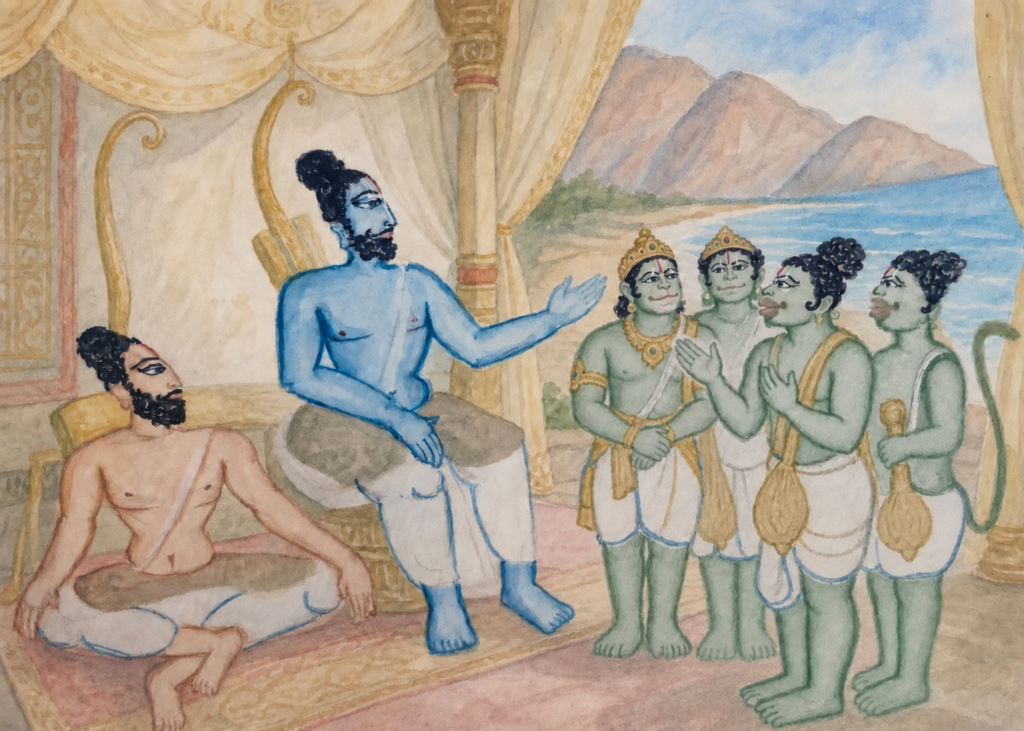
So far, we enjoyed the SlOkams where hanumAn expressed his thoughts refuting the opinions of angadhap perumAL, Sarabhan, jAmbavAn, and maindhan. They expressed that vibhIshaNa must not be accepted immediately, that a spy should be sent to observe him and gather intelligence about his true intent, and that his arrival at an improper place and time raised suspicion about his motives. hanumAn humbly explains the flaws in all of these perspectives.
All of this has been published by puththUr swAmy along with a beautiful tamil commentary. We are learning the meanings of these SlOkams through these granthams.
We express our gratitude to periyavAchchAn piLLai and puththUr swAmy. We also express our gratitude to SrI u vE sArathy thOthAthri swAmy. This article is a translation of periyavAchchAn piLLai’s commentary, summarised with the support of SrI sArathy swAmy’s thamizh kAlakshEpam series.
SrI rAmAyaNa thani SlOkam – yudhdha kANdam 17.60
avathArikai (Introduction)
After highlighting the flaws in others’ perspectives, hanumAn begins to explain his own opinion.
na thvasya bruvathO jAthu lakshyathE dhushta bhAvathA I
prasannam vadhanam chApi thasmAn mE na asthi samSaya: II
Word-by-word meaning
bruvatha: asya – he, who is speaking
jAthu – at any point in time
dhushta bhAvathA – evil intention
na lakshyathE – is not to be seen
vadhanam cha – his face too
prasannam – is clear
thasmAth – therefore
mE – for me
samSaya: – doubt
na asthi – is not present
Simple meaning
[hanumAn says] The face of this person, who is speaking to us, is clear. No evil intentions are visible on it. Therefore, I do not doubt him.
Notes from periyavAchchAn piLLai’s vyAkhyAnam
asya bruvatha: dhushta bhAvathA jAthu na lakshyathE – There is no trace of malevolence in his speech
hanumAn says] I do not see any maliciousness in his speech. Normally, when a malevolent person speaks at length, their evil intent becomes obvious at some point. However, even though vibhIshaNa has spoken many words, no hint of malice can be found. Therefore, hanumAn says that he cannot be malicious.
asya – The grammatical rule – anAdharE shashtI dictates the absence of any evidence of maliciousness in spite of his long speech.
jAthu – never
An evil person, even when trying to hide their wickedness, will have their true nature become apparent at some point. However, no kind of malice was visible at any point in time in vibhIshaNa.
dhushta bhAvathA means ‘actions of the wicked person’. Scriptural texts mention specific indicators to identify a wicked person, such as changes in facial expressions, sweating, quivering, physical movements, gaze and observations of one’s surroundings.
- yAgyavalkya smruthi 2.13-14 “dhESAdh dhESAntharam yAthi srukkiNI parilEdi cha I lalAtam svidhyathE chAthra mukham vaivarNayamEthi cha II pariSushyath skhaladhvAkyO virudhdham prathibhAshathE I svabhAvAdh vikruthim gachchEth manOvAkkAyakarmabhi: II (He shifts from one spot to another; he licks the corners of his lips; his forehead sweats; his face turns pale; his throat dries and his speech stumbles; he says contradictory things; his thoughts, words, and actions deviate from normal behaviour. This type of person is malevolent).
- manu smruthi 8.25-26 “bAhyair vibhAvyathE lingair bhAvamanthargatham nruNAm I svaravarNEngithAkArairSchakshushA chEshtithEna cha II AkArairingithair gathyA chEshtayA bhAshithEna vA I nEthravakthravikAraScha dhruSyathE’nthargatham mana: II” (The inner thoughts of a person are known by external clues such as a quivering voice, darkened facial complexion, involuntary postures like looking down, overall appearance like sweating, eye movements, and body language. The inner thoughts are understood through his physical appearance, gestures, gait, behaviour, words, and changes in facial expressions and eye movements).
Not only does vibhIshaNa completely lack the characteristics of a wicked person, but he also possesses all the signs of a noble person – a pleasant countenance.
prasannam vadhanam chApi
vibhIshaNa’s face is clear. While an evil person’s face might also appear clear at times, taints of uncertainty can usually be detected on them. But vibhIshaNa’s face always looked serene. Just as a person looted by bandits on his journey would feel relaxed and comforted upon reaching home and seeing his mother’s face, vibhIshaNa’s face appeared tranquil after abandoning rAvaNa and beholding the divine face of SrI rAma. The scriptures state that facial serenity is an important sign of purity.
perumAL too expressed this same sentiment upon seeing hanumAn for the first time.
- SrI rAmAyaNam kishkindhA kANdam 3-30 “na mukhE nEthrayOr vApi lalAtE cha bhruvOs thathA I anyEshvapi cha sarvEshu dhOsha: samvidhitha: kvachith ||” (Neither on the face nor in the eyes nor on the forehead nor on the eyebrows – nor indeed anywhere else on any part of the body – is any blemish or defect found).
thasmAn mE na asthi samSaya: – Therefore, I do not have doubts about him.
[hanumAn says] vibhIshaNa does not have defects. Moreover, the qualities manifested through his actions are also truly excellent. Therefore, I do not have any doubts and suspicions raised by the ministers.
- SrI rAmAyaNam yudhdha kANdam 17-37 “sarvathA Sankya Eva hi” (Isn’t he worthy of being suspected in all respects).
- SrI rAmAyaNam yudhdha kANdam 17-44 “sarvathA SankyathAmayam” (He should be doubted by all means).
na thvasya bruvathO jAthu lakshyathE dhushta bhAvathA I
prasannam vadhanam chApi thasmAn mE na asthi samSaya: II
Thus concludes the vyAkhyAnam for this SlOkam.
SrI rAmAyaNa thani SlOkam – yudhdha kANdam 17.61
avathArikai (Introduction)
In this SlOkam, hanumAn says, ‘After seeing the manner in which he approached and the way he spoke, not only I but no one should have any doubt about vibhIshaNa’.
aSankithamathi: svasthO naSata: parisarpathi I
na chAsya dhushtavAgasthi thasmAn nAsthIha samSaya: II
Word-by-word meaning
aSankithamathi: – with fearless intellect
svastha: – well grounded
naSata: – as a person who is not wicked
parisarpathi – he is approaching
asya – him
dhushtavAg na asthi – no words of blemish
thasmAth – therefore
iha – in his matter
na samSaya: – (no one) needs to doubt
Simple meaning
[hanumAn says] He approached us not as a wicked person, but with a fearless intellect and composure. There are no deceitful words in his speech. Therefore, there is no reason for anyone to doubt him.
Notes from periyavAchchAn piLLai’s vyAkhyAnam
aSankithamathi: svastha: – he is composed, without any uncertainty
- SrI rAmAyaNam yudhdha kANdam 17-6 “sAlAnudhyamya SailAmScha” (Lifting the trees and mountains).
He took them to be his well-wishers, even when the monkeys raised the stones and sticks against him, and he remained composed, free of doubt.
naSata: parisarpathi
He approaches with affection, as if seeking a safe haven. Just as an exhausted person welcomes a recliner, he turns to us with love.
- SrI rAmAyaNam yudhdha kANdam 17-5 “rAkshasO’bhyEthi” (rAkshasa is approaching us)
Did he not approach us fearlessly and disregard our presence, alarming sugrIva mahArAja?
[hanumAn says] A malicious person’s characteristics will not be of this kind; due to their flawed intentions, they will hesitate to come closer and resort to staying uninvolved.
na chAsya dhushtavAk asthi – there is no faltering or defect in his speech
Typically, the speech of someone with malicious intent lacks fluency and decisiveness. vibhIshaNa’s speech, however, was free of hesitation. Therefore, his intentions are flawless.
thasmAth iha nAsthi samSaya: – Therefore, there is absolutely so doubts about him
[hanumAn says] Not only is this my opinion of him, but all of you, who have unwarranted suspicions out of your affection for perumAL, need not doubt him.
aSankithamathi: svasthO naSata: parisarppathi I
na chAsya dhushtavAgasthi thasmAn nAsthIha samSaya: II
Thus concludes the vyAkhyAnam for this SlOkam.
SrI rAmAyaNa thani SlOkam – yudhdha kANdam 17.62
avathArikai (Introduction)
hanumAn thinks that the others might perceive his opinion as, ‘Oh, hanumAn, you are only saying this because you have believed vibhIshaNa’s deceitful disguise to be genuine’. Therefore, he responds with this SlOkam.
AkAraS chAdhyamAnO’pi na SakyO vinigUhithum I
balAdhdhi vivruNOthyEva bhAvamanthargatham nruNam II
Word-by-word meaning
AkAra: – bodily or facial changes
chAdhyamAna: api – even when concealed
vinigUhithum – to hide
na Sakya: – impossible
hi – because
nruNam – humans’
anthargatham – inner
bhAvam – (malicious) intents
balAth – (out of his control) forcibly
vivruNOthyEva – (the facial /bodily changes to conceal them) will expose him
Simple meaning
It is not possible to conceal bodily language or facial changes. Even when deliberately suppressed, by their own force, they reveal the innermost thoughts of humans.
Notes from periyavAchchAn piLLai’s vyAkhyAnam
AkAra: – body language, facial change and overall physical demeanour
chAdhyamAnO’pi – even when it is deliberately concealed
Even when a person tries to deliberately hide their body language and facial changes, they cannot succeed in doing so.
na SakyO vinigUhithum – It is impossible to hide.
Because their inner thoughts are different from their outward behaviour, the body language stemming from those intentions cannot be suppressed.
Why is this?
nruNam anthargatham bhAvam balAth vivruNOthyEva – The inner thoughts of humans will forcibly reveal themselves.
Even when someone tries to suppress outwardly visible cues to mask their true intentions, those inner thoughts overpower the person’s control, and involuntarily expose them to others.
hi – indeed, this is the reason. There is no escape from this; a person’s body language [or facial changes] will inevitably reveal what is hidden within one’s mind. This can be understood from manu smruthi 8 – 26 “AkArairingithair gathyA” (An individual’s hidden thoughts can be understood by their general appearance, gestures, gait, speech, and movements of the eyes and face).
AkAraS chAdhyamAnO’pi na SakyO vinigUhithum I
balAdhdhi vivruNOthyEva bhAvamanthargatham nruNam II
Thus concludes the vyAkhyAnam for this SlOkam.
SrI rAmAyaNa thani SlOkam – yudhdha kANdam 17.63
avathArikai (Introduction)
hanumAn finally concludes his perspective in this SlOkam by requesting perumAL ‘please accept this friend [vibhIshaNa] who has arrived with purity and by the divine grace of the supreme, to make your protective nature and his arrival fruitful’.
dhESakAlOpapannam cha kAryam kAryavidhAm vara I
sapalam kuru thE kshipram prayOgENAbhisamhitham II
Word-by-word meaning
kAryavidhAm vara – Oh, the best among those skilled in executing tasks!
dhESakAlOpapannam – appropriate for the time and place
kAryam – action (with respect to vibhIshaNa’s acceptance)
prayOgENa – by practice, employment
abhisamhitham – connected with
thE – for dhEvarIr
sapalam – fruitful
kshipram – quickly
kuru – (please) execute
Simple meaning
Oh, the best among those skilled in executing tasks! Quickly carry out the action of [accepting] vibhIshaNa, which is appropriate for time and place and which is fruitful for dhEvarIr.
Notes from periyavAchchAn piLLai’s vyAkhyAnam
dhESakAlOpapannam cha kAryam kshipram prayOgENAbhisamhitham thE sapalam kuru
May dhEvarIr quickly perform this action, suited to both time and place, so that it brings you benefit.
dhESakAlOpapannam cha – Similar to how his arrival is befitting for the time and place, this time and place is also appropriate for dhEvarIr to accept him.
- SrI rAmAyaNam yudhdha kANdam 17-55 “sa Esha dhESa: kAlaScha” (This is exactly the right place and right time).
“kAryam” (action) signifies an act that is essential to perform – in this context, the act of accepting vibhIshaNa.
kshipram prayOgENAbhisamhitham thE sapalam kuru – may dhEvarIr execute this action quickly
- SrI rAmAyaNam yudhdha kANdam 17-1 “AjagAma muhUrthEna” (he came quickly). The act of his acceptance must also be done quickly, matching his eager and swift arrival.
kAryavidhAm vara – Oh, the one who is desired by those who know their duties
dhEvarIr is revered among those who know the appropriate time to perform the various duties.
Alternatively, by including the word kuruthE in the above –
dhESakAlOpapannam cha kAryam kshipram prayOgENAbhisamhitham sapalam kuruthE
The one who understands the proper actions suited to the place and time will execute them well, so that it becomes beneficial for them.
kAryavidhAm vara – Oh, the best among those who know their duty!
When this is true for all who perfectly understand the actions they must execute – and when dhEvarIr is desired by all those who know their duty – will dhEvarIr not perform it [the act of accepting vibhIshaNa]?
dhESakAlOpapannam cha kAryam kAryavidhAm vara I
sapalam kuru thE kshipram prayOgENAbhisamhitham II
Thus concludes the vyAkhyAnam for this SlOkam.
SrI rAmAyaNa thani SlOkam – yudhdha kANdam 17.64, 17.65
avathArikai (Introduction)
“Is it possible for one to abandon his relatives and wealth and come to us simply to seek our friendship? hanumAn says, “If you think so, I have previously explained that this is absolutely possible with vibhIshaNa. However, if this is not agreeable to dhEvarIr, there is also a probability that he has come here with a desire to destroy his brother and claim his kingdom. Even if this is true, he must still be accepted. Thus, hanumAn says in the following SlOkam.
udhyOgam thava samprEkshya mithyAvruththam cha rAvaNam I
vAlinam cha hatham Sruthva sugrIvam chAbhishEchitham II
rAjyam prArthayamAnasthu budhdhipUrvam ihAgatha: I
EthAvaththu puraskruthya vidhyathE thvasya sangraha: II
Word-by-word meaning
thava – your
udhyOgam – efforts
samprEkshya – seeing
mithyAvruththam – with improper conduct
rAvaNam cha – rAvaNa also
hatham – having been killed
vAlinam cha – and vAli
abhishEchitham – having been anointed [as king]
sugrIvam cha – sugrIva mahArAja also
Sruthva – hearing
rAjyam – kingdom
prArthayamAna: thu – indeed desiring
budhdhipUrvam – whole-heartedly
iha – here
Agatha: – has come
EthAvaththu – all of this
puraskruthya – considering
asya sangraha: – accepting him
vidhyathE thE – doing this is highly appropriate
Simple meaning
After hearing about vAli’s death, the anointment of sugrIva mahArAja and seeing your efforts as well as rAvaNa’s improper conduct, vibhIshaNa – knowing all of this – has perhaps come with desire for his kingdom. Considering this, accepting him is indeed the most befitting action.
Notes from periyavAchchAn piLLai’s vyAkhyAnam
In the first SlOkam, hanumAn highlights the reasons as to why he believes vibhIshaNa came desiring for his kingdom.
thava udhyOgam samprEkshya – Seeing dhEvarIr’s efforts/valour
Upon seeing the efforts of dhEvarir – who single-handedly destroyed fourteen thousand rAkshasas, such as khara, dhUshaNa, thriSira:, in just three and three-quarter of nAzhigai (one hour and 30 minutes) – now on the shores along with numerous monkey armies.
mithyAvruththam cha rAvaNam vAlinam cha hatham Sruthva sugrIvam chAbhishEchitham, rAjyam prArthayamAnasthu budhdhipUrvam ihAgatha: – He has come here intentionally after hearing about the deceitful conduct of rAvaNa, the slaying of vAli, and the coronation of sugrIva, because of his desire for the kingdom.
[hanumAn says] vibhIshaNa is well aware of rAvaNa’s illusory tricks. He heard how dhEvarIr destroyed vAli – a far greater warrior than rAvaNa – with a single arrow, simply for the sake of a brother who surrendered to you. He also knows that you handed vAli’s kingdom over to sugrIva without any interest in it for yourself. Since he has come here with a clear intent to have his brother destroyed and to acquire the kingdom through dhEvari, there is no reason to suspect him. He is worthy of being accepted.
EthAvaththu puraskruthya asya sangrahasthu vidhyathE – Considering all this, it is only appropriate that he be accepted.
Even if the monkeys doubt his intentions and do not believe that he has come solely for friendship, and even if we consider that he has come seeking a favour from us, accepting him is still the right thing to do. Thus, hanumAn conveys his opinion.
The word thu [in EthAvaththu] serves as a conjunction, summing up this reason along with the others stated earlier; the word thu [in vidhyathE thu] provides emphasis, highlighting that the act of accepting vibhIshaNa is indeed appropriate.
udhyOgam thava samprEkshya mithyAvruththam cha rAvaNam I
vAlinam cha hatham Sruthva sugrIvam chAbhishEchitham II
rAjyam prArthayamAnasthu budhdhipUrvam ihAgatha: I
EthAvaththu puraskruthya vidhyathE thvasya sangraha: II
Thus concludes the vyAkhyAnam for this SlOkam.
SrI rAmAyaNa thani SlOkam – yudhdha kANdam 17.66
avathArikai (Introduction)
Thus, hanumAn conveys that vibhIshaNa is worthy of acceptance even in the opinion of ordinary people. With this SlOkam, he concludes his speech by explaining that vibhIshaNa is highly virtuous.
yathASakthi mayA uktham thu rAkshasasya Arjavam prathi I
pramANam thvam hi sarvasya SruthvA budhdhimathAm vara II
Word-by-word meaning
rAkshasasya – of vibhIshaNa, the one who belongs to the rAkshasa clan
Arjavam prathi – regarding the integrity
mayA – by me
yathASakthi – to my ability
uktham – has been spoken
budhdhimathAm vara – the supreme among the wise!
thvam – dhEvarIr (you)
SruthvA – after hearing
sarvasya – of everything
pramANam – ultimate decision-maker
Simple meaning
Oh, the supreme among the wise! I have spoken about the integrity of the rAkshasa, vibhIshaNa, to the best of my ability. After hearing, dhEvarIr indeed is the ultimate decision maker of everything.
Notes from periyavAchchAn piLLai’s vyAkhyAnam
rAkshasasyArjavam prathi – regarding the integrity of the rAkshasa
hanumAn speaks about the integrity of vibhIshaNa, who was suspected by the monkeys because of his origin in the rAkshasa clan.
mayA – hanumAn says, this was spoken by me, who is merely a monkey. By referring to himself as a ‘monkey’, hanumAn conveys that if vibhIshaNa is doubted due to his lineage, he could very well be suspected too, due to his monkey clan.
yathASakthi uktham thu – to the best of my ability
hanumAn says, ‘I spoke this according to the capacity of my limited intellect’.
budhdhimathAm vara – the supreme among the wise!
You are the supreme one, who, without the aid of another, has complete awareness of all entities in all places. Only dhEvarIr truly knows vibhIshaNa’s purity.
SruthvA sarvasya pramANam thvam hi – dhEvarIr alone can ultimately decide after hearing my words.
[hanumAn says] Although I have spoken about his unconditional benevolence, his nature of being subservient to dhEvarIr, and his complete surrender, dhEvarIr indeed is the ultimate authority to make a decision. Just as the smruthis [treatises which came about to explain vEdhams], ithihAsams [epics] and purANams [treateises which explain the divine activities of emperumAn] follow the radiant Sruthi [vEdham] as their supreme authority, I, your humble servitor, shall abide by dhEvarIr’s divine will.
yathASakthi mayOktham thu rAkshasasyArjavam prathi I
pramANam thvam hi sarvasya SruthvA budhdhimathAm vara II
Thus concludes the vyAkhyAnam for this SlOkam.
AzhwAr emperumAnAr jIyar thiruvadigaLE SaraNam
periyavAchchAn piLLai thiruvadigaLE SaraNam
Source – SrI rAmAyaNa thani SlOkam – 74 – yudhdha kANdam 17.60 – 17.66 Audio Video
adiyEn chithrA rAmAnuja dhAsi
Proofreading/Curating done by – kOsalEndhra rAmAnuja dhAsan, krishNan rAmAnuja dhAsan
Artwork – namperumAL rAmAnuja dhAsan
Related Links
SrI rAmAyaNa thani SlOkam – 73 – yudhdha kANdam 17.53 – 17.59 Audio Video
SrI rAmAyaNa thani SlOkam – 72 – yudhdha kANdam 17.50 – Part 3, 17.51,17.52 Audio Video
SrI rAmAyaNa thani SlOkam – 71 – yudhdha kANdam 50 – Part 2 Audio Video
SrI rAmAyaNa thani SlOkam – 70 – yudhdha kANdam 17.48 – 50 – Part1 Audio Video
SrI rAmAyaNa thani SlOkam – 69 – yudhdha kANdam 17.41 – 47 Audio Video
SrI rAmAyaNa thani SlOkam – concise english meanings
archived in https://granthams.koyil.org
pramEyam (goal) – https://koyil.org
pramANam (scriptures) – https://granthams.koyil.org
pramAthA (preceptors) – http://acharyas.koyil.org
SrIvaishNava education/kids portal – http://pillai.koyil.org