SrI: SrImathE satakOpAya nama: SrImathE rAmAnujAya nama: SrImadh varavaramunayE nama:
achith prakaraNam
sUthram 89
Having explained that prakruthi is the first among the twenty-four thathvas, the commentator now describes the various avasthA viSEshas (successive states) through which it passes during cosmic dissolution and creation.
sUthram
இது அவிப4க்த தமஸ்ஸென்றும், விப4க்த தமஸ்ஸென்றும், அக்ஷரமென்றும் சில அவஸ்தைகளையுடைத்தாயிருக்கும்.
idhu avibhaktha thamas enRum, vibhaktha thamas enRum, aksharam enRum sila avasthaigaLai udaiththAy irukkum.
meaning
prakruthi passes through several distinct states. Among them are:
- avibhaktha thamas
- vibhaktha thamas
- aksharam
These are not different entities but different states of the same prakruthi.
Explanation
The successive states of prakruthi
The commentator explains that prakruthi, though one and the same entity, assumes different names according to the particular state in which it exists.
To establish this, he cites the following scriptural statement:
अव्यक्तमक्षरे लीयते । अक्षरं तमसि लीयते । तमः परे देवे एकीभवति ॥
avyaktham aksharE leeyathE | aksharam thamasi leeyathE | thama: parE dhEvE EkIbhavathi ||
“The unmanifest merges into the imperishable; the imperishable merges into darkness; and darkness becomes one with the supreme dhEva.”
This passage describes the successive stages through which prakruthi passes during samhAra (cosmic dissolution).
avibhaktha thamas
At the time of cosmic dissolution, the state known as avyaktham merges into aksharam.
The akshara state in turn merges into an even subtler condition designated by the word thamas.
In this state:
- all distinctions of nAma and rUpa have completely disappeared,
- no differentiation remains,
- and prakruthi exists in complete union with sarvESvara, resting entirely under His control.
Since it remains in an undifferentiated condition without any manifestation of names and forms, this state is called avibhaktha thamas.
vibhaktha thamas
When the time for creation arrives, the lord, by his divine will, sets prakruthi into motion.
The commentator supports this with another scriptural statement:
प्रादुरासीत्तमोऽनु तत् ॥
prAdhurAsIth thamO’nu thath ॥
“After that, darkness appeared.”
By the lord’s prompting, the previously undifferentiated thamas becomes fit for the manifestation of nAma and rUpa.
Although creation has not yet commenced, prakruthi has now become oriented towards evolving into the material cause of the universe (kAryOnmukha).
Since it has become differentiated with a view to creation, this state is called vibhaktha thamas.
aksharam
Thereafter, through a further specification of the lord’s sankalpa, prakruthi reaches another state known as aksharam.
Before this stage, prakruthi exists in such an extremely subtle condition that it is impossible to distinguish between achith and the aggregate of all purushas (purusha-samashti).
As this subtle thamas-avasthA undergoes further development, the state in which the purusha samashti becomes distinguishable is called aksharam.
Thus, aksharam is not a separate thathva, but another avasthA of the same prakruthi.
Summary of the three states
The commentator now briefly summarizes these three avasthAs.
avibhaktha thamas
This is the state in which, after the conditions known as avyaktham and aksharam have subsided, prakruthi exists merely as the extremely subtle thamas, with all distinctions of nAma and rUpa remaining completely unmanifest while abiding inseparably with sarvESvara.
vibhaktha thamas
This is the state in which prakruthi has become differentiated and oriented towards creation, having become fit for the manifestation of nAma and rUpa.
aksharam
This is the state in which the extremely subtle condition of thamas has developed sufficiently for the purusha-samashti to become distinguishable, though creation has not yet begun.
Clarification from SruthprakASikA
To explain these subtle avasthA-vishEshas more clearly, the commentator refers to the explanation given by the SruthprakASikAkAra in his commentary on the subAla upanishadh. He explains that the various names such as avyaktham, aksharam, and thamas denote successive states of the same prakruthi, and not different entities.
He writes:
गुणत्रयवैषम्यस्यानन्तरपूर्वावस्था गुणसाम्यं गुणसाम्यलक्षणमव्यक्तम् । (अव्यक्तमक्षरे लीयते इति) । यस्यामवस्थायां गुणसाम्यमप्यस्पुटं तदवस्थं चेतनसमष्टिगर्भं तदक्षरशब्देनोच्यते । न तु चेतनमात्रम्, तस्याव्यक्तप्रकृतित्वतमोविकृतित्वायोगात् । अतः सर्वं तत्त्वजातं चिदचिदात्मकं मन्तव्यम् । प्रधानादिविशेषान्तं चेतनाचेतनात्मकम् इति पराशरवचनात् । अत्र तु चिद्गर्भे वस्तुन्यक्षरशब्द उपचरितप्रयोगेणैव सिद्धे शक्त्यन्तरकल्पनायोगात् । “अक्षरं तमसि लीयते“ इति । चिद्गर्भत्वम् अचित्त्वमपि यत्र विवेक्तुमशक्यं तदवस्थम् अतिसूक्ष्मं प्रधानं तमःशब्देनाभिलप्यम् । अक्षराद्यवस्था–प्राप्यौन्मुख्यविशिष्टं तदेव विभक्तं तमः । तदौन्मुख्यरहितम् अविभक्तं तमः ।
guNa thraya vaishamyasyAnanthara pUrvAvasthA guNa sAmyam guNa sAmya lakshaNam avyaktham । (avyaktham akshare leeyathE ithi). yasyAm avasthAyAm guNa sAmyam apyasputam thadhavastham chEthana samashti garbham thadhakshara SabdhEnOchyathE । na thu chEthana-mAthram, thasya avyaktha prakruthithva-thamO vikruthithvAyOgAth । atha: sarvam thathva jAtham chidhachidhAthmakam manthavyam । pradhAnAdhi viSEshAntham chEthanAchEthanAthmakam ithi parASara vachanAth । athra thu chidhgarbhE vasthuni akshara Sabdha upacharitha prayOgENaiva sidhdhE Sakthy-anthara kalpanAyOgAth ।“aksharam thamasi leeyathE” ithi. chidh garbhathvam achiththvam api yathra vivEkthum aSakyam thadhavastham athi sUkshmam pradhAnam thama: SabdhEnAbhilapyam । aksharAdhi avasthA prApy aunmukhya viSishtam thadh Eva vibhaktham thama: । thadhaunmukhya rahitham avibhaktham thama:।
“The condition that lies just before the disturbance of the three guṇas is their state of balance; that equilibrium is what is meant by “the unmanifest.” (Hence the statement, “the unmanifest merges into the imperishable.”) When even that balance is not clearly discernible, and the whole mass of consciousness lies folded within it, that subtle condition is referred to by the term akshara. It is not mere consciousness, for it cannot be identified either with the unmanifest prakruthi or with any transformation of darkness.
From this, one must understand that every category of reality carries both the sentient and the non‑sentient aspect. parASara says that from pradhAna down to the smallest particular, all entities are of this mixed character. In the present context, since the word akshara is applied in a figurative way to that entity which contains consciousness, there is no need to posit any separate power beyond it. Hence the further statement, “the imperishable merges into darkness.”
That state in which consciousness and non‑consciousness cannot be distinguished — exceedingly subtle pradhAna — is indicated by the term thamas. When that same darkness is marked by a tendency toward the akshara‑state, it is called “differentiated darkness.” When that tendency is absent, it remains “undifferentiated darkness.””
Explanation of the above passage
The SruthprakASikAkAra first explains that the state immediately preceding the disturbance of the equilibrium of the three guNas (guNa-thraya vaishamya) is called avyaktham. It is characterised by perfect equilibrium (guNa-sAmya) among the guNas.
He then explains that there is an even subtler condition in which even this equilibrium is not distinctly manifest. In that state, the aggregate of all chEthanas (chEthana-samashti) exists in an unmanifest manner. This state is designated by the word aksharam.
However, the word aksharam does not refer merely to the collection of chEthanas. Such an interpretation would be inconsistent because the scriptures declare:
अक्षरं तमसि लीयते ।
“aksharam thamasi leeyathe ।“
“The imperishable passes into darkness.”
If aksharam meant only the aggregate of conscious beings, it could not be said to merge into thamas.
The SruthprakASikAkAra therefore explains that the word aksharam is employed here in a secondary sense (upachAra). Since the aggregate of chEthanas exists inseparably associated with this extremely subtle state of prakruthi, the name aksharam is extended to that state itself.
He further cites the teaching of parASara that the entire category of thathvas, from pradhAna onwards, is to be understood as comprising both chith and achith. Therefore, the state denoted by aksharam cannot be understood as consisting of chEtanas alone.
Finally, he explains that the exceedingly subtle state of pradhAna, in which it is impossible to distinguish chith from achith, is denoted by the word thamas.
When this same thamas becomes oriented towards attaining the akshara state and the subsequent stages of evolution, it is called vibhaktha thamas.
When it has not yet acquired that orientation towards manifestation, it is called avibaktha thamas.
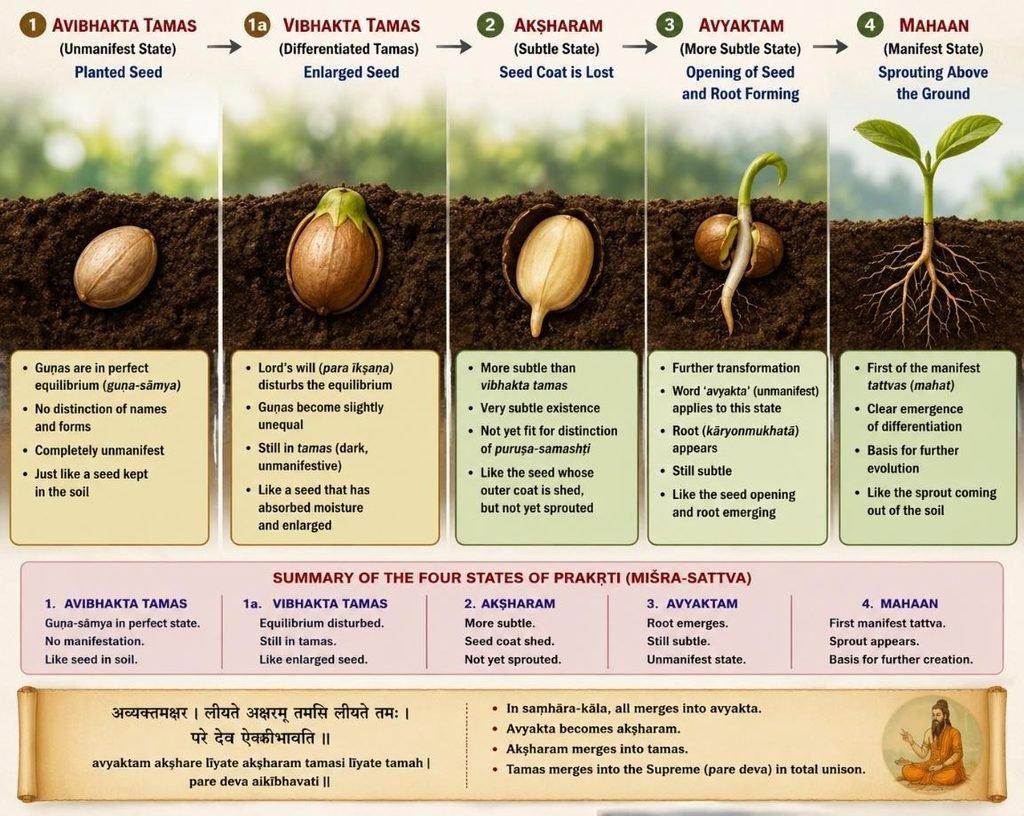
The intended conclusion
From the above explanation, it becomes clear that aksharam and thamas are not independent thathvas. They are merely successive states (sankOcha-dhaSAs) of prakruthi.
The commentator illustrates this with a simple analogy.
A flower passes through successive stages such as a bud (mukula) and a half-open blossom (kOraka) before it blooms fully. Although each stage has a distinct appearance and is referred to by a different name, they are not different flowers. They are merely different stages in the development of the same flower.
In the same way, avibhaktha thamas, vibhaktha thamas, aksharam, and avyaktham are successive conditions of one and the same prakruthi. They are distinguished only to explain the progressive stages through which prakruthi passes during dissolution and creation.
They should therefore not be counted as separate thathvas.
This is unlike mahath, ahamkAra, the thanmAthras, the mahAbhUthas, and the other evolutes, each of which is a distinct thathva produced during the process of creation.
Thus, the purpose of distinguishing these various states is merely to explain the gradual transformation of prakruthi, not to increase the number of fundamental principles accepted by the SAsthrams.
adiyen vAsudhEva rAmAnuja dhAsan
archived in https://granthams.koyil.org
pramEyam (goal) – https://koyil.org
pramANam (scriptures) – https://granthams.koyil.org
pramAthA (preceptors) – https://acharyas.koyil.org
SrIvaishNava Education (Children) – https://pillai.koyil.org