SrI: SrImathE SatakOpAya nama: SrImathE rAmAnujAya nama: SrImath varavaramunayE nama:
The extremely merciful periyavAchchAn piLLai has selected important SlOkams from SrI rAmAyaNam and provided a detailed commentary for them. This was published by puththUr swAmy along with a simple explanation for these.
We express our deepest gratitude to periyavAchchAn piLLai and puththUr swAmy, as well as to SrI u vE sArathy thOthAthri swAmy. This article is a translation of periyavAchchAn piLLai’s thaniSlOka vivaraNam, compiled with the support of SrI sArathy swAmy’s thamizh kAlakshEpam series.
In this grantham, we are currently experiencing the yudhdha kANdam, celebrated as ‘abhaya pradhAna sAram’ – where vibhIshNAzhwAn surrenders to perumAL. vibhIshNAzhwAn requests sugrIva mahArAja and others to inform perumAL of his arrival. However, sugrIva mahArAja expresses his concerns to perumAL, warning that vibhIshaNAzhwAn is an enemy coming from rAvaNa who might be a spy waiting for an opportunity to attack. Therefore, he conveys his intention to kill vibhIshaNAzhwAn. After communicating his opinion, he waits to understand perumAL’s response. At this point, perumAL addresses hanumAn and other monkeys and asks for their opinion on the matter; and the monkeys begin to respond to perumAL.
The monkeys praise perumAL saying, “You are omniscient and have asked for our opinion only out of love and friendship. Your will is unfailing. You are brave and righteous. You always execute your actions after careful scrutiny and remain steadfast in accomplishing them. You entrust yourself to your friends”.
Let us now proceed with the vyAkhyAnam for the 35th SlOkam.
avathArikai (Introduction)
All the monkeys – except for the four ministers, angadhan et al said, “Since dhEvarIr has submitted this divine task to be executed according to the will of your devotees, your four ministers will present their individual opinions respectively. The rest of us completely agree with their opinions”.
thasmAdhEkaikaSas thAvath bruvanthu sachivAsthava I
hEthuthO mathi sampannAssamarthAScha punasthathA II
Word-by-word meaning
thasmAth – hence
mathi sampannA: – those, who are intelligent
puna: thathA – in the same way
samarthA: cha – those, who possesses eloquence
thava – your
sachivA: thAvath – all the ministers
hEthutha: – pointing out the reasons
EkaikaSa: – one by one
bruvanthu – let them speak
Simple meaning
[The monkeys say] The ministers who are both intelligent and eloquent will point out the reasons and convey their opinions, one by one.
Notes from periyavAchchAn piLLai’s vyAkhyAnam
thasmAth – Therefore
[The monkeys say – therefore] Because dhEvarIr has made yourself dependent on your devotees, by placing us in this position – asking us, your servitors, for counsel.
EkaikaSa:
Let them express their individual opinions, respectively
thAvath bruvanthu – let everyone say
Initially, let everyone express their respective opinions. Later, when it comes to execution, dhEvarir may mercifully carry out as per dhEvarIr’s divine mind
[puththUr swAmy’s explanation
thAvath bruvanthu – let everyone say
Since the word ‘thAvath’- sAkalyavAsi, refers to ‘everyone’, it can also be interpreted as – initially, let everyone express their respective opinions; this also includes the meaning that at the time of execution, it can be carried out according to your divine mind.]
thava sachivA: – your ministers
In this great yAgam of protecting your devotees, you have taken a vow of protection, and these ministers are the ones who perform this sacrifice. The reason for the monkeys to speak in this manner is because they consider themselves as helpers in perumAL’s SaraNAgatha rakshaNam.
[Note from kAlakshEpam: perumAL independently performs the rakshaNam. However, because he asked the monkeys for their counsel, they assume this role of helper – knowing that to be their duty – and offer their recommendation accordingly].
hEthutha: – indicating reason such that perumAL cannot dismiss by simply claiming that it is already known.
mathi sampannA: – intelligent
This means they were all individually experts at determining the right course of action.
samarthAScha punasthathA –
Whatever was decided, they are able to convey it in a precise and acceptable manner to perumAL. They praised the four ministers in this SlOkam so that SrI rAma would honour their words.
thasmAdhEkaikaSas thAvath bruvanthu sachivAsthava I
hEthuthO mathi sampannAssamarthAScha punasthathA II
Thus concludes the vyAkhyAnam for this SlOkam.
SrI rAmAyaNa thani SlOkam yudhdha kANdam 36 – ithyukthE
avathArikai (Introduction)
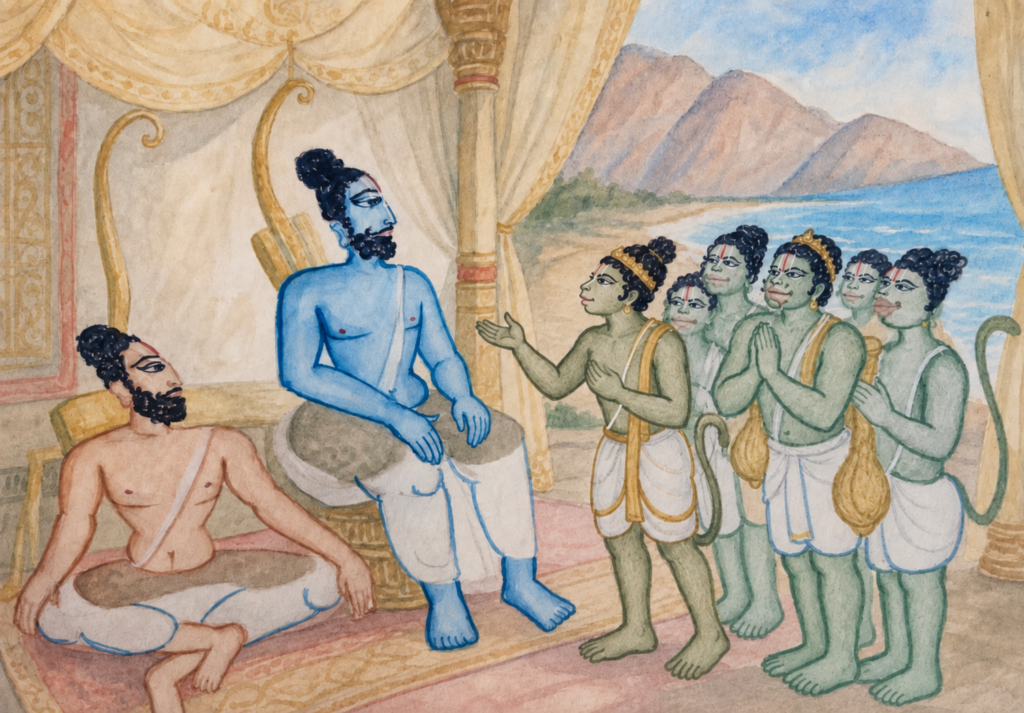
Thereafter, the most significant among them, the prince, angadhap perumAL speaks his thoughts through this SlOkam ‘ithyukthE‘ …
ithyukthE rAghavAyA’ tha mathimAn angadhO’ gratha: I
vibhIshaNaparIkshArtham uvAcha vachanam hari: II
Word-by-word meaning
atha – thereafter
ithi – thus
ukthE – having been spoken
agratha: – first
mathimAn – the intelligent
angadha: – named angadhan
hari: – a monkey
rAghavAya – for SrI rAma
vibhIshaNaparIkshArtham – to examine vibhIshaNa
vachanam – these words
uvAcha – spoke
Simple meaning
Thereafter, having thus been spoken by the monkeys, an intelligent monkey named angadha, spoke to SrI rAma to examine vibhIshaNa.
Notes from periyavAchchAn piLLai’s vyAkhyAnam
ithyukthE – When they said this – these four monkeys shall speak their thoughts.
rAghavAya harir vachanam uvAcha – the monkey offered his opinion to rAghavan, perumAL
vAlmeeki bhagavAn celebrates perumAL’s ASritha pArathanthryam [being dependent on those who had attained him] here, saying, “How extraordinary that the affairs of people in raghu dynasty are being solved by the words of a monkey!”
athA’ gratha: – after that, first in line
As the next in the line of succession after sugrIva mahArAja, and as the most prominent among the monkeys, angadhan [spoke first].
mathimAn angadha: – the wise angadhan, angadhan, the intelligent one
[He spoke first] not only because he was next in succession, but also because he possessed the high intellect needed to determine the actions to be executed presently.
vibhIshaNa parIkshArtham – for investigating vibhIshaNa
sugrIva mahArAja said, “vadhyathAm” – he deserves to be killed. However, perumAL’s divine heart resonated, “na thyajEyam” – “I will not abandon him”. Therefore, angadhan says for the purpose of examining vibhIshaNa, “To choose either of these two options without a proper investigation is incorrect”.
- SrI rAmAyaNam yudhdha kANdam 17-27 “vadhyathAm” (Let vibhIshaNa be killed).
- SrI rAmAyaNam yudhdha kANdam 18-3 “na thyajEyam” (I will not abandon those who have surrendered unto me). Thus, angadhan spoke his perspective regarding the examination of vibhIshaNa.
ithyukthE rAghavAyA’ tha mathimAn angadhO’ gratha: I
vibhIshaNaparIkshArthamuvAcha vachanam hari: II
Thus concludes the vyAkhyAnam for this SlOkam.
SrI rAmAyaNa thani SlOkam yudhdha kANdam 37 – SathrO:
vibhIshaNa deserves to be doubted in all aspects since he has come from the enemy. Therefore, he can neither be accepted nor rejected immediately.
avathArikai (Introduction)
Since vibhIshaNa has come from the enemy camp, he cannot be trusted immediately. In this SlOkam, he is characterised as‘Sankya’ (object of suspicion).
SathrO: sakASAth samprAptha: sarvathA Sankya Eva hi I
viSvAsayOgya: sahasA na karthavyO vibhIshaNa: II
Word-by-word meaning
vibhIshaNa: – vibhIshaNan
SathrO: sakASAth – from the enemy
samprAptha: – who has come
sarvathA – in all aspects
Sankaya: Eva hi – is he not worthy of being suspected?
sahasA – quickly
viSvAsayOgya: – as trustworthy
na karthavya: – not apt to be treated
Simple meaning
vibhIshaNan, who has come from the enemy side must be suspected in all aspects. He is not apt to be treated as trustworthy, immediately.
Notes from periyavAchchAn piLLai’s vyAkhyAnam
SathrO: sakASAth samprAptha: – one who has come from the enemy’s camp
Due to intense hatred, angadhan says ‘SathrO”:(enemy) and without mention of a name. Since there is no personal conflict or quarrel between vibhIshaNa and angadhan, why then does he address him as an enemy? It is because the devotees of the lord consider those who are hostile to bhagavAn as their enemies. Similarly, the supreme lord considers his devotees’ enemies as his own. This arises from the mutual affection between devotees, the SEshan and bhagavAn, the SEshi. Otherwise, neither the devotees nor bhagavAn treat or consider anyone as an enemy.
[Note from kALakshEpam: A devotee realises that everyone is bhagavAn’s SarIram; hence, he does not show any animosity towards anyone. It is only when others turn hostile towards bhagavAn that the devotees think of them as enemies. Why did hiraNyakaSipu and rAvaNa become objects of bhagavAn’s wrath, while prahlAdhan and vibhIshaNa became subject of his compassion? It is solely because the former caused suffering to his devotees. For example, within our own body, even though the different parts and organs remain harmonious, there may be instances when a specific part or organ becomes diseased, causing distress to the rest of the body. When this happens, the diseased limb or organ may be severed to save the body as a whole. Similarly, although everyone is bhagavAn’s SarIram, if some cause destruction to the rest of the creation, they are destroyed].
[puththUr swAmy’s explanation
SathrO: sakASAth samprAptha: – he has come from the enemy’s side
Due to extreme hatred, instead of referring to him by his name, ‘rAvaNa’, he says, ‘from the enemy’s side’. Those who harbour animosity towards bhagavAn are considered enemies by devotees. [krishNa opted to eat at the home of vidhura and rejected food offered by dhuryOdhana. He declared at that time, “You hate the paNdavas, and the paNdavas are my very life-breath. Therefore, you are my enemy, and I cannot accept food provided by an enemy). Thus, bhagavAn has declared his devotees’ enemies as his own through expressions such as “dhvishadhannam – food provided by an enemy”. Other than this, bhagavAn, who is sarva SarIri (who has everyone has his divine body), does not possess any direct enmity towards a specific few. Likewise, his devotees who see everything as bhagavAn’s vibhUthi (wealth), do not harbour enmity towards anyone.]
sakASAth samprApthO hi – hasn’t he come from the enemy’s side?
[This is true,] but rAvaNa is the enemy; what is wrong with accepting vibhIshaNa?
[angadhan says,] The fact that he has come directly from rAvaNa’s royal assembly is well-known to dhEvarIr as well. Therefore, he must have come regarding rAvaNa’s affairs.
[puththUr swAmy’s explanation
sakASAth samprApthO hi – hasn’t he come from the enemy’s side?
rAvaNa is the enemy here; what is wrong with vibhIshaNa? [angadhan reiterates,] dhEvarIr is also aware that he has come from rAvaNa’s assembly, isn’t that so? Therefore, it is possible that he has come as rAvaNa’s spy.]
sarvathA Sankaya Eva – Therefore, by all means, he must be suspected. The word Sankaya is significant here. Observing how perumAL’s divine face revealed compassion for vibhIshaNa, angadhan says Sankaya – to be suspected, and not vadhyan – to be killed.
Because vibhIshaNa has come from the enemy’s camp, declared himself to be rAvaNa’s brother, and born as a rAkhasa, angadhan believes there is not a single reason to trust him.
viSvAsayOgya: sahasA na karthavya: – he cannot be trusted immediately
“If he has come to take refuge, won’t he then be worthy of trust”? Realising that this is perumAL’s opinion, angadhan says, “Even in that case, he is not fit to be trusted immediately”. Why is it that way?
[puththUr swAmy’s explanation
viSvAsayOgya: sahasA na karthavya: – he cannot be trusted immediately
“Even though vibhIshaNa is related to the enemy, don’t those who come seeking refuge deserve to be trusted”? angadhan understood that this question resonated in SrI rAma’s divine heart. Therefore, he said, “He cannot be trusted all of a sudden just because he has surrendered himself; either acceptance or rejection must be done only after a thorough investigation”. Why is it that way?]
vibhIshaNa:
[Why can’t he be trusted? This is obvious even from his name. He is vibhIshaNa:, which means ‘one who instills fear in the entire world’].
vibhIshaNa has performed SaraNAgathi, However, because he is a fearsome person who terrifies all the worlds through torments, his surrender to his enemy can only mean deceit. It is possible that he has come, speaking a word which is believed in this assembly [act of surrendering] to harm us. Hence, it is not appropriate to trust him immediately. He is apt to be viewed with suspicion.
SathrO: sakASAth samprAptha: sarvathA Sankaya Eva hi I
viSvAsayOgya: sahasA na karthavyO vibhIshaNa: II
Thus concludes the vyAkhyAnam for this SlOkam.
SrI rAmAyaNa thani SlOkam yudhdha kANdam 17.38 – chAdhayithvA
Those with deceitful intentions often pose as virtuous people. Therefore, anyone who trusts them without examining their true nature will bring harm upon themselves.
avathArikai (Introduction)
“His sorrow and helplessness were visible when he surrendered, so how could we not trust him?” Considering these to be perumAL’s thoughts, angadhap perumAL conveys in this SlOkam that even a SaraNAgathan is not worthy of immediate trust. He provides his reasoning and warns of the disaster that might befall if they trust him.
chAdhayithvA Athma bhAvam hi charanthi Sata budhdhaya: I
praharanthi cha randhrEshu sO’narthasthathkruthO bhavEth II
Word-by-word meaning
Satabudhdhaya: – evil-minded rAkshasa
AthmabhAvam – one’s own perspective
chAdhayithvA – concealing
charanthi hi – aren’t they moving about (like a virtuous person)?
randhrEshu – when an opportunity arises
praharanthi – they also cause harm
sa: anartha: – that harm
thathkrutha: bhavEth – is brought upon by oneself due to placing the trust
Simple meaning
An evil-minded rAkshasa moves about concealing his true intentions and causes harm when an opportunity arises. The ones who trust [the wrong entity], bring this harm upon themselves.
Notes from periyavAchchAn piLLai’s vyAkhyAnam
Sata budhdhaya: Athma bhAvam chAdhayithvA charanthi
Sata budhdhaya: – evil-minded
They are evil-minded because the rAkshasas are predominantly governed by their thamasic [qualities of laziness, ignoranceetc] nature. [Note from kAlakshEpam: Due to the possession of thamO guNa, they lack the knowledge and inclination to respect the SAsthram and the wise. As a result, many mistakes arise, and become evil-minded].
Athma bhAvam chAdhayithvA
He might have come intending to kill us, but he hides his true motive.
charanthi
They move about like sages. They will interact appearing in disguise contrary to their impurity in intent.
hi – this is well-known
The malevolent rAkshasas appearing as virtuous well-wishers is widely known. Have we not experienced this through the incidents of mArIcha and rAvaNa?
Thus, angadhap perumAL expresses that vibhIshNAzhwAn is not to be trusted immediately.
Suppose you ask, what can he do to us, by coming here while hiding his inherent nature?
praharanthi cha randhrEshu – they will attack when vulnerabilities appear
When you are alone with him, or when you are focussed on something else. He will fraternise with you in an intimate way and make others believe that both of you are very close. By doing so, others may lower their guard around him.
sO’narthas thathkruthO bhavEth – misfortune caused by one’s own action
The consequence of immediate trust without proper examination brings harm upon oneself.
chAdhayithvA’’thma bhAvam hi charanthi Sata budhdhaya: I
praharanthi cha randhrEshu sO’narthasthathkruthO bhavEth II
Thus concludes the vyAkhyAnam for this SlOkam.
SrI rAmAyaNa thani SlOkam yudhdha kANdam 17.39 – arthAnarthau
angadhap perumAL says, “After an investigation, if we determine that he is righteous, we can accept him; otherwise, we will reject him”.
avathArikai (Introduction)
This SlOkam explains the evaluation criterion for whether vibhIshaNa is to be accepted or cast aside.
arthAnarthau viniSchithya vyavasAyam bhajEtha hi I
guNatha: sangraham kuryAth dhOshathasthu visarjayEth II
Word-by-word meaning
arthAnarthau – the pros and cons
viniSchithya – well decided
vyavasAyam – willpower (regarding killing the person who has approached us)
bhajEtha hi – (a person) has to attain it, indeed.
guNatha: – if there is virtue
sangraham kuryAth – has to be accepted
dhOshatha: thu – but if there are faults
visarjayEth – abandoned
Simple meaning
A firm resolution (regarding killing him) should only be made after examining the pros and cons, isn’t it? If he possesses virtues, he should be accepted; if he has faults, he must be abandoned.
Notes from periyavAchchAn piLLai’s vyAkhyAnam
arthAnarthau viniSchithya
Before accepting and assigning him to a task, we must determine the benefits he will bring.
vyavasAyam bhajEtha hi
A firm decision must be made as to whether to accept or abandon. We must not accept or reject anything without prior evaluation.
hi – this well-known, and is present in the nIdhi SAsthram (rules of conduct). Indeed there is nothing that dhEvarIr is not knowledgeable about!
guNatha: sangraham kuryAth dhOshathasthu visarjayEth
If he has the qualities required to accomplish our task, we should accept him. However, if his traits could be detrimental to our mission, we must abandon him immediately. If we fail to accept him despite observing his noble virtues, we could lose any accomplishment that we could have achieved due to him. Conversely, if we fail to abandon him despite knowing his faults, it will lead to our own destruction. Therefore, he must be abandoned.
[puththUr swAmy’s explanation
guNatha: sangraham kuryAth dhOshathasthu visarjayEth – accept him if he possesses noble virtues; abandon him if he possesses faults.
Upon analysing, if we determine that he has the virtues to accomplish our mission in its entirety, we should accept him whole heartedly. Conversely, if the faults will jeopardise our mission, he must be abandoned instantly. If we do not accept him despite knowing his noble traits, we could forfeit the opportunity to capitalise on his potential. In contrast, if we do not cast him aside despite knowing his defects, we could destroy ourselves.]
Thus, he states with absolute firmness, ‘It is essential to choose the appropriate one of these two options’, through the words guNatha: sangraham kuryAth dhOshathasthu visarjayEth.
arthAnarthau viniSchithya vyavasAyam bhajEtha hi I
guNatha: sangraham kuryAth dhOshathasthu visarjayEth II
Thus concludes the vyAkhyAnam for this SlOkam.
SrI rAmAyaNa thani SlOkam yudhdha kANdam 17.40 – yadhi dhOshO
avathArikai (Introduction)
‘Since no one is entirely noble or entirely evil, a person cannot be rejected or accepted solely for this reason’ Realising that this is perumAL’s thought, angadhap perumAL says, ‘If he possesses many defects, we will reject him, conversely, if he possesses many good qualities, we will accept him’.
yadhi dhOshO mahAmsthasmin thyajyathAm aviSankitha: I
guNAn vApi bahUn gyAthvA sangraha: kriyathAm nrupa II
Word-by-word meaning
nrupa – Oh, king!
thasmin – in him
mahAn dhOsha: yadhi – if there are great faults
aviSankitha: – undoubtedly
thyajyathAm – let him be rejected
bahUn guNAn vA api – many good qualities
gyAthvA – recognising (in him)
sangraha: kriyathAm – must accept (him)
Simple meaning
Oh, king! If he possesses great fault, undoubtedly, let him be rejected. If we recognise that he possesses many good qualities, we must accept him.
Notes from periyavAchchAn piLLai’s vyAkhyAnam
nrupa
Oh, the one who was born to rule the world! Do we need to preach this justice to dhEvarir? dhEvarIr is already well aware of this.
thasmin dhOshA mahAn yadhi aviSankithasthyajyathAm
If the faults are greater, the few noble traits will be suppressed and defeated; hence, those virtues will not flourish. Therefore, accepting him simply because he possesses a few good qualities is not appropriate. Such a person must be rejected without any mercy.
[puththUr swAmy’s explanation
thasmin dhOshA mahAn yadhi aviSankithasthyajyathAm – he must be abandoned without hesitation if his faults greatly outnumber his good qualities.
If his faults are innumerable, the few good qualities present will perish amid those faults and will be completely destroyed. Hence, they will not contribute to any goodness. Therefore, considering those few good qualities he must not be accepted. He must be abandoned without any mercy.]
guNAn vApi bahUn gyAthvA sangraha: kriyathAm
If one possesses an enormous number of good qualities, the small flaws cannot overpower and will become hidden by the good qualities. Since those flaws cannot sustain, we should not abandon him because of those flaws. In that case, he must be accepted.
yadhi dhOshO mahAmsthasmin thyajyathAmaviSankitha: I
guNAn vApi bahUn gyAthvA sangraha: kriyathAm nrupa II
Thus concludes the vyAkhyAnam for this SlOkam.
AzhwAr emperumAnAr jIyar thiruvadigaLE SaraNam
periyavAchchAn piLLai thiruvadigaLE SaraNam
Source – SrI rAmAyaNa thani SlOkam – 68 – yudhdha kANdam 17.38 – 40 Audio Video
adiyEn chithrA rAmAnuja dhAsi
Proofreading/Curating done by – kOsalEndhra rAmAnuja dhAsan, krishNan rAmAnuja dhAsan
Artwork – namperumAL rAmAnuja dhAsan
Related Links
SrI rAmAyaNa thani SlOkam – 67 – yudhdha kANdam 17.31 – suhruthA, 17.32 – ithyEvam, 17.33 – agyAtham, 17.34 – thvam hi Audio Video
SrI rAmAyaNa thani SlOkam – 66 – yudhdha kANdam 17.28 – EvamukthvA , 17.29 – sugrIvasya, 17.30 – yadhuktham Audio Video
SrI rAmAyaNa thani SlOkam – 65 – yudhdha kANdam 17.24 – rAvaNO praNihitham, 17.25 – rAkshasO jihmayA , 17.26 – pravishta: Sathrusainyam, 17.27 – vadhyathAmEsha Audio Video
SrI rAmAyaNa thani SlOkam – 64 – 17.20 – praNidhI rAkshasEndhrasya, 17.21 – athavA svayamEvaisha, 17.22 – mithrAtavI balam, 17.23 – prakruthyA Audio Video
SrI rAmAyaNa thani SlOkam – 63 – yudhdha kANdam 17.16 – Ethaththu vachanam, 17.18 – manthrE vyUhE, 17.19 – anthardhAnagathA Audio Video
SrI rAmAyaNa thani SlOkam – concise english meanings
archived in https://granthams.koyil.org
pramEyam (goal) – https://koyil.org
pramANam (scriptures) – https://granthams.koyil.org
pramAthA (preceptors) – http://acharyas.koyil.org
SrIvaishNava education/kids portal – http://pillai.koyil.org