SrI: SrImathE SatakOpAya nama: SrImathE rAmAnujAya nama: SrImath varavaramunayE nama:
In this series, we have enjoyed the commentaries up to sundhara kANdam; we shall now begin perusing the vyAkhyAnams for SlOkams in yudhdha kANdam. Before proceeding to the commentaries on the SlOkam, we will explore the introduction to yudhdha kANdam, titled as abhayapradhAna sAram which is mercifully authored by periyavAchchAn piLLai.
We are deeply grateful to puththUr swAmy, who published this grantham, SrI rAmAyaNa thaniSlokam vivaraNam alongside his lucid thamizh commentary for it. With the aid of these commentaries, we are able to appreciate the in-depth meanings of these SrI rAmAyaNa SlOkams. We are also indeed grateful to SrI u vE sArathy thOthAthri swAmy for his thamizh kAlakshEpams (discourses) on this grantham; this article series is a translation of his insightful kAlakshEpams on this grantham.
The ithihAsam SrI rAmAyaNam was first authored by brahmA in sathyalOka as a prodigious grantham. With brahmA’s blessings, vAlmeeki bhagavAn authored SrI rAmAyaNam encompassing 24000 SlOkams. It is celebrated as Adhi kAvyam – The First Epic. Comprising both general virtues (sAmAnya dharmam) and specific virtues (viSEsha dharmam), it elaborates upon the essence of the vEdhas. Hence, it is referred to as upabrahmaNam, a secondary scripture.
The SlOkams in SrI rAmAyaNam also convey the greatnesses of perumAL, pirAtti, iLaiya perumAL, bharathAzhwAn, SathrughnAzhwAn, thiruvadi, vibhIshaNAzhwAn, guhap perumAL, SabarI, jatAyu mahArAja, among others. This marvellous epic offers two distinct experiences to its readers; while the narrative progresses through sundhara kANdam, the beginning of yudhdha kANdam specifically highlights vibhIshaNa SaraNAgathi.
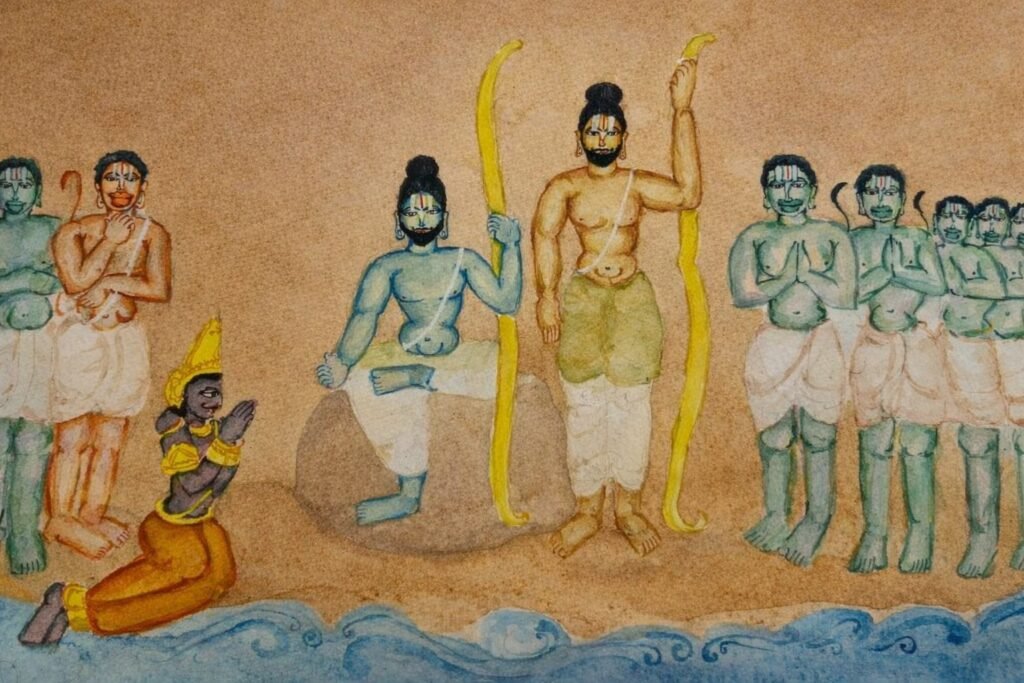
When vibhIshaNAzhwAn arrives to surrender to perumAL, many oppose his acceptance out of their protective devotion. sugrIva mahArAja rejects him, viewing him as an adversary, while thiruvadi rationalises that he is trustworthy. At this juncture, perumAL explains that he shall accept vibhIshNAzhwAn regardless of any flaws because he has sought refuge. He then instructs sugrIva mahArAja to bring vibhishaNAzhwAn to him.
(Note from kAlakshEpam: This juncture, where vibhIshaNAzhwAn performs SaraNAgathi, is considered pivotal in our sampradhAyam. Once, during emperumAnAr’s kAlakshEpam (on the acceptance of vibhishaNAzhwAn’s SaraNAgathi), piLLai uRangAvilli dhAsar walked out in tears. When asked why, he explained his regret: ‘If there is so much hesitation to accept vibhIshaNAzhwAn, who has relinquished everything, what hope is there for people like me who still hold on to material things? How will we be uplifted?’ emperumAnar then mercifully explained the prabhAvam (divine influence) of our guruparamparai. He assured that if we simply hold onto our AchAryas, they will take us to perumAL and ensure our salvation.)
The paramount SaraNAgathi that is explained in yudhdha kANdam is described by periyavAchchAn piLLai as abhayapradhAna sAram – the essence of bestowing refuge, where perumAL bestows protection upon vibhIshaNAzhwAn. Similarly, after the war, pirAtti offered her own protection to the rAkshasis. Thus, the entire yudhdha kANdam demonstrates both perumAL and pirAtti offering their divine protection.
We shall now enjoy the introduction to yudhdha kANdam – abhayapradhAna sAram that explains the significance of SaraNAgathi.
- SrI rAmAyaNam bAla kANdam 4-6 “thau thu mEdhAvinau dhrushtvA vEdhEshu parinishtithau I vEdhOpabhrumhaNArthAya thAvagrAhayatha prabhu: II” (vAlmeeki bhagavAn, seeing both of them (kuSa and lava) as extremely intelligent and steadfast in vEdhic virtues, recognized them as apposite to expound the vEdhas (through SrI rAmAyaNam)).
(Note from kAlakshEpam: With the grace of brahmA, having completed the SrI rAmAyaNam manuscript, vAlmeeki bhagavAn desires to proclaim it. Upon seeing kuSa and lava engaged in vEdha adhyayanam one day, he deems them capable of illuminating the glories of SrI rAmAyaNam far and wide).
The birth of this prabhandham – divine literature – SrI rAmAyaNam is, predominantly, to explicate the essence of the vEdhas and to identify the supreme lord who is the cause of this universe. The word ‘prabandham’ also means ‘binding together’. Since ‘bandham’ means to bind, it can be interpreted as one that which binds the devotee to bhagavAn or as that which makes bhagavAn bound to those who are engaged in learning and reciting this prabandham.
- purushasUktham uththarAnuvAkam 1 “adhbhya: sambhUtha: pruthivyai rasAchcha” (The earth born from the waters and developed by the essence of food appears manifested from the supreme lord).
Thus, from the above statement and other statements mentioned below from purushasUktham, one is able to understand the creation of cosmos and about the incarnations of the supreme.
- purushasUktham uththarAnuvAkam 3 “ajAyamAnO bahudhA vijAyathE” (The unborn supreme takes birth in many forms).
Further, the purpose of incarnation: protecting the sAdhus (those following the virtuous path, supreme SrIvaishNava), destroying the evildoers, and establishing dharma, is explained in the vEdhas. This can be seen in the vEdha vAykyam (statement) below from purushasUktham.
- purushasUktham uththarAnuvAkam 4 “yO dhEvEbhya Athapathi yO dhEvAnAm purO hitha:” (I bow to the supreme, one who torments the asuras to protect the dhEvas, the supreme lord, who incarnated as vishNu – the leader of all dhEvas, the effulgent one, and parabrahmam).
Let us now examine some relevant SlOkams in SrI rAmAyaNam which expound the above vEdha vAkyam, describing bhagavAn’s incarnation.
- SrI rAmAyaNam yudhdha kANdam 14-14 “vyakthamEsha mahAyOgI paramAthmA sanAthana:” (It is evident that this SrI rAma is the supreme yOgi, eternal, supreme being).
- SrI rAmAyaNam yudhdha kANdam 120-13 “bhavAn nArAyaNO dhEva: SrImAn chakrAyudhO vibhu:” (The dhEvas praise upon seeing SrI rAma in the battlefield: Your highness! You are nArAyaNa, one eternally with SrI mahAlakshmi, one who has discus (chakram), one who pervades everywhere).
- SrI rAmAyaNam ayOdhyA kANdam 1-7 “arthithO mAnushE lOkE jagyE vishNu: sanAthana:” (Implored by the dhEvas, the eternal vishNu bhagavAn incarnated in the world of humans).
As such, from these SrI rAmAyaNa pramANams, it is evident that the supreme truth is that bhagavAn incarnated as SrI rAma. Thus, through these SlOkams one is able to understand that SrI rAmAyaNam elucidates the purports shown in the vEdham (hence, it is known as upabhrahmaNam).
Next, let us examine how SrI rAmAyaNa SlOkams describe the vEdha vyAkyam which illustrate the incarnation of supreme lord as vishNu bhagavAn to help the dhEvas [purushasUktham 4 “yO dhEvEbhya Athapathi yO dhEvAnAm purO hitha:”].
By describing how SrI rAma protected sage viSwAmithra’s yAgam, the rishis of dhaNdakAraNya forest, and the dhEvas, oppressed by rAvaNa’s formidable boons and might, SrI rAmAyaNam illustrates the principle of sAmAnya dharmam – protecting all beings.
- SrI rAmAyaNam yudhdha kANdam 131-102 “rAmO rAmO rAma ithi prajAnAmabhavan kathA: I rAmabhUtham jagadhabhUtham rAmE rAjyam praSAsathi II” (rAma, rAma, rAma – thus the residents of SrI ayOdhyA always spoke in their conversation, and everything became filled with SrI rAma, when SrI rAma ruled the kingdom).
- SrI rAmAyaNam uththara kANdam 109-22 “thiryagyOnigathASchApi sarvE rAmam anuvrathA:” (Even those creatures which crawl and slither, followed SrI rAma).
With their flaws removed and captivated by his beauty, simplicity, and auspicious qualities, the residents of SrI ayodhyA reached a state where they could not bear to live without SrI rAma. SrI rAma captivated all and took them along with him to SrI vaikuNtam (mOksham). Through this, viSEsha dharmam – anishta nivruththi (removal of unfavourable desires) and ishta prApthi (bestowal of favourable desires) – is illustrated in SrI rAmAyaNam. Thus sAdhu rakshaNam as ordained in vEdhas can be seen in these SlOkams in SrI rAmAyaNam.
Next, dhushta nirAsanam: By destroying the enemies of the rishis such as thAtakA and thAtakEya (sons of thAtakA, mArIcha and subAhu) and other rAkshasas, khara and dhUshaNa, thriSiras, rAvaNa, kumbhakarNa, and others, the evil doers were vanquished. Through this, SrI rAma’s dhushta nirAsanam – elimination of the unvirtuous is seen.
By practicing pithru vachana paripAlanam (adherence to father’s word), following the counsel of sages, and upholding kshathriya dharmam – preventing the mighty from oppressing the meek (specifically, destroying vAli and protecting sugrIva mahArAja) – SrI rAma fulfilled both sAmAnya and kshathriya dharmam (common and kingly duties). Furthermore, by performing 100 aSwamEdha yAgam, he established the highest standards of righteousness.
- SrI rAmAyaNam kishkindhA kANdam 4-19 “sugrIvam SaraNangatha:” (SrI rAma took refuge in sugrIva mahArAja).
- SrI rAmAyaNam yudhdha kANdam 19-31 “samudhram rAghavO rAjA SaraNam ganthumarhathi” (vibhIshaNAzhwAn says: It is appropriate for king SrI rAma to take refuge in the king of ocean).
Thus, SrI rAmAyaNam exemplifies the viSEsha dharmam – SaraNAgathi (total surrender) through the instances of surrendering to sugrIva mahArAja and the king of the ocean.
- SrI rAmAyaNam sundhara kANdam 35-11 “maryAdhAnAm cha lOkasya karthA kAryamithA cha sa:” (perumAL is the one who defines the conduct to be followed in the world (by each and everyone), he also is the enforcer, the controller who ensures that everyone acts accordingly).
- SrI rAmAyaNam bAla kANdam 1-96 “svE svE dharmE niyOkshyathi” (perumAL ensures that all act according to their dharmams).
Thus, to ensure others followed dharma, perumAL strictly adhered to it himself, thereby restoring order – dharma samsthApanam. This principle is also clearly seen in SrI rAmAyaNam.
Therefore, SrI rAmAyaNam clearly demonstrates as to how perumAL has accomplished sAdhu parithrANam (protection of the righteous), dhusta nirAsanam (destruction of evil), dharma samsthApanam (establishment of righteousness). Thus, SrI rAmAyaNam is proven to be the upabrahmaNam of the vEdham, as it describes the meanings found in the vEdham in great detail. Now, let us see the primary objective of this upabrahmaNam, SrI rAmAyaNam.
- thaiththirIya upanishadh “nyAsa ithyAhUr manIshiNO brahmANam – thasmAnnyAsamEshAm thapasAm athirikthamAhu:” (The wise say that nyAsa or SaraNAgathi is brahmam (perumAL) himself. Therefore, they say that nyAsa or SaraNAgathi is superior to all other austerities).
As such, vAlmeeki bhagavAn elucidates this supreme pramEyam – SaraNAgathi dharmam in SrI rAmAyaNam by illustrating SrI rAma offering protection to vibhIshaNAzhwAn. Now, let us see how SrI rAmAyaNam establishes SaraNAgathi as the supreme pramEyam.
Through the description of perumAL’s parathvam (supreme nature) alongside his incarnation as a human, we see his Seela guNam (quality of mixing with others freely). Setting aside his supremacy, he mixes like water with water – with guhap perumAL, Sabari, sugrIva mahArAja and vibhishaNAzhwAn without any discrimination. By protecting the virtuous (sAdhu parithrANam), establishing dharma (dharma samsthApanam), and annihilating the unrighteous (dhushta nirasanam), vAlmeeki bhagavAn illustrates perumAL’s sarva rakshakathvam (nature as a universal protector). Aren’t these the definitive characteristics of one worthy to be a SaraNyan (protector)?
The entire SrI rAmAyaNam illustrates this nature of SrI rAma as SaraNyan – the ultimate refuge, the one who accepted the SaraNAgathi of vibhIshaNAzhwAn. Consequently, it can be said that SaraNAgathi is the paramount subject matter of SrI rAmAyaNam.
Thus, in yudhdha kANdam, vAlmeeki bhagavAn reveals the greatness of SaraNAgathi through these key principles/aspects: the obligation of a SaraNyan (protector) to offer refuge to those who surrender, the acceptance of SaraNAgathi (surrender) for the sake of the servitors’ well-being, the compassionate nature of perumAL’s as servitor [to the one who has surrendered to him]. Furthermore, he highlights the two essential limbs of SaraNAgathi: Akinchanyam (the feeling of not having anything [means] in one’s hand to protect oneself) and ananyagathithvam (having no refuge other than perumAL).
This concludes the introduction to yudhdha kANdam. In the next article, we shall continue to enjoy the SlOkams in yudhdha kANdam.
AzhwAr emperumAnAr jIyar thiruvadigaLE SaraNam
periyavAchchAn piLLai thiruvadigaLE SaraNam
Source – SrI rAmAyaNa thani SlOkam – 50 – yudhdha kANdam – abhaya pradhAna sAram – pravESam (Introduction) Audio Video
adiyEn chithrA rAmAnuja dhAsi
Proofreading/Curating done by – kOsalEndhra rAmAnuja dhAsan, krishNan rAmAnuja dhAsan
Artwork – namperumAL rAmAnuja dhAsan
Related Links
SrI rAmAyaNa thani SlOkam – 49 – sundhara kANdam 51.38 – sathyam rAkshasa rAjEndhra Audio Video
SrI rAmAyaNa thani SlOkam – 48 – sundhara kANdam 38.33 – sa pithrA cha Audio Video
SrI rAmAyaNa thani SlOkam – 47 – 31.19 – sA thiryakUdhvancha, 34.23 – svapnEpi Audio Video
SrI rAmAyaNa thani SlOkam – 46 – sundhara kANdam 21.9 – iha santhO – Part 2 Audio Video
SrI rAmAyaNa thani SlOkam – 45 – sundhara kANdam 21.9 – iha santhO – Part 1 Audio Video
SrI rAmAyaNa thani SlOkam – concise english meanings
archived in https://granthams.koyil.org
pramEyam (goal) – https://koyil.org
pramANam (scriptures) – https://granthams.koyil.org
pramAthA (preceptors) – http://acharyas.koyil.org
SrIvaishNava education/kids portal – http://pillai.koyil.org