SrI: SrImathE SatakOpAya nama: SrImathE rAmAnujAya nama: SrImath varavaramunayE nama:
In the previous article, we explored the introduction to yudhdha kANdam – abhayapradhAna sAram. SrI rAmAyaNam is revered as an incarnation of the vEdham, appearing to explain the profound meanings within the SAsthram. Herein, periyavAchchAn piLLai has highlighted verses from purshasUktham (a vital portion of the vEdham) to demonstrate how the vEdham praises the glories of bhagavAn – his parathvam (supreme nature), his Saulabhyam (accessibility), and his rakshakathvam (protection).
vAlmeeki bhagavAn provides a detailed expansion (upabrahmaNam) of all these aspects. Why does the vEdham praise these attributes of bhagavAn? It is to show that he is the ultimate refuge for all. This principle of seeking the supreme lord’s refuge, or SaraNAgathi, is clearly illustrated by vAlmeeki bhagavAn throughout SrI rAmAyaNam. WithIn this, vibhIshaNa SaraNAgathi is especially celebrated as abhayapradhAna sAram or the essence of bestowing protection.
Before proceeding to the commentaries on the SlOkam, we express our gratitude to periyavAchchAn piLLai for mercifully bestowing this in-depth meanings, and to puththUr swAmy, for publishing these vyAkhyAnams. We also extend our gratitude to SrI u vE sArathy thOthAthri swAmy for his thamizh kAlakshEpams on this grantham, from which this article is translated, and for his continuous guidance in publishing these articles.
Let us now enjoy the next SlOkam in this series.
rAvaNa does not mend his ways even after thiruvadi proclaims SrI rAma’s praise and instructs rAvaNa to reunite pirAtti with perumAL. thiruvadi returns and delivers pirAtti’s message to perumAL. Upon hearing from thiruvadi, perumAL, along with his army, reaches the shores and contemplates on how to cross the ocean.
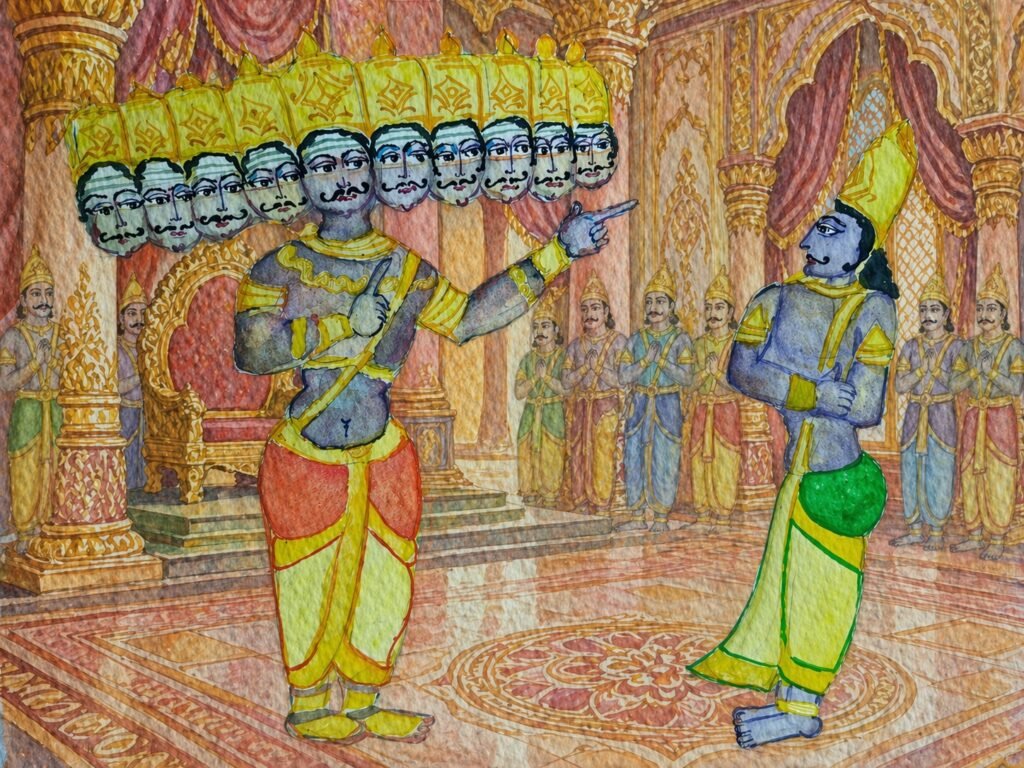
On the other side of the ocean in lankA, vibhIshaNAzhwAn, observing the immoral actions of rAvaNa, counsels him. rAvaNa and his son, indhrajith, become furious and condemn him for his advice. This SlOkam is uttered by vibhIshaNAzhwAn while feeling disgraced and regretful during his conversation with rAvaNa.
avathArikai (Introduction)
vAlmeeki bhagavAn detests rAvaNa’s disposition: his animosity towards SrI rAma, the most supreme among all entities; his blatant disregard for the advice of his younger brother, vibhIshaNAzhwAn, who sought only his rescue and well-being; and his obstinacy in following the imprudent words of yama, the catalyst of his destruction.
sunivishtam hitham vAkyamukthavantham vibhIshaNam I
abravIth parusham vAkyam rAvaNa: kAlachOdhitha: II
Word-by-word meaning
sunivishtam – sweet (to the ears)
hitham – that which results in goodness
vAkyam – sentence
ukthavantham – one, who spoke
vibhIshaNam – with respect to vibhIshaNa
rAvaNa: – rAvaNa
kAlachOdhitha: – prompted by yama
parusham – harsh
vAkyam – sentence
abravIth – spoke
Simple meaning
rAvaNa, provoked by kAla (yama), spoke harsh words to vibhIshaNAzhwAn, who had spoken sweet words intended for rAvaNa’s goodness.
Notes from periyavAchchAn piLLai’s vyAkhyAnam
sunivishtam – sweet (to the ears)
- SrI rAmAyaNam sundhara kANdam 31-1 “samSravE madhuram” (words which are sweet to the ears)
vibhIshaNAzhwAn’s words need not be analysed in depth to recognise their sweetness. Simply hearing those beautifully and cohesively constructed phrases is a delight to the ears. Even though they are undesirable to rAvaNa, they are so sweet that one cannot help but listen.
sunivishtamukthavantham
Not only were vibhIshaNAzhwAn’s words sweet, but so was the manner in which they were spoken. Even when words are sweet, they are futile if they do not resonate with the listener. His words could not be ignored; they entered and registered deeply in the mind.
hitham
vibhIshaNAzhwAn’ words were not only sweet to the ears, but they also had the power to save rAvaNa from his misfortune. Even if they were unpleasant for rAvaNa to hear, he should have listened instead of ignoring them. Even if they had been harsh, he should not have disregarded them, as they were for his own well-being. How, then, could such words become unbearable to him?
vAkyam
vibhIshaNAzhwAn’s sentences were filled with beneficial words; the words were well integrated and conveyed the full, intended meaning.
ukthavantham
- aitharEya AraNyakam 3-2-6 “nAsamvathsaravAsinE prabhruyAth” (A Sishya should not be instructed unless he stayed at least for a year with the AchArya and served him).
vibhIshaNAzhwAn out of extreme compassion, could not bear to remain silent while witnessing rAvaNa’s adversity. Thus, he offered these words of counsel exclusively for those who serve and surrender. They are meant for those pining to serve at the feet of an AchArya with a sincere desire to receive such instructions.
vibhIshaNam
Words spoken by someone distant, physically or mentally, may not be trustworthy, and hence we may dismiss them as unreliable. However, if they are spoken by someone close – a brother who is simply oneself in a different form – they should be accepted.
- manu smruthri 2-226 “bhrAthA svA mUrthirAthmana:” (A brother is one’s own another form).
parusham vAkyam abravIth – spoke harsh words
What ought to be rAvaNa’s reaction upon hearing vibhIshaNAzhwAn’s words?
- rAvaNa should have gained clarity, just as arjuna did after hearing krishNa’s advice: ‘All my doubts have been clarified’. SrI bhagavath gIthA 18-73 “sthithO’smi gathasandhEha:” (arjuna says: I am standing firm, with realisation of truth, being freed from doubts).
- rAvaNa should have expressed gratitude for the benevolence of vibhIshaNAzhwAn’s advice. SrIvishNu purANam 1-1-2 “thvaththO hi vEdhAdhyayanam” (maithrEya says to sage parASara: Oh, sage! I owe the learning of the entire vEdham to you).
- rAvaNa should have expressed his inability to repay the kindness shown by vibhIshaNAzhwAn. thiruvAimozhi 2-7-8 “ennaith thI manam keduththAy unakken seygEn” (What can I do for you to reform my evil mind?)
Instead of showing gratitude for vibhIshaNAzhwAn’s kindness, he speaks to him in contempt, as if he were his nemesis.
vAkyam – (rAvaNa’s) words
Just as vibhIshaNAzhwAn spoke with every intent for rAvaNa’s well-being, rAvaNa unleashed every harsh word he could find to berate him. While vibhIshaNAzhwAn spoke so sweetly and meaningfully that his words entered and registered well in rAvaNa’s mind, rAvaNa spoke in a manner that pierced vibhInAzhwAn’s heart; his words were bitter, derisive, and deeply hurtful.
Why did rAvaNa behave in this manner? Simple: because he is rAvaNa!
rAvaNa:
“rAvayathi rOdhayathi” – ‘rAvayathi rOdhayathi – ithi rAvaNa:’ (He who causes to cry and causes grief/fear is rAvaNa). His very name implies that he causes others to weep through the pain he inflicts upon them.
It can also be interpreted as rAvaNa bringing pain upon himself. By misjudging his own might, he put his feet in inappropriate places and got caught – as seen in his defeats by kArthavIryArjuna and vAli – where he suffered greatly. Therefore, it is apparent that rAvaNa (who causes others to weep) did not know how to do good for either others or himself.
kAlachOdhitha:
rAvaNa did not (could not) hear his brother vibhIshaNAzhwAn’s words because kAla (yama), by staying close to rAvaNa’s ears, prevented him from hearing those good words and pushed him towards evil deeds. Subsequently, rAvaNa followed kAlan’s prompt and ignored vibhIshaNAzhwAn’s advice.
His brother advised him to surrender at perumAL’s divine feet, but kAla paved the way for his destruction. Why was rAvaNa persuaded by kAla’s words rather than following the words of his own brother? It was his nature that influenced him towards the path of malevolence. His absolute unwillingness to surrender to perumAL induced rAvaNa to follow kAla.
- SrI rAmAyaNam yudhdha kANdam 36-11 “dhvidhA bhajyEyamapyEvam na namEyam” (I would rather be split into halves than bow down to another).
sunivishtam hitham vAkyamukthavantham vibhIshaNam I
abravIth parusham vAkyam rAvaNa: kAlachOdhitha: II
Thus concludes the vyAkhyAnam for this SlOkam.
SrI rAmAyaNa thani SlOkam – yudhdha kANdam – 17.1 – ithyukthvA
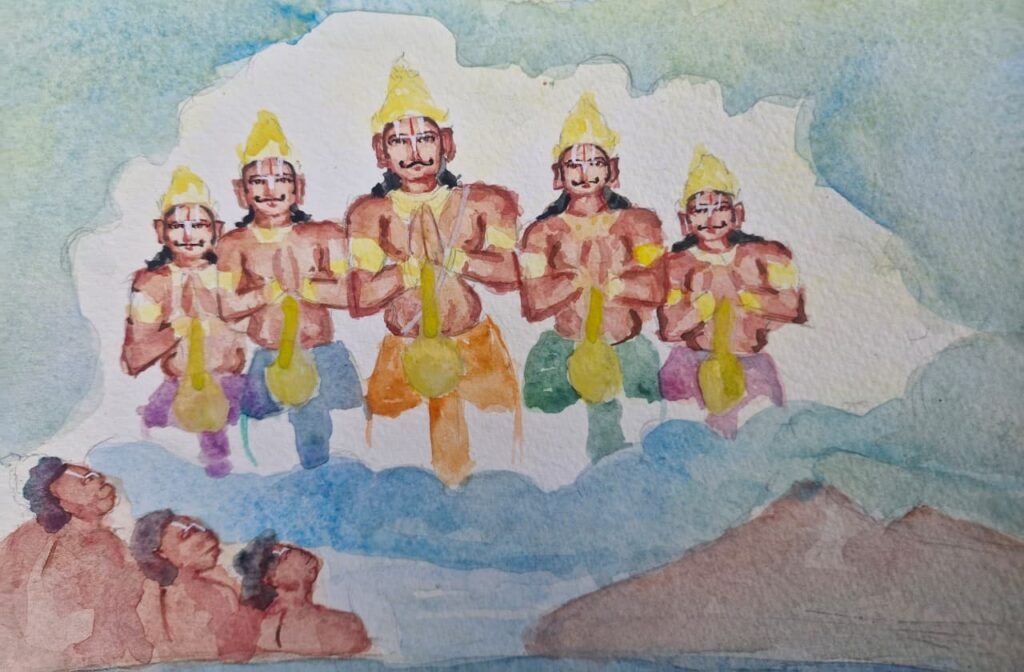
rAvaNa rejected vibhIshaNAzhwAn’s advice with scorn. vibhIshaNAzhwAn responded, “If you humiliate me in this manner, it is not appropriate for me to remain with you”, and expressed his thoughts and emotions. Following this conversation, he immediately left and came to the place where perumAL was, along with iLaiya perumAL.
avathArikai (Introduction)
rAvaNa summoned his ministers to discuss his plan of action upon learning that perumAL and his army had reached the shores of lankA. Despite rAvaNa’s unrighteous behaviour and anger, vibhIshaNAzhwAn remained focused on his dharmam. Driven by extreme compassion, he viewed this as an opportunity to rescue rAvaNa from grave danger. However, rAvaNa found vibhIshaNAzhwAn’s counsel unbearable. Recognising rAvaNa’s intolerance, vibhIshaNAzhwAn relinquished rAvANa’s kingdom and resolved to reach his true destination: the place where the embodiment of righteousness, perumAL, was present. He fled lankA like a man escaping a house on fire. vAlmeeki bhagavAn celebrates vibhIshaNAzhwAn seeing this deep attraction to righteousness.
ithyukthvA parusham vAkyam rAvaNam rAvaNAnuja: I
AjagAma muhUrthEna yathra rAma: salakshmaNa: II
Word-by-word meaning
rAvaNAnuja: – vibhIshaNa, rAvaNa’s younger brother
rAvaNam – with regard to rAvaNa
ithi – like this
parusham – harsh
vAkyam – sentence
ukthvA – spoke
yathra – to that place (where)
rAma: – SrI rAma (was present)
salakshmaNa: – along with lakshmaNa (iLaiya perumAL)
muhUrthEna – quickly
AjagAma – came
Simple meaning
Having spoken to rAvaNa, vibhIshaNAzhwAn arrived immediately to the place where SrI rAma was together with iLaiya perumAL.
Notes from periyavAchchAn piLLai’s vyAkhyAnam
ithi parusham vAkyamukthvA – in this manner, he spoke severely harsh words
- SrI rAmAyaNam yudhdha kANdam 14-3 “pradhIyathAm dhaSarathAya maithilee” (Entrust pirAtti (maithilee) to king dhaSaratha’s son SrI rAma). Saying so, valmeeki bhagavAn points out the simplicity of this action.
- SrI rAmAyaNam yudhdha kANdam 14-4 “yAvannagruhNanthi SirAmsi bANA:” (Return pirAtti (maithilee) before SrI rAma’s divine arrows sever the heads of the rAkshasa leaders). Through this verse, valmeeki bhagavAn delightedly highlights vibhIshaNAzhwAn’s warnings regarding the peril awaiting lankA if rAvaNa refuses to reunite pirAtti with perumAL.
parusham
Just as how the gentle breeze, that brings comfort to all, is unbearable to the fox, vibhIshaNAzhwAn’s words of well-being were seen as harsh by rAvaNa due to his inherent flaws.
vAkyam
vibhIshaNAzhwAn’s upadhESam (advice) was a complete, meaningful sentence filled with good intentions, clearly expressing a fully formed thought.
ukthvA
vibhIshaNAzhwAn, being rAvaNa’s well-wisher and brother, counseled him thoroughly with words of wisdom. He was not worried that others might accuse him of abandoning his brother in a time of misfortune, since he only left rAvaNa after his advice had proven futile.
The phrase ‘he said harsh words’ emphasises the peak of rAvaNa’s unrighteous behaviour. vibhIshaNAzhwAn remained by his side as long as possible, departing only when rAvaNa proved incorrigible. While rAvaNa’s malevolence merited immediate abandonment, vibhIshNAzhwAn’s attempt to counsel him highlighted his own (vibhIshaNAzhwAn’s) greatness and virtue.
Why were vibhIshaNAzhwAn’s words of well-being considered harsh? Because they were addressed to rAvaNa.
rAvaNam
rAvaNa inflicted pain on everyone – both the powerful and the weak – through the strength of his boons and valour. Hence, he was blinded by arrogance. When vibhIshaNAzhwAn narrated the strength of the opponent, perumAL’s formidability, this truth was, alas, considered harsh by rAvaNa!
rAvaNAnuja:
vibhIshaNAzhwAn, despite being born of the same womb as rAvaNa, offered advice that only one in the ultimate state of sathva guNam could provide. vAlmeeki bhagavAn highlights the greatness of vibhIshaNAzhwAn as he counselled rAvaNa against his improper conduct towards perumAL. Furthermore, regarding the eligibility of an advisor, it is understood that a knowledgeable person may advise those lacking it, regardless of seniority. Since age discrimination holds no place in such matters, vibhIshaNAzhwAn offered righteous counsel despite being younger than rAvaNA.
AjagAma – he came
Instead of the word jagAma, meaning ‘he went’, the word AjagAma (‘he came’) is used in this SlOkam. Rather than saying that vibhIshaNAzhwAn went to where SrI rAma was after offering advice, the text says that he came to where SrI rAma was.
To vibhIshaNAzhwAn, rAvaNa’s congregation felt alien, while SrI rAma’s noble assembly felt like his true home. Despising rAvaNa’s company, he viewed perumAL’s abode as his natural residence; thus, he came to perumAL as if returning to his own place. vAlmeeki bhagavAn expresses this deep connection by specifically using the word AjagAma.
muhUrthEna
- gAruda pUrva “na SaurichinthAvimukhajana samvAsavaiSasam I varam hUthavahajvAlA panjarAntha vyavasthithi: II” (To be amongst those who do not meditate upon the supreme lord is more grueling than being inside a burning cage).
Just like escaping from the burning house, vibhIshaNAzwAn fled from rAvaNa and came to SrI rAma. Thus, vAlmeeki bhagavAn, describes vibhIshaNAzhwAn’s refusal to remain in rAvaNa’s assembly.
Just as a tethered calf, once released, immediately rushes to its mother for milk, vibhIshaNAzhwAn, unable to endure rAvaNa’s assembly, left him to seek refuge with SrI rAma.
- “vathsO gAmiva mAtharam” (Like the calf that seeks its mother)
- mudhal thiruvandhAdhi 30 “thAy nAdu kanRE pOl thaNduzhAyAn adikkE pOy nAdikkoLLum purindhu” (Just like the calf that seeks to attain its mother, the jIvAthmA, with desire, will seek and join together with the divine feet of sarvESvaran who adorns a cool thuLasi garland).
yathra rAma: – where SrI rAma is
For servitors, the divine abodes (dhivyadhESams) where perumAL chooses to reside are as important as, if not more important than, perumAL himself.
(Note from kAlakshEpam: In these divine abodes, emperumAn’s thirunAmams are eponymous with the location, like SrIranganAthan and thiruvEngadamudaiyAn. Residing in such divine places, the constant association with SrIvaishNavas fosters deeper devotion. For this reason, this has been recommended by our pUrvAchAryas too).
- purusha sUktham “yathra pUrvE sAdhyA: santhi dhEvA:” (In that paramapadham, where nithyasUris (eternal entities) reside).
- SrI rAmAyaNam ayOdhyA kANdam 98-12 “subhagaS chithrakUtO’sau” (This chithrakUta mountain, where SrI rAma resides, is auspicious).
Thus, as seen in pramANams as above, the glories of the divine places are clearly established.
salakshmaNa: SrI rAma, who is with iLaiya perumAL
This explains that iLaiya perumAL serves as the defining, essential attribute of perumAL. It conveys iLaiya perumAL’s continuous presence along with perumAL, as it is impossible for a servitor to remain apart from his master.
As stated by the phrase “rAmAnujam lakshmaNapUrvajancha” (rAmAnuja, who was previously lakshmaNa), bhagavath rAmAnujar is revered as an incarnation of AdhiSEsha and iLaiya perumAL. This highlights the inseparable nature of their identities. Furthermore, since ‘lakshmaNa:’ refers to his identity as purushakAram, AdhiSEsha remains eternally with emperumAn in paramapadham. Thus, he serves as the purushakAram, ensuring the jIvathmA is not bewildered upon reaching paramapadham (the supreme abode).
When sugrIva mahArAja expressed his intent that vibhIshaNazhwAn is to be killed through severe punishment, iLaiya perumAL – filled by immense compassion in his divine heart – desired that perumAL accept him instead.
- SrI rAmAyaNam yudhdha KANdam 17-29 “vadhyathAm” (to be killed).
- SrI rAmAyaNam yudhdha KANdam 18-7 “lakshmaNam puNyalakshaNam” (lakshmaNa (iLaiya perumAL), the one with the auspicious virtue of compassion).
iLaiya perumAL is referenced here because vibhIshaNAzhwAn left the company of rAvaNa – who refused to listen to his own brother – to join SrI rAma, who always heeded the desires of his brother, ILaiya perumAL.
Through this SlOkam, it is said that one who desires perumAL should avoid associating with those who are not dedicated to him. As SrIvaishNavas and servitors, we must not only renounce those who show detachment for perumAL but also abandon the very places where they dwell. Thus, the ultimate goal of life – to attain the supreme abode of bhagavAn – is emphasised.
ithyukthvA parusham vAkyam rAvaNam rAvaNAnuja: I
AjagAma muhUrthEna yathra rAma: salakshmaNa: II
Thus concludes the vyAkhyAnam for this SlOkam.
AzhwAr emperumAnAr jIyar thiruvadigaLE SaraNam
periyavAchchAn piLLai thiruvadigaLE SaraNam
Source – SrI rAmAyaNa thani SlOkam – 51 – yudhdha kANdam – 16.1 – sunivishtam, 17.1 – ithyukthvA Audio Video
adiyEn chithrA rAmAnuja dhAsi
Proofreading/Curating done by – kOsalEndhra rAmAnuja dhAsan, krishNan rAmAnuja dhAsan
Artwork – namperumAL rAmAnuja dhAsan
Related Links
SrI rAmAyaNa thani SlOkam – 50 – yudhdha kANdam – abhaya pradhAna sAram – pravESam (Introduction) Audio Video
SrI rAmAyaNa thani SlOkam – 49 – sundhara kANdam 51.38 – sathyam rAkshasa rAjEndhra Audio Video
SrI rAmAyaNa thani SlOkam – 48 – sundhara kANdam 38.33 – sa pithrA cha Audio Video
SrI rAmAyaNa thani SlOkam – 47 – 31.19 – sA thiryakUdhvancha, 34.23 – svapnEpi Audio Video
SrI rAmAyaNa thani SlOkam – 46 – sundhara kANdam 21.9 – iha santhO – Part 2 Audio Video
SrI rAmAyaNa thani SlOkam – concise english meanings
archived in https://granthams.koyil.org
pramEyam (goal) – https://koyil.org
pramANam (scriptures) – https://granthams.koyil.org
pramAthA (preceptors) – http://acharyas.koyil.org
SrIvaishNava education/kids portal – http://pillai.koyil.org