SrI: SrImathE SatakOpAya nama: SrImathE rAmAnujAya nama: SrImath varavaramunayE nama:
We are currently enjoying the in-depth meanings of SrI rAmAyaNa SlOkams from the yudhdha kANdam, based on periyavAchchAn piLLai’s commentaries (vyAkhyAnam) and puththUr swAmy’s lucid explanations. This section is celebrated as abhayapradhAna sAram, also known as vibhIshaNa SaraNAgathi, wherein perumAL offered protection to vibhIshaNAzhwAn. We are enjoying the details of how vibhIshaNazhwAn performed SaraNAgathi.
We express our gratitude to periyavAchchAn piLLai and puththUr swAmy, and also to SrI u vE sArathy thOthAthri swAmy.
This article is a translation of the grantham with the support of SrI sArathy swAmy’s thamizh kAlakshEpam series.
vibhIshaNAzhwAn sees sugrIva maharAja and other monkeys and tells them, “I have arrived near SrI rAma, who possesses supreme virtues and is the refuge for all the worlds. Please inform perumAL quickly that vibhIshaNa has arrived”.
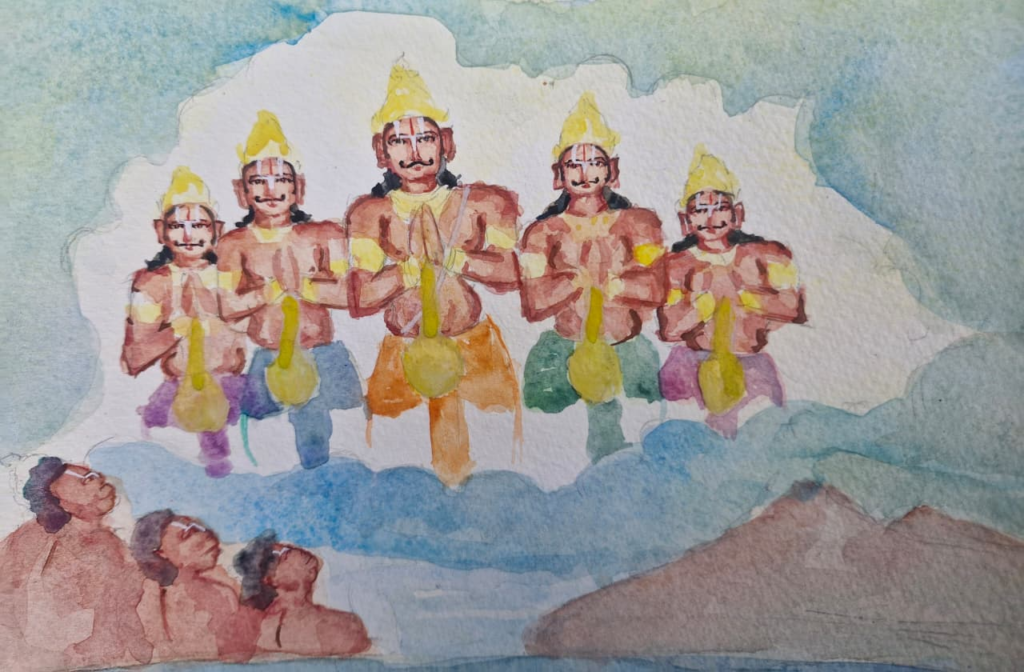
In the previous article, we enjoyed the abhayapradhAna sAra vyAkhyAnam. In this article, we will enjoy the thaniSlOka vyAkhyAnam.
avathArikai (Introduction)
nivEdhayatha mAm kshipram rAghavAya mahAthmanE |
sarva lOka SaraNyAya vibhIshaNam upasthitham ||
In the previous SlOkam, “sO’ham parushithasthEna dhAsavachchAvamAnitha: I thyakthvA puthrAmScha dhArAmScha rAghavam SaraNam gatha: II” – vibhIshaNAzhwAn says, “I, who was spoken to harshly and humiliated by rAvaNa like a servant, have left my children and my wife, and surrendered to perumAL. I offered counsel – advice that is pleasing to perumAL’s divine heart and disliked by rAvaNa. Upon hearing this, rAvaNa should have acknowledged the benefit he received and praised me with gratitude”.
- “prathyakshE gurava: sthuthyA:” (AchAryas should be glorified directly in their presence).
- thiruvAimozhi 2-7-8 “ennaith thI manam keduththAy unakken seygEn” (What can I do for you? You have helped me by reforming my evil mind that was focussed on worldly pleasures)?
- thiruvAimozhi 2-3-2 “aRiyAdhana aRiviththa aththA! nI seydhana” (You are the AchArya, you have taught what I don’t know. I don’t fully know the limitless favours done by you)!
vibhIshaNAzhwAn continues, “Instead of expressing a sense of indebtedness, rAvaNa, being an evil person, berated me with harsh words – telling me that I am a disgrace to the whole clan”.
- SrI rAmAyaNam yudhdha kANdam 16-15 “thvAm thu dhikkulapAmsanam” (Shame upon you! You are indeed a disgrace and destroyer of our clan).
- SrI rAmAyaNam yudhdha kANdam 16-15 “asmin muhUrthE na bhavEth” (If anyone else had uttered these harsh words, he would not be alive at this very moment).
vibhIshaNAzhwAn expresses his mortification at being humiliated by rAvaNa, “He castigated me like a servant caught in a mistake, saying, ‘I have spared you without severing you, only because you are my brother’. I endured it, thinking that he took the liberty of uttering those insults as an elder brother. However, he did not stop at humiliating me himself. Beyond this, he allowed his lowly son, indhrajith, who is much younger than I, to disgrace me”.
- SrI rAmAyaNam yudhdha kANdam 15-2 “kim nAma thE thAtha kanishta vAkyamanarthakam chaiva subhIthavaScha: I asminkulE yO’pi bhavEnna jAthO sOpIdhruSam naiva vadhEnna kuryAth II” (Oh, youngest uncle! Your lowly words are meaningless and resemble those of an apprehensive person. Even a person who is not born in this brave clan would never speak or act in such a manner).
rAvaNa not only insulted vibhIshaNAzhwAn himself, but also encouraged others to do so. Because of this, even though his wife and children were righteous, vibhIshaNAzhwAn abandoned the relationships stemming from his ties to rAvaNa. Instead, he surrendered at the divine feet of perumAL, who naturally embodies all of those abandoned relationships.
- thiruvAimozhi 5-1-8 “sElEy kaNNiyarum perum selvamum nanmakkaLum … avar” (emperumAn becomes the damsels with beautiful eyes, great wealth, and sons with very good qualities).
- thiruvAimozhi 10-6-2 “nAttArOdu iyalvu ozhindhu nAraNanai naNNi” (Approached nArAyaNa, eliminating the co-existence with the worldly people who consider body to be the self).
Adhering to the protocols of governance (rAja nIthi), when an enemy’s brother arrives under the false pretense of surrendering, should he be accepted? No, he would be warded off. Accordingly, sugrIva mahArAja and other monkeys forsook him and told him to go back the same way he came.
Upon seeing them forsake him, vibhIshaNAzhwAn asks, “Is it because of your obligation towards your master that you are rejecting me? If so, informing perumAL – who took birth in the raghu clan that provides shelter to all those tormented by rAkshasas and seeking refuge – is also an obligation towards your master”.
vibhIshaNAzhwAn adds, “Before SrI rAma becomes angry at the guards at the main entrance for not informing him of my arrival, quickly notify perumAL of my arrival”.
- SrI rAmayaNam sundhara kANdam 21-20 “vidhitha: sa hi dharmagya: SaraNAgathavathsala:” (SrI rAma, is a knower of dharma; he possesses the quality of motherly forbearance (vAthsalyam) towards those who surrender to him).
This is the connection with the previous context regarding the dismissal of vibhIshaNAzhwAn based on rAja nIthi (rules of state governance), as he arrived from the enemy’s camp. However, from the perspective of our sidhdhAntham – which places paramount importance on purushakArathvam – the connection is interpreted as follows-
sugrIva mahArAja and other monkeys ask vibhIshaNAzhwAn, “Have you not heard that perumAL is SaraNAgatha vathsalan (affectionate towards those who surrender)? Why don’t you approach him directly”?
vibhIshaNAzhwAn replies, “I am not the one to follow an improper path”
- SrIrangarAja sthavam 2-102 “thava bharOhamakArishi dhArmikai:” (I have been placed under your responsibility by the righteous ones (referring to the AchAryas)).
- thiruvAimozhi 4-6-8 “vEdham vallArgaLaik koNdu viNNOr perumAn thiruppAdham paNindhu” (Having the bhAgavathas who are experts in the essence of all vEdhams as purushakAram [recommendation], and surrendering at the divine feet of sarvESvaran who is worshipped by nithyasUris).
Just as demonstrated by AzhwAr and AchAryas, vibhIshaNAzhwAn states that his nature is that he will approach perumAL only through sugrIva mahArAja and others as his purushakAram. Therefore, this can also be interpreted as vibhIshaNAzhwAn requesting sugrIva mahArAja and others to act as his purushakAram and unite him at perumAL’s divine feet.
nivEdhayatha mAm kshipram vibhIshaNam upasthitham I
sarva lOka SaraNyAya rAghavAya mahAthmanE II
Notes from periyavAchchAn piLLai’s vyAkhyAnam
nivEdhayatha mAm – inform of my arrival
[periyavAchchAn piLLai has given 19 different explanations for the above phrase].
- nivEdhayatha
- yajur vEdham 1-6 “yam prajApathir vEdha sa puNyO bhavathi” (The supreme lord desires a jIvAthmA, a jIvAthmA desires the supreme lord, [without a doubt] the jIvAthmA who is desired by the supreme lord attains the supreme lord).
vibhIshaNAzhwAn says, “Only when perumAL desires me in his divine heart will my svarUpam be sustained. Let me attain that greatness on your account”.
- nivEdhayatha
vibhIshaNAzhwAn says, “Just as you share information about him with us, you should share information about us with him. Is it not your duty to let him know something about us?”
- SrI bhagavath gIthA 4-34 “thadh vidhdhi praNipAthEna paripraSnEna sEvayA I upadhEkshyanthi thE gyAnam gyAninas thathvadharSina:” (Acquire true knowledge by paying obeisances and performing service to the wise and hearing from them. Those who are wise (thathva gyAni) shall offer you the upadhESam [explanation] of true knowledge).
- vishNu purANam 1-2-8,9 “kathayAmi yathApUrvam dhakshAdhyair munisaththamai: I prushta: prOvAcha bhagavAnabjayOni: pithAmaha: II thaiSchOktham purukuthsAya bhUbhujE narmadhAthatE I sArasvathAya thEnApi mahyam sArasvathEna cha II” (Sage parAsara says: I shall recite to you this purANam precisely as it was told in the past by brahmA, who emerged from the lotus blossoming from emperumAn’s divine navel, when he was questioned by dhaksha and other great sages. They then narrated it, on the banks of river narmadhA, to king purukuthsa. King purukuthsa narrated it to sArasvatha, and sArasvatha instructed it to me).
puththUr swAmy’s explanation: vibhIshaNAzhwAn views them [sugrIva et al) as AchAryas. Therefore he says, “As AchAryas, you have made us cognisant about perumAL. Similarly, inform perumAL about us. Is it not your responsibility to inform anything that is good?”
- nivEdhayatha
vibhIshaNAzhwAn says, “perumAL shall desire in his divine heart to accept me upon hearing me call out to him in a loud voice. By announcing my arrival, you can acquire your purushakArathva svarUpam”.
- SrI rAmAyaNam yudhdha kANdam 17-9 “svarENa mahathA mahAn” (The one with great virtues, vibhIshaNAzhwAn, began to speak in a loud voice).
- nivEdhayatha
vibhIshaNAzhwAn says, “If you do not notify perumAL of my misfortune, it would be like committing a bhAgavatha apachAram (offence carried out to a follower of bhagavAn), resulting in the destruction of your true nature (svarUpa hAni). Furthermore, after you have informed perumAL, if he does not call me to him (kUvudhal) or mercifully come here (varudhal), his abandonment of a SaraNAgathan will result in his own svarUpa hAni (destruction of his basic nature). Since bringing glory to perumAL (paragathAthiSayAdhAnam) is the true nature of a SEshabhUthan (servitor), and since being abandoned by both of you, I will be unable to bring any joy to him or add to his glory, this would result in my svarUpa hAni. Please inform him of my arrival so that there is no harm to any of our svarUpams. Announce my arrival in an ideal manner and unite me with him”.
- thiruvAimozhi 9-2-10 “kUvudhal varudhal seyyAy” (You should either call me there or mercifully come here).
[Note from kAlakshEpam: The following sentence has been coined by emperumanAr to explain SEshathvam: paragatha athiSaya AdhAnEchchaya upAdhEyathvamEva yasya svarUpam sa SEsha:, para: SEshI I (An entity is called a SEshan (servitor) if his entire essential nature (svarUpam) exists solely to be utilised to bring excellence to another entity, according to that other entity’s will. The other entity, for whose pleasure and purpose the SEshan exists, is called the SEshi (the supreme lord)].
- nivEdhayatha
vibhIshaNAzhwAn says, “Have you not heard of the conversation between a monkey and a tiger? Being born in such a race that protects the surrendered even when they have committed an offence, please inform perumAL of my arrival”.
[Note from kAlakshEpam: The conversation between a monkey and a tiger: A hunter, chased by a tiger, climbs a tree. A monkey on the tree welcomes the hunter and gives him refuge. While the tiger waits at the bottom, the monkey and the hunter decide to take turns sleeping and keeping watch over the tiger. When the hunter is asleep, the tiger tries to persuade the monkey to push the hunter down, but the monkey refuses, stating he cannot abandon someone who sought refuge. When the monkey sleeps, the tiger convinces the hunter to push the monkey down. However, the monkey climbs to safety. The tiger tries one last time to convince the monkey to betray the hunter, but the monkey refuses, saying ‘I will never abandon the one who has surrendered to me’ – and remains committed to protecting the hunter. periyAzhwAr thirumozhi 3-5-7 “anuman pugazh pAdith tham kuttangaLaik kudangaik koNdu mandhigaL kaN vaLarththum” (The female monkeys support their baby monkeys on their palms, singing hanuman’s eminence, and caress them to sleep)].
- nivEdhayatha
vibhIshaNAzhwAn says, “Without distressing me (nirvEdha), inform (nivEdhayatha) perumAL of my arrival”.
- nivEdhayatha
vibhIshaNAzhwAn says, “nibhrutham vEdhayatha – inform quietly. Immediately upon observing the manner of your announcement, perumAL should not think, ‘The one who has arrived is arrogant’. Therefore, do not appear proud with a puffed-out chest while informing. Instead, announce (aRiyach chenRu uraiyAy) in a quiet, bowed down and modest manner – nibhrutha: praNatha: prahva:. Your speech and demeanour should make him think in his divine heart, ‘The one who has arrived is a virtuous person’”.
- SrI rAmAyaNAm yudhdha kANdam 116-3 “nibhrutha: praNatha: prahva:” (In a humble, respectful and quiet manner).
- periya thirumozhi 3-6-4 “aRiyach chenRu uraiyAy” (You should go and tell him, so it will be known by him).
- nivEdhayatha
nitharAm vEdhayatha – The prefix ‘ni’ [in nivEdhayatha] indicates – emphasis. vibhIshaNAzhwAn says, “Inform in such a manner, firmly, that it registers in the mind of perumAL who is engaged in deliberation with his ministers”.
- nivEdhayatha
In a large crowd of purushakAra bhUthars, some may notice, some may not notice, hence, he requests all of them.
- nivEdhayatha
This contains the suffix – ‘tha’, that indicates prayers in this context. This is similar to what has been expressed by AzhwAr – he too requested multiple groups – such as swans and storks – to serve as his messenger. vibhIshaNAzhwAn says, “You all, who are of diverse species – bear, monkey, black monkey (karungkurangu/macaque monkey), convey this state of mine – as I implore you all – to perumAL”.
- thiruviruththam 30 “annam selveerum vaNdAnam selveerum thozhudhirandhEn” (I took refuge under and beseeched the swans and storks who were going as my messengers).
- nivEdhayatha
He does not say this to any one particular individual; he says it to everyone in the entire gathering. [Why is he addressing everyone?] Since he is a new entrant to this group and unfamiliar about their nature – not knowing their individual capabilities to accomplish his goal – he informs everyone.
- nivEdhayatha
“thathra bhAgavathA: sarvE SlAghyA: pUjyAScha bhAratha” (Oh, descendant of bhAratha! All devotees of the lord are praiseworthy and worthy of respect).
Since everyone shares the same relationship with SrI rAma, vibhIshaNAzhwAn considers everyone in the gathering praiseworthy and respected. Therefore, he addresses the entire assembly.
nivEdhayatha mAm kshipram vibhIshaNamupasthitham I
sarvalOkaSaraNyAya rAghavAya mahAthmanE II
vyAkhyAnam for this SlOkam will be continued in the next article.
AzhwAr emperumAnAr jIyar thiruvadigaLE SaraNam
periyavAchchAn piLLai thiruvadigaLE SaraNam
Source – SrI rAmAyaNa thani SlOkam – 58 – yudhdha kANdam 17.15 – nivEdhayatha – Part 2 Audio Video
adiyEn chithrA rAmAnuja dhAsi
Proofreading/Curating done by – kOsalEndhra rAmAnuja dhAsan, krishNan rAmAnuja dhAsan
Artwork – namperumAL rAmAnuja dhAsan
Related Links
SrI rAmAyaNa thani SlOkam – 57 – yudhdha kANdam 17.14 – sO’ham, 17.15 – nivEdhayatha – Part 1 Audio Video
SrI rAmAyaNa thani SlOkam – 56 – yudhdha kANdam 17.12 – thamaham hEthubhi:, 17.13 – sa cha na Audio Video
SrI rAmAyaNa thani SlOkam – 55 – yudhdha kANdam 17.11 – thEna sIthA Audio Video
SrI rAmAyaNa thani SlOkam – 54 – yudhdha kANdam 17.8 – thEshAm, 17.9 – uvAcha cha, 17.10 – rAvaNO nAma Audio Video
SrI rAmAyaNa thani SlOkam – 53 – yudhdha kANdam 17.5 – Esha sarvAyyudhOpEtha:, 17.6 – sugrIvasya, 17.7 – SIgram vyAdhiSa Audio Video
SrI rAmAyaNa thani SlOkam – concise english meanings
archived in https://granthams.koyil.org
pramEyam (goal) – https://koyil.org
pramANam (scriptures) – https://granthams.koyil.org
pramAthA (preceptors) – http://acharyas.koyil.org
SrIvaishNava education/kids portal – http://pillai.koyil.org