SrI: SrImathE SatakOpAya nama: SrImathE rAmAnujAya nama: SrImath varavaramunayE nama:
The extremely merciful periyavAchchAn piLLai has selected important SlOkams from SrI rAmAyaNam and provided detailed commentary for them, known as thaniSlOka vivaraNam. puththUr swAmy has also published this, along with an exquisite thamizh commentary. We are enjoying the special meanings of the SlOkams through these granthams.
We are currently enjoying the following SlOkam in yudhdha kANdam.
nivEdhayatha mAm kshipram vibhIshaNam upasthitham I
sarva lOka SaraNyAya rAghavAya mahAthmanE II
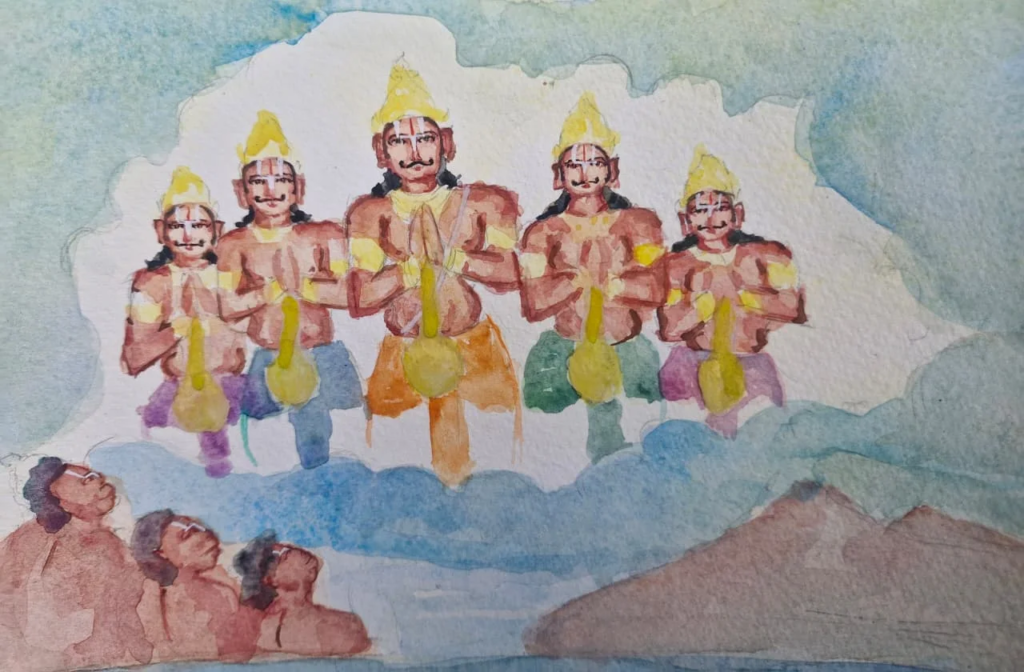
vibhIshaNAzhwAn, along with four rAkshasas, travelled by the aerial path and arrived near the shores where perumAL was present. There, sugrIva mahArAja and other monkeys were moving around the supreme lord to protect him. At that juncture, they saw vibhishaNAzhwAn. Recognising him as someone from the enemy’s camp, they decided to kill him. Both sugrIva mahArAja, the leader of the monkey armies, and his subordinates, felt the same way.
At that point in time, vibhIshaNAzhwAn uttered this SlOkam – “Born in the lineage of raghu, rAghavan is the sole refuge for all the worlds. Those in the raghu clan sacrifice even their own lives to protect those who seek their refuge. He is mahAthmA, inherently possessing supreme qualities (thirukkalyANa guNams), virtues, and divine form (thirumEni)”. vibhIshaNAzhwAn thus described his grounds of belief and told them, “I take refuge in him. Quickly inform him of my arrival”.
He also added, “The mind is unstable, and it could waver from my present resolution. Furthermore, not announcing my arrival will result in bhAgavatha apachAram (offence). Therefore, do not delay in informing perumAL”.
[Note from kAlakshEpam: It is an important duty of emperumAn’s devotees to help bhAgavathas by imparting knowledge and fostering their devotion, ultimately guiding them to become magaLASAsanaparars [praising emperumAn and carrying out servitude] to emperumAn. emprumAnAr, AzhwArs, AchAryas have all steered us in this direction. For instance, thiruppallANdu, is an important prabandham that illustrates the principle of mangaLASAsanam. periyAzhwAr, a great magaLASAsanaparar, desired that everyone – whether they aspired for wealth, kaivalyam, or eternal service to emperumAn – perform mangaLASAsanam in union with all devotees. AzhwArs not only relished the divine experiences bestowed upon them by bhagavAn but gave them life in the form of pAsurams so that everyone could benefit. This was done purely out of their utmost compassion. AchAryas then multiplied that benefit manyfold, ensuring that AzhwArs’ pAsurams and their profound meanings were communicated to all who were interested].
[maNavALa mAmunigaL glorifies the importance of thiruppallANdu in the following pAsuram. upadhESa raththina mAlai 19 “vEdhaththukku Om ennum adhu pOl uLLadhukkellAm surukkAyth thAn mangalamAdhalAl” (Like Om, that is recited first, for the vEdhas, thiruppallANdu is the essence for all other prabandhams because it is the auspicious mangaLASAsanam)].
Before proceeding with the vyAkhyAnam, we express our gratitude to periyavAchchAn piLLai and puththUr swAmy, as well as to SrI u vE sArathy thOthAthri swAmy. This article is a translation of periyavAchchAn piLLai’s thaniSlOka vivaraNam with the support of SrI sArathy swAmy’s thamizh kAlakshEpam series.
We enjoyed the vyAkhyAnam up to nivEdhayatha mAm kshipram. In this article, we will enjoy the commentary for the remaining part of the SlOkam.
Notes from periyavAchchAn piLLai’s vyAkhyAnam
Upon hearing vibhIshaNAzhwAn’s request, sugrIva mahArAja and others ask him, “About whom should we inform”?
- vibhIshaNam
Just as the names parASara, parAnkuSa, parakAla mean ‘One who controls the enemies and destroys them’, the name vibhIshaNa also means ‘one who scares the enemies in various ways’.
The etymology (vyuthpaththi) for ‘vibhIshaNa’ is “vividham bhIshayathIthi vibhIshaNa:” (The one who terrifies in various ways is vibhIshaNa). [Since vibhIshaNAzhwAn had left lankA, it is understood that this refers to rAvaNa and his associates, who were now vibhIshaNAzhwAn’s enemies].
Because his name itself means ‘the terrifying one’, it could be interpreted as, vibhIshaNAzhwAn saying, ‘Announce me as vibhIshaNa, one who will terrify rAvaNa’.
- vibhIshaNam
“All the pancha bhUthams (ether, air, fire, water, and earth) function out of apprehension for the supreme lord. He instills terror in his adversaries, but such a lord is a protector to his servitors. Is there even a reason for you all, who are his servitors, to be afraid of me or those like rAvaNa”? asked vibhIshaNAzhwAn.
- thaiththirIya upanishadh Anandhavallee 8 “bhIshAsmAdhvAtha: bhavathE bhIshOdhEthi sUrya:” (Due to fear of him (the supreme lord), the wind blows; out of fear of him, the sun rises).
- vishNu purANam 1-17-36 “bhayam bhayAnAm apahAriNI” (When ananthan, destroyer of fear resides within my heart, how could I possibly have any fear)?
Hence, it could also be interpreted as vigathabhIshaNa – devoid of fear, ‘Inform perumAL that vibhIshaNa, who is fearless, has arrived’.
- vibhIshaNam
- SrI rAmAyaNam yudhdha kANdam 16-18 “gadhApANi” (One who holds a mace in his hand).
Alternatively, it could be interpreted as ‘Please tell SrI rAma that someone bearing a stave in hand has come to execute his orders (ANai) and to administer justice (sengOl)’.
- vibhIshaNam
Instead, it could also be interpreted as follows. vibhIshaNAzhwAn says, “If you do not desire to announce me as an anukUlan (as a servitor of SrI rAma), at least inform perumAL that someone has arrived bearing a stick in his hand, causing fear in you”.
- SrI rAmAyaNam yudhdha kANdam 16-16 “uthpapAtha gadhApANi:” (He soared up, holding a mace in his hand).
[The following is an introduction to the next interpretation for the name vibhIshaNa].
Just as a person afflicted with illness approaches a medical practitioner who can analyse the cause for his ailments, list the forbidden foods consumed by him, such as intake of unwholesome foods he consumed, and find a cure for his symptoms, a samsAri (jIvAthmA in material realm) possessing no goodness, has no means of rescue other than to stand in front of emperumAn, who is the only physician with a remedy for samsAram and who is sarvagyan (omniscient) and confess his sins (flaws and offences).
- sahasranAmam 584, 585, 586 “nirvANam bhEshajam bhishak” (as a cure for the disease of birth (mOkshasAdhanam) and as a medical practitioner).
- periyAzhwAr thirumozhi 5-3-6 “maruththuvanAy ninRa mAmaNi vaNNA” (Oh lord, who possesses a radiant, deep blue gem-like form! You are the only physician who has the medicine to cure this disease (cycle of birth and death)).
- vibhIshaNam
- sthOthra raththinam 23 “na nindhitham karma thadhasthi lOkE sahasraSO yanna mayA vyadhAyi” (There is no prohibited action or sin in this world that I have not committed thousands of times).
- periya thirumozhi 1-9-3 “konREn palluyiraik kuRikkOL onRilAmaiyinAl” (I tormented many creatures due to not having any knowledge such as discrimination between body and self).
Therefore, vibhIshaNAzhwAn says that such was the state of his previous deeds and knowledge (meaning he has nothing superior to say about himself, except inferiority), and he asks sugrIva mahArAja and others to inform perumAL that vibhIshaNa, with such past proclivities and dispositions has arrived.
- vibhIshaNam
- SrI rAmAyaNam yudhdha kANdam 18-5 “IdhruSam vyasanam prAptham bhrAtharam ya: parithyajEth” (If he can desert his own brother at a time of peril, whom will he not betray subsequently)?
- thirumAlai 31 “uvarththa nIr pOla enRan uRRavarkku onRum illEn” (Like salty water, I am not of any help to my relatives).
Thus, vibhIshaNam could also be interpreted as one who abandoned his brother in a perilous situation, one who was loathed even by his brother and one who was perfidious.
Upon hearing, they ask, “Since your deeds and intellect are so lowly, how can we announce you to perumAL”?
- upasthitham – one who has arrived
A person becomes sinless when he surrenders to the supreme lord, even if he was in a lowly state before. Therefore, after his surrender, his antecedents should not be thought of, and he should not be considered as lowly. Hence, vibhIshaNazhwAn said, “Inform perumAL that, though previously full of defects, we have now arrived pure”.
- sAthvatha samhithai 16-23 “dhurAchArO’pi sarvASI kruthaghnO nAsthika: purA I samASrayEdhAdhidhEvam SradhdhayA SaraNam yadhi II nirdhOsham vidhdhi tham janthum” (Even one, who has engaged in unrighteous conduct, ate without restriction, lived as an ingrate, and lacked belief in SAsthram, if he sincerely surrenders to the primordial supreme lord, that person becomes sinless through the glory of the supreme lord in whom he took refuge).
- thiruppAvai 16 “thUyOmAi vandhOm” (We came with a pure mind).
- vibhIshaNamupasthitham – vibhIshaNa, who has arrived
“Inform perumAL that vibhIshaNa has arrived in his presence even before he could come to him. Inform perumAL that I have eased his burden by approaching him and taking four steps towards him. Yet, even if I had not come here and performed my SaraNAgathi from lankA, shouldn’t he have come to the other side of the shore? Shouldn’t he have rushed to me, just as he rushed to the pond to rescue gajEndhrAzhwAn without a second thought, in a disheveled appearance – with his waist garment displaced and his hair untied and unadorned ”? asked vibhIshaNAzhwAn.
[Note from kAlakshEpam: We can also infer this from ANdAL nAchchiyAr’s pAsuram (thiruppAvai 29) “chiRRam chiRukAlE vandhu unnaich chEviththu” (Very early in the morning, we have come here to pray), she says ‘vandhu’ – (we have) come, when actually you should have come for us].
- siRiya thirumadal 44 “nArAyaNA O! maNivaNNA! nAgaNaiyAy! vArAy en Aridarai nIkkAy” (Oh, nArAyaNa! Oh, one with a blue gemstone like complex! Oh, one who is lying on the serpent-bed! You should come; you should mercifully remove my great sorrow).
- upasthitham – one who has come near
- SrI bhagavath gIthA 18-73 “sthithO’smi gathasandhEha:” (standing firm, being freed from doubts).
vibhIshaNAzhwAn said, “Due to the glory of having arrived in the vicinity of SrI rAma gOshti, I stand firm, freed from doubts”.
- upasthitham nivEdhayatha – announce the arrival of the person who has arrived
- periya thirumozhi 3-6-1 “Evari venjlaiyAnukku en nilaimai uraiyAyE” (You should inform my situation to sarvESvaran who is holding an arrow and beautiful bow in his hands).
“You should inform perumAL of my situation (possessing a firm conviction in SaraNAgathi)”, said vibhIshaNAzhwAn.
- upasthitham nivEdhayatha – announce the arrival of the person who has arrived
Instead of approaching perumAL directly out of ignorance or haste, vibhIshaNAzhwAn said, “Inform perumAL that I have come to all of you, desiring to approach him only after understanding his divine intentions”.
- upasthitham nivEdhayatha – announce the arrival of the person who has arrived
vibhIshaNAzhwAn said, “Rather than emperumAn trying to attain me with much difficulty from his end, I have come so close to his presence, just as a garment is in proximity to the body”.
puththUr swAmy’s explanation
- thiruvAimozhi 2-7-6 “Uzhi Uzhi thoRum edhir sUzhal pukku enaiththOr piRappum enakkE aruLgaL seyya vidhi sUzhndhadhAl enakkEl ammAn thirivikkiramanaiyE” (To transform me to such state, he took many many distinct/unique births in kalpa (day of brahmA) after kalpa, assuming different forms to do different tricks to become friendly with me; such lord thrivikrama of mine who positioned himself to favour me exclusively).
vibhIshaNAzhwAn said, “Inform perumAL that I have arrived in his immediate vicinity, like a garment clinging to the body, thereby eliminating his burden of pursuing me through kalpA after kalpA and incarnating in diverse divine forms for the sake of attaining me”.
- upasthitham nivEdhayatha – announce the arrival of the person who has arrived
- SrI rAmAyaNam kishkindhA kANdam 2-7 “jagmurgirithatAththasmAdhanyam Sikharamuththamam” (Then, upon seeing those two exceptional archers (SrI rAma and lakshmaNa), out of fear, sugrIva and his companions, fled from that mountain slope to a different loftier mountain peak).
- periya thirumozhi 1-1-1 “OdinEn Odi” (ran behind them, following their footsteps; in this manner, not remaining in any place).
vibhIshaNAzhwAn said, “hanumAn and others informed perumAL of sugrIva and others who fled from perumAL. I have come willingly, seeking SrI rAma’s abode. Won’t you announce me”?
- vibhIshaNamupasthitham nivEdhayatha – vibhIshaNa has arrived, inform perumAL
vibhIshaNAzhwAn said, “I did not stop mid-way, thinking that I am king rAvaNa’s brother and therefore deserve to be respected. I had no intention of sending messengers to determine whether we should establish a truce or fight. I did not muster troops for battle while waiting for messengers to deliver news. Whether or not I am granted the opportunity to perform service to perumAL, I am here. Please inform perumAL of the fact that I have arrived”.
- periya thirumozhi 6-3-4 “unnai eydhi en theevinaigaL thIrndhEn” (Reaching you, I got my cruel sins to be eliminated).
- periya thirumozhi 5-8-9 “ponnadiyE adaindhu uyndhEn” (Got uplifted by considering your desirable divine feet to be the means).
- thiruvAimozhi 9-10-1 “Alin mElAl amarndhAn adi iNaigaLE naNNith thozhudhezhuminO” (Attain liberation (mOksham) by surrendering unto the divine feet of sarvESvaran, who is resting on a banyan leaf).
Thus, as stated by nammAzhwar in thiruvAimozhi 4-6-8 “vEdham vallArgaLaik koNdu viNNOr perumAn thiruppAdham paNindhu”, one must surrender to sarvESvaran only by keeping the bhAgavathas, who are experts in the essence of all vEdhams, at the forefront. Through this, a profound concept is conveyed – one should not approach the supreme lord directly, but must approach him only through a purushakAram (recommendation).
nivEdhayatha mAm kshipram vibhIshaNamupasthitham I
sarvalOkaSaraNyAya rAghavAya mahAthmanE II
Thus concludes the vyAkhyAnam for this SlOkam.
AzhwAr emperumAnAr jIyar thiruvadigaLE SaraNam
periyavAchchAn piLLai thiruvadigaLE SaraNam
Source – SrI rAmAyaNa thani SlOkam – 62 – yudhdha kANdam 17.15 – nivEdhayatha – Part 6 Audio Video
adiyEn chithrA rAmAnuja dhAsi
Proofreading/Curating done by – kOsalEndhra rAmAnuja dhAsan, krishNan rAmAnuja dhAsan
Artwork – namperumAL rAmAnuja dhAsan
Related Links
SrI rAmAyaNa thani SlOkam – 61 – yudhdha kANdam 17.15 – nivEdhayatha – Part 5 Audio Video
SrI rAmAyaNa thani SlOkam – 60 – yudhdha kANdam 17.15 – nivEdhayatha – Part 4 Audio Video
SrI rAmAyaNa thani SlOkam – 59 – yudhdha kANdam 17.15 – nivEdhayatha – Part 3 Audio Video
SrI rAmAyaNa thani SlOkam – 58 – yudhdha kANdam 17.15 – nivEdhayatha – Part 2 Audio Video
SrI rAmAyaNa thani SlOkam – 57 – yudhdha kANdam 17.14 – sO’ham, 17.15 – nivEdhayatha – Part 1 Audio Video
SrI rAmAyaNa thani SlOkam – concise english meanings
archived in https://granthams.koyil.org
pramEyam (goal) – https://koyil.org
pramANam (scriptures) – https://granthams.koyil.org
pramAthA (preceptors) – http://acharyas.koyil.org
SrIvaishNava education/kids portal – http://pillai.koyil.org