SrI: SrImathE SatakOpAya nama: SrImathE rAmAnujAya nama: SrImath varavaramunayE nama:
The extremely merciful periyavAchchAn piLLai has selected important SlOkams from SrI rAmAyaNam and provided a beautiful vyAkhyAna grantham. This is celebrated as SrI rAmAyaNa thaniSlOkam.
In this series, we are currently enjoying yudhdha kANdam, a juncture where vibhIshaNAzhwAn performs SaraNAgathi. This section is also known as abhaya pradhAna sAram.
puththUr swAmy has published this grantham along with an exquisite thamizh commentary. We are now learning the meanings of the SlOkams in SrI rAmAyaNam through these granthams.
vibhIshaNAzhwAn requests sugrIva mahArAja and others to inform perumAL of his arrival. However, they become anxious upon hearing his request. They ponder, “He says that he wants to surrender to perumAL. But is this his true intention? This may be a pretense to deceive us and attack perumAL”.
Consequently, sugrIva mahAraja expresses his apprehension about accepting vibhIshaNAzhwAn. He voices his worry to perumAL, saying, “He could be a spy sent to cause a rebellion, or he could be an enemy planning to attack”.
One may observe that in the last few SlOkams, sugrIva mahArAja repeatedly shares his anxiety. Why did he communicate in this repetitive manner? This demonstrates sugrIva mahAraja’s anxiety and fear stemming from his overwhelming affection towards perumAL. Therefore, he emphasises his thoughts over and over again.
Before proceeding with the vyAkhyAnam, we express our gratitude to periyavAchchAn piLLai and puththUr swAmy, as well as to SrI u vE sArathy thOthAthri swAmy. This article is a translation of periyavAchchAn piLLai’s thaniSlOka vivaraNam with the support of SrI sArathy swAmy’s thamizh kAlakshEpam series.
avathArikai (Introduction)
“vibhIshaNa has forsaken his relationship with rAvaNa because he was insulted by rAvaNa. Consequently, in anguish, he has approached us to seek refuge. Why do you not trust this”? sugrIva mahArAja foresees this question and therefore pre-empts it by saying, “Such a thought has occurred to dhEvarIr only by virtue of his deceitfulness”.
rAvaNEna praNihitham thamavEhi niSAcharam I
thasyA’ham nigraham manyE kshamam kshamavathAm vara II
Word-by-word meaning
kshamavathAm vara – Oh the leader among those who recognise the merits and capabilities of everyone!
tham – that
niSAcharam – rAkshasa
rAvaNEna – by rAvaNa
praNihitham – sent as a spy
avEhi – know
aham – I
thasya – his
nigraham – destruction
kshamam – apt
manyE – think
Simple meaning
Oh lord, one who is the leader among those who know the worthiness of everyone! Know him as a spy sent by rAvaNa. I think killing him is most apt.
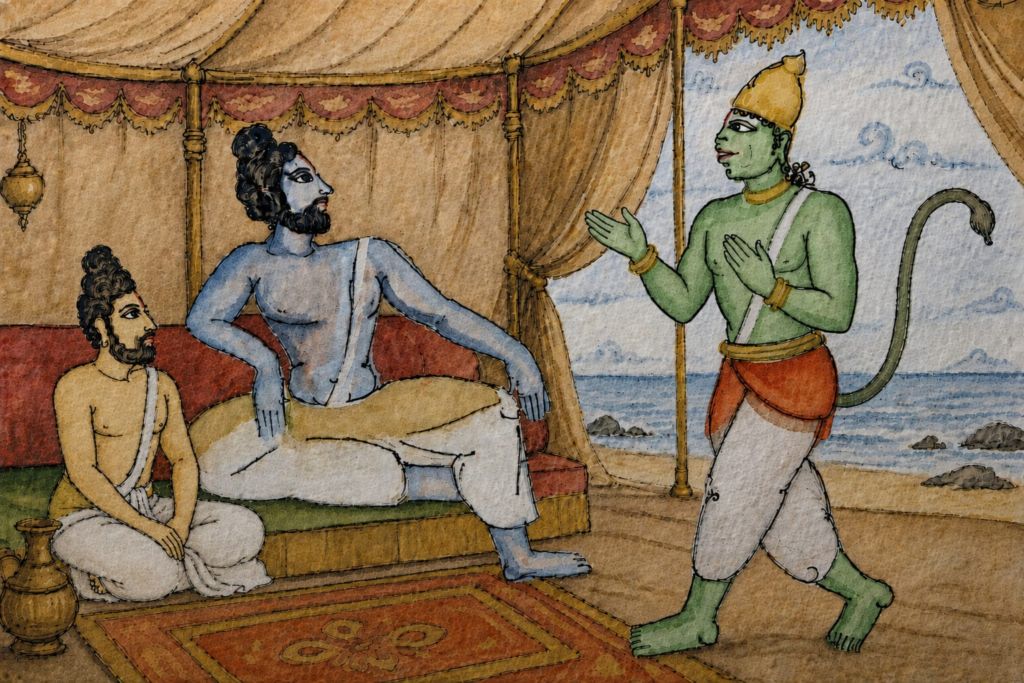
Notes from periyavAchchAn piLLai’s vyAkhyAnam
tham niSAcharam rAvaNEna praNihitham
sugrIva mahArAja says, “He, who has been misapprehended as a well-wisher by dhEvarIr, is actually a spy sent by our enemy, rAvaNa”.
avEhi
sugrIva mahArAja says, “We learn from others what we do not know. So, if dhEvarIr has not understood him to be a spy, then please learn this new detail from me”.
perumAL asks, “If so, what should be done to him”?
[puththUr swAmy’s explanation
avEhi – perceive
sugrIva mahArAja says: considering the maxim, “yukthiyuktham vachOgrAhyam bAlAdhapi SukAdhapi” (Even if it is the prattle of a child, or a mimicry of a parrot, words endowed with reasoning should be accepted), unknown truths must be learnt and accepted. If dhEvarIr has not yet perceived him as a spy, understand this new insight from me].
thasyA’ham nigraham manyE kshamam – I think that killing this deceitful person is appropriate.
kshamam – appropriate.
sugrIva mahArAja says, “Subjecting him to our anger and destroying him is appropriate. I, who know him truly, know that he is a deceitful person, have come to the conclusion that killing him is most fitting. To kill those who are inimical towards bhagavAn is a duty; this has been prescribed by the SAsthram”.
- mahAbhAratham sabhA parva 68-26 “dhvau thu mE vadhakAryE’smin na kshanthavyau kathanchana I yagyavighnakaram hanyAm pANdavAnAncha dhurhrudham II”
- SrI bhAgavatham 4-4-17 “karNau pidhAya nirayAth”
- SrI bhAgavatham 3-16-6 “yasyAmruthAmalayaSa:”
- “nAhamAthmAnam”
[Note: Explanations for the pramANams (references) are given subsequently]
[Note from kAlakshEpam: thirumAlai 7 “thalaiyaRuppuNdum sAvEn saththiyam kANmin” (For those who do not have faith in the words of faultless vEdham, I shall prove it without any doubt). This should not be misinterpreted as taking the law into one’s own hand; rather, it signifies legitimate, effective action taken by the proper authorities].
[puththUr swAmy’s explanation
thasyA’ham nigraham manyE kshamam –
sugrIva mahArAja says, “I think it would be appropriate to kill him. I know his true nature; I have come to the conclusion that killing him is most appropriate. When animosity develops towards bhagavAn and bhAgavathas, killing is most appropriate”. This is the essence of the following statements from SAsthram.
- mahAbhAratham sabhA parva 68-26 “dhvau thu mE vadhakAryE’smin na kshanthavyau kathanchana I yagyavighnakaram hanyAm pANdavAnAncha dhurhrudham II” (Among those deeds which deserve capital punishment, these two are not spared by me; I will kill those who obstruct the yagyams; and I will kill those who think harm to pANdavas).
- SrI bhAgavatham 4-4-17 “karNau pidhAya nirayAth” (One should close one’s ears and walk away from a place where there is blasphemy towards wise people).
- SrI bhAgavatham 3-16-6 “yasyAmruthAmalayaSa: SravaNAvagAha: sadhya: punAthi jagadhASvapachAdhvikuNta: I sO’ham bhavadhbhya upalabdha suthIrthakIrthi: chinthyAm svabAhumapi va: prathikUlavruththim II” (When bathed in the form of hearing, one whose flawless glories, which are sweeter than nectar, purifies no matter how lowly the person is (even if he is living by cooking and eating the flesh of a dog), I, vaikuNtanAthan, glorified by you as that supreme purifier, will not hesitate to severe connection with my hands if it is hostile towards you).
- “nAhamAthmAnam” (I, me) [Note by puththUr swAmy: The complete pramANam and its source is not known. Hence, the full meaning of this has not been provided. To anyone who is able to offer this information, I express my gratitude by bowing my head, as there is no other better way to repay your kindness (thalai allAl kaimARilEnE)]].
kshamavathAmvara – Oh, the leader of those who possess the discernment of what is proper and appropriate!
sugrIva mahArAja said, “You are the chief among those who know what is right and suitable. dhEvarIr should bless us with your thoughts”.
athavA – alternatively [a different interpretation]
thasyA’ham nigraham manyE kshamam
Even when sugrIva mahArAja stated that killing vibhIshaNAzhwAn was a fitting punishment, he noticed no anger. Instead, there was only compassion for vibhIshaNa on perumAL’s divine face. So, he asked, “Why is this depraved vibhIshaNa the subject of your mercy? [dhEvarIr will only face dangers because of this] Shouldn’t only those who seek your shelter be the subject of your mercy”?
[Thus, kshama has been explained with two meanings 1) suitable or deserving. 2) The pinnacle of patience/ forbearance].
[puththUr swAmy’s explanation
In the first interpretation, kshamam means worthiness, and kshamavAn means ‘one who knows worthiness’.
Alternatively, since kshama also means ‘forbearance’, it can also be understood as – kshamavAn – ‘the leader of those who are forbearing’ (where ‘vara’ means ‘SrEshtan, preeminent’, ‘varaNIyan’ means ‘praiseworthy’).
sugrIva mahArAja observes profound compassion on SrI rAma’s divine face, even after hearing him state, ‘Killing him is appropriate’. He therefore addresses perumAL as kshamavAn – the leader of those who forbear! He asks, “Is it upon him – an enemy – that dhEvarIr should bestow such boundless patience? Shouldn’t that be bestowed upon your devotees?]
rAvaNEna praNihitham thamavEhi niSAcharam I
thasyA’ham nigraham manyE kshamam kshamavathAm vara II
Thus concludes the vyAkhyAnam for this SlOkam.
SrI rAmAyaNa thani SlOkam – 65 – yudhdha kANdam 17.25 – rAkshasO jihmayA
sugrIva mahArAja continues: “He is posing himself as a SaraNAgathan without revealing his true nature, and upon gaining your trust, he will attack you”.
avathArikai (Introduction)
perumAL asks, “You say it is befitting to kill him, (thasyA’ham nigraham manyE). How is it appropriate to kill a spy”?
sugrIva mahArAja responds in the following SlOkam, “He is not only a spy, but due to his malicious nature (by birth, as a rAkshasa) he will attack you when there is an opportunity. Therefore, there is no proscription against killing him”.
rAkshasO jihmayA budhyA sandhishtO’yam upasthitha: I
praharthum mAyayA channO viSvasthE thvayi chAnagha II
Word-by-word meaning
anagha – Oh, the faultless one!
ayam – this
rAkshasa: – rAkshasa
jihmayA – crooked (deceitful)
budhyA – intellect
sandhishta: – prompted by
thvayi cha viSvasthE – when you and your associates have trusted
praharthum – to assault (you)
upasthitha: – as one who has approached
mAyayA – in deceit
channa: – remains hidden (concealing his true intentions)
Simple meaning
Oh, the faultless one! This rAkshasa, prompted by his deceitful intellect, has come here concealing his true intentions to attack you and your associates when he is trusted.
Notes from periyavAchchAn piLLai’s vyAkhyAnam
ayam rAkshasa: – this rAkshasa
sugrIva mahArAja says, “This rAkshasa – he has not merely come as a spy sent by rAvaNa; he will engage in far more deeds than just espionage”.
perumAL asks, “What will he really do”?
jihmayA budhdhyA sandhishta: praharthumupasthitha:
sugrIva mahArAja says, “kutilabudhyA prEritha: thvAm praharthum upasthitha: – Don’t we already know that rAkshasas are evil-minded? Directed by rAvaNa, he has come here with a deceitful mind (rAvaNEna sandhishta: kutilabudhyA upasthitha:)”.
perumAL asks, “Will he really harm us”?
[puththUr swAmy’s explanation
jihmayA budhyA sandhishta: praharthum upasthitha: – prompted by deceitful mindset, he has come to attack.
sIthAp pirAtti was abducted by rAvaNa – from this, we know for a fact that all rAkshasas are evil-minded.
sandhishta: – sent by (rAvaNa) also means prEritha: – incited by evil-mind (as a rAkshasa). Alternatively, by saying rAvaNEna, (both of these are summed up and understood together) as – Having been directed by rAvaNa and possessing an evil mindset, he has come here (rAvaNEna sandhishta: jihmayA budhyA upasthitha:).
“Will he cause harm to us”? asks perumAL].
mAyayA channa:
sugrIva mahArAja says, “Yes, he can harm us because he has come here concealing his true nature through deceitfulness. In the disguise of a SaraNAgathan, he has hidden his cruel intentions”.
perumAL asks, “When will he harm us”?
viSvasthE thvayi
sugrIva mahArAja says, “He will harm you, the moment he has swayed you, without investigating or knowing what is really in his mind, when you are enamored by his words of surrender’”.
Here, ‘thvayi’ (you) not only refers to perumAL but also includes iLaiyaperumAL and others.
This is interpreted due to the usage of ‘cha’ – the implied conjunction (known as ‘ummaith thogai’ in thamizh).
Why has sugrIva mahArAja used the word ‘cha’?
perumAL says to sIthAp pirAtti: I might destroy my life, or leave you or even lakshmaNa, but I will not break the promise given to the rishis “apyaham jIvitham jahyAm”.
From this we know that perumAL does not worry about the dangers that can come to him when it comes to protecting those surrendered to him. sugrIva mahArAja, knowing well that perumAL will not worry about dangers that may befall his own self, says, ‘vibhIshaNa will harm not only you, but he will also harm others like lakshmaNa, whom you care about”.
[puththUr swAmy’s explanation
viSvasthE thvayi – when you have trusted
sugrIva mahArAja says, “He will harm you once you have been captivated by his words, trusting that he has surrendered to you without analysing his true intentions”.
thvayi cha viSvasthE thvayi – when dhEvarIr also (cha) has trusted – the word cha is the unuttered conjunction here. Hence, it included iLaiyaperumAL, thiruvadi, and others.
- SrI rAmAyaNam AraNya kANdam 10-19 “apyaham jIvitham jahyAm” (I will not hesitate to sacrifice my life to fulfil the vows made to those who have taken refuge in me). Reckoning perumAL’s mindset to be, ‘I do not care about the dangers to my life’, sugrIva mahArAja warns, “Not only will dhEvarIr trust him, but iLaiyaperumAL will also begin to trust him. He will harm them too, in a manner that causes you immense suffering”].
agha – Oh, the faultless one!
sugrIva mahArAja says, “You do not see the faults in others because dhEvarIr thinks of others as self. So, please hear them from me”.
rAkshasO jihmayA budhdhyA sandhishtO’ya mupasthitha: I
praharthum mAyayA channO viSvasthE thvayi chAnagha II
Thus concludes the vyAkhyAnam for this SlOkam.
SrI rAmAyaNa thani SlOkam – 65 yudhdha kANdam 17.26 – pravishta: Sathrusainyam
sugrIva mahArAja says: He will destroy us, just as the crows kill the owls.
avathArikai (Introduction)
Is it appropriate to find fault in someone who has declared his lowliness and sought refuge?
In this SlOkam, sugrIva mahArAja says “A huge disaster will occur if we accept an enemy who has taken refuge solely to destroy us, without a proper investigation ”.
pravishta: Sathru sainyam hi prAptha: Sathruratharkitha: I
nihanyAdhantharam labdhvA ulUkAniva vAyasa: II
Word-by-word meaning
atharkitha: – unanalysed
Sathru – an enemy
Sathrusainyam – within the enemy’s troops
pravishta: – having entered
prAptha: – having attained the state of a close confidant (of enemy)
antharam – position/status
labdhvA – having gained
vAyasa: – crow
ulUkAn iva – like an owl
nihanyAdh hi – will kill
Simple meaning
An unalysed adversary will infiltrate the enemy’s force, become a confidant, and – having gained such a position – kill as the crows kill the owls.
Notes from periyavAchchAn piLLai’s vyAkhyAnam
atharkitha: Sathru: Sathrusainyam pravishtO hi
sugrIva mahArAja says, “If we do not analyse a person who defects from the enemy force to see if he is favourable (anukUlan) or hostile (prathikUlan), he will infiltrate and kill us by posing as an ally”.
perumAL asks, “But how can he kill us when he is a lone person and we are a large army”?
prAptha:
An enemy who presented himself as a confidant can attack the entire army.
perumAL asks, “Still, how can he individually attack the entire group”?
antharam labdhvA nihanyAth – having found an opportunity
sugrIva mahArAja says, “He can destroy us when we fall asleep”.
To demonstrate natural hostility (instinctive, inimical traits present from birth/ sahaja Sathru) and the feasibility of one destroying many, a real-world scenario (dhrushtAntham) is cited here.
ulUkAniva vAyasa:
Owls (being nocturnal) fear the daytime; a lone crow takes advantage of the situation and kills many owls (their sahaja Sathru) in the daylight. [Note from kAlakshEpam: sugrIva mahArAja implies that there is an inherent incompatibility between virtuous and unvirtuous. Therefore, as a rAkshasa, vibhIshaNAzhwAn’s enmity towards SrI rAma is innate. Furthermore, since humans and monkeys) sleep during the night, the rAkshasa will seize that opportunity during the night when he is awake].
[puththUr swAmy’s explanation
antharam labdhvA nihanyAth – having gained an intimate position, he would destroy us.
Waiting for an opportunity – such as when we are asleep – he will strike. This example illustrates an inherent rivalry that exists between two species right from birth, demonstrating how a single enemy can destroy an entire group.
ulUkAniva vAyasa: – like a crow killing owls
A crow, possessing a natural hostility towards owls from birth, kills many owls while they sleep during the day. Similarly, sugrIva mahArAja says, “He is a niSasara who remains active at night, and being inherently inimical to us, will kill us. He will kill us at night while we sleep. I am definite about this”].
pravishta: Sathrusainyam hi prAptha: Sathruratharkitha: I
nihanyAdhantharam labdhvA ulUkAniva vAyasa: II
Thus concludes the vyAkhyAnam for this SlOkam.
SrI rAmAyaNa thani SlOkam – 65 yudhdha kANdam 17.27 – vadhyathAmEsha
sugrIva mahArAja orders vibhIshaNAzhwAn to be killed.
avathArikai (Introduction)
In this manner, though the many calamities that might befall them because of vibhIshaNAzhwAn had been brought to perumAL’s attention, sugrIva mahArAja became extremely scared upon observing that perumAL’s mercy towards him remained unchanged. As his fear manifested as anger, he, on his own accord, ordered vibhIshaNAzhwAn’s execution in the following SlOkam.
vadhyathAmEsha thIvrENa dhaNdEna sachivai: saha I
rAvaNasya nruSamsasya bhrAthA hyEsha vibhIshaNa: II
Word-by-word meaning
Esha – this vibhIshaNa
sachivai: saha – along with his ministers
thIvrENa – severe
dhaNdEna – punishment
vadhyathAm – be killed
hi – because
Esha – this
vibhIshaNa: – vibhIshaNa
nruSamsasya – one who is cruel
rAvaNasya – rAvaNa’s
bhrAthA – brother
Simple meaning
This vibhIshaNa is indeed the brother of cruel rAvaNa. Therefore, he and his ministers deserve severe punishment, let them be killed.
Notes from periyavAchchAn piLLai’s vyAkhyAnam
Esha vadhyam
sugrIva mahArAja says, “We will not resort to options such as tying him up or letting him go with a simple strike that brings further misery like mArIcha, we will indeed kill him”.
[puththUr swAmy’s explanation
Esha vadhyam – Let him be killed
sugrIva mahArAja says, “We must not keep him tied, or chase him away like mArIcha with a single arrow (and leave him to survive) – as was done with protecting sage viSwAmithra’s yAgam – only to cause great misfortune later. We will kill him”].
thIvrENa dhaNdEna
We must not kill him effortlessly with a single arrow, as though blowing out air. Rather, he must be tortured – like placing a burning lamp on his head like a crown.
[puththUr swAmy’s explanation
thIvrENa dhaNdEna – cruel punishment
sugrIva mahArAja says, “He must not be killed quickly by decapitation with a single, painless arrow, as if blowing a piece of cotton. Instead, it must be an onslaught – superimposing a ‘singa viLLaku’ upon his head like a crown on his head”.
A singa viLakku is a lion shaped lamp structure on a pillar found in temples. The head portion of the lion contains a cavity for oil and a wick to light the lamp. While it is customary to light these in temples, ‘singaviLakku eriththal’ was also an ancient form of punishment. Similar to the lamp, a cavity was created on top of a human’s head to light a flame].
sachivai: saha
sugrIva mahArAja says, “Since he has come as a joint force, first, we must behead those who have accompanied him and hand him their severed heads, and then we must kill him”.
perumAL asks, “Why should such a cruel punishment be given to him”?
sugrIva mahArAja describes further the reason behind awarding this cruel punishment.
Esha vibhIshaNa: rAvaNasya nruSamsasya bhrAthA hi
“He is the brother of rAvaNa. [What kind of person is rAvaNa?] He is pitiless (nruSamsasya), so, no harm in doing this way”, says sugrIva mahArAja.
It is apparent that vibhIshaNa is capable of causing harm. Everyone knows that he is the brother of the malicious rAvaNa. thirumangai AzhwAr describes rAvaNa as – “suri kuzhal kanivAyth thiruvinaip piriththa kodumaiyil kaduvisai arakkan” – a cruel rAkshasa who separated pirAtti from SrI rAma.
rAvaNa is someone who envied the union of his own mother and father (pirAtti and perumAL). He separated them like separating life from its body.
He is a lowly entity who separated pirAtti, the nithyAnapAyinI from perumAL across a landscape of mountain and ocean.
vibhIshaNa is this rAvaNa’s brother. A brother is an embodiment of one’s own self – “bhrAthA svO mUrthirAthmana:”. Thus, vibhIshaNa is practically a part of rAvaNa and very intimate to him.
This is well-known (hi) – that he is the brother of this virulent rAvaNa.
Thus, his status as rAvaNa’s brother, a spy, and an enemy forms the primary basis for sugrIva mahArAja’s contention (pUrvapaksha yukthi).
[puththUr swAmy’s explanation
Esha vibhIshaNa: rAvaNasya nruSamsasya bhrAthA hi – vibhIshaNa, the brother of the atrocious rAvaNa!
sugrIva mahArAja says, “It is well known to everyone that rAvaNa is malevolent, and the fact that vibhIshaNa is his brother is public knowledge. Therefore, he too is malevolent and has come here to destroy us”.
- periya thirumozhi 5-7-7 “suri kuzhal kanivAyth thiruvinaip piriththa kodumaiyil kaduvisai arakkan” (rAvaNa, a cruel rAkshasa, separated sIthAp pirAtti who is having beautiful hair and mouth which is like reddish fruit, from SrI rAma).
sugrIva mahArAja says: rAvaNa, isn’t he cruel? He is the one who displays aversion to the union of pirAtti and perumAL, who are the mother and father for all the worlds! Like separating the life from the body, he separated iRaiyum agalagillAtha pirAtti – who is inseparable even for a moment – from perumAL. He created an unyielding distance between them, like a mountain and an ocean. vibhIshaNa is the brother to this miscreant!
- manu smruthi 2-226 “bhrAthA svO mUrthirAthmana:” (One’s brother is the reflection of one’s own self). Thus one can say vibhIshaNa is like a part of rAvaNa.
(hi) – well-known. This highlights that – vibhIshaNa is rAvaNa’s confidant! – this is widely accepted by everyone.
Thus, vibhIshaNAzhwAn being rAvaNa’s brother, a spy, and an enemy constitutes sugrIva mahArAja’s primary rationale for concluding he should be killed. Hence, sugrIva mahArAja emphasises this repeatedly].
vadhyathAmEsha thIvrENa dhaNdEna sachivai: saha I
rAvaNasya nruSamsasya bhrAthA hyEsha vibhIshaNa: II
Thus concludes the vyAkhyAnam for this SlOkam.
AzhwAr emperumAnAr jIyar thiruvadigaLE SaraNam
periyavAchchAn piLLai thiruvadigaLE SaraNam
Source – SrI rAmAyaNa thani SlOkam – 65 – yudhdha kANdam 17.24 – rAvaNO praNihitham, 17.25 – rAkshasO jihmayA , 17.26 – pravishta: Sathrusainyam, 17.27 – vadhyathAmEsha Audio Video
adiyEn chithrA rAmAnuja dhAsi
Proofreading/Curating done by – kOsalEndhra rAmAnuja dhAsan, krishNan rAmAnuja dhAsan
Artwork – namperumAL rAmAnuja dhAsan
Related Links
SrI rAmAyaNa thani SlOkam – 64 – 17.20 – praNidhI rAkshasEndhrasya, 17.21 – athavA svayamEvaisha, 17.22 – mithrAtavI balam, 17.23 – prakruthyA Audio Video
SrI rAmAyaNa thani SlOkam – 63 – yudhdha kANdam 17.16 – Ethaththu vachanam, 17.18 – manthrE vyUhE, 17.19 – anthardhAnagathA Audio Video
SrI rAmAyaNa thani SlOkam – 62 – yudhdha kANdam 17.15 – nivEdhayatha – Part 6 Audio Video
SrI rAmAyaNa thani SlOkam – 61 – yudhdha kANdam 17.15 – nivEdhayatha – Part 5 Audio Video
SrI rAmAyaNa thani SlOkam – 60 – yudhdha kANdam 17.15 – nivEdhayatha – Part 4 Audio Video
SrI rAmAyaNa thani SlOkam – concise english meanings
archived in https://granthams.koyil.org
pramEyam (goal) – https://koyil.org
pramANam (scriptures) – https://granthams.koyil.org
pramAthA (preceptors) – http://acharyas.koyil.org
SrIvaishNava education/kids portal – http://pillai.koyil.org