SrI: SrImathE SatakOpAya nama: SrImathE rAmAnujAya nama: SrImath varavaramunayE nama:
The extremely merciful periyavAchchAn piLLai has selected important SlOkams from SrI rAmAyaNam and has given us a vyAkhyAna grantham known as SrI rAmAyaNa thani SlOkam. The in-depth meanings of SrI rAmAyaNam can be fully understood by studying this grantham. We express our gratitude to periyavAchchAn piLLai and puththUr swAmy, who has published this work along with a simple explanation. We also express our deepest gratitude to SrI u vE sArathy thOthAthri swAmy. This article is a translation of periyavAchchAn piLLai’s commentary, summarised with the support of SrI sArathy swAmy’s thamizh kAlakshEpam series.
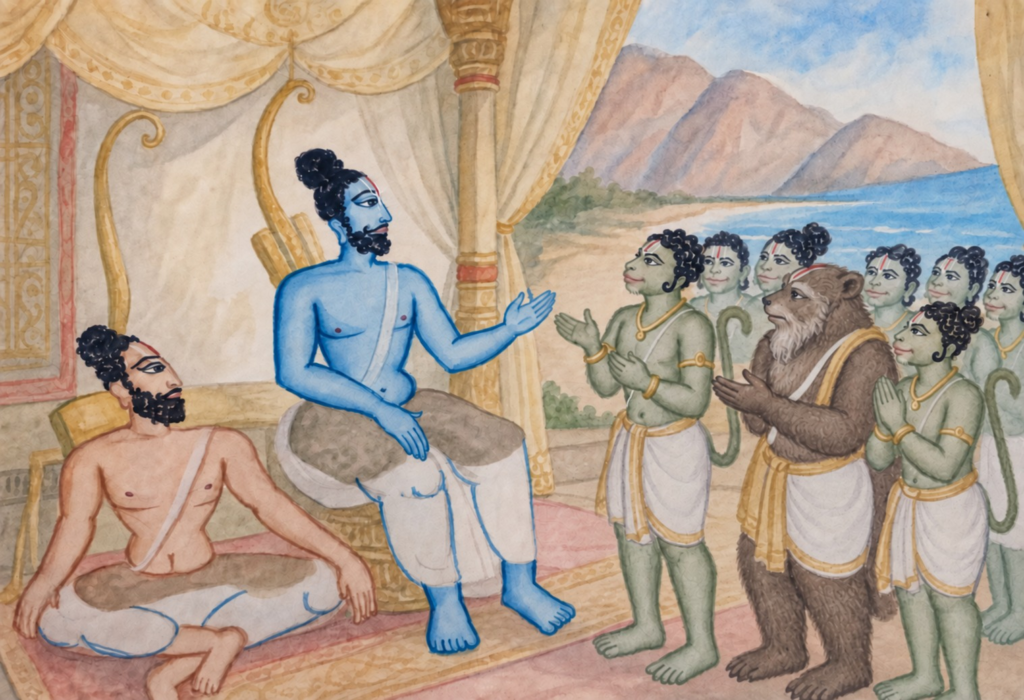
In this grantham, we are currently experiencing the yudhdha kANdam. vibhIshaNAzhwAn arrives from lankA and reaches where perumAL is present. vibhIshaNAzhwAn surrenders to perumAL and requests sugrIva mahArAja and others to inform perumAL of his arrival.
Upon hearing this, sugrIva mahArAja and others become anxious, considering that vibhIshaNAzhwAn has come from the enemy camp, especially before the commencement of the war. Therefore, they conclude that he must have come with evil intentions and inform perumAL of their suspicion.
After hearing this from sugrIva mahArAja, perumAL lovingly asks the rest of the monkeys to express their opinions as well. The monkeys praise perumAL and express their happiness that he is revealing his friendship by asking for their counsel. They state that four main monkeys (angadhan, Sarabhan, jAmbavAn, and maindhan) will speak on behalf of everyone.
First, angadhap perumAL expresses his thoughts, saying, “vibhIshaNa has come from the enemy, and hence he must not be accepted without a proper examination of his virtues and defects. Furthermore, the good qualities he possesses must also be many in number and not just a few to accept him”.
We shall now enjoy the vyAkhyAnam for the next SlOkam, where the monkey, Sarabhan, expresses his opinion.
avathArikai (Introduction)
In this manner, after angadhap perumAL finished conveying his perspective, Sarabhan, the second-in-command among the four, expressed his opinion.
Sarabhasvatha niSchithya sAdhyam vachanamabravIth I
kshipramasmin naravyAghra chAra: prathividhIyathAm II
Word-by-word meaning
atha – thereafter
Sarabha: thu – however, the monkey Sarabhan
sAdhyam – that which is to be accomplished
niSchithya – having decided
vachanam – this word
abravIth – spoke
naravyAghra – Oh, the leader among men!
asmin – to him
kshipram – quickly
chAra: – messenger (spy)
prathividhIyathAm – be sent
Simple meaning
After [angadhap perumAL spoke], however, the monkey Sarabhan, having decided upon the action, spoke these words – ‘Oh, leader among men! Let a messenger (spy) be sent to him quickly’.
Notes from periyavAchchAn piLLai’s vyAkhyAnam
Sarabhasvatha
The perspective of Sarabhan, who is next in line of succession after angadhap perumAL – was simpler than the opinion expressed earlier [by angadhap perumAL]. His view is therefore introduced with ‘Sarabhan, however’, using the word thu to denote the difference in his perspective.
[puththUr swAmy’s explanation
Sarabhasvatha – After that, Sarabhan however
Sarabhan, who was next in line of succession after angadhap perumAL, conveyed his thoughts. Through the word thu in Sarabhasthu [Sarabhan however], it is conveyed that his perspective is distinct from angadhan’s opinion. angadhan said, ‘Accept him if he has good qualities after examining him, or reject him for his defects’. However, since vibhIshaNa is a relatively new entrant to their group it is not easy to analyse and evaluate him in this manner. angadhan’s suggestion is difficult to put into action; Sarabhan however, said, ‘Let us analyse whether he is virtuous or not by sending a spy, and then we can accept or reject him’. This approach is more practical and simpler to execute. vAlmeeki bhagavan uses the pivotal word thu to emphasise the uniqueness of Sarabhan’s perspective].
sAdhyam vachanam niSchithya abravIth
sAdhyam vachanam – purposeful words which can accomplish the goal, niSchithya – having determined, abravIth – spoke
Having decided upon the words capable of accomplishing the task, he spoke.
sAdhyam niSchithya vachanam abravIth – Having decided upon the goal to be accomplished, he then spoke his words.
[puththUr swAmy’s explanation
sAdhyam vachanam niSchithya abravIth – Having determined the words which can be translated into actions, he spoke them. In other words, his statements were easily executable. Alternatively, if the word order is arranged as sAdhyam niSchithya vachanam abravIth, the interpretation shifts to – Having decided upon the action to be executed, he spoke accordingly].
naravyAghra – Oh, tiger among men! [Note from kAlakshEpam: perumAL is addressed here as a tiger because a tiger relies on its sharp intellect to calculate its moves]. Addressing perumAL in this manner, Sarabhan said, “Could dhEvarIr offer dhEvarIr’s protection without considering this person’s lowliness and the evil-intents”? Then, supposing that perumAL were to ask, “What should be done now”?
He continued, asmin chAra: prathividhIyathAm – Let a spy be sent to evaluate him.
Sarabhan said, “Is vibhIshaNa malevolent or benevolent? He remains susceptible to doubt. Let a spy be sent now to evaluate his true nature”. Thus, he expressed his opinion on this matter.
kshipram – immediately
If he is a virtuous person, we must not show delay in acceptance. We must send a spy quickly to verify this. Suppose he is evil, we must abandon him immediately to prevent any potential harm. For this reason too, a spy must be dispatched at once.
Either way, there must not be any delay in sending a spy.
Sarabhasvatha niSchithya sAdhyam vachanamabravIth I
kshipramasmin naravyAghra chAra: prathividhIyathAm II
Thus concludes the vyAkhyAnam for this SlOkam.
SrI rAmAyaNa thani SlOkam yudhdha kANdam 17.42
avathArikai (Introduction)
What is to be accomplished by sending a spy?
praNidhAya hi chArENa yathAvath sUkshmabudhdhinA I
parIkshya cha thatha: kAryO yathAnyAyam parigraha: II
Word-by-word meaning
sUkshmabudhdhinA chArENa – with the help of keenly intellectual spy
praNidhAya – mingling (along with this person who has arrived)
yathAvath – in the proper method
parIkshya cha – and examining
thatha: – only after that
yathAnyAyam – accordingly
parigraha: – accepting him
kArya: – has to be done
Simple meaning
Through a keenly intellectual spy, a proper investigation should be conducted by mingling with him; only thereafter, accepting him must be done accordingly as per justice.
Notes from periyavAchchAn piLLai’s vyAkhyAnam
praNidhAya – examining by mingling and interacting with him
The spy must analyse his conduct and affairs while interacting with him. praNidhAnam samAdhAnam samAdhiScha samA: smruthA:.
[puththUr swAmy’s explanation
praNidhAya – together
The spy must mingle with the enemy to observe his conduct. praNidhAnam samAdhAnam samAdhiScha samA: smruthA: (All the three words – praNidhAnam, samAdhAnam and samAdhi – are considered synonymous here, referring to the act of placing a spy with the enemy to gather intelligence). Thus, praNidhAya implies the act of spying, as inferred from the above pramANam].
sUkshmabudhdhinA chArENa yathAvath parIkshya cha – the spy with a fine intellect must examine him
His good qualities and defects must be determined by a spy who is wise enough to judge character and flaws by observing his [enemy’s] facial expressions and other gestures.
hi – this is well-known
As a king, you must already know that – intelligence gathered by a spy is like observing and knowing through your own eyes. Spies are the eyes of a king.
[puththUr swAmy’s explanation
hi – indeed
As the saying goes, rAjAnaS chAra chakshusha: (Kings have spies as their eyes). Indeed, as a king, you would know that comprehending the enemy through a spy is like perceiving through your own eyes].
yathAnyAyam parigrahas thatha: kArya: – He must be accepted or rejected accordingly.
Sarabhan said, “If he is determined to be a well-wisher after investigation, he must be accepted in the manner of a SaraNAgathan”. Sarabhan does not state this with a differentiation, such as – guNatha: sangraham kuryAdhdhOshathasthu visarjayEth – Accept him if he is virtuous or abandon him if there are faults. Instead, he only states, parigraha: karthavya:, meaning that we must accept him if he is determined to be virtuous, leaning towards perumAL’s compassion for vibhIshaNa. He took this stance because he had already observed perumAL’s deep compassion towards vibhIshaNa.
- SrI rAmAyaNam yudhdha kANdam 17-39 “guNatha: sangraham kuryAdhdhOshathasthu visarjayEth” (Accept him if he is virtuous or abandon him if there are faults).
praNidhAya hi chArENa yathAvath sUkshmabudhdhinA I
parIkshya cha thatha: kAryO yathAnyAyam parigraha: II
Thus concludes the vyAkhyAnam for this SlOkam.
SrI rAmAyaNa thani SlOkam yudhdha kANdam 17.43
avathArikai (Introduction)
jAmbavAn, who is third in position in that group, offered his thoughts.
jAmbavAms thvatha samprEkshya SAsthra budhyA vichakshaNa: I
vAkyam vigyApayAmAsa guNavadh dhOsha varjitham II
Word-by-word meaning
atha – after that
vichakshaNa: – expert (in code of royal justice)
jAmbavAn thu – named jAmbavAn
SAsthra budhyA – through the knowledge derived from scriptures
samprEkshya – perceiving well
dhOsha varjitham – fault-less
guNavadh – possessing good qualities
vAkyam – words
vigyApayAmAsa – offered
Simple meaning
Thereafter, jAmbavAn, who is well-versed in the scriptures, deeply reflected using his intellect, refined by SAsthram, and offered these virtuous and faultless words.
Notes from periyavAchchAn piLLai’s vyAkhyAnam
jAmbavAms thvatha –
atha – after, Sarabhan offered his opinion (carries similar meaning as explained in the previous SlOkams) – referring to the prominence of jAmbavAn in that group.
jAmbavAmsthvatha – then, jAmbavAn however.
The word thu [however] conveys a different meaning from the previous SlOkam. It highlights the prominence of his opinion, indicating that it ought to be accepted because of his maturity in age and profound knowledge of SAsthrams.
vichakshaNa: – expert (in SAsthram)
While angadhan and Sarabhan were also knowledgeable in the SAsthram, jAmbavAn has been referred to here as vichakshaNa:, or an expert in the SAsthram. This is because he was deeply immersed in it – possessing in-depth knowledge of the SAsthrams.
SAsthra budhyA samprEkshya –
Without looking at perumAL’s divine intentions, he examines it through wisdom gathered from SAsthram, and proves beautifully.
guNavadh dhOsha varjitham
His sentences are not only virtuous but also faultless. ‘Virtuous’ sentences are those whose meanings are well understood – so clear that even perumAL, who does not support the content, would have no doubts about them. ‘Faultless’ means they convey a thought after thoroughly analysing both sides of a situation.
vigyApayAmAsa – humbly offered his perspective
jAmbavAms thvatha samprEkshya SAsthra budhdhyA vichakshaNa: I
vAkyam vigyApayAm Asa guNavadh dhOsha varjitham II
Thus concludes the vyAkhyAnam for this SlOkam.
SrI rAmAyaNa thani SlOkam yudhdha kANdam 17.44
jAmbavAn says that rAvaNa has brought enmity upon himself with SrI rAma, and vibhIshaNa – his brother – has approached us at an inappropriate place and time. The summation of all these factors will only lead to doubts about him.
avathArikai (Introduction)
The previous SlOkam mentioned that jAmbavAn expressed his opinion; in this SlOkam, his opinion is detailed in full
badhdhavairAchcha pApAchcha rAkshasEndhrAdh vibhIshaNa: I
adhESakAlE samprAptha: sarvathA SankyathAmayam II
Word-by-word meaning
vibhIshaNa: – vibhIshaNan
badhdhavairAth cha – one, who has contracted hostility with you
pApAth cha – one, who is deceitful
rAkshasEndhrAdh – from rAvaNa, the leader of rAkshasas
adhESakAlE – at the wrong place and time
samprAptha: – has come
ayam – he
sarvathA – by all means
SankyathAm – is to be suspected
Simple meaning
vibhIshaNa has arrived from rAvaNa, the king of rAkshasas, who is an evil-doer and has harboured animosity toward you. Coming at an inappropriate location and occasion, he must be distrusted in every way.
Notes from periyavAchchAn piLLai’s vyAkhyAnam
badhdhavairAchcha pApAchcha – he has come from a deceptive enemy.
vibhIshaNa has come from rAvaNa, a deceitful enemy who brought suffering to perumAL, the ultimate refuge for everyone. “sahaja: kAryajaSchaiva dhvividha: SathrurishyathE I sahaja: svakulOthpanna ithara: kAryaja: smrutha: II” (Enemies are of two types – sahaja: Sathru, those who are born into the same clan, such as a sibling; and kArya Sathru, those who deliberately become enemies because of their actions).
rAvaNa is kArya(ja) Sathru. Predicting his deceitfulness and circumventing it is very difficult. Contrarily, since a sahaja: Sathru has been with oneself from the beginning, their inimical actions are already well-known. Because intelligence about this type of enemy is available, their actions can be anticipated and prevented. However, a kArya Sathru’s existence is unknown until the moment they turn into an enemy; therefore, such an enemy is crueler than sahaja: Sathru.
pApAchcha – Previously, pApAth was used to refer to rAvaNa as an enemy. Alternatively, the word can be interpreted as a ‘deceitful person’, since he kidnapped pirAtti through deception.
rAkshasEndhrAdh – leader of all rAkshasas
rAkshasas exclusively focus on causing suffering to others, rAvaNa is the leader of their clan. vibhIshaNa has come from him.
vibhIshaNa: athESakAlE samprAptha: – vibhIshaNa has come at the wrong time to the wrong place
[A brief preface is provided to explain this context, assuming that perumAL asks these questions to him]. rAvaNa is a karya(ja) Sathru, deceitful, and the leader of the rAkshasa clan. That being said about rAvaNa, what is wrong with vibhIshaNa? Why cannot he be innocent?
He cannot be considered innocent because vibhIshaNa has come at the wrong time to the wrong place. A truly virtuous person would not arrive here at this time. [But, why this notion?] If he were truly a well-wisher and innocent, he would have surrendered when we were in ruSyamUkagiri, after rAvaNa separated pirAtti. That would have been an appropriate time for him to arrive. It is not that vibhIshaNa became aware of rAvaNa’s deceitful deed only now. Instead, he arrived only after we had reached the shores of lankA. The timing is suspicious because we have already surrounded the enemy’s fortress; at this juncture he may have come only to find a way to destroy us. Additionally, he has arrived at night.
sarvathA SankyathAmayam – in all ways, he is to be suspected
jAmbavAn thus says, ‘For the reasons described, he should still be suspected, even though he has surrendered’.
badhdhavairAchcha pApAchcha rAkshasEndhrAdh vibhIshaNa: I
athESakAlE samprAptha: sarvathA SankyathAmayam II
Thus concludes the vyAkhyAnam for this SlOkam.
SrI rAmAyaNa thani SlOkam yudhdha kANdam 17.45
avathArikai (Introduction)
In this SlOkam vAlmeeki bhagavAn says – After jAmbavAn, maindhan, who is next in prominence, speaks his perspective in the following SlOkams.
thathO maindhasthu samprEkshya nayApanayakOvidha: I
vAkyam vachanasampannO babhAshE hEthumaththaram II
Word-by-word meaning
thatha: – thereafter
nayApanayakOvidha: – expert in discriminating between justice and injustice
vachanasampanna: – the one who speaks eloquently and meaningfully
maindha: thu – the monkey named as maindhan
samprEkshya – having come to a conclusion
hEthumaththaram – the best among the strategies
vAkyam – sentence
babhAshE – uttered
Simple meaning
Then maindhan, the monkey versed in both justice and injustice and possessing perfect oratory skills – determined the finest among the strategies and spoke his opinion.
Notes from periyavAchchAn piLLai’s vyAkhyAnam
thathO maindhasthu –
jAmbavAn stated sarvathA SankyathAmayam – meaning vibhIshaNa should be suspected in all ways, almost to the extent of abandoning vibhIshaNa entirely. maindhan’s perspective, however (thu) has a distinct quality. He suggests that vibhIshaNa should be accepted and allowed to interact with them so that his true nature can be examined. The word thu highlights the greatness of maindhan’s opinion that advocates for this inclusiveness.
[puththUr swAmy’s explanation
Unlike jAmbhavAn’s , who had said that vibhIshaNa should be given up, as said in
- SrI rAmAyaNam yudhdha kANdam 17-44 “sarvathA SankyathAmayam” (He is to be doubted by all means).
maindhan said, ‘Let us consider him as a well-wisher, accept him in our group, and then analyse his traits’. The greatness of his notion is conveyed by the word thu. Unlike the perspectives of others, his opinion is much closer to SrI rAma’s divine will].
nayApanayakOvidha:
He is an expert capable of distinguishing between the righteous and unrighteous.
[puththUr swAmy’s explanation
He is a scholar, who can resolve matters by distinguishing between what is royal justice and what is contrary to it. He has higher degree of expertise than the older jAmbhavAn].
vachanasampanna: – eloquent
His speech not only enters through your ears but resonates deeply in the mind. In this manner, he is able to communicate his resolve precisely.
hEthumaththaram
maindhan’s speech was greater than sugrIva mahArAja’s speech that was filled with strategies and delightful to hear.
SrI rAmayaNam yudhdha kANdam 17-30 “hEthumadharthyam cha” (His statement) endowed with reasonings and pleasing to hear).
samprEkshya vAkyam babhAshE – having thoroughly analysed, he spoke the words
Having determined the strategy to analyse whether or not vibhIshaNa should be suspected, maindhan delivered his speech.
thathO maindhasthu samprEkshya nayApanayakOvidha: I
vAkyam vachanasampannO babhAshE hEthumaththaram II
Thus concludes the vyAkhyAnam for this SlOkam.
SrI rAmAyaNa thani SlOkam yudhdha kANdam 17.46
maindhan begins to speak, addressing perumAL as, ‘Oh, king of kings! Why don’t we ask the intentions of rAvaNa from vibhIshaNa in person? Through this, we will also be able to determine vibhIshaNa’s traits’.
avathArikai (Introduction)
In this SlOkam, maindhan agrees with the earlier perspective that vibhIshaNa ought to be accepted only after examining his true nature. But, he did not say that vibhIshaNa is completely suspicious (as jAmbavAn asserted – sarvathA SankyathAmayam). Instead, he shows the way to investigate him.
vachanam nAma thasyaisha rAvaNasya vibhIshaNa: I
pruchyathAm madhurENAyam SanairnarapathISvara II
Word-by-word meaning
narapathISvara – [emperor] Oh, the king of kings!
Esha: – one who is in front of us
ayam vibhIshaNa: – this vibhIshaNa
thasya rAvaNasya – that rAvaNa’s
vachanam – words
Sanai: – slowly
madhurENa – by sweet words
pruchyathAm nAma – he can be asked
Simple meaning
[maindhan says] Oh, the king of kings! We can slowly and with sweet words question this vibhIshaNa, who is in front of us, about rAvaNa’s statements [intentions].
Notes from periyavAchchAn piLLai’s vyAkhyAnam
Let us accept vibhIshaNa who has surrendered as one of us and listen to what he has to say.
Esha vibhIshaNa: thasya rAvaNasya vachanam nAma pruchyathAm – let us hear through vibhIshaNa about rAvaNa’s thoughts and intentions
maindhan says, ‘Let us hear from vibhIshaNa about our enemy, rAvaNa – what are his assessments of us’?
Sanair madhurENAyam pruchyathAm – slowly, in sweet words
We must question him patiently and gently, in sweet words, without creating suspicion or revealing anxiety.
narapathISvara –
Only dhEvarIr, who is the king of all kings, knows the righteous way to question him. There is very little for me to elaborate on this.
vachanam nAma thasyaisha rAvaNasya vibhIshaNa: I
pruchyathAm madhurENAyam SanairnarapathISvara II
Thus concludes the vyAkhyAnam for this SlOkam.
SrI rAmAyaNa thani SlOkam yudhdha kANdam 17.47
avathArikai (Introduction)
By saying, ‘He must be investigated and accepted through his approach’ maindhan details the strategy for examining vibhIshaNAzhwAn in this SlOakm.
bhAvamasya thu vigyAya thaththvathas thvam karishyasi I
yadhi dhushtO na dhushtO vA budhdhipUrvam nararshabha II
Word-by-word meaning
nararshabha – Oh, the best among men!
dhushta: yadhi – whether he is evil
na dhushta: vA – or virtuous
asya – his
bhAvam – mind (intention)
thaththvatha: – truly (as it is)
vigyAya – knowing it
thvam – your highness
budhdhipUrvam – with the knowledge (about his true nature)
karishyasi – should act
Simple meaning
[maindhan says to perumAL] Oh, the best among men! Knowing his true intentions as they are in his mind – whether he is evil or virtuous – you should act accordingly with this knowledge.
Notes from periyavAchchAn piLLai’s vyAkhyAnam
yadhi dhushtO na dhushtO vA asya bhAvanthu thaththvathO vigyAya thvam budhdhipUrvam karishyasi – knowing what is in his mind, you must act according to your divine will
maindhan says, “Perhaps he is evil, as per sugrIva mahArAja’s estimate, or he is virtuous according to dhEvarIr’s divine heart. dhEvarIr’s assessments will not change him into an evil or virtuous person. We must investigate him in the manner I have suggested; only then he should be accepted. Without an analysis, simply labelling him ‘evil’ or ‘virtuous’ will not help us arrive at the truth. Once we truly know about him, we do not necessarily have to abandon him based on sugrIva mahArAja’s opinion – we can also choose to accept him in accordance with dhEvarIr’s divine intention”.
In essence, he conveys that a decision must be made only after careful analysis, rather than merely trusting his words of surrender.
nararshabha – Oh, the best among men!
Is it sufficient to take into consideration only the greatness of vibhIshaNa’s words of surrender? Why has dhEvarIr not considered dhEvarIr’s greatness of the divine quality of maintaining neutrality during investigation?
bhAvamasya thu vigyAya thaththvathas thvam karishyasi I
yadhi dhushtO na dhushtO vA budhdhipUrvam nararshabha II
Thus concludes the vyAkhyAnam for this SlOkam.
AzhwAr emperumAnAr jIyar thiruvadigaLE SaraNam
periyavAchchAn piLLai thiruvadigaLE SaraNam
Source – SrI rAmAyaNa thani SlOkam – 69 – yudhdha kANdam 17.41 – 47 Audio Video
adiyEn chithrA rAmAnuja dhAsi
Proofreading/Curating done by – kOsalEndhra rAmAnuja dhAsan, krishNan rAmAnuja dhAsan
Artwork – namperumAL rAmAnuja dhAsan
Related Links
SrI rAmAyaNa thani SlOkam – 68 – yudhdha kANdam 17.38 – 40 Audio Video
SrI rAmAyaNa thani SlOkam – 67 – yudhdha kANdam 17.31 – suhruthA, 17.32 – ithyEvam, 17.33 – agyAtham, 17.34 – thvam hi Audio Video
SrI rAmAyaNa thani SlOkam – 66 – yudhdha kANdam 17.28 – EvamukthvA , 17.29 – sugrIvasya, 17.30 – yadhuktham Audio Video
SrI rAmAyaNa thani SlOkam – 65 – yudhdha kANdam 17.24 – rAvaNO praNihitham, 17.25 – rAkshasO jihmayA , 17.26 – pravishta: Sathrusainyam, 17.27 – vadhyathAmEsha Audio Video
SrI rAmAyaNa thani SlOkam – 64 – 17.20 – praNidhI rAkshasEndhrasya, 17.21 – athavA svayamEvaisha, 17.22 – mithrAtavI balam, 17.23 – prakruthyA Audio Video
SrI rAmAyaNa thani SlOkam – concise english meanings
archived in https://granthams.koyil.org
pramEyam (goal) – https://koyil.org
pramANam (scriptures) – https://granthams.koyil.org
pramAthA (preceptors) – http://acharyas.koyil.org
SrIvaishNava education/kids portal – http://pillai.koyil.org