SrI: SrImathE SatakOpAya nama: SrImathE rAmAnujAya nama: SrImath varavaramunayE nama:
The extremely merciful periyavAchchAn piLLai has selected important SlOkams from SrI rAmAyaNam and has given us a vyAkhyAna grantham known as SrI rAmAyaNa thani SlOkam. abhaya pradhAna sAram is an important portion in SrI rAmAyaNam, where vibhIshaNAzhwAn surrenders to perumAL and perumAL grants his protection. This is explained in detail by periyavAchchAn piLLai.
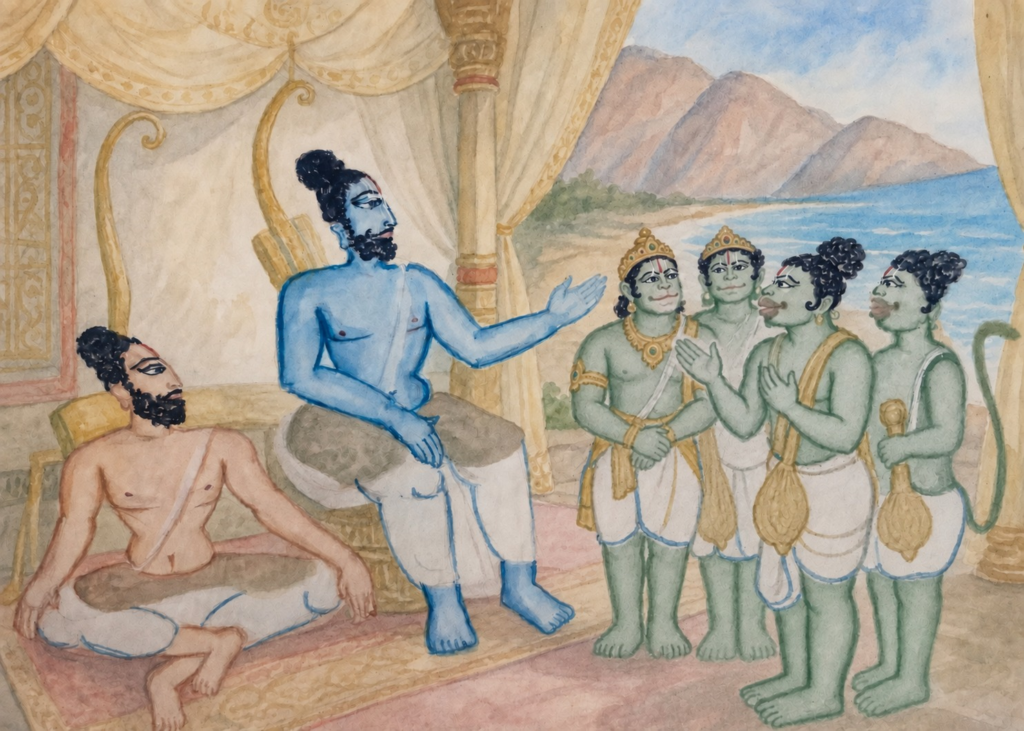
angadhan, Sarabhan, jAmbavAn and maindhan each offered their respective opinions. Upon hearing them, perumAL’s divine heart empathised with vibhIshaNAzhwAn. At this point, hanumAn begins to speak about what is pleasing to perumAL.
We express our gratitude to periyavAchchAn piLLai and puththUr swAmy, who has published this work along with a simple explanation. We also express our deepest gratitude to SrI u vE sArathy thOthAthri swAmy. This article is a translation of periyavAchchAn piLLai’s commentary, summarised with the support of SrI sArathy swAmy’s thamizh kAlakshEpam series.
We shall now enjoy the vyAkhyAnam for the SlOkam where thiruvadi, who is celebrated as nava vyAkaraNa paNdithan (a scholar who has studied and mastered the nine foundational schools of classical grammar), desires to convey his thoughts after observing the situation.
avathArikai (Introduction)
[The reason for thiruvadi’s desire to express his opinion is given below].
Since the perspectives of all four monkey elders – angadhan, Sarabhan, jAmbavAn, and maindhan – were favoured by everyone, they remained silent. There really was no difference between sugrIva mahArAja’s opinion of ‘vadhyathAm’ (Let him be killed) and the opinion of the others who favoured an investigation. After listening to all of them, perumAL thought, “Not even one of them said, ‘We must accept vibhIshaNa who has surrendered’”; his divine mind was deeply disheartened. Moved to sorrow, [the one who declares that his own life ‘depends’ on his devotee] his divine form grew pale.
Observing this and desiring to sustain the life of this exemplary gem among the leaders – SrI rAma, hanumAn began to express his thoughts. Treating the views of the previous speakers as pUrvapaksham (the opposing argument), he conveyed his own perspective in eighteen SlOkams. In this very first SlOkam beginning with ‘atha samskAra’, vAlmeeki bhagavAn celebrates hanumAn’s words because they deeply pleased SrI rAma’s divine heart.
atha samskAra sampannO hanUmAn sachivOththama: I
uvAcha vachanam SlakshNamarthavan madhuram laghu II
Word-by-word meaning
atha – after
samskAra sampanna: – possessing mastery (regarding the meanings of words)
sachivOththama: – best among the ministers
hanUmAn – anuman (thiruvadi)
SlakshNam – well-suited
arthavath – meaningful
madhuram – sweet
laghu – concise
vachanam – words
uvAcha – spoke
Simple meaning
Thereafter, hanumAn, who was endowed with mastery and was best among the ministers, spoke appropriate and meaningful words which were also concise and pleasant.
Notes from periyavAchchAn piLLai’s vyAkhyAnam
atha [after] Commonly, the word atha carries the meaning ‘after’. In this context, it means ‘after the opposing perspectives spoken by the monkey elders’. In some instances, however, atha is used as an auspicious word before a new topic is commenced. Accordingly, it can be interpreted that hanumAn commenced with atha before beginning to explain his perspective.
samskAra sampanna: [endowed with refined knowledge] Due to his scholarly knowledge and longstanding familiarity with scriptures and the royal strategies, politics, and justice, his wisdom is flawless. His understanding of sanskrit grammar concepts – including prakruthi – prathyaya (root and suffix), sandhi (combination of sounds and words) and vigraha (splitting of combined words) – is impeccable.
[puththUr swAmy’s explanation
samskAra sampanna: [possessing refinement] samskAra refers to the vAsanA [imprints in the mind, resulting from experience in many births]. In this context, it denotes gyAna vAsanA. He [hanumAn] mastered SAsthrams like vyAkaraNam from sun. Also due to his long-term acquaintance with the royal monkey clan, his comprehension of prakruthi-prathyayam of words and his knowledge of royal governance – such as the art of peacemaking (sandhi) and warfare (vigraham) – have no deficiencies].
hanUmAn sachivOththama:
Since hanumAn strives to increase the magnificence of perumAL, he is the best among ministers.
[puththUr swAmy’s explanation
hanumAn is the best among the ministers – By preserving SrI rAma’s life and by bringing even more glory to him, he is the best among the ministers].
SlakshNam
Whatever he speaks in the present is coherent, consistent, and connected to what was previously spoken. In this context, ‘connection’ can also be interpreted as referring to the connection between words and their meanings. [Note from kAlakshEpam: Using superior words to communicate a subject that is superior or noble; and using lowly words to describe inferior matters. For example, the word dhvayam means ‘a pair or two’. In our sampradhAyam, it denotes the two parts of the sacred manthram; using this supreme word to denote a lowly, material subject matter would be inappropriate. Similarly, when referring to something supreme like perumAL’s divine processions, using ordinary words such as ‘he is coming’ instead of using superior sampradhAyam paribhashA words like ‘ezhundharuLugiRAr’ (he is mercifully coming), would be inappropriate].
arthavath – [hanumAn’s words are not mere sounds, but] meaningful. [Three different interpretations are given to explain this meaning]
- His words are not only beautiful in their sound, but their meanings are even more beautiful than the words themselves.
- They carry a distinct or extraordinary meaning. [For example, the sentence, ‘Will he do it?’ is a simple phrase, but carries a distinctive meaning beyond it in connection with the previous sentence or context].
- His expressions convey many purposes. For example, hanumAn’s single sentence, will resolve perumAL’s existence, vibhIshaNAzhwAn’s acceptance, and sugrIva mahArAja’s anxiety.
madhuram
hanumAn’s words, even if they do not carry any specific meaning, will still be very sweet to hear.
laghu
His words are not extensive. They are concise, such that their meaning is easily understood.
vachanam uvAcha – He spoke the words – those which, if not heeded and put into action, will result in anartham (misfortune). The glory of his speech was such that it was as indisputable as ‘manu vachanam’. And at all times, the wisdom and cleverness of his speech remained consistent. It was even celebrated by perumAL during his first meeting with hanumAn.
- SrI rAmAyaNam kishkindhA kANdam 3-32 “samskAra krama sampannAm adhbhuthAm avilambithAm I uchchArayathi kalyANeem vAcham hrudhaya harshinIm II” (His utterances are filled with wisdom and conveyed in a proper manner – not very fast, not very slow, auspicious, and pleasing to the heart).
atha samskAra sampannO hanUmAn sachivOththama: I
uvAcha vachanam SlakshNamarthavan madhuram laghu II
Thus concludes the vyAkhyAnam for this SlOkam.
SrI rAmAyaNa thani SlOkam yudhdha kANdam 17.49
hanumAn speaks to perumAL – dhEvarIr’s words are exemplary; even bruhaspathi cannot surpass dhEvarIr.
avathArikai (Introduction)
thiruvadi said, “dhEvarIr’s intention is my ideology. However, to determine dhEvarIr’s divine will is beyond anyone’s capability”. [What is the reason for thiruvadi to glorify perumAL in this manner?] perumAL was distressed, thinking, ‘Alas! there is not a single person here to share my thoughts’. To alleviate SrI rAma’s distress and bring happiness in perumAL’s divine face, thiruvadi celebrates perumAL’s intellectual prowess.
na bhavantham mathi SrEshtam samartham vadhathAm varam I
athiSAyayithum SakthO bruhaspathir api bruvan II
Word-by-word meaning
mathi SrEshtam – one, who is intellectually superior
samartham – powerful
vadhathAm varam – best among the eloquent speakers
bhavantham – dhEvarIr
bruvan – saying the words
athiSAyayithum – to surpass
bruhaspathir api – even bruhaspathi
na Saktha: – is not competent
Simple meaning
Even bruhaspathi, by his speech, is not competent to excel dhEvarIr, who is intellectually superior, powerful and best among the eloquent speakers.
Notes from periyavAchchAn piLLai’s vyAkhyAnam
mathi SrEshtam [wisest person] – exceptional at discerning what to accept and what to reject, as well as what is essential to perform and what must be avoided.
samartham [competent] meaning, he is not only knowledgeable but also competent to execute his decisions.
vadhathAm varam – he is the best among the finest orators. Throughout the process of implementation, perumAL’s divine words are very impactful and convincing, such that they become deeply registered in the minds of his listeners. Even those who may have initially opposed his decision, ultimately come to understand and agree with them. SrI rAma thus leads with absolute conviction and influence.
bhavantham – dhEvarIr [is an honorific; the supreme, possessing all auspicious qualities] Although only a few qualities – such as intelligence, execution competency, and powerful communication – have been mentioned here, dhEvarIr indeed is a repository of all auspicious qualities essential for executing these deeds!
athiSAyayithum na Saktha: bruhaspathir api bruvan – even bruhaspathi cannot win you over with his words
bruhaspathi who communicates with utmost clarity and vividly expresses a conglomeration of innumerable meanings, is still not competent to surpass or persuade dhEvarIr. This means that even bruhaspathi cannot convince perumAL to alter his firm stance. By emphasising that bruhaspathi himself is incapable of altering perumAL’s intentions, hanumAn implies (through kimpunarnyAya, a maxim, that it is obvious), ‘adiyEn and others are entirely powerless in this matter’. [Note: kimpunarnyAya, a maxim – a logic that if a difficult condition has already been proven true, then an easier, or more obvious condition must automatically be true as well].
na bhavantham mathi SrEshtam samartham vadhathAm varam I
athiSAyayithum SakthO bruhaspathir api bruvan II
Thus concludes the vyAkhyAnam for this SlOkam.
SrI rAmAyaNa thani SlOkam yudhdha kANdam 17.50 – Part 1
hanumAn conveys to sugrIva manArAja his intentions for speaking at this juncture. Because sugrIva mahArAja is the king and hanumAn is his subordinate minister, hanumAn did not want the king to misinterpret his desire to communicate a differing perspective.
[Two commentaries are available for this SlOkam – one as part of abhaya pradhAna sAram commentary, and the other is the thaniSlOkam commentary].
First, we will go through the abhaya pradhAna sAram commentary.
avathArikai (Introduction)
In this SlOkam, to reveal his perspective regarding vibhIshaNAzhwAn’s virtuousness, hanumAn explains his reasons to sugrIva mahArAja for critiquing and deconstructing the opinions expressed thus far,
na vAdhAnnApi sangharshAnnAdhikyAnna cha kAmatha: I
vakshyAmi vachanam rAjan yathArtham rAmagauravAth II
Word-by-word meaning
rAjan – [sugrIrva] mahArAja!
vAdhAth – to display one’s proficiency in argument
na [vakshyAmi] – not speaking
sangharshAth api na [vakshyAmi] – not speaking out of jealousy
AdhikyAth na [vakshyAmi] – to establish superiority
kAmatha: cha na [vakshyAmi] – not speaking out of favouritism
rAmagauravAth – upon seeing SrI rAma’s greatness
yathArtham – as it is (truth)
vachanam – words
vakshyAmi – I am going to speak
Simple meaning
Oh, [sugrIva] mahArAja! This is neither a display of my argumentative prowess nor an act of jealousy. It is also not to establish my significance. There is no bias here; I speak these words solely upon seeing the greatness of SrI rAma.
Notes from periyavAchchAn piLLai’s vyAkhyAnam
na vAdhAth [not due to my competence in arguing]
[hanumAn says] I do not say this is to display my competence in argumentative skills, aspiring to succeed in my point of view.
nApi sangharshAth [not due to jealousy]
[hanumAn says] I do not say this out of jealousy, thinking, ‘How can others express their opinions while I am present’?
nAdhikyAth [superiority]
[hanumAn says] I do not say this because I think I am greater than others, or that everyone should act or decide based on my words.
na cha kAmatha: [not due to any preference or interest]
[hanumAn says] I speak neither out of my affinity toward vibhIshaNa nor to convince others out of favouritism towards him; nor is there any expectation to receive any benefit from vibhIshaNa in the future. It is also not a spontaneous expression of my thoughts.
The word kAmatha: means both affection and preference (favouritism); alternatively, it also refers to a desired benefit. Hence, it is interpreted that hanumAn did not speak expecting to receive any benefit from vibhIshaNAzhwAn. Because kAmatha: also means ‘doing something of one’s own accord’, it is further interpreted that hanumAn did not randomly express the thoughts in his mind.
What are hanumAn’s reasons for stating so many exclusions (neither like this nor like that) and clarifying each of them?
rAjan – king
A careful analysis – excluding everything that is inappropriate or irrelevant – is required while expressing a thought that differs from what is in a king’s heart.
yathArtham vachanam vakshyAmi [I shall speak words that reflect reality exactly as it is]
[hanumAn says] I speak these words which describe the truth, explaining reality exactly as it is. Because their [leaders of monkeys, who have spoken until now] perspectives are fundamentally flawed, I am describing them as they are. Alternatively, this is interpreted as – because vibhIshaNAzhwAn is virtuous, I am describing his traits exactly as they are.
Given that sugrIva mahArAja is hanumAn’s lord, is it appropriate to express a contrary perspective, even when conveying the truth?
rAmagauravAth [I speak on seeing SrI rAma’s greatness]
[hanumAn says] Upon seeing perumAL’s glory, the truth must be stated. If I do not state reality exactly as it is, we might lose perumAL’s existence; it is because of that, that I state my opinion, even if it is contrary.
na vAdhAnnApi sangharshAnnAdhikyAnna cha kAmatha: I
vakshyAmi vachanam rAjan yathArtham rAmagauravAth II
vyAkhyAnam for this SlOkam will continue in the next article.
AzhwAr emperumAnAr jIyar thiruvadigaLE SaraNam
periyavAchchAn piLLai thiruvadigaLE SaraNam
Source – SrI rAmAyaNa thani SlOkam – 70 – yudhdha kANdam 17.48 – 50 – Part1 Audio Video
adiyEn chithrA rAmAnuja dhAsi
Proofreading/Curating done by – kOsalEndhra rAmAnuja dhAsan, krishNan rAmAnuja dhAsan
Artwork – namperumAL rAmAnuja dhAsan
Related Links
SrI rAmAyaNa thani SlOkam – 69 – yudhdha kANdam 17.41 – 47 Audio Video
SrI rAmAyaNa thani SlOkam – 68 – yudhdha kANdam 17.38 – 40 Audio Video
SrI rAmAyaNa thani SlOkam – 67 – yudhdha kANdam 17.31 – suhruthA, 17.32 – ithyEvam, 17.33 – agyAtham, 17.34 – thvam hi Audio Video
SrI rAmAyaNa thani SlOkam – 66 – yudhdha kANdam 17.28 – EvamukthvA , 17.29 – sugrIvasya, 17.30 – yadhuktham Audio Video
SrI rAmAyaNa thani SlOkam – 65 – yudhdha kANdam 17.24 – rAvaNO praNihitham, 17.25 – rAkshasO jihmayA , 17.26 – pravishta: Sathrusainyam, 17.27 – vadhyathAmEsha Audio Video
SrI rAmAyaNa thani SlOkam – concise english meanings
archived in https://granthams.koyil.org
pramEyam (goal) – https://koyil.org
pramANam (scriptures) – https://granthams.koyil.org
pramAthA (preceptors) – http://acharyas.koyil.org
SrIvaishNava education/kids portal – http://pillai.koyil.org