SrI: SrImathE SatakOpAya nama: SrImathE rAmAnujAya nama: SrImath varavaramunayE nama:
The extremely merciful periyavAchchAn piLLai has selected important SlOkams from SrI rAmAyaNam and provided us with a vyAkhyAna grantham known as SrI rAmAyaNa thani SlOkam.
We are currently enjoying a very important SlOkam, which is also celebrated as SrI rAma charama SlOkam. This SlOkam beautifully illustrates how SrI rAma considers vibhIshaNa.
mithrabhAvEna samprAptham na thyajEyam kathanchana I
dhOshO yadhyapi thasya syAth sathAmEthadhagarhitham II
vibhIshaNa has arrived well with the intention of a friend. No matter what reasons may arise, I will not abandon him. The virtuous will not reproach his acceptance, in spite of his faults.
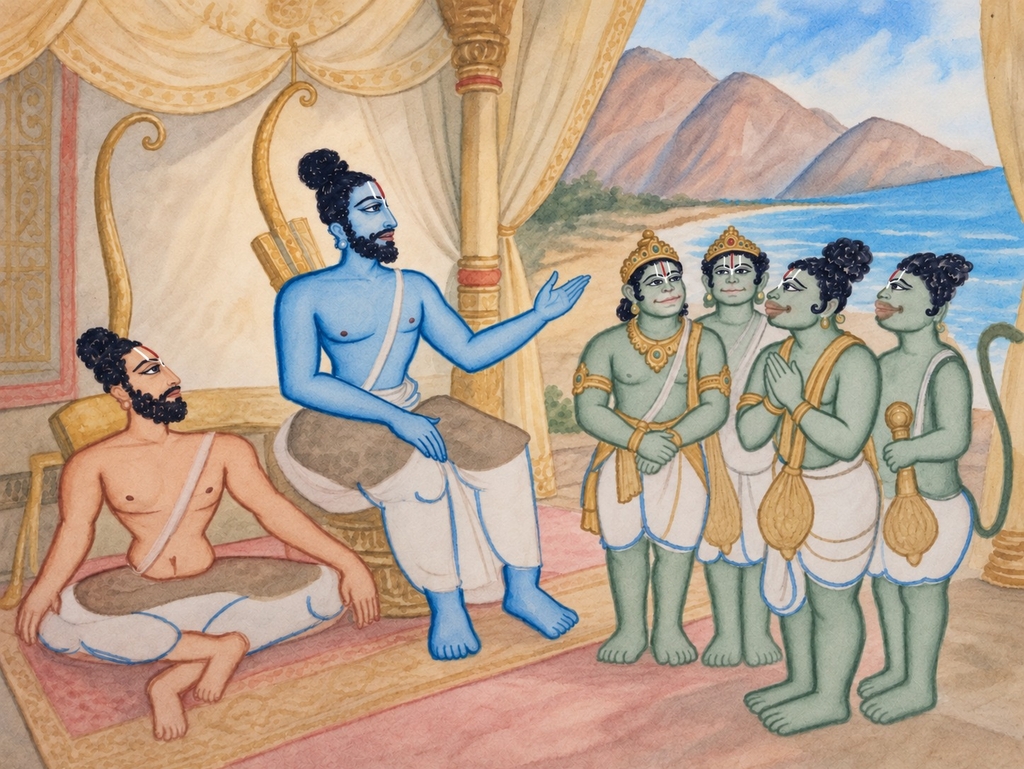
Below is a depiction of the conversation regarding ‘na thyajEyam kathanchana’ between perumAL and sugrIva mahArAja –
perumAL says, “I will not abandon vibhIshaNa for any reasons”.
sugrIva mahArAja asks, “What will you do if he becomes dangerous to dhEvarIr’s life”?
perumAL says, “Even if it were to cost my life, I will not abandon vibhIshaNa”.
sugrIva mahArAja asks, “What will you do if he proves to be harmful to your beloved, sIthAp pirAtti”?
perumAL says, “Even if something were to happen to sIthA dhEvi, I will still accept him”.
sugrIva mahArAja asks, “What if he is a danger to iLaiyaperumAL, who is dearer than your own life”?
perumAL says, “Even if he is dangerous to lakshmaNa, I will not abandon vibhIshaNa”.
Finally, sugrIva mahArAja asks, “dhEvarIr has shown immense affection towards me, what if he causes danger to me”?
perumAL says, “Even if it is dangerous to you, sugrIva, I will still accept vibhIshaNa”.
This is his excellence. perumAL’s inherent nature towards his servitors is that he desires and accepts the newcomers with even greater fondness. Just as perumAL was willing to accept sugrIva in spite of any hardships of losing even sIthAp pirAtti, perumAL desires to accept vibhIshaNa regardless of any dangers that may befall anyone else.
In the previous article, we enjoyed the many meanings given by periyavAchchAn piLLai for mithrabhAvEna samprAptham na thyajEyam kathanchana. We will continue with the commentary for the remainder of the SlOkam in this article.
Notes from periyavAchchAn piLLai’s vyAkhyAnam
- SrI rAmAyaNam ayOdhyA kANdam 96-24 “pUrvApakAriNAm thyAgE na hyadharmO vidhIyathE” (There is no unrighteousness in abandoning someone who has previously wronged you).
sugrIva mahArAja, after listening to perumAL’s response, continues. He says, “vibhIshaNa is rAvaNa’s brother – the one who abducted dhEvarIr’s pathni – and a spy who has come knowing our presence here, to strike us at an opportune time. Before we enter the enemy’s capital of lankA, he has approached us in our own place to cause threefold harm. It is therefore only fitting that we abandon this evil-minded vibhIshaNa, who is full of flaws”.
[1] dhOshO yadhyapi – even if there are faults
perumAL responds, “I had already instructed you that he has arrived as a friend and that he is faultless. Without listening to this even a little bit, if you presume that he is faultful, I will still not abandon him – even if it so happens that he possesses even more defects than what you have mentioned”.
[2] yadhyapi dhOsha: – even if there are faults
perumAL asks, “Do you really believe that he truly possesses defects as per your judgement”? He continues, “thasya syAth – let it be that he possesses those faults; in fact, possessing those faults is exactly what makes him qualified to perform SaraNAgathi”.
How does the possession of defects make a person eligible for SaraNAgathi?
The scriptures describe the essential characteristics required for a SaraNAgathan as follows –
- ahirbudhnya samhithai 37-31 “aham asmyaparAdhAnAm AlayO’kinchanO’nanyagathi: I thvamEvOpAyabhUthO mE bhava” (I am the abode of all sins; (to protect myself) I have no means; (except for you) I have no other refuge; “You should become the means for me”). The intellect that prays to the supreme lord in this manner is known as performing SaraNAgathi.
[Note from kAlakshEpam: The scripture thus describes the characteristics of SaraNAgathi as admitting one’s faults and helplessness, declaring that one has no other refuge, and praying to the supreme lord to be that refuge. vibhIshaNa performed precisely what is prescribed in the scriptures. perumAL says, “He has declared his faults and utter helplessness”. This shows that he has authority and qualification to perform SaraNAgathi].
It is also described by ALavandhAr in –
- sthOthra rathnam 22 “na dharmanishtO’smi na chAthmavEdhI na bhakthimAmsthvachcharaNAravindhE | akinchanO’nanyagathiS SaraNya! thvathpAdhamUlam SaraNam prapadhyE ||” (Oh my lord who is apt to be surrendered to! I am not firm on karma yOgam: I do not have the knowledge about the self; I do not have bhakthi (devotion) at your divine lotus feet; I, who am having having no other means and no other refuge, firmly accept your divine lotus feet as the means).
[Note from kAlakshEpam: As said by nammAzhwAr in thiruvAimozhi 5.7.1
“nORRa nOnbilEn nuNNaRivilEn Agilum ini unnai vittonRum
ARRagiRkinRilEn aravin aNai ammAnE!
sERRuth thAmarai sennel Udu malar sireevaramangala nagar
vIRRirundha endhAy! unakku migai allEn angE”
(I have not performed karma yOgam to attain the result; I have not performed gyAna yOgam which is in subtle form and is focussed on knowledge about self and god; though not having bhakthi yOgam which is possible by having these two, i.e., karma yOgam and gyAna yOgam, I am unable to survive even for a moment without you, after meditating upon your qualities; Oh benefactor for me who is seated in a distinguished manner manifesting your readiness to protect well your devotees in Sreevaramangala nagar [vAnamAmalai/thOthAdhri, also known as nAngunEri] where attractive lotus flower is blossoming while being mingled with paddy crop in muddy fields! In your presence there, I am not an outsider to the savable souls who are to be saved by you who are the saviour)].
When accepting a person, it is impossible to abandon his qualities and accept only him. Similarly, vibhIshaNa can also be accepted only along with his characteristics. Therefore, his very defects became his identifying characteristics and qualification for SaraNAgathi. Hence, the question of needing to be accepted without defects does not arise at all.
[3] dhOshA yadhyapi thasya – even if he has defects.
In this interpretation, perumAL first poses a question – Does he have defects? He then answers himself, saying, ‘syAth’ (let it be so).
perumAL says, “A father endures the mistakes committed by his son, and a husband endures the mistakes committed by his wife; this can be observed in case of worldly relationships that exist due to karma. When people are able to overlook the flaws of relatives in relationships that exist purely due to karma, should I, who share an eternal, natural relationship with vibhIshaNa, not tolerate his defects?”
[4] syAth – This interpretation is based on sanskrit grammar. ling is the grammatical terminology for sanskrit verbs. Here, “prArthanAyAm ling”, is used to express a desire. Therefore, the use of syAth indicates that accepting vibhIshaNa, especially with his defects, is indeed desired by perumAL – as though obtaining a rare or priceless treasure that seemed impossible to get.
Therefore, perumAL says, “Is this opportunity to accept him with his defects not an unattainable gain? If a virtuous person is protected, it would be said that because he was virtuous, he was offered protection. In that case, his virtues become the price paid for protection. Therefore, protecting a person with defects and earning a reputation because of it – is indeed an unattainable fortune”.
[Note from kAlakshEpam: This mercy is what emperumAnAr has bestowed upon us. It is due to emperumAnAr’s benevolence that we possess even this tiny amount of devotion towards perumAL today. In olden times, even the most qualified individual would be tested and disciplined for more than a year; only when the AchArya was fully satisfied with their eligibility and service, would they be instructed. Even then, the instruction was not guaranteed. Until emperumAnAr’s time, this was how the AchArya -Sishya relationship existed. However, emperumAnAr realised that it was impossible for many to attain such a high level of eligibility to attain liberation. He decided that even those with defects but have developed the desire for detachment from samsAram, when given the opportunity to be attached to perumAL, could be disciplined and elevated. [A teacher who helps a very low performer to ace an exam is celebrated much more than one who assists an already high-performing student]. This approach is beautifully witnessed today in our sampradhAyam. Due to emperumAnAr’s mercy and AchArya’s grace, all of us – who may still have defects – are gradually improving ourselves by learning from and following instructions of pUrvAchAryas].
[5] Alternatively, it is also interpreted as follows. perumAL says, “To begin with, he does not actually possess any defects. However, even if you are somehow able to prove that he does possess defects, I would still embrace them simply because they are vibhIshaNa’s defects! His defects are more desirable to me than he himself is. Just as beloveds desire the scent of each other [which might otherwise be repulsive to outsiders], vibhIshaNa’s defects, too, will be an object of my liking”.
[6] dhOshO yadhyapi – even if there are faults; thasya syAth (his desired object would be achieved) – thasyAbhimath sidhdhi: syAth – [How do the defects help vibhIshaNa?] perumAL says, “His desires are fulfilled by them. If his intention is to spy upon us, let that desire be fulfilled for him. What is the harm to us in that? If he desires to kill us, let him kill us. In that case, I would earn the reputation of protecting SaraNAgathan by sacrificing my own life!”
[Note from kAlakshEpam: His defects are the very reason perumAL accepts vibhIshaNa; hence his desire to attain perumAL is fulfilled because of his defects. Hence, it is said that these defects are not even considered to be vibhIshaNa’s shortcomings].
[7] dhOshO yadhyapi thasya syAth – na mama – Even if they are defects, they belong to him, and not to me. [dhOshO yadhyapi – Even if there are defects; thasya syAth – they are his defects; na mama – not mine]
perumAL says, “His defects belong to him; I, who protected him, bear no fault”.
[8] dhOshO yadhyapi thasya syAth – If he has defects, they [in fact] bring good times for him. But how is this possible? perumAL says, “Look at vibhIshaNa’s affection towards his brother, rAvaNa! So far, rAvaNa’s army has not been damaged, lankA has not faced any calamity, and rAvaNa has not even been scarred. Suppose, at this moment he defeats [us] rAvaNa’s enemy, will that not bring him glory? Even if I lose my life, if it brings glory to vibhIshaNa, then all is well”.
[9] dhOshO yadhyapi syAth thasya – perhaps he may have defects
- sAthvatham samhithai 16-23,24 “dhurAcharO’ pi sarvASI kruthaghnO nAsthika: purA | samASrayEdhAdhidhEvam SradhdhayA SaraNam yadhi || nirdhOsham vidhdhi tham janthum” (Even if one has engaged in immoral conduct, eaten without discrimination, remained ungrateful, and lived as an atheist [a non-believer of scriptures] since time immemorial, if he surrenders to SrIman nArAyaNa with faith, by the greatness of bhagavAn, he is considered faultless).
- SrI bhagavath gIthA 4-37 “gyAnAgni: sarvakarmANi bhasmasAth kuruthE” (Oh, arjuna! The fire of knowledge reduces all karma (actions) to ashes).
- thiruppAvai 5 “manaththinAl sindhikka pOya pizhaiyum pugu tharuvAn ninRanavum theeyinil thUsAgum” (When the supreme lord is meditated upon in our mind, all our bad deeds of the past as well as sins which we may indulge in, in the future, will disappear just like a piece of cotton thrown into fire).
- periyAzhwAr thirumozhi 5-4-2 “pAvakkAdu theekkoleei vEginRadhAl (The forest of sin, is caught in fire and burned by the grace of bhagavAn).
perumAL states that even if vibhIshaNa was once full of flaws, the moment he surrendered, those flaws were obliterated; therefore, he is now faultless.
[10] thasya dhOshO yadhyapi – Even if he has defects. perumAL asks sugrIva mahArAja, “Are you saying that he arrived here with an evil intention to kill us? Let that thought become true!”
- SrI rAmAyaNAm yudhdha kANdam 18-28 “ari: prANAm parithyajya rakshithavya: kuthAthmanA” (A virtuous person must protect a surrendered enemy even at the cost of his own life).
As such, SrI rAma says, ‘Earning this reputation – that SrI rAma protected the surrendered by sacrificing his life, isn’t this indeed an esteemed reward?’
What is the benefit by accepting him in this manner, in spite of his defects?
[1] sathAmEthadhagarhitham – this is an essential attribute to avoid being despised by the wise and good-hearted
- periyAzhwAr thirumozhi 3-6-11 “sAdhu kOttiyuL koLLap paduvArE” (he will be recognised in the assembly of SrIvaishNavas).
perumAL says, “Saibyan and others protected yayAthi who surrendered to them, and viSwAmithra protected SunaSEpan, thriSanku and others. If I do not protect vibhIshaNa, I will not be accepted into their group”.
[2] sathAmEthath syAth – only the virtuous will obtain this privilege. Accepting a surrendered person is a fortunate experience that belongs only to the virtuous. How will this happen to me if I listen to your words, sugrIva?” [says perumAL].
[3] sathAmEthath syAth – animals will receive this.
perumAL says, “Only the birds and animals, like the pigeon and monkey, shall attain this glory. How am I, in this human form, going to achieve this?”
[4] agarhitham means being beyond reproach. It is an essential attribute for avoiding contempt and refraining from blame.
perumAL says, “The performance of nithya karmas, such as sandhyavandhanam, does not fructify into any specific merit; however, failing to perform them results in a defect. Similarly, for us who are kshathriyas, it is our natural duty to protect others from danger. When we fail in this duty, garhai (blame) is born, and we will be censured by the world. Preventing that reproach from happening is our true strength”.
- raghuvamSam 2-53 “kshathAth kila thrAyatha ithyudhagra: kshaththrasya SabdhO bhuvanEshu rUda: |” (Derived from the words kshatha (destruction) and thraya (protection), the revered title kshathriya – meaning “one who protects others from destruction” – is famously established throughout the world).
agarhitham – The word garhitham means reproached or blamed. However, when the prefix – the negative particle ‘a’ is added – it introduces three distinct meanings. [1] thadhanya – totally different from garhitham [2] thadhabhAva – the absence of garhitham [3] thadhvirOdhi – the opposite of garhitham.
[5] agarhitham – that which is not reproached [Interpretation based on the first meaning, thadhanya – totally different from garhitham]
- SrI rAmAyaNam yudhdha kANdam 18-32 “svargam syAth thu palOdhayE” (By protecting the surrendered, a person can attain svargam as the result of this action).
This refers to something that is simply different from – is considered garhitham (reproached or blamed).
That is, when a SaraNAgathan is not accepted, it will result in garhai (blame); therefore, when a SaraNAgathan is accepted, it will result in something completely different from garhitham – such as svargam etc. Thus, agarhitham denotes that the action will result in attainment of rewards such as svargam.
[6] agarhitham – that which is not reproached [Interpretation based on the second meaning, thadhabhAva – absence of garhitham]. This refers to the sheer absence or non-existence of reproach or blame. In this case, agarhitham denotes that he will not be reproached.
[7] agarhitham – that which is not reproached [Interpretation based on the third meaning, thadhvirOdhi – opposite of garhitham]. This refers to something that is the direct opposite of reproach – namely, praise.
- SrI rAmAyaNam kishkindhA kANdam 15-20 “yaSasa: cha Eka bhAjanam” (SrI rAma is the very abode for glory). Thus, agarhitham denotes that it will result in attainment of praise.
Therefore, apart from the direct meaning of ‘is not despised’, agarhitham – due to the presence of negative particle ‘a’ – also conveys that the action will yield different results such as svargam, ensure there is no blame, and result in praiseworthiness.
Thus, the SlOkam conveys that a person surrendering to perumAL needs only a slightly favourable tendency towards him – this is the only characteristic that is expected of them. perumAL, on the other hand, views this minimal conduciveness as ginormous.
- SrI rAmAyaNam ayOdhyA kANdam 1-11 “na smarathyapakArANAm SathamapyAthmavaththayA I kathanchidhupakArENa kruthEnaikEna thushyathi II” (SrI rAma does not remember the hundreds of offences committed against him; because he is extremely compassionate and merciful; but he is thoroughly pleased and satisfied with even a single good deed or favour is done to him).
- “kshAnthamithyabravIth hari:” ([the supreme lord, hari said] the offences were tolerated).
- SrI bhagavath gIthA 18-66 “sarvadharmAn parithyajya mAm Ekam SaraNam vraja | aham thvA sarvapApEbhyO mOkshayishyAmi mA Sucha: || (Fully renouncing all means, consider me as your only means; I will free you from all sins; do not grieve).
- varAha charamam “madhbhaktham nayAmi paramAm gathim” (I take my devotee to supreme abode)
- thiruvAimozhi 9-1-7 “sindhippE amaiyum” (mere thoughts are sufficient).
- thiruvAimozhi 1-10-2 “eNNilum varum” (For those who are merely contemplating his existence, the supreme lord is at their disposal).
As stated in many places, this SlOkam conveys that perumAL gives himself to those who surrender unto him. Whoever they are, he does not abandon them in any situation and no matter what obstacles come in the way.
mithrabhAvEna samprAptham na thyajEyam kathanchana I
dhOshO yadhyapi thasya syAth sathAmEthadhagarhitham II
Thus concludes the vyAkhyAnam for this SlOkam.
AzhwAr emperumAnAr jIyar thiruvadigaLE SaraNam
periyavAchchAn piLLai thiruvadigaLE SaraNam
Source – SrI rAmAyaNa thani SlOkam – 80 – yudhdha kANdam 18.3 mithra bhAvEna – Part 6 Audio Video
adiyEn chithrA rAmAnuja dhAsi
Proofreading/Curating done by – kOsalEndhra rAmAnuja dhAsan, krishNan rAmAnuja dhAsan
Artwork – namperumAL rAmAnuja dhAsan
Related Links
SrI rAmAyaNa thani SlOkam – 79 – yudhdha kANdam 18.3 mithra bhAvEna – Part 5 Audio Video
SrI rAmAyaNa thani SlOkam – 78 – yudhdha kANdam 18.3 mithra bhAvEna – Part 4 Audio Video
SrI rAmAyaNa thani SlOkam – 77 – yudhdha kANdam 18.3 mithra bhAvEna – Part 3 Audio Video
SrI rAmAyaNa thani SlOkam – 76 – yudhdha kANdam 18.3 mithra bhAvEna – Part 2 Audio Video
SrI rAmAyaNa thani SlOkam – 75 – yudhdha kANdam 18.1 – 18.3 mithra bhAvEna – Part 1 Audio Video
SrI rAmAyaNa thani SlOkam – 74 – yudhdha kANdam 17.60 – 17.66 Audio Video
SrI rAmAyaNa thani SlOkam – concise english meanings
archived in https://granthams.koyil.org
pramEyam (goal) – https://koyil.org
pramANam (scriptures) – https://granthams.koyil.org
pramAthA (preceptors) – http://acharyas.koyil.org
SrIvaishNava education/kids portal – http://pillai.koyil.org