SrI: SrImathE SatakOpAya nama: SrImathE rAmAnujAya nama: SrImath varavaramunayE nama:
The extremely merciful periyavAchchAn piLLai has selected important SlOkams from SrI rAmAyaNam and provided us with a vyAkhyAna grantham known as SrI rAmAyaNa thani SlOkam.
We are currently enjoying the yudhdha kANdam in this series. For this SlOkam, there are two commentaries. In the previous articles we enjoyed the commentary from abhaya pradhAna sAram. In this article, we are enjoying the thaniSlOka commentary. All of this has been published by puththUr swAmy along with a beautiful thamizh commentary. We are learning the meanings of these SlOkams through these granthams. We express our gratitude to periyavAchchAn piLLai and puththUr swAmy. We also express our gratitude to SrI u vE sArathy thOthAthri swAmy. This article is a translation of periyavAchchAn piLLai’s commentary, summarised with the support of SrI sArathy swAmy’s thamizh kAlakshEpam series.
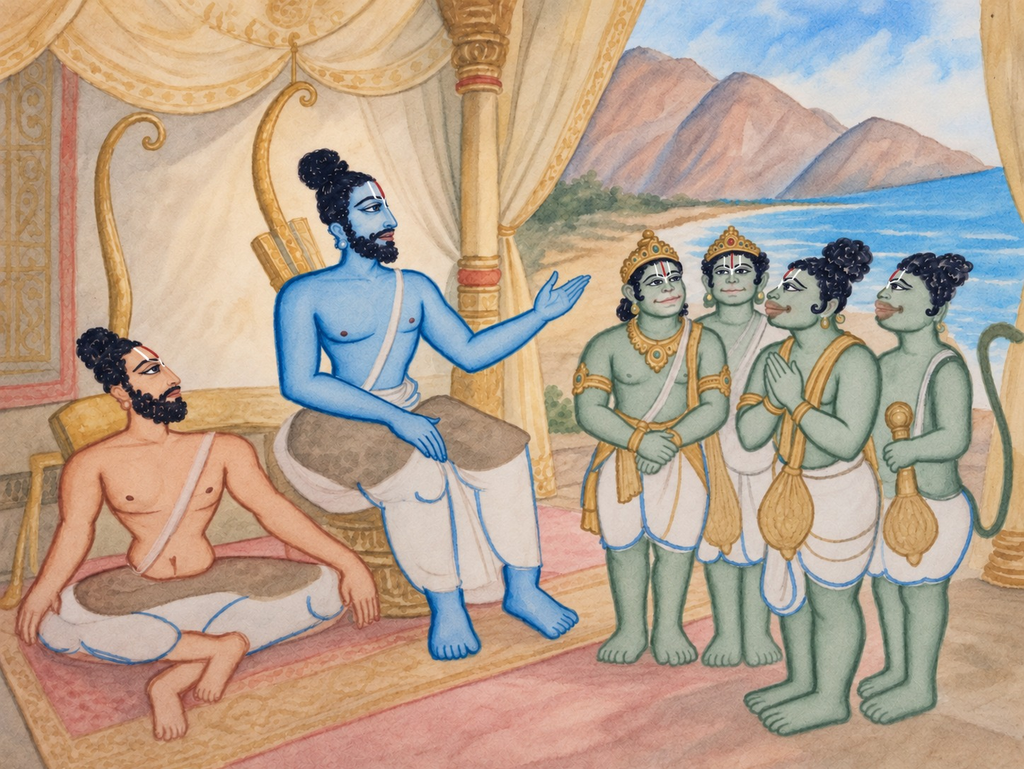
perumAL explains in this SlOkam that even if vibhIshaNa has arrived posing as a friend, or even if he is suspected of bearing defects and prone to being dangerous, we must still protect him. The virtuous will not reproach for accepting him in spite of his faults.
mithrabhAvEna samprAptham na thyajEyam kathanchana I
dhOshO yadhyapi thasya syAth sathAmEthadhagarhitham II
In the previous article, we enjoyed the many meanings given by periyavAchchAn piLLai for mithrabhAvEna. perumAL is supreme, yet he considers even one who comes to surrender to him as a friend. perumAL does not look down upon him as his subordinate just because vibhIshaNa approached him seeking refuge.
Notes from periyavAchchAn piLLai’s vyAkhyAnam
A question may arise, ‘vibhIshaNa might be a friend. What is the use of his friendship if he is in lankA?”
[1] samprAptham means one who has arrived.
That problem does not exist anymore, since vibhIshaNa has arrived from lankA.
[2] samprAptham – one who has arrived quickly. As the saying goes, “samyak prAptham samprAptham” – he arrived quickly. Just as he was seen rising up in lankA, he was immediately spotted within a few seconds on the other end of the shore; he arrived with such swiftness.
- SrI rAmAyaNam yudhdha kANdam 17-1 “AjagAma muhUrthEna” ([vibhIshaNa] came quickly).
[3] samprAptham – the one who has arrived.
Suppose vibhIshaNa had said, “rAghavam SaraNam gatha:” – SrI rAma! I seek your refuge from lankA, perumAL would have rushed to him instantly – with his dress and locks in dishevelled condition – just as he once hastened to the crocodile pond to save gajEndhrAzhwAn. Instead, vibhIshaNa came all the way to the shores where perumAL was present. Therefore, perumAL thinks, ‘Instead of my going to him, he has come all the way to me. He has made this much easier for me. How wonderful!’.
[4] samprAptham – the one who has arrived. Seeing guhapperumAL walk towards him and greet him, perumAL celebrates him greatly by saying, “Since you have come walking, we feel that we have been worshipped; we feel happy too”. ANdAL nAchchiyAr also speaks about approaching the supreme lord, she says, “[Instead of your coming to us] We have come to you very early in the morning”.
Upon seeing vibhIshaNa arrive, perumAL is saddened and speaks in distress, “Did you not see how vibhIshaNa arrived? He came [due to the urgency] at an inappropriate time [at night] and resorted to an unconventional means [aerial path] to arrive”.
- SrI rAmAyaNam ayOdhyA kANdam 50-41 “padhbhyAmabhi gamAchchaiva” ([SrI rAma replies to guha] by walking towards me with your feet, I was worshipped; I was also pleased by it).
- thiruppAvai 29 “chiRRam chiRukAlE vandhu” (we came here very early in the morning).
[5] samprAptham – the one who has arrived.
perumAL says, “Did we not stop in many places – such as SrungibErapuram, bharadhwAjASramam, chithrakUtam, panchavatI and mAlyavAn – before arriving late at our destination? vibhIshaNa however, did not rest anywhere in between. How wonderful! He arrived in a very short time”.
[6] samprAptham – samyak prAptham – the one who has arrived beautifully.
perumAL says, “Oh, see! How beautifully vibhIshaNa has come!” This means that the deeds he performed before his arrival were beautiful and favourable – through his daughter analA, he solaced sIthAp pirAtti, he prevented rAvaNa from killing hanumAn by advising him that it is improper to kill a messenger, and he offered good counsel to rAvaNa to return sIthAp pirAtti to SrI rAma. Thus, he has arrived beautifully, after already doing so many favours.
- SrI rAmAyaNam yudhdha kANdam 14-3, 4 “pradhIyathAm dhASarathAya maithilee” (May sIthAp pirAtti be reunited with dhaSaratha’s son).
[7] samprAptham – the one who arrived. When perumAL approached the mountain where sugrIva was residing, sugrIva mahArAja immediately relocated to a different mountain [out of fear that vAli had sent someone to capture him]. perumAL says to sugrIva, “Unlike you, who fled away from me when I approached, vibhIshaNa came seeking me on his own accord”.
- SrI rAmAyaNam kishkindhA kANdam 2-7 “jagmur girithatAth thasmAdhanyam Sikharam uththamam” (From that mountain slope, they went to another loftier peak).
[8] samprAptham – the one who arrived well.
perumAL says, “sugrIva! When I approached you, you treated me as your equal and extended your arms cordially to me. vibhIshaNa, however, humbled himself and fell at my feet. See how well vibhIshaNa approached me!”.
- SrI rAmAyaNam kishkindhA kANdam 5-12 “bAhurEsha: prasAritha:” (This hand has been extended by me (as a symbol of friendship)).
- SrI rAmAyaNam yudhdha kANdam 19-2 “pAdhayO: SaraNAnvEshI” (With a desire to surrender, he fell at the divine feet).
[9] samprAptham – the one who arrived.
perumAL says, “sugrIva! After attaining your kingdom and wife, which were earlier out of your reach and despised by you, you indulged in living in your kingdom with your wife. Meanwhile, I, who cannot live without you, suffered the monsoon filled with lightning and thunder on the mAlyavAn mountain. But, look at vibhIshaNa; he is unlike you. He expressed apathy towards the kingdom and wife, and sought me solely”.
- SrI rAmAyaNam kishkindhA kANdam 28-57 “vijithAri: sadhAScha rAjyE mahathi cha sthitha:” (Having conquered his enemy, vAli, and being united with his wife, he is well-established in his vast kingdom).
- SrI rAmAyaNam yudhdha kANdam 17-14 “thyakthvA puthrAmScha dhArAmScha rAghavam SaraNam gatha:” (He [vibhIshaNa] left behind his wife and children, and surrendered to SrI rAma).
[10] samprAptham – the one who came confidently
perumAL says, “Unlike us – who questioned his arrival, doubting if he approached us as a spy or to attack us, wondering whether we should treat him with resentment or kindness, accept or reject him, kill him or let him go – he neither evaluated nor judged us. Unlike someone who repeatedly pours and re-measures the grain out of doubt, he did not doubt us; from the very beginning, he came with a firm conviction of trust towards us. sugrIva! vibhIshaNa approached us with confidence and trust”.
[11] samprAptham means one who has approached with a unified goal. samithi yEkIkArE refers to combining two or more separate entities; it denotes unification.
perumAL says, “sugrIva! vibhIshaNa has come with the intention of becoming one among us, sharing our exact objective, without perceiving any difference – disregarding that he is a rAkshasa and we are kshathriyas”
- SrI rAmAyaNam yudhdha kANdam 18-38 “asmAbhisthulyO bhavathu” (Let him become one among us).
[12] samprAptham – the one who arrived.
perumAL says, “vibhIshaNa did not call out for me to come; rather, seeking me, he himself came to me”.
- thiruvAimozhi 8-5-1 “kANa vArAy” ([AzhwAr says] Mercifully come, so that you can be seen).
- thiruvAimozhi 9-2-10 “kUvudhal varudhal seyyAy” ([AzhwAr says] Either you call me there, or mercifully come here).
- SrI rAmAyaNam yudhdha kANdam 17-1 “yathra rAma” (He came where SrI rAma was present).
[The following response by sugrIva mahArAja is the preface to the subsequent commentary].
The fact that he came on his own accord implies nothing. Unlike us, he does not tread the path of virtue; he is evil. He has come as rAvaNa’s brother to kill us, and he is sinful. The scriptures order that the utmost sinner be killed. On grounds of compassion, even if we do not kill vibhIshaNa, he must definitely at least be abandoned”.
- vishNu smruthi 5-185 “gurum vA bAlavrudhdhau vA brAhmaNam vA bahuSrutham | AthathAyinamAyAntham hanyAdhEvAvichArayan ||” (Whether an individual is an AchArya, or a young boy, or old person, or a scholarly brahmaNa, the utmost sinner – who is called as AthathAyi, must be killed instantly upon his arrival without investigation).
[1] na thyajEyam – I will not abandon.
perumAL says, “I may even give up on your counsel, but I will not abandon vibhIshaNa”.
[2] na thyajEyam – I do not have the ability to abandon.
The verb thyajEyam functions here as ‘ling’, specifically – ‘Saki ling’. Thus, na thyajEyam is interpreted as perumAL saying, “Even if I wanted to give up on vibhIshaNa, upon hearing you – my dear friend – speak with such grief, abandoning him is beyond my ability”.
[Saki ling is the grammatical terminology for samskrutham verbs denoting capability/possibility].
[Note from kAlakshEpam: Protecting those who have surrendered is perumAL’s inherent nature; hence, it is said that abandoning vibhIshaNa is an absolute impossibility for him].
[3] na thyajEyam – I do not have the capacity to sacrifice
perumAL says, “sugrIva, my friend, you have many resources as a mahArAja, therefore, it is within your capacity to sacrifice. But for ascetics like me who do not possess anything, how do we sacrifice?”
[4] na thyajEyam – I will not abandon.
perumAL says, “Everything that is considered as renounceable in this world has already been completely abandoned by vibhIshaNa; there is nothing left for me to abandon”. [In other words, it is impossible to abandon a person who has completely sacrificed everything].
- SrI rAmAyaNam yudhdha kANdam 19-5 “parithyakthA mayA lankA” (lankA was abandoned by me).
- SrI rAmAyaNam yudhdha kANdam 17-14 “thyakthvA puthrAmScha dhArAmScha” (leaving behind the wife and children).
[5] na thyajEyam – I have no ability to reject him.
perumAL says, “Even if I were to want and attempt to abandon him, I could not. Did you see the conviction with which he surrendered?”
- SrI rAmAyaNam ayOdhyA kANdam 31-2 “charaNau gAdam nipIdya” ([iLaiyaperumAL requesting perumAL to take him along to the forest] holding the divine feet firmly).
- thiruvAimozhi 10-10-1 “ini nAn pOgalottEn” (Now, I will not permit you to leave me as you did previously).
- thiruvAimozhi 10-10-2 “thiruvANai ninnANai” ([AzhwAr says] by periya pirAttiyAr’s order and your order [you must not abandon me]).
- thiruvAimozhi 1-7-9 “amara azhumbath thuzhAvi en Avi amarath thazhuviRRu ini agalumO” (Once my AthmA became fit to be fully existing for him after analysing many aspects and embraced emperumAn, is there any question of separation?).
Since perumAL states that he will not abandon vibhIshaNa, [sugrIva asks him] What if you have to abandon others because you cannot abandon vibhIshaNa? [Because accepting vibhIshaNa could lead to misfortunes, sugrIva mahArAja asks what perumAL would do if accepting vibhIshaNa led to the loss of others].
[1] kathanchana – no matter what
perumAL says, “I am prepared to do even the impossible, but I cannot do this (that is, abandon him)”. sugrIva, asks in response, “If he creates danger for dhEvarIr, oh! What will we do?
- SrI rAmAyaNam yudhdha kANdam 17-25 “praharthum mAyayA channO viSvasthE thvayi” (Once you place your trust in him, he will strike deceitfully when you are off guard).
- thiruvAimozhi 8-1-5 “OruyirEyO! ulagangatkellAm” (Oh, you are the singular AthmA that sustains all the creatures in the world!).
[2] kathanchana – come what may, no matter what
perumAL says, “Even if I were to give up my life, I will not abandon him”. sugrIva, asks in response, “Oh, but what would you do if you were to lose pirAtti, who is dearer and sweeter than your own life?”
- SrI rAmAyaNam AraNya kANdam 10-19 “apyaham jIvitham jahyAm” ([perumAL says] I will even give up my life).
- SrI sundhara kANdam 66-10 “na jIvEyam kshaNamapi vinA thAmasithEkshaNAm” (But I cannot live for even a single moment without the one with the dark beautiful eyes).
[3] kathanchana – come what may, no matter what
perumAL says, “Even if I were to abandon sIthA dhEvi, who is dearer than my own life, I will not abandon vibhIshaNa”. sugrIva, asks in response, “Oh, but what to do if he were to cause danger to lakshmaNa?”
- SrI rAmAyaNam AraNya kANdam 10-19 “thvam vA sIthE” ([perumAL says] even you sIthA dhEvi! I will give up).
- SrI rAmAyaNam AraNya kANdam 10-22 “prANEbhyO’pi garIyasI” ([perumAL says] he who is dearer to me than my own life).
- SrI rAmAyaNam uththara kANdam 107-3 “adhyaivAham gamishyAmi lakshmaNEna gathAm gathim” ([perumAL says] Today itself, I shall go on the same path (to vaikuNta) that lakshmaNa took).
- SrI rAmAyaNam yudhdha kANdam 18-19 “lakshmaNE vA mahAbAhO” (Oh, the one with long arms! He has come to cause danger to lakshmaNa and dhEvarIr).
[4] kathanchana – even then, whatever happens
sugrIva asks, “Maybe dhEvarIr is able to abandon sIthAp pirAtti, is it possible for dhEvarIr to abandon lakshmaNa? perumAL says, “Even if I were to abandon my kin lakshmaNa, who stood by me even in the forest, I will not abandon vibhIshaNa”.
- SrI rAmAyaNam AraNya kANdam 10-19 “salakshmaNAm” (I will abandon you, including lakshmaNa).
- SrI rAmAyaNam yudhdha kANdam 41-1 “thvayi kinchith samApannE kim kAryam sIthayA mama” (If even the slightest harm or insult were to happen to you, what use would I have in getting back sIthA dhEvi).
sugrIva asks, “Oh, but what will dhEvarIr do if vibhIshaNa causes any harm to me, who is so fondly cherished by dhEvarIr?”
[Note from kAlakshEpam: When SrI rAma and his army approach rAvaNa, rAvaNa watches them from his palace. sugrIva mahArAja, who could not bear to see rAvaNa standing on loftier ground while SrI rAma was situated on the ground, immediately jumps up, knocks off rAvaNa’s crown, and returns. perumAL is saddened upon seeing this risky effort of sugrIva. He says, ‘How can I live if something had happened to you during this endeavour! Even getting back sIthA dhEvi would become useless”. perumAL considered it a great insult and harm to sugrIva even when rAvaNa referred to sugrIva as a ‘monkey’. This affection is what sugrIva mahArAja refers to here as being ‘fondly cherished by perumAL’].
[5] kathanchana – in any case
perumAL says, “sugrIva! Even if it means losing you, whom I would rather have than sIthA dhEvi herself, I still do not intend to abandon vibhIshaNa”.
sugrIva mahArAja immediately asks, “I understand that dhEvarIr’s intention is to never abandon a SaraNAgathan. In that case, what about the SaraNAgathi that I have performed unto dhEvarIr? Is there a dead snake standing in the way of my SaraNAgathi?
[Note from kAlakshEpam: A SaraNAgathan who approaches perumAL for the first time must remain steadfast in his relationship with perumAL, continuously developing his desire and affection towards him after performing SaraNAgathi. To ensure that this relationship is well established, perumAL shows more fondness towards a newcomer].
perumAL explains the truth and the subtlety of the situation, mercifully replying, “Have you forgotten the proverb? A cow pushes and kicks away its older calves with its horn and hoof just to protect its new born”.
mithrabhAvEna samprAptham na thyajEyam kathanchana I
dhOshO yadhyapi thasya syAth sathAmEthadhagarhitham II
vyAkhyAnam for this SlOkam will continue in the next article.
AzhwAr emperumAnAr jIyar thiruvadigaLE SaraNam
periyavAchchAn piLLai thiruvadigaLE SaraNam
Source – SrI rAmAyaNa thani SlOkam – 79 – yudhdha kANdam 18.3 mithra bhAvEna – Part 5 Audio Video
adiyEn chithrA rAmAnuja dhAsi
Proofreading/Curating done by – kOsalEndhra rAmAnuja dhAsan, krishNan rAmAnuja dhAsan
Artwork – namperumAL rAmAnuja dhAsan
Related Links
SrI rAmAyaNa thani SlOkam – 78 – yudhdha kANdam 18.3 mithra bhAvEna – Part 4 Audio Video
SrI rAmAyaNa thani SlOkam – 77 – yudhdha kANdam 18.3 mithra bhAvEna – Part 3 Audio Video
SrI rAmAyaNa thani SlOkam – 76 – yudhdha kANdam 18.3 mithra bhAvEna – Part 2 Audio Video
SrI rAmAyaNa thani SlOkam – 75 – yudhdha kANdam 18.1 – 18.3 mithra bhAvEna – Part 1 Audio Video
SrI rAmAyaNa thani SlOkam – 74 – yudhdha kANdam 17.60 – 17.66 Audio Video
SrI rAmAyaNa thani SlOkam – concise english meanings
archived in https://granthams.koyil.org
pramEyam (goal) – https://koyil.org
pramANam (scriptures) – https://granthams.koyil.org
pramAthA (preceptors) – http://acharyas.koyil.org
SrIvaishNava education/kids portal – http://pillai.koyil.org