SrI: SrImathE SatakOpAya nama: SrImathE rAmAnujAya nama: Srimath varavaramunayE nama:
The following article is a translation from SrI u vE sArathy thOthAthri swAmy’s thamizh kAlakshEpam on this vArthAmAlai grantham. We are grateful to swAmy for giving us this opportunity and his continuous help in reviewing and publishing these.
This series is based on the wonderful grantham vArthAmAlai authored by pinbazhagarAm perumAL jIyar, recording the history or events in life of pUrvAchAryas, divine conversations and teachings (upadhESams) of our pUrvAchAryas. pinbazhagarAm perumAL jIyar is the sathSishya of nampiLLai. He is the author of guruparamparA prabhAvam 6000 padi. It is pinbazhagarAm perumAL jIyar who gave us the history of our pUrvAchAryas up to the time of nampiLLai.
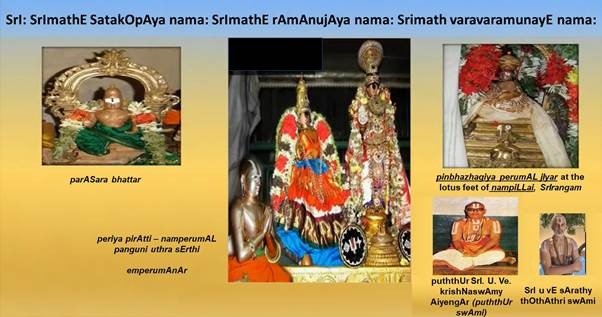
He also bestowed upon us this beautiful grantham called vArthAmAlai. The word ‘vArthai’ means a message or teaching. He compiled many historical events and instructions from the lives of the pUrvAchAryas, stringing them together as a beautiful garland of words, and offered it for our sake. Many of these vArthais expound upon profound subjects such as the meanings of three secrets – thirumanthram, dhvayam, charama SlOkam (rahasya thrayam), artha panchakam, AchArya bhakthi etc. puththUr swAmy (also known as sudharSanar) has beautifully published this work. Additionally, puththUr swAmy has provided a simple explanatory commentary to clarify the difficult and profound meanings within these vArthais which serves as a guiding lamp. We are experiencing these meanings with the help of his commentary.
In this grantham, each vArthai and subject matter may either stand independently or connect to adjoining themes. At various points, the author illuminates artha panchakam, rahasya thrayam, or the thathva thrayam – chith, achith, and ISvara. Given this structure, it is not mandatory to study this grantham in strict linear sequence from beginning to end. While continuous study is beneficial, missing a previous section does not hinder one’s understanding of the present topic. Each vArthai stands as a self-contained teaching with its own explanation, carrying a profound principle of our sampradhAyam.
Forty-third vArthai
vAthsalyAdhi guNa viSishtavasthu – ASrayaNIyam; gyAna SakthyAdhi guNaviSishtavasthu – upAyam; samastha kalyANa guNaviSishtavasthu – bhOgyam; ASrayaNa prathisambandhi – oru mithunam; SEshathva prathisambandhi – oru mithunam; kainkarya prathisambandhi – oru mithunam. pramANam – “nALum nam thiruvudaiyadigaLtham nalankazhal vaNangi” enRum, “thirumAlE! nAnum unakkup pazhavadiyEn” enRum, “adimai seyvar thirumAlukku” enRum.
While the text of this forty-third vArthai is concise, the philosophical truth contained within it is immensely profound. Grasping its full depth is made easier by understanding its foundational concepts.
For example, this vArthai incorporates several key technical terms, including vAthsalyam, guNam, viSishtam, vasthu, and ASrayaNIyam. Familiarity with these terms – as expounded across rahasya granthams such as mumukshuppadi, SrIvachana bhUshaNam, artha panchakam, sAra sangraham, and navarathna mAlai – makes following and understanding this article much easier.
vAthsalyAdhi guNa viSishta vasthu – ASrayaNIyam
In sanskrit, the term vasthu denotes any existing entity – this includes sentient, non-sentient, and the supreme entity, emperumAn. Among these, emperumAn, the supreme entity alone is the ASrayaNIyam, the one whom the AthmA must approach to surrender. The entity who accepts this surrender is the SaraNyan and those who perform surrender are the SaraNAgathas.
For AthmA to actively seek refuge in emperumAn, emperumAn must possess specific qualities that facilitate the surrender. The phrase ‘vAthsalyAdhi guNa viSishta’ indicates that emperumAn, who serves as the sole refuge, is eternally endowed with divine attributes beginning with vAthsalyam. [In our sampradhAyam, emperumAn is seen as both the means and the ultimate goal to be attained and enjoyed].
These are broadly categorized into
- ASrayaNa saukarya ApAdhaka guNas – the qualities that make approaching and surrendering to emperumAn, effortless.
- ASritha kArya ApAdhaka guNas – the qualities belonging to emperumAn as the upAyam that ensure the fulfillment and protection of those who have sought refuge.
The primary qualities that make surrender effortless consist of four – vAthsalyam, swAmithvam, sauSeelyam, and saulabhyam:
- vAthsalyam is motherly affection and forbearance. As seen in mumukshuppadi sUthram 138, ‘kuRRam kaNdu veruvAmai’ means not turning away or being repulsed upon seeing the AthmA’s faults. Having existed in samsAram since time immemorial, the AthmA has accumulated countless errors and sins. vAthsalyam is the divine quality of accepting the AthmA without anger, even regarding the AthmA’s very faults as endearing. This is illustrated by the analogy of a mother cow and her newborn calf; the cow licks away the dirt on the newborn calf, treating that very dirt as enjoyable in order to cleanse her offspring.
- swAmithvam is lordship. It denotes emperumAn’s status as swAmy, the absolute owner who possesses everything as his property – both the spiritual and the material realms, along with all the AthmAs within them. Thus, all the AthmAs have a natural and eternal relationship with the supreme lord and emperumAn, as the natural owner, inherently protects all that which belongs to him. Hence, surrendering to any other entity does not yield the ultimate fruit.
- sauSeelyam is the divine simpliity of emperumAn. The quality whereby emperumAn, despite his supreme greatness, mingles freely with the lowly without any sense of superiority. When a AthmA hesitates to approach, considering emperumAn to be beyond his reach, emperumAn’s sauSeelyam reassures the AthmA that he graciously mixes with all and that there is no barrier.
- saulabhyam means easy accessibility. As shown by piLLai lOkAchAryar in mumukshuppadi sUthram 138, ‘kaNdu paRRugai’, the quality that enables the AthmA to easily behold and hold on to emperumAn.
The supreme entity that is endowed with these four guNas is emperumAn and he stands as the true and ultimate refuge.
gyAna SakthyAdhi guNaviSishtavasthu – upAyam
This explains the qualities known as ‘ASritha kArya ApAdhaka guNas’. These four attributes – gyAnam, Sakthi, prApthi, and pUrthi – are essential for emperumAn to bestow his protection to those who have surrendered unto him:.
- gyAnam refers to emperumAn’s omniscience. emperumAn is all knowing; he knows AthmA’s faults, welfare, and true desires. Therefore, he can lift the AthmA up and rescue the AthmA safely to the shore. One who does not know what the AthmA needs cannot uplift the AthmA. Therefore, possessing gyAnam is essential for emperumAn to serve as the ultimate means.
- Sakthi refers to emperumAn’s omnipotence. Possessing only the knowledge of what is needed without the power to execute the task accomplishes nothing. emperumAn is sarvaSakthan; he possesses the absolute power to achieve everything.
- This next attribute – prApthi is implied from the word Adhi (and others). prApthi means to obtain or attain something. Since emperumAn is the master and AthmA is his property, a natural relationship exists between them. Therefore, he possesses a rightful ownership, by virtue of which he protects the AthmA.
- pUrthi refers to the absolute state of fullness. When emperumAn protects the AthmA, he does not expect anything in return. Only an entity that lacks something will have an expectation. For example, a merchant may look at a customer with the expectation of payment when they buy a kilogram of rice. This is because the merchant needs that money to run his business. However, emperumAn is avAptha samastha kAman, the one whose desires are all eternally fulfilled, meaning there is no deficiency in him. Because of this pUrthi, emperumAn accomplishes the AthmA’s purpose effortlessly and without any expectation. Therefore, when he bestows mOksham or does good to the AthmA, emperumAn has no deficiencies, nor does he depend on or expect anything from the AthmA. Being endowed with absolute pUrthi, emperumAn acts as the upAyam without any expectation.
upAyam refers to that which bestows the fruit, bringing the AthmA to the fruit and granting it directly. That upAyam can only be emperumAn.
Thus, the four qualities, vAthsalyam, swAmithvam, sauSeelyam, and saulabhyam, are necessary for the AthmA to approach and surrender to emperumAn. Once the AthmA has surrendered, the qualities – gyAnam, Sakthi, prApthi, and pUrthi are required for emperumAn to accomplish the AthmA’s protection and goal. And because these attributes – sarvagyathvam, sarvaSakthathvam, prApthi, and pUrthi, reside completely and eternally only in emperumAn, no one other than emperumAn can ever be the upAyam.
samastha kalyANa guNaviSishta vasthu – bhOgyam
After the AthmA performs SaraNAgathi, emperumAn uplifts the AthmA and takes him from the material realm to his supreme abode, paramapadham. The vasthu, or the entity to be enjoyed there – is ‘samastha kalyANa guNa viSishta vasthu’, the one who is endowed with all divine, auspicious qualities.
thaiththirIya upanishadh states “sO’SnuthE sarvAn kAmAn saha“, upon attaining liberation, the mukthAthmA remaining inseparably with emperumAn, he continuously enjoys all the auspicious qualities in union with him. In this upanishadh passage, the word kAmAn establishes that all experiences and boundless bliss of the liberated AthmA are grounded in the enjoyment of emperumAn’s divine attributes; thus, it clearly understood that emperumAn is the abode of all auspicious qualities.
At the very outset, in thiruvAimozhi, nammAzhwAr declares this [1.1.1] “uyarvaRa uyarnalam udaiyavan yavan avan”, describing emperumAn as being endowed with uyarnalam – unexplainable high bliss [the most exalted auspicious qualities that surpass and eclipse all worldly excellences]. In thirvuvAimozhi commentary, it is highlighted that kUraththAzhwAn would often declare that nammAzhwAr, in the opening line itself has established wonderfully that emperumAn possesses all of the supreme auspicious qualities as though grasping the throats of those who claim that emperumAn is formless and devoid of attributes.
Thus, emperumAn is samastha kalyANa guNa viSishta, the dwelling place of all divine auspicious attributes. Such an emperumAn, fully endowed with all auspicious qualities is the bhOgyam, the object of eternal experience and enjoyment.
These sections demonstrate how emperumAn stands when the AthmA approaches to perform SaraNAgathi, how emperumAn acts with specific attributes to fulfill that SaraNAgathi, and how emperumAn is experienced in fullness once the fruit of that surrender is realised.
ASrayaNa prathisambandhi – oru mithunam
When the AthmA approaches emperumAn to perform SaraNAgathi, he exists in union with pirAtti. This union is referred to as a mithunam. perumAL is eternally united with pirAtti. At the time of seeking refuge, pirAtti who remains inseparable from perumAL performs purushakAram to unite the AthmA with emperumAn. As piLLai lOkAchAryar highlights in mumukshuppadi, being united with pirAtti is the inherent nature of emperumAn. Therefore, it is said that prathisambandhi exists as a mithunam [divine couple], when the AthmA approaches to perform ASrayaNam.
SEshathva prathisambandhi – oru mithunam
SEshathvam denotes the state of being a servant. The AthmA is not subservient to nArAyaNan alone; rather, he is subservient to SrIman nArAyaNan, the divine couple together. In thiruvAimozhi 8.1.1, “dhEvimAr AvAr thirumagaL bhUmi Eva maRRamarar AtcheyvAr” nammAzhwAr states that the nithyasUris perform kainkaryam as ordered by emperumAn and his divine consorts SrI dhEvi, bhUmi dhEvi and others. This reveals AthmA’s subservience to emperumAn along with his divine consorts. Therefore, it is said that SEshathva prathisambandhi, to whom the AthmA belongs in eternal servitude, exists as a mithunam [divine couple].
kainkarya prathisambandhi – oru mithunam
The terms ASrayaNam, SEshathvam, and kainkaryam, although they appear identical on the surface, reveal a distinct and essential aspect upon deeper reflection. SEshathvam is the inherent state of being a servant, while kainkaryam is the active expression of that servitude. Therefore, if one claims to be a SEshabhUthan, a servant, but renders no service, the very nature of SEshathvam is lost. For example, a person who renders service in a household takes orders from both the husband and the wife. It would be completely unacceptable if he refused to take orders from the wife, claiming he was appointed by the husband. Similarly, kainkaryam is rendered to emperumAn, who is eternally united with pirAtti. Thus, kainkarya prathisambandhi establishes that service must always be rendered to both perumAL and pirAtti together as a divine couple.
pramANam – “nALum nam thiruvudaiyadigaLtham nalankazhal vaNangi” enRum, “thirumAlE! nAnum unakkup pazhavadiyEn” enRum, “adimaiseyvAr thirumAlukku” enRum
These three pramANams confirm each of the three prathisambandhis [described above].
- ASrayaNa prathisambandhi – thiruvAimozhi 1.3.8 declares, “nALum nam thiruvudai adigaL tham nalam kazhal vaNangi”. In the commentary on the thiruvAimozhi thaniyan “mikka iRai nilaiyum meyyAm uyir nilaiyum“, when explaining the paramAthma svarUpam, nature of the supreme lord, the term ‘thiruvudai adigaL tham’ is significant. adigaL denotes emperumAn SrIman nArAyaNan, and thiruvudai refers to emperumAn being eternally united with thiru – pirAtti. nalam kazhal vaNangi means bowing before the divine thiruvadi of emperumAn. Bowing down represents nama:, which signifies surrender. This mirrors the first line of the dhvaya mahAmanthram, “SrIman nArAyaNa charaNau SaraNam prapadhyE“, where one surrenders at the thiruvadi of nArAyaNa having placed pirAtti at the forefront as the mediator, holding to that thiruvadi as the sole upAyam. Thus, it is understood that ASrayaNam (seeking shelter) is performed to emperumAn who is united with pirAtti.
- SEshathva prathisambandhi – This pramANam is from periyAzhwAr‘s thiruppallANdu 11, “thirumAlE nAnum unakkup pazha adiyEn”. In this pAsuram, periyAzhwAr calls out “thirumAlE!”, addressing emperumAn as SrIman nArAyaNan, the consort of SrI and says that he has been an eternal servitor to emperumAn from time immemorial. This SEshathvam, eternal servitude, is directed specifically to thirumAl, SrIman nArAyaNan. Thus by stating as thirunmAl and not mAl (nArAyaNan), it clearly establishes that SEshathva prathisambandhi is the divine couple.
- kainkarya prathisambandhi – The pramANam is from nammAzhwAr’s thiruvAimozhi 6.5.11, which states, “adimai seyvAr thirumAlukkE” – will become servitors for Sriya:pathi who is sarvESvara. This establishes that those who perform service render it exclusively to thirumAl, who is eternally united with pirAtti.
Summary of the 43rd vArthai
| sambandham (Relationship) | prathisambandhi (Counterpart) | sAram (Essential Principle) | pramANam (Scriptures) |
| ASrayaNam (Surrender / Refuge) | oru mithunam (A divine couple) | When the AthmA approaches to surrender, adoration is offered to emperumAn ever united with pirAtti, who acts as the mediator (purushakAram). | nALum nam thiruvudai adigaL tham nalam kazhal vaNangi (thiruvAimozhi 1.3.8) |
| SEshathvam (Inherent servitude) | oru mithunam (A divine couple) | The AthmA’s eternal constitutional servitude belongs to SrIman nArAyaNan, not to nArAyaNan alone. | thirumAlE nAnum unakkup pazha adiyEn (thiruppallANdu 11) |
| kainkaryam (Active service) | oru mithunam (A divine couple) | All divine service, as the active expression of servitude, is rendered exclusively to the divine couple together. | adimai seyvAr thirumAlukkE (thiruvAimozhi 6.5.11) |
The eternal union of emperumAn with pirAtti is of supreme importance. This vArthai establishes that in seeking refuge (ASrayaNam), in inherent servitude (SEshathvam), and in active devotional service (kainkaryam), the object of relationship is always the divine couple (mithunam), emperumAn in inseparable union with pirAtti.
Forty-fourth vArthai
sarva rakshakathvamum, sarvasmAth parathvamum, Sriya:pathithvamum, sarva SEshithvamum, sarvagyathvamum, sarva Sakthithvamum, samastha kalyANa guNAthmakathvamum, ivai – akArArthangaL; anyaSEshathva nivruththiyum, ananyArha SEshathvamum – ukArArtham; gyAnAnandha lakshaNathvamum, gyAna guNakathvamum, EkarUpathvamum, svayam prakASathvamum ivai – makArArtham. svasvAthanthrya nivruththiyum, svarUpAnurUpamAna upAyamum, upAyaththukku ellai nilamAna athyantha pArathanthryamum, pArathanthrya parAkAshtaiyAna thadhIya SEshathvamum ivai – namaSSabdhArtham; chEthanAchEthanangaLinudaiya nithyathvamum, samUhathvamum, asankyAthathvamum ivai – nAraSabdhArtham; sarvavidha bandhuthvamum, ubhaya vibhUthi nAthathvamum, AdhArathvamum, kAraNathvamum, niyanthruthvamum, ivai – ayanaSabdhArtham; nithyakainkaryam – chathurthyartham.
The 44th vArthai is a complete explanation of thirumanthram.
thirumanthram, dhvaya mahAmanthram, and charama SlOkam together form the rahasya thrayam, which is celebrated as the most significant in our sampradhAyam. It is the traditional path shown by our pUrvAchAryas that one should listen to these rahasyArthams only after undergoing pancha samskAram. Therefore, it is essential that only those who have obtained AchArya sambandham learn these rahasyArthams.
Part 1 (a)
sarva rakshakathvamum, sarvasmAth parathvamum, Sriya:pathithvamum, sarvaSEshithvamum, sarvagyathvamum, sarva Sakthithvamum, samastha kalyANa guNAthmakathvamum, ivai – akArArthangaL
First, the meaning of akAram is explained. thirumanthram is divided into three parts – praNavam, nama:, and nArAyaNAya. praNavam consists of three letters: a, u, and ma. nama: forms the second part. The third word, nArAyaNAya, is divided into three components – nAra, ayana, and Aya. All of these elements are explained here.
sarvarakshakathvamum
emperumAn is denoted by the letter akAram. SAsthram establishes that the letter akAram [the sound ‘a’] denotes only vishNu. bhattar also declares this in ashta SlOkee SlOkam 1, “akArArthO vishNu:”. The meaning contained within akAram describes the true nature of bhagavAn SrIman nArAyaNan.
The first among these is sarva rakshakathvam, which indicates that emperumAn is the protector of all. This is also elaborated in the commentary on thirumanthrArtham in mumukshuppadi. Four primary meanings are shown for akAram – rakshakathvam, SEshithvam, kAraNathvam, and Sriya:pathithvam. In sanskrit, the letter ‘a’ is derived from the root ‘ava rakshaNE’, meaning protection; thus, he who protects everyone is denoted by akAram – namely, SrIman nArAyaNan.
sarvasmAth parathvamum
This conveys that emperumAn is supreme; he is above all and higher than everyone. He alone is the cause of everything and the entity that is the cause is inherently superior to all its effects. That which is the cause of all is the highest thathvam, establishing that emperumAn is supreme above all.
Sriya:pathithvamum
emperumAn is Sriya:pathi, the consort of periya pirAtti, SrI mahAlakshmi thAyAr. This is his foremost identity. As Azhwar mercifully declares in nAnmugan thiruvandhAdhi 53, “thiruvillAth thEvarai thERElmin dhEvu” – since they do not have the grace of SrI mahAlakshmi, they are not dhEvas. Through the connection with pirAtti, emperumAn attains his greatness, and by the connection with emperumAn, pirAtti attains her greatness; thus, they mutually bestow glory upon each other. In this manner, emperumAn is eternally celebrated as Sriya:pathi.
sarva SEshithvamum
sarvaSEshi means being the lord and master of all. SEshi denotes the master, and SEshabhUthan denotes the servant. emperumAn stands as the master of everyone.
sarvagyathvamum
emperumAn is omniscient. SAsthram states that emperumAn perceives – everything that happens – past, present, or future, in both the material and spiritual realm – directly and clearly, as if it were right before his divine eyes.
sarva Sakthithvamum
emperumAn is sarvaSakthan – omnipotent, endowed with the power to perform anything. While lifting the gOvardhana mountain to protect the world may appear astonishing to us, for emperumAn, who creates the universe and protects it within his stomach, lifting a mountain is a simple act. He possesses the absolute power to accomplish whatever he wills.
samastha kalyANa guNAthmakathvamum
emperumAn is the abode and embodiment of all divine, auspicious attributes. These include qualities such as vAthsalyam, swAmithvam, sauSeelyam, Arjavam, and mArdhavam, along with the primary six divine attributes, namely gyAnam, balam, aiSvaryam, veeryam, Sakthi, and thEjas. Possessing these six qualities fully, naturally, and independently without relying on anyone else is the very definition of the term bhagavAn.
ivai – akArArthangaL
These seven are the primary meanings conveyed by the letter akAram. While there are numerous other divine nature and qualities of bhagavAn, these significant principles are highlighted here as the essential meanings of akAram.
Part 1 (b)
anyaSEshathva nivruththiyum, ananyArha SEshathvamum – ukArArtham
In praNavam, there are the three letters a, u, and ma. Two meanings conveyed by the letter ‘u’ are explained here.
anyaSEshathva nivruththiyum
anyaSEshathva nivruththi means that the AthmA is not subservient to anyone else. praNavam is internally structured as a + Aya + u + ma, where the chathurthi (dative) case ending Aya remains hidden. The letter ‘a’ denotes bhagavAn, and Aya signifies servitude unto him. Following this, the letter ‘u’ establishes the meaning of “exclusively unto him” – meaning that the AthmA belongs only to him and to no one else. This is anyaSEshathva nivruththi, where the ukAram effectively removes subservience to any other entity.
ananyArha SEshathvamum
Similarly, the letter ‘u’ establishes ananyArha SEshathvam. The AthmA is fit to be subservient only to bhagavAn and to no one else. The ukAra artham reveals that the individual is a qualified SEshabhUthan – a servant solely to bhagavAn and never to any other entity.
Part 1 (c)
gyAnAnandha lakshaNathvamum, gyAna guNakathvamum, EkarUpathvamum, svayamprakASathvamum ivai – makArArtham
The letter ma (makArArtham) denotes the individual AthmA, jIvAthmA. SAsthram identifies twenty-six thathvams. Among them, twenty-four are achith thathvams (insentient matter). AzhwAr in thiruvAimozhi 10.7.10, reveals as “pongaimpulanum poRiyaindhum karumEndhriyam” twenty-four thathvams as insentient matter. As outlined in “pongaimpulan, poRiyaindhu, karumEndhriyam, aimbUdham, inguyirE piRakiruthi, mAnAngAra manangaL“, these comprise the karmEndhriyams (organs of action), gyAnEndhriyams (sensory organs), aimpulan (subtle elements), pancha bhUthams (five gross elements), and above them manas (the mind), ahankAram (ego), mahAn (intellect), and mUlaprakruthi (primordial matter). Thus, twenty-four thathvams are achith thathvams. Above them is the twenty-fifth thathvam, the jIvAthmA, and the twenty-sixth thathvam is paramAthmA, who is bhagavAn SrIman nArAyaNan. In this context, the letter makAram, the sound ‘m’, specifically denotes the jIvAthmA. In sanskrit, the direct meaning of the letter ‘ma’ signifies one who possesses knowledge, and therefore it denotes the jIvAthmA.
gyAnAnandha lakshaNathvamum
The jIvAthmA has gyAnam (knowledge) and Anandham (bliss) as his defining characteristics. The AthmA is atomic in size and is composed of gyAnam itself, of which Anandham is a modified, experiential state.
gyAna guNakathvamum
The AthmA possesses knowledge as an attribute. The AthmA itself is known as dharmi gyAnam (substantive knowledge), which provides constant self-awareness of one’s own existence.
In addition, the knowledge required to understand how one exists, how one is situated in this world, and what surrounds oneself is known as gyAna guNakam, which exists as an attribute. Having knowledge in science, mathematics, or carpentry exemplifies dharma bhUtha gyAnam. For each individual, this attributive knowledge expands and contracts in varying degrees.
However, dharmi gyAnam remains uniform and is of single nature for all AthmAs.
EkarUpathvamum
While dharma bhUtha gyAnam varies, all AthmAs are uniform and alike in their essential dharmi nature. Though AthmAs are countless in number, their essential nature is identical and unchanging. Just as a manufacturing facility produces countless items strictly adhering to a single uniform standard without variation, all AthmAs – when viewed in their essential nature – possess complete uniformity. This characteristic is referred to as EkarUpathvam.
svayam prakASathvamum
The AthmA is self-luminous, revealing its own existence without needing another entity to comprehend its existence. Unlike an insentient object like a table that cannot know its own existence, the AthmA is inherently conscious of its own being.
It is shown that the jIvAthmA, denoted by makAram, is endowed with all these characteristics.
Part 2
svasvAthanthrya nivryththiyum, svarUpAnurUpamAna upAyamum, upAyaththukku ellai nilamAna athyantha pArathanthryamum, pArathanthrya parAkAshtaiyAna thadhIya SEshathvamum ivai – namaSSabdhArtham
Following praNavam, the second part of thirumanthram is the word nama:
svasvAthanthrya nivruththiyum
In the word nama:, ma: denotes “for myself”, and nama: denotes “not for myself”. This establishes – swaswAthanthrya nivruththi – the complete cessation of independent self-will, affirming that the AthmA does not exist for himself, but exists solely for emperumAn.
svarUpAnurUpamAna upAyamum
The principle that the divine feet of bhagavAn are our sole means, and that bhagavAn himself is our refuge, is revealed in the word nama:. Surrendering at his divine feet and bowing down to him, that itself the upAyam. When a person desires an outcome from someone, he prostrates before that person and makes a request, whereupon the desired result is obtained. In this manner, the word nama: itself serves as the upAyam.
upAyam signifies accepting that emperumAn alone is our sole refuge. This means is entirely harmonious with the swarUpam – inherent nature of the AthmA, and has no contradiction with AthmA’s true nature.
There are various means to attain emperumAn, such as karma yOgam, gyAna yOgam, bhakthi yOgam, chanting the divine names, purushOththama vidhyA, lighting lamps, and stringing flower garlands, etc. However, in all these paths, a subtle trace of independence remains attached, accompanied by the feeling “I am performing this”. Because of this sense of independence, all such means are fit to be abandoned.
In contrast, the means of SaraNAgathi is the realisation and acceptance that emperumAn alone, through his divine feet, is our sole upAyam. That alone is known as SaraNAgathi, and it is explained here as being perfectly suited to the true nature of the AthmA.
upAyaththukku ellai nilamAna athyantha pArathanthryamum
athyantha pArathanthryam is absolute dependence. The boundary limit of the upAyam is this extreme dependence, which means considering emperumAn alone as our sole refuge. For our own protection, we do not undertake any independent effort until emperumAn himself comes and protects us. Importantly, this does not mean that one refrains from performing kainkaryam. Refraining from taking any independent effort to protect oneself, to liberate oneself from this material world, or to secure any benefit for oneself is what is called pArathanthryam. Looking solely toward his hand and awaiting him to take hold of us is athyantha pArathanthryam, and that stands as the ultimate boundary limit of the upAyam.
pArathanthrya parAkAshtaiyAna thadhIya SEshathvamum
The ultimate boundary limit of that pArathanthryam is being subservient to the devotees of emperumAn and looking toward their hands, rather than looking merely toward emperumAn’s hands. That is thadhIya SEshathvam. thadhIya refers to the devotees of emperumAn. thath denotes emperumAn, and thadhIyan denotes one who is subservient to that emperumAn. Remaining subservient toward such devotees who belong to emperumAn is conveyed by the word nama:
ivai – namaSSabdhArtham
In this manner, the four essential meanings within nama: are shown.
Part 3
chEthanAchEthanangaLinudaiya nithyathvamum, samUhathvamum, asankyAthathvamum ivai – nAraSabdhArtham
The third part of thirumanthram begins with the word nAra.
chEthanAchEthanangaLinudaiya nithyathvamum
chEthanas refer to the sentient AthmAs endowed with knowledge, and achEthanas refer to insentient primordial matter and its products devoid of knowledge. ‘chEthanAchEthanangaLinudaiya nithyathvam’ means the eternity of both sentient and insentient entities.
In the word nAra, ra denotes perishable entities, nara denotes imperishable entities, nAra denotes the collection of imperishable entities, and nArA: denotes the multitude of such collections. Such precise divisions exist within the word nArAyaNa, all of which have been explained elaborately in mumukshuppadi.
This phrase signifies that because both sentient and insentient entities are described as imperishable, they are both eternal. As defined by the scriptures, according to our SrIvaishNava viSishtAdhvaita sampradhAyam that is rooted entirely in vEdhAntha, prakruthi is also an imperishable entity and is eternal.
Just as jIvAthmAs are eternal, insentient matter is eternal as well. While SAsthram occasionally refers to them as non-eternal, it does so only because matter undergoes constant transformations, and not because the substance ever ceases to exist completely. prakruthi was never non-existent in the past, nor will it ever cease to exist in the future, thus, establishing prakruthi to be eternal too. In the same way, AthmAs are also eternal, and this eternity of both sentient and insentient entities is conveyed by the word nAra.
samUhathvamum
The word nAra signifies a collection of AthmAs, along with the collection of all other entities. Since nAra refers to imperishable entities, it encompasses both sentient and insentient entities. This has also been explained in detail in mumukshuppadi, where piLLai lOkAchAryar explains, in sUthram 96 – ‘nArangaLAvana – nithyavasthukkaLinudaiya thiraL’ and in suthram 97 – ‘avaiyAvana – gyAna-SakthyAdhigaLum’, identifies the divine consorts, nithyasUris, mukthas, badhdhAthmAs, universes, and dhEvas like brahmA, demonstrating that all these entities are subsumed within the word nAra. samUhathvam denotes existing as a collective assembly, indicating that these entities are manifold and not just a single object.
asankyAthathvamum
The word nAra denotes that these entities are boundless, incalculable, and beyond numerical count. Rather than being restricted to a specific number, they exist in quantities beyond measurement, signifying that they are infinite in number.
ivai – nAraSabdhArtham
These principles constitute the meaning of the word nAra.
Part 4
sarvavidha bandhuthvamum, ubhaya vibhUthi nAthathvamum, AdhArathvamum, kAraNathvamum, niyanthruthvamum, ivai – ayanaSabdhArtham
The word ayana means that bhagavAn is the resting place of all nAras. Two derivations are established for the word nArAyaNa: “nArANAm ayanam ya: sa: nArAyaNa:” – he who has all nAras as his abode and “nArANAm ayanam yasya sa: nArAyaNa:” – he who serves as the abode for all nAras. These explanations can be found in detail in mumukshuppadi.
In this context, the meaning of the word ayana denotes that emperumAn sustains all nAras. His divine nature in this role is revealed through the following attributes:
sarvavidha bandhuthvamum
emperumAn is related to everyone in all possible ways, and by virtue of this relationship, he sustains everyone. The SlOkam explaining the ninefold relationships between the jIvAthmA and paramAthmA as revealed in thirumanthram states that SrIman nArAyaNan is the father, protector, lord, husband, object of knowledge, owner, substratum, super-AthmA and enjoyer of chEthana.
pithAScha rakshaka: SEshI bharthA gyEyO ramApathi: |
swAmyAdhArO mamAthmA cha bhOkthA chApi manUdhitha: ||
Thus, as stated in this SlOkam, emperumAn stands as all types of relatives to all AthmAs.
ubhaya vibhUthi nAthathvamum
ubhaya vibhUthi refers to both vibhUthis – nithya and leelA. Within the nAras, both these realms – spiritual and material are included. emperumAn is the master of both realms. Because he serves as the abode and sustainer for all these nAras, his supreme lordship is clearly established.
AdhArathvamum
He is the sole supporter who sustains everything; the state of emperumAn supporting all entities is AdhArathvam.
kAraNathvamum
emperumAn is the primary cause of everything. In this context, kAraNathvam means that which accounts for the sustained existence of an entity. For instance, if one supports a poor person by meeting all of their monthly expenses, that person remarks that the benefactor is the cause of their livelihood. While the benefactor neither created them nor physically held them up, they are the cause of their sustained existence. Similarly, all entities exist because emperumAn resides within them as the indwelling AthmA. Being the fundamental reason for everyone’s existence, his kAraNathvam is established.
niyanthruthvamum
emperumAn commands, directs, and guides all entities, which is established through the word ayana.
ivai – ayanaSabdhArtham
These principles constitute the meaning of the word ayana.
Part 5
nithya kainkaryam – chathurthyartham
Aya is the dative case ending (chathurthI vibhakthi). It denotes ‘for’ as in – for nArAyaNa. As seen earlier in praNavam (a, u, ma, and with implicit – Aya), where the makAram (jIvAthmA) is subservient to akAram (emperumAn), here too, the AthmAs are subservient to nArAyaNan. [Note: In thamizh, the case markers are enumerated as ai, Al, ku, in, adhu, kaN, and in sanskrit, this fourth case marker (nAngAm vERRumai urubu) is called chathurthI vibhakthi. nArAyaNanukku – the marker ‘ku’ denotes the sense “unto nArAyaNa”].
The word Aya ending the name nArAyaNAya at the conclusion of thirumanthram signifies nithya kainkaryam – rendering eternal service unto emperumAn at all times.
In this manner, the profound meaning of thirumanthram is presented in the forty-fourth vArthai in a precise, gem-like summary.
Forty-fifth vArthai
svarUpam svarUpAntharaththaip poRAdhu; sAdhanam sAdhanAntharaththaip poRAdhu; prayOjanam prayOjanAntharaththaip poRAdhu.
Three essential principles are shown in this vArthai, which serves as an explanation for the three parts of thirumanthram, namely praNavam, nama: and nArAyaNAya.
svarUpam svarUpAntharaththaip poRAdhu
The first principle states that the essential nature of the AthmA does not tolerate any other nature. The true svarUpam of the jIvAthmA is exclusive subservience to emperumAn, he alone is the master, and the AthmA must remain subservient solely to him. If a person maintains subservience to anyone else or considers themselves subservient to another entity, their true essential nature will not tolerate it . This profound meaning is conveyed in praNavam, the first part of thirumanthram. In praNavam, the eternal relationship between akAram (paramAthmA) and makAram (jIvAthmA) is established, showing that the jIvAthmA depends entirely upon the paramAthmA as his exclusive servant. That constitutes the true jIvAthma svarUpam. Therefore, it is shown that this svarUpam rejects any other nature, completely refusing to accept subservience to anyone else.
sAdhanam sAdhanAntharaththaip poRAdhu
The second principle states that the ultimate means does not tolerate any other means. upAyam – the means, is revealed in the word nama:, which establishes that emperumAn alone is our upAyam. When emperumAn himself is the means, he will not tolerate our resorting to any other means. If one holds on to emperumAn while simultaneously asserting that they perform karma yOgam, gyAna yOgam, or chanting the divine names with the expectation of achieving results through these efforts, emperumAn will not accept it. His command is to surrender unto him and place sole trust in him, as emperumAn himself established in the charama SlOkam of SrI bhagavath gIthA 18.66 –
sarvadharmAn parithyajya mAm Ekam SaraNam vraja |
aham thvA sarvapApEbhyO mOkshayishyAmi mA Sucha: ||
emperumAn declared that he will liberate the AthmA from all sins, and that one must surrender unto him alone, placing total trust in him. Thus, the sAdhanam, which is bhagavAn acting as the upAyam, does not tolerate any other means.
prayOjanam prayOjanAntharaththaip poRAdhu
The third principle states that the ultimate goal does not tolerate any other goals. The true prayOjanam (goal), is experiencing emperumAn and rendering service to him purely for his divine pleasure. All other goals are completely incompatible with this true purpose. Service must be rendered to emperumAn solely for the supreme lord’s pleasure, and not for one’s own enjoyment, the pleasure of others in the community, or for the pleasure of other dhEvathAs. The only true prayOjanam is rendering service for the pleasure of emperumAn alone.
Forty-sixth vArthai
bhattarum SrIvaishNavargaLumAgath thiruveedhiyilE ezhundharuLiyirukkach cheydhE, viLaiyAdikkoNdu varugiRa piLLaigaLaip pArththu, “piLLaigaL! thirumanthraththilE pirandhARpOlE ungaLukku iththanai serukken?” enRu aruLich cheydhAr.
This is a brief historical incident that demonstrates the glory of thirumanthram.
While bhattar was walking along the divine streets of SrIrangam accompanied by SrIvaishNavas, including his disciples and followers, he observed some young children playing. Seeing them play with such joy and pride, bhattar wondered why they possessed such great pride and delight. He addressed them, mercifully saying, “piLLaigAL! thirumanthraththilE piRandhARpOlE ungaLukku iththanai serukken?” (Oh, children! Why do you possess such pride, as if you were born into thirumanthram?)
Being “born in thirumanthram” means receiving thirumanthra upadhESam. In our sampradhAyam, SrIvaishNavas approach an AchArya and receive pancha samskAram. After receiving it, all kinds of fear should completely leave us – whether it is fear for life, fear of disease, fear regarding wealth, or fear of death. Since being born into thirumanthram means receiving it as an upadhESam, emperumAn will protect us from that moment on. When emperumAn himself protects us, there is no cause for any fear.
The fact that those who have received thirumanthram are free from fear is evident in many places. In the commentaries, it is described that SrIvaishNavas lie down peacefully with their hands on their chests, looking at the entrance and awaiting the arrival of mruthyu dhEvan (the lord of death). Once pancha samskAram is completed, those endowed with true faith lie peacefully in their homes and joyfully await the arrival of death at their doorstep. They know that as soon as this physical body falls, they will directly reach paramapadham and fully enjoy emperumAn there.
In this world, the human body is described as “poy ninRa gyAnamum pollA ozhukkum azhukkudambum” [thiruviruththam 1] (a dirty body associated with false knowledge and bad conduct), which naturally inspires detachment towards it. Furthermore, considering the troubles caused to us by others through this body – as well as the troubles we may cause to others – one feels it is better to depart from this world. SrIvaishNavas hold this realisation in their hearts with true affection and longing, always anticipating when they will attain paramapadham and when this body will fall.
This state is highlighted here to explain the phrase “thirumanthraththilE piRandhARpOlE ungaLukku iththanai serukken“. Just as the realised SrIvaishNavas remain entirely fearless towards the messengers of yama, knowing that no one could harm them, bhattar wondered why these young children exhibited such absolute pride and carefree joy while playing. This statement was not uttered in condemnation, but out of genuine wonder. Just as one might affectionately ask children playing and making noise in the house what makes them so joyful and cheerful, parASara bhattar addressed them, saying, “piLLaigAL! thirumanthraththilE piRandhARpOlE ungaLukku iththanai serukken?“
Forty-seventh vArthai
thirukkurugaippirAn piLLAn aruLichcheydha vArthai; praNavaththil madhyamAksharaththai Sikshiththu vaiththum rAja dhvArangaLilE nuzhaiyA ninRArgaL; madhyama padhaththai Sikshiththu vaiththum idaivElikkup piNangi ninRArgaL; thruthIya padhaththai Sikshiththu vaiththum thAm thAm bhOkthAkkaLAgAninRArgaL.
thirukkurugaippirAn piLLAn aruLichcheydha vArthai
This forty seventh vArthai is shown as the divine teaching blessed by thirukkurugaippirAn piLLAn.
[Note: In this grantham, when the name of an AchArya, such as thirukkurugaippirAn piLLAn, periyavAchchAn piLLai, or vadakkuth thiruvIdhip piLLai, is explicitly recorded, it indicates that the specific AchArya who delivered it is well-established. Where an AchArya’s name is not explicitly mentioned, it should be understood as a traditional meaning handed down through lineage, preserved and taught by elders from generation to generation.
thirukkurugaippirAn piLLAn was the beloved spiritual son of emperumAnAr. It was through him that emperumAnAr initiated the very first commentary on thiruvAimozhi, known as the 6000-padi, which was followed by many other commentaries on thiruvAimozhi in later times. In the granthams of our pUrvAchAryas, such as SrIvachana bhUshaNam, mumukshuppadi etc., piLLAn’s words are cited in numerous places, showing that he bestowed many such profound instructions].
The meaning of this divine word blessed by thirukkurugaippirAn piLLAn is explained as follows.
praNavaththil madhyamAksharaththai Sikshiththu vaiththum rAja dhvArangaLilE nuzhaiyA ninRArgaL
This shows that true knowledge of one’s essential nature has not fully blossomed in some people.
[Note: After obtaining AchArya sambandham in our sampradhAyam, one must nurture svarUpa gyAnam. That knowledge must be developed by approaching an AchArya, depending on him, listening to and understanding good spiritual truths from him, learning the essential meanings initially, and subsequently sitting before revered elders to understand these principles through kAlakshEpam.
People often assume that they have understood this or that, and that they know a great deal about our sampradhAyam. When studying or listening through kAlakshEpam to a grantham like vArthAmAlai or bhagavath vishayam, out of a hundred points presented, ninety points may be completely unknown. At best, ten points might have been heard here and there, and even ten is an overstatement. When listening to a new kAlakshEpam on bhagavath vishayam, one finds that our AchAryas have compiled and documented the insights of numerous AchAryas within the vyAkyAnams. As one listens continuously to these, one realises the immense depth of knowledge and how little one actually knew.
It is stated in SAsthram that the more one learns, the more one realises how much more remains to be learned. When people know nothing, they assume they know a great deal. However, as one reads progressively and listens to kAlakshEpams, one truly comes to realise that while one previously thought they knew much, the depth of what remains to be learned is vast].
praNavam comprises akAram, ukAram, and makAram. Among these, the middle letter is ukAram. Sikshiththu vaiththum signifies having researched, understood, and learned this meaning thoroughly from revered elders; yet, having done so, they enter the royal gates.
Even while possessing a sound understanding of these meanings, they proceed to the royal courts of kings seeking employment and avenues for income. This is highlighted because ukAram denotes “unto him alone”, signifying that the AthmA exists exclusively for emperumAn and for no one else. Once this meaning is realised, one cannot enter the service of others, nor can the thought arise to work under someone, receive money from them, and lead one’s livelihood through that. When ukAram is truly understood in the heart, such tendencies do not arise. Engaging in such actions indicates that the meaning of ukAram has not been fully grasped.
For this reason, our pUrvAchAryas emphasise that both gyAnam and anushtAnam are essential. Acquiring gyAnam is the initial stage, but it must be carried through into one’s day-to-day conduct. While this may not be accomplished in a single day, as faith in these truths deepens gradually, one must bring about the practical conduct corresponding to that faith.
This state is conveyed here in the phrase “praNavaththil madhyamAksharaththai”, showing that although the letter ukAram reveals that we exist solely for emperumAn, even after learning and knowing this well, people still enter the gates of worldly rulers.
madhyama padhaththai Sikshiththu vaiththum idaivElikkup piNangi ninRArgaL
The middle word of thirumanthram is nama:. The word nama: completely eradicates the sense of “mine”. Within this word, ma: denotes “for myself”, and nama: denotes “not for myself”, thereby establishing that nothing belongs to oneself and that everything belongs to emperumAn.
This detachment is illustrated through the historical account of king janaka and his AchArya. When the other disciples felt that their AchArya showed special affection toward janaka merely because he was an emperor ruling a great empire, the AchArya created a visionary illusion of the capital city mithilA burning in flames. Seeing this, king janaka remained completely calm and unmoving, knowing that nothing truly belonged to him. Simultaneously, when the AchArya made it appear as though the clothes and loinclothes left out to dry by the other disciples were catching fire, they panicked and rushed to rescue their garments. When asked about mithilA burning, janaka stated that he owned nothing in the kingdom as his own personal property.
When one truly understands the middle word nama:, one realises that all possessions belong exclusively to ISvaran. If a person who has studied this truth still enters into quarrels and litigation with neighbors over boundary fences or property partitions, it demonstrates that true faith in the word nama: has not taken root and that their knowledge remains incomplete.
thruthIya padhaththai Sikshiththu vaiththum thAm thAm bhOkthAkkaLAgAninRArgaL
The third word is nArAyaNAya. The meaning of nArAyaNAya is that emperumAn alone is the enjoyer, and the AthmA exists to perform service for his divine pleasure. Yet, owing to conditioning in this material world, even after mastering this truth, people still consider themselves the enjoyers and continuously seek personal sensory gratification.
When svarUpa gyAnam arises, the corresponding anushtAnam must follow. Serving others despite knowing that one is subservient solely to emperumAn, disputing over worldly properties despite knowing that emperumAn is the sole proprietor of everything, and seeking personal pleasure despite knowing that all kainkaryam is meant purely for the joy of emperumAn, represents a state of having knowledge without practical realisation. This principle was revealed in the forty-seventh vArthai.
AzhwAr emperumAnAr jIyar thiruvadigaLE SaraNam
jIyar thiruvadigaLE SaraNam
pinbhazhagarAm perumAL jIyar thiruvadigaLE SaraNam
puththUr swAmi thiruvadigaLE SaraNam
Source:
- Audio – https://1drv.ms/u/s!Art-LqcmUTrFg0GlXlv–u-fZton?e=1PHVvO
- Video – https://youtu.be/GwRPL6a7Yn8
adiyEn gOvindarAja rAmAnuja dhAsan
archived in https://granthams.koyil.org
pramEyam (goal) – https://koyil.org
pramANam (scriptures) – https://granthams.koyil.org
pramAthA (preceptors) – http://acharyas.koyil.org
SrIvaishNava education/kids portal – http://pillai.koyil.org