SrI: SrImathE SatakOpAya nama: SrImathE rAmAnujaya nama: Srimath varavaramunayE nama:
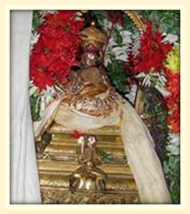
pinbazhagiya perumAL jIyar at the lotus feet of nampiLLai, SrIrangam
The following article is a translation from SrI u vE sArathy thOthAthri swAmy’s thamizh kAlakshEpam on this vArthAmAlai grantham. We are grateful to swAmy for giving us this opportunity and his continuous help in reviewing and publishing these.
pinbazhagiya perumAL jIyar authored vArthAmAlai. He is the beloved disciple of nampiLLai. Just as his authorship of guruparamparA prabhAvam 6000 padi is well known, swAmy has compiled many of our pUrvAchAryas’ words in this vArthAmAlai granthem for our benefit. vArthai means an information or an upadhESam; here, he has strung together many upadhESams to form a mAlai (garland). In this grantham, many sampradhAya and esoteric meanings of thirumanthram, dhvayam, charama SlOkam (rahasya thrayam), thathva thrayam, artha panchakam, etc., are beautifully and extensively explained.
Thirty eighth vArthai
This vArthai is very profound; it is a beautiful explanation of the thirumanthram. This instruction was blessed by periya bhattar (parASara bhattar) to nanjIyar. It has many meanings and has been explained in great detail.
parASara bhattar, in his sthOthra grantham ashta SlOkee, has blessed us with the sanskrit explanations for rahasya thrayam in the form of SlOkams. In fact, this is the very first rahasya grantham written in our sampradhAyam. It consists of four SlOkams for thirumanthram, two for dhvayam, and two for charama SlOkam, totaling eight SlOkams.
The fourth SlOkam is a very beautiful slOkam; it explains how to gain clarity when doubts arise from our understanding of thirumanthram.
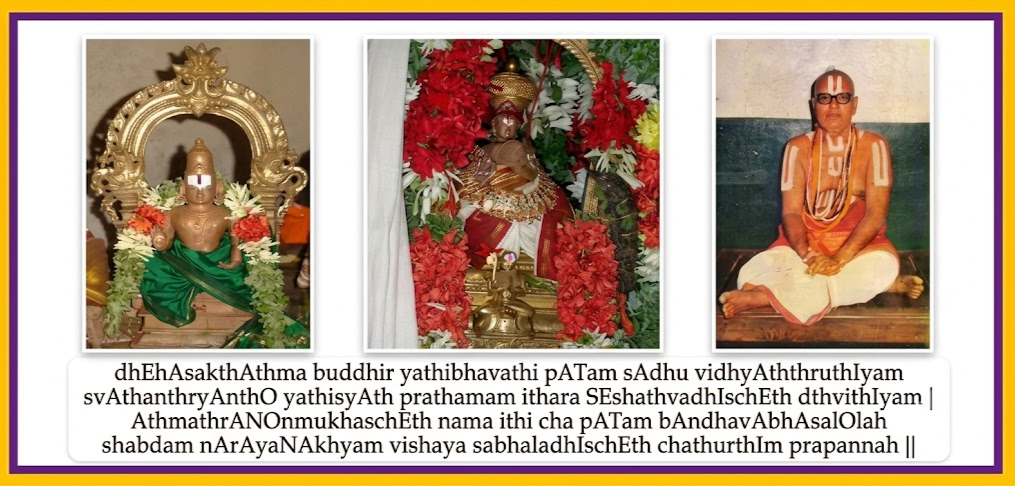
dhEhAsakthAtmabudhdhiryadhi bhavathi padham sAdhu vidhyAth thruthIyam
svAthanthryAndhO yadhi syAth prathamamitharaSEshathvadhIshchEth dhvithIyam |
AthmathrANOn mukhaSchEnnama ithi cha padham bAndhavAbhAsalOla:
Sabdham nArAyaNAkhyam vishayachapaladhISchEdh chathurthIm prapanna: ||
This vArthai is set like a commentary for this SlOkam, in which bhattar explains the kind of confusion that arise in our minds and how they can be removed. Relying on the beautiful commentary blessed by puththUr swAmy, we attempt to understand the inner meanings of many subtle matters.
nanjIyarAna vEdhAnthigaLukkup periyabhattar EkAnthaththilE paNiththa parama rahasyam; thirumanthra gyAnam piRandhAlum ingEyirukkiRavanAgaiyAlE svarUpaththOdE sErAdha dhuritha paramparaigaL vandhu mElittAl, thirumanthiraththil padhangaLin arthangaLai anusandhiththup parihariththu meeLuvAn;
enganE ennil – bahuvirOdhi bIjamAna svAthanthryam mElittAl, “bhagavath parathanthrar allOmO, namakku svAthanthryam kadavadhO?” enRu akArArthaththai anusandhiththu meeLuvAn;
asEvya sEvaigaL vandhu mElittAl, “nAm anyarkku SEshamO bhagavadh ananyArha SEshabhUthar allOmO?” enRu ukAra arthaththai anusandhiththu meeLuvAn.
SarIraththilE kArSyasthUlAdhigaL mElittAl “nAm gyAnAnandha svarUpar allOmO, nithyar allOmO, EkarUpar allOmO, nAm svayamprakASamanRO?” enRu makAra arthaththai anusandhiththu meeLuvAn.
“namakku oru purushArtham sampAdhikka vENdAvO?” enRu sAdhanAnushtAnam paNNath thEdinAl, “svarakshaNaththil prApthiyillAdha bhagavath parathanthrar allOmO, svathanthran anRO rakshaNaththukkuk kadavan” enRu. namassil arthaththai anusandhiththu meeLuvAn.
thanakku upakAramAga ezhundharuLiyirukkiRa archAvathAraththilE sila kuRai vandhu piRandhu kaNNukku vishayamAnAl, chEthananudaiya izhavukku ISvaran bhruSam bhavathi dhukkhithanAmA pOlE, ISvaranudaiya izhavukku dhukkhithanAgAdhapOdhu nArAyaNapadhaththOdu uRavu pOtkanenRu anusandhiththu “para vyUha vibhavAdhigaL engumuLLa kuRaigaL thIrndha idamanRO; onRAloru kuRaivaRRa idamanRO; anubhAvyamellAm nAraSabdhAnthargathamanrO” enRu nArAyaNa padhaththai anusandhiththu meeLuvAn;
svarUpaththOdu sErAdha idhara parimARRangaL mElittAl, “svarUpAnurUpamAna vruththi kainkaryam anrO” enRu chathurthiyil arthaththai anusandhiththu meeLuvAn;
ippadi parihariththukkollAdhapOdhu, ‘piRarkku upadhESikkiRadhukkum, idhil thanakkup piRandha gyAnaththukkum enna prayOjanam uNdu?’ enRu anusandhippAn.
svapaurushaththAlE than kAryam thAn nirvahippadhAga ninaiththAnAgil akAra arthaththai anusandhiththu meeLuvAn; anyarai rakshagarAga ninaiththAnAgil, ukAra arthaththai anusandhiththu meeLuvAn;
sAdhanaththil thanakku anvayam uNdu enRum, SrIvaishNava samabudhdhiyum paNNinAnAgil, namaSSabdha arthaththai anusandhiththu meeLuvAn; ISvara vibhUthibhUtharOdE thanakku rAgadhvEsham nadaiyAdiRRAgil, nAraSabdha arthaththai anusandhiththu meeLuvAn;
aupAdhikabandhukkal pAkkalilE bandhuthva prathipaththi paNNinAnAgil, ayanaSabdha arthaththai anusandhiththu meeLuvAn;
puthra paSvannAdhi thodakkamAga svarga aiSvaryam naduvAga kaivalyam mudivAga uNdAnavaRRil purushArthabudhdhi piRandhadhAgil chathurthiyil arthaththai anusandhiththu meeLuvAn.
Part 1 (Introduction)
nanjIyarAna vEdhAnthigaLukkup periyabhattar EkAnthaththilE paNiththa parama rahasyam
nanjIyar was known as mAdhavAchAryar prior to becoming a disciple to parASara bhattar and accepting the sannyAsASramam. He was celebrated as vEdhAnthi, a great scholar in vEdhAntham; he had many disciples, immense wealth, and resided in thirunArAyaNapuram. parASara bhattar embraced him with great affection, thinking, “Is he not nam jIyar (our jIyar)?” and bestowed him with the revered name nanjIyar.
kUraththAzhwAn had two sons, vEdha vyAsa bhattar and parASara bhattar. parASara bhattar was the eldest and therefore he was called periya bhattar. This vArthai is a supreme secret told in EkAntham, or solitude by periya bhattar.
thirumanthra gyAnam piRandhAlum ingEyirukkiRavanAgaiyAlE svarUpaththOdE sErAdha dhuritha paramparaigaL vandhu mElittAl, thirumanthiraththil padhangaLin arthangaLai anusandhiththup parihariththu meeLuvAn;
[dhuritha paramparaigaL – a chain of sins; anusandhiththu – contemplate]
Even after receiving pancha samskAram and gaining the knowledge of thirumanthram from an AchArya, a succession of sins can overpower a person because of their existence in this samsAram. Our true nature is to be subservient to bhagavAn and to remain content where he places us. When afflictions that conflict with this true nature arise, one should contemplate the meanings of the words in the thirumanthram (praNavam, nama:, nArAyaNAya), clear hos doubts, and regains his true nature.
By thoroughly understanding its meaning and meditating upon them, one dispels those afflictions and frees himself from difficulties.
This is a brief introduction. The aspects and meanings contained in the thirumanthram are highlighted below.
Part 2 (Aspect 1)
enganE ennil
If it is asked, how (will he free himself)?
bahuvirOdhi bIjamAna svAthanthryam mElittAl
bahuvirOdhi – many obstacles; bIjam – seed; svAthanthryam – independence; ahankAram – the ego of doership.
How does one dispel the bewilderment that arises from thoughts of independence – which is the seed for many obstacles – such as “I am my own ruler, I am independent, I have no master”?
[The thirumanthram constitutes three words – praNavam, nama:, and nArAyaNAya. The word praNavam is composed of three sounds – akAram, ukAram, and makAram. By understanding each of these separately, one’s misconceptions can be removed].
“bhagavath parathanthrar allOmO, namakku svAthanthryam kadavadhO?” enRu akArArthaththai anusandhiththu meeLuvAn
akAram is the first letter in praNavam. Although it is a single letter, because it possesses a complete meaning, the SAsthrams refer to it as a word. SAsthram declares “akArArthO vishNu:“- the word akAram signifies bhagavAn vishNu, who is the leader of all.
The meaning of akAram is that SrIman nArAyaNan alone is independent and we are all subservient to him. Contemplating this meaning of akAram – “Are we not subservient to bhagavAn? How then can independence belong to us? Can we even think that we belong to ourselves?” Thus, by constant contemplation of this meaning derived from akAram, one saves oneself from that first misconception [svAthanthryam – the false notion of independence].
Part 3 (Aspect 2)
asEvya sEvaigaL vandhu mElittAl
asEvya sEvaigaL – serving those unfit to be served
When the question ‘Can I render service to those unfit to be served’? arises.
asEvya sEvaigaL vandhu mElittAl, “nAm anyarkku SEshamO bhagavadh ananyArha SEshabhUthar allOmO?” enRu ukAra arthaththai anusandhiththu meeLuvAn
We understand that we are subservient to bhagavAn from the akAram (through the implied suffix ‘Aya’ in nArAyaNAya). However, what gives us the understanding that we are not subservient to others?
The ukAram denotes the restrictive particle Eva, or “to him alone”. That is, our subservience is exclusive to bhagavAn and to no one else. Therefore, when the doubt arises, “Are we subservient to others”? one contemplates the meaning of ukAram – realising ‘We are those who serve bhagavAn alone” – and retreats from serving others. Thus, one remains steadfast in the state of serving bhagavAn and his servitors alone.
Part 4 (Aspect 3)
SarIraththilE kArSyasthUlAdhigaL mElittAl “nAm gyAnAnandha svarUpar allOmO, nithyar allOmO, EkarUpar allOmO, nAm svayamprakASamanRO?” enRu makAra arthaththai anusandhiththu meeLuvAn.
In thirumanthram, praNavam is the first word which is composed of akAram, ukAram, and makAram. By understanding akAram, we realise that we are not independent; by understanding ukAram, we realise that we should exclusively serve only bhagavAn and his servitors. makAram denotes that jIvAthmA possesses knowledge and is distinct from the body.
kArSyaSthUlAdhigaL – physical manifestations
Thoughts focused on the body – such as considering it beautiful, ugly, fat, or thin – should not arise, because we are not the body. It is only when we mistake ourselves for the body that all these irrelevant thoughts arise.
makAram indicates jIvAthmA, revealing that we are inherently of the nature of knowledge and bliss. When the AthmA departs from the body, it becomes clear that the body possesses neither gyAnam nor Anandham. Therefore, jIvAthmA alone possesses gyAnam. By understanding makAram, one realises that gyAnam and Anandham are the very nature of jIvAthmA.
nithyar allOmO – the jIvAthmA is eternal, whereas the body is impermanent. EkarUpam – constant. The body is affected by disease – fever, cold, it changes in size etc. In this manner, the body is not constant. The jIvAthmA, however, is EkarUpam; its nature never changes and always exists with gyAnam and Anandham.
svayamprakASamanRO – jIvAthmA is self-luminous.
The jIvAthmA knows its own existence because the constant thought “I” exists; no one else needs to inform us of our own existence. Thus, the jIvAthmA is svayamprakASam. However, the body is not svayamprakASam. The body does not know itself; we know it, and others perceive it in the presence of light. Therefore, when looking at the body, we can clearly see that it is distinct from the jIvAthmA. As we internalise this meaning from ‘makAram’, the distinction between body and AthmA becomes clear, and we will no longer be agitated or confused by changes occurring to the body.
To summarise – in the praNavam, it becomes known that the jIvAthmA is not independent; he is subservient to bhagavAn and his servitors, and he is not the body, but entirely distinct from it.
Part 5 (Aspect 4)
“namakku oru purushArtham sampAdhikka vENdAvO?” enRu sAdhana anushtAnam paNNath thEdinAl
sAdhanAnushtAnam – performance of an action to accomplish something; purushArtham – the object of pursuit
The jIvAthmA possesses knowledge, by virtue of this knowledge, he gets a desire to perform an action to attain his goals. What is the consequence of attempting to fulfill these desires?
“svarakshaNaththil prApthiyillAdha bhagavath parathanthrar allOmO, svathanthran anRO rakshaNaththukkuk kadavan” enRu. namassil arthaththai anusandhiththu meeLuvAn
svarakshaNam – self-protection; prApthi – eligibility or act of attaining; bhagavath-parathanthrars – totally dependent on bhagavAn
The word nama: means “not mine” – that is, ‘I belong to bhagavAn alone’. Since our existence is solely for bhagavAn, he alone is our protector. Therefore, we have no eligibility or entitlement to protecting ourselves.
That being said, it is clear that we, who are bound in subservience to bhagavAn, are completely dependent on him. The independent one alone is responsible to protect us. The very meaning of nama: demonstrates the truth that bhagavAn alone is independent, while we are his dependents whom he alone must protect. Thus, it reveals our ineligibility to pursue our goal through our own self-efforts.
Thus, karma yOgam, gyAna yOgam, bhakthi yOga, singing the divine names, residing in dhivya dhEsams, and making garlands are all considered actions performed in pursuit of a goal. Since the jIvAthmA is inherently dependent, it does not suite the jIvAthma svarUpam to practice any of these as a means to attain bhagavAn. Instead, we should do all of the above as a service. The moment one thinks, “I am going to attain bhagavAn through my effort,” it conflicts with the true nature of being subservient to bhagavAn. As a dependents, we cannot achieve our goal through self-efforts; this impossibility is demonstrated by the word nama:.
As we constantly contemplate the meaning of nama:, the inclination to engage in other self-efforts will vanish. Instead, we constantly look to bhagavAn’s grace. This, however, does not mean that we will cease to act. We will perform everything, but strictly as a service, without the thought that bhagavAn grants us the rewards because of our actions. All of this must be understood from nama:.
Part 6 (Aspect 5)
Next, the word nArAyaNAya is explained. nArAyaNa refers to emperumAn. Among the different states of emperumAn, the most vital is archAvathAram. Out of his desire to protect all entities, emperumAn resides in our homes, in mutts, in temples, dhivyadhESams, abhimAna sthalams, and in various village temples. This divine state is explained here.
thanakku upakAramAga ezhundharuLiyirukkiRa archAvathAraththilE
In our present state, we cannot experience emperumAn in paramapadham, as it is separated from us by a vast distance. Nor can we experience him in his vyUha state within the milky ocean. We can no longer experience vibhava incarnations like SrI rAma and krishNa, as those times have passed. We also do not possess the yogic vision required to perceive emperumAn as antharyAmi within ourselves.
When we are unable to experience emperumAn in these four states, archAvathAram becomes the only state in which we can truly experience him. archAvathAram serves as the sole accessible representative of the para, vyUha, vibhava, and antharyAmi emperumAn. He exists as archAvathAra emperumAn solely for the benefit of the jIvAthmAs.
sila kuRai vandhu piRandhu kaNNukku vishayamAnAl
SAsthram says that analysing the material composition or quality of archAvathAram is equivalent to analysing one’s mother’s conduct, as piLLai lOkAchAryar cites in SrIvachana bhUshaNam. Yet, if someone evaluates emperumAn’s thirumEni as being made of gold, five metal alloy, or silver, and makes a judgement as superios or inferior based on the type of material, that is a great sin. Similarly, if there is any imperfection on emperumAn’s thirumEni and one views it as defective [as in jagannAtha puri (purushOththama dhAmam) where emperumAn resides in a form accepted out of his own divine desire] – considering these as faults is a great offence. What is the state of such a person who analyses or dwells on such imperfections? [His state is explained below].
chEthananudaiya izhavukku ISvaran
emperumAn grieves regarding the loss of the chEthanan, thinking, “This chEthanan has been lost and suffering in this samsAram since time immemorial; what are we going to do for him?”
bhruSam bhavathi dhukkhithanAmA pOlE
This SlOkam from SrI rAmAyaNam ayOdhyA kANdam 2.42 “vyasanEshu manushyANAm bhruSam bhavathi dhu:khitha:” describes when people face any hardships or calamities SrI rAma feels immensely and profoundly grieved. Though this is cited in rAmavathAram, it should be understood that this is the essential nature of emperumAn. He is the first to rejoice any good that comes to a jIvAthmA, and he grieves more for their sorrows. When sugrIva mahArAja lost vAli, when vibhIshaNAzhwAn lost rAvaNa, perumAL grieved deeply for their loss.
Similary, when there is any deficiency or affliction concerning the jIvAthmA, emperumAn who is of such tender nature, grieves for us.
ISvaranudaiya izhavukku dhukkhithan AgAdhapOdhu
Just as emperumAn grieves for us, we too must grieve ‘Alas! how did I let such a defect happen!’
nArAyaNa padhaththOdu uRavu pOtkanenRu anusandhiththu
We must feel remorse for not having understood the meaning of the word nArAyaNa. We must contemplate and reflect upon it meaning.
para vyUha vibhavAdhigaL engumuLLa kuRaigaL thIrndha idamanRO
Isn’t archAvathAram free of all limitations [such as – limitations of distance, time, and accessibility] which are present in para, vyUha, vibhava, and antharyAmi states!
onRAloru kuRaivaRRa idamanRO
This archA thirumEni is indeed a divine form that is completely free of any defect whatsoever.
“anubhAvyamellAm nAra SabdhAnthargathamanRO” enRu nArAyaNa padhaththai anusandhiththu meeLuvAn
Everything that is to be understood and experienced is contained within the word ‘nAra’. mumukshuppadi explains – all indestructible entities – nithya vibhUthi, leelA vibhUthi, emperumAn’s thirukkalyANa guNams, pirAttimArs, nithyars, and mukthars – are all contained within the word ‘nAra’.
In archAvathAram, emperumAn’s auspicious qualities – his saulabhyam (quality of easy accessibility), sauSeelyam (simplicity), vAthsalyam (motherly forbearance), and svAmithvam (lordship) – shine most brightly. As piLLai lOkAchAryar states in mumukshuppadi sUthram 142, “kaviththa mudiyum, mukamum muRuvalum, AsanapadhmaththilE azhuththina thiruvadigaLumAy niRkiRa nilaiyE namakkuth thanjam” (Meaning: the crown sitting majestically on his head, the alluring face and the enchanting smile, the benevolent feet struck firmly on the seat of lotus, all combining into his poise, is our only refuge). All of these can be experienced while looking at namperumAL. Remembering that all enjoyable qualities reside in archAvathAram, one forgets external shortcomings and refrains from seeing defects in archAvathAram. In this manner, he contemplates the meaning of the word nArAyaNa.
Part 7 (Aspect 6)
Finally, he highlights our performing service to others and our experiencing a divine matter among others.
svarUpaththOdu sErAdha idhara parimARRangaL mElittAl
The only appropriate interactions for a jIvAthmA are – being subservient to bhagavAn, rendering service to him, and having affection for his devotees and serving them.
What must one do in a situation where interactions other than these overpower him?
“svarUpAnurUpamAna vruththi kainkaryam anRO”
Realising that performing kainkaryam to bhagavAn and bhAgavathas alone are activities that naturally allign with our svarUpam.
enRu chathurthiyil arthaththai anusandhiththu meeLuvAn
This is revealed in nArAyaNAya. The syllable Aya is the fourth case ending, that means “for nArAyaNan“. Realising this we remain established in rendering service to SrImannArAyaNan alone. Thus, understanding the meaning of Aya, one refrains from serving others or engaging in worldly interactions incompatible to the true nature.
Thus, the six impediments and the words in thirumanthram that eliminate them by resolving various doubts were highlighted.
Part 8 (Conclusion)
ippadi parihariththuk koLLAdhapOdhu, ‘piRarkku upadhESikkiRadhukkum, idhil thanakkup piRandha gyAnaththukkum enna prayOjanam uNdu?’ enRu anusandhippAn.
If one does not dispel these errors and doubts using these words then there is no purpose in the knowledge born within oneself, nor is there any benefit in instructing them to others.
When confusions arise, we must resolve them using these sacred words. For instance, if we are invited to a worldly pursuit, one must instantly remember that the letter Aya signifies rendering service to perumAL alone. With the knowledge – that it does not suit one’s true nature – one should decline such inappropriate invitations. If possible, one can invite them to spiritual pursuits. Instead, if we simply go along with worldly pursuits, then neither possessing this knowledge or nor instructing others will serve any practical purpose.
Part 9 (Summary)
If we do not resolve these doubts and confusions within ourselves, acquiring knowledge and expounding it to others yields no benefit. Finally, he summarizes and explains this in brief.
[The same point is explained again using different words. Our pUrvAchAryas first explain a topic in detail and then present it concisely so we can verify our understanding and gain complete clarity. They write repeatedly not because they lack clarity, but rather because they are fully established in it and wish to ensure that we too absorb it in a manner leading to practical application].
svapaurushaththAlE than kAryam thAn nirvahippadhAga ninaiththAnAgil
If one thinks that he manages his own affairs through his own efforts out of ego and independence.
akAra arthaththai anusandhiththu meeLuvAn
bhagavAn alone is independent, and all of us are entirely dependent on him – this is the meaning conveyed by the letter “a”. Therefore, there is no such thing as managing our own affairs; our protection is solely emperumAn’s responsibility. We must not perform any action for our own protection.
The actions we perform are only to uphold our true nature, not for self-protection. A true servitor must conduct himself in a specific way such as listening to kAlakshEpams, reciting pAsurams, and rendering services – that is why we perform all these activities and, not as means to protect ourselves.
Therefore, if one thinks that he manages his own affairs through his own efforts, then reflecting upon the meaning of akArAm – bhagavAn vishNu is the supreme ruler and controller of all -makes him step back from attempting to manage his own affairs.
anyarai rakshakarAga ninaiththAnAgil, ukAra arthaththai anusandhiththu meeLuvAn;
anyar, or “Others” include other dhEvathAs, relatives, parents, and even oneself. If one considers others as protectors, he contemplates the meaning of the letter “u” and steps back. The letter u (ukAram) denotes “to bhagavAn alone”; reflecting upon that exclusive dependence, he retreats from viewing others as protectors.
Part 10 (Summary continued)
sAdhanaththil thanakku anvayam uNdu enRum, SrIvaishNava samabudhdhiyum paNNinAnAgil, namaSSabdha arthaththai anusandhiththu meeLuvAn
Considering oneself to be eligible of karma yOgam, gyAna yOgam, or bhakthi yOgam and thinks that he can attain bhagavAn through those means, or if one viewing oneself on a par with other SrIvaishNavas, thinking, “They too look like me and perform similar services as me” – such a mindset must be completely avoided. When looking at all SrIvaishNavas, one must always consider them superior to oneself.
If one engages in other means or views SrIvaishNavas as equals, he then contemplates the meaning of the word nama: and steps back. The word nama: means “I do not belong to myself; I belong strictly to bhagavAn.” Being subservient to bhagavAn is the first stage, but being subservient to his devotees is the ultimate stage. Once the true meaning of nama: is understood, one will never view SrIvaishNavas as equals; instead, one will see every SrIvaishNava as superior, and with this the mindset to render service arises.
Furthermore, nama: when viewed as a single word, signifies SaraNAgathi. This provides complete clarity that SaraNAgathi alone is our means, and no other means exist for us. Thus, if the erroneous thoughts of relying on other means or viewing SrIvaishNavas as equals arise, reflecting upon the word nama: completely dispels those errors, prompting one to correct their actions.
ISvara vibhUthibhUtharOdE thanakku rAgadhvEsham nadaiyAdiRRAgil, nAraSabdha arthaththai anusandhiththu meeLuvAn
The word nAra refers to the assembly of eternal entities. The letter ra signifies perishable entities, nara signifies imperishable entities, nAra signifies the assembly of imperishable entities, and nArA: signifies the vast collection of all such assemblies – this is the immense depth found in the word nArAyaNAya.
When reflecting upon the word nAra, one understands that everything is bhagavAn’s property and his divine realm. whether it is the oceans, forests, mud, bound souls, liberated souls, eternally liberated souls, or the divine consorts – everything belongs solely to emperumAn.
Since everything belongs to perumAL, one entity cannot harbour desire or hatred towards another entity. rAgam means attachment, and dhvEsham means aversion. For example, when two children belong to the same father, both are his offsprings; therefore, there is no place for hatred between them. Similarly, when the entire universe is recognised as bhagavAn’s property, the mindset of liking one person and disliking another cannot exist.
One can harbour attachment or hatred toward entities only if they are distinct and independent. However, when everything is entirely bhagavAn’s property, one cannot show favour to one and harbour aversion towards another. By deeply contemplating the word nAra, one discards the wrongful mindset of selective preference and dislike. Everything is within bhagavAn’s realm and must be cherished as his property. Thus, understanding the true meaning of the word nAra enables one to completely resolve this confusion.
Part 11 (Summary continued)
aupAdhika bandhukkaL pAkkalilE bandhuthA prathipaththi paNNinAnAgil, ayana Sabdha arthaththai anusandhiththu meeLuvAn
In nArAyaNAya, the compound word is split as nAra + ayana = nArAyaNa. The word nAra denotes all indestructible entities as bhagavAn‘s property, while the word ayana indicates that bhagavAn is the resting place supporting all entities and he also resides within everything as antharyAmi.
aupAdhika bandhus, or conditional relatives – parents, siblings, and relatives – are related to us only temporarily by karmam in this particular birth and will change completely in the next birth. Expecting true kinship from those who are connected merely at the physical body level creates confusion and hinders spiritual progress, if they pull us towards worldly matters while we seek involvement in bhagavath-vishayam.
If one holds the impression of kinship towards conditional relatives, he contemplates the meaning of the word ayana and refrains from it. Recognising that bhagavAn alone is our true, eternal relative who supports and sustains us causes one to retreat from worldly attachments and align with our true spiritual nature.
puthra paSvannAdhi thodakkamAga svarga aiSvaryam naduvAga kaivalyam mudivAga uNdAnavaRRil purushArtha budhdhi piRandhadhAgil chathurthiyil arthaththai anusandhiththu meeLuvAn.
The suffix Aya represents the fourth case ending, which declares that we exist exclusively for bhagavAn.
What is demonstrated here is that three levels of pursuits – initial worldly pleasures such as children, livestock, land and wealth; intermediate pleasures like enjoyment in svargam after leaving the physical body; and finally, kaivalyam, which is the eternal self-enjoyment of the AthmA remaining outside of paramapadham. If one misconstrues worldly wealth, svargam or kaivalyam as true goals, one must reflect upon the meaning of the fourth case ending Aya.
Aya reveals that rendering service to bhagavAn alone is the ultimate goal for this jIvAthmA, as established by the SAsthrams. By reflecting upon the meaning of Aya, the wrongful desire for worldly wealth, heaven, or kaivalyam completely falls apart.
Thus, pinbazhagarAm perumAL jIyar beautifully summarises the meanings present in this 38th vArthai. This also serves as a detailed commentary on the fourth verse of ashta SlOkee composed by parASara bhattar, and the esoteric meanings of rahasyArtham which were directly imparted by parASara bhattar to nanjIyar.
Thirty ninth vArthai
“sthrI SUdhrAdhigaLukku thirumanthra pAdaththil adhikAram illai, arthaththilE adhikAram uLLadhu” enRu nampiLLai aruLich cheyya athruptharaip pOlE, thirukkurugUr dhAsar irundhavARE, “ivarkkup purushArtha sidhdhikku uRuppAna arthaththil adhikAram uNdAgil aprayOjakamAna pAdaththil adhikAram illai. Aga iththAl ivarkku varumadhen?” enRu aruLich cheydhAr.
During pancha samskAram, the AchArya instructs the three esoteric truths: thirumanthram, dhvaya mahAmanthram, and charama SlOkam. Elders in our sampradhAyam designate thirumanthram as manthra rahasyam, dhvayam as anushtAna rahasyam, and charama SlOkam as vidhi rahasyam.
The term manthra rahasyam signifies that which liberates the one who meditates upon it in mind and dispels their suffering. The true meaning of manthram is that it grants liberation from suffering and fulfills the desires of those who meditate upon it or chant it as japam. Therefore, it is referred to as manthra rahasyam (thirumanthram / ashtAkshara manthram). dhvaya mahAmanthram involves approaching perumAL’s divine feet as the means through pirAtti as the recommendation authority and praying for service in their divine togetherness for their pleasure. charama SlOkam contains bhagavAn’s direct command SrI bhagavath gIthA 16.66 (vidhi): “sarvadharmAn parithyajya mAm Ekam SaraNam vraja | aham thvA sarvapApEbhyO mOkshayishyAmi mA Sucha: ||” – relinquish all other dharmams, seek me alone as refuge, I shall liberate you from all sins, do not grieve. The statement “do not grieve” is a direct order from emperumAn, meaning SrIvaishNavas should never grieve over anything.
The dhvaya mahAmanthram, is anushtAna rahasyam, which we should constantly recite. As piLLai lOkAchAryar states in SrIvachana bhUshaNam 274: “japthavyam guruparamparaiyum dhvayamum” – what is to be constantly recited is the guruparamparA manthram and dhvaya mahAmanthram.
The guruparamparA manthram sequence recited is:
- asmath gurubhyO nama:
- asmath parama gurubhyO nama:
- asmath sarva gurubhyO nama:
- SrImathE rAmAnujAya nama:
- SrIparAnkuSa dhAsAya nama:
- SrImath yAmunamunayE nama:
- SrIrAmamisrAya nama:
- SrI puNdarIkAkshAya nama:
- SrIman nAthamunayE nama:
- SrImathE SatakOpAya nama:
- SrImathE vishvaksEnAya nama:
- Sriyai nama:
- SrIdharAya nama:
Our elders did not prescribe thirumanthram for repetitive chanting; they highlighted that meditating on it mentally when applying thirumaN, while chanting guruparamparai and dhvayam at all other times. maNavALa mAmunigaL‘s practice is described by erumbiyappA in pUrva dhinacharyai 9: “manthra rathna anusandhAna santhatha sphurithAdharam“—noting that mAmunigaL’s lips were constantly moving in recitation of dhvayam (manthra rathnam). Thus, both the instruction and practice of pUrvAchAryas center on constant recitation of dhvayam, whereas ashtAkshara manthram is meant for understanding its meaning rather than japam.
A question arises regarding scriptural statements that women and those without the sacred thread should not chant the phonetic text of thirumanthram. nampiLLai addresses this by stating that they do not have eligibility in the phonetic chanting, but they have full eligibility in its essential meaning. Everyone is eligible to know the meaning of thirumanthram; no one is barred from understanding what praNavam, nama:, and nArAyaNAya signify. However, vocal chanting of the manthram is restricted to those wearing the yajnOpavItham.
When nampiLLai stated this in a kAlakshEpa gOshti, a SrIvaishNava named thirukkurugUr dhAsar appeared dissatisfied, feeling grief in his heart that swAmy declared women and SUdhras should not chant the thirumanthram received during initiation. Observing his face – for great AchAryas discern a disciple’s doubt simply from facial expressions – nampiLLai stated: “If he has eligibility in the meaning that leads to the attainment of the ultimate goal, he has no need for eligibility in the unserviceable text . Therefore, nothing is lost to him by this restriction”.
purushArtham is not attained through manthra-japam. SAsthram mentions japam and rituals for practitioners wearing the yagyOpavItham, those who adhere to karma, gyAna, or bhakthi yOgam. But for surrender-oriented devotees, essential self-knowledge shines simply by reflecting on the meaning of thirumanthram, while mOksham is granted purely by bhagavAn’s grace through the AchArya connection. Therefore, whether one chants the phonetic text or not is of no consequence.
nampiLLai clarifies that when women and SUddras have full eligibility in the essential meaning that grants purushArtham, phonetic chanting offers no practical benefit to a prapanna. To illustrate this, suppose there is a 100-story building that one cannot climb by stairs anyway. If someone instructs that a person need not climb the staircase, it causes no actual loss or hardship, as the task was not applicable or beneficial to them in the first place. Similarly, since vocal japam of thirumanthram offers no practical benefit to prapannas, being restricted from phonetic chanting causes no loss. Thus, thirukkurugUr dhAsar had no reason to feel grieved.
Ultimately, thirumanthram is meant for understanding its meaning and contemplating it to nourish our intrinsic nature, not for japam. As piLLai lOkAchAryar states in the beginning of mumukshuppadi, upAsakars utilise the words of thirumanthram for japam and hOmams to gain temporary ends, whereas prapannas anchor themselves in its meaning to nourish their svarUpam. Similarly, in the commentary (Idu vyAkhyAnam) on thiruvAimozhi 1.2.10 “eN perukku annalaththu oNporuL IRilavaNpugazh nAraNan thiNkazhal sErE“, nampiLLai highlights that prapannas do not use thirumanthram for japa or hOmams, but attain the goal purely by meditating on its meaning. This is the core instruction conveyed in vArthai 39.
AzhwAr emperumAnAr jIyar thiruvadigaLE SaraNam
jIyar thiruvadigaLE SaraNam
pinbhazhagiya perumAL jIyar thiruvadigaLE SaraNam
puththUr swAmi thiruvadigaLE SaraNam
Source:
- Audio – https://1drv.ms/u/s!AhgMF0lZb6nnhXM2T4SORtavKQlX?e=70MLf7
- Video – https://www.youtube.com/watch?v=qSk-Y1UmsyA
adiyEn govindharAja rAmAnuja dhAsan
archived in https://granthams.koyil.org
pramEyam (goal) – https://koyil.org
pramANam (scriptures) – https://granthams.koyil.org
pramAthA (preceptors) – http://acharyas.koyil.org
SrIvaishNava education/kids portal – http://pillai.koyil.org