SrI: SrImathE SatakOpAya nama: SrImathE rAmAnujAya nama: SrImath varavaramunayE nama:
The extremely merciful periyavAchchAn piLLai has selected important SlOkams from SrI rAmAyaNam and provided us with a vyAkhyAna grantham known as SrI rAmAyaNa thani SlOkam. In this series, we are currently enjoying the section where perumAL bestows his protection upon vibhIshaNa. This portion of the text is also described as abhaya pradhAna sAram.
All of this has been published by puththUr swAmy along with a beautiful thamizh commentary. We are learning the meanings of these SlOkams through these granthams. We express our gratitude to periyavAchchAn piLLai and puththUr swAmy. We also express our gratitude to SrI u vE sArathy thOthAthri swAmy. This article is a translation of periyavAchchAn piLLai’s commentary, summarised with the support of SrI sArathy swAmy’s thamizh kAlakshEpam series.
In the 18th sargam, perumAL begins to speak his divine intention, after thoroughly hearing the perspectives of the monkeys. He says that it is essential to protect the lives of those who have surrendered to us, even at the cost of our own lives. He begins by conveying that vibhIshaNa has arrived as a friend and that he has no intention of abandoning vibhIshaNa for any reason. Furthermore, he states that even if vibhIshaNa has defects and is accepted despite his flaws, this action of accepting the SaraNAgathan with those defects will not be condemned by the wise, good-hearted people. Moreover, he illustrates the stories of the pigeon and the monkey, stating that if he does not provide protection to vibhIshaNa, he will not attain the glory that the pigeon and monkey attained by protecting those who had sought efuge.
periyavAchchAn piLLai, who fully understood the background of each incident, has explained in great detail within his commentary, even the subtle nuances which were explicitly uttered by perumAL.
Immediately as perumAL finishes declaring his intention, sugrIva mahArAja rushes to speak his notions again. His overflowing affection towards perumAL blinds him to the fact that he is actually speaking against perumAL’s wishes.
avathArikai (Introduction)
Upon hearing SrI rAma’s words, sugrIva mahArAja understood perumAL’s true nature through his [SrI rAma’s] own merciful utterances. He then grew fearful, thinking, ‘Oh, what a dangerous act is this!’ and expressed his thoughts through this SlOkam.
sugrIvas thvatha thadhvAkyam AbhAshya cha vimruSya cha I
thatha: Subhatharam vAkyamuvAcha haripungava: II
Word-by-word meaning
atha – thereafter
haripungava: – chief of the monkeys
sugrIva: thu – sugrIva mahArAja, however
thath vAkyam – those words
AbhAshya cha – again, saying (to himself)
vimruSya cha – also analysed
thatha: – compared to that
Subhatharam – very beautiful [auspicious]
vAkyam – words
uvAcha – spoke
Simple meaning
Thereafter, sugrIva mahArAja, however, repeated and analysed those words [uttered by perumAL] to himself. He then spoke words which were very beautiful even when compared to perumAL’s own.
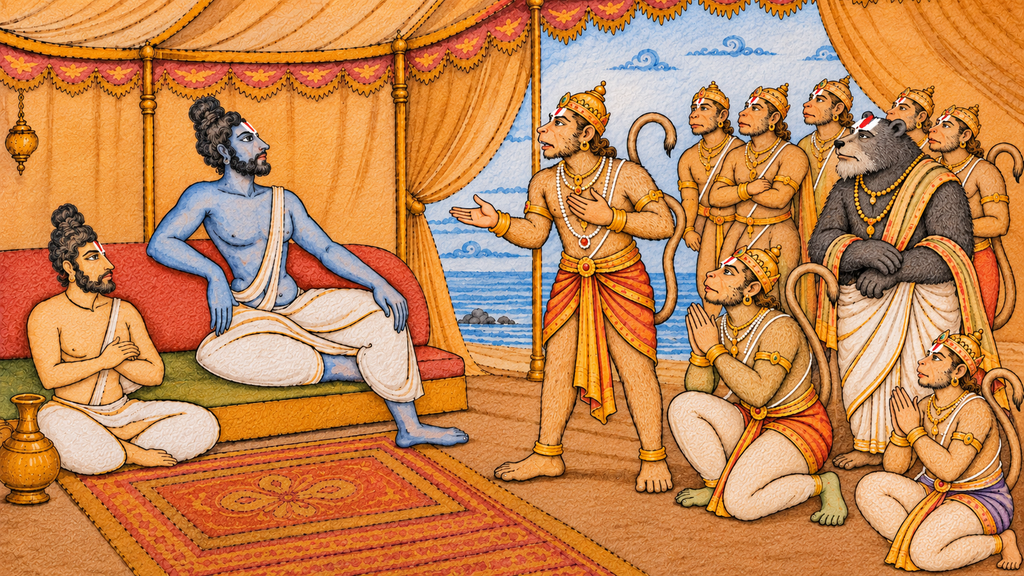
[Note from kAlakshEpam: sugrIva mahArAja’s words are described as beautiful and auspicious because they focused on perumAL’s well-being. Similarly, when perumAL arrived to witness the felicitations being bestowed upon periyAzhwAr by the king, periyAzhwAr expressed immense anxiety. He feared that harm might befall perumAL since he was being seen by people in this dangerous material realm. Hence, out of his abundant affection towards perumAL, he immediately began to sing pallANdu rather than enjoying his own honours. Such are the emotions and behaviour of those with overflowing affection towards perumAL].
Notes from periyavAchchAn piLLai’s vyAkhyAnam
sugrIvas thu ithi – however, sugrIva
thu – however
In the previous sargam [17.4] “chinthayithvA muhUrtham thu”, the word thu conveyed the fear that arose in sugrIva mahArAja’s mind. This fear was mainly because sugrIva mahArAja was certain that vibhIshaNa would certainly harm them, given that he had come directly from their enemy, rAvaNa.
In the 16th SlOkam [17.16] “Ethaththu vachanam SruthvA”, the word thu conveyed the intensifying fear within sugrIva mahArAja. sugrIva mahArAja thought, ‘vibhIshaNa has arrived here after hearing about perumAL’s efforts [such as killing vAli and bestowing the kingdom to me] and knowing very well that rAghava and the monkeys in this assembly are favourable towards those who surrender’. vibhIshaNa not only surrendered but he also sought the recommendation of sugrIva and others to convey his arrival to perumAL. Thus, sugrIva mahArAja’s fear heightened upon realising that vibhIshaNa was not only fully aware of perumAL’s true nature, but he also knew the exact words – ‘I surrender’ – which were highly regarded in their group.
- SrI rAmAyaNam yudhdha kANdam 17-14 “rAghavam SaraNam gatha:” (I surrender to SrI rAma).
- SrI rAmAyaNam yudhdha kANdam 17-15 “nivEdhayatha” (inform him).
Immediately, it became apparent to sugrIva mahArAja, “If these words of vibhIshaNa reach SrI rAma’s divine ears, perumAL will no longer pay heed to our advice!” In this SlOkam, the word thu conveys this sudden realisation that triggered sugrIva mahArAja to stride quickly towards perumAL.
sugrIva mahArAja’s initial thoughts were, ‘perumAL will listen and do everything according to our advice; therefore, we can defeat the enemies by following our plan’. However, after hearing perumAL say, ‘Even if he were to come in the guise of a friend and harm us, we will still support him’, sugrIva mahArAja feared for perumAL’s safety. Out of desperate desire to protect perumAL, he thought, ‘If perumAL is lenient towards vibhIshaNa and has joined hands with him, how can we protect perumAL now from this danger?’ In this context, the word thu, illustrates the heightened anxiety that arose due to this within sugrIva mahArAja.
atha – thereafter, sugrIva mahArAja did not wait for perumAL to finish his sentence. He rushed to speak his perspective without pausing to consider his words. When a master speaks, a subordinate must listen, understand the master’s intent, recognise their own servitorship, and respond carefully and accordingly, after examination. But sugrIva mahArAja did not follow these protocols. Upon hearing SrI rAma say, ‘I will protect vibhIshaNa even at the cost of my own life’, he rushed to speak out of panic over the dangerous predicament, even before perumAL could complete the SlOkam.
thadhvAkyam refers to those words [of perumAL] after which nothing remained to be said. Knowing very well that sugrIva mahArAja’s response would be, ‘He is evil’, SrI rAma said, ‘Let him be evil; I will not abandon him’. Therefore, there was nothing left for sugrIva mahArAja to say in response. Hence, perumAL’s words are glorified here as thadhvAkyam – words which could not be refuted.
AbhAshya cha – repeated those words
sugrIva mahArAja repeated those words to himself, word by word and in their entirety.
vimruSya cha – analysed them
sugrIva mahArAja analysed the significant words. Or, AbhAshya can be interpreted as repetition of the sentence and vimruSya can be interpreted as carefully analysing its meaning.
thatha: Subhatharam vAkyamuvAcha – Then, he spoke these words which were even more auspicious
SrI rAma’s words themselves were auspicious, but sugrIva mahArAja spoke those words which were even more auspicious than those of perumAL. Why are perumAL’s words auspicious? And why are sugrIva mahArAja’s words considered even more highly auspicious here?
perumAL said, ‘It is sufficient if those who surrender unto me merely disguise themselves as a friend, or just have the thought of being my friend. Even if they have faults, I will not abandon them’. These words provide hope for those who seek his shelter. His words are like a tree that provides shade – a shade that bestows life-giving benediction. Hence, perumAL’s words are auspicious.
Nevertheless, the words of sugrIva mahArAja are highly auspicious. This is because, out of his boundless love for perumAL, he said, ‘I will not allow dhEvarIr to fulfil your wishes at the cost of harming your own life.’ Even though these words were objectionable – as they went against perumAL’s divine will – they are still considered highly auspicious because of his pure affection.
hari pungava: – the best among the monkeys
- SrI bhagavath gIthA 9-2 “rAjavidhyA” (best among vidhyA (knowledge/path)).
krishNa tells arjuna, “bhakthi yOga is the best among all paths of knowledge and the greatest of secrets” – this is beautifully reflected in the actions of sugrIva mahArAja here. His respectful plea – that refutes SrI rAma and matches the depth of his anxiety – highlights his superior knowledge [a knowledge focussed primarily on protecting SrI rAma, going above and beyond the words of even perumAL].
sugrIvas thvatha thadhvAkyam AbhAshya cha vimruSya cha I
thatha: Subhatharam vAkyamuvAcha haripungava: II
Thus concludes the vyAkhyAnam for this SlOkam.
SrI rAmAyaNa thani SlOkam – yudhdha kANdam 18.5 – sudhushtO
avathArikai (Introduction)
In this SlOkam, sugrIva mahArAja, thinking that he is bringing forth another defect of vibhIshaNa, speaks of a flaw that SrI rAma had already eliminated.
sudhushtO vApyadhushtO vA kimEsha rajanIchara: I
IdhruSam vyasanam prAptham bhrAthram ya: parithyajEth I
kO nAma sa bhavEth thasya yamEsha na parithyajEth II
Word-by-word meaning
sudhushta: vA – even if he has numerous defects
adhushta: vA – even if he has no defects
ya: Esha rajanIchara: – this rAkshasa, who is active during night
IdhruSam vyasanam prAptham – experiencing this kind of misfortune
bhrAthram – brother
parithyajEth – abandoning completely
(thEna) kim – what is the benefit? (because of him)
Esha – he, who is of that kind
yam – whom
na parithyajEth – will not abandon
sa: – he
thasya – for that vibhIshaNa
kO nAma – of what sort of relative will he be?
Simple meaning
sugrIva mahArAja speaks, ‘Whether he has numerous defects or none at all, how will this rAkshasa be helpful to us, having completely abandoned his own brother – who is experiencing this kind of suffering? A person who is of this nature is sure to abandon anyone. Who can be a relative to vibhIshaNa, given this nature?
Notes from periyavAchchAn piLLai’s vyAkhyAnam
sudhushtO vApyadhushtO vA – whether he is evil or virtuous
Herein, our doubts lie mainly in his qualities. Just as everyone is aware of the cruelty of snakes, his birth as a rAkshasa is already known to us.
- vishNu purANam 5-7-71 “sarpajAthiriyam krUrA” (The species of snakes is inherently cruel).
kimEsha rajanIchara: – what is the use of this rAkshasa?
kimkshEpE – kim means ‘what?’ and kshEpE signifies a remark indicating lowliness, thereby expressing an insult. Rather than posing a question, it implies – What is the use of this rAkshasa?
[perumAL asks] Even if he is a rAkshasa, should we think less of him because of that? He has already expressed his lowliness and surrendered to us. Therefore, he will be a supportive force for us.
IdhruSam – of this kind
This term is used to signify rAvaNa. Because he is a rAkshasa king with abundant wealth, it emphasises that a person “of this kind” is now experiencing suffering.
vyasanam prAptham – one, who is experiencing suffering.
[sugrIva mahArAja says] He is afflicted by his enemies. The burning of lankA, the destruction of his relatives, and our invasion – all of these cause him to suffer.
bhrAthram – brother
The relationship with a brother is such that he must never be abandoned, even if he is not in any kind of distress.
ya: parithyajEth – he who abandoned
[sugrIva mahArAja despises vibhIshaNa’s act] and speaks with contempt, saying, ‘He abandoned his brother without any trace!’ ‘garhAyAm ling’, which denotes contempt, is used here to highlight the scorn. [ling is the grammatical terminology for sanskrit verbs].
[sugrIva mahArAja says] The fact that rAvaNa is his brother is a reason enough for vibhIshaNa to not abandon him. Not only that, rAvaNa is also in great difficulty. How can a person who deserts his own brother in times of trouble ever be helpful to us?
[Previously, the word IdhruSam was used to refer to rAvaNa, this kind of rAvaNa – one who possesses great wealth and pride, one who is in trouble, one who is his brother. Thus, it means vibhIshaNa abandoned a brother of this stature]. Alternate interpretation –
IdhruSam – of this kind, in this context, refers to vyasanam [suffering], this kind of misfortune. It means, vibhIshaNa abandoned rAvaNa, who is in this kind of severe calamity.
- SrI rAmAyaNam sundhara kANdam 38-33 “sa pithrA cha parithyaktha:” (That kAkAsura was abandoned by his father (and mother)).
[sugrIva mahArAja says] dhEvarIr is so merciful that any one can take refuge under your shadow – even those who have been deserted by their parents or who righteously deserve death. But now, dhEvarIr, infuriated, like a snarling tiger, has arrived to invade and destroy rAvaNa. Because of this, rAvaNa has attained this ultimate misfortune – becoming the object of wrath of the protector of all.
[perumAL asks] But since vibhIshaNa has completely severed ties with rAvaNa and approached us, will he not be supportive?
kO nAma ithi – Who will he not abandon?
thasyAsya kO nAma sa bhavEth yamEsha vibhIshaNO na parithyajEth – Could there indeed be anyone that this vibhIshaNa will not abandon?
That person whom this vibhIshaNa does not forsake – how would he be associated with this vibhIshaNa who is a source of disgrace? How would he be related to him? What kind of wealth would he possess? What sort of danger does he face? Such a person simply does not exist.
Those who must not be abandoned can be classified into seven categories. [1] One who possesses wealth [2] One who is in danger [3] One who is a relative. These three cannot be forsaken. [4] One who possesses wealth and is in danger [5] One who is in danger and is a relative [6] One who possesses wealth and is a relative. These three, possessing two-fold reasons for non-abandonment, must not be forsaken under any circumstances. [7] One who possesses wealth, is in danger and is also a relative. This person, possessing all three reasons for non-abandonment, must absolutely never be forsaken.
The words IdhruSam, vyasanam prAptham, and bhrAthram signify rAvaNa’s wealth, his perilous situation, and his relationship to vibhIshaNa. Therefore, rAvaNa belongs to the seventh category – an individual who must absolutely never be abandoned. However, since vibhIshaNa abandoned the one person who should never have been forsaken, and because no eighth category exists, it follows that there is no one in this world whom he will not abandon. Thus, sugrIva mahArAja argues that vibhIshaNa will not be helpful to them, as he has proven himself to be capable of abandoning anyone.
sudhushtO vApyadhushtO vA kimEsha rajanIchara: I
IdhruSam vyasanam prAptham bhrAthram ya: parithyajEth I
kA nAma sa bhavEth thasya yamEsha na parithyajEth II
AzhwAr emperumAnAr jIyar thiruvadigaLE SaraNam
periyavAchchAn piLLai thiruvadigaLE SaraNam
Source – SrI rAmAyaNa thani SlOkam – 81 – yudhdha kANdam 18.4 – sugrIvas thvatha, 18.5 – sudhushtO Audio Video
adiyEn chithrA rAmAnuja dhAsi
Proofreading/Curating done by – kOsalEndhra rAmAnuja dhAsan, krishNan rAmAnuja dhAsan
Artwork – namperumAL rAmAnuja dhAsan
Related Links
SrI rAmAyaNa thani SlOkam – 80 – yudhdha kANdam 18.3 mithra bhAvEna – Part 6 Audio Video
SrI rAmAyaNa thani SlOkam – 79 – yudhdha kANdam 18.3 mithra bhAvEna – Part 5 Audio Video
SrI rAmAyaNa thani SlOkam – 78 – yudhdha kANdam 18.3 mithra bhAvEna – Part 4 Audio Video
SrI rAmAyaNa thani SlOkam – 77 – yudhdha kANdam 18.3 mithra bhAvEna – Part 3 Audio Video
SrI rAmAyaNa thani SlOkam – 76 – yudhdha kANdam 18.3 mithra bhAvEna – Part 2 Audio Video
SrI rAmAyaNa thani SlOkam – 75 – yudhdha kANdam 18.1 – 18.3 mithra bhAvEna – Part 1 Audio Video
SrI rAmAyaNa thani SlOkam – concise english meanings
archived in https://granthams.koyil.org
pramEyam (goal) – https://koyil.org
pramANam (scriptures) – https://granthams.koyil.org
pramAthA (preceptors) – http://acharyas.koyil.org
SrIvaishNava education/kids portal – http://pillai.koyil.org