SrI: SrImathE SatakOpAya nama: SrImathE rAmAnujAya nama: Srimath varavaramunayE nama:
The following article is a translation from SrI u vE sArathy thOthAthri swAmy’s thamizh kAlakshEpam on this vArthAmAlai grantham. We are grateful to swAmy for giving us this opportunity and his continuous help in reviewing and publishing these.
Contextual for the day
In this series on vArthAmAlai, graced by pinbazhagarAm perumAL jIyar, up to the forty-seventh vArthai has been covered. The exposition continues here from the forty-eighth vArthai onwards.
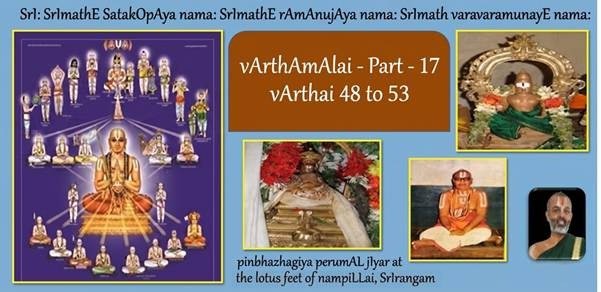
In this vArthAmAlai, pinbazhagarAm perumAL jIyar has highlighted many wonderful principles. These are being enjoyed in sequence. Each vArthai presents a unique perspective – a historical incident, a philosophical principle, or an essential meaning within the sampradhAyam. Concepts like the rahasya thrayam such as the thirumanthram, dhvayam and charama SlOkam, chith (sentient entities), achith (insentient matters), ISvaran, and artha panchakam have been analysed from diverse dimensions, and the interpretations of various pUrvAchAryas have been compiled and presented in this grantham by pinbazhagarAm perumAL jIyar.
pinbazhagarAm perumAL jIyar was an exemplary disciple of nampiLLai. He was a sannyAsi, while nampiLLai was a householder. Nevertheless, possessing boundless devotion towards nampiLLai, he performed all forms of kainkaryams to him. He possessed profound scriptural knowledge. He also bestowed the grantham 6000 padi guru paramparA prabhAvam, where the sacred biographies of our pUrvAchAryas are lucidly expounded. In this grantham, historical records, numerous traditional incidents, and philosophical truths have been brought forth.
Forty-eighth vArthai
Synopsis :
· Explains pArathanthryam, the AthmA’s absolute dependence on emperumAn.
- The jIvAthmA must give up reliance on its own strength and approach emperumAn, the sarvaSakthan, as the sole upAyam.
- After performing SaraNAgathi, one must not regard that act itself as the cause of emperumAn’s grace; emperumAn alone is the upAyam, and even the ability to approach him is due to his grace.
- The AthmA should have an intense urgency to attain the upEyam, namely eternal kainkaryam to emperumAn, without postponing that attainment.
- Thus, pArathanthryam involves both complete dependence on emperumAn as upAyam and an earnest desire for the attainment of the ultimate goal.
AchchAnpiLLaiyai oru SrIvaishNavar “pArathanthryam irukkumpadi en?” enRu kEtka – svaSakthi nivruththi pUrvakamAga sarva Sakthiyai aNdai koNdu, upAyaththil kandhal aRRu, upEyaththil thvarai vinji irukkai – pArathanthryam enRu aruLichcheydhAr.
AchchAnpiLLaiyai
Here, the AchArya indicated as ‘AchchAn piLLai’ is generally understood to refer to periyavAchchAn piLLai. In our sampradhAyam, ‘AchchAn piLLai’ universally denotes periyavAchchAn piLLai.
oru SrIvaishNavar “pArathanthryam irukkumpadi en?” enRu kEtka
Looking at periyavAchchAn piLLai, a SrIvaishNava asked a question – “What is the nature of pArathanthryam (absolute dependence)”?
pArathanthryam means existing in a state of absolute dependence, existing solely for another. Here, the word ‘paran’ refers exclusively to emperumAn. The enquiry concerned the manner in which that state of existing solely for emperumAn manifests, as well as the true nature of that pArathanthryam. To this, periyavAchchAn piLLai graces the response [as below].
svaSakthi nivruththi pUrvakamAga
There are certain actions that can potentially be performed through one’s capability and effort. However, even such actions must not be performed through one’s own initiative. This is because a parathanthran is defined as one who exists awaiting solely the benevolent hand of emperumAn. The notion that something can be attained through self-capacity or personal effort holds no place here. Under such circumstances, this pArathanthryam must necessarily be preceded by the cessation of one’s own efforts. svaSakthi nivruththi means renouncing reliance on one’s own strength, and pUrvakamAga means making that the foremost prerequisite. First, all reliance on personal effort must be completely relinquished. Beyond that –
sarva Sakthiyai aNdai koNdu,
sarvaSakthi refers to emperumAn SrIman nArAyaNan. He alone is capable of accomplishing all deeds and bears the divine name sarvaSakthan, the almighty, which means there is no act beyond his capacity. emperumAn lifted the gOvardhana hill and if one wonders how a mountain could be lifted – it may be impossible for mortals but it is effortlessly possible for that emperumAn. In this manner, emperumAn performs countless wondrous deeds and exists as the sarvaSakthan. sarvaSakthiyai aNdai koNdu means approaching that emperumAn and surrendering unto him, holding onto that emperumAn as the sole refuge and means. In addition to holding him as the upAyam –
upAyaththil kandhal aRRu,
upAyaththil kandhal refers to a defect or taint in the upAyam. That defect is the mistaken notion that emperumAn is bestowing good because the individual has performed SaraNAgathi. Thinking, “emperumAn does good only because one has performed SaraNAgathi” is itself a serious defect because even that upAyam became available solely through his divine grace. SaraNAgathi was performed purely out of his compassion; the act of SaraNAgathi did not create or induce his compassion. That defect concerning the upAyam must be completely cast aside. Renouncing that defect, there must be –
upEyaththil thvarai vinjiyirukkai,
upEyam means the ultimate goal that is to be attained and experienced. While upAyam is the path, upEyam is the goal and fruit to be attained. In that upEyam, in the eternal kainkaryam to be performed unto emperumAn, thvarai (immense urgency) must overflow. thvarai signifies an intense longing to reach and attain that goal with extreme speed. That thvarai must overflow and surpass all bounds. One must pine with restless yearning regarding when emperumAn will be attained. It is for this that the AzhwArs lamented in thiruviruththam – pAsuram 1 “poy ninRa gyAnamum pollA ozhukkum azhukkudambum” (false knowledge – knowledge which considers that which is not self as the self, bad conduct, and the deficient body). This context was highlighted in the commentary on the thiruvAimozhi – thaniyan “mikka iRai nilaiyum” [the true nature of the supreme lord]; while reflecting upon the nature of upAyam, upEyam, and the pala svarUpam (essential nature of the supreme fruit).
pArathanthryam enRu aruLichcheydhAr.
Thus, maintaining an intense and restless yearning to attain the divine lotus feet of emperumAn at the earliest is the essential aspect.
Summary:
Three critical aspects are shown here –
- svaSakthi nivruththi pUrvakamAga sarvaSakthiyai aNdaikoNdu (Renouncing self-reliance and taking refuge in the emperumAn) – First, relinquishing reliance on one’s own capacity, emperumAn must be grasped as the sole upAyam.
- upAyaththil kandhal aRRu (Remaining free from defects regarding the means) – While grasping him as the upAyam, the notion that one’s own act of grasping is the means must never arise. Exalted elders declare: “viduviththu paRRa vaippavanE upAyam” (He who detaches the AthmA from other things and causes it to hold onto him is alone the upAyam). It is emperumAn who causes the AthmA to abandon other pursuits, and it is he who causes the soul to hold fast to him. He alone is the upAyam; neither one’s grasping nor one’s letting go constitutes the upAyam, this is the definitive conclusion of our pUrvAchAryas.
Surrendering unto emperumAn must not be treated as an instrumental means. Regarding the nature of SaraNAgathi, if an inquiry is made whether the SaraNAgathi performed by an individual is the upAyam, it is definitely not; emperumAn alone is the upAyam. For a jIvAthmA who is inherently subservient to emperumAn, SarNAgathi is the natural expression of its innate disposition, designated as adhikAri viSEshaNam, or the defining qualification of the eligible seeker. The pUrvAchAryas have examined this extensively across numerous granthams and established it definitively. SaraNAgathi is not the upAyam; emperumAn alone is the upAyam. What an individual performs as SaraNAgathi is simply what a AthmA subservient to emperumAn naturally does, grasping emperumAn as the sole upAyam as an organic manifestation of its svarUpam.
For example, when an individual is employed in an office, duties are carried out in that workplace. Performing that work does not constitute the upAyam for compensation. Once a position is granted, the individual works in that office, and the salary is disbursed. One cannot demand, “Having worked today, pay the salary,” because the post has already been assigned and the remuneration established. Fulfilling the assigned role is the duty of the employee, and disbursing the salary is the responsibility of the establishment. It exists as a natural relationship. If one asserts, “Work is performed, therefore pay the salary”, the employer could argue that absence of work stops compensation, which does not apply to divine grace. What befits that inherent state of dependence is SaraNAgathi. For one who is an eternal servant to emperumAn, holding onto him alone as the means is designated as adhikAri viSEshaNam.
Being free from taint in the upAyam means never thinking that one’s personal effort is the cause. One must recognise that emperumAn has enabled this hold and that it is granted purely through his causeless compassion.
- upEyaththil thvarai vinji irukkai (an overflowing urgency for the ultimate goal) – Beyond this, in the upEyam, urgency must overflow. An intense longing must exist in that which is to be attained and experienced. The one who thinks, “Let it arrive in due course when I am much older in age, let me live comfortably in this world until a ripe old age, and experience everything before I attain emperumAn”, ignores unforeseen hazards. No one knows what perils may arise in the interim. Whether devotion or faith will remain steadfast in the mind cannot be guaranteed. If that firm conviction is lost, one would be left depending solely on emperumAn’s grace. At that juncture, if faith, spiritual practice, true knowledge, or devotion are entirely absent, how emperumAn will accept the AthmA cannot be definitively assumed. Therefore, while mental clarity and noble thoughts endure, one must intensely yearn to attain emperumAn swiftly. That essential principle is highlighted here.
This concludes the forty-eighth vArthai.
Contextual for the day
The subsequent vArthais are concise, elegant, and easily understood. While certain vArthais are extensive, elaborated with numerous scriptural authorities and pAsurams, the vArthais taken up now are relatively brief.
Forty-ninth vArthai
Synopsis
- Uses the example of gold repeatedly refined in fire to explain the expansion of the AthmA’s contracted knowledge.
- When the contraction of knowledge is removed, the AthmA’s inherent nature as subservient to emperumAn becomes fully manifest.
- In this state, the AthmA is described as being in sAmyam [equality] with the nAchchimArs (divine consorts of bhagavAn), possessing the six qualities known as sAmya-shatkam.
- These six qualities express exclusive servitude, exclusive refuge, exclusive enjoyment of emperumAn, dependence upon him, inability to bear separation from him, and complete subservience to his will.
- This full expansion of knowledge belongs to the mukthas and nithyasUris, whereas its contraction is experienced in samsAra.
ponnaip pudamidap pudamida uruch chiRugi oLi vinji mARRu ezhumApOlE, sankOchamaRRu gyAna vikAsam uNdAnavARE nAchchimArudanE sAmyam sollalAyiRE iruppadhu ivvAthmAvukku enRu thirukkOttiyUr nambi aruLichcheyvar.
enRu thirukkOttiyUr nambi aruLichcheyvar
thirukkOttiyUr nambi was an exalted AchArya of emperumAnAr. The very divine name ‘emperumAnAr’ was conferred upon rAmAnuja by thirukkOttiyUr nambi. To receive the inner meaning of the charama SlOkam from thirukkOttiyUr nambi, bhagavath rAmAnuja journeyed eighteen times to thirukkOttiyUr on foot. While his krupai was not immediately granted, thirukkOttiyUr nambi relented after the eighteenth visit and revealed the sacred meaning of the charama SlOkam. This occurred in the precinct known as theRkAzhvAn sannidhi.
Observing bhagavath rAmAnuja, the foremost leader of the entire sampradhAyam, walking repeatedly across long distances to learn an esoteric truth from thirukkOttiyUr nambi, the local SrIvaishNavas approached rAmAnuja and prayed, “dhEvarIr is walking all these times; if some profound truth is received, please instruct us as well”. rAmAnuja gave his solemn word that he would do so. Popular modern narratives describe him ascending the temple tower and announcing it in a loud manner, however, from the narratives of our pUrvAcharyas we understand that emperumAnAr did not act in that manner.
After thirukkOttiyUr nambi expounded the meaning of the charama SlOkam, rAmAnuja instructed those longing devotees who gathered with sincere desire in the seclusion of the mandapam and explained the sacred meaning imparted by thirukkOttiyUr nambi. Hearing this, thirukkOttiyUr nambi expressed displeasure, questioning why rAmAnuja disclosed it when he had been instructed not to reveal it to others. bhagavath rAmAnuja immediately approached thirukkOttiyUr nambi, prostrated and said, “What adiyEn did may be an error; it may not meet with your divine pleasure. Yet, adiyEn could not restrain their yearning. They possessed immense desire to learn these sacred truths and prayed earnestly. If they remained ignorant of this, it would be their ruin, whereas now they have attained upliftment. Even if this act displeases your divine heart, adiyEn revealed it considering their spiritual need; even if adiyEn is cast into hell for violating instructions, it is acceptable as long as these devotees are saved”.
In our sampradhAyam, gyAnam is held to be of supreme importance. In this history, it was not that learning the charama SlOkam was the sole cause of their liberation, since liberation is attained through connection with an AchArya; rather, knowledge must be acquired and gradually brought to fruition in conduct. With that noble intention, rAmAnuja guided them onto the path of elevation.
Recognising his extraordinary greatness, thirukkOttiyUr nambi conferred upon him the name ‘emperumAnAr’, declaring, “You possess compassion far exceeding even emperumAn; let the name emperumAnAr be yours!” Thus, thirukkOttiyUr nambi was a paramount AchArya who personally travelled to SrIrangam whenever challenges arose to resolve issues and guide bhagavath rAmAnuja.
The profound vArthai graced by such an AchArya is now considered.
ponnaip pudamidap pudamida uruch chiRugi oLi vinji mARRu ezhumApOlE,
When raw gold is repeatedly refined in fire, its volume gradually contracts, its brilliant radiance blazes forth, and its purity and quality continuously rise.
sankOchamaRRu gyAna vikAsam uNdAnavARE
sankOcham signifies contraction, and vikAsam signifies expansion. When gyAnam remains in a contracted state, the comprehension of both worldly affairs and SAsthram remains limited. When gyAnam expands fully, virtuous and noble truths are comprehended with complete clarity. When this gyAna vikAsam takes place, when all sankOcham is dispelled and full vikAsam is attained, the state attained by the AthmA is revealed.
nAchchimArudanE sAmyam sollalAyiRE iruppadhu
The AthmA attains a state where it has sAmyam, a qualitative equality with the nAchchimArs, viz., SrI dhEvi, bhU dhEvi , and neeLA dhEvi, can be spoken off. This principle appears frequently in AzhwArs’ pAsurams. In the pAsuram of thirumangai AzhwAr in periya thirumozhi – 3.7.9, “kadimAmalarp pAvai oppAL” (she who resembles periyap pirAtti who is living in a fragrant lotus flower), sung in the mood of a mother describing her daughter, the daughter is described as equal to periya pirAtti. This is designated as sAmya-shatkam (the sixfold parity). Every AthmA possesses a sAmya-shatkam with pirAtti. This state parity manifests when all gyAna sankOcham is eliminated and gyAna vikAsam happens fully, enabling the AthmA to be described as equal to the nAchichimAr.
All AthmAs are sthrI-prAyam, meaning, fundamentally feminine. The outer physical body may be a manusha (human) – a purusha (a male) or a sthrI (a female), a mruga (animal), dhEva (celestial), or a pakshi (bird), but when viewed from the perspective of AthmA’s svarUpam, the AthmA is eternally subservient to emperumAn. emperumAn alone is the purushOththaman, the supreme male, and all AthmAs are feminine in relation to him. That inherent sthrI-prAyam of the AthmA becomes fully and vividly manifest when the gyAna vikAsam occurs.
puththUr swAmy has highlighted those six attributes –
- ananyArha SEshathvam – Subservience to none other than emperumAn.
- ananya SaraNathvam – Accepting no refuge or upAyam other than emperumAn.
- ananya bhOgyathvam – Relishing solely emperumAn, free from worldly distractions.
- samslEshaththil dharikkaiyum – Sustaining life and thriving only in union with emperumAn, experiencing boundless bliss.
- vislEshaththil dhariyAmaiyum – Experiencing agonising sorrow and inability to sustain existence when separated from him.
- thadhEka nirvAhyathvam – Remaining entirely situated under the divine direction and pleasure of emperumAn.
These sixfold qualities are experienced in SrIvachana bhUshaNam sUthram 239 and AchArya hrudhayam, where it is stated that, “kandhal kazhindhAl sarvarkkum nArINAm uththamaiyudaiya avasthai varakkadavadhAy irukkum.” (When the body is eliminated, every AthmA will acquire the state of the best of women (SrI mahAlakshmi)).
All these qualities belong naturally to pirAtti, and these identical qualities are inherent to all jIvAthmAs, manifesting fully when gyAnam expands. Upon attaining liberation, the nithyasUris and the mukthas exist in qualitative equality with pirAtti in these six dimensions. gyAna sankOcham (contraction of knowledge) lasts only as long as the soul remains in the material realm. Once released from the material realm, the full expansion of knowledge occurs, and all AthmAs abide in that exalted state. This truth is highlighted by thirukkOttiyUr nambi in the forty-ninth vArthai.
The fiftieth vArthai is graced by mudhaliyANdAn.
Fiftieth vArthai
Synopsis
- Uses the example of a dirt-covered ruby whose inherent brilliance becomes visible when the dirt is removed.
- Similarly, the jIvAthmA is naturally characterised by gyAnam and dhAsathvam, but this nature is concealed during its existence in samsAra.
- The veil of agyAnam prevents the AthmA from recognizing its true nature.
- When this concealment is removed, AthmA’s true identity shines forth as “adiyEn” – an eternal servant of emperumAn.
- The rahasya thrayam serves as the sharpening tool that removes this obscuring ignorance and enables AthmA’s intrinsic nature to manifest.
mUlam
azhukkadaindha mANikkaththai nEr sANaiyilE ERittuk kadaindhAl paLapaLakkai vadivAy irukkumApOlE, agyanAna chEthananukku, thirOdhAna nivruththiyilE adiyEn engai vadivAyirukkum enRu mudhaliyANdAn.
enRu mudhaliyANdAn
This is the nirvAham and divine insight of mudhaliyANdAn. The pUrvAchAryas have expressed profound insights in numerous contexts. Worldly opinions expressed casually by individuals hold no spiritual benefit, whereas the words of the pUrvAchAryas and the AzhwArs are in complete accord with the SAsthram and are immensely uplifting.
The meaning revealed by mudhaliyANdAn is now examined.
azhukkadaindha mANikkaththai nEr sANaiyilE ERittuk kadaindhAl.
A ruby covered with accumulated dirt is placed upon a sharpening whetstone and polished. When that ruby is placed on the sharpening whetstone, ground skillfully, and cleansed of its dirt, what happens next is –
paLapaLakkai vadivAyirukkumApOlE.,
It shines with radiant brilliance, and that sparkling luster becomes its very form and manifestation.
agyAniyAna chEthananukku, thirOdhAna nivruththiyilE
In this material realm, the chEthana – sentient entity, exists enveloped in ignorance. thirOdhAnam refers to a veil or screen or screening barrier, which is constituted by this material realm and the physical body. The reason emperumAn cannot be perceived at present is because of the physical body, which conceals the innate knowledge. When that veil is removed, that agyAnam is completely dispelled. Upon the departure of agyAnam, an innate spiritual consciousness awakens within the AthmA.
adiyEn engai vadivAyirukkum
The realisation and declaration, “adiyEn” (I am a humble, eternal servant of emperumAn), becomes an essential form and expression. For this AthmA, ‘adiyEn’ is its very form. vadivu here signifies its true intrinsic manifestation, through which AthmA reveals itself as an adiyEn (a servant of the emperumAn). While knowledge and bliss are foundational attributes of the AthmA, the foremost identifying attribute is the specific awareness, “adiyEn”. That awareness of being ‘adiyEn’ is the true constitutional state of the jIvAthmA.
A common principle to be noted between the ruby and the AthmA is that dirt is not natural to a ruby; brilliance alone is its inherent nature. Similarly, agyAnam is not natural to the jIvAthmA; gyAnam is its natural constitutional state. Due to existence in the material realm, that gyAnam remains concealed and suppressed. The sANai that dispels this agyAnam is the sacred rahasya thrayam, relishing the thirumanthram, dhvaya mahAmanthram, and charama SlOkam repeatedly and mastering their inner purposes, and causes the true nature of the AthmA as a humble servitor to shine forth brilliantly.
This concludes the fiftieth vArthai.
The fifty-first vArthai is graced by vadakkuth thiruvIdhip piLLai. This exact vArthai appears verbatim as a sUthram 77 in SrIvachana bhUshaNam.
Fifty-first vArthai
Synopsis
- Establishes that “adiyAn” is the eternal and imperishable identity of the AthmA.
- The ahankAram that covers this truth is an adventitious obscuring crust, specifically the false notion of svAthanthryam or independence.
- When this crust is removed, the AthmA’s intrinsic dhAsathvam becomes manifest.
- Thus, gyAnam and servitude to emperumAn are intrinsic to the AthmA, while agyAnam and the false notion of independence are incidental and are ultimately removed.
- The vArthai therefore establishes that the AthmA’s true, unalterable identity is that of an adiyAn.
“ahankAramAgiRa Arppaith thudaiththAl AthmAvukku azhiyAdha pEr ‘adiyAn’ enRiRE” enRu vadakkuth thiruvIdhip piLLai.
maNavALa mAmunigaL has provided a sublime commentary on this passage in SrIvachana bhUshaNam, which is summarized here.
ahankAramAgiRa Arppaith thudaiththAl.
Arppu signifies encrusted dirt. When that crust called ahankAram (considering the body to be the soul, considering the AthmA to be independent, here the emphasis is on the thought of being independent) is wiped away, the eternal, imperishable name of the AthmA becomes manifest.
AthmAvukku azhiyAdha pEr ‘adiyAn’ enRiRE.
The eternal, imperishable name of the AthmA is none other than ‘adiyAn’.
While in this material realm, this ahankAram currently exists merely as vandhERi – something that came in between. Describing it as vandhERi does not imply that the AthmA was at some point pristine in the past and that ahankAram entered at a specific chronological date. Because the AthmA has been residing in samsAram time immemorial. The pUrvAchAryas designate it as a vandhERi because whatever is truly intrinsic to the AthmA remains permanently; since this agyAnam and ahankAram are completely discarded upon attaining liberation, it is established as vandhEri rather than intrinsic. When genuine gyAnam dawns and mukthi is attained, this ahankAram and agyAnam are completely dispelled. Because it departs, it is proven to be non-intrinsic. Once mOksha is attained, the AthmA never slips from that state; it abides eternally experiencing emperumAn and rendering continuous kainkaryam. Therefore, gyAnam is natural to the AthmA, while agnyAnam is an extrinsic encrustation.
In his commentary, maNavALa mAmunigaL explains that ahankAram exists in two forms – dhEhAthmAbhimAna (misidentification of body as AthmA) and svAthanthrya (false independence). In this context, it specifically denotes svAthanthryam. While mistaking the dhEham for the AthmA is an expression of agyAnam and ahankAram, the Arppu referred to here is specifically svAthanthryam, the arrogant illusion of being one’s own master.
mAmunigaL clarifies that by using the word Arppu, two characteristics are revealed – its thirOdhAyakathvam (obscuring nature) and its Agandhukathvam (adventitious nature). Just as a thick coating of dirt conceals the existence of a gem beneath it, this crust acts as an obscuring veil. And because it is eventually removed, it is proven to be Agandhukathvam / vandhERi. mAmunigaL cites pramANams (scriptural authorities) establishing that dAsathvam (servitude to the emperumAn) is the “dhAsabhUthA: svathassarvE” (intrinsic nature of all souls). dhAsathvam to emperumAn is the eternal constitutional nature of the AthmA. When the crust of ahankAram and svAthanthryam is cleansed away, the permanent, unalterable name of the AthmA is realised as ‘adiyAn’.
enRu vadakkuth thiruvIdhip piLLai
This is revealed by vadakkuth thiruvIdhip piLLai, who was the revered father of piLLai lOkAchAryar, an exemplary disciple of nampiLLai, and the exalted AchArya who documented the monumental Idu 36,000-padi vyAkhyanam.
This concludes the fifty-first vArthai.
The fifty-second vArthai is an extensive exposition analysing how esoteric truths are systematically embedded within the thirumanthram, charama SlOkam, and dhvayam.
Fifty-second vArthai
Synopsis
- Explains how the essential truths are revealed through the thirumanthram, charama SlOkam and dhvaya mahAmanthram.
- The thirumanthram establishes the fundamental relationship between emperumAn and the AthmA, emperumAn as the Lord and the AthmA as his exclusive possession and servant.
- The charama SlOkam establishes emperumAn alone as the upAyam.
- The dhvayam reveals the upEyam as kainkaryam rendered for the delight of the divine couple, with the purushakAram of pirAtti.
- The three rahasyams also provide distinct modes of contemplation –
- thirumanthram – emperumAn’s thiruvabhishEkam / kirIdam [the divine crown]
- charama SlOkam – his sErththi with the nAchchimArs [union with the divine consorts].
- dhvayam – his thiruvadigaL [the divine feet].
- Thus, the three rahasyams reveal complementary aspects of the AthmA’s svarUpam, upAyam and upEyam.
This vArthai is contemplated in distinct parts.
Part 1
uthpaththiyaiyum, udaimaiyaiyum, udaimaikkuNdAna URRaththaiyum, udaimaikku udaimai illAmaiyaiyum, uthpaththiyAna(vaigaLai?) udaiyavanudaiya uyarnilaiyaiyum, udaimaikkum udaiyavanukkum uNdAna uRavaiyum sollugiRadhu – thirumanthram
This vArthai first demonstrates the truths contained within the thirumanthram, followed by the truths contained within charama SlOkam, and subsequently the meanings expounded in the dhvaya mahAmanthram. These meanings are extensively shown in granthams such as mumukshuppadi, Sriya:pathippadi, across earlier sections of vArthAmalai etc.,
The meanings revealed by the thirumanthram are explained first:
The thirumanthram consists of three divisions: praNavam, nama:, and nArAyaNAya.
- uthpaththiyaiyum
Within praNavam, the syllable akAram represents emperumAn, establishing that he is the universal cause of everything, and it is that kAraNathvam (causality) which is designated here as uthpaththi (origination). Because emperumAn is the kAraNan, all entities originate from him. This does not mean emperumAn creates entities afresh; rather, he retains everything within his SarIram – form. All of this takes place only within this samsAram. During cosmic creation, he grants physical body anew to all AthmAs, and during dissolution, he transforms everything into a subtle state and preserves them within his form.
- udaimaiyaiyum
udaimai (the possession) denotes the jIvAthmA. The jIvAthmA is an entity that arises from emperumAn and is sustained by him; udaimai here signifies the property of emperumAn. This is revealed by the syllable makAram.
- udaimaikkuNdAna URRaththaiyum
URRam signifies that the AthmA belongs exclusively to him and to no one else. URRam can be understood as a profound connection or deep attachment, the enduring bond belonging to this property. If one considers whether the AthmA exists as the property of anyone else, it is definitively not; it is solely the property of emperumAn which is revealed by the middle syllable ukAram. ukAram indicates this ananyArha SEshathvam, demonstrating that the AthmA belongs to none other. Thus, within praNavam, emperumAn and the jIvAthmA are revealed; here, the jIvAthmA does not denote merely a single AthmA, but countless jIvAthmAs, all of whom exist as eternal servants exclusively unto him.
- udaimaikku udaimaiyillAmaiyaiyum
The word nama: reveals that this jIvAthmA possesses no independent property of its own. “ma:” signifies “mine”, and “nama:” negates it signifying “not mine”; meaning that the soul does not exist for itself, has nothing for its own sake, but exists solely for emperumAn. This realisation is derived directly from the word nama:
- uthpaththiyAna(vaigaLai?) udaiyavanudaiya uyarnilaiyaiyum
The uyarnilai – the supreme status of the master is revealed by the word nAra in nArAyaNAya. nAra indicates that emperumAn is the substratum of all entities and abides pervading within all of them as the antharyAmi (one who resides within). It further encompasses his boundless auspicious attributes and his supreme glory.
- udaimaikkum udaiyavanukkum uNdAna uRavaiyum
The uRavu – the relationship between the owner and the property is revealed by the word ‘ayana’. nArAyaNa conveys two fundamental purports through its compound structure: he is the abode of all entities (nArANAm ayanam ya: sa:), and all entities serve as his abode (nArA: ayanam yasya sa:). This demonstrates two essential facets of emperumAn: his supremacy as one who sustains everyone and his simplicity and ease of accessibility by antharyAmithvam. It likewise signifies the AdhAra-AdhEya bhAvam (relation of supporter and supported), and the SarIra-SarIri bhAvam (relation of body and soul). These dimensions are articulated by the thirumanthram.
Part 2
dharmaththaiyum, dharmaththil kaLaiyaRuppaiyum, kaNNanaiyum, kaNNan karuththaiyum, gathiyaiyum, paRRumpadiyaiyum, paranaiyum, paRRumavanaiyum, pApaththaiyum, pApaththil paRRaRugaiyaiyum sollugiRadhu – charama SlOkam.
The meanings expounded by the charama SlOkam are now detailed, mirroring the explanations in piLLai lOkAchAryar’s mumukshuppadi. Across each sUthram and vArthai, the pUrvAchAryas examine and analyse the rahasya thrayam from multifaceted angles, inspiring deep wonder at the profound depth of wisdom contained within these sacred truths.
- dharmaththaiyum
dharmaththaiyum (dharma itself) is revealed by the phrase sarva-dharmAn (all dharmas). emperumAn commands, “Relinquishing all dharmas, grasp me alone”; within this injunction, sarvadharmAn signifies all those diverse ritualistic and spiritual dharmas.
- dharmaththil kaLaiyaRuppaiyum
dharmathithil kaLaiyaRuppu means ‘weeding out of dharma’, which is revealed by parithyajya – completely renouncing. In this context, all other independent disciplines and upAyams resemble weeds. The essential purport is that having eradicated all of them, one must hold fast solely unto the divine lotus feet of emperumAn. Thus, sarvadharmAn denotes all such dharmas, while parithyajya signifies removal of weeds. When seedlings are planted in an agricultural field, weeds inevitably crop up alongside them and must be plucked out. Similarly, prior to surrendering unto emperumAn, all other means that linger alongside like weeds must be discarded and cast far away. Only then does holding onto emperumAn bear its true spiritual fruit; hence, they are identified as weeds, and their renunciation is termed the dharmaththil kaLaiyaRuppaiyum.
- kaNNanaiyum
kaNNanaiyum (krishNa himself) is revealed by the word mAm. emperumAn declares, “mAm” (unto me); in this context, it points directly to emperumAn krishNa who stood visibly manifest before arjuna.
- kaNNan karuththaiyum
‘kaNNan karuththu’ means ‘the inner intention of krishNa’; this is revealed by the word ‘Ekam’. When taking refuge in this upAyam, one must completely abandon the notion that one’s own act of grasping is the upAyam. As highlighted earlier, emperumAn is himself the sole upAyam, as indicated by mAm, and the qualifying term Ekam emphasises that he alone is the means. Thus, precluding one’s surrender from being viewed as an instrumental cause. This divine disposition of the emperumAn is what constitutes ‘kaNNan karuththu’.
- gathiyaiyum
The term gadhi, or path, is conveyed by SaraNam. In the injunction ‘mAmEkam SaraNam vraja’, SaraNam signifies the upAyam – true path. Here, gathi must be understood as the sole means, establishing that emperumAn alone is the upAyam.
- paRRaRumpadiyaiyum
paRRaRumpadiyaiyum – the manner of grasping that means, is indicated by the verb ‘vraja’. It demonstrates how one should embrace and hold onto this supreme upAyam through mental resolve and acceptance.
The declaration sarvadharmAn parithyajya mAmEkam SaraNam vraja constitutes this first half and opening line of the charama SlOkam.
Beyond this, the second line of the charama SlOkam is expounded: aham thvA sarvapApEbhyO mOkshayishyAmi mA Sucha:
- paranaiyum
Within this, paranaiyum – the Supreme Lord is indicated by aham (I). paran signifies emperumAn, sarvESvaran, SrIman nArAyaNan, who stood directly manifest before arjuna as emperumAn krishNa. Through the first-person declaration aham, he reveals himself as the all-powerful.
- paRRumavanaiyum
paRRumavanaiyum – the one who seeks refuge is revealed by the word ‘thvA’ (you). In this immediate context, it denotes arjuna as the seeker of refuge, while universally representing all chEthanas who perform SaraNAgathi unto the emperumAn.
- pApaththaiyum
pApaththaiyum (the impediment of sins) is indicated by ‘sarva pApEbhyO’. The phrase sarva pApEbhyO encompasses all sins and obstacles without exception, pointing to the entirety of accumulated karmic bondage.
- pApaththil paRRaRugaiyaiyum
pAbhaththil paRRaRugaiyaiyum (complete severance of all sins) is revealed by the word mOkshayishyAmi. emperumAn declares his divine resolve to liberate the AthmA from all sins and bonds of karma. Concluding with the assurance mA Sucha: (grieve not), he commands that one should no longer experience sorrow.
Thus, the charama SlOkam reveals the complete severance of sins and dispels all grief. It is these fundamental truths that are systematically expounded by the charama SlOkam.
Part 3
periya pirAttiyAraiyum, perumALaiyum, ivargaLukkup pirivillAmaiyaiyum, perumALudaiya poruLaiyum, aruL surakkum thiruvadiyaiyum, thiruvadigaL SaraNAmpadiyaiyum, araNAm thiruvadigaLai adaiyumpadiyaiyum, adaindhAr anubhavaththaiyum, aruLudaiyavan Akkaththaiyum, anubhavaththil ugappaiyum, anubhavaththil azhukkaRukkaiyaiyum sollugiRadhu – dhvayam.
The esoteric meanings embedded within the dhvaya mahAmanthram (SrIman nArAyaNa charaNau SaraNam prapadhyE, SrImathE nArAyaNAya nama:) are expounded part by part –
- periya pirAttiyAraiyum
SrI mahAlakshmI is revealed by the syllable ‘SrI’ in SrIman.
- perumALaiyum
emperumAn is revealed by the divine name nArAyaNa in the first sentence.
- ivargaLukkup pirivillAmaiyaiyum
Their eternal, inseparable union is revealed by the possessive suffix ‘math’ (SrI + math becomes SrIman), signifying that perumAL and pirAtti never separate from each other under any circumstance.
- perumALudaiya poruLaiyum
The divine possession and wealth of emperumAn are revealed through the words SrIman nArAyaNa charaNau. The divine lotus feet of perumAL constitute his own personal possession. In this phrase, nArAyaNa is split as nAra and ayana. The expression perumALudaiya poruL (the possession of perumAL) refers to the word nAra, which encompasses the wondrous, countless kalyANa guNams (divine attributes) belonging to emperumAn.
- aruL surakkum thiruvadiyaiyum
His grace-showering thiruvadigaL (the divine lotus feet) are indicated by the dual noun charaNau.
- thiruvadigaL SaraNAmpadiyaiyum
That his two thiruvadigaL serve as the sole upAyam (refuge) is revealed by the term SaraNam.
- araNAm thiruvadigaLai adaiyumpadiyaiyum
The manner of approaching and grasping those protective thiruvadigaL is revealed by the verb prapadhyE (I seek refuge).
- adaindhAr anubhavaththaiyum
The uninterrupted anubhavam (blissful experience) of those who attain him is revealed by the word SrImathE, indicating the AthmAs’s enjoyment of the united divine couple, in togetherness.
- aruLudaiyavan Akkaththaiyum
The Akkam (sovereign glory) of the majesty of the merciful emperumAn is revealed by the word nArAyaNa in the second sentence. His supreme glories encompass divine attributes such as vAthsalyam – unconditional motherly affection and SEshithvam – supreme lordship, along with countless other auspicious qualities. Foremost among these is his SEshithvam, his essential nature as the ultimate master, and it is that exalted glory which is revealed here.
- anubhavaththil ugappaiyum
The delight arising from blissful experience is revealed by the dative fourth-case suffix – Aya (nArAyaNAya). When rendering kainkaryam unto him, that service is performed exclusively for emperumAn’s pleasure, generating boundless joy within him.
- anubhavaththil azhukkaRukkaiyaiyum
The complete elimination of any selfish taint in that experience is revealed by the concluding word nama:. The word nama: here carries a distinct purport from the nama: in the thirumanthram. While rendering kainkaryam, the resulting pleasure must belong entirely to emperumAn and never be appropriated for oneself, directly reflecting the earnest prayer of ANdAL nAchchiyAr: in thiruppAvai – 29, “maRRai nam kAmangaL mARRu” (dispel all other selfish desires).
These profound purports are comprehensively established by the dhvaya mahAmanthram.
Part 4
thirumanthraththAlE – thiruvabhishEkaththai anusandhippAn; charamaSlOkaththAlE – thirumArbil nAchchimArOttaich sErththiyai anusandhippAn; dhvayaththAlE – thiruvadigaLai anusandhippAn.
A sublime truth is highlighted here regarding meditation and contemplation –
- Through the thirumanthram, one contemplates the thiruvabhishEkam or the divine supreme crown of emperumAn. Because the thirumanthram proclaims him as the sovereign lord of all, the thiruvabhishEkam adorning his thirumudi (sacred head) naturally comes to mind for continuous contemplation. Just as a universal emperor wears an exalted diadem, emperumAn, being the lord of all, wears this thiruvabhishEkam.
- Through the charama SlOkam, one contemplates the inseparable presence of the divine consorts upon his divine chest. When declaring “sarvadharmAn parithyajya mAm Ekam SaraNam vraja”, emperumAn pointed directly to his divine chest where pirAtti resides eternally, to perform SarNAgathi. Hence, upon reciting the charama SlOkam, one continually remembers that inseparable presence of the divine consorts upon his divine chest.
- Through the dhvayam, one contemplates his divine feet, as the manthram explicitly invokes “SrIman nArAyaNa charaNau SaraNam prapadhyE”, establishing that his divine feet alone must be grasped as the sole upAyam; therefore, one abides contemplating those divine feet.
Thus, the thirumanthram brings to mind emperumAn’s divine supreme crown, the charama SlOkam brings to mind the eternal presence of the divine consorts upon his divine chest, and dhvayam brings to mind his divine feet. This concludes the fifty-second vArthai.
The fifty-third vArthai explains how the artha panchakam are expounded across the rahasya thrayam.
Fifty-third vArthai
- Explains how the artha panchakam is revealed through the rahasya thrayam (thirumanthram, charama SlOkam and dhvaya mahAmanthram.)
- paramAthma svarUpam — the nature of emperumAn
- jIvAthma svarUpam — the nature of the AthmA
- upAya svarUpam — the nature of the means
- virOdhi svarUpam — the obstacles
- pala / purushArtha svarUpam — the ultimate goal
- thirumanthram expounds the svarUpam, reveals ultimate servitude to devotees, and cherished by SAsthrams.
- charama SlOkam establishes the upAyam appropriate to the AthmA’s svarUpam, reveals the emperumAn alone as the saviour, cherished by emperumAn.
- dhvayam is the mode of contemplation for one who has developed firm desire and faith in the svarUpam and upAyam. It reveals the service to the divine couple, as cherished by AchAryas.
- The three rahasyams are further characterised as:
- thirumanthram — prApya pradhAnam
- charama SlOkam — prApaka pradhAnam
- dhvayam — purushakAra pradhAnam
- Thus, the vArthai brings together the essential truths of the artha panchakam through the rahasya thrayam.
This vArthai is expounded and examined in parts.
arthapanchakamum rahasyathrayaththil sollugiRapadi enganE ennil
The artha panchakam comprises five fundamental truths:
– paramAthma svarUpam (nature of the emperumAn),
– jIvAthma svarUpam (nature of the individual AthmA),
– upAya svarUpam (nature of the means),
– virOdhi svarUpam (nature of the obstacles), and
– pala svarUpam / purushArtha svarUpam (nature of the ultimate goal).
How these five truths are detailed across the rahasya thrayam is now set forth.
thirumanthraththil – nArAyaNa padhaththAlE – paramAthma svarUpam solliRRu; praNavaththAlE – Athma svarUpam solliRRu; chathurthiyAlE – purushArtha svarUpam solliRRu; “nama:” enRu – upAya svarUpam solliRRu; namaS Sabdhaththil shashtyanthamAna makAraththAlE – virOdhi svarUpam solliRRu.
He explains how the arthapanchakam is stated in thirumanthram.
- nArAyaNa padhaththAlE – paramAthma svarUpam solliRRu
Revealed by the divine name nArAyaNa. The thirumanthram comprises the praNavam, nama:, and nArAyaNAya. Among these, the word nArAyaNa expounds the paramAthma svarUpam – he serves as the ayanam – resting abode of all nArams – entities, and he abides pervading within all nArams as their inner controller. In this manner, paramAthma svarUpam is stated by the word nArAyaNa.
- praNavaththAlE – Athma svarUpam solliRRu
Revealed by the praNavam. In the praNavam, the jIvAthmA denoted by makAram is subservient to emperumAn denoted by akAram. The primary intent of the praNavam is the jIvAthmA being subservient to emperumAn; hence, Athma svarUpam is stated by the praNavam.
- chathurthiyAlE – purushArtha svarUpam solliRRu
Revealed by the dative case (chathurthI), that is, the suffix ‘Aya’. purushArtham denotes that which is attained and experienced by the purusha; that is the pala svarUpam. Because ‘Aya’ is the fourth-case suffix denoting “unto emperumAn”, the fruit is stated by this chathurthI.
In the praNavam, the three letters akAram, ukAram, and makAram are present. akAram is emperumAn, ukAram is the EvakAram (restrictive emphasis), and makAram is the jIvAthmA. The understanding that this jIvAthmA is an exclusive servant unto emperumAn alone arises only when ‘Aya’ is present. That ‘Aya’ remains latent within the praNavam because the praNavam is an abridged form of nArAyaNAya. Since ‘Aya’ is present at the end of nArAyaNAya, it must be present here in the praNavam as well. Thus, the jIvAthmA denoted by makAram is an exclusive servant denoted by ukAram unto the paramAthmA denoted by akAram through this dative suffix ‘Aya’.
Alternatively, the chathurthI can be taken as the explicit fourth case present in nArAyaNAya, which is the very case ending hidden within the praNavam. Thus, while Athma svarUpam is stated by the praNavam, the purushArtha svarUpam, that rendering kainkaryam unto him is the supreme goal, is stated by the chathurthI.
- “nama:” enRu – upAya svarUpam solliRRu
Revealed by nama:. This can be understood either as a single undivided word or by splitting it. Interpreted as an undivided word, namaskAram signifies reverential prostration, approaching his divine feet with absolute faith and SaraNAgathi, which directly indicates the upAyam. Alternatively, splitting it as na-ma: (not mine) establishes that the soul does not belong to itself, meaning that emperumAn alone is both master and sole saving means. Thus, upAya svarUpam is stated by nama:.
- namaS Sabdhaththil shashtyanthamAna makAraththAlE – virOdhi svarUpam solliRRu
Revealed by the syllable makAram as shashtyantham (genitive sixth-case ending) within nama:. Within the word nama:, there is this makAram associated with the sixth case. ma: means “for myself”. When we look at the thamizh grammar – case endings, ai (2nd), Al (3rd), ku (4th), in (5th), adhu (6th), kaN (7th), it is adhu (ai, Al, ku, in, adhu) that serves as the sixth-case genitive suffix). Through this sixth-case ending, that sense of possession “mine” is made known. ma: signifies “mine”, and nama: signifies “not mine”. That is how the shashti-antham operates, the makAram ending with the sixth case, where ma (mama) becomes ma:. It denotes what belongs to the jIvAthmA; because na precedes it, it becomes “not belonging to the jIvAthmA”. When the question arises as to whose possession it is, it is established as belonging to emperumAn. The very self-centered thought of ma: (“mine, for myself”) serves as the obstacle; that is the virOdhi svarUpam stated here. If we constantly think “ma:, ma:”, that thought itself is the obstacle. As piLLai lOkAchAryar points out in mumukshuppadi: “ma: engai svarUpa nASam; nama: engai svarUpa ujjIvanam” (‘ma:’ is the destruction of the AthmA; ‘nama:’ is the redemption of the AthmA). Declaring ma: is itself the obstacle; virOdhi svarUpam is revealed through it.
charamaSlOkaththil – “mAm, aham” engiRa padhangaLAlE – paramAthma svarUpam solliRRu; “vraja” engiRa madhyamanAlum, “thvA, mA Sucha:” engiRa padhangaLAlum – sva svarUpam solliRRu; “sarva pApEbhyO mOkshayishyAmi” engaiyAlE – anishta nivruththi pUrvakamAna purushArtham solliRRu; “sarva pApEbhya:” enRu – virOdhi svarUpam solliRRu; EkapadhaththAlE upAya svarUpam solliRRu.
He explains how the arthapanchakam is stated in charama SlOkam.
- “mAm, aham” engiRa padhangaLAlE – paramAthma svarUpam solliRRu
Revealed by the words ‘mAm’ and ‘aham’. In the charama SlOkam, emperumAn has graced – ‘sarvadharmAn parithyajya mAmEkam SaraNam vraja, aham thvA sarva pApEbhyO mOkshayishyAmi mA Sucha:’. In this, two words refer to emperumAn – mAm (unto me) and aham (I). Elders explain that mAm signifies saulabhyam, while aham signifies parathvam. The thathvam (entity) possessing both of these saulabhyam and parathvam is the paramAthmA; thus, paramAthma svarUpam is stated here.
- “vraja” engiRa madhyamanAlum, “thvA, mA Sucha:” engiRa padhangaLAlum – sva svarUpam solliRRu
Revealed by the second-person verb ‘vraja’ (madhyaman), and by the words thvA and mA Sucha:. madhyaman indicates the second person; here, emperumAn krishNa addresses arjuna directly, saying: “You take SarNAgathi, hold onto me as the upAyam.” Because it is spoken directly to someone present in the second person, it shows that the person addressed possesses gyAnam. One does not command an insentient object to perform an action. For example, if one tells a table, “Move from here to there,” it will not move. Addressing with the verb ‘vraja’ can only be done unto a sentient entity endowed with knowledge; thus, sva svarUpam is revealed. Similarly, addressing arjuna as thvA (“I shall liberate you from sins”) and mA Sucha: (“Grieve not”) demonstrates that the jIvAthmA, while residing in samsAram, is in a state of sorrow, and emperumAn removes that grief. These attributes of the jIvAthmA reveal sva svarUpam.
- “sarva pApEbhyO mOkshayishyAmi” engaiyAlE – anishta nivruththi pUrvakamAna purushArtham solliRRu
Revealed by sarva pAbhEbhyO mOkshayishyAmi, which signifies anishta nivruththi pUrvakamAna purushArtham (the goal preceded by the removal of the undesirable). This is the purushArtha / pala svarUpam. When emperumAn states, “I shall liberate you from all sins,” the removal of what is undesirable leads to the attainment of what is desired. For instance, if one wishes to eat sweet rice but is prevented by a severe stomach pain, once that stomach pain is cured, no one will stop them from eating the sweet rice. Stating anishta nivruththi (cessation of the undesirable) itself conveys the purushArtham. In sarva pApEbhyO mOkshayishyAmi, emperumAn states that the obstacle will be removed; ishta prApthi, the attainment of desired mOksham and kainkaryam, is not stated explicitly because once the obstacle departs, the goal naturally arrives. In this manner, purushArtham is stated.
- “sarva pApEbhya:” enRu – virOdhi svarUpam solliRRu
Revealed by sarva pApEbhyO. The word sarva pApEbhyO indicates the nature of the obstacles – all sins and karmic impediments are removed here, and those sins are the obstacles.
- EkapadhaththAlE upAya svarUpam solliRRu
Revealed by the word Ekam. In mAmEkam SaraNam vraja, the most vital word of the charama SlOkam is the word Ekam. emperumAn firmly declares: “I alone am the upAyam; nothing else is the upAyam, and the act of your grasping is also not the upAyam”. When emperumAnAr went to thirukkOttiyUr nambi to receive the inner meaning of the charama SlOkam, it was this essential meaning of the word Ekam that was sought. That meaning was guarded as an esoteric secret, because only when one has clear knowledge of Ekam can one’s SrIvaishNava anushtAnam – practices remain steadfast; if the understanding of Ekam, that emperumAn alone is the upAyam, is lacking, one cannot remain properly established. The word Ekam does not merely reiterate that other disciplines are not the upAyam, since that was already stated by sarva dharmAn parithyajya. What he declares through Ekam is: “You might consider your own act of grasping to be the upAyam; that grasping is not the upAyam here.” Thus, upAya svarUpam is stated by the word Ekam.
dhvayaththil – saviSEshaNamAna nArAyaNa padhaththAlE – para svarUpam solliRRu; “prapadhyE” engiRa uththamAnAlE – Athma svarUpam solliRRu; chathurththi namassukkaLAlE – purushArtha svarUpam solliRRu; namaS Sabdhaththil makAraththAlE – virOdhi svarUpam solliRRu; SaraNa SabdhaththAlE – upAya svarUpam solliRRu.
He explains how the arthapanchakam is stated within the dhvayam.
- saviSEshaNamAna nArAyaNa padhaththAlE – para svarUpam solliRRu
Revealed by the qualified word nArAyaNa (saviSEshaNa nArAyaNa padham). The viSEshaNam (qualification) unto the word nArAyaNa is SrIman, nArAyaNa united with pirAtti. SrIman nArAyaNan alone is the supreme deity; one must not refer to nArAyaNa alone as the paran, because this supremacy is established through pirAtti. The deity united with pirAtti is the paran. There are many deities, but they lack thiru (SrI). As thirumazhisai AzhwAr graced in nAnmugan thiruvandhAdhi – 53: “thiruvillAth thEvarai thERElmin dhEvu” (do not acknowledge as supreme any deity who lacks thiru). He with whom pirAtti resides as his divine consort is the paran; other deities are not supreme. The qualified word nArAyaNa, bearing the attribute of being the consort of pirAtti, reveals para svarUpam.
- “prapadhyE” engiRa uththamAnAlE – Athma svarUpam solliRRu
Revealed by the first-person verb prapadhyE (uththaman). In the dhvaya mahAmanthram (SrIman nArAyaNa charaNau SaraNam prapadhyE, SrImathE nArAyaNAya nama:), the word “I” or “I am doing SarNAgathi” is not explicitly stated. The statement “I take refuge” is present within prapadhyE, which denotes first-person action (“I perform”). Because it is in the first person, Athma svarUpam is present within it; only a conscious AthmA can perform SarNAgathi, whereas insentient entities cannot.
- chathurthi namassukkaLAlE – purushArtha svarUpam solliRRu
Revealed by both the chathurthI and nama:. In SrImathE nArAyaNAya nama:, the Aya indicates the rendering of kainkaryam, while nama: indicates that this kainkaryam must be exclusively for the happiness of emperumAn. Both of these fall within purushArtham; thus, purushArtha svarUpam is stated.
- namaS Sabdhaththil makAraththAlE – virOdhi svarUpam solliRRu
Revealed by the syllable makAram within the word nama:. ma: is the obstacle, because thinking “for me” constitutes an impediment; thus, virOdhi svarUpam is stated.
- SaraNa SabdhaththAlE – upAya svarUpam solliRRu
Revealed by the word SaraNam. In SrIman nArAyaNa charaNau SaraNam prapadhyE, the thiruvadigaL of SrIman nArAyaNan serve as the SaraNam (refuge), which is the upAyam. Hence, upAya svarUpam is stated by the word SaraNam.
svarUpam sollugiRadhu – thirumanthram; svarUpAnurUpamAna upAyaththai vidhikkiRadhu – charama SlOkam; ivai iraNdarthaththilum ruchiyudaiyavanudaiya anusandhAna prakAram – dhvayam.
- svarUpam sollugiRadhu – thirumanthram
The thirumanthram expounds the svarUpam (intrinsic nature) of the jIvAthmA.
- svarUpAnurUpamAna upAyaththai vidhikkiRadhu – charama SlOkam
The charama SlOkam ordains the svarUpAnurUpa upAyam (means strictly befitting that essential nature). It functions as vidhi rahasyam (injunction), declaring what the jIvAthmA must do. For one who is an eternal servant, the befitting means is taking refuge in that emperumAn alone; other upAyams are not befitting. Hence, emperumAn commands “mAmEkam SaraNam vraja” in the charama SlOkam, ordaining that befitting upAyam.
- ivai iraNdarthaththilum ruchiyudaiyavanudaiya anusandhAna prakAram – dhvayam
The dhvayam is the anusandhAna prakAram (mode of contemplation) for one who possesses deep taste and conviction in both this svarUpam and this upAyam. One who has attained firm conviction in the svarUpam through the thirumanthram and in the upAyam through the charama SlOkam must continually meditate upon the dhvaya mahAmanthram, preceded by the guru paramparA.
It is the daily mode of contemplation for one who possesses deep taste and faith in both the svarUpam and the upAyam. One must constantly meditate upon the dhvaya mahAmanthram preceded by the guru paramparA.
SAsthra ruchi parigruhItham – thirumanthram; SaraNya ruchi parigruhItham – charama SlOkam; AchArya ruchi parigruhItham – dhvayam.
Next, he shows to whom each of these aspects and rahasyams is most dear.
- SAsthra ruchi parigruhItham – thirumanthram
The thirumanthram is embraced and cherished by the SAsthrams, being celebrated everywhere as the ashtAkshara manthram and mUla manthram
- SaraNya ruchi parigruhItham – charama SlOkam
The charama SlOkam is cherished by the SaraNyan (saviour). The SaraNyan is emperumAn, who accepts our SaraNAgathi. It is cherished by him because he directly declares it himself “sarvadharmAn parithyajya mAmEkam SaraNam vraja | aham thvA sarva pApEbhyO mOkshayishyAmi mA Sucha: ||” (Abandon all dharmas, hold onto me alone; I shall liberate you from your sins.)
- AchArya ruchi parigruhItham – dhvayam
The dhvayam is cherished by the AchAryas. It is cherished by the AchAryas because the relationship with pirAtti is clearly revealed in it, taking SaraNAgathi at the divine feet of emperumAn with pirAtti as the mediator, and praying for kainkaryam rendered to both perumAL and pirAtti together. Our elders show that the dhvaya mahAmanthram is what must be contemplated and meditated upon constantly.
Athma yAthAthmya prathipAdhana param – thirumanthram; upAya yAthAthmya prathipAdhana param – charama SlOkam; upEya yAthAthmya prathipAdhana param – dhvayam.
- Athma yAthAthmya prathipAdhana param – thirumanthram
The thirumanthram is committed to establishing the Athma yAthAthmyam – true ultimate nature of the soul. prathipAdhanam means expounding or setting forth clearly. The initial state of the soul is servitude unto emperumAn; its ultimate state is bhAgavatha SEshathvam – servitude unto his devotees. This is revealed when thirumangai AzhwAr graces in periya thirumozhi – 8.10.3: “uRRilEn uRRadhum un adiyArkku adimai maRRellam pEsilum nin thiruvettezhuththum kaRRu nAn” (“Having learned your sacred eight syllabled manthra, I realised that my ultimate nature is servitude to your devotees”).
- upAya yAthAthmya prathipAdhana param – charama SlOkam
The charama SlOkam is committed to establishing upAya yAthAthmyam – the true nature of the means, revealing the supreme state that the thiruvadigaL of emperumAn alone are the upAyam, and that our own efforts and our SarNAgathi are not the upAyam.
- upEya yAthAthmya prathipAdhana param – dhvayam
The dhvayam is committed to establishing upEya yAthAthmyam – the true nature of the supreme goal. upEyam denotes that which is to be attained and experienced; the deep culmination is revealed in the dhvayam, that the kainkaryam rendered for the delight of emperumAn and pirAtti, is the upEyam.
Focuses on establishing the true nature of the ultimate goal, revealing that selfless service rendered for the delight of the divine couple is the supreme pursuit.
prApya pradhAnam – thirumanthram; prApaka pradhAnam – charama SlOkam; purushakAra pradhAnam – dhvayam.
- prApya pradhAnam – thirumanthram
The thirumanthram is prApya pradhAnam (gives primacy to the goal to be attained). The primary focus being nArAyaNAya, rendering kainkaryam unto nArAyaNa.
- prApaka pradhAnam – charama SlOkam
The charama SlOkam is prApaka pradhAnam. prApakam denotes the upAyam (path and means); emperumAn firmly declares that he alone is the upAyam.
- purushakAra pradhAnam – dhvayam
The dhvayam is purushakAra pradhAnam (gives primacy to the mediation of pirAtti, through whom SaraNAgathi must be performed).
To attain the kainkaryam unto nArAyaNa shown in the thirumanthram, emperumAn serves as the upAyam in the charama SlOkam; for that upAyam to be realised, the purushakAram of pirAtti shown in the dhvayam is required.
This concludes the fifty-third vArthai.
AzhwAr emperumAnAr jIyar thiruvadigaLE SaraNam
jIyar thiruvadigaLE SaraNam
pinbhazhagarAm perumAL jIyar thiruvadigaLE SaraNam
Source:
- Audio – https://1drv.ms/u/s!Art-LqcmUTrFg0OuUvupB64GbCMX?e=KNECvo
- Video – https://youtu.be/dMOEGEu2qX8
adiyEn gOvindarAja rAmAnuja dhAsan
archived in https://granthams.koyil.org
pramEyam (goal) – https://koyil.org
pramANam (scriptures) – https://granthams.koyil.org
pramAthA (preceptors) – http://acharyas.koyil.org
SrIvaishNava education/kids portal – http://pillai.koyil.org