SrI: SrImathE SatakOpAya nama: SrImathE rAmAnujAya nama: SrImath varavaramunayE nama:
We are currently enjoying the in-depth meanings of SrI rAmAyaNa SlOkams from the yudhdha kANdam, based on periyavAchchAn piLLai’s commentaries (vyAkhyAnam) and puththUr swAmy’s lucid explanations. We are presently in the thani SlOka vyAkhyAnam for the fifth SlOkam in sargam 17.
nivEdhayatha mAm kshipram vibhIshaNam upasthitham I
sarva lOka SaraNyAya rAghavAya mahAthmanE II
Before proceeding with the vyAkhyAnam, we express our gratitude to periyavAchchAn piLLai and puththUr swAmy, as well as to SrI u vE sArathy thOthAthri swAmy. This article is a translation of periyavAchchAn piLLai’s thaniSlOka vivaraNam with the support of SrI sArathy swAmy’s thamizh kAlakshEpam series.
vibhIshaNAzhwAn sees sugrIva mahArAja and others and prays, “I have come to surrender to perumAL, who possesses supreme virtues and is the refuge for all. Please inform him of my arrival immediately”. In this vyAkhyAnam, periyavAchchAn piLLai provides 19 distinct meanings for the word nivEdhayatha. In our previous article, 12 of those were explained. In this article, we will continue to enjoy the remaining meanings.
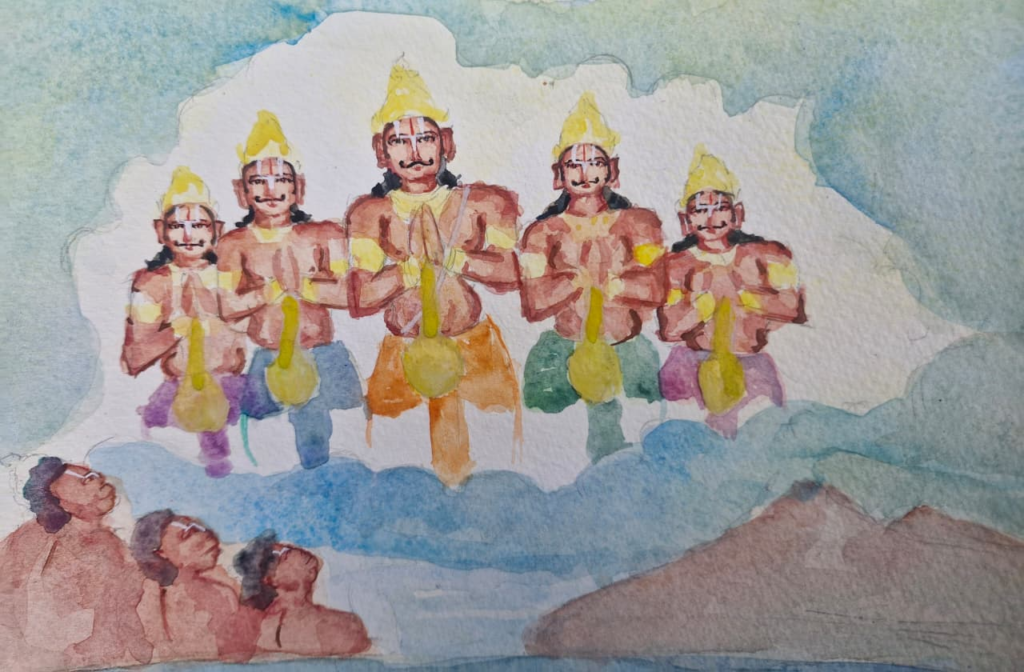
Notes from periyavAchchAn piLLai’s vyAkhyAnam
- nivEdhayatha – inform
The tastes, preferences, and perspectives of people in this world differ due to variations in their knowledge. Consequently, their opinions and thoughts vary.
Accordingly, in the assembly of sugrIva mahArAja and other monkeys, there were many individuals possessing different levels of intellect. One said, ‘I will not let him join us’. Another said, ‘I will not leave him alive’. Someone else said, ‘I will tie him up’. Upon hearing vibhIshaNAzhwAn say ‘Tie me’ and understanding that he was a sAthvikan (noble person), one monkey suggested, ‘Let us announce his arrival’. Another countered, ‘Let go of him; let him survive’. Because there were so many varied opinions, this can also be interpreted as vibhIshaNAzhwAn addressing everyone in the entire assembly.
- “lOkO bhinnaruchi:” (The tastes – preferences, opinions, and perspectives – of people in the world differ).
- thiruchchandha viruththam 2 “vERu vERu gyAnamAgi” (It is emperumAn who conducts all the other philosophies as well, such as bAhya [not believing in vEdham], kudhrushti [misinterpreting vEdham] etc.).
- thiruviruththam 96 “madhivigaRpAl piNangum samayangaL palapala” ([You created] many different philosophies due to differences in intellectual capacity).
- nivEdhayatha – inform
“gurushu bahuvachanam” refers to the practice of addressing a single, respected person or AchArya in the plural form). When addressing elders and venerable persons, it is customary to use this honorific plural.
Since vibhIshaNAzhwAn uses the plural form of the verb – nivEdhayatha – it can be interpreted [as a sign of high respect] as referring to sugrIva mahArAja, the king of all monkeys.
[Note from kAlakshEpam: For example, we say ‘swAmigaL ezhundharuLinAr’ in plural form to show respect to a single swAmy. Thus, we understand that the plural form is explicitly used to denote honorific titles].
- nivEdhayatha – inform
[This is interpreted as addressing or referring to thiruvadi/hanumAn].
When those present in rAvaNa’s assembly tried to kill thiruvadi, who had come as a messenger, vibhIshaNAzhwAn offered good counsel, stating, “It is not apt to kill a messenger”. Since vibhIshaNAzhwAn was helpful (kruthOpakAran) to thiruvadi, vibhIshaNa’s words were internally directed towards thiruvadi (addressed, having thiruvadi in his mind). However, he knew that addressing only one person in a large gathering might cause others to feel slighted (viparItham) and provoke them to do harm. Keeping this in mind, he addressed the assembly in general. Thus, ‘nivEdhayatha – all of you inform’ can also be interpreted in this manner.
- nivEdhayatha – express your opinion, whatever it maybe
vibhIshaNAzhwAn appeals, “When perumAL enquires about me, do not remain silent. You may express whatever your opinion is, whether it is ‘He is to be suspected’ or ‘He is to be trusted or ‘He is to be protected’ or ‘He is to be abandoned’.
- nivEdhayatha – Help SrI rAma attain me
[Here, the vyAkhyAthA (commentator) provides an alternative interpretation by changing the grammatical case relation, as explained below].
- SrI bhagavath gIthA 7-18 “sa mahAthmA sudhurlabha:” (Such a great AthmA is very rare. After many virtuous births, a gyAni whose knowledge is matured, thinks “vAsudhEva is my parama prApyam (ultimate goal), prApaka (means), dhAraka (who sustains me), pOshaka (who nourishes me), bhOgya (who gives pleasure to me)”; he surrenders unto me. He is large-hearted, and it is difficult for me to attain him (in this world)).
If nivEdhayatha is derived from the root “vidhl lAbhE” (to gain), it yields a different interpretation. As per this perspective, vibhIshaNAzhwAn is saying that SrI rAma is grieving because he has not attained an AthmA – a great soul who is difficult to be attained (sa mahAthmA sudhurlabha:). vibhIshaNAzhwAn has renounced all relationships and kingly pleasures to hold SrI rAma as his everything. Therefore, it is interpreted as vibhIshaNAzhwAn saying, “Help SrI rAma attain me”.
The samskrutham rule ‘vivakshAtha: kArakANi’ states that case relations are determined by the speaker’s intention. Using this rule, a speaker can shift the emphasis of a sentence. In the sentence, ‘Inform SrI rAma of my arrival’, ‘my arrival’ is the direct object. However, following this grammatical rule, SrI rAma – the indirect recipient – can be transformed to direct object. The sentence is then interpreted as – ‘Make SrI rAma a beneficiary [by granting me, a lowly person, refuge]’.
- nivEdhayatha – make him exist
If nivEdhayatha is derived from the root “vidha saththAyAm” (denoting the state of existence), it can be interpreted as: ‘Offer me to perumAL – who would perish if he did not obtain me – and thereby make him exist’.
- SrI rAmAyaNam AraNya kANdam 10-19 “apyaham jIvitham jahyAm” (perumAL says to pirAtti: I shall even renounce my life). [Note from kAlakshEpam: perumAL speaks to pirAtti on account of his vows to protect the brAhmaNas, ‘I shall give up my life, or even give up you or lakshmaNa, but I shall not give up that vow for any reason”].
- nivEdhayatha – analyse/enquiry
If nivEdhayatha is derived from the root vidha vichAraNE (this refers to analysis), it offers a different interpretation. In this context, vibhIshaNAzhwAn looks at sugrIva mahArAja and the others and says, “There are many wise people among you, such as angadhan, Sarabhan, jAmbavAn. Analyse with them whether I should be given protection or not”.
Upon vibhIshaNAzhwAn speaking thus, they replied, “We shall do so. We shall inform perumAL”. However, they asked, “You have spoken of two things – “sO’ham parushithasthEna” (I was spoken to with harsh words by that rAvaNa) and “rAghavam SaraNam gatha:” (I surrender to SrI rAma). Should we first inform perumAL that you have been berated by rAvaNa? or should we first inform perumAL of your arrival as a SaraNAgathan”?
- SrI rAmAyaNam yudhdha kANdam 17-14 “sO’ham parushithasthEna” (I was spoken to with harsh words by that rAvaNa)
- SrI rAmAyaNam yudhdha kANdam 17-14 “rAghavam SaraNam gatha:” (I surrender to SrI rAma).
- mAm nivEdhayatha – Inform perumAL about me
vibhIshaNAzhwAn requests, “Inform perumAL about me. I can avenge those derogatory words only if I become a close associate of perumAL. Therefore, announce my arrival first”. They ask, “To announce your arrival, have you brought a golden pot filled with offerings for the emperor’s son”?
- mAm – me
vibhIshaNAzhwAn says, “Inform perumAL that a servitor has arrived, who will stand by to support him without abandoning him, even when suffering from the attacks of nAgapASam and brahmAsthram” [these are powerful weapons, launched by a warrior to harm an opponent].
- thiruvAimozhi 8-3-7 “ingu ummOdu oru pAduzhalvAn Or adiyAnum uLan” (In this material realm, to travel along with you, remaining in close proximity to you, one (unparalleled) servitor is available).
[Note from kAlakshEpam: They ask vibhIshaNAzhwAn about his offerings to perumAL, to which he replies that he has come to offer himself to perumAL].
They ask again, “We can only estimate what you will accomplish based on your past performance. Have you done any good deeds prior to this”?
- mAm – me
Me – I who offered good counsel (pradhIyathAm dhASarathAya maithilee). Thus, vibhIshaNAzhwAn mentions the good advice he gave earlier in rAvaNa’s assembly.
- SrI rAmAyaNam yudhdha kANdam 14-3 “pradhIyathAm dhASarathAya maithilee” (Let sIthAp pirAtti (maithilee) be given back to SrI rAma).
Dissatisfied with his response, sugrIva mahArAja and the monkeys question him again, “Without speaking from your heart, you are just uttering words. What is the benefit of merely speaking from the tip of your tongue if it is not heartfelt? Has sithAp pirAtti been reunited because of your words of advice?
- mAm – me
Me – I am the one who [fearlessly] proclaimed the glories of SrI rAma to rAvaNa, just as the vEdhas, the poet laureates, sing the glories of perumAL.
- SrI rAmAyaNam yudhdha kANdam 14-4 “yAvanna gruNanthi SirAmsi bANA rAmErithA rAkshasapungavAnAm” (Before the arrows shot by SrI rAma sever (or effortlessly pluck) the heads of all the rAkshasa kings, let sIthAp pirAtti be given back to SrI rAma).
- SrI rAmAyaNam sundhara kANdam 26-21 “vidhamEScha purIm lankAm” (SrI rAma will destroy the city of lankA).
- chAndhOgya upanishadh 1-8 “ruk sAma cha gEshNau” (ruk and sAma vEdha [sing praises of the supreme lord] as poet laureates).
They continue to say, “Due to brotherly affection and a desire for his welfare, you have explained the ill-effects of his actions. You offered good counsel by describing the consequences of not returning sIthAp pirAtti. You have spoken as a well-wisher to rAvaNa, why, then should we inform perumAL about you, who remains devout to rAvaNa”?
- SrI rAmAyaNam yudhdha kANdam 16-24 “guruthvAdh hithamichchathA” (Desiring the welfare of elder brother).
- mAm – me
Me – I was berated and discarded by rAvaNa, who was unable to tolerate my greatness arising from singing perumAL’s glories.
- SrI rAmAyaNam yudhdha kANdam 17-14 “parushithasthEna avamAnithaScha” (I was reviled and humiliated by him).
They continue to ask vibhIshaNAzhwAn, “Aren’t you the one who said that an elder brother is to be honoured (jyEshtO mAnya: pithrusama:)? Did you mistake your brother’s harsh words and come here because of that”?
- SrI rAmAyaNam yudhdha kANdam 16-17 “jyEshtO mAnya: pithrusama:” (An elder brother is worthy of honour; he is equal to a father).
- mAm – me
vibhIshaNAzhwAn replied, “I left my wife and children who are indeed considered as one’s own self, because I was unable to tolerate rAvaNa’s humiliation. I have severed all my ties with him”.
- SrI rAmAyaNam yudhdha kANdam 17-14 “thyakthvA puthrAmScha dhArAmScha” (I left my children and wife and surrendered to perumAL).
- “AthmA vai purushasya dhArA:” (A wife is indeed one’s own self)
- manthra praSnam 2-11-33 “AthmA vai puthranAmAsi” (The father is born as the son).
They continued to ask vibhIshaNAzhwAn, “What is the benefit of discarding your relationship with rAvaNa? What is your attachment to perumAL”?
- mAm – me
vibhIshaNAzhwAn replied, “I have surrendered to perumAL”.
- SrI rAmAyaNam yudhdha kANdam 17-14 “rAghavam SaraNam gatha:” (I have surrendered to SrI rAma).
- thiruvAimozhi 3-6-8 “thayaradhaRku magan thannai anRi maRRilEn thanjam AgavE” (I will not have any one, even another form of bhagavAn as my refuge, other than SrI rAma, the son of dhaSaratha chakravarthi). [Note from kAlakshEpam: nammAzhwAr, personification of krishNa bhakthi, expresses his surrender to SrI rAma. SrI rAma is also celebrated by ANdAL nAchchiyAr as ‘manadhukku iniyAn’].
- mAm – me
[Note from kAlakshEpam: A person surrendering possesses six qualities. These are: AnukUlyasya sankalpam (firmness in being favourable to emperumAn and his followers), prAthikUlyasya varjanam (abandoning those actions which are unfavourable), rakshishyathIthi viSvAsam (Absolute faith that the perumAL will protect), gOpthruthvE varaNam (Accepting perumAL as the only refuge), kArpaNyam (feeling utter helplessness), and AthmanikshEpanam (total surrender). periyavAchchAn piLLai explains below how each of these characteristics is present in vibhIshaNAzhwAn].
[Note from kAlakshEpam: First, AnukUlyasya sankalpam is explained: vibhIshaNAzhwAn offers good counsel to reform rAvaNa and make him favourable towards SrI rAma. This illustrates that there is AnukUlyasya sankalpam in vibhIshaNAzhwAn].
- SrI rAmAyaNam yudhdha kANdam 16-25 “AthmAnam sarvathA raksha purIm chEmAm sarAkshasAm” (Protect yourself by all means; protect this lankA along with all the rAkshasas).
vibhIshaNAzhwAn says, “I offered good counsel to rAvaNa, who humiliated me (mAm), and to all of rAvaNa’s associates without any distinction, for their benefit”.
[Note from kAlakshEpam: This is expressed very beautifully in perumAL thirumozhi by kulaSEkhara AzhwAr. In the first decad (iruLiriyach chudarmaNigaL), he expresses the quality of being favourable to emperumAn. In the second decad (thEttaram thiRal thEninai ), he shows how that quality manifests as AnukUlyam – being favourable towards emperumAn’s followers. In the third decad, he demostrates prAthikUlya varjanam – avoiding the unfavourable ones; desisting from carrying out activities inimical to emperumAn – (meyyil vAzhkkaiyai). In the fifth decad, he expresses that he has no refuge other than the divine feet of thiruviththuvakkOttu emperumAn (tharu thuyaram thadAyEl).
Furthermore, the usage of these words itself manifests their deep meaning. AnukUlyasya sankalpam means making a resolve to be favourable to emperumAn and his followers. (sankalpam means an intention or resolve in doing favourable actions). Conversely, prAthikUlyasya varjanam indicates a deliberate exclusion or active rejection of unfavourable actions. For the latter, a mere resolve to abandon unfavourable actions is not sufficient; it requires total avoidance. For example, while a sankalpam to eat perumAL prasAdham will not yield any benefit, making a sankalpam to engage in kainkaryam will always please perumAL].
- lakshmee thanthram 17-66 “AnukUlyamithi prOkthA sarvabhUthAnukUlathA” (Being benevolent towards all entities is referred to by the term ANukUlyam).
[Note from kAlakshEpam: lakshmee thanthram is a portion in SrI pAncharAthra Agamam].
- SrI rAmAyaNam yudhdha kANdam 16 -17 “jAthakrOdhO vibhIshNa:” (vibhIshaNAzhwAn, filled with rage).
- SrI rAmAyaNam sundhara kANdam 55-5 “krudhdhO hanyAdh gurunapi” (An angry person can kill even the elders).
vibhIshaNAzhwAn should have killed rAvaNa right then. But he soared up in the sky with his mace.
- SrI rAmAyaNam yudhdha kANdam 16 -17 “uthpapAtha gadhApANi:” (He soared into the sky with a mace in his hand).
Even though he had a mace in his hand, he avoided the unfavourable conduct since one should not practice adversity to any being. [prAthikUlya varjanam].
- lakshmee thanthram 17-67 “prAthikUlyancha bhUthAnAm sarvEshAm na samAcharEth” (One must not cause harm to any entity).
Upon hearing of perumAL’s destruction of vAli and the crowning of sugrIva mahArAja as king, vibhIshaNAzhwAn recognised SrI rAma’s rakshakathvam (protectorship) through this example, and he came, confident that SrI rAma would protect him too.
- SrI rAmAyaNam yudhdha kANdam 17-66 “sugrIvaSchAbhishEchitha:” (sugrIva mahArAja was crowned as king).
- lakshmee thanthram 17-70,71; praSna samhithA 54-26,27 “SakthE: sUpasadhathvAchcha krupAyOgAchcha SaSvathAth I ISESithavyasambandhAdhanidham pradhamAdhapi II rakshishyathyanukUlAnna ithi yA sudhrudhA mathi: I sa viSvAsObhavEth Sakra (dhEvi) sarvadhushkruthanASana: II” (The knowledge that the merciful supreme lord, due to his Sakthi (power), his saulabhyam (easy to attain), his nithya kAruNyam (eternal compassion), and the eternal relationship between him, as the controller and us, as the controlled, who have affection for him, would protect us, is said as viSvAsam (unwavering, firm conviction); this destroys all sins).
mAm – the one with firm conviction (viSvAsam) that perumAL would protect him.
vibhIshaNAzhwAn says, “With this great viSvAsam (confidence), I surrender to SrI rAma”.
- SrI rAmAyaNam yudhdha kANdam 19-5 “bhavantham SaraNangatha:” (I surrendered to your highness).
- lakshmee thanthram 17-72,73; praSna samhithA 54-28,29 “karuNAvAnapi vyaktham Saktha: svAmyapi dhEhinAm I aprArththithO na gOpAyEthithi thath prArththanAmathi II gOpAyithA bhavEthyEvam gOpthruthvavaraNam thathA” (Even though it is well-known that emperumAn is full of compassion and is omnipotent, and is the supreme lord of jIvAthmAs, with the thought that he will not protect unless he is prayed to, the intellect which prays to him “You should become my protector” is known as gOpthruthvavaraNam).
As such, vibhIshaNAzhwAn requests perumAL to offer him protection – gOpthruthvavaraNam. Therefore, he offers all of his pala (rewards) to the supreme lord – pala bharanyAsam.
- SrI rAmAyaNam yudhdha kANdam 19-6 “bhavadhgatham mE rAjyancha jIvithancha sukhAni cha” (My kingdom, life, and happiness, all are in you).
AthmanishEpam –
- lakshmee thanthram 17-74; praSna samhithA 54-30 “thEna samrakshyamANasya palE svAmyaviyukththA I kESavArppaNAparyanthA hyAthmanikshEpa uchyathE II” (The ultimate state where a person protected by bhagavAn forfeits privileges to all rewards and surrenders everything to the supreme lord, kESavan is ‘Athma nikshEpam’).
vibhIshaNAzhwAn offers all the fruits of his actions (palam), his burden (bhAram), and surrenders himself also to emperumAn.
kArpaNyam
- SrI rAmAyaNam yudhdha kANdam 19-4 “thEna chAsmyavamAnitha:” (I was humiliated by that rAvaNa).
Thus, humiliated by rAvaNa, vibhIshaNAzhwAn raises his hands exhibiting his helplessness.
lakshmee thanthram 17-67 through 69; praSna samhithA 54-24 through 26 “thyAgO garvasya kArpaNyam SruthaSeelAdhijanmana: I angasAmagryasampaththEraSakthErapi karmaNAm II adhikArasya sAsidhdhEr dhESakAlaguNakshayAth I upAyA naiva sidhyanthi hyapAyAbahulAs thathA II ithi yA garvahAnis thadh dhainyam kArpaNyam uchyathE” (Obliteration of pride that arises from one’s knowledge and virtue is called kArpaNyam. The many components of action and auxiliary materials are difficult and rare to obtain, jIvAthmA’s sheer inability to execute prescribed actions (karmAnushtAnam) due to being completely dependent on another (athyantha parathanthran), his ineligibility (due to his inherent nature – svapravruththirUpam), and lack of appropriate place, time, and qualities. Realising that these upAyams (means) not only fail but are also full of obstacles (dangers) destroys pride (garva hAni). This state of absolute helplessness is kArpaNyam).
As such, vibhIshaNAzhwAn identifies himself as one in a helpless state (kArpaNyam) and who has performed SaraNAgathi following all the six aspects of it without any shortcoming.
- mAm – me
[Note from kAlakshEpam: The characteristics of SaraNAgathi are explained as follows: being the abode of all sins, possessing nothing, having no other refuge, and possessing the intellect that prays for the supreme lord to become one’s sole means in attaining the supreme lord].
As such, vibhIshaNAzhwAn identifies himself as: ‘As one named as vibhIshaNa (one who causes fear in many ways) and the brother of the unrighteous rAvaNa; as the repository for all offences, entirely destitute akinchanan [without karmayOgam, gyAna yOgam, or bhakthi yOgam, chanting the divine names, lighting divine lamps, offering divine garlands, and similar other means instructed by the SAsthram] without any means (upAyahIna:), discarded even by brother, without any other refuge (ananyagathi), with an intellect that prays to perumAL to become his means (thvamEvOpAyabhUthO mE bhavEthi prArthanAmathi:).
- ahirbudhnya samhithai 37-30 “aham asmyaparAdhAnAm AlayO’kinchanO’gathi: I thvamEvOpAyabhUthO mE bhavEthi prArthanAmathi: II” (I am the abode of all sins; (to protect myself) I have no means; (except for you) I have not other refuge; the intellect which prays to him “You should become the means for me” is known as SaraNAgathi).
- mAm – me
vibhIshaNAzhwAn says, “I was on the other side of the ocean, but now I have reached the northern shore”.
- SrI rAmAyaNam yudhdha kANdam 17-8 “uththaram thIramAsAdhya” (He reached the northern shore and stood in the sky).
- periyAzhwAr thirumozhi 5-3-7 “akkarai ennum anaththak kadaluL azhundhi un pEr aruLAl ikkarai ERi iLaiththu irundhEnai” (From the other side of the samsAra ocean, because of your divine mercy I have climbed onto ‘this shore’ and now resting in comfort).
- mAm – me
vibhIshaNAzhwAn identified himself as one who is staggering in the sky, having abandoned lankA and its wealth, and forsaken his friends.
- SrI rAmAyaNam yudhdha kANdam 19-5 “parithyakthA mayA lankA mithrANi cha dhanAni cha” (lankA, friends, and wealth have been relinquished by me).
- SrI rAmAyaNam yudhdha kANdam 17-8 “khastha Eva vyanishtatha” (He stood there, in the sky, firmly).
- mAm – me
vibhIshaNAzhwAn says, “I have travelled all the paths [lankA/in the samsAram] and now I have reached bhagavAn vishNu’s abode – SrI rAma’s divine feet”.
- katOpanishadh 1-3-9 “sO’dhvana: pAramApnOthi thadhvishNO: paramam padham” (That mukthAthmA crosses the realm of samsAra and attains the supreme abode of vishNu).
- mAm – me
- “prachyuthO vA asmAllOkAdh AgathO dhEvalOkam” (Having attained dhEvalOkam and slipped from it, he has departed and slipped from this world too).
- thiruvAimozhi 5-7-2 “anguRREn allEn inguRREn allEn” (I have not entered your apt abode, having you as ready means; I am not remaining patiently where I am now).
vibhIshaNAzhwAn says, “Having abandoned rAvaNa and his cohorts, I find myself in the middle ground (AntharALigan), having not yet entered SrI rAma’s gOshti”.
[Note from kAlakshEpam: AntharALigan – one who is in an intermediate position. In general, SrIvaishNavas are also called AntharALigaL because they are not desirous of being in samsAram but have not yet attained paramapadham. Therefore, this word refers to a mumukshu (one who desires mOksham)].
- mAm – me
- thiruvAimozhi 9-5-10 “izhai nalla Akkaiyum paiyavE puyakkaRRadhu” (My body that is like an ornament [for emperumAn], is trying to leave in proper sequence).
vibhIshaNAzhwAn says, “If you inform perumAL, my body will sustain, otherwise, it cannot survive. I am one, who exists in such a state”.
nivEdhayatha mAm kshipram vibhIshaNamupasthitham I
sarvalOkaSaraNyAya rAghavAya mahAthmanE II
vyAkhyAnam for this SlOkam will be continued in the next article.
AzhwAr emperumAnAr jIyar thiruvadigaLE SaraNam
periyavAchchAn piLLai thiruvadigaLE SaraNam
Source – SrI rAmAyaNa thani SlOkam – 59 – yudhdha kANdam 17.15 – nivEdhayatha – Part 3 Audio Video
adiyEn chithrA rAmAnuja dhAsi
Proofreading/Curating done by – kOsalEndhra rAmAnuja dhAsan, krishNan rAmAnuja dhAsan
Artwork – namperumAL rAmAnuja dhAsan
Related Links
SrI rAmAyaNa thani SlOkam – 58 – yudhdha kANdam 17.15 – nivEdhayatha – Part 2 Audio Video
SrI rAmAyaNa thani SlOkam – 57 – yudhdha kANdam 17.14 – sO’ham, 17.15 – nivEdhayatha – Part 1 Audio Video
SrI rAmAyaNa thani SlOkam – 56 – yudhdha kANdam 17.12 – thamaham hEthubhi:, 17.13 – sa cha na Audio Video
SrI rAmAyaNa thani SlOkam – 55 – yudhdha kANdam 17.11 – thEna sIthA Audio Video
SrI rAmAyaNa thani SlOkam – 54 – yudhdha kANdam 17.8 – thEshAm, 17.9 – uvAcha cha, 17.10 – rAvaNO nAma Audio Video
SrI rAmAyaNa thani SlOkam – concise english meanings
archived in https://granthams.koyil.org
pramEyam (goal) – https://koyil.org
pramANam (scriptures) – https://granthams.koyil.org
pramAthA (preceptors) – http://acharyas.koyil.org
SrIvaishNava education/kids portal – http://pillai.koyil.org