SrI: SrImathE SatakOpAya nama: SrImathE rAmAnujaya nama: Srimath varavaramunayE nama:
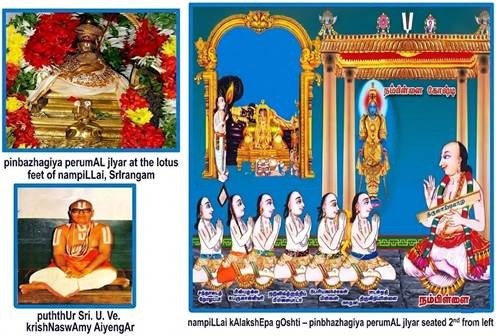
In our SrIvaishNava sampradhAyam, nampiLLai was an AchArya (great preceptor) who resided in SrIrangam (thiruvarangam) for a long time, performing numerous kAlakshEpams (discourses) and beautifully nurturing our sampradhAyam. One of his prominent disciples was pinbazhagiya perumAL jIyar.
This pinbazhagiya perumAL jIyar wonderfully compiled the life histories of our AzhwArs and AchAryas, graciously authoring a highly significant grantham known as the 6000 padi guruparamparA prabhAvam. It is only by using this text that we learn about the history of the AzhwArs and the Acharyas up until nampiLLai, making it an essential grantham. He also beautifully compiled another grantham called vArthAmAlai, consisting of numerous historical events that occurred in the lives of various AchAryas. puththUr swAmy published this vArthAmAlai and also graciously wrote a simple viLakka urai (explanatory commentary) for it himself.
In this grantham, many important matters that are the foundational root meanings of our tradition, such as rahasya thrayam (the three secrets), thathva thrayam (the three realities), and artha panchakam (the five essential concepts ), are presented both briefly and in detail. The explanations gathered and given by various AchAryas at different times have been compiled into a single text by pinbazhagiya perumAL.
In this series, the explanation has covered up to 24th vArthai, and this article is discussing from 25th vArthai.
Twenty-fifth vArthai
rakshakathvaththai azhiththAn; SEshathvaththai azhiththAn; parathvaththai azhiththAn; vigrahaththai azhiththAn; aruLai azhiththAn; adiyArai azhiththAn; vibhUthiyai azhiththAn; bandhaththai azhiththAn; vruththiyai azhiththAn; thannai SarIriyAga prathipaththi paNNi anarthappadudhal; thannai SarIramAga prathipaththi paNNi ujjIviththal seyyumaththanai – enRu piLLai aruLichcheydhAr.
This was graciously stated by piLLai. When ‘piLLai’ is mentioned, generally it refers to nampiLLai, as he is the famous AchArya of pinbazhagiya perumAL jIyar. This vArthai details the mistakes the jIvAthmA has committed since anAdhi kAlam (time immemorial ) in this samsAram (material cycle), the matters in which he lacked faith, and how he has lost the emperumAn. This applies to all jIvAthmAs which have existed in this samsAram since time immemorial. He first shows what was lost, and at the end, he shows the nivAraNam (remedy) for it.
rakshakathvaththai azhiththAn
He destroyed the rakshakathvam (protectorship). The jIvAthmA is the entity to be protected, and emperumAn is the rakshakan (protector). By thinking that we can protect ourselves, the jIvAthmA destroys the protectorship of the emperumAn, who is supposed to protect us. Thus, he destroyed the principle that ISvaran is the rakshakan.
SEshathvaththai azhiththAn
He destroyed SEshathvam (subservience), which means adimaiththanam (servitude). emperumAn is the SEshi (master), and we are SEshabhUthargaL (subservient beings). Since time immemorial, we have remained in this samsAram precisely because we lacked the awareness that we are SEshabhUthas to emperumAn. The moment we accept that emperumAn is our SEshi and we are his SEshabhUthas, our dawn of liberation begins. Because we fail to accept this, the AthmA has destroyed its own inherent SEshathvam.
parathvaththai azhiththAn
He destroyed parathvam (supremacy). emperumAn alone is param (supreme); he is the paradheyvam (supreme deity). Rather than objectively analysing who is paradheyvam, people often choose the ones they are fond of and declare them as their dheyvam. By abandoning emperumAn and viewing other dhEvathAs or favoured deities as param, a person destroys the parathvam of emperumAn. While emperumAn’s parathvam does not actually vanish and remains exactly as it is, the AthmA remains ignorant, unknowingly abandoning the truth and making it non-existent for himself.
vigrahaththai azhiththAn
He destroyed the vigraham (thirumEni or divine form). emperumAn possesses various vigrahams; for instance, we visit many sanctums today to worship various archA vigrahams. He also took avathArams (incarnations) as SrI rAma, krishNa, varAha, and narasimha, assuming vigrahams unique to each avathArams. Furthermore, he possesses vigrahams in paramapadham (the supreme abode) and thiruppARkadal (the milky ocean). However, proponents of certain sidhdhAntham (philosophies) like mAyAvAdham, claim that emperumAn is aruvam (a formless entity). By refusing to accept the vigrahams of emperumAn, they effectively ‘destroy’ these forms for themselves and forfeit the opportunity to experience them.
aruLai azhiththAn
He destroyed the aruL (grace). It is only through the limitless krupai (compassion) of emperumAn that all auspicious things happen to us. Since this krupai is the most vital factor in uplifting the AthmA, by failing to acknowledge it, he destroyed that aruL for himself.
adiyArai azhiththAn
He destroyed the adiyArs (devotees). There are countless kainkaryaparargaL (servitors) dedicated to kainkaryam (divine service) such as the nithyasUris, ananthan (AdhiSEsha), garuda, and vishvaksEnar, as well as the pirAttis (divine consorts), who eternally perform kainkaryam to him. By failing to accept their existence and their role in the divine realm, he destroyed them as well.
vibhUthiyai azhiththAn
He destroyed the vibhUthi (divine wealth). emperumAn possesses two types of vibhUthi: nithya vibhUthi (the eternal realm of paramapadham) and leelA vibhUthi (samsAram). vibhUthi essentially means his property or assets. However, certain sects refuse to acknowledge this divine ownership. For instance, the mAyAvAdhis claim that this entire world is a “poi” (mere illusion), while the nihilists/budhdhists (SUniyavAdhis) go further to argue that nothing exists at all. By propagating these theories, either that the world is a myth or that it is non-existent, they effectively ‘destroy’ the vibhUthi of emperumAn.
bandhaththai azhiththAn
He destroyed the bandham (relationship). bandham refers to the eternal link between emperumAn and AthmA. We understand that there is a navavidha sambandham (nine-fold relationship) between them. piLLai lokAchAryar, citing the verse ‘pithA cha rakshakas SEshI…’, elucidates these nine roles: emperumAn is the pithA (father), rakshakan (protector), SEshI (master), bharthA (husband), gyEyan (object of knowledge), AdhAram (support), swAmy (owner), AthmA (soul), and bhOkthA (enjoyer). These are intrinsic ties, understood as in the SAsthram. However, during its beginningless stay in this samsAram, the AthmA fails to acknowledge this inherent connection. By refusing to accept that such a bandham exists between himself and emperumAn, he effectively destroyed that relationship for himself.
vruththiyai azhiththAn
He destroyed the vruththi (service/action). emperumAn granted us this body (SarIram) specifically to perform kainkaryam to him. As nammAzhwAr says in thiruvAimozhi – 3.2.1, ‘annAL nI thandha Akkai‘ (this body given by you back then during the time of srushti), the purpose of this form is to walk the righteous path according to SAsthram, serve him and reach him. However, this AthmA abandons that kainkaryam and immerses itself in vishayAnubhavams (sensual/worldly experiences), focusing entirely on bodily needs like house, family, children, and relatives. As one pursues these, the time dedicated to bhagavath vishayam (divine matters) diminishes, thereby destroying the very purpose of his existence.
For ages, this AthmA has caused its own ruin. We alone are the cause of our suffering in this samsAram; it is our own karmam that keeps us here. Conversely, emperumAn by his causelessly mercy alone uplifts the AthmA. This is a vital tenet of our sampradhAyam: we are responsible for our miseries by committing forbidden acts and ignoring the SAsthram, while emperumAn is the sole reason for any good that befalls us. Thus, by remaining ignorant, the AthmA destroys and loses its recognition of emperumAn’s rakshakathvam, SEshathvam, parathvam, vigraha, aruL, adiyArs, vibhUthi, and the bandham they share.
There is a simple yet profound nivAraNam for all the spiritual losses an AthmA faces. It depends entirely on how one perceives their prathipaththi (thoughts.
thannai SarIriyAga prathipaththi paNNi anarthappadudhal
If the AthmA considers itself the SarIri (indwelling controller and master), it results in anartham (spiritual danger). By believing that the AthmA is the SarIri, the jIvAthmA brings unnecessary ruin upon itself. It is evident that the AthmA directs the body; for instance, when the AthmA directs the hand to move, the body responds accordingly. However, once the AthmA departs from this body, no action can take place. Therefore, mistakenly assuming the status of SarIri over one’s actions leads to self-ruin.
thannai SarIramAga prathipaththi paNNi ujjIviththal seyyumaththanai
ujjIvanam (Salvation) is achieved by realizing: “The jIvAthmA is the SarIram to emperumAn; that emperumAn is my AthmA and this soul is his SarIram”. A SarIram exists solely for the bliss and purposes of the SarIri.
When the jIvAthmA truly accepts its identity as emperumAn’s SarIram, the previously lost or destroyed connections are naturally restored through these realisations.
- rakshakathvam – It is the nature of AthmA to protect the body, and the body cannot protect the AthmA. Since the jIvAthmA is emperumAn’s body and emperumAn is the AthmA, he will naturally protect AthmA. This understanding creates nishtai (firm faith) within us.
- SEshathvam – The body is SEsha and serves as an instrument for AthmA; the body acts according to the desires of the AthmA, not the other way around. By accepting itself as the SarIram, AthmA realises its SEshabhUtham, thereby keeping our SEshathvam intact.
- parathvam – Because the AthmA is superior and the body is subordinate, it follows that emperumAn, who is the AthmA to all, is the paradheyvam. Recognising him as the universal indweller ensures that one no longer denies or destroy his parathvam.
- vigraham – vigraham refers to emperumAn’s thirumEni. Accepting that the soul is his body leads to the understanding that he also possesses vigraham. Just as the AthmA exists within a body, there is no contradiction in accepting that bhagavAn possesses dhivya mangala vigrahams (glorious, transcendental forms); this realisation overcomes the error of denying vigraham.
- aruL – If emperumAn is the AthmA of all, the body lives and functions only through his krupai. Understanding this prevents us from disregarding his aruL.
- adiyAr – Realising its nature as his SarIram leads the jIvAthmA to recognise that emperumAn possesses many other favoured bodies in the form of adiyArs and bhAgavathas. Just as we cherish our own bodies, emperumAn holds his devotees in the highest regard, as highlighted by nammazhwAr in the following context in thiruvAimozhi – 6.9.8, “arivAr uyirAnAy “(You are the sustainer for the distinguished wise persons). Through this SarIra-SarIri connection, the jIvAthmA understands that these devotees are the bodies most beloved to him, leading to the reverence and service as the primary objects of the emperumAn’s affection.
- vibhUthi – The body is the soththu (property) of the AthmA. Recognizing this, reveals that emperumAn possesses all such properties, instilling respect and support all of his creation as his vibhUthi.
- bandham – The eternal and inherent SarIra-SarIri bandham (body-soul bond) between emperumAn and the jIvAthmA is fully acknowledged and realized.
- vruththi – Since the function of the body is to act upon the soul’s command, the jIvAthmA preserves its vruththi by dedicating itself entirely to kainkaryam.
In the viSishtAdhvaitha sidhdhAntham, this SarIra-SarIri bhAvam serves as the primary cornerstone. emperumAn is the antharyAmi for all achith (non-sentient entities) and chith (sentient souls), abiding as the inherent soul for everything. The entire philosophy is constructed upon this specific relationship established in the SAsthram.
This twenty-fifth vArthai from nampiLLai, documented by pinbazhagiya perumAL jIyar, clarifies that unless the jIvAthmA realises it is SarIram to emperumAn, it will remain in confusion. Recognizing him as the antharyAmi clears all doubts and is the only means for ujjIvanam.
Twenty-sixth vArthai
This vArthai is a brief one directly stated by AchchAn piLLai (periyavAchchAn piLLai). He highlights three matters that are found within the thirumanthram (praNavam, nama:, nArAyaNAya).
- In praNavam, AthmA’s svarUpam (true nature) of pArathanthryam (absolute dependence) is stated.
- In namas, vyavasAyam (our firm faith) that paramAthmA alone is the refuge and the means is stated.
- In nArAyaNAya, the kainkaryam or vruththi (service) to be performed is stated.
He then shows what actions that act as a virOdham (obstacle / contradiction) to these three concepts.
paurushaththai ERittukkoLLugai – pArathanthryaththai azhikkai
Taking upon oneself paurusham (the stance of an independent enjoyer) destroys absolute pArathanthryam (dependence). In a worldly life, a purushan (husband) assumes the role of a protector / ruler, while the sthrI (wife) is subservient to him. This principle is similarly reflected in the SAsthram. emperumAn alone is purushOththaman (supreme male), and all jIvAthmAs are like sthrI before him. When a jIvAthmA assumes the nature of a purushan by thinking, “I am the ruler, I am the enjoyer,” the quality of pArathanthryam towards emperumAn is destroyed.
vyApAraththai ERittuk koLLugai – vyavasAyaththai azhikkai
Assuming vyApAram (self-protective efforts) destroys vyavasAyam. The term vyApAram refers to any actions undertaken by an individual to protect oneself. If one practices such as karma yOgam, bhakthi yOgam, gyAna yOgam or thiruviLakku erikkai (lighting lamps) or thirumAlai kattuvadhu (making garlands) as an upAyam (means) to attain emperumAn, it constitutes an error, as it contradicts the svarUpam. While these can be done as kainkaryam, using them as upAyam through our personal effort to attain mOksham destroys the vyavasAyam that emperumAn alone is the protector.
vishayAntharangaLilE anvayikkai vruththiyai azhikkai enRu AchchAn piLLai.
Engaging in vishayAntharam (worldly matters) destroys vruththi. If one becomes immersed in bodily, mental, or material comforts under the premise of deriving Anandham (bliss) from them, the time dedicated to kainkaryam is lost on these pursuits. Thus, attachments to external objects create an obstacle to the kainkaryam intended for emperumAn.
By assuming paurusham, a defect is brought into the soul’s natural state of pArathanthryam. If one undertakes vyApAram, performing actions specifically for self-protection, the vyavasAyam that emperumAn alone is the protector is destroyed. Furthermore, engaging in vishayAntharam creates an impediment to the uninterrupted kainkaryam due to emperumAn.
Though concise, this vArthai clearly demonstrates the fundamental truths embedded within the thirumanthram.
Twenty-seventh vArthai
This vArthai is extensive and filled with profound SAsthra arthams (scriptural meanings). It is inherently difficult to grasp; puththUr swAmy has noted in his viLakka urai that it is complex, with certain words appearing missing or disconnected. In earlier times, these texts were preserved on Olaichchuvadi (palm leaves). Over time, leaves could be misplaced, or the inscriptions could wear down and tear, causing portions in between to be lost. In this vArthai, pinbazhagiya perumAL jIyar explains the interactions and exchanges between the jIvAthmA and paramAthmA.
Part 1
gyAnam gyAnaththai viniyOgam koLLumpadi ennennil; – ivan karaNadhvArA viniyOgappadum; avan vigrahadhvArA viniyOgam koLLum.
gyAnam gyAnaththai viniyOgam koLLumpadi ennennil
If it is asked how one gyAnam (knowledge) utilizes another gyAnam, given that both paramAthmA and jIvAthmA are gyAna svarUpi (embodiments of knowledge) and possess gyAnam as guNam (attribute), the answer is provided below.
ivan karaNadhvArA viniyOgappadum
The jIvAthmA serves the paramAthmA through karaNam (the senses). The jIvAthmA is endowed with a SarIram or kalEvaram and indhriyams or karaNam, which are collectively designated as “karaNa kaLEvarangaL”. Engaging them means making a flower garland with the hands, reciting pAsurams with the mouth, and meditating on perumAL with the mind. As the pAsuram 5 in thiruppAvai says, vAyinAl pAdi manaththinAl sindhikka pOya pizhaiyum pugu tharuvAn (Singing with the mouth, meditating with the mind, the past and incoming sins will be destroyed), these actions are carried out utilizing the karaNams. In this manner, the jIvAthmA engages itself usefully in the service of emperumAn through instruments, performing kainkaryam to him.
How does the emperumAn, in turn, accept that service?
avan vigrahadhvArA viniyOgam koLLum
emperumAn accepts this kainkaryam through his vigraham / thirumEni. When pAsurams are recited, emperumAn listens while residing in the archA rUpam (worshippable deity form). When a garland is offered, it is placed upon perumAL’s thirumEni – whether it is in archA form, a sacred picture, or a SAlagrAma SrImUrthi. Our pUrvAchAryas took great care to document these meanings through their upadhESams (teachings) and in granthams, so we can understand the profound thAthparyam (spiritual significance), namely. that the jIvAthmA, endowed with karaNams and indhriyams, serves the thirumEni of emperumAn. These SAsthrArthams ought to be comprehended clearly and integrated into our anushtAnam (daily practice).
Part 2
gyAnam gyAnaththukku SEshamAnapadi ennennil; yAdhonRinudaiya svarUpa sthithi pravruththi nivruththi yAdhonRilE kidakkiRadhu adhu SEshiyAgaththattillai –
gyAnam gyAnaththukku SEshamAnapadi ennennil
Since both paramAthmA and jIvAthmA are gyAna svarUpis, a question arises: How one gyAnam (jIvAthmA) can be SEsham to another gyAnam (paramAthmA) ? The explanation is provided below:
yAdhonRinudaiya svarUpa sthithi pravruththi nivruththi yAdhonRilE kidakkiRadhu adhu SEshiyAgaththattillai
For whichever entity its svarUpam, sthithi (existence), pravruththi (action), and nivruththi (inaction) are dependent completely on another, there is no flaw in the latter being the SEshi. If the jIvAthmA exists, undertakes an action, or refrains from an action, it is entirely because of emperumAn. Without his will, AthmA cannot exist, nor can it perform any function. Because its svarUpam, existence, and activities rest entirely upon emperumAn, that gyAnam (paramAthmA) is the SEshi, and the AthmA is the SEshabhUthan.
Part 3
ippadiyirukkiRa gyAnaththai avidhyai mUdinapadi enganE ennil; gyAnASrayamAgaiyAlE; kallu kalangAdhE; nIr kalangumiththanaiyiRE; gyAnadhravyamiRE; eppOdhumokkak kalangiyalladhu irAdhE; aprApthaththilE kalangudhal, prApthaththilE kalangudhaliRE.
ippadiyirukkiRa gyAnaththai avidhyai mUdinapadi enganE ennil
How can avidhyai (ignorance) cover such a gyAnam? The AthmA inherently possesses the capacity for boundless knowledge, just like the liberated mukthAthmAs (liberated souls) and nithyasUris (eternal residents) in paramapadham. Why then this same AthmA remains bound and ignorant in this world, unaware of what transpires in an adjacent room, or even incapable of controlling its own SarIram, such as abruptly succumbing to sleep or stumbling?
gyAnASrayamAgaiyAlE
It is because the AthmA is the gyAnASrayam (abode of knowledge). Just as knowledge can expand outward, ignorance can also veil in the AthmA in this world.
kallu kalangAdhE; nIr kalangumiththanaiyiRE
He further explains this using an analogy: dharmi gyAnam (fundamental knowledge of the AthmA), the constant awareness of the self which remains unchanged across the states of sleeping and waking, is like a kallu (stone) because it never gets clouded or perturbed. In contrast, the dharmabhUtha gyAnam (the attribute knowledge, which can expand/shrink), through which one perceives the external objects, is like nIr (water), in that it can get kalakkam (muddled or perturbed). Due to this clouding, confusion often arises and avidhyai veils the AthmA.
gyAnadhravyamiRE
This signifies that the AthmA, the entity itself, is constituted of gyAnam.
eppOdhumokka kalangi alladhu irAdhE
Is it always uniformly cloudy? No. While it is occasionally clear, it remains predominantly clouded. He points out that this agitation occurs in this realm as well as in the paramapadham. The manner in which this happens is explained below.
aprApthaththilE kalangudhal, prApthaththilE kalangudhaliRE
It is clouded in this material realm (aprAptham – inapt place/state), and it is also described as becoming perturbed even upon attaining paramapadham (prAptham – apt place/state). To explain how this dharmabhUtha gyAnam becomes clouded, puththUr swAmy offers an analogy. How does this agnyAnam (ignorance) envelop the jIvAthmA? The sun is a immense orb of light radiation with brilliant luminescence, yet a small patch of cloud can obscure it. In the same manner, while the AthmA inherently possesses vast and profound knowledge, a small piece of ignorance conceals it. Just as a cloud obstructs the sunlight, agnyAnam veils the AthmA’s dharmabhUtha gyAnam in this world.
However, perturbation occurs in both realms. What kind of agitation happens here, and what kind happens there? In the aprAptham, the intellect becomes clouded due to its preoccupation with trivial, worldly pursuits. In the prAptham, it becomes overwhelmed upon beholding the incomparable divine beauty of emperumAn and marveling at such supreme bliss. The agitation there is a blissful, divine overflow of emotion, whereas the agitation here is an unwelcome delusion. Nevertheless, a form of perturbation exists in both realms.
Part 4
sthUlaththil sUkshmamirukkumpadi enganE ennil; gyAnEndhriyangaLilE vyApiththirukkum.
sthUlaththil sUkshmamirukkumpadi enganE ennil
How does the sUkshmam (subtle) reside within sthUlam (the gross)? The term sthUlam refers to that which is tangible and large, while sUkshmam denotes that which is minute and invisible to the eye. One way to understand this is that the AthmA is inherently subtle and dwells within the gross body. Alternatively, the AthmA is invested in sUkshma SarIram, comprising manas (the mind) and indhriyams, which resides within the sthUla SarIram.
Beyond the mind, the AthmA possesses these indhriyams. One often mistakes the physical eye for the indhriyam, but it is actually the subtle power of sight residing within the tip of the eye . For this reason, certain individuals possess physical eyes with the identical outer structures, yet remain blind, as the subtle power of sight is absent. Similarly, some possess ears that appear normal but cannot hear because the subtle faculty of hearing is missing. Thus, the sUkshmam designates to the subtle body comprising the mind and these indhriyams.
gyAnEndhriyangaLilE vyApiththirukkum
Those subtle indhriyams pervade the gyAnEndhriyams (organs of knowledge). These include the eyes, ears, nose, tongue, and skin. They are designated as gyAnEndhriyams because they enable apprehension and comprehension of external objects through sight, sound, smell, taste, and touch. In contrast, the karmEndhriyams (organs of action), like hands and legs, are used to perform physical functions.
The jIvAthmA resides within the hrudhayam (heart). From this seat, dharmabhUtha gyAnam travels through the manas and the subtle indhriyam, extending outward to alight upon an object. The perception is then relayed back through the organ, and transmitted inward to be comprehended by the AthmA. Thus, the subtle faculty of sight exists localized within the gross physical eye, enabling the AthmA to establish contact with the external world.
Part 5
sthUlam kazhiyumpOdhu “vAyurgandhAniva” engiRapadiyE, vAyu gandhaththaik koydhukoNdupOmA pOlE, indhriyangaL sAravaththaiyAm.
sthUlam kazhiyumpOdhu “vAyurgandhAniva” engiRapadiyE, vAyu gandhaththaik koydhukoNdupOmA pOlE, indhriyangaL sAravaththaiyAm
These indhriyams are exceptionally potent. Citing a SrI bhagavath gIthA SlOkam 15.8 (“SarIram yadhavApnOthi yach chApyuthkrAmathISvara: | gruhIthvaithAni samyAthi vAyur gandhAn ivASayAth ||“), puththUr swAmy explains that when an individual departs the body and the sthUlam is shed, just as the vAyu (wind) draws and carries away gandham (fragrance) from a pushpam (flower) to another place, the AthmA gathers the manas and the powerful indhriyams along with it, carrying them forward into the subsequent body.
Part 6
aruchi aviSvAsamadiyAgap pugum.
aruchi (disinterest) in bhagavath vishayam (divine matters) stems solely from aviSvAsam (lack of faith). When the viSvAsam that emperumAn is our sole protector diminishes, desire towards him also declines. When external influences agitate the mind, faith wavers. leading to hesitation in visiting the temple. Conversely, when viSvAsam is steadfast and complete, regardless of the hardships encountered, an irresistible urge arises to worship perumAL and perform kainkaryam.
Part 7
sthUlam vitta pOdhE sUkshmam vidAdhu ozhivAnen? ennil; – prAkruthadhESaththilE aprAkrutha SarIramillAmaiyAlE, idhu yAdhoru dhESaththilE vittadhu, adhu aprAkrutha dhESamAm iththanai. idhu gamanasAdhanam AgaiyAlum, pOgiRa vazhiyil uLLa dhEvajAthigaL sathkariththu svarUpam peRugaikkum, sUkshmam vittAl panniraNdu kOdi AdhithyargaLai azhalaik kazhaRRi oLiyaith thEkkinAR pOlE thEjassu puRa veLLappattAl dhEvadhESangaLil uLLAr edhirninRu kinchithkariththu svarUpam peRavoNNAmaiyAlE; innam rAjamahishi anthappuraththukkup pOgumpOdhu thattuppAyittup pOgai svarUpamiRE; appOdhu dhEvajAthigaLum “idarkeda emmaip pOndhaLiyAy” enRum, “nINagar neeLeri vaiththaruLAy” enRum solli, karumam thalaikkattinAl, edhirambu kOkkum asaththukkaLAgaiyAlE, ippadippatta hEyar kaNpadAmal pOy vaikunthath thiruvAsalilE izhindhu thattup pAy vAngum iththanai; adhAvadhu – virajaiyilE izhiyum iththanai. thiraivAnginAl madhimuga madandhaiyar mukaththilE vizhikkum iththanai. “Satham mAlAhasthA:” enRu SrIvaikuNtanAdhanai oppikkakkadava apsarassukkaL ivanai oppikka vaiththAl avargaL mugaththilEyiRE ivan vizhippadhu.
When SaraNAgathas (surrendered souls) shed their sthUla SarIram, they travel via the archirAdhi (path of light) through fourteen lOkams (realms) up to the virajA river. During this journey, as nammAzhwAr in his thiruvAimozhi pAsuram 10.9.1 (“sUzh visumbaNi mugil thUriyam muzhakkina“) describes, the dhEvathAs celebrate and welcome the liberated AthmA with musical instruments and clouds, entreating the AthmA to grace their respective realms. After taking a holy bath in the virajA river, the AthmA receives a beautiful thirumEni. Following this, they adorn the AthmA with celestial decorations and usher it to attain union with emperumAn. The explanations that follow details why sUkshma SarIram is retained during the intermediate journey.
sthUlam vitta pOdhE sUkshmam vidAdhu ozhivAnen ? ennil
When the sthUla SarIram is dropped, why does the sUkshma SarIram not drop immediately?
prAkrutha dhESaththilE aprAkrutha SarIramillAmaiyAlE
Because in this prAkrutha dhESam (material world – constituted of the five primordial elements), an aprAkrutha SarIram (non-material divine body) is wholly unobtainable; the AthmA can dwell only in a material body. Therefore, perumAL preserves sUkshma SarIram so that the AthmA may traverse the upward path and ultimately attain paramapadham. This is the primary rationale, which he elucidates further.
idhu yAdhoru dhESaththilE vittadhu, adhu aprAkrutha dhESamAm iththanai.
When does the sUkshma SarIram completely depart from the jIvAthmA? Because the manas and the indhriyams are material entities, the sUkshma SarIram is likewise prAkrutham (material). The point where sUkshma SarIram is finally cast off marks the boundary of paramapadham; it can be relinquished solely upon reaching paramapadham; and until that threshold is crossed, it does not leave the AthmA. Therefore, it is not shed within this material realm; but is dropped exclusively upon attaining paramapadham.
idhu gamanasAdhanam AgaiyAlum, pOgiRa vazhiyil uLLa dhEvajAthigaL sathkariththu svarUpam peRugaikkum, sUkshmam vittAl panniraNdu kOdi AdhithyargaLai azhalaik kazhaRRi oLiyai thEkkinAR pOlE thEjassu puRa veLLappattAl dhEvadhESangaLil uLLAr edhirninRu kinchithkariththu svarUpam peRavoNNAmaiyAlE
He provides three primary reasons for the retention of the sUkshma sarIram during this transition
- First: It serves as a gamana sAdhanam (means of transport) to move from one realm to another. To traverse the intermediate path towards paramapadham, a vehicle is necessary for the AthmA’s movement.
- Second: It enables dhEvajAthigaL (celestial beings), such as indhra and varuNa stationed along the path to welcome, do sathkAram (honour with reverence), and perform pAdha pUjA (worship at the sacred feet) to the arriving AthmA, thereby fulfilling their own inherent duty of kainkaryam. Even though the attainment is effectively instantaneous, as nammAzhwAr affirms that emperumAn grants vaikuNtam at the very moment of departure from this SarIram in his thiruvAimozhi – 9.10.5 “saraNamAgum thana thAL adaindhArkkellAm maraNam AnAl vaikundham kodukkum pirAn” – the AthmA requires a perceptible medium to receive the homage. Deprived of this SarIram, there would be no locus for the dhEvathAs to render their service.
- Third: Were the sUkshma SarIram to be shed prematurely, the unblemished AthmA’s intrinsic brilliance would blaze forth with the intense luminescence of twelve crore Adhithyas (suns). Since human vision cannot bear direct gaze upon a single sun for even a couple of minutes, the overwhelming thEjas (radiance) of twelve crore suns would render it impossible for the dhEvathAs to approach the AthmA and perform their kainkaryam. Therefore, emperumAn encloses the AthmA’s thEjas with the sUkshma SarIram.
innam rAjamahishi anthappuraththukkup pOgumpOdhu thattuppAyittup pOgai svarUpamiRE
He provides another beautiful reason using an analogy: A king will send his rAjamahishi (royal queen) from the palace to the anthappuram (inner chambers) in a covered thattuppAy/pallakku (palanquin) so that no one sees her. In the same manner, when this jIvAthmA, who occupies the position of a beloved consort to emperumAn, departs from this SamsAram and goes to paramapadham, he escorts the AthmA within the sUkshma SarIram.
appOdhu dhEvajAthigaLum “idarkeda emmaip pOndhaLiyAy” enRum, “nINagar neeLeri vaiththaruLAy” enRum solli, karumam thalaikkattinAl, edhirambu kOkkum asaththukkaLAgaiyAlE
What is the inherent nature of dhEvajAthigaL? They pray, as in thiruvAimozhi pAsuram 10.1.4 “idar keda emmaip pOndhaLiyAy” (remove our sorrows and protect us) and in thiruviruththam pAsuram 92 “nINagar nILeri vaiththaruLAy” (destroy this city and save us).
However, once their karumam thalaikattinAl (objectives are fulfilled), these very dhEvathAs turn hostile and edhirambu kOkkum (draw their bows) against emperumAn. While their peril persists, they offer humble prayers; the moment their crisis is resolved, they oppose him. They are categorized as asaththukkaL (imperfect, unreliable entities) because they do not abide in pure sathva guNam (quality of goodness). Instead, their constitution is tainted by a mixture of sathvam (goodness), rajas (passion), and thamas (ignorance).
ippadippatta hEyar kaNpadAmal pOy vaikunthath thiruvAsalilE izhindhu thattup pAy vAngum iththanai
To prevent the direct gaze of such hEyar (lowly, flawed entities) from falling directly upon the mukthAthmA traveling towards paramapadham, emperumAn covers the mukthAthmA within a sUkshma SarIram. Just as a king escorts his queen in a covered palanquin so that commoners cannot look upon her, all jIvAthmAs, who are his eternal consorts, are essential sthrI in nature to the emperumAn.
For this reason, as the jIvAthmA ascends to paramapadham, emperumAn ensures that these opportunistic dhEvathAs, who prostrate at his feet when in distruss yet rebel once their desires are fulfilled, are shielded from directly beholding the exalted mukthAthmA. Guided by his protective intent, he envelops the AthmA within a sUkshma SarIram. Upon reaching the vaigunthath thiruvAsal (sacred gates of vaikuNtam), which mark the entrance to paramapadham, he removes the protective veil (thattuppAy vAngumiththanai) and bestows upon the AthmA, an aprAkrutha thirumEni.
adhAvadhu – virajaiyilE izhiyum iththanai.
The sUkshma SarIram is finally dropped when the AthmA steps into the virajA river.
thiraivAnginAl madhimugamadandhaiyar mugaththilE vizhikkum iththanai.
What is the significance of thiraivAnginAl (withdrawing the veil)? When the sUkshma SarIram leaves and it dissolves, AthmA emerges upon the banks of the virajA river, madhimuga madandhaiyar (the moon-faced celestial maidens), viz the apsaras possessing beautiful faces radiant like the full moon , assemble to perform oppanai (sacred adornment).
To usher this jIvAthmA into the presence of perumAL for eternal union, the soul must be exquisitely decorated. Once the soul assumes its dhivya SarIram, these apsarAs embellish it with divine ornaments and garments before leading that jIvAthmA to join perumAL. Furthermore, as highlighted in piLLAn’s ARAyirappadi vyAkyAnam (6000-padi commentary) for thiruvAimozhi, the pirAttims themselves will come to invite and escort that jIvAthmA. It is upon the gracious and luminous visages of these apsaras and the pirAttimArs that the mukthAthmA will first open his eyes to the eternal realm.
“Satham mAlAhasthA:” enRu SrIvaikuNtanAthanai oppikkakkadava apsarassukkaL ivanai oppikka vaiththAl avargaL mugaththilEyiRE ivan vizhippadhu
Phrases like “Satham mAlAhasthA: Satham anjanahasthA:” are sentences found in the kaushithaki Upanishad. When a jIvAthmA immediately after crossing the banks of the virajA river attains paramapadham, divine apsaras arrive to adorn him with numerous garlands and decorations. Significantly, the very same apsaras dedicated to decorating emperumAn himself come to decorate this AthmA and escort him to emperumAn. Thus, when the apsaras meant to adorn SrI vaikuNtanAthan – the ones who decorate SrI vaikunthanAthan himself – are assigned to decorate this AthmA, it is upon their faces that the AthmA first opens its eyes. Right after attaining mukthi, AthmA is ordained to gaze immediately upon the faces of those who render kainkaryam to emperumAn. Just as one naturally desire to behold the auspicious sight upon awakening at dawn, the same principle governs the emergence of nInda uRakkam (long slumber). Having slumbered in the cycle of samsAram from anAdhikAlam, the AthmA, upon ultimate awakening, opens its eyes upon the auspicious countenances of these divine apsaras.
Part 8
svarUpamirukkumpadi gyAnamAy irukkum, avanugappilE piRakkaiyAlEyiRE; adhAvadhu – avanudaiya gyAnAnandhaththilE ivan saththai kidakkai. avanugappilE piRakkaiyAlEyiRE ivanai “thaNNIr thaNNIr” ennap paNNugiRadhu.
svarUpamirukkumpadi gyAnamAy irukkum, avanugappilE piRakkaiyAlEyiRE
Because the svarUpam is established by his Anandham, it exists as gyAnamayam. Conferring joy to emperumAn is the thanmai (essential character) of this jIvAthmA; hence, its identity as an embodiment of knowledge remains entirely unblemished.
adhAvadhu – avanudaiya gyAnAnandhaththilE ivan saththai kidakkai.
This signifies that the jIvAthmA exists and is sustained solely through the gyAnam and Anandham of emperumAn. The saththai (existence / iruppu) of the jIvAthmA is entirely contingent upon the bliss and knowledge of emperumAn. This absolute dependence constitutes the foundational swarUpam of this jIvAthmA.
avanugappilE piRakkaiyAlEyiRE ivanai “thaNNIr thaNNIr” ennap paNNugiRadhu.
Because the AthmA iruppu (sustained existence) solely for the ugappu (divine pleasure) of emperumAn, it evokes the yearing cry “thaNNIr thaNNIr” (water! water!).
Here, the term ivanai (referring to “him”), can be interpreted in two ways
- As the jIvAthmA-: jIvAthmA looks towards emperumAn in intense spiritual thirst, imploring, “When will I attain You? When will I attain You?”.
- As the paramAthmA: Since reclaiming the jIvAthmA confers Anandham upon paramAthmA , he eagerly waits with anticipation, thinking, “When is this jIvAthmA arriving? When is he arriving”?
emperumAn exhibits this longing because the jIvAthmA is emperumAn’s soththu (property) and regaining his own possession brings him bliss.
AzhwAr emperumAnAr jIyar thiruvadigaLE SaraNam
jIyar thiruvadigaLE SaraNam
pinbazhagiya perumAL jIyar thiruvadigaLE SaraNam
puththUr swAmy thiruvadigaLE SaraNam
Audio – https://1drv.ms/u/s!AhgMF0lZb6nnhCCel572DFXXaxR3?e=ZN0Sdc
Video – https://youtu.be/cvS6vw9W5pA
adiyEn govindharAja rAmAnuja dhAsan
archived in https://granthams.koyil.org
pramEyam (goal) – https://koyil.org
pramANam (scriptures) – https://granthams.koyil.org
pramAthA (preceptors) – http://acharyas.koyil.org
SrIvaishNava education/kids portal – http://pillai.koyil.org