SrI: SrImathE SatakOpAya nama: SrImathE rAmAnujaya nama: Srimath varavaramunayE nama:
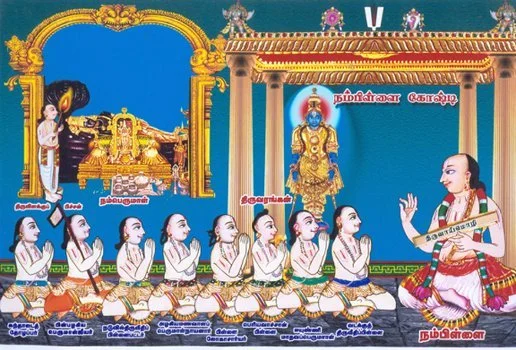
nampiLLai kAlakshEpa gOshti – pinbhazhagiya perumAL jIyar seated 2nd from left
pinbazhagarAm jIyar, a sanyAsi, is nampiLLai’s sath Sishya (devoted disciple). He served his AchArya ardently, engrossed in AchArya thirumEni kainkaryam. His fervent devotion is akin to madhurakavi AzhwAr’s devotion to nammAzhwAr and vaduga nambi’s to emperumAnAr. We are able to learn about the lives of pUrvAchAryas up to nampiLLai through his 6000 padi guru paramparA prabhAvam. [The yathIndhra pravaNa prabhAvam provides details pertaining to AchAryas who came after nampiLLai). He also compiled the upadhESams of many pUrvAchAryas in this grantham, vArthA mAlai that we are currently enjoying.
A vArthai can sometimes be a small phrase, a few sentences, or even many pages long. Each vArthai provides an in-depth meaning and explanation of a thathvam, philosophy or topic (such as artha panchakam etc.) as elaborated by our pUrvAchAryas.
In this article series, we have covered up to vArthai 16. We will continue with the next vArthai in this article.
Before we proceed, we express our gratitude to pinbazhagarAm jIyAr for his mercy in bestowing this grantham upon us. Many in-depth sidhdhAntha matters and thathvams conveyed in vAthAmAlai require expertise in samskrutham and erudite vedhAntha knowledge to conceptualise. However, puththUr swAmy, who has published this grantham (vArthAmAlai), has also provided a lucid explanation for them. We are able to comprehend these complex concepts only because of puththUr swAmy’s elucidations.
Therefore, we are grateful to puththUr swAmy as well.
Finally, we are grateful to SrI u vE sArathy thOthAthri swAmy, who has given us the opportunity to learn these teachings through his thamizh kAlakshEpam series. This article is a translation of swAmy’s kAlakshEpam on this grantham. We thank swAmy for this opportunity and for his continuous help in publishing these series.
This is a long vArthai and is considered to be the vArthai of engaLAzhwAn.
There was an AchAryan called ammangi ammAL. In our sampradhAyam, a few AchAryas have the distinction of being called ammAL. They were not women, but male AchAryas who possessed motherly love towards emperumAn; thus, “ammAL” is considered a reverential title for such AchAryas.
engaLAzhwAn hailed from a place called thiruveLLaRai. His AchAryan was thirukkurugaip pirAn piLLAn, from whom he learnt about our sampradhAyam extensively. He also had close association with emperumAnAr. He held another distinction as well – he was the AchAryan of nadAthUr ammAL, and because of this, he was known as “ammAL AchAryan”.
Below is the entirety of vArthai 17. However, it has been broken into smaller parts to ease our understanding.
engaLAzhwAn SrI pAdhaththilE ammangi ammAL chenRu dhaNdanittu, ‘adiyEnukku dharSanamirukkum padi aruLich cheyya vENum’ enRu viNNappam seyya, engaLAzhwanum, ‘dharSanAntharigaLai nirasikkavO? svadharSana sthApanam paNNavO? dharSanam irukkumpadi kEtkavO?’ enRu aruLich cheyya; ivarum ‘dharSanAntharigaLai nirasikkavum, svadharSana sthApanam paNNavum dhEvarIr ezhundharuLi irundhIr; adiyEnukku dharSanam irukkumpadi aruLich cheyyavENum’ enna; engaLAzhwAn, ammangi ammALukku arulich cheydha sArArtha chathushtayam.
emperumAnAr thiruvadigaLE thanjam enRirukkum nam pUrvAchAryargaL, thangaLukkuth thanjamAgavum uththArgamAgavum bhOgyamAgavum anusandhiththum, upadhESiththum pOruvadhu nAliraNdu arthamuNdu. avaiyAvana – svarUpa gyAnam enRum, svarUpa yAthAthmya gyAnam enRum, virOdhi gyAnam enRum, virOdhi yAthAthmya gyAnam enRum, pala gyAnam enRum, pala yAthAthmya gyAnam enRum, upAya gyAnam enRum, upAya yAthAthmya gyAnam enRum
idhil, svarUpa gyAnamAvadhu – gyAnAnandhangaLum puRavidhazh ennumpadi bhagavadhananyArha SEshathvamE svarUpam enRirukkai. svarUpa yAthAthmya gyAnamAvadhu – bhagavath SEshathvamum puRavidhazh ennumpadi bhAgavatha SEshathvamE svarUpam enRirukkai.
virOdhi gyAnamAvadhu – paramabhAgavatha viSlEshaththilE nenjazhiyAdha ninaivu. virOdhi yAthAthmya gyAnamAvadhu – varundhi oru bhAgavadhanOdE samSlEshikkath thodangi, avan pakkal dhOsha dharSanam paNNugai.
pala gyAnamAvadhu – oru bhAgavathan niyamanaththai veRuththal poRuththal seygai anRikkE, vishaya pravaNanukkup padukkaiththalaiyil vishayapArushyam bhOgyamAmApOlE Agilum bhOgyam enRirukkai. pala yAthathmya gyAnamAvadhu – Arthap prapaththiyaip paNNi akkaraippada oruppattirukkach cheydhE, mAthA pithAkkaLum kUda anAdharikkum padiyAna Arththiyai udaiya SrI vaishNavargaLaik kaNdAl, avargaLudaiya rakshaNaththukku uRuppAga ingE irukkaiyilE oruppadugai.
upAya gyAnamAvadhu – sambandha gyAnam; sambandha gyAnam thAn – sambandha gyAnam enRum, sambandha yAthAthmya gyAnam enRum, sambandha svarUpa gyAnam enRum, sambandha svarUpa yAthAthmya gyAnam enRum nAlu vagai irukkum. idhil sambandha gyAnamAvadhu – avanudaiya nirupAdhika SEshithvaththaiyum, thannudaiya nirupAdhika SEshathvaththaiyum theLiya aRigai. sambandha yAthAthmya gyAnamAvadhu – avanudaiya nirupAdhika SarIrithvaththaiyum, thannudaiya nirupAdhika SarIrathvaththaiyum theLiya aRigai. sambandha svarUpagyAnamAvadhu – avanudaiya nirupAdhika dharmithvaththaiyum thannudaiya nirupAdhika dharmathvaththaiyum theLiya aRigai. sambandha svarUpa yAthAthmya gyAnamAvadhu – dharmi dharmangaLinudaiya aikyaththai theLiya aRigai; adhAvadhu – viSishta vEshaththilE avan oruvanumEyAi thAn illaiyennalAm padi irukkai.
upAya yAthAthmya gyAnamAvadhu – than nishtai. adhAvadhu – SEshathvaththil karthruthva nivruththiyum, gyAnAthruthvaththil karthruthva nivruththiyum, karthruthvaththil karthruthva nivruththiyum, bhOkthruthvaththil karthruthva nivruththiyum piRakkai. SEshathvaththil karthruthvamAvadhu – rAjASrayaththaiyittu jagaththaip pIdikkum manthrigaLaip pOlE, bhagavadhAsaththiyaiyittu sadhAchAraththai negizhkai. adhAvadhu – SabdhAdhi vishayasparSaththil achchamum, bhagavath bhAgavatha kainkarya viSlEshaththil Arththiyum viLaiyAdhozhigai; thannivruththiyAvadhu – prAmAdhikamAna vishayaththilE achchamum, prAmAdhikamAna kainkarya viSlEshaththil Arththiyum viLaigai. gyAthruthvaththil karthruthvamAvadhu – nAm gyAthAvagaiyAlE anRO nammai avan angIkariththadhu enRu than gyAnaththaiyittu iRumAkkai; thannivruththiyAvadhu – dhEhAthmAbhimAnigaLilum kadaiyAi, achith kalpanAy, mudhalazhiththukkoNdu asathkalpanAyk kidandha ennai, irumbaip ponnAkkuvAraippOlE, karundhaRaiyilE pugundhu, Athma gyAnaththaip piRappiththu angIkarippadhE! enRu kruthagyanAyp pOrugai.
karthruthvaththil karthruthvamAvadhu – nAm nishidhdhangaLai vittu vihithangaLaip paRRugaiyAlE anRo nammai avan angIkariththAn enRu than pravruththi nivruththiyaiyittu iRumAkkai; thannivruththiyAvadhu – nam vyApArangaL onRum illai, marappAvaiyai AttuvAraip pOlE, thAnE nishidhdhangaLininRum viduviththu vihithangaLaip paRRuviththAn enRirukkai. bhOkthruthvaththil karthruthvamAvadhu – nAm avanukku adimai seygiROm enRu irukkai; thannivruththiyAvadhu – than kaiyAlE than mayirai vaguththAl anyOnyam upakAra smruthi paNNAdhAp pOlE, avayava bhUthanAna AthmA avayaviyAna emperumAnukku adimai seygiRAn enRu irukkai. ivvarthangaL OrAchAryan angIkariththa mumukshuvukku gyAthavyam.
We shall now the meanings for each vArthai.
engaLAzhwAn SrI pAdhaththilE ammangi ammAL senRu dhaNdanittu, ‘adiyEnukku dharSanamirukkum padi aruLich cheyya vENum’ enRu viNNappam seyya
ammangi ammAL prostrates at the divine feet of engaLAzhwAn, and with folded hands, prays to him (viNNappam cheyya), “Please impart the important principles and characteristics of SrIvaishNava dharSanam”.
engaLAzhwanum, dharSanAntharigaLai nirasikkavO?, svadharSana sthApanam paNNavO? dharSanam irukkumpadi kEtkavO? enRu aruLich cheyya
engaLAzhwan graciously asks, “Is it to win over the dharSanAntharigaL – proponents of other philosophies, or to establish sampradhAyam elsewhere, or to understand in detail about our own sampradhAyam”?
ivarum ‘dharSanAntharigaLai nirasikkavum, svadharSana sthApanam paNNavum dhEvarIr ezhundharuLi irundhIr; adiyEnukku dharSanam irukkumpadi aruLich cheyyavENum’ enna;
ammangi ammAL, replies with devotion and sincerity, “dhEvarIr is present to win over the proponents of other philosophies as well as to establish our sampradhAyam. adiyEn wishes to understand about our sampradhAyam from dhEvarIr”.
engaLAzhwAn, ammangi ammALukku arulich cheydha sArArtha chathushtayam
sAram in sArArtha means ‘essence/core of our sampradAyam’ and chathushtayam means it is divided in four parts. Thus, the essence of our sampradhAyam, graciously bestowed by engaLAzhwAn to ammangi ammAL, is categorised into four.
[Below, is the explanation provided by engaLAzhwAn, describing sArArtha chathushtayam].
emperumAnAr thiruvadigaLE thanjam enRirukkum nam pUrvAchAryargaL
Our pUrvAchAryas, who always took refuge in emperumAnAr’s divine feet
[Note: embAr tells bhattar, “Do not consider yourself to be a vidhwAn; always be under the shelter of emperumAnAr’s divine feet”. bhattar tells nanjIyar, “Do not think of yourself as a vEdhAnthi; always be under the shelter of emperumAnAr’s divine feet”. nanjIyar conveys the same to nampiLLai. In this manner, each and every AchArya instructs their Sishya to always be dependent on emperumAnAr’s divine feet. Therefore engaLAzhwAn says, ‘Our pUrvAchAryas who say – ‘always take refuge in emperumAnAr’s divine feet’].
thangaLukkuth thanjamAgavum uththArgamAgavum bhOgyamAgavum anusandhiththum, upadhESiththum pOruvadhu nAliraNdu arthamuNdu.
As their support, as means to uplift them, and as a source of joy, they contemplated and instructed the eight arthams (meanings)/nAliraNdu (4*2).
avaiyAvana – svarUpa gyAnam enRum, svarUpa yAthAthmya gyAnam enRum, virOdhi gyAnam enRum, virOdhi yAthAthmya gyAnam enRum, pala gyAnam enRum, palayAthAthmya gyAnam enRum, upAya gyAnam enRum, upAya yAthAthmya gyAnam enRum
svarUpam (true nature), palam (results), virOdhi (hurdles), upAyam (means). Each of these can be divided further into yAthAthmya gyAnam – svarUpa yAthAthmya gyAnam, pala yAthAthmya gyAnam, virOdhi yAthAthmya gyAnam, upAya yAthAthmya gyAnam.
gyAnam is knowledge and yAthAthmya gyAnam is indepth knowledge.
idhil, svarUpa gyAnamAvadhu – gyAnAnandhangaLum puRavidhazh ennumpadi bhagavadhananyArha SEshathvamE svarUpam enRirukkai.
The true knowledge about svarUpam (svarUpa gyAnamAvadhu) is understanding exclusive subservience to perumAL. Just as a flower’s fragrance is its core and its petals are only the outer layer, realisation of bhagavadhananyArha SEshathvamE (absolute, exclusive servitude to bhagavAn) is the essential essence, more vital than gyAnam and Anandham, which are merely like outer petals. Here, ananyArham denotes subservience to perumAL alone.
svarUpa yAthAthmya gyAnamAvadhu – bhagavath SEshathvamum puRavidhazh ennumpadi bhAgavatha SEshathvamE svarUpam enRirukkai.
svarUpa yAthAthmya gyAnamAvadhu means in-depth knowledge of our true nature. However, the deeper knowledge of our svarUpam (true nature) is realising that bhagavath SEshathvam (subservience to bhagavAn) is just as outer layer of the flower, while the true essence is bhAgavatha SEshathvam (subservience to his devotees). As expressed by thirumangai AzhwAr to perumAL in periya thirumozhi 8.10.3 “nin thiruvettezhuththum kaRRu – nAn uRRadhum un adiyArkku adimai” (after learning SrI ashtAksharam, I realised that I am a servitor of your devotees).
virOdhi gyAnamAvadhu – paramabhAgavatha viSlEshaththilE nenjazhiyAdha ninaivu.
What is our enemy? Being separated from bhAgavathas is the enemy. Not even having any emotion that arise from the pain of such separation and being oblivious of such absence in our sentiment is our adversary. (nammAzhwAr says in thiruvAimozhi 2.3.10 “adiyAr kuzhAngaLai – udan kUduvadhu enRukolO” (when will I enter the groups of nithyasUris).
virOdhi yAthAthmya gyAnamAvadhu – varundhi oru bhAgavathanOdE samSlEshikkath thodangi, avan pakkal dhOsha dharSanam paNNugai.
After one gains association with a spiritually elevated bhAgavatha, if one begins to look for faults in that bhAgavatha, understanding this tendency as the deeper form of virOdhi is yAthAthmya gyAnam (deeper knowledge).
pala gyAnamAvadhu – oru bhAgavathan niyamanaththai veRuththal poRuththal seygai anRikkE, vishaya pravaNanukkup padukkaiththalaiyil vishayapArushyam bhOgyamAmApOlE Agilum bhOgyam enRirukkai.
palam is purushArtham, the ultimate purpose or goal. When performing a kainkaryam to a bhAgavatha, just as even unfavourable things can become pleasurable in certain circumstances (The example given is in the association between a man and a woman, even sweat normally considered unpleasant is accepted with joy and not disgust), in the same way, kainkaryam must be performed with joy, never with dislike or reluctance. That is the ultimate goal.
pala yAthathmya gyAnamAvadhu – Artha prapaththiyaip paNNi akkaraippada oruppattirukkach cheydhE, mAthA pithAkkaLum kUda anAdharikkum padiyAna Arththiyai udaiya SrIvaishNavargaLaik kaNdAl, avargaLudaiya rakshaNaththukku uRuppAga ingE irukkaiyilE oruppadugai.
pala yAdathmya gyAnam – In prapaththi there are 2 approaches. One is dhruptha prapaththi, where a person surrenders to perumAL and then, patiently waits – performing kainkaryam to bhAgavathas and performing kainkaryams in various dhivyadhESams until that day mOksham is granted.
The other is Artha prapaththi, exemplified by nammAzhwAr in his prayer – I cannot remain separated from You even for a moment; please grant me moksham immediately. (thiruviruththam 1) “poy ninRa gyAnamum pollA ozhukkum azhukkudambum inninRa nIrmai iniyAm uRAmai” (Oh the lord of nithyasUris (permanent dwellers of SrIvaikuNtam)! We should be without these births which are the cause for our sorrow and which are with knowledge which is the opposite of truth (we should be without faulty knowledge), with wrongful deeds, physical forms which are full of impurity etc. You should stand firmly and hear my appeal to you from me, your servitor, for the sake of this).
When a SrIvaishNavan who has performed Artha prapaththi and, because of his constant and intense longing for perumAL, even his parents do not support him, a SrIvaishNava realising that protecting and supporting such a SrIvaishNavan living solely for that purpose and even postponing one’s own desire for mOksham in order to support such SrIvaishNavan is pala yAthAthmya gyAnam.
Example for this is the life of pinbazhagarAm perumAL jIyar, disciple of nampiLLai and a sanyAsi.
He once suffered from an illness and went to a local doctor for some medicine. In those days, going to a doctor and taking medicine was considered lowly for SrIvaishNavas. They were expected to show complete dependence on perumAL for everything and protecting one’s own body was seen as inferior. People reported this to his AchAryan, nampiLLai, saying, “Perhaps he did this to ensure dharSan of namperumAL, or to continue attending nampiLLai’s kAlakshEpam”.
When pinbazhagarAm perumAL jIyar arrived, nampiLLai asked him about it directly. He replied, “You are already aware of the reason . Yet, since you ask, I will say it. When you, my AchAryan take a dip in the river and come out after bathing, small droplets of sweat appear on your back. It is my duty to fan your back as I walk behind you. To continue this service, I went and took medicine from a doctor”. Everyone was astonished at his devotion to his AchAryan.
maNavAla mAmunigaL highlights this kind of devotion in 2 pAsurams of upadesa rathinamAlai, upadhESa raththina mAlai 65
“AchAryan chichchan Aruyiraip pENumavan
thEsArum chichchan avan seer vadivai – Asaiyudan
nOkkumavan ennum nuN aRivaik kEttu vaiththum
Arkkum annEr niRkai aRidhAm” (He (maNavALa mAmunigAL) divined in the last two pAsurams about how due to gratitude and due to love towards services to AchAryan would not let a disciple stay away from AchAryan; he divines in this pAsuram that by the relationship formed due to the aforementioned, how they take care of svarUpam and divine body respectively, and that even though this meaning is heard, doing that in practice is difficult to achieve). – this pAsuram highlights how due to gratitude and due to love towards services to AchAryan would not let a disciple stay away from AchAryan.
“than Ariyanukkuth thAn adimai seyvadhu avan
innAdu thannil irukkum nAL – annEr
aRindhum adhil Asai inRi AchAriyanaip
pirindhu irupAr Ar manamE pEsu” (He (maNavALa mAmunigaL) says that if one thinks about the help of AchAryan as explained in the previous pAsuram, there is no reason for separating from him. If one realises the service to be done to the true goal that is AchAryan, then too there is no reason for separating from him).
And he also quotes pinbazhagarAm perumAL jIyar as an example to show the rarity of disciple’s identity expressed through unwavering devotion, highlighting how he was involved in doing services to his AchAryan without separating from him for even a second.
“pinbazhagarAm perumAL seeyar perunthivaththil
anbadhuvum aRRu mikka AsaiyinAl – nampiLLaikku
Ana adimaigaL sey annilaiyai nannenjE
UnamaRa eppozhudhum Or” (Disciple by the name of pinbazhagarAm perumAL jIyar, not having any in interest in the big paramapadham, instead, possessed distinguished devotion for his AchAryan nampiLLai and perfomed appropriate kainkaryams to him. Oh, the goood mind! Keep that state in mind at all times without fail).
upAya gyAnamAvadhu
upAya gyAnam is the knowledge of the sambandham (relationship) that perumAL is the SEshi (master) and the jIvAthmA is the SEshabUthan (dependent). perumAL is the protector, and we are the ones to be protected. Understanding this relationship is upAya gyAnam.
This understanding of the relationship (sambandha gyAnam) is explained in four ways.
- sambandha gyAnam
- sambandha yAthAthmya gyAnam
- sambandha svarUpa gyAnam
- sambandha svarUpa yAthAthmya gyAnam.
sambandha gyAnam – sambandha gyAnam thAn – sambandha gyAnam enRum, sambandha yAthAthmya gyAnam enRum, sambandha svarUpa gyAnam enRum, sambandha svarUpa yAthAthmya gyAnam enRum nAlu vagai irukkum. idhil sambandha gyAnamAvadhu – avanudaiya nirupAdhika SEshithvaththaiyum, thannudaiya nirupAdhika SEshathvaththaiyum theLiya aRigai. sambandha yAthAthmya gyAnamAvadhu – avanudaiya nirupAdhika SarIrithvaththaiyum, thannudaiya nirupAdhika SarIrathvaththaiyum theLiya aRigai.
sambandha gyAnam – This is the knowledge of our natural association with perumAL, an association that exists without any reason. Our relationships with other beings arise due to karma accumulated over previous births. It is sOpAdhikam (with a condition). However, perumAL’s relationship with us, as our protector, is the only relationship that exists naturally and without cause. It is nirupAdhikam means “without reason”. Therefore our subservience to him is also natural and causeless.
sambandha yAthAthmya gyAnam is the knowledge of the SarIra- SarIri sambandham that perumAL is the AthmA and we are his body. Our association with our physical body is due to karma, but our SarIra- SarIri sambandham with perumAL is not. Instead, it is inherent and natural. It is only because of this sambandhham that perumAL is able to exercise his authority over us. This is also nirupAdhika sambandham, he is nirupAdhika SarIri and we exist as his nirupAdhika SarIram.
All these relationship between AthmA and emperumAn are explained step by step describing the different levels. SEshi -SEshan, SarIri – SarIram. Next, dharmi – dharmam are explained.
sambandha svarUpa gyAnam is the knowledge of dharmi – dharma sambandham, the inseparable relationship between an entity and its attribute, like a flower and its fragrance or a cloth and its whiteness. In the same way, there is an inseparable relationship between the jIvAthmA and perumAL. In sampradhAyam, this inseparability is termed as “apruthak sidhdham”. thirumazhisai AzhwAr describes this relationship in nAnmugan thiruvandhAdhi 7 “nAraNanE nI ennai anRi ilai/ nAnunnai anRi ilEn” (Oh nArAyaNa! I have no refuge other than you, you too, do not have one to take care of, other than me).
sambandha svarUpagyAnamAvadhu – avanudaiya nirupAdhika dharmithvaththaiyum thannudaiya nirupAdhika dharmathvaththaiyum theLiya aRigai. sambandha svarUpa yAthAthmya gyAnamAvadhu – dharmi dharmangaLinudaiya aikyaththai theLiya aRigai; adhAvadhu – viSishta vEshaththilE avan oruvanumEyAi thAn illaiyennalAm padi irukkai.
sambandha svarUpa yAthAthmya gyAnam – This is the proper and deeper understanding of the dharmi-dharma relationship, because different philosophies interpret this relationship differently. In the state of togetherness, he, the supreme lord appears as the only one, and it seems as though we do not exist. This is because the importance is entirely for perumAL and not for others. [This concept is bit difficult to grasp, however, can be understood with the following example]. thiruvAimozhi 2-9-9, nammAzhwAr first says, “Due to lack of knowledge, I was bewildered in myself. After realisation, I understand, that I am also ‘you’ and my belongings (i.e. SarIram etc) are also ‘you'”. This may lead one to doubt whether AzhwAr is referring about adhvaitham. Such doubt is eliminated in the last sentence. AzhwAr says, Oh, one who is praised by all in paramapadham.
“yAnE ennai aRiyagilAdhE
yAnE enRanadhE enRirundhEn
yAnE nI en udaimaiyum nIyE
vAnE Eththum em vAnavar ERE“
In the same way in another pAsuram (thiruvAimozhi 4-9-10), nammAzhwAr says “oNdodiyAL thirumagaLum nIyumE nilA niRpak kaNda sadhir kaNdozhindhEn adaindhEn un thiruvadiyE“. Here, AzhwAr talks about the togetherness of pirAtti and perumAL alone in nithya vibUthi. This has the meaning as the previous pAsuram.
What is inferred here is that perumAL has all the jIvAthmAs as his body(his prakAram). When perceived in this manner, he alone is seen. As we approach him and understand him better, we realise that jIvAthmAs and insentient beings are his body. So when AzhwAr says, pirAtti and perumAL are the only ones present in nithya vibUthi it means – all others are present are subservient, engaged in eternal kainkaryam. That is, they exist only to witness the joy and satisfaction on the divine faces of perumAL and pirAtti.
A worldly example to understand this – When people say to a king, “You are the kingdom,” it does not mean he is alone. It means there is no one else significant, other than the king himself in the kingdom. He represents the entire kingdom.
Therefore, when AzhwAr says, yAnE nI en udaimaiyum nIyE, he means that AzhwAr (the AthmA) is perumAL’s body and AzhwAr’s possessions like his body, house, jug etc are also perumAL’s body. This knowledge has to be understood clearly. emperumAn is viSEshyam, and everything exsits as viSEshaNam (attributes) to him. This oneness is the inseparable unity between prakAram (jIvAthmAs) and prakAri (emperumAn). This is sambandha svarUpa yAthAthmya gyAnam.
upAya yAthAthmya gyAnamAvadhu – than nishtai. adhAvadhu – SEshathvaththil karthruthva nivruththiyum, gyAnAthruthvaththil karthruthva nivruththiyum, karthruthvaththil karthruthva nivruththiyum, bhOkthruthvaththil karthruthva nivruththiyum piRakkai.
upAya yAthAthmya gyAnam is the unwavering, steadfast devotion towards perumAL that arises after understanding the four types of knowledge described above.
karthA refers to the doer, and “karthruthvam” is the feeling of “I am the doer”. This feeling must not be present in four aspects. This knowledge is divided into four forms: 1. SEshathvaththil karthruthva nivruththi 2. gyAthruthvaththil karthruthva nivruththi 3. karthruthvaththil karthruthva nivruththi 4. bhOkthruthvaththil karthruthva nivruththi.
thirumazhisai AzhwAr calls perumAL “paththi uzhavan” (the efforts put in by this farmer (emperumAn)) in nAnmugan thiruvandhAdhi -23. Just as a farmer prepares the field, sows the seed, nurtures the crop, removes the weeds and harvests the final produce for his own purpose, perumAL does everything to uplift the jIvAthmA from beginning to end. He grants us birth in this universe, bestows devotion, removes our obstacles and faults, and ultimately places us on the path of kainkaryam.
Therefore, whatever the jIvAthmAs does is entirely dependent on the grace of perumAL. Hence, we must abandon self-reliance and live with absolute dependence on him , constantly look to his hands rather than relying on our own efforts.
SEshathvaththil karthruthvamAvadhu – rAjASrayaththaiyittu jagaththaip pIdikkum manthrigaLaip pOlE, bhagavadhAsaththiyaiyittu sadhAchAraththai negizhkai.
karthruthvam in SEshathvam is explained through the example of a minister who misuses his authority and the influence in a kingdom, causing trouble for the common people. In the same way, even after knowing well that perumAL resides within us, and even after performing prapaththi, if one gives up the austerities and religious disciplines followed by our pUrvAchAryas, it becomes karthruthvam in SEshathvam. It leads to the mistaken belief that because we are close to perumAL, we may do anything and no one will question us. It is said that bhagavAn treats those who have performed SaraNAgathi to him as a rAja puthran (prince). Abandoning duties due to this privilege is karthruthvam.
However, the truth is that the minister will be punished the moment the king learns of his misdeeds. Similarly, if one begins to perform actions with the feeling of the doer – ‘I am doing this’ – then he will be made to face the consequences for his actions. Therefore, even after performing SaraNAgathi, if we do not act according to the SAsthram, the jIvAthma will face the punishments appropriate for the wrong actions. Hence, one must stay away (nivruththi) from karthruthvam in SEshathvam.
adhAvadhu – SabdhAdhi vishayasparSaththil achchamum,
achchamum – fear. Fear of material senses such as sight, touch etc. (any worldly pleasures).
In thiruvAimozhi 6-10-10, AzhwAr performs SaraNAgathi at the divine feet of thiruvEngadamudaiyAn, pleading, “agalagillEn iRaiyum enRu alar mEl mangai uRai mArbA!” Thinking he has attained moksham, he opens his eyes and sees the same samsAram again. He then cries out out of fear of the sense organs, “uNNilAviya aivarAl kumai thIRRi” (the senses which are internal enemy due to residing inside permanently, torture me) thiruvAimozhi 7-1-1 . Therefore, it is essential that we have this fear. Cultivating this fear is sadhAchAram (righteous conduct). Staying away from the worldly pleasures was the religious austerity that our pUrvAchAryAs followed.
bhagavath bhAgavatha kainkarya viSlEshaththil Arththiyum viLaiyAdhozhigai
Another important aspect is to feel the pain when kainkaryam to perumAL and his bhAgavathas gets disrupted. The absence of this feeling indicates a lack of upAya yAthAthmya gyAnam.
thannivruththiyAvadhu – How is this corrected?
prAmAdhikamAna vishayaththilE achchamum, prAmAdhikamAna kainkarya viSlEshaththil Arththiyum viLaigai.
prAmAdhikam means carelessness, negligence. viSlEsham means separation. This means a person develops a sense of fear even for mistakes committed unknowingly. Similarly, when there is a disruption in services (kainkaryam) – even if we did not stay away by choice – we must regret it. Here, we must understand that even when we have a valid reason, the disruption still happened because of our past karma. Having this feeling is essential. When we feel this way, it shows that karthruthva nivruththi (the removal of the sense of ‘doership’) is present in SEshathvam (being subservient to emperumAn).
gyAthruthvaththil karthruthvamAvadhu – nAm gyAthAvagaiyAlE anRO nammai avan angIkariththadhu enRu than gyAnaththaiyittu iRumAkkai;
gyAthruthvathil karthruthvam – This is the pride that arises from thinking “Because I have gained knowledge about perumAL by studying various scriptures, perumAL endorses me due to this knowledge”.
than nivruththiyAvadhu – How does one overcome it?
dhEhAthmAbhimAnigaLilum kadaiyAi, achith kalpanAy, mudhalazhiththukkoNdu asathkalpanAy kidandha ennai, irumbaip ponnAkkuvAraippOlE, karunthaRaiyilE pugundhu, Athma gyAnaththaip piRappiththu angIkarippadhE! enRu kruthagyanAy pOrugai.
By considering oneself the last person in the long queue of those who suffer from dhEhAthmAbhimAnam (the mistaken identification of the body as the self), seeing oneself as equivalent to achith at the time of praLayam, and by remembering that – just as an alchemist changes iron into gold, or a farmer turns barren land into fertile soil – emperumAn has moulded a useless person like me by granting appropriate wisdom and knowledge, we cultivate gratitude. When we hold this gratitude, gyAthruthvathil karthruthvam can be corrected. [thiruvAimozhi 5-7-3 “poruL allAdha ennaip poruL Akki adimai koNdAy” (He transformed me, who cannot be considered as an entity as said in “asannEva” (like achith) to realise my nature)].
karthruthvaththil karthruthvamAvadhu – nAm nishidhdhangaLai vittu vihithangaLaip paRRugaiyAlE anRo nammai avan angIkariththAn enRu than pravruththi nivruththiyaiyittu iRumAkkai
karthruthvam refers to what we do and the challenge is to eradicate the feeling “I am doing” from those actions. Taking pride in following what SAsthram command, avoiding what they prohibit (pravruththi nivruththiyaiyittu ), and thinking that perumAL endorses us because of this is karthruthvaththil karthruthvam.
than nivruththiyAvadhu – How to remove this?
nam vyApArangaL onRum illai, marappAvaiyai AttuvAraip pOlE, thAnE nishidhdhangaLininRum viduviththu vihithangaLaip paRRuviththAn enRirukkai.
To give this up, one must feel that the actions are not ours, that we are puppets in his hands and that he alone removes our deficiencies and bestows us with his grace. This attitude reduces the sense of personal doer-ship.
bhOkthruthvaththil karthruthvamAvadhu – nAm avanukku adimai seygiROm enRu irukkai;
The feeling that, “I am perumAL’s slave and I am serving him’ is bhOkthruthvaththilE karthruthvam.
than nivruththiyAvadhu – How to overcome this?
than kaiyAlE than mayirai vaguththAl anyOnyam upakAra smruthi paNNAdhAp pOlE, avayava bhUthanAna AthmA avayaviyAna emperumAnukku adimai seygiRAn enRu irukkai.
We, jIvAthmAs are his SarIram. emperumAn manifests a joy for himself using jIvAthmAs. A simple example is given: when we adjust or comb out hair, the hair does not say “thank you” or remain in gratitude. It is a natural, inherent act that requires no recognition. In the same way, emperumAn, using the jIvAthmAs has created certain things for joy. Therefore, feeling that we are performing kainkaryam and expect something in return is not appropriate (for example, in difficulty, one may say, why do I have to face so much hardship in spite of all the services done by me). Rather, we must realise that it is only because emperumAn desired and made us perform the kainkaryam that we perform it. Hence, understand that it is natural and not something to take pride in.
ivvarthangaL OrAchAryan angIkariththa mumukshuvukku gyAthavyam.
These profound meanings (sArArtha chathushtayam) are must to be understood by those who have an innate desire for mOksham, mumukshu, who is subservient to his AchAryan.
AzhwAr emperumAnAr jIyar thiruvadigaLE SaraNam
jIyar thiruvadigaLE SaraNam
pinbhazhagiya perumAL jIyar thiruvadigaLE SaraNam
Source
- Audio – https://1drv.ms/u/s!AnOSadexHn4jhGyqtgfBcJxHCZC2?e=P0dVse
- Video – https://youtu.be/LWSRO6H_W1A
adiyEn SrIdhEvi rAmAnuja dhAsi
archived in https://granthams.koyil.org
pramEyam (goal) – https://koyil.org
pramANam (scriptures) – https://granthams.koyil.org
pramAthA (preceptors) – http://acharyas.koyil.org
SrIvaishNava education/kids portal – http://pillai.koyil.org
2 thoughts on “vArthAmAlai – Part 6 – vArthai 17”