SrI: SrImathE SatakOpAya nama: SrImathE rAmAnujAya nama: SrImath varavaramunayE nama:
The extremely merciful periyavAchchAn piLLai has selected important SlOkams from SrI rAmAyaNam and provided detailed commentary for them; this is celebrated as SrI rAmAyaNa thaniSlOkam. puththUr swAmy has published this grantham along with an exquisite thamizh commentary. SrI rAmAyaNam is glorified as SaraNAgathi SAsthram. Currently, in this series, we are enjoying the special meanings of the SlOkams in yudhdha kANdam. In the previous six articles, SaraNAgathi was illustrated in detail with the characterisation of vibhIshaNa SaraNAgathi.
Generally, in worldly matters, a person, capable of achieving something on their own, does not plead to someone saying ‘You are my refuge!’. Conversely, in Athma ujjIvanam, the belief that we could save ourselves through self-endeavour will prevent us from approaching perumAL and performing SaraNAgathi. However, some may raise a question, is SaraNAgathi the only path to liberation, or are there other paths for Athma ujjIvanam?
The scriptures reveal many paths to attain bhagavAn, such as karma yOgam [path of deeds], gyAna yOgam [path of knowledge], bhakthi yOgam [path of devotion], chanting the divine names, serving the supreme lord through various means, residing in a dhivyadhESam, purushOththama vidhyA, etc. However, not all of these paths can be pursued by everyone due to qualifications prescribed for engaging in those activities. For example, karma yOgam, gyAna yOgam, bhakthi yOgam can be performed only by the thraivarNikars, who have had the upanayana samskAram and have learnt the vEdham. Conversely, chanting the divine names of the supreme lord or residing in a dhivyadhESam can be pursued by everyone. Consequently, nAma sankIrthanam, [reciting the divine names of emperumAn] is the most prevalent path in the world. In SrI bhagavath gIthA, emperumAn, krishNa himself declares that he can be attained through bhakthi [devotion] or prapaththi [SaraNagathi, act of surrendering].
There are many pramANams [authentic texts], which describe nAma sankIrthanam as a means to attain perumAL. In krutha yugam, one engages in meditation to realise the supreme lord; in thrEthA yugam, one performs yAgam [rituals] to attain him; in dhvApara yugam, one worships the archA thirumEni [emperumAn in idol form in divine abodes] to attain him; and in kali yugam, one attains the supreme lord by chanting his divine names. Even though these dharmams [paths] differ across each yugam, the common dharmam for all yugams is realising that we cannot protect ourselves, acknowledging the supreme lord is our rAkshakan [protector], and surrendering to him. Therefore, SaraNAgathi is revealed in the scriptures as the supreme means to attain emperumAn in all yugams. Everyone is qualified to perform SaraNAgathi.
We have seen many people perform SaraNAgathi on different occasions, some were successful, while a few others were not. The presence of two qualities in the surrenderer and two qualities in the surrenderee is considered the true reason for SaraNAgathi to succeed. That is, the SaraNyan (one who accepts the surrender) must possess supremacy (so that he can accomplish everything) and simplicity (so that he can be approachable by the refugee). Conversely, the SaraNAgathan (one who surrenders) must possess Akinchanyam (state of helplessness) and ananyagathithvam (state of having no refuge other than emperumAn).
The sublimity and candidness in SaraNAgathi can be understood through this anecdote. Once, while passing through a forest, the great AchArya bhattar encountered a hunter. As soon as the hunter beheld the radiant thirumEni of bhattar, beautifully adorned in SrIvaishNava alankAram – with Urdhva puNdram, thulasi and lotus garland – an instant impulse prompted him to prostrate before bhattar immediately. He offered his respects and served him. At this juncture, bhattar enquired about the hunter’s day. While describing his daily events, the hunter mentioned catching a young rabbit but releasing it upon seeing the mother rabbit looking desperately at him. Upon hearing this, bhattar lost consciousness from sheer emotion. After recovering, bhattar explained that neither the hunter nor the rabbit knew the formal concept of SaraNAgathi. However, the mother rabbit displayed its absolute helplessness through its gaze, and the hunter, moved by compassion, released the young rabbit. Explaining this, bhattar remarked, ‘This is the true glory of SaraNAgathi’.
Thus, when we stand in front of emperumAn displaying our inability, he bestows his mercy and accepts us. This is how vibhIshaNAzhwAn stood and asked sugrIva mahArAja and others to announce his arrival. What happened next is revealed in the subsequent SlOkams, which we will enjoy in this article.
Before proceeding with the vyAkhyAnam, we express our gratitude to periyavAchchAn piLLai and puththUr swAmy, as well as to SrI u vE sArathy thOthAthri swAmy. This article is a translation of periyavAchchAn piLLai’s thaniSlOka vivaraNam with the support of SrI sArathy swAmy’s thamizh kAlakshEpam series.
avathArikai (Introduction)
Out of profound affection for perumAL, sugrIva mahArAja misinterprets vibhIshaNAzhwAn’s well-meaning words as deceptive; anxious to refute them, he speaks to perumAL, advocating vibhIshaNAzhwAn’s destruction.
[Note from kAlakshEpam: Many times, due to our ignorance, we are intrigued by certain events described in ithihAsams and purANams, and we are surprised by the emotions of great devotees. perumAL is compelled by his mercy towards vibhIshaNAzhwAn, whereas, sugrIva mahArAja is compelled by his affection towards perumAL. Similarly, when iLaiyaperumAL sees bharathAzhwAn in the forest, he says, ‘He deserves to be killed’. Likewise, sugrIva mahArAja says that vibhIshaNAzhwAn must be killed. One may wonder why iLaiyaperumAL and sugrIva mahArAja, being esteemed devotees, expressed such emotions towards another devotee. These are expressions that stem from their overwhelming affection towards perumAL and are not born out of personal enmity. This must not be compared to the despise we are familiar with in our mundane lives. They were overly anxious regarding dangers that might befall perumAL. Since their focus was entirely on perumAL, when counselled, they were able to make peace and abandon their earlier notions].
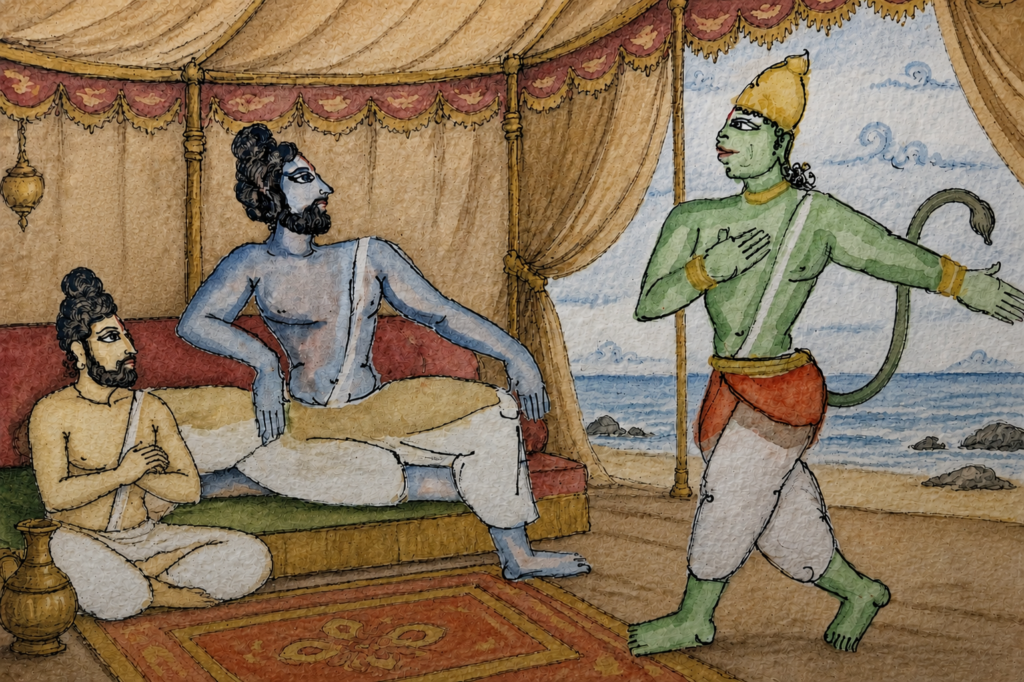
Ethaththu vachanam SruthvA sugrIvO laghuvikrama: I
lakshmaNasyAgrathO rAmam samrabdham idham abravIth II
Word-by-word meaning
sugrIva: thu – As for sugrIva mahArAja
Ethath – these
vachanam – words
SruthvA – having heard
laghuvikrama: – having a swift pace
lakshmaNasya – lakshmaNa’s (iLaiyaperumAL’s)
agratha: – in the divine presence of
rAmam – to SrI rAma
samrabdham – hurriedly
idham – these words
abravIth – spoke
Simple meaning
After hearing these words, sugrIva mahArAja, walking at a swift pace, arriving in iLaiyaperumAL’s divine presence, hurriedly spoke these words to SrI rAma.
Notes from periyavAchchAn piLLai’s vyAkhyAnam
Ethath vachanam SruthvA thu – After hearing these words
- SrI rAmAyaNam yudhdha kANdam 17-14 “rAghavam SaraNam gatha:” (I have surrendered to SrI rAma).
Herein, the word ‘thu’ indicates a shift in sugrIva mahArAja’s mental disposition [he became anxious and angry] upon hearing these words of surrender – ‘I have come to take refuge in SrI rAma’.
[Previously, seeing vibhIshaNAzhwAn with his mace, merely aroused suspicion in sugrIva mahArAja. However, after hearing the declaration of surrender, he became certain that vibhIshaNAzhwAn’s true intention was to harm perumAL].
- SrI rAmAyaNam yudhdha kANdam 17-4 “chinthayithvA muhUrtham thu” (But after thinking for a moment).
In this SlOkam, the word ‘thu’, indicates a shift in sugrIva mahArAja’s frame of mind due to fear of suspicion. He begins to think, “vibhIshaNa is not a spy or a messenger, he is indeed, an enemy”.
However, this shift in his mindset differs from the previous SlOkam. Earlier, when sugrIva mahAraja first ascertained that vibhIshaNAzhwAn – the enemy had arrived, he felt a sense of solace. He was in a much better disposition because he was certain that SrI rAma would defeat him. Now, his perspective has changed. sugrIva mahArAja suspects that vibhIshaNAzhwAn is hiding his evil intentions behind his words of SaraNAgathi just to prompt SrI rAma to accept him as a confidant. Because of this new fear, he can no longer find comfort with his earlier respite.
laghuvikrama: – walked with great speed
sugrIva mahArAja thought, “If vibhIshaNAzhwAn’s words of SaraNAgathi reach perumAL’s ears, there will be no possibility to avert the danger”. Therefore, he walked swiftly to approach perumAL before vibhIshaNAzhwAn’s words could be heard. (puththUr swAmy’s explanation: ‘vikrama’ illustrates sugrIva mahArAja’s swift pace, as in thrivikrama perumAL, who had swiftly measured the two worlds, with his two divine feet. Alternatively, it refers to the ease with which sugrIva had attained valour to defeat vibhIshaNa. Of the two, the earlier meaning is more eminent, being in synchronisation with the explanation).
lakshmaNasyAgratha:
Consequently, he went and joined hands in the presence of iLaiyaperumAL, who was just as solicitous about SrI rAma, as he. iLaiyaperumAL, too, had the quality of doubting if danger would occur, even in inappopriate situations; when bharathAzhwAn came to the forest to meet perumAL, he became overanxious upon seeing him.
- SrI rAmAyaNam ayOdhyA kANdam 96-23 “bharathasya vadhE dhOsham nAham paSyAmi” (I do not see any fault in killing bharatha).
rAmam
rAmam – He, who became pleased, beautiful, upon hearing ‘I surrendered to rAghava’.
- SrI rAmAyaNam yudhdha kANdam 17-14 “rAghavam SaraNam gatha:” (I have surrendered to SrI rAma).
samrabdham – anxiously
sugrIva mahArAja anxiously spoke to SrI rAma in a manner that makes it impossible for perumAL to refute or deny his words. He addressed SrI rAma with such anxiety, as if to say “Has it been a long time since you left ayOdhyA? Have you forgotten the rAja nIthI (royal justice) due to being away from your kingdom for so long? Are we not at the entrance of lankA (the enemy’s fort)? Don’t you know the atrocities committed by rAvaNa? Have you forgotten about all these aspects merely upon hearing someone surrender to you?”
idhamabravIth – spoke these
sugrIva mahArAja did not convey his doubts, saying, “He appears to be a rAkshasa chief; he spoke favourably, but I don’t know whether he is an enemy or a friend”. Instead, he concluded that he was an enemy and, without informing SrI rAma about the arrival of vibhIshaNa, began to indulge in the good activity [sarcasm] to reject vibhIshaNAzhwAn.
rAmam lakshmaNasyAgratha: samrabdham idhamabravIth – in the presence of iLaiyaperumAL he spoke with anxiety
- SrI rAmAyaNAm AraNya kANdam 13-12 “thvAm Aha sIthA bahU vAkya jAtham” (perumAL says to iLaiyaperumAL: sIthA dhEvi spoke many words to you). In this instance, sIthAp pirAtti spoke about winning over perumAL to iLaiyaperumAL in perumAL’s presence. Thus, it can also be understood similarly that sugrIva mahArAja, while looking towards iLaiyaperumAL, spoke to perumAL.
Ethaththu vachanam SruthvA sugrIvO laghuvikrama: I
lakshmaNasyAgrathO rAmam samrabdhamidhamabravIth II
Thus concludes the vyAkhyAnam for this SlOkam.
SrI rAmAyaNa thani SlOkam – 63 – yudhdha kANdam 17.18 – manthrE vyUhE
In the 17th SlOkam, sugrIva mahArAja says, “We must not accept him without analysing. Since he has come from the enemy’s side, he may lead us into things of which we are unaware. His intention might be to destroy us through deception, like owls destroying crows”.
In the 18th SlOkam, sugrIva mahArAja speaks to perumAL. He begins by saying, “May auspiciousness come to you (bhadhram thE)”!
avathArikai (Introduction)
Addressing perumAL, sugrIva mahArAja says, “dhEvarIr must exercise caution during confidential discussions and troop organisation, so that vibhIshaNa and his associates cause no harm”. Furthermore, driven by his affection towards perumAL, sugrIva mahArAja continues to offer mangaLASAsanam.
manthrE vyUhE nayE chArE yukthO bhavithumarhasi I
vAnarANAm cha bhadhram thE parEshAm cha paranthapa II
Word-by-word meaning
paranthapa – Oh, the annihilator of enemies!
manthrE – in confidential discussion
vyUhE – in organising the troops
nayE – in strategies (such as sAma, bhEdha, dhAna, dhaNda
chArE – in espionage
yuktha: bhavithum – to be wary
arhasi – your highness is apt
thE – to your highness
vAnarANAm cha – and to the monkeys
parEshAm cha – and to all others present
bhadhram – may auspiciousness happen
Simple meaning
Oh, the annihilator of enemies! May auspiciousness come to your highness! Your highness has to be wary in the matters of confidential discussions, configuration of troops, strategies and secret services.
Notes from periyavAchchAn piLLai’s vyAkhyAnam
manthrE – deliberations with ministers – This refers to analysing strategies for executing royal affairs in strict confidentiality with ministers who are experts in the codes of justice and law (rAja nIdhI).
vyUhE – tactical disposition. This refers to the strategic positioning of troops who are in a state of readiness.
nayE – policy. This refers to achieving a desired outcome by utilising one of four strategies -sAma, bhEdha, dhAna, dhaNda [through conversation, differentiation, appropriation and punishment, respectively].
chArE – espionage. This refers to deploying spies who are experts in gathering insights.
yukthO bhavithumarhasi – your highness is the most befitting to be engaged in these.
sugrIva mahArAja says, “Unlike before, we can no longer ignore the enemy. Especially now, with the arrival of vibhIshaNa and his associates who might catch us offguard, we must exercise caution. Therefore, it is only fitting for a king, dhEvarIr, to be fully engaged in these affairs”.
Between the two aspects, dhaivam (vidhi – destiny orchestrated by god) and paurusham (self-effort), self-effort is stated [by sugrIva mahArAja] in the first half of the SlOkam, and then he prays for the support of dhaivam for those endeavours to be successful.
bhadhram thE
sugrIva mahArAja said, “Oh, lord of all the universes, may auspiciousness come to your highness! For, any inauspiciousness to dhEvarIr would result in inauspiciousness to the world”.
vAnarANAm cha – for the monkeys too
- SrI rAmAyaNam yudhdha kANdam 27-1,47 “rAghavArthE parAkrAnthA, na prAnE kuruthE dhayAm” (Those who strive bravely for the cause of SrI rAma, do not even care for their own lives).
sugrIva mahArAja wished auspiciousness for the monkeys and bears, who did not care for their own lives.
parEshAm cha
sugrIva mahArAja wished auspiciousness to iLaiya perumAL [who was not included in the previous mangaLASAsanam] and others present there.
vAnarANAm parEshAm cha vishayE manthrE vyUhE nayE chArE yukthO bhavithumarhasi
It could also be interpreted as sugrIva mahArAja expressing his thoughts that perumAL exercises caution while analysing matters pertaining to the monkeys and the enemies regarding strategies, configuration of troops, policies and espionage. It could also be interpreted as engaging with configuration of troops in the case of monkeys and strategies, policies and espionage in the case of enemies.
bhadhram thE
What does sugrIva mahArAja consider as bhadhram (auspiciousness) at this point? He regards rejection of vibhIshaNAzhwAn, who has surrendered, as auspiciousness. Due to unnecessary fear (asthAnE bhaya SankA), he considers inauspiciousness to be auspiciousness.
paranthapa – one who torments the enemies
sugrIva mahArAja addresses perumAL as paranthapa! He says, “dhEvarIr’s bravery makes the enemy troops embrace defeat. This divine name paranthapa, must truly be a fit to its meaning in this instance, with regard to vibhIshaNa”.
manthrE vyUhE nayE chArE yukthO bhavithumarhasi I
vAnarANAm cha bhadhram thE parEshAm cha paranthapa II
Thus concludes the vyAkhyAnam for this SlOkam.
SrI rAmAyaNa thani SlOkam – 63 – yudhdha kANdam 17.19 – anthardhAnagathA
avathArikai (Introduction)
In this SlOkam, sugrIva mahArAja interprets perumAL’s thoughts as, “Why are you feeling anxious about these four people who have approached us in a friendly manner”? He then conveys to perumAL that their friendship is merely an outward show (veLivEsham) and cannot be trusted.
anthardhAnagathA hyEthE rAkshasA: kAmarUpiNa: I
SUrAScha nikruthigyAScha thEshAm jAthu na viSvasEth II
Word-by-word meaning
EthE rAkshasA: – these rAkshasas
anthardhAnagathA – act, remaining invisible
kAmarUpiNi: – can assume any form at will
SUrAScha – are capable of fighting bravely
nikruthigyA: cha hi – are knowledgeable about deceitful ways
thEshu – (in) them
jAthu – at any time
na viSvasEth – cannot put our trust
Simple meaning
These rAkshasas can make themselves invisible and change their forms at will. They are very brave on the battlefield and skilled in deceit. Therefore, they must not be trusted.
Notes from periyavAchchAn piLLai’s vyAkhyAnam
EthE anthardhAnagathA: – they act concealed (invisible)
While addressing them as EthE (these) as those who are visible to his eyes, is it also appropriate to refer to them as anthardhanagathA: (out of sight or hidden)?
That is, sugrIva maharAja says, “Do not perceive them to be just four people as seen by us; they have hidden troops with them”. [sugrIva maharAja uses EthE (these) to point out the rakshasas visible to the naked eye, while simultaneously qualifying them as anthardhanagathA: (hidden/out of sight) to warn SrI rAma that they are accompanied by an invisible army.
EthE
Their appearance alone exposes them as untrustworthy.
What can just four or five rAkshasas do to us?
SUrAScha nikruthigyAScha
They will not fight a righteous war face-to-face, they are experts in deceptive warfare.
As much as you are habituated in righteousness, they are habituated in deceitfulness.
thEshAm jAthu na viSvasEth
They are not to be trusted at any time.
Therefore, even if they surrender a thousand times, a prudent person must never trust them.
anthardhAnagathA hyEthE rAkshasA: kAmarUpiNa: I
SUrAScha nikruthigyAScha thEshAm jAthu na viSvasEth II
This concludes the vyAkhyAnam for this SlOkam.
AzhwAr emperumAnAr jIyar thiruvadigaLE SaraNam
periyavAchchAn piLLai thiruvadigaLE SaraNam
Source – SrI rAmAyaNa thani SlOkam – 63 – yudhdha kANdam 17.16 – Ethaththu vachanam, 17.18 – manthrE vyUhE, 17.19 – anthardhAnagathA Audio Video
adiyEn chithrA rAmAnuja dhAsi
Proofreading/Curating done by – kOsalEndhra rAmAnuja dhAsan, krishNan rAmAnuja dhAsan
Artwork – namperumAL rAmAnuja dhAsan
Related Links
SrI rAmAyaNa thani SlOkam – 62 – yudhdha kANdam 17.15 – nivEdhayatha – Part 6 Audio Video
SrI rAmAyaNa thani SlOkam – 61 – yudhdha kANdam 17.15 – nivEdhayatha – Part 5 Audio Video
SrI rAmAyaNa thani SlOkam – 60 – yudhdha kANdam 17.15 – nivEdhayatha – Part 4 Audio Video
SrI rAmAyaNa thani SlOkam – 59 – yudhdha kANdam 17.15 – nivEdhayatha – Part 3 Audio Video
SrI rAmAyaNa thani SlOkam – 58 – yudhdha kANdam 17.15 – nivEdhayatha – Part 2 Audio Video
SrI rAmAyaNa thani SlOkam – concise english meanings
archived in https://granthams.koyil.org
pramEyam (goal) – https://koyil.org
pramANam (scriptures) – https://granthams.koyil.org
pramAthA (preceptors) – http://acharyas.koyil.org
SrIvaishNava education/kids portal – http://pillai.koyil.org