SrI: SrImathE SatakOpAya nama: SrImathE rAmAnujAya nama: SrImath varavaramunayE nama:
The extremely merciful periyavAchchAn piLLai has selected important SlOkams from SrI rAmAyaNam and has given us a vyAkhyAna grantham known as SrI rAmAyaNa thani SlOkam. abhaya pradhAna sAram is an important portion in SrI rAmAyaNam, where vibhIshaNAzhwAn surrenders to perumAL and perumAL grants his protection. This is explained in detail by periyavAchchAn piLLai.
We express our gratitude to periyavAchchAn piLLai and puththUr swAmy, who has published this work along with a simple explanation. We also express our deepest gratitude to SrI u vE sArathy thOthAthri swAmy. This article is a translation of periyavAchchAn piLLai’s commentary, summarised with the support of SrI sArathy swAmy’s thamizh kAlakshEpam series.
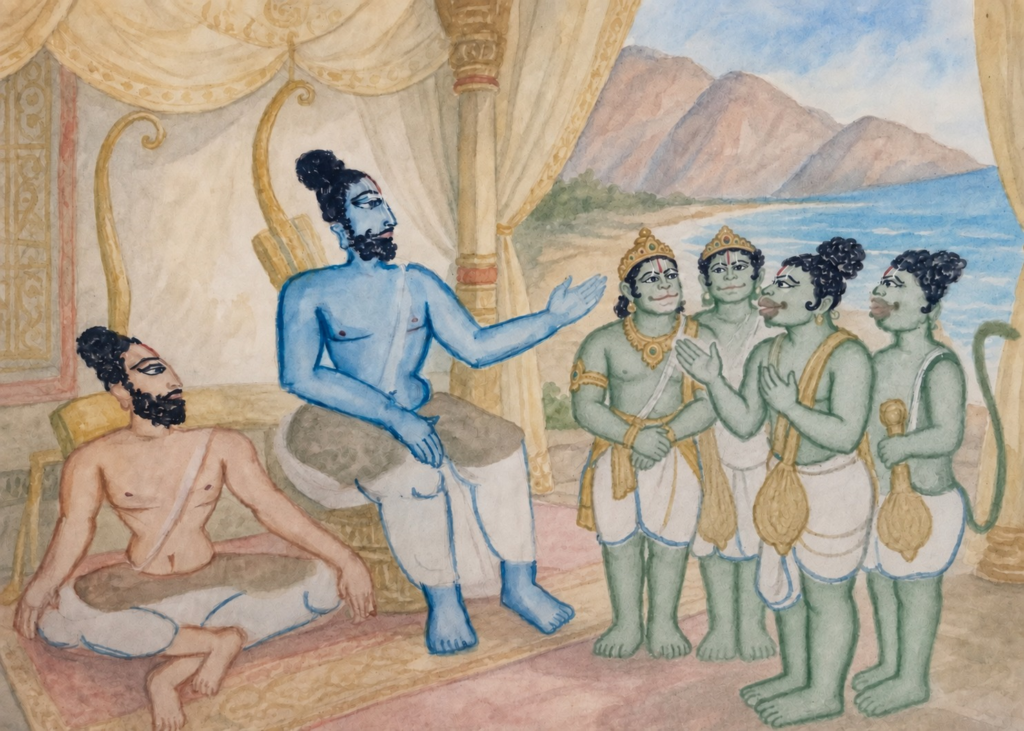
Upon hearing the respective opinions of angadhan, Sarabhan, jAmbavAn, and maindhan, perumAL’s divine heart empathised with vibhIshaNAzhwAn. At this point, hanumAn began to speak, conveying pleasing words to perumAL.
periyavAchchAn piLLai has provided two commentaries for this section – one as part of abhaya pradhAna sAram commentary, and the other as thaniSlOkam commentary. In the previous article, we enjoyed the abhaya pradhAna sAram commentary. We will now enjoy the thaniSlOkam commentary for this SlOkam.
avathArikai (Introduction)
sugrIva mahArAja upon hearing that vibhIshaNap perumAL left rAvaNa and has come to surrender to perumAL, said, “He is not a well-wisher; he is trying to deceive us. He must be tied up and killed”.
After hearing these words, perumAL felt distressed and thought, ‘Oh! If these are the perspectives of someone in senior leadership, will there be anyone in this large gathering who aligns with my thoughts. What is the way to accept vibhIshaNa now?”
- SrI rAmAyaNam yudhdha kANdam 17-31 “suhrudhA hyarthakruchchrEshu yuktham budhdhi mathA sathA I samarthEnApi sandhEshtum SASvathIm bhUthimichchathA” (A friend – who desires the eternal welfare and prosperity of his companion, who thinks like him, who does not possess excessive love or hatred, possessing righteous knowledge, and who is capable and powerful enough to accomplish his resolve – should be ready to offer good counsel in times of crisis).
Thinking thus, he [perumAL] conveyed these words to the monkeys in front of everyone – ‘A good friend who understands with clarity and in their entirety, without likes or dislikes, possessing the wisdom and determination to accomplish their goals, must guide us in times of trouble to help us make rightful decisions’.
- SrI rAmAyaNam yudhdha kANdam 17-33 “agyAtham nAsthi thE kinchith thrishu lOkEshurAgava I AthmAnam pUjayan rAma pruchchasyasmAn suhruththayA” (Oh raghava! There is nothing in the three worlds that is unknown to you. Yet, you ask us questions purely out of your friendly and affectionate nature).
The monkeys thus praised perumAL and said, ‘Your asking us questions is nothing but the benevolence for us in your divine heart. You ask so that dhEvarIr’s saulabhyam [easy approachability] and sauSeelyam [equal disposition towards all] are known and celebrated throughout the worlds”.
The monkeys neither wanted to conflict with sugrIva mahArAja, who is their provider nor did they want to oppose perumAL, who is sugrIva mahArAja’s lord.
angadhan, Sarabhan, jAmbavAn and others expressed their respective perspectives, stating that vibhIshaNa must be investigated and only then accepted, that he should be doubted in all respects, and that he must not be accepted immediately without examination.
- SrI rAmAyaNam yudhdha kANdam 17-42 “parIkshya cha thatha: kAryO yathAnyAyam parigraha:” (Sarabhan said – He has to be accepted only after examining).
- SrI rAmAyaNam yudhdha kANdam 17-37 “sarvathA Sankaya Eva hi” (angadhan said – He is to be suspected by all means).
- SrI rAmAyaNam yudhdha kANdam 17-44 “badhdhavairAchcha pApAchcha rAkshasEndhrAdh vibhIshaNa: I adhESakAlE samprAptha: sarvathA SankyathAmayam II” (jAmbavAn said – Coming at an inappropriate location and occasion, he must be distrusted in every way).
- SrI rAmAyaNam yudhdha kANdam 17-37 “viSvAsayOgya: sahasA na karthavyO vibhIshaNa:” (angadhan said – He should not be trusted immediately).
thiruvadi, who heard all their opinions, feared ‘Oh! Would SrI rAma be able to sustain his life, unwilling to oppose their views and at the same time unable to reject vibhIshaNa’. Therefore, he thought to destroy their perspectives using appropriate tactics and strategies. He wanted to speak in a manner pleasing to perumAL’s divine heart, which was appropriate to the situation in accordance with the scriptural rules. At the same time, he did not want to see angadhan and other monkeys’ faces turn red with fury.
Therefore, hanumAn humbly said, ‘I do not say this for any other reason; out of my affection towards perumAL and because this is king sugrIva’s mission, and due to the sweetness of its meanings, I too, am going to say a word’.
Notes from periyavAchchAn piLLai’s vyAkhyAnam
na vAdhAn nApi sangharshAn nAdhikyAn na cha kAmatha: [not for argument, nor for favouritism, not as a display of glory, and not according to any whim]
[hanumAn says] Generally, the people in this world, when stating their views in a forum, try to outweigh each other’s argument for the reasons mentioned above. However, I am not expressing my views for any of those reasons.]
na vAdhAn [not by argument]
[Looking at sugrIva mahArAja, perumAL and other monkeys, hanumAn says] dhEvarIr, in the presence of respected persons such as yourselves, I do not speak to argue, to hold on to my contention.
nApi sangharshAth [not because of any bias]
[hanumAn says] I am not forcing my views on others because of any bias or special affinity towards vibhIshaNa.
nAdhikyAth [not to display superiority]
- SrI rAmAyaNam sundhara kANdam 40-38; 68-21 “maththa: prathyavara: kaSchin nAsthi sugrIvasannidhau” (There is no one inferior than me in sugrIva’s army). As such, [hanumAn says] I do not speak this to prove my own significance.
[Note from kAlakshEpam: This kind of profound humility demonstrated by hanumAn can also be observed in periya thirumalai nambi. When emperumAnAr arrives at thirumalA, the sacred hill, nambi himself comes to welcome emperumAnAr at the entrance. nambi being most qualified, elder to emperumAnAr and also his AchAryan, emperumAnAr asks him if he could not find someone who is less qualified to be sent to welcome him. nambi, out of great humility, replies that he looked around everywhere and could not find any one less qualified than him].
na cha kAmatha: [not according to my liking]
[hanumAn says] I do not speak mindlessly like a madman, acting entirely on my own whim with no one to restrain me.
Alternatively, periyavAchchAn piLLai, provides a second explanation for this, as follows –
na vAdhAnnApi sangharshAn nAdhikyAn na cha kAmatha:
It can also be interpreted as hanumAn saying, “What I am about to say is neither for vAdham nor for vithaNdA nor for jalpam nor for abhinivESam. He makes it clear that he is not engaging in any of these four types of arguments”.
na vAdhA [not a debate]
“vItha rAga kathA vAdha:” (A debate with no interest in both the sides). [hanumAn says,] My intention is not merely to establish the truth using pramANam and strategic arguments to achieve a goal.
nApi sangharshAth [Nor is it out of a desire for obstinate dispute]
[hanumAn says,] I do not say this out of an obstinate desire to win my argument with flawed statements.
nAdhikyAth [not to show my significance, or merely to succeed]
“jalpO’sya vijaya: balam” (Victory is strength). [hanumAn says,] I do not chatter in vain to show superiority.
na cha kAmatha: [not out of desire]
[hanumAn says,] I do not say this out of desire or because I expect something from vibhIshaNa.
When it is sufficient to use the word ‘na’ just once, why does hanumAn use it repeatedly? He emphasises it to confirm that while these reasons are prevalent among people, they are not the reasons behind his speech.
vakshyAmi [I shall speak]
In this context, instead of vakshyE (the AthmanEpadham or reflexive voice), vakshyAmi is used in the parasmaipadham (active) voice. hanumAn says as. hanumAn speaks in this manner to indicate that he is speaking for the benefit of perumAL, sugrIva mahArAja, and the other monkeys, rather than for his own self-interest. Addressing sugrIva mahArAja and the assembly of monkeys, hanumAn implies – “As I speak, if my words please you all, I shall proceed; otherwise, I will not.”
vachanam vakshyAmi [I am going to speak these words]
While “vakshyAmi” [I am going to speak] naturally implies words or a sentence, why is it necessary to also include “vachanam”? This could be similar to saying, “He is cooking food” – it is simply an idiomatic way of speaking.
Alternatively, there may be a deeper reason behind using “vachanam” alongside “vakshyAmi”. hanumAn did not want to frustrate the listeners with a verbose speech amidst a flood of urgent matters. According to its etymology, that which expresses a specific, precise meaning is called a vachanam (“artham vakthIthi vachanam”). By using this specific word, he implies that his thoughts will be explained concisely rather than through a long-winded explanation. Therefore, “vachanam” is not just a redundant figure of speech, but a deliberate choice that carries a specific purpose.
rAjan – Oh, king! [hanumAn says] I say this because you are a king. As king, only those who oppose you must be destroyed; ones like vibhIshaNa, who have surrendered, must be protected.
rAjan – [hanumAn says] You are the king, and I am your minister; therefore, it is my obligation to offer you my counsel.
rAjan – “visthIrNAgAdhamanasO rAjAna:” (The minds of kings are vast and unfathomably deep). As such, [hanumAn says] Oh King, given your vast intellect, you can easily assimilate what I am about to say. Though you may already know its meaning, I speak anyway, knowing you have the depth of mind to truly anchor and absorb it.
rAjan – “prajASchapyanuranjathE” (A king keeps his subjects happy). “ranjanAth rAjA” (Because he brings joy to his subjects he is called a king). [hanumAn says] Oh, king! I convey this to you because you do not keep a stern countenance when approached, and because you welcomed our thoughts with a gracious face.
Just because you were asked out of love, will you convey whatever is there in your mind?
yathArtham – that which is true, as it is
[hanumAn says] I will not speak simply because a thought occurred to me; I will only speak in accordance with the scriptural meanings.
rAjan yathArtham – the truth must be told to the king
“sathyam rAjasu SObhathE” (Only the truth will bring goodness in the presence of kings). Therefore, [hanumAn says] Can I speak anything but the truth in front of the king?
yathArtham
[hanumAn says] One cannot reject my words on the basis of any pramANam or logic.They are not false statements; they are the absolute truth which will remain unaffected.
If you are not speaking for the usual reasons people argue, what are your reasons?
rAmagauravAth – for SrI rAma’s glory
[hanumAn says] I only said there are no superficial reasons for my argumentation, however, I never implied that higher reasons do not exist. I speak for the glory of SrI rAma.
rAmagauravAth
perumAL will not be able to tolerate the perspectives expressed earlier by sugrIva mahArAja, angadhan, Sarabhan, jAmbavAn and maindhan. hanumAn says, “I am afraid that we might lose this gem among men. Therefore, out of fear, I speak”.
- SrI rAmAyaNam AraNya kANdam 10-19 “apyaham jIvitham jahyAm thvAm vA sIthE sa lakshmaNAm I na thu prathigyAm samSrutham brAhmaNEbhyO viSEshatha: II” (Oh, sIthA dhEvi! I would rather give up my own life, or even you and lakshmaNa, but I can never abandon my vow – especially the one made to the sages).
Alternatively, it can also be interpreted as follows.
rAmagauravAth – one who is glorified as SaraNAgathavathsala (the one who is supremely affectionate and protective towards those who have surrendered)
- SrI rAmAyaNam sundhara kANdam 21-21 ‘SaraNAgathavathsala:” (perumAL protects and nurtures those who take refuge in him, showing a tender, protective love similar to that of a mother cow for her calf).
[hanumAn says] “I speak, realising this divine will of perumAL to offer protection to those who have surrendered to him”.
sugrIva mahArAja asks hanumAn, “I have clearly stated that vibhIshaNa must be killed. Will you speak against my words?”
bhavathOpi rAmagauravAth [SrI rAma is superior to you (sugrIva mahArAja), as well]
- vishNu purANam 5-1-14 “mamApyakhilalOkAnAm gurur nArAyaNO’guru:” (To all the worlds and for me too he is the supreme and the master, nArAyaNan, the one who has no master for himself).
[hanumAn says] I say this because SrI rAma is superior to you too, it is your duty as well to honour SrI rAma’s divine will.
Alternatively, a different interpretation –
rAjan rAma [Oh, king! SrI rAma]
Addressing both sugrIva mahArAja and SrI rAma, hanumAn says, “‘Due to your honour and greatness, you are the commanders and gurus, and we are your subordinates and Sishyas. Nevertheless, when there is a violation by the preceptor, it is necessary for the Sishya to humbly inform him. Therefore, I speak these words”.
- “niyamAthikramam rahasi bOdhayEth” ([If a teacher] transgresses the rules, one should point it out to him, in private).
[Note from kAlakshEpam: Although it is said that a Sishya must convey information in secret, one may wonder as to why hanumAn speaks openly in this large gathering of monkeys. perumAL considers all the monkeys to be his well-wishers – indeed, his very life – so they are not viewed as outsiders. Because perumAL considers them to be so close to him, speaking in their presence is equivalent to speaking in private].
rAjan [Oh, king!]
Addressing sugrIva mahArAja as Oh, king! hanumAn says, “Out of respect for SrI rAma, I humbly convey these words”.
Alternatively, a different interpretation –
gauravAth [due to honour]
[hanumAn says] The affairs of kings are both important and honourable. The royal strategy is to use the person who has come from the enemy to disperse and destroy our enemy. Why would we let him go when he has come voluntarily to us? Thus, I speak because it is pertinent to royal affairs.
gauravAth [due to the honour of the scriptures]
[hanumAn says] To protect those who have surrendered is ordained in the scriptures. Therefore, offering protection is our duty. It is because of this that I speak these words”.
- SrI rAmAyaNam yudhdha kANdam 18-28 “ari: prANAn parithyajya rakshithavya: kruthAthmanA” (An enemy who has surrendered must be protected by a person of noble mind, even by abandoning one’s own life).
gauravAth
[hanumAn says] Accepting a SaraNAgathan will bring glory to you. I speak these words with the intention of bringing this greatness to you.
na vAdhAnnApi sangharshAnnAdhikyAnna cha kAmatha: I
vakshyAmi vachanam rAjan yathArtham rAmagauravAth II
vyAkhyAnam for this SlOkam will continue in the next article.
AzhwAr emperumAnAr jIyar thiruvadigaLE SaraNam
periyavAchchAn piLLai thiruvadigaLE SaraNam
Source – SrI rAmAyaNa thani SlOkam – 71 – yudhdha kANdam 50 – Part 2 Audio Video
adiyEn chithrA rAmAnuja dhAsi
Proofreading/Curating done by – kOsalEndhra rAmAnuja dhAsan, krishNan rAmAnuja dhAsan
Artwork – namperumAL rAmAnuja dhAsan
Related Links
SrI rAmAyaNa thani SlOkam – 70 – yudhdha kANdam 17.48 – 50 – Part1 Audio Video
SrI rAmAyaNa thani SlOkam – 69 – yudhdha kANdam 17.41 – 47 Audio Video
SrI rAmAyaNa thani SlOkam – 68 – yudhdha kANdam 17.38 – 40 Audio Video
SrI rAmAyaNa thani SlOkam – 67 – yudhdha kANdam 17.31 – suhruthA, 17.32 – ithyEvam, 17.33 – agyAtham, 17.34 – thvam hi Audio Video
SrI rAmAyaNa thani SlOkam – 66 – yudhdha kANdam 17.28 – EvamukthvA , 17.29 – sugrIvasya, 17.30 – yadhuktham Audio Video
SrI rAmAyaNa thani SlOkam – concise english meanings
archived in https://granthams.koyil.org
pramEyam (goal) – https://koyil.org
pramANam (scriptures) – https://granthams.koyil.org
pramAthA (preceptors) – http://acharyas.koyil.org
SrIvaishNava education/kids portal – http://pillai.koyil.org