SrI: SrImathE SatakOpAya nama: SrImathE rAmAnujAya nama: SrImath varavaramunayE nama:
The extremely merciful periyavAchchAn piLLai has selected important SlOkams from SrI rAmAyaNam and provided a beautiful vyAkhyAna grantham, SrI rAmAyaNa thaniSlOkam. puththUr swAmy has published this grantham along with an exquisite thamizh commentary. With this grantham, we are now learning the meanings of SlOkams in SrI rAmAyaNam.
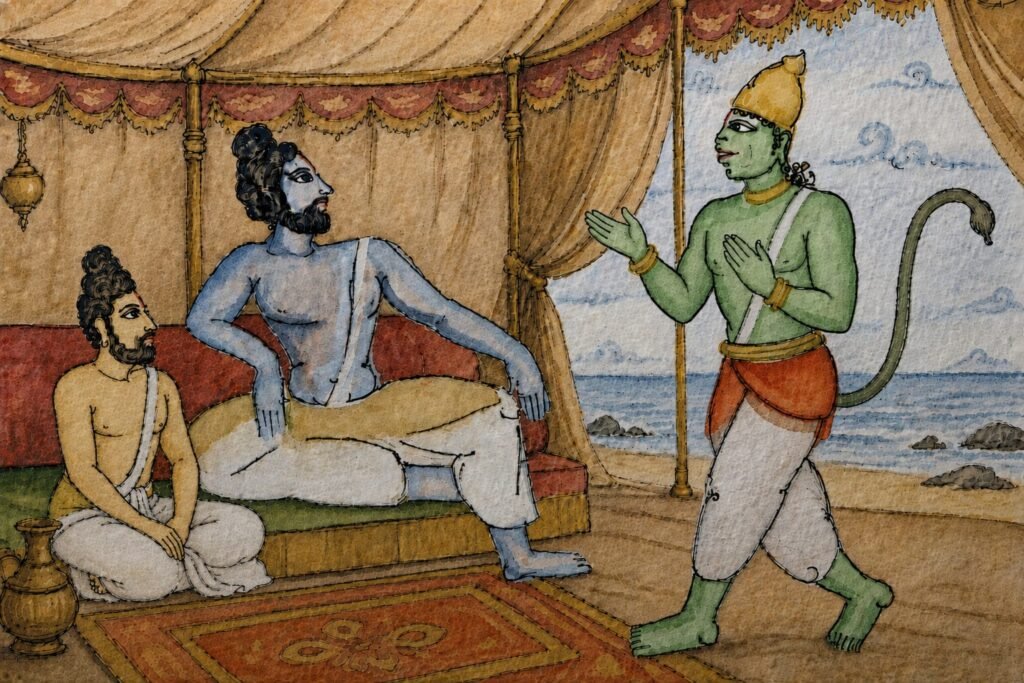
vibhIshaNAzhwAn had left lankA and arrived on the shores where perumAL was present. He described his situation to sugrIva mahArAja and others, requesting them to inform perumAL that he had come to surrender to him. After hearing his words, sugrIva mahArAja was convinced that vibhIshaNAzhwAn had actually come to attack and harm perumAL. Therefore, he approached perumAL with great anxiety and said, “He has come in the disguise of an anukUlan (well-wisher), contrarily, he is a prathikUlan (opponent)”. In this article, we will enjoy the SlOkams which describe the subsequent developments.
Before proceeding with the vyAkhyAnam, we express our gratitude to periyavAchchAn piLLai and puththUr swAmy, as well as to SrI u vE sArathy thOthAthri swAmy. This article is a translation of periyavAchchAn piLLai’s thaniSlOka vivaraNam with the support of SrI sArathy swAmy’s thamizh kAlakshEpam series.
avathArikai (Introduction)
[Intending to answer questions that may arise in perumAL’s thoughts] “If he is not an anukUlan (a well-wisher), in what capacity has he approached us? Even if he is an enemy, what harm can he do to us when we are acting with great care”? sugrIva mahArAja explains this in the following SlOkam. He says,
praNidhI rAkshasEndhrasya rAvaNasya bhavEdhayam I
anupraviSya sO’smAsu bhEdham kuryAn na samSaya: II
Word-by-word meaning
ayam – he (This person/vibhIshaNa)
rAkshasEndhrasya rAvaNasya – of rAvaNa, rAkshasa king
praNidhI: – indeed a spy
bhavEdh – must be
sa: – he (this person)
asmAsu – among us
anupraviSya – infiltrate/enter and become one within us
bhEdham kuryAth – he will stir up dispute and create a division
na samSaya: – no doubt (about this)
Simple meaning
sugrIva mahArAja says to perumAL, “He must be rAvaNa’s spy. He has come to fraternise among us and create commotion. There is no doubt about it”. [It is a standard intelligence tactic to infiltrate enemy territory for the purpose of inciting chaos].
Notes from periyavAchchAn piLLai’s vyAkhyAnam
ayam praNidhir bhavEdh – he is a spy
sugrIva mahArAja says, “He, whom dhEvarIr think of as a SaraNAgathan, is actually a spy sent by rAvaNa”.
sugrIva mahArAja continues, in prolepsis of perumAL’s questions, “If he were a spy, wouldn’t he disguise himself while approaching us? Why would he introduce himself, reveal his identity as vibhIshaNa, and surrender? Since they have surrendered, would he still engage in espionage”?
- SrI rAmAyaNam yudhdha kANdam 17-10 “vibhIshaNa: ithi Srutha:” (I am known as vibhIshaNa).
- SrI rAmAyaNam yudhdha kANdam 17-15 “vibhIshNam upasthitham” (vibhIshaNa has arrived).
- SrI rAmAyaNam yudhdha kANdam 17-14 “rAghavam SaraNangatha:” (I surrender to SrI rAma).
sugrIva mahArAja says:
rAkshasEndhrasya rAvaNasya (of rAkshasa king rAvaNa)
- “vachasyanyath manasyanyath karmaNyanyath” (Those who are unvirtuous, what is in their mind is different from what is spoken, and what is spoken is different from what is done).
sugrIva mahArAja says, “rAvaNa, a chief among the evil-minded rAkshasas, who accomplish their deeds using disguises, assessing – ‘He, vibhIshaNa is most suitable for this task’, has sent him as a spy”.
perumAL responds, “Even if he is rAvaNa’s spy and is present among us, what can he do to us”?
sO’smAsu anupraviSya – he will enter our group
sugrIva mahArAja says, “He, who is hostile to us, will infiltrate our group disguised as a well-wisher (anukUlan)”.
bhEdham kuryAth – he will create a rift
sugrIva mahArAja says, “We share our pain and happiness, but he will incite hostility and turn dhEvarIr and myself into enemies”. [Both perumAL and sugrIva mahArAja had taken vows – using fire as witness – to establish a bond, stating, “Ekam dhu:kham sukhancha nau”].
- SrI rAmAyaNam yudhdha kANdam 5-1 “Ekam dhu:kham sukhancha nau” (We share our grief and joy).
na samSaya: – there is no doubt
sugrIva mahArAja says, “He must be considered an enemy due to his relationship with rAvaNa”.
“However, since he has surrendered, he appears to be a well-wisher. Consequently, we can only doubt whether he is a friend or an enemy. How can we conclude that he is definitely an enemy”?
Anticipating these questions from perumAL, sugrIva mahArAja responds, “There is no need to investigate further. He is a rAkshasa by birth; there is no possibility of his being a friendly person. Therefore, it is certain that he has arrived only to deceive us”.
[Note from kAlakshEpam: sugrIva mahArAja is known for his strict policy of punishing first and investigating later. This trait is highlighted when thiruvadi (hanumAn) returns after meeting sIthAp pirAtti. Upon hearing the joyous news, the monkeys celebrate in sugrIva mahArAja’s orchard, madhuvanam, and destroy it in the process. When the orchard’s custodian approaches sugrIva mahArAja to complain, sugrIva mahArAja immediately lifts and bangs his tail on a rock nearby as a gesture of happiness. Instead of resorting to his usual approach of ordering an immediate punishment, sugrIva mahArAja expresses immense joy because the lord’s mission (perumAL kAryam) has succeeded. While this specific reaction was driven by his deep devotion to perumAL, his inherent nature remains to punish first and investigate later – a behavioural pattern that is clearly mirrored during his initial interaction with vibhIshaNAzhwAn].
praNidhI rAkshasEndhrasya rAvaNasya bhavEdhayam I
anupraviSya sO’smAsu bhEdham kuryAn na samSaya: II
Thus concludes the vyAkhyAnam for this SlOkam.
SrI rAmAyaNa thani SlOkam – 64 – 17.21 – athavA svayamEvaisha
sugrIva mahArAja explains in this SlOkam – “While a spy typically focuses on inciting riots and causing chaos, an infiltrator, who is not a spy, will wait for an opportune time after entering our group and attack us. Therefore, vibhIshaNa is an enemy who will directly attack us at some point”.
avathArikai (Introduction)
“Since we are of one mind, how can he create conflict between us”? Understanding this to be perumAL’s thoughts, sugrIva mahArAja says, “Suppose he cannot do that, he will fraternise with us until we have completely trusted him. Then, at a vulnerable time, he might attack us”.
athavA svayamEvaisha chidhramAsAdhya budhdhimAn I
anupraviSya viSvasthE kadhAchith praharEdhapi II
Word-by-word meaning
athavA – or, otherwise
budhdhimAn – the intelligent
Esha: – this vibhIshaNa
anupraviSya – will become one among us
viSvasthE – (when we) have trusted him
chidhram – vulnerable time
AsAdhya – take
svayam Eva – himself on his own
kadhAchith – at an opportune time
praharEdhapi – he might attack (us)
Simple meaning
Or, this clever person will find a vulnerable moment himself; he might even strike after infiltrating us and gaining our trust though guile.
Notes from periyavAchchAn piLLai’s vyAkhyAnam
athavA – otherwise (i.e., if he is not a spy).
In the previous SlOkam, sugrIva mahArAja said ‘bhEdham kuryAth’, meaning vibhIshaNAzhwAn might provoke a conflict by creating a rift. Now, sugrIva mahArAja expresses an alternative perspective – that is, [What would he do?] if he is not a spy (athavA) .
svayamEvaisha: – he himself
sugrIva mahArAja says, “Suppose he is unsuccessful in turning us against each other, svayamEvaisha: (he himself ) will cause harm to us”.
When do you think he will attack us?
anupraviSya viSvasthE – when he has gained our trust by becoming one among us.
Even if he has become a confidant, could he still find an opportunity to harm us while we remain united?
chidhram AsAdhya – when he finds an opening.
sugrIva mahArAja says, “He might never get a chance if we do not trust him and do not accept him among us. However, once he is accepted as one of us and gains our trust, won’t the opportunity arise”?
budhdhimAn – intelligent person
sugrIva mahArAja says, “Though we may not present him with a vulnerable opportunity, he is budhdhimAn (intelligent) enough to make use of even the smallest chance. Just as dhEvarIr possesses the insight to search every possible place to protect the jIvAthmAs, he possesses the same wit and acumen for causing harm”.
kadhAchith praharEdhapi
sugrIva mahArAja says, “There is a possibility that he will attack us if he finds an opportunity”.
Now, the second interpretation for this SlOkam.
athavA – otherwise,
sugrIva mahArAja says, “He does not need to be rAvaNa’s spy. Just as rAvaNa caused harm by disguising himself as a sanyAsi, he too has arrived in disguise, as a SaraNAgathan, to become one among us and attack us when he has gained our trust”.
In the first interpretation, it was said that if he did not find an opportunity to create an uproar destroy dhEvarIr through me or me, through dhEvarIr, he might launch an assault on his own. Now, instead of interpreting him as ‘rAvaNa’s spy’, he is viewed differently. That is, similar to how rAvaNa abducted sIthAp pirAtti in the disguise of an ascetic (sanyAsi), he will fraternise under the disguise of seeking refuge and attack like an enemy at the perfect moment.
athavA svayamEvaisha chidhramAsAdhya budhdhimAn I
anupraviSya viSvasthE kadhAchithpraharEdhapi II
Thus concludes the vyAkhyAnam for this SlOkam.
SrI rAmAyaNa thani SlOkam – 64 – 17.22 – mithrAtavI balam
avathArikai (Introduction)
Presupposing perumAL’s question, “When we have arrived here to attack the enemies, he has approached us from the other side [rAvaNa’s side]. He appears to be honest and has given up all his support. Is it not rAja nIdhi, a principle of governance, to accept him? Since you are king, should you not be aware of this?” sugrIva mahArAja says, “No, that is not the law”.
mithrAtavIbalanchaiva maulam bhruthyabalam thathA I
sarvamEthadh balam grAhyam varjayithvA dhvishadhbalam II
Word-by-word meaning
dhvishadhbalam – enemies’ troops
varjayithvA – excluding
mithrAtavI balam – strength supplied by the allies as well as strength from the forest
maulam – our core strength, hereditary soldiers
thathA bhruthyabalam – as well as the strength of the mercenaries
Ethadh sarvam balam – all these strengths
grAhyam – are to accepted
Simple meaning
All the resources – such as those provided by friends or gathered from the forest, our own native troops, and mercenaries – must be brought together, with the exception of enemy sources.
Notes from periyavAchchAn piLLai’s vyAkhyAnam
mithrAbalam – army of friends
That is, this is a group that shares one another’s happiness and sorrow. As stated in the nIthi SAsthram (thathA kAmanthakE) “aurasam mithra sambandham thathA vamSakramAgatham I rakshakam vyasanEbhyaScha mithram gyEyam chathurvidham II” – Those friends who are related to mother and father; those who are associated to friends; those who are friends through lineage; those who provide protection in distress. Thus, there are four types of friends.
[Thus sugrIva mahArAja says mithrAbalam, to state that strengths of such friends ought to be utilised].
[puththUr swAmy’s explanation
In the hard copy of kAmanthaka nIthi sAram, a slight variation is seen to the above pramANam. The SlOkam and meaning for that are as below: –
kAmanthaka nIthi sAram 4-71 “aurasam maithrasambadhdham thathA dhESakramAgatham I rakshitham vyasanEbhyaScha mithram gyEyam chathurvidham II”
(1) Sincere friends who share a bond with father and mother. (2) Friends by mere association with father and mother. Such friends are known as ‘sahaja mithram’, or friends from birth. (3) A country adjacent to a neighbouring country, (inherently, by nature) is a friend. (kautilyar calls such friends natural (prakruthi) friends) (4) Those who become friends because they save you during hard times. (kautilyar calls such friends kruthrima – created, aupAdhika – conditional). Thus, there are four types of friends].
atavIbalam – forest force
[puththUr swAmy’s explanation
Forces which include the people living in the forest].
[Note from kAlakshEpam: sugrIva mahArAja sends a message to all monkeys and bears to come immediately. They all come to help upon hearing sugrIva mahArAja’s message].
maulam –
The lineage or those groups of slaves, consisting of father, grandfather, and great-grandfather.
bhruthyabalam – mercenary (those who fight for money)
sarvamEthadh balam grAhyam
These four categories of strength are acceptable.
varjayithvA dhvishadhbalam
The forces of enemies are not fit for acceptance. thathA kAmanthakE, as stated in kAmanthakam “arirmithramarEr mithram mithramithram thatha: param” (An enemy’s friend, an enemy’s friend’s friend, and so on). This implies that an associate of an enemy should never be accepted. Do we require scripture (SAsthram) to understand this basic principle? Therefore sugrIva mahArAja says, “vibhIshaNa’s eyes will well with tears when rAvaNa is struck by an arrow. How, then, can we rely on him as our support?
[puththUr swAmy’s explanation
The troops of an enemy are not fit to be accepted. kAmanthakar has described those, who are (naturally) considered friends and enemies based on geographical sequence of countries in the nIthi sAram (8-16,17) as follows:-
arir mithramarEr mithram mithramithramatha: param I
athArimithramithrancha vijigIshO: pura: smruthA: II
pArshNigrAhas thatha: paSchAth Akrandhas thadhananthara: I
AsArAvanyOSchEthi vijigIshOsthu prushtatha: II
(To a king who desires victory (vijigIshuvAn), the ruler of the kingdom directly in front of his country is an enemy. The ruler of the kingdom adjacent to the neighbouring kingdom (because he is the enemy of his enemy) is a friend. The ruler of the country adjacent to this kingdom is his enemy’s friend; the one next to him is friend of his friend; the ruler of the country that is next to this is a friend of enemy’s friend. (Among these, the friend and friend’s friend belong to friend alliance – mithra gOshti; the enemy, enemy’s friend, and the friend of enemy’s friend belong to the enemy alliance – Sathru gOshti). Similarly, the ruler of the country directly behind the triumphant king (vijigIshu) could attack his rear, so he is known as pArshNigrAhan. The ruler behind pArshNigrAhan, when vijigIshu calls for help (Akrandhanam – a shout for help), since he is in a position to attack the pArshNigrAhan, he is known as Akrandhanan. The ruler behind Akrandhanan, favours the pArshNigrAhan, hence, he is known as pArshNigrAhAsAran. The one who is behind pArshNigrAhAsAran, he is accommodative to Akrandhanan, hence he is known as AkrandhAsAran. Among these Akrandhanan and AkrandhAsAran belong to the friend alliance – mithra gOshti, pArshNigrAhan and pArshNigrAhAsAran belong to enemy alliance – shathru gOshti).
Therefore, as stated here, since vibhIshaNAzhwAn belongs to the country adjacent to SrI rAma’s, he naturally belongs to the enemy alliance – shathru gOshti. “Setting this nIdhi SAsthram aside, how can we accept vibhIshaNa as our ally when he is someone who will weep for his brother rAvaNa, the moment rAvaNa is struck by an arrow”? – this is sugrIva mahArAja’s opinion.
Therefore, through this SlOkam, sugrIva mahArAja has illustrated that as per rAja nIthi (royal governance), the support of those in mithra gOshti, forest forces, hereditary subordinates, and mercenaries are four types of support which are acceptable, while the support from an enemy’s side is to be abandoned].
mithrAtavIbalanchaiva maulam bhruthyabalam thathA I
sarvamEthadh balam grAhyam varjayithvA dhvishadhbalam II
Thus concludes the vyAkhyAnam for this SlOkam.
SrI rAmAyaNa thani SlOkam – 64 – 17.23 – prakruthyA
sugrIva mahArAja asks, “How can we trust him”?
avathArikai (Introduction)
perumAL asks, ‘varjayithvA dhvishadhbalam – can we abandon him just because the enemy’s support is unfavourable for acceptance? He has renounced his attachments there; should we not trust him? Therefore, what is the flaw in accepting him’?
sugrIva mahArAja cites the reasons why vibhIshaNAzhwAn has not renounced his attachments there and is not to be trusted, in this SlOkam:
prakruthyA rAkshasO hyEsha bhrAthA’mithrasya vai vibhO I
AgathaScha ripO: pakshAth kathamasmimScha viSvasEth II
Word-by-word meaning
vibhO – Oh, lord!
Esha hi – he, byhimself
prakruthyA – by birth (naturally)
rAkshasa: vai – is indeed a rAkshasa
amithrasya – enemy’s
pakshAth – from the (enemy’s) side
Agatha: cha – has come
asmimn cha – in him
katham – how
viSvasEth – can we keep trust?
Simple meaning
Oh, lord! By birth, he is a rAkshasa and he has come from the enemy’s side. How can we trust him”?
Notes from periyavAchchAn piLLai’s vyAkhyAnam
prakruthyA rAkshasO hyEsha
It is well known that vibhIshaNa is a rAkshasa by birth. Therefore, what reason could he have to abandon rAvaNa, a fellow rAkshasa, to join us, who belong to a different species? In this context, the word ‘hi’ signifies a known understanding (samprathipaththi) – [namely, vibhIshaNa is rAkshasa rAvaNa’s brother].
bhrAthA’mithrasya – enemy’s brother
manu smruthi 2-226 “bhrAthA svO mUrthirAthmana:” (A brother is one’s own self). As such, he is like the SarIram of our enemy (indicating he is not different from rAvaNa). How can such a person, who is practically like the enemy’s own body, abandon rAvaNa and join us?
vai
sugrIva mahArAja says, “These are vibhIshaNa’s own words, ‘rAvaNasyAnujO bhrAthA’, isn’t this well-known? perumAL asks, “Did you not leave your brother and join us”?
- SrI rAmAyaNam yudhdha kANdam 17-10 “rAvaNasyAnujO bhrAthA” (I am the younger brother of that rAvaNa), thus, as it is known through vibhIshaNa’s own words;
- SrI rAmAyaNam yudhdha kANdam 17-17 (rAvaNa’s brother), and through the words of sugrIva mahArAja, it is suprasidhdham – very well-known.
AgathaS cha ripO: pakshAth
sugrIva mahArAja says, “He did not come as a nirasthan (banished person) like me, being driven away. Has he not come from the royal assembly”?
[Note from kAlakshEpam: sugrIva mahArAja says, “I was banished by my brother vAli. He chased me away, taking away everything from me, including my wife. This did not happen to vibhIshaNa, he simply had an argument and left the royal assembly to come here”].
vibhO
Your highness are the leader! Do not forsake analysing this.
kathamasmimScha viSvasEth
sugrIva mahArAja says, “Thus, there are many reasons to abandon him. On what superficial grounds can we trust him”?
prakruthyA rAkshasO hyEsha bhrAthA’mithrasya vai vibhO I
AgathaScha ripO: pakshAth kathamasmimScha viSvasEth II
This concludes the vyAkhyAnam for this SlOkam.
AzhwAr emperumAnAr jIyar thiruvadigaLE SaraNam
periyavAchchAn piLLai thiruvadigaLE SaraNam
Source – SrI rAmAyaNa thani SlOkam – 64 – 17.20 – praNidhI rAkshasEndhrasya, 17.21 – athavA svayamEvaisha, 17.22 – mithrAtavI balam, 17.23 – prakruthyA Audio Video
adiyEn chithrA rAmAnuja dhAsi
Proofreading/Curating done by – kOsalEndhra rAmAnuja dhAsan, krishNan rAmAnuja dhAsan
Artwork – namperumAL rAmAnuja dhAsan
Related Links
SrI rAmAyaNa thani SlOkam – 63 – yudhdha kANdam 17.16 – Ethaththu vachanam, 17.18 – manthrE vyUhE, 17.19 – anthardhAnagathA Audio Video
SrI rAmAyaNa thani SlOkam – 62 – yudhdha kANdam 17.15 – nivEdhayatha – Part 6 Audio Video
SrI rAmAyaNa thani SlOkam – 61 – yudhdha kANdam 17.15 – nivEdhayatha – Part 5 Audio Video
SrI rAmAyaNa thani SlOkam – 60 – yudhdha kANdam 17.15 – nivEdhayatha – Part 4 Audio Video
SrI rAmAyaNa thani SlOkam – 59 – yudhdha kANdam 17.15 – nivEdhayatha – Part 3 Audio Video
SrI rAmAyaNa thani SlOkam – concise english meanings
archived in https://granthams.koyil.org
pramEyam (goal) – https://koyil.org
pramANam (scriptures) – https://granthams.koyil.org
pramAthA (preceptors) – http://acharyas.koyil.org
SrIvaishNava education/kids portal – http://pillai.koyil.org