SrI: SrImathE SatakOpAya nama: SrImathE rAmAnujaya nama: Srimath varavaramunayE nama:
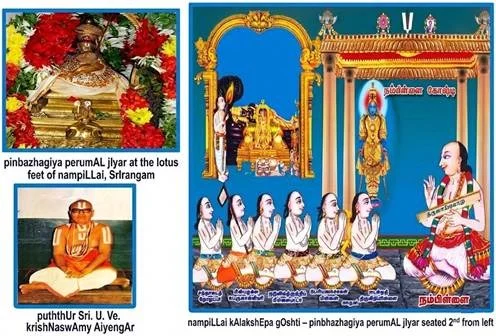
vArthAmAlai contains significant concepts from our philosophy, sampradhAyam, as passed down by our pUrvAchAryas. These upadhESams, along with their important life events, were summarised by pinbazhagarAm perumAL jIyar (nampiLLai’s very dear Sishya and the author of 6000 padi gurumparA prabhAvam). While the historical events (aithihyams) can be comprehended through reading, the in-depth analysis of our sidhdhAntham – specifically chith, achith, Isvaran which have been analysed in many vArthais and explained can be a bit difficult to grasp. A good amount of knowledge in SAsthram and fundamentals of vEdhAntham is required to understand these sections.
We are grateful to puththUr swAmy for having published this grantham and for also providing detailed explanation for these complex concepts.
The following article is a translation from SrI u vE sArathy thOthAthri swAmy’s thamizh kAlakshEpam on this vArthAmAlai grantham. We are grateful to swAmy for giving us this opportunity and his continuous help in publishing these.
vArthai refers to the upadhESam (teachings) given by AchAryas passed down through disciplic succession which have been later summarised.
There are a few important points to keep in mind. Occasionally, the same concept may be repeated across different vArthais with slightly different interpretations. This occurs because the focus of explanation may be different by different AchAryas in order to emphasise specific aspects.
vArthai 35
Summary of vArthai 35:
- thirumanthram reveals pramANam, pramEyam and pramAthA.
- praNavam reveals AthmA’s svarUpam. It is prAmANam.
- nama: Sabdham (word) in thirumanthram shows pramEyam.
- nArAyaNAya Sabdham in thirumanthram signifies the pramAthA.
Thirty-fifth vArthai
pramANa pramEya pramAthAkkaLaich chEra anusandhikkumpadi; – AthmAvukku svarUpam – ananyArha SEshathvam EthathprakASakam – praNavam; ananyArha SEshathva prathisambandhi – perumAL pOrundhavitta thiruvadigaL. AthmAvukku svarUpam – ananya SaraNathvam; EthathprakASakam – namassu; ananya SaraNathva prathisambandhi – perumAL amaiththa thirukkai.
AthmAvukku svarUpam – ananya bhOgathvam EthathprakASakam – nArAyaNa padham; ananya bhOgathva prathisambandhi – perumAL thirumuRuval. idhukku karuththu – thAnaRigai; chaithanyamaRugai; sAdhanA(sAdhyA?)ntharam aRugai. adhAvadhu – vEraRugai, vyApArAntharam aRugai, vishayAntharam aRugai.
Explanation:
In the previous vArthai, the important meaning of thirumanthram was explained. Our AchArya teaches us three rahasyams (esoteric doctrine) – thirumanthram, dhvaya mahA manthram and charama SlOkam – of which thirumanthram is the first. It is also known as ‘periya thirumanthram’ or ‘ashtAksharam’. SAsthram revere thirumanthram as an important manthram. nammAzhwAr, thirumangai AzhwAr, other AzhwArs have explained the meaning of thirumanthram in several places. Similarly, our AchAryas too have explained the meanings of thirumanthram. In ashta SlOkee, an eight-verse sanskrit SlOkam, parASara bhattar has explained the meaning of thirumanthram, dhvaya manthram and the charama SlOkam.
periyavAchchAn piLLai composed several granthams where thirumanthram has been explained. Similarly, piLLai lOkAchAryar composed granthams like yAdhruchchika padi, Sriya:pathi padi, parandha padi, mumukshuppadi, thani praNavam, thani dhvayam, thani charamam, etc. In all of these granthams, the meanings of rahasya thrayam are explained.
pramANa pramEya pramAthAkkaLaich chEra anusandhikkumpadi
In thirumanthram, pramANam, pramEyam, and pramathA are contemplated upon.
pramANam is that which gives knowledge. It is the means through which we obtain knowledge. For example, granthams are known as pramANam.
pramEyam is the goal of knowledge. This refers to what are we going to attain by obtaining the knowledge.
pramAthA refers to those who reveal the pramEyam. Thus, AchAryas are the pramAthas.
The thirumanthram talks about emperumAn, and nArAyaNa is an important name for him. Since emperumAn is the prathamAchAryan (first AchAryan), he is also called pramAthA.
thirumanthram is like an ocean containing an abundance of information. The explanation provided here reveals a profound meaning. AchAryas have analysed this in several places and presented these explanations, demonstrating how the thirumanthram contains pramANam, pramEyam and pramAthA.
AthmAvukku svarUpam – ananyArha SEshathvam
AthmA’s svarUpam is ananyArha SEshathvam. SEshathvam means being in servitude. ananyArha SEshathvam means not being a servant to anyone other than paramAthmA.
EthathprakASakam – praNavam
prakASakam means illuminating or revealing. praNavam reveals that jIvAthmA is a servitor to paramAthmA, and that he is an ‘ananyArha SEshan’ – a servitor exclusive to paramAthmA.
ananyArha SEshathva prathisambandhi – perumAL pOrundhavitta thiruvadigaL
prathisambandhi – When we give something, the recipient is the prathisambandhi. For example, when we give a girl in marriage, the receiver is the prathisambandhi.
All jIvAthmAs have ananyArha SEshathvam. jIvAthmAs are not servants to anyone else other than bhagavAn. If the jIvAthmA is a servant to someone, then he has to perform service to that one. However, the receiver of our service is only perumAL’s thiruvadi (divine foot).
Thus, our svarUpam is ananyArha SEshathvam. praNavam reveals this concept and shows that service must be performed to perumAL’s thiruvadi.
Since the praNavam (Om) reveals this servitorship of jIvAthmA to bhagavAn, it is the pramANam. Therefore, praNavam is the pramANam.
pramEyam is that which needs to be attained and enjoyed. The word nama: reveals this pramEyam.
AthmAvukku svarUpam – ananya SaraNathvam
AthmA’s svarupam (nature) can be of different types. For example, a person can simultaneously be a husband, a father, and a son depending on the relationship. Since all of these states are true in their respective contexts, they do not contradict one another. Similarly, ananyArha SEshathvam and ananya SaraNathvam – both are svarUpams for AthmA.
ananya SaraNathvam – SaraNam means refuge, meaning we must have faith only in bhagavAn. ananya SaraNathvam refers to the state where no one other than bhagavAn is considered as a refuge. bhagavAn alone is our ultimate refuge.
EthathprakASakam – namassu
The word ‘nama:’ in thirumanthram reveals the above svarUpam, the exclusive servitude and exclusive dependence. It shows that we are servitors only to bhagavAn and are dependent solely on him. He is the only one who can protect us.
In the word ‘nama:’, ma: means ‘for me’, and na means ‘not’. Therefore, nama: translates to ‘not for me’. Since all jIvathmAs are in the same state, and bhagavAn is the only one who is supreme, it indicates that jIvathmAs do not exist for themselves but exist solely for bhagavAn. He alone is our ultimate refuge and protector.
ananya SaraNathva prathisambandhi – perumAL amaiththa thirukkai
ananya SaraNathvam means we will not consider anyone else as our protector. prathisambandhi means recipient. The recipient of ananya SaraNathvam is perumAL’s divine hand. perumAL shows his ‘abhaya hastham’ to convey that he will rid us of our fears.
When we remain with absolute faith that bhagavAn will protect us, the recipient of that faith is bhagavAn’s divine hand. He says ‘mA sucha:’ (do not worry).
In SrI bhagavath gIthA 18.66, bhagavAn says, “sarvadharmAn parithyajya mAm Ekam SaraNam vraja | aham thvA sarvapApEbhyO mOkshayishyAmi mA Sucha: ||“ (Fully renouncing all means, consider me as your only means; I will free you from all sins; do not grieve).
In various dhivya dhESams, we can see the words “mA Sucha:” inscribed on perumAL’s palm. This is because his divine hands perform the task of removing our fears. Therefore, bhagavAn’s divine hands are the recipient of ananya SaraNathvam, our exclusive faith in him alone.
AthmAvukku svarUpam – ananya bhOgathvam
ananya bhOgathvam is another svarUpam for jIvAthmA.
ananya bhOgathvam – We must not consider anything other than bhagavAn as enjoyable.
nammAzhwAr says in thiruvAimozhi 5.1.8 “sElEy kaNNiyarum perum selvamum nanmakkaLum mElAth thAy thandhaiyum avarE ini AvArE”. In this pAsuram, nammAzhwAr says that perumAL becomes the women with beautiful eyes, great wealth, and virtuous children – meaning “Everything is perumAL for me”. AzhwAr implies that whatever joy one may get from these wordly relationhips, he receives the same joy from emperumAn.
Similarly, ALavandhAr said towards nammAzhwAr “mAthA pithA yuvathayas thanayA vibhUthi: sarvam ya dhEva niyamEna madhanvayAnAm Adhyasyana: kulapathEr vakuLAbirAmam SrImath thadhangriyugaLam praNamAmi mUrdhnA” (I bow down at the lotus feet of nammAzhwAr whose lotus feet are always the mother, father, children, wealth and everything else and who is the leader of our SrIvaishNava community and such lotus feet are decorated with magizha flowers and always radiantly glowing). Here, ALavandhAr states that nammAzhwAr is his mother, father, children, wealth, and everything else.
Thus, all scholars state that we do not need to turn towards worldly things for happiness; we derive all happiness from bhagavAn himself.
bhagavAn gives us a bliss far more superior than any other happiness. For example, if we need 10 rupees and someone promises us 10,000 rupees instead, we will not grieve that we did not get 10 rupees. The happiness we get from spouses, children, mother and father is tiny compared to the happiness we experience from bhagavAn. Indeed, all the happiness found in worldly things is encompassed within the infinite bliss of bhagavAn.
EthathprakASakam – nArAyaNa padham
The word nArAyaNa reveals that bhagavAn grants us all happiness. nArAyaNa means the one who possesses all the divine qualities, auspiciousness and wealth. Therefore, the word nArAyaNa illuminates ananya bhOgathvam.
ananya bhOgathva prathisambandhi – perumAL thirumuRuval
bhagavAn shows that he bestows all happiness through his ‘punmuRuval’ (the divine smile on his face). This smile is the prathisambandhi, or his response to the ananya bhOgathvam. kulaSEkara AzhwAr says in perumAL thirumozhi 4.9 “padiyAyk kidandhu un pavaLa vAy kANbEnE”. AzhwAr expresses his desire to lie like a step – resembling an insentient object – yet possess the knowledge required to experience and enjoy the smile on emperumAn’s face. The jIvAthmA thus embodies achithvath pArathanthryam (dependence akin to an inanimate object), which is illuminated and validated by the smile on emperumAn’s face.
idhukku karuththu – thAnaRigai; chaithanyamaRugai; sAdhanA(sAdhyA?)ntharam aRugai
thAnaRigai– knowing the self. AthmA possesses chaithanyam (knowledge). The primary goal of this knowledge is to understand that AthmA is a servitor to bhagavAn. This is understood from praNavam. The objective of praNavam is to reveal the svarUpam of jIvAthmA.
chaithanyamaRugai is the eradication of the thought that we can protect ourselves. This principle is shown in nama:. The word nama: teaches that we do not have the strength to protect ourselves. Even if we had the strength, we should not protect ourselves because only the leader should protect the servant, and we do not have the prApthi (the right) to do so.
sAdhanAntharamaRugai [sAdhyAntharamaRugai] means that we have no other means [goal] except bhagavAn.
Our ultimate purpose is to perform kainkaryam to bhagavAn. We must possess no other thought than this, completely abandoning any desire to enjoy svargam, worldly pleasures, or kaivalyam. The very word nArAyaNa reveals that we must renounce all other forms of enjoyments.
adhAvadhu – vEraRugai, vyApArAntharam aRugai, vishayAntharam aRugai.
The above is now explained from a different perspective.
Previously, it was explained (thAnaRigai; chaithanyamaRugai; sAdhanAntharam aRugai)- This refers to knowing the self as servitor to bhagavAn, abandoning the right to self-protection, and accepting bhagavAn as the sole protector. Through this knowledge, the word nArAyanAya reveals that we have no purpose other than to perform kainkaryam to bhagavAn.
Alternatively, it is explained as follows –
vEruaRugai- The jIvAthmA possesses ahankAram – the misconception that the body is self and mamakAram – the misconception that the self is independent and that everything belongs to him. The eradication of these thoughts is referred to as ‘vEruaRugai’. Since ahankAram and mamakAram give rise to wrong actions, we must correctly understand that we are AthmA, not the body, and that we are not independent but are servitors to bhagavAn. This is precisely revealed in the praNavam.
vyApArAntharam aRugai – vyApArAntharam means actions. We must dismiss the thought to perform actions to protect ourselves. The word nama: reveals this.
vishayAtharam aRugai – All subjects and objets other than bhagavAn are considered as vishayAntharam. Our ultimate goal is to enjoy bhagavAn and perform kainkaryam to him. We should distance ourselves from enjoying the worldly things born out of prakruthi which is made of pancha bhUthams – such as wealth, land, and various other objects in numerous names and forms. This is understood from the word nArAyaNa.
Thus the three component found in thirumanthram – pramANam, pramEyam, and pramAtha have been explained in this vArthai.
praNavam serves as our pramANam, providing us with the knowledge of jIvAthmA’s true nature. The word nama: represents the pramEyam, showing that we must be protected only by bhagavAn. Finally, the word nArAyanAya represents the pramAtha, revealing the nature of emperumAn.
vArthai 36
Summary of vArthai 36:
- The meaning of thirumanthram by various AchAryas is shown here.
- As per thirukkurugaippirAn piLLAn jIvAthmA has three types of svarUpam.
- As per thirunaRaiyUr araiyar thirumanthram shows prApyam.
- As per nanjIyar thirumanthram shows ananyArhathvam.
- As per embAr thirumanthram shows pArathanthryam.
- As per mudhaliyAr thirumanthram shows gyAna, vairAgya and bhakthi through the three padhams.
- As per ALavandhAr thirumanthram shows abhijana (born in a great clan), vidhyA (great knowledge) and vruththangaL (having good deeds).
- As per nampiLLai thirumanthram shows artha panchakam.
- As per piLLai uRangAvilli dhAsar thirumanthram shows pANigrahaNam.
- As per mudhaliyANdAn thirumanthram shows jIvAthmA is servitor only to paramAthmA, inability to protect self, and performing kainkaryam only to bhagavAn.
Thrithy-sixth vArthai
thirumanthram svarUpam sollugiRadhu enRu thirukkurugaippirAn piLLAn anusandhiththu aruLuvar; thirumanthram prApyam sollugiRadhu enRu piLLAi thirunaRaiyUr araiyar anusandhiththu aruLuvar; ivvAthmAvinudaiya ananyArhathvam sollugiRadhu enRu nanjIyar anusandhiththu aruLuvar; ivvAthmAvinudaiya pArathanthryam sollugiRadhu enRu embAr anusandhiththu aruLuvar; thirumanthram mUnRu padhaththAlum – gyAna vairAgya bhakthigaLai veLiyidugiRadhu enRu mudhaliyAr anusandhiththu aruLuvar;
thirumanthram munRu padhaththAlum – abhijana vidhyA vruththangaLai veliyidugiRadhenRu ALavandhAr anusandhiththu aruLuvar; thirumanthram artha panchakaththaiyum sollugiRadhenRu nampiLLai anusandhiththu aruLuvar; pANigrahaNamum udan maNa nIrum chathurthi kalaviyum sollugiRadhenRu piLLai uRangAvilli dhAsar anusandhiththu aruLuvar;
svarUpaththil uNarthiyaiyum, svarakshaNaththil aSakthiyaiyum, emperumAnaip pENugaiyaiyum sollugiRadhenRu mudhaliyANdAn anusandhiththu aruLuvar.
Our AchAryas have shown different meanings for the same subject. If a meaning is contrary to the sampradhAyam, it can be rejected. However, our AchAryas have never given any interpretations contrary to sampradhAyam. They have analysed and explained the subject in different ways, providing beautiful meanings for our enjoyment.
Thus, our AchAryas have presented different meanings within the thirumanthram without contradicting one another.
thirumanthram svarUpam sollugiRadhu enRu thirukkurugaippirAn piLLAn anusandhiththu aruLuvar
thirukkurugaipirAn piLLAn, who was the gyAna puthran of bhagavadh rAmAnujar, used to say that thirumanthram explains the svarUpam.
[He stayed with emperumAnAr like a son and showed extreme affection towards him. He had great knowledge, and was known as ‘gyAna puthran’ to emperumAnAr. thirukkurugaipirAn piLLAn also provided the 6000 padi commentaries for thiruvAimozhi].
anusandhiththu aruLuvar – he deeply contemplated these truths and spoke them for the benefit of others.
In mumukshuppadi, piLLai lOkAchAryar mentions that thirumanthram shows:
- jIvAthma svarUpam and palan (benefit) befitting the svarUpam, and
- SEshathvam, pArathanthryam and kainkaryam.
[To recap, jIvAthmA has three types of svarUpam – ananyArha SEshathvam, ananya SaraNathvam and ananya bhOgyathvam. The goal of thirumanthram is to show the svarUpam of jIvAthmA in praNavam, nama: and nArAyanNAya, these three words convey three meanings].
[About piLLai thirunaRaiyUr araiyar: SrIvachana bhUshaNam sUthram 80, “upAyaththukku pirAttiyaiyum, dhraupadhiyaiyum, thirukkaNNamangai ANdAnaiyum pOlE irukka vENum. upEyaththukku iLaiyaperumALaiyum, periya udaiyAraiyum, piLLai thirunaRaiyUr araiyaraiyum, chinthayanthiyaiyum pOlE irukka vENum” (For upAyam, one should be like SrI mahAlakshmi, dhraupadhi and thirukkaNNamangai ANdAn. For upEyam, one should be like SrI lakhsmaNa, jatAyu mahArAja, piLLai thirunaRiyUr araiyar and chinthayanthi [a gOpikA]).
This sUthram gives examples of how someone who understands upAyam and upEyam lives. piLLai thirunaRaiyUr araiyar used to live in a small town in thottiyam thrunArAyaNapuram, near SrIrangam. He was performing mangaLASAsanam to emperumAn along with his family. During that time, people of other religion set the temple on fire. As a result, a situation arose where emperumAn’s divine body was going to be caught on fire. piLLai thirunaRaiyUr araiyar immediately embraced emperumAn to save perumAL. He lost his life in this effort. His children also lost their lives because they embraced their father to save him.
It is said in SAsthram that those who lose their lives while immersed in bhagavadh vishayam attain mOksham, as such an act is considered as a upAyam. A debate arises that if piLLai thirunaRaiyUr araiyar’s actions were intended as an upAyam and if he did it as an upAyam for mOksham. To this, piLLai lOkAchAryar responds that piLLai thirunaRaiyUr araiyar did it purely out of love, because devotees cannot bear to see any harm come to emeprumAn’s divine body. A devotee would readily sacrifice his life to save emperumAn, rather than refraining from the action thinking of the action as an upAyam since it is said in the SAsthram. If we refrain then we are in the intial stage of devotion. But if we are at an advanced stage, then we will think, “Since emperumAn’s divine body is in danger, I must act to protect him even if it costs me my life”].
thirumanthram prApyam sollugiRadhu enRu piLLAi thirunaRaiyUr araiyar anusandhiththu aruLuvar
prApyam means upEyam (the ultimate goal). This goal is to attain emperumAn and perform kainkaryam, which is beautifully explained in the thirumanthram.
piLLAi thirunaRaiyUr araiyar always contemplated how to protect emperumAn and how to perform service to him. Since his mind was constantly immersed in kainkaryam, he highlighted that this prApyam is revealed in the thirumanthram. The nArAyaNa padham within the thirumanthram tells us that the ultimate goal is to perform kainkaryam to nArAyaNa.
[We previously saw how this same concept of prApyam was also mentioned in SrIvachana bhUSaNam, which explains that for prApyam, one should emulate thirukaNNamangai ANdAn. Finding the identical sentiment here in vArthamAlai beautifully demonstrates how perfectly synchronised our AchAryas’ thoughts were on these matters].
ivAthmAvinudaiya ananyArhathvam sollugiRadhu enRu nanjIyar anusandhitharuLvar;
nanjIyar, previously known as mAdhavAchArya, followed another sidhdhanthAntham before being reformed by parASara bhattar. After his reformation, he became parASara bhattar’s Sishya and accepted sanyAsASramam. He was the next AchAryan in line after parASara bhattar.
nanjIyar used to say that the thirumanthram establishes that the AthmA does not exist for anyone other than bhagavAn. While the thirumanthram reveals many meanings that different AchAryas have cherished, one most important aspect is that jIvAthmA exists solely for bhagavAn.
In this context, arhathvam means being eligible for someone, whereas ananyArhathvam means belonging exclusively to bhagavAn and no one else.
ivvAthmAvinudaiya pArathanthryam sollugiRadhu enRu embAr anusandhiththu aruLuvar
embAr used to explain that the jIvAthmA’s nature of parathanthryam – existing solely for someone and acting purely according to his wishes – is explained in the thirumanthram.
[bharathAzhwAn is a great example of pArathanthryam. In mumukshuppadi, thirumanthram is explained as revealing SEshathvam in the praNavam, pArathanthryam in nama:, and kainkaryam in nArAyaNAya].
thirumanthram mUnRu padhaththAlum – gyAna vairAgya bhakthigaLai veLiidugiRadhu enRu mudhaliyAr anusandhiththu aruLuvar
mudhaliyAr here refers to someone who is revered for their supreme knowledge. In our sampradhAyam, SrIman nAthamunigaL is known as periya mudhaliyAr. Here, nAthamunugaL is referred to with the word mudhaliyAr.
According to nAthamunigaL, the thirumanthram shows gyAna, vairAgya and bhakthi through its three padhams.
gyAnam refers to the knowledge that jIvAthmA is servitor to bhagavAn, this is SEshathva gyAnam. This gyAnam is revealed in the praNavam – akAram reperesents paramAthmA, ukAram reveals ananyArhathvam, Aya shows the kainkaryam, and makAram represents the jIvAthmA. Thus, the knowledge that jIvAthmA exists solely for paramAthmA is explained in praNavam.
vairAgyam means without attachment to wordly aspects and having absolute faith only in bhagavAn – believing that bhagavAn alone is our protector.
[kUraththAzhwAn was known as someone who never asked anything from emperumAn. Even during times of suffering, he believed it was a result of past karmas and that since emperumAn has given it to us, he must endure it. When his children reached marriageable age, his wife asked him to pray to emperumAn to find good wives for them. In response, kUrathtAzhwAn said that they did not have to worry about emperumAn’s property, since the children are his property and so he would take care of everything. He had great faith that emperumAn would protect them and never give up on them].
The word nama: reveals that we are all objects of protection and bhagavAn alone is the protector. Therefore, it is said that nama: demonstrates vairAgyam.
bhakthi is very important and its significance is explained in the word nArAyaNAya. The suffix ‘Aya’ refers to performing kainkaryam. We can perform kainkaryam only if we have the desire and bhakthi. In our sampradhAyam, it is taught that bhakthi itself is this desire to perform kainkaryam.
Thus, gyAna, vairAgyam and bhakthi are revealed in the thirumanthram through the praNavam, nama:, and nArAyaNaya Sabdham respectively.
thirumanthram munRu padhaththAlum – abhijana vidhyA vruththangaLai veliyidugiRadhenRu ALavandhAr anusandhiththu aruLuvar
ALavandhAr, who is also known as yAmunAchArya, used to contemplate the thirumanthram and explain its meaning as revealing the three qualities – abhijana – birth in a great clan, vidhyA – great knowledge, and vruththangaL – good deeds. According to AlavandhAr, these three attributes are inherently shown in the thirumanthram.
bhagavAn, who is the paramAthmA, is represented as akAram and the jIvAthmA as makAram. It is said that there is nava vidha sambandham, or nine types of relationship, between them. These nine types of relationships are explained by piLLai lOkAcharyar in the SlOkam – “pithAcha rakshaka SEshi bharthA gyEyO ramApathi: | svAmyAdhArO mama AthmA bhOkthA chAdhya manUdhitha”. In this, it is said that the pithA-puthra (father-son) relationship is one of the important relationship.
abhijana – There is no higher clan than being a child of bhagavAn. If someone is the child of a king, that prince will possess immense pride. Since all the jIvAthmAs are in the position of being a child of bhagavAn, it is referred to as “abhijana”.
vidhyA – The ultimate knowledge is knowing that bhagavAn alone is our upAyam. This supreme knowledge is embedded within the word ‘nama:’. nama: shows that bhagavAn alone is our upAyam and that we we will not accept anything else as our means.
vruththam – All our actions must be performed as kainkaryam. This is revealed by the word ‘nArAyaNAya’. nArAyaNAya shows that kainkaryam must only be performed exclusively for bhagavAn.
Thus, the three words – praNavam, nama: and nArAyaNAya – reveal AbhijAthyam (our nobility of birth), vidhyA (our knowledge that bhagavAn alone is our protector), and vruththam (our actions of performing everything as kainkaryam to bhagavAn).
All these are ALAvandhAr’s words.
thirumanthram artha panchakaththaiyum sollugiRadhenRu nampiLLai anusandhiththu aruLuvar
nampiLLai says that thirumanthram reveals the ‘artha panchakam‘.
[This has also been explained in mumukshuppadi sUthram 22 – “aRiya vENdum arthamellAm idhukkuLLE uNdu” (All the esoteric truths to be known by us are rooted in this). The five meanings that a mumukshu must understand are – paramAthma svarUpam (nature of supreme god), jIvAthma svarUpam (nature of individual soul), upAya svarUpam (nature of the means by which the individual soul can reach supreme god), upEya svarUpam (the activity/goal of the individual soul after reaching supreme god), and virOdhi svarUpam (the hurdles which stop the individual soul from achieving the ultimate goal). Everything we need to know is encompassed within these five subjects, all of which are contained in the thirumanthram. makAram describes the jIvAthma svarUpam, akAram describes the paramAthmA svarUpam, nama: illustrates both the upAya svarUpam and virOdhi svarUpam. nArAyaNAya explains the pala svarUpam. These can be remembered here in this context].
[Note: It is indeed beautiful how pinbazhagarAm perumAL jIyar has captured the insights of various AchAryas under this one grantham – vArthamAlai. We are able to enjoy all of it in this vArthAmAlai].
pANigrahaNamum udan maNa nIrum chathurthi kalaviyum sollugiRadhenRu piLLai uRangAvilli dhAsar anusandhiththu aruLuvar
piLLai uRangAvilli dhAsar, who was a very dear Sishya of emperumAnAr, used to be a wrestler in a king’s court; later, emperumAnAr corrected him and made him his Sishya. piLLai uRangAvilli dhAsar and his wife were both very attached to emperumAnAr. They lived their entire lives thinking emperumAnAr was everything for them. They were such esteemed servitors. This explains how he described the meanings of thirumanthram. All jIvAthmAs are females. bhagavAn alone is purushOththaman. The marriage that occurs between bhagavAn who is purushOththaman and AthmA is this thirumanthram. In mumukshuppadi sUthram 113 , “ettizhaiyAy mUnRu saradAy iruppadhoru mangaLa sUthram pOlE thirumanthram” (thirumanthram is like a mangaLasUthram, of eight strands and three strings). The same essence is mentioned here too. praNavam in thirumanthram highlights the action of paNigrahaNam. pANi means hands, and grahaNam means holding; thus pANigrahaNam means holding hands. The action of holding hands can be inferred from praNavam because it clearly decsibes the relationship between jIvAthmA and paramAthmA.
udan maNa nIr – To explain this, putthur swAmy uses the pAsuram from nAchchiyAr thirumozhi 6.10 “maNa nIr angavanOdum udan senRu angu Anai mEl manjanam Attak” (We were taken on an elephant, in that place, around the well decorated streets. We were given divine bath with fragrant water).
During marriage ceremony, thirumanjanam (sacred bath) is performed. This indicates that the relationship between the two has been established, and henceforth, the wedded couple must not have alternate thoughts.
Thus, the thirumanjanam signifies upAyAnthara sUNyathai, or the total absence of any other means by the jIvAthma. This is conveyed by the nama: Sabdham – that bhagavAn is the only upAyam and nothing else.
chathurthi kalavi – the union of man and woman. This is shown in the nArAyaNAya sabdham. The service that is performed by everyone – kainkaryam is the kakavi which is shown in nArAyaNAya sabdham [Aya – chathurthi vibhakthi – fourth case]. The union – paramAthmA and jIvathmA, where the jIvAthmA performs kainkaryam and paramAthmA accepts that kainkaryam.
svarUpaththil uNarthiyaiyum, svarakshaNaththil aSakthiyaiyum, emperumAnaip pENugaiyaiyum sollugiRadhenRu mudhaliyANdAn anusandhiththu aruLuvar.
This is mudhaliyANdAn‘s perspective,
svarUpaththil uNarthiyaiyum- svarUpam refers to jIvAthma svarUpam. uNarthi means the knowledge that we are a servitor only to paramAthmA. This knowledge is shown in praNavam.
svarakshaNaththil aSakthiyaiyum – The inability of self-protection. The state that describes having only bhagavAn as the protector, this is shown in nama: Sabdham.
emperumAnaip pENugaiyaiyum – performing kainkaryam to emperumAn as per his needs and performing mangaLASAsanam is shown in nArAyaNAya padham.
mudhaliyANdAn thought as mentioned here and explained accordingly.
vArthai 37
Summary of vArthai 37:
- jIvAthmA is different from prakruthi and is indicated as one with knowledge.
- jIvAthmA’s SEshathvam is shown in luptha chathurthi of akAram.
- jIvAthmA should be devoid of ahankAram and mamakAram and this is shown in nama: padham.
- nama: padham shows virOdhi and upAyam.
- The svarUpam after the removal of ahankAram and mamakAram is – being parathanthran to bhagavAn alone.
- Being subservient to bhagavAn’s servitors is the highest level.
- The goal of performing SaraNAgathi is to perform kainkaryam to bhagavAn.
- nArAyaNa Sabdham shows that nArAyaNa is the prathisambhandhi for the kainkaryam performed by jIvAthmA.
- nArAyaNAya Sabdham shows the kainkaryam we perform is for him alone.
Thrithy-seventh vArthai
prakruthE: parathvam, prakruthE: paranudaiya SEshathvam, SEshathvaththinudaiya ananyArhathai, SEshabhUthanudaiya ahankAra mamakAra nivruththi, nivruththamAna svarUpaththinudaiya pArathanthryam, pArathanthrya parAkAshtaiyAna thadhIya SEshathvam, parathanthranukku anurUpamAna upAyam, upAya palamAna kainkaryam, kainkarya prathisambandhiyaiyum sollugiRadhu thirumanthram.
Explanation:
prakruthE: parathvam
jIvAthmA’s nature is described here, meaning jIvAthmA is superior to or distinct from prakruthi. The word para carries two meanings. First, it can refer to the “highest one”, like the words parAparan and paraman, which refer to paramAthmA. The second meaning is, being different.
jIvAthmA is different from prakruthi; we can also say that jIvAthmA is higher than prakruthi because prakruthi is achith lacking knowledge, whereas jIvAthmA possesses knowledge. This is shown by makAram (in thirumanthram). makAram indicates objects with knowledge. jIvAthmA is indicated by makArama, one with knowledge, it indicates that he is different from prakruthi.
prakruthE: paranudaiya SEshathvam
We have seen that jIvAthmA is different from prakruthi. However, sometimes we incorrectly think that we are same as our body. We are not this body – AthmA and body are different. We should be able to differentiate this; this is the first aspect that is explained here. Furthermore, the jIvAthmA’s SEshathvam, or subservience is understood from the suffix – ‘Aya’ (in nArAyaNAya), which indicates that jIvAthmA is a servitor to paramAthmA.
SEshathvaththinudaiya ananyArhathai,
akAram and Aya can be understood side by side, together. While the suffix ‘Aya’ shows jIvAthmA’s subservience to paramAthmA, ananyArhathai, his exclusive subservience is understood from the implied EvakAram in the ukAram (in the praNavam).
SEshabhUthanudaiya ahankAra mamakAra nivruththi
We should not have ahankaram or mamakAram. ahankAram means thinking of this body as AthmA, while mamakAram means thinking that we are independent. Both of these are eliminated by understand the meaning of nama:. Thus, the word nama: removes the virOdhi (obstacle) and also shows us that bhagavAn is our upAyam. Through this, one can understand that ahankAra mamakAra nivruththi – the removal of obstacles – as revealed by the word nama:.
nivruththamAna svarUpaththinudaiya pArathanthryam
Thus, jIvAthmA’s svarUpam is illuminated after the removal of ahankAram and mamakAram, as being parathanthran – totally dependent on bhagavAn alone. This is also revealed by the word nama:.
pArathanthrya parAkAshtaiyAna thadhIya SEshathvam
Being subservient to bhagavAn is the first level. The highest level is being subservient to the servitors of bhagavAn. This is the ultimate state, which is also shown in nama: padham. When we say bhagavAn, we also simultaneously refer to his servitors too. For example, when bhagavAn reveals his divine form, he is seen with the nithyasUris – the divine chakram and conch shell – along with pirAtti in his divine chest. In this way, he reveals that he is always present along with his servitors.
kAshtai means the highest level. Therefore, the highest level of SEshathvam is thadhIya SEshathvam – being subservient to bhagavAn’s servitors. This, too, is shown in the nama: padham.
parathanthranukku anurUpamAna upAyam
The jIvAthmA who is always dependent on bhagavAn, his appropriate upAyam is SaraNAgathi. That is also shown in nama:.
upAya palamAna kainkaryam
That is, when we perform SaraNAgathi to bhagavAn, although we can ask him for anything, we must not ask for anything other than being granted eternal kainkaryam at his divine feet. This kainkaryam is revealed in the nArAyaNAya padham (in thirumanthram). The word nArAyaNAya signifies that we are absolute servitors to bhagavAn and perform service to him alone.
kainkarya prathisambandhiyaiyum
This refers to the recepient of service, who is nArAyaNa. When we perform kainkaryam, nArAyaNa is the one who accepts it. nArAyaNa padham establishes the recepient of the service, while the dative case ending in ‘nArAyaNaya’ explicitly denotes the kainkaryam we perform for his pleasure alone.
sollugiRadhu thirumanthram
All of these are shown in thirumanthram.
In the next article, we shall continue with the thirty-eigth vArthai.
AzhwAr emperumAnAr jIyar thiruvadigaLE SaraNam
jIyar thiruvadigaLE SaraNam
pinbazhagiya perumAL jIyar thiruvadigaLE SaraNam
Source:
- Audio – https://1drv.ms/u/s!AhgMF0lZb6nnhTBv63Gk37C1Kymd?e=a4Y8ox
- Video – https://youtu.be/m6fCj2imQH8
adiyEn vidhyA rAmAnuja dhAsi
archived in https://granthams.koyil.org
pramEyam (goal) – https://koyil.org
pramANam (scriptures) – https://granthams.koyil.org
pramAthA (preceptors) – http://acharyas.koyil.org
SrIvaishNava education/kids portal – http://pillai.koyil.org