SrI: SrImathE SatakOpAya nama: SrImathE rAmAnujAya nama: SrImath varavaramunayE nama:
The extremely merciful periyavAchchAn piLLai has selected important SlOkams from SrI rAmAyaNam and provided us with a vyAkhyAna grantham known as SrI rAmAyaNa thani SlOkam. In this series, we are currently enjoying the section where perumAL bestows his protection upon vibhIshaNa. This portion of the text is also described as abhaya pradhAna sAram.
All of this has been published by puththUr swAmy along with a beautiful thamizh commentary. We are learning the meanings of these SlOkams through these granthams. We express our gratitude to periyavAchchAn piLLai and puththUr swAmy. We also express our gratitude to SrI u vE sArathy thOthAthri swAmy. This article is a translation of periyavAchchAn piLLai’s commentary, summarised with the support of SrI sArathy swAmy’s thamizh kAlakshEpam series.
In the 18th sargam, perumAL begins to speak. He says, “vibhIshaNa has arrived here seeking my refuge. Therefore, no matter what his qualities are, how many defects he possesses, and even if we are put in danger because of him, I shall accept him”. Upon hearing perumAL say these words, sugrIva mahArAja could hardly wait for perumAL to complete his speech before expressing his own thoughts. Out of extreme affection towards perumAL, sugrIva mahArAja refutes perumAL’s reasoning. He says, “This is not about whether vibhIshaNa is virtuous or evil. vibhIshaNa abandoned his opulent brother, rAvaNa, in spite of his perilous predicament. Someone who has deserted their brother in difficult times is sure to abandon anyone in this world. Therefore, why should we accept him?”
avathArikai (Introduction)
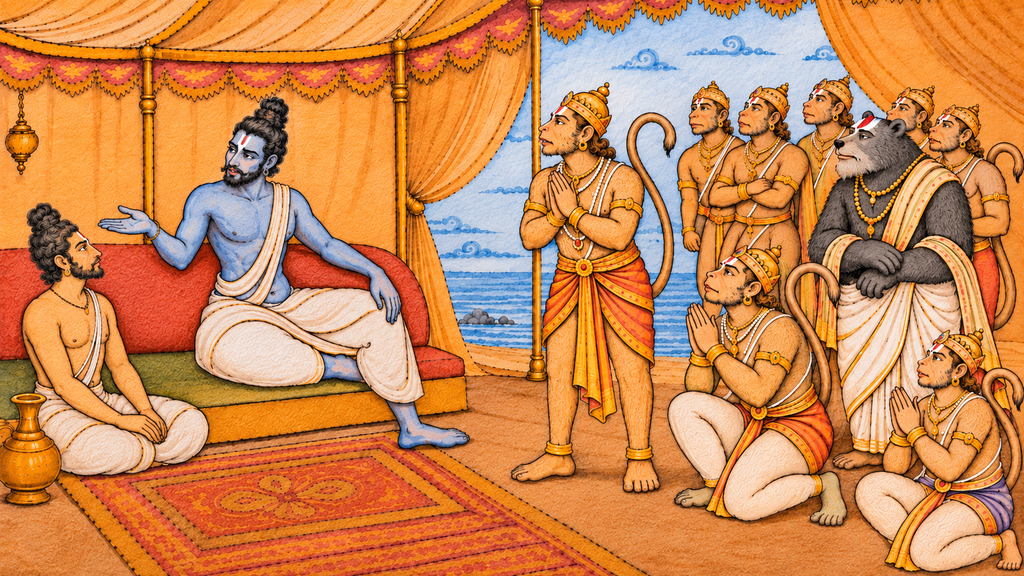
perumAL hears sugrIva mahArAja’s words and thinks, ‘I want to protect vibhIshaNa, but this makes sugrIva anxious out of care for my well-being. Not only that, but the affection he has towards me brings about a wisdom in him to refute my own will. Oh, how wondrous is the nature of sugrIva’s affection!’ Thus, peumAL smiles gently, thinking of sugrIva mahArAja’s love. He looks around to see if anyone in sugrIva mahArAja’s army is willing to accept his thoughts, but he does not see anyone agreeable. Therefore, he looks at iLaiyaperumAL, who understands his thoughts, and begins to speak.
vAnarAdhipathEr vAkyam SruthvA sarvAn udhIkshya cha I
Ishadh uthsmayamAnasthu lakshmaNam puNyalakshaNam I
ithi hOvAcha kAkuthsthO vAkyam sathyaparAkrama: II
Word-by-word meaning
sathyaparAkrama: – one who possesses unhindered power [to defeat anyone] kAkuthstha: – SrI rAma
vAnarAdhipathE: – sugrIva’s
vAkyam – words
SruthvA – after hearing
sarvAn – everyone
udhIkhsya cha – also looks [at them]
Ishath uthsmayamAna: – with a slight, gentle smile
puNyalakshaNam – with a good [expressive] facial features
lakshmaNam – to lakshmaNa [iLaiyaperumAL]
ithi – in this manner
vAkyam – words
uvAcha ha – spoke
Simple meaning
After hearing sugrIva mahArAja’s words, SrI rAma, who possesses unhindered power, looked around at everyone with a slight, gentle smile and spoke the following to lakshmaNa, who possessed a pleasing countenance.
[Note from kAlakshEpam: perumAL replies after hearing the words of sugrIva mahArAja. He looks at iLaiyaperumAL and speaks because those with sugrIva mahArAja did not possess the courage to contradict their master’s words. Since the others around perumAL did not show support for his opinion, perumAL speaks to iLaiya perumAL, although his words were intended for sugrIva mahArAja].
Notes from periyavAchchAn piLLai’s vyAkhyAnam
vAnarAdhipathEr vAkyam SruthvA
perumAL heard the words of sugrIva mahArAja – words spoken out of boundless affection, which remained incomprehensible to scholars who attempted to understand them through their mere intellect, without love for perumAL in their heart.
[Note from kAlakshEpam: Even those who have realised perumAL could not comprehend sugrIva mahArAja’s words. sugrIva mahArAja is situated in the position of love that is much higher than those of the wise.
While sugrIva mahArAja spoke out of love, the wise tried to understand his words through their intellectual knowledge, wondering, how the jIvAthmAs, as parathanthras, could ever refute perumAL’s will!]
sugrIva mahArAja is addressed here as vAnarAdhipathE not only because he is the chief of the monkeys, but because he is a leader, the one possessing utmost affection.
[Note from kAlakshEpam: vAnarAdhipathE – the chief of monkeys, a leader of such superior level that his leadership [perspectives] could not be easily understood. Although those present there [such as jAmbhavAn, hanumAn, angadhap perumAL and others] were all mahAmathis, they could not understand the thoughts expressed out of extreme affection by sugrIva mahArAja].
vAnarAdhipathE signifies a leader whose path is reverently followed by all with the highest respect. Therefore, because all the monkeys, including hanumAn, were completely obedient to sugrIva mahArAja, they refrained from providing the necessary backing for SrI rAma.
sarvAnudhIkshya – looking at everyone
Though it was sugrIva mahArAja who spoke, perumAL looked at everyone around him with a desire to know – ‘Would these monkeys in sugrIva’s army follow what I said? Or, would they follow sugrIva’s words?’
Alternative interpretation –
In the dharma SAsthram – Apasthamba dharmam 1-8-19,20 “AchAryaprAchAryasannipAthE prAchAryAyOpasangruhya” (When a Sishya approaches and both the Acharya and prAchArya (AchArya’s AchArya) are present together, he must prostrate to the prAchAryan first. Following this, when he attempts to prostrate to his own AchAryan, the AchArya must stop him, indicating that it is unnecessary because honouring the prAchArya is sufficient. In this manner, when both are present, the opportunity to worship one’s AchArya is absent). Accordingly, perumAL looks around at everyone with loving curiosity, thinking, ‘sugrIva mahArAja and I, sugrIva’s lord, are both present here. Will they follow my will as dictated in the scriptures?
cha (udhIkshya cha) – The word cha means ‘also’. In the phrase, ‘sarvAnudhIkshya cha’ (meaning ‘he also saw everyone’s face’), the use of cha implies that perumAL observed something more than just their faces. That is, he also noticed the changing expressions on their faces – whether they were favourable or not, the intentions running through their minds. Thus, the word cha, comprehensively conveys all of these aspects.
Ishadh uthsmayamAna: – with a slight, gentle smile
perumAL smiled gently. But what was the reason for his smile? sugrIva mahArAja was anxious upon realising that perumAL wanted to protect vibhIshaNa at any cost. This realisation made him anxious, yet it also brought him a unique clarity of mind, allowing him to possess both anxiety and clear intellect simultaneously. His anxiety stemmed from the belief that perumAL was doing something dangerous. At the same time, his intense affection for perumAL triggered a clarity of intellect, prompting him to try and convince permAL otherwise – even if it meant refuting his divine will. Seeing this, perumAL smiled and thought, “What a wonder! His affection arouses both anxiety and clarity at once”.
“nalamE validhu kol nanju Uttu van pEy
nilamE puraNdu pOy vIzha salamEdhAn
vengongai uNdAnai mIttAychchi UttuvAn
thangongai vAy vaiththAL sArndhu”.
(The cruel pUthanA came with deceitfulness to feed poison to krishNa. krishNa, in turn, deceitfully suckled her bosom and drew the life out of her. yashOdhAp pirAtti quickly took krishNa and nursed him after seeing him consume the poisonous milk). In this pAsuram, pEyAzhwAr talks of the intense affection of yaSOdhAp pirAtti that nudged her to nurse krishNa with her milk, even after seeing pUthanA die after giving her milk to krishNa. Oh, the strength of affection – what will it not do! It supersedes all fear.
Although yaSOdhAp pirAtti was overcome with fear and anxiety upon seeing pUthanA’s death, she also had the clear intellect to protect krishNa, and hence, she rushed to feed him. Similarly, sugrIva mahArAja spoke in the same mood.
thu – A special meaning is conveyed by this word, bringing out a noticeable difference.
In this phrase ‘IshadhuthsmayamAna: thu’, which means, perumAL smiled, the word ‘thu’ conveys a discernible shift communicated by that smile – perumAL’s resolve to convey his own intention while setting aside the perspective of sugrIva mahArAja.
[Note from kAlakshEpam: At this juncture, perumAL is going to refute sugrIva mahArAja’s response. Although he explains his reasoning to sugrIva mahArAja in many subsequent verses, his response at this specific juncture is considered highly significant. This distinctive response is illustrated by the word thu. This is an important aspect that perumAL points out here. Even if one is immediately unable to hold on to a higher standard of righteousness, he must definitely let go of that which is unrighteous. That is, it is necessary to renounce the unfavourable first before attempting to hold on to what is favourable].
Previously, sugrIva mahArAja said, ” Is there any person, whom he will not abandon? [in SrI rAmAyaNam yudhdha kANdam 18-5 “yamEhsa na parithyajEth”]. Responding to him, SrI rAma says, ‘When in distress, the relatives (those like rAvaNa) will harm; hence, vibhIshaNa arrived here. [SrI rAmAyaNam yudhdha kANdam 18-10 “vyasanEshu praharthArasthasmAdhayamihAgatha:”]. Since rAvaNa is going to torment him, he has come here seeking our refuge’. Thus perumAL conveys this to iLaiyaperumAL [lakshmaNam].
Since no one in sugrIva mahArAja’s army was ready to listen to perumAL’s words, perumAL spoke to the great scholar – the one who adorned himself with treebarks even before SrI rAma did – to accompany SrI rAma to the forest [SrI rAmAyaNam sundhara kANdam 33-28 “prAgEva thu mahAprAgyA” (even before me, the great and illustrious)]. Because iLaiyaperumAL stands ready to execute his divine will even before perumAL could convey his intentions, perumAL addressed those words to iLaiyaperumAL.
puNyalakshaNam – signs of good virtue
In spite of the varied perspectives presented by sugrIva mahArAja and others regarding vibhIshaNa’s complete surrender, perumAL had already conveyed his absolute resoluteness [na thyajEyam] to protect vibhIshaNa. Therefore, after listening to sugrIva mahArAja’s words, iLaiyaperumAL was excited to hear perumAL’s response at this juncture. This enthusiasm and eagerness to hear perumAL’s response was well visible on iLaiyaperumAL’s face.
ithi vAkyamuvAcha – in this manner, he spoke. In this way, perumAL expressed his thoughts. His words celebrated sugrIva mahArAja’s boundless affection while simultaneously refuting sugrIva mahArAja’s perspective and indicating his own desire to respond. Thus, ithi [in this manner] illustrates perumAL expressing his distinct mindset.
ha – Normally, the word ha is used as an exclamation to express joy. Here, vAlmeeki bhagavAn expresses his awe upon witnessing perumAL’s humility in celebrating sugrIva mahArAja – Oh, what a magnanimity! Oh, his simplicity! He praises sugrIva in this manner without any regard to his own greatness. He further celebrates, ‘How wonderful is his response to sugrIva, just when everyone thought that sugrIva mahArAja’s words were irrefutable’.
kAkuthstha: means ‘born in the lineage of kakuthstha’. indhra once requested a king – one of SrI rAma’s ancestors – to support him in a battle. To this, the king replied, ‘indhra! you must be my vAhanam [a vehicle]’. indhra then assumed the form of a bull and the king sat on the bull’s hump [kakuth] and destroyed indhra’s enemies. Hence, he became renowned as kakuthstha – a fact well-known from the ithihAsams and purANams.
vAlmeeki bhagavAn is amazed by perumAL’s simplicity, which he highlights using the word kAkuthstha:. He says, ‘What a wonder! Born into the great kakuthstha lineage, whose kings protected even the dhEvas, such as indhra, by defeating their enemies in times of danger. Yet, disregarding the grandeur of his birth [in such a superior raghu dynasty], SrI rAma spoke with such humility to sugrIva, a monkey!’
sathyaparAkrama: means truly brave. A warrior, who fights ferociously even when the enemies fight in a manner that seems unassailable, is known as sathyaparAkrama. Though SrI rAma spoke in a simple manner, his power is absolute with an infallible intent.
A mighty warrior, even when surrounded by an unassailable enemy, will escape from their clutches and still defeat them. Even after destroying the entire enemy army – the chariots with elephants and horses, including the infantry [the foot soldiers who are sent at the end] – SrI rAma will still remain resilient. Similarly, no matter how eloquent his opponent is in a debate, he will skillfully analyse the answers, rise beyond them, and win the argument.
[Note from kAlakshEpam: The pAsuram in reference to ‘the foot soldiers’ mentioned here – periya thirumozhi 6-5-3 “Anaip puravith thErodu kAlAL aNi koNda sEnaith thogaiyaich chAdi ilangai seRRAnUr (The abode of one who destroyed rAvaNa’s army with elephants, horses, chariots and foot soldiers)].
Therefore, because SrI rAma is a sathyaparAkrama:, he was able to respond to even the most irrefutable words of sugrIva mahArAja.
vAnarAdhipathEr vAkyam SruthvA sarvAnudhIkshya cha I
IshadhuthsmayamAnasthu lakshmaNam puNyalakshaNam I
ithi hOvAcha kAkuthsthO vAkyam sathyaparAkrama: II
Thus concludes the vyAkhyAnam for this SlOkam.
SrI rAmAyaNa thani SlOkam – yudhdha kANdam 18.8 – anadhIthya cha
This SlOkam also highlights the significant words spoken by SrI rAma.
avathArikai (Introduction)
To highlight the eminence of his own response, perumAL celebrates the superiority of sugrIva’s words.
[Note from kAlakshEpam: If a scholar effortlessly refutes an inappropriate argument made by an individual ignorant of scriptural injunctions, it does not add to his glory. This is because defeating an ignorant person is not something to be commended. Contrarily, if one wins an argument that was well-supported with scriptural references, such a debate will be much appreciated and glorified. Similarly, sugrIva mahArAja’s words were superior, and perumAL’s response to them was even more superior].
anadhIthya cha SAsthrANi vrudhdhAnanupasEvya cha I
na SakyamIdhruSam vakthum yadhuvAcha harISvara: II
Word-by-word meaning
harISvara: – the chief of monkeys, mahArAja [sugrIva mahArAja]
yadhuvAcha – those words said by him
IdhruSam – such words
SAsthrANi – the scriptures
anadhIthya – without studying
vrudhdhAn – the elders, the wise
anupasEvya cha – and without serving and listening
vakthum – to speak
na Sakyam – impossible
Simple meaning
Without studying the scriptures and without hearing from the elders by serving them, it is impossible to speak such words as spoken by the chief of monkeys, sugrIva mahArAja.
Notes from periyavAchchAn piLLai’s vyAkhyAnam
SAsthrANi anadhIthya vrudhdhAmScha anupasEvya IdhruSam vakthum na Sakyam – without learning the SAsthram and hearing from the wise, words of this nature cannot be spoken!
[From the word-by-word meaning of the SlOkam, we understand that it is impossible to speak in this manner without learning from the scriptures and hearing from the wise. periyavAchchAn piLLai elaborates on this further, very beautifully, in the vyAkhyAnam].
The greatness of sugrIva mahArAja’s words is highlighted here. A person cannot speak in this manner with the knowledge of just a single SAsthram; he must have learned many scriptures. Similarly, it is impossible for a person to speak like this by hearing from only a single AchArya. Only someone who has served and learned from many AchAryas can speak in this way.
In addition, the word cha indicates that a person whose intellect follows only one thought or path cannot speak in this fashion; only a person who analyses situations from multiple dimensions can speak in this manner.
IdhruSam – ‘of this nature’. It is impossible for anyone other than sugrIva mahArAja to speak words of this nature. These words can only be described as ‘such a nature’ – unique, and cannot be compared to anyone else’s.
- SrI rAmAyaNam ayOdhyA kANdam 1-27 “Sraishtyam SAsthra samUhEshu prAptha:” (He who has attained excellence across various scriptures).
- SrI rAmAyaNam sundhara kANdam 36-61 “vrudhdhOpasEvI” (One who serves the wise).
- SrI rAmAyaNam yudhdha kANdam 18-12 “yasthu dhOshas thvayA prOktha:” (The faults which were stated by you).
Thus, it is stated that sugrIva mahArAja’s words were very superior. They were of such nature that it would be impossible for even perumAL to state these kinds of words.
yadhuvAcha – that which was spoken by him. His words can only be described as yadhuvAcha. This is because words other than those spoken by sugrIva mahArAja lack the power to convey the same meaning. Therefore, if one attempts to retell, they can only simply say, ‘those words of sugrIva mahArAja’.
harISvara: – the chief of monkeys
He, who is the utmost affectionate among the monkeys, spoke these superior words reflecting his greatness. Thus, nothing other than his own glory could be equivalent to sugrIva mahArAja’s words.
This SlOkam and yudhdha kANdam SlOkam 17-50 “na vAdhAth” illustrate the manner in which the virtuous, those embodied with sathva guNam should conduct themselves during a debate or discussion.
anadhIthya cha SAsthrANi vrudhdhAnanupasEvya cha I
na SakyamIdhruSam vakthum yadhuvAcha harISvara: II
Thus concludes the vyAkhyAnam for this SlOkam.
SrI rAmAyaNa thani SlOkam – yudhdha kANdam 18.9 – asthi sUkshmatharam
In this SlOkam, perumAL conveys a very important meaning, through which he guides sugrIva mahArAja to understand his perspective. [He says] Many kings across the world conduct themselves in a similar manner [as vibhIshaNa]. We can see this in front of our eyes [perumAL is referring here to sugrIva mhArAja who had also behaved in a similar manner with vAli].
avathArikai (Introduction)
In the previous SlOkam, perumAL addressed iLaiyaperumAL in his speech and celebrated sugrIva mahArAja. In this SlOkam, he addresses sugrIva mahArAja and conveys that what he is about to convey in the next SlOkam is applicable to many kings, including sugrIva himself. In the subsequent SlOkam, perumAL states, ‘Since it is natural for relatives like rAvaNa to torment those like vibhIshaNa during their difficult times, he has approached us. Therefore, vibhIshaNa is certainly trustworthy’.
asthi sUkshmatharam kinchidhyadhathra prathibhAthi mE I
prathyaksham laukikam vApi vidhyathE sarvarAjasu II
Word-by-word meaning
athra – in this matter
yath kinchith – that which
mE – to me
prathibhAthi – appears [to me] in my mind, [thath – that]
sUkshmatharam – highly subtle
asthi – is present
prathyaksham – directly visible to everyone
laukikam vA api – it is also conforming to the society/world
sarvarAjasu – and is seen in all the kings
vidhyathE – exists
Simple meaning
[perumAL says] The understanding [regarding vibhIshaNa] that comes to mind regarding this matter is very subtle. However, it is consistent with worldly practices, can be directly observed, and is prevalent among all kings.
Notes from periyavAchchAn piLLai’s vyAkhyAnam
asthi sUkshmatharam – there is something that is very subtle
[perumAL says] That which was said by sugrIva mahArAja is sUkshmam, subtle. He thought very minutely and spoke [that vibhIshaNa had abandoned his brother at a crucial juncture]. However, what I am about to state is sUkshmatharam – highly subtle. There is nothing left to be said beyond this, no other logic to consider, and not a single defect can be found in this statement, making it superior to everything that has been said before. How is it?
Because, in response to what perumAL has stated [such as – prathyaksham, laukikam, and sarvarAjasu], there is nothing left to say except to repeat what was said earlier. No other wording will communicate a new meaning.
Here, periyavAchchAn piLLai is referring to the words that sugrIva mahArAja and perumAL are going to speak in the subsequent verses.
- SrI rAmAyaNam yudhdha kANdam 18-18 “rAvaNEna praNIhitham” (Sent by rAvaNa).
- SrI rAmAyaNam yudhdha kANdam 18-19 “rAkshasO jihmayA” (Deceitful rAkshasa).
- SrI rAmAyaNam yudhdha kANdam 18-22 “sudhushtO vApyadhushtO vA” (whether he is extremely wicked or completely faultless).
- SrI rAmAyaNam yudhdha kANdam 18-23 “piSAsAn” (wicked entity).
In SlOkam 18-18 and 18-19, sugrIva conveys the same meaning that was spoken in SlOkam 17-24 [rAvaNEna praNihitham], and 17-25 [rAkshasO jihmayA]. Subsequent to this, perumAL, states his might in order to provide comfort and assurance to sugrIva, whose intellect has been very much blinded by his overflowing affection. All of these instances, including the illustration of pigeon and monkey stories, are only reiterations – mainly to emphasise the meanings which were already stated. Thus, it is clear that what perumAL is about to convey at this juncture is the pinnacle.
kinchith means something small. Out of humility, perumAL, describes his own words as kincith – what I am about to convey are very small words. Although perumAL’s words were far superior to what sugrIva mahArAja had spoken, perumAL refers to them in this manner because of simplicity and his lack of interest in self-praise.
yadhathra prathibhAthi means ‘regarding this matter, this is what comes to my mind’. When perumAL says this, he means, “In this matter regarding acceptance of vibhIshaNa, this is what comes to my mind”.
prathyaksham means that which is directly visible. In this context, vibhIshaNa’s actions [leaving rAvAna, arriving with a mace and four companions, and surrendering to SrI rAma] are clear, distinct and can be perceived directly by everyone.
laukikam vApi means ‘consistent with worldly practices’.
While vibhIshaNa’s actions are completely transparent to everyone, one might ask – isn’t it wrong to destroy one’s own brother? However, such conflicts are quite common in ordinary life; when individuals are tortured by their own relatives, they often turn against them.
[Note from kAlakshEpam: This perspective reflects the general conduct seen in mundane life among those engrossed in worldly affairs. In contrast, a SrivaishNava transcends these worldly practices by taking upon himself the faults of others and maintaining an elevated, distinct standard of conduct].
vidhyathE sarvarAjasu – ‘[this trait] can be seen among all kings’. [In this context, ‘all’ should be interpreted as ‘many,’ since this behaviour is not seen in exemplary, ideal kings like SrI rAma or bharathAzhwAn].
[perumAL says] This course of action that vibhIshaNa has resorted to, is quite natural for those troubled by their relatives in danger; it is a prevalent trait among the kings, including sugrIva mahArAja. Perhaps sugrIva is unable to remember his own past predicament due to his abundant affection towards me.
[Note: sugrIva surrendered to SrI rAma when he was troubled by vAli. Hence, the words SrI rAmAyaNam yudhdha kANdam 18-5 “IdhruSam vyasanam prAptham bhrAthram ya: parithyajEth” (he abandoned his brother completely who was experiencing this kind of misfortune) are also applicable to sugrIva mahArAja].
asthi sUkshmatharam kinchidhyadhathra prathibhAthi mE I
prathyaksham laukikam vApi vidhyathE sarvarAjasu II
Thus concludes the vyAkhyAnam for this SlOkam.
AzhwAr emperumAnAr jIyar thiruvadigaLE SaraNam
periyavAchchAn piLLai thiruvadigaLE SaraNam
Source – SrI rAmAyaNa thani SlOkam – 82 – yudhdha kANdam 18.6, 18.7 – vAnarAdhipathEr, 18.8 – anadhIthya cha, 18.9 – asthi sUkshmatharam Audio Video
adiyEn chithrA rAmAnuja dhAsi
Proofreading/Curating done by – kOsalEndhra rAmAnuja dhAsan, krishNan rAmAnuja dhAsan
Artwork – namperumAL rAmAnuja dhAsan
Related Links
SrI rAmAyaNa thani SlOkam – 81 – yudhdha kANdam 18.4 – sugrIvas thvatha, 18.5 – sudhushtO Audio Video
SrI rAmAyaNa thani SlOkam – 80 – yudhdha kANdam 18.3 mithra bhAvEna – Part 6 Audio Video
SrI rAmAyaNa thani SlOkam – 79 – yudhdha kANdam 18.3 mithra bhAvEna – Part 5 Audio Video
SrI rAmAyaNa thani SlOkam – 78 – yudhdha kANdam 18.3 mithra bhAvEna – Part 4 Audio Video
SrI rAmAyaNa thani SlOkam – 77 – yudhdha kANdam 18.3 mithra bhAvEna – Part 3 Audio Video
SrI rAmAyaNa thani SlOkam – 76 – yudhdha kANdam 18.3 mithra bhAvEna – Part 2 Audio Video
SrI rAmAyaNa thani SlOkam – concise english meanings
archived in https://granthams.koyil.org
pramEyam (goal) – https://koyil.org
pramANam (scriptures) – https://granthams.koyil.org
pramAthA (preceptors) – http://acharyas.koyil.org
SrIvaishNava education/kids portal – http://pillai.koyil.org