SrI: SrImathE SatakOpAya nama: SrImathE rAmAnujaya nama: Srimath varavaramunayE nama:
The following article is a translation of vArthAmAlai grantham from SrI u vE sArathy thOthAthri swAmy’s thamizh kAlakshEpam. We are grateful to swAmy for giving us this opportunity and for his continuous help in publishing these.
In this grantham, many important matters which are the foundational root meanings for our tradition – such as rahasya thrayam (the three secrets), thathva thrayam (the three realities), and artha panchakam (the five essential concepts) – are presented both briefly and in detail.
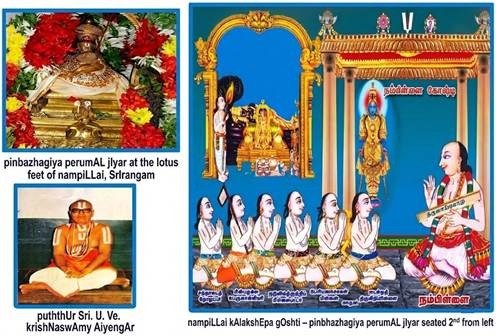
AchArya, pinbazhagiya perumAL jIyar was deeply rooted in firm faith towards his preceptor. His AchArya was nampiLLai. nampiLLai was a famous AchArya who graciously resided in SrIrangam and was celebrated as lOkAchAryar. nampiLLai organized and wonderfully conducted a massive gathering of scholars in thiruvarangam. While he lived in SrIrangam, a discourse gathering was always underway in the maNdapam located near the divine feet of periyaperumAL. Our pUrvAchArya granthams note that periya perumAL himself would eagerly rise and come to listen to these discourses. His era is widely called as nalladi kAlam, or golden era. During this period, our sampradhAyam flourished beautifully, and all traditional scriptures were well propagated.
nampiLLai excelled as the one who absorbed everything within himself – whether it be the verses of AzhwArs’ pAsurams, samskrutham vEdhAntha granthams like SrI bhAshyam, or ithihAsams and purANams. Furthermore, he was a master of both thamizh and sanskrit grammar and literature.
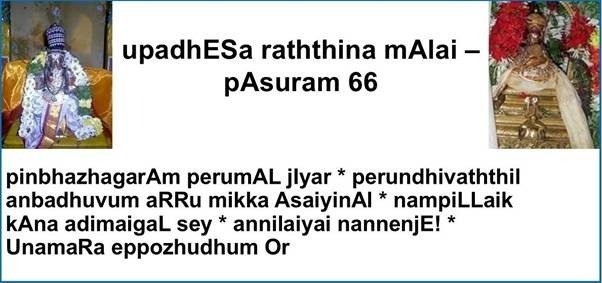
Among nampiLLai’s disciples, pinbazhagiya perumAL jIyar was a prominent. Our AchAryas show that he remained as divine feet to nampiLLai. pinbazhagiya perumAL jIyar was deeply devoted to nampiLLai’s thirumEni. His intense devotion to his AchArya is described beautifully in this pAsuram 66 in upadhESa raththina mAlai.
pinbhazhagarAm perumAL jIyar * perundhivaththil anbadhuvum aRRu mikka AsaiyinAl * nampiLLaik kAna adimaigaL sey * annilaiyai nannenjE! * UnamaRa eppozhudhum Or
As disciples we must have deep involvement in the thirumEni of the AchArya. The AchArya must have deep involvement in the upliftment of Sishya’s AthmA . This is the primary characteristic of an AchArya. The lakshaNam of a Sishya is to have deep involvement in the thirumEni of the AchArya – focussing on its well-fare, he must take care of all the things needed for AchArya. This is the AchArya Sishya lakshaNam.
This has been elaborated by piLLai lOkAchAryar in SrIvachana bhUshaNam. It is shown that holding onto the thiruvadi of the AchArya and taking refuge in AchArya’s affection is the sole path to liberation for a Sishya. maNavALa mAmunigaL has presented these essential meanings from SrIvachana bhUshaNam in upadhESa raththina mAlai.
In those pAsurams the qualities of a Sishya are described by taking the example of pinbazhagarAm perumAL jIyar who had such immense devotion towards his AchArya, nampiLLai. Because of his involvement in the thirumEni of his AchArya , he wanted to perform physical service to his thirumEni. Due to this, he did not even desire to go to paramapadham.
Performing service is not mere study of granthams, or propagation of sampradhAyam by alienating ourselves. We must constantly care for the thirumEni of AchArya. pinbazhagarAm perumAL jIyar perfectly illustrated how we must perform the necessary kainkaryams.
pinbazhagiya perumAL jIyar has graciously authored a wonderful grantham called vArthAmAlai. In this grantham, he has compiled numerous conversations and life events of several pUrvAchAryas. A ‘vArthai’ refers to a conversation that occurred in the life of a pUrvAchArya, or a historical account. Within these, he reveals profound philosophical meanings. The nature of traditional devotion to AchArya, the proper way to perform kainkaryam to AchAryas, and the true relationship between an AchArya and Sishya are also explained here.
All of these are individual vArthais conveying crucial meanings of our sampradhAyam and sidhdhAntham from various AchAryas on different occasions. In order for us to retain these firmly in our minds and to help us understand our sampradhAyam, they are repeatedly mentioned. For instance, the concept that body is distinct from the AthmA has been highlighted in countless places by our pUrvAchAryas. Similarly, in this grantham too, many meanings of thathva thrayam, rahasya thrayam, and artha panchakam are repeated in several places.
In vArthAmAlai, pinbazhagiya perumAL jIyar presents the vArthais, which have been extracted from conversations of different AchAryas as reference quotes. Therefore, some portions might feel familiar, as if we have already heard them before. Indeed, to establish a familiarity about all the concepts is precisely the goal – it is with this intention that our pUrvAchAryas have presented these granthams.
Twenty-eighth vArthai
rakshya rakshaka sambandham, pithA puthra sambandham, SEsha SEshi sambandham, bharthru bhAryA sambandham, gyAthru gyEya sambandham, svaswAmi sambandham, SarIra SarIri sambandham, AdhAra AdhEya sambandham, bhOkthru bhOgya sambandham.
In this 28th vArthai, navavidha sambandham, or the nine-fold relationship and the profound nature of these relationships existing between the jIvAthmA and the paramAthmA is beautifully brought out. The term “navam” means nine, and “vidham” means types; hence, this represents nine distinct types of relationships.
Indeed, piLLai lOkAchAryar has graciously authored an entire independent grantham titled navavidha sambandham. In the beginning of this grantham, he presents a pramANa SlOkam – pithA cha rakshaka: SEshI bharthA gyEyO ramApathi: I swAmyAdhAra: mama AthmA cha bhOkthA cha AdhyamananUdhitha: II
During the sacred occasion of pancha samskAram, the AchArya instructs us in rahasya thrayam. Among them, the thirumanthram, or ashtAksharam is the foremost. In this SlOkam, he demonstrates that thirumanthram is the primordial, foundational, and most vital manthram. He also explains that all these nine types of relationships are inherently embedded within it.
The nine types of relationships represents the essential truths that one must understand. Only if the relationship that exists between jIvAthmA and paramAthmA is understood, we can act accordingly. For example, in worldly life, only when a husband and wife understand their precise relationship, they can perform the mutual duties they owe to each other. The relationship between a son and a father operates in the same manner. Only when that relationship is properly understood will their actions correspond to it. That is why piLLai lOkAchAryar has highlighted and explained these nine types of relationships in this grantham.
In this particular vArthai, pinbazhagiya perumAL jIyar extracts the core principles of that grantham – navavidha sambandham and presents them here very succinctly.
By declaring “pithA cha rakshaka: SEshI… ramApathi:”, the SlOkam clarifies right at the outset who is that bhagavAn, ensuring that there is no ambiguity. He is ramApathi: – ramA refers to SrI mahAlakshmi, SrIman nArAyaNan is her husband. That superme lord holds nine types of relationships with the jIvAthmA. He exists as pithA (father), rakshakan (the protector), SEshi (the master), bharthA (the husband), gyEyam (the object to be known), swAmi (the owner), AdhAram (the support), AthmA and bhOkthA (the enjoyer).
pithA puthra sambandham
This refers to father-son relationship. In the material realm, a father is the cause of our physical birth; it is because the father exists that the son is formed. Similarly, it is solely because bhagavAn exists that all jIvAthmAs exist. However, in this context, we must not misunderstand that bhagavAn newly creates the jIvAthmA out of nothing. The jIvAthmA is an eternal entity. It is neither created nor destroyed. Therefore, one must understand bhagavAn as the fundamental cause for jIvAthmA’s existence. It is on the basis of this causal relationship that the term pithA is applied. It does not mean that the jIvAthmA did not exist before and was generated; the AthmA has always existed, bhagavAn is the ultimate reason for its continued sustenance and existence. The jIvAthmA exists because bhagavAn exists, and this reason forms the bedrock of father-son relationship.
rakshya rakshaka sambandham
This is protected-protector relationship. In the vArthai, this relationship is listed first, followed by the pithA-puthra sambandham. Conversely, in the SlOkam, pithA-puthra appears first and rakshya-rakshaka appears second. This structural variation presents no flaw whatsoever. For ease of understanding the philosophical meaning, we first examined the pithA-puthra sambandham. Let us now understand the rakshya-rakshaka sambandham.
“rakshyam” refers to the object that is to be protected, and “rakshakan” denotes the one who protects it. Such a perennial relationship exists between us and bhagavAn. This truly implies that bhagavAn alone protects us at all times. Out of ignorance, we often think that we are protecting ourselves through our own efforts as long as we can, and that bhagavAn steps in to protect us only when our strength fails and we give up. While people generally think this way, it is far from the truth; he is the one actively sustaining us at every single moment.
For instance, when we walk down the street, the very fact that the earth does not split open beneath our feet is a manifestation of his protection. And it is no impossible feat for the earth to slide or split in an instant. These may be rare ocurrences, but consider the numerous traffic accidents which occur daily. We walk along, completely unaware of the what vehicles are approaching from behind. Yet, we prevail from such mishaps with no personal effort from us. It is bhagavAn alone who protects us. This is a simple, everyday illustration, but the principle applies universally – bhagavAn alone is our protector in every dimension of life. Therefore, realising this relationship of his being the protector is paramount.
We are inherently the objects to be protected, and all jIvAthmAs share this status. When we categorise entities into jIvAthmAs and paramAthmA, bhagavAn alone is the paramAthmA, while all others are jIvAthmAs. This encompasses all cosmic entities, be it the dhEvas starting from brahmA, including rudhra, indhra, varuNa, and agni, or humans, animals. Inside every form that we can perceive with our eyes, an AthmA resides, clothed for the time being in that specific physical body. bhagavAn alone stands as the protector for every single one of them.
It is never a case of a single jIvAthmA uniquely sharing these nine relationships with perumAL to the exclusion of others, nor is it denied to humans while granted to dhEvas. This is a shared, intrinsic relationship binding all AthmAs to bhagavAn. This universality is emphasised to make us appreciate that bhagavAn is completely distinct from and vastly superior to everyone else. This is the core realisation here. Thus, through the rakshya-rakshaka sambandham, it is understood that he is the sole protector, and we are all eternally the protected.
SEsha SEshi sambandham
This is servant-master relationship. “SEshi” signifies the primary being, the ultimate master, while “SEshabhUthan” signifies the dependent servant, the servitor. We are all inherently his servitors, and he is our supreme master. This relationship, too, is universally applicable to all AthmAs, irrespective of whether it is brahmA or a tiny ant; both are equally servitors to bhagavAn.
Some individuals consciously accept this truth, while others deny it. In our own human sphere, while one might consciously accept their human identity, another might arrogantly proclaim themselves to be god. Such a claim does not change the reality; they remain human. In the same way, every single AthmA is inherently a servitor to bhagavAn. Whether we willingly acknowledge it or not is only a practical difference. The reality remains that bhagavAn alone is the SEshi, and we are all eternally his servitors.
bharthru bhAryA sambandham
This represents the husband-wife relationship. bhAryA means wife and bharthA means husband.
This marital relationship is also common to all AthmAs in their relation to bhagavAn. The spiritual entity known as the AthmA is inherently feminine in nature; thus, all AthmAs are metaphorically like women. bhagavAn alone is purushOththaman, or the supreme male, whom we must all choose as our husband.
We might superficially think that only a human born as a woman can desire to marry bhagavAn, pointing to how ANdAL cherished that divine longing. However, the AzhwArs also longed for bhagavAn in the exact same manner; nammAzhwAr desired him intensely, as did thirumangai AzhwAr. The deep truth we understand from this is that while an external physical body may be structured as male, the inner AthmA itself possesses an inherently feminine nature. Those who are entirely receptive, who listen to and obey commands, embody the feminine aspect. Conversely, he who commands and rules embodies the masculine aspect. From this perspective, bhagavAn alone is the ruler who commands, and we are entirely subject to his sovereign rule. In that exalted sense, because every AthmA exists in this receptive state of devotion, we all share this bharthru-bhAryA bond.
gyAthru gyEya sambandham
The relationship between the knower and the object to be known. This implies that we are the knowers and bhagavAn is the supreme object to be known. The jIvAthmA naturally possesses consciousness and knowledge, which is the precise line of demarcation between achith and chith The AthmA residing within a physical body is characterised by gyAnam, giving it the cognitive capacity to perceive an object, comprehend it, and act independently. On the other hand, achith matter is completely devoid of this cognitive capacity. Therefore, the attribute of gyAnam is the unique, defining characteristic of jIvAthmA.
While the unique attribute of the AthmA is knowledge, the absolute purpose of that knowledge is to know bhagavAn. By definition, knowledge must seek to know something, and the primary reality that deserves to be known above all else is bhagavAn. Consequently, we function as the gyAthru (the knower) and he exists as the gyEya (the one to be known). This, too, is an intrinsic potential shared by all AthmAs.
Even an animal can come to know him. For example, gajEndhrAzhwAn was in the physical form of an elephant, a mere animal, yet he recognized and knew bhagavAn. Similarly, garudAzhwAr manifests in a bird form, yet he knows bhagavAn perfectly. Thus, any AthmA, regardless of its current embodiment has an opportunity to know bhagavAn. A human body or a celestial body is simply more advanced, offering a much more refined functional capacity to utilise this knowledge effectively. An animal possesses enough basic intelligence to know where to find food, but it lacks the higher realisation of its own nature as an AthmA and the conscious awareness of the supreme bhagavAn. Though there are extraordinary exceptions where certain animals have known bhagavAn and attained his divine feet, animals generally lack this spiritual knowledge. In general, the capacity for knowledge is common to all souls, but depending on the specific body it inhabits, this knowledge will either be expanded or contracted – contracted in animal forms and significantly expanded in human or dhEva forms. Thus, the gyAthru-gyEya sambandham is clearly established.
svaswAmi sambandham
The relationship of a property and the owner. bhagavAn exists as our swAmi. We use this word routinely in common speech, but in sanskrit, the word “swam” literally translates to “property” or “wealth”. Therefore, the one who owns that property is called the swAmi, “the possessor” or “the owner”. When we address a person as swAmi, we are effectively saying, “I exist as your property, and you are my owner who holds absolute right over me, to rule me entirely according to your sweet will”. Therefore, when calling someone as ‘swAmi’ carries this exact weight of being his personal asset.
To use a mundane analogy, a mobile phone is the property of its owner. The owner picks it up and takes it along, and the property never questions why it is being moved or placed elsewhere, nor can a third party challenge that right. In the exact same manner, we must all remain as a submissive property to bhagavAn, who can direct us entirely according to his own pleasure and purpose. Every AthmA exists solely as bhagavAn’s precious property, which is the profound truth illuminated by the sva-swAmi sambandham.
SarIra SarIri sambandham
The body and the indweller relationship. We all constitute the body, and bhagavAn is eternally present inside us as the divine indweller. Currently, within this physical body, an AthmA resides, and going a step deeper, bhagavAn is present inside that AthmA. Consequently, just as this physical frame is the body and the AthmA is its animating force, the AthmA itself becomes a SarIram (a body) to bhagavAn, who dwells within it as the ultimate Soul. This extraordinary relationship means he exists as the SarIri, and all these AthmAs serve as a SarIram to him. Metaphorically, a SarIram is like a protective blanket wrapped around; the AthmA exists as a clothing wrapped over bhagavAn, defining a reality common to all AthmAs.
AdhAra AdhEya sambandham
The support and the supported relationship. bhagavAn exists as AdhAram (the foundational support), and we all exist as AdhEyam (entities supported). An AdhAram refers to whatever bears, holds, or sustains an object. As we sit here, the floor is our immediate AdhAram, holding us up, while the building structure rests on the earth. Ultimately, it is bhagavAn who bears and sustains the entire massive earth. Looked at from this cosmic perspective, every single entity in existence is fundamentally sustained and held in place by him alone, constituting the eighth relationship.
bhOkthru bhOgya sambandham
The enjoyer and the object of enjoyment relationship. “bhOgyam” means that which is experienced or enjoyed, while “bhOkthru” refers to the bhOkthA, the one who enjoys. He alone exists as the supreme enjoyer, and we are all objects to be enjoyed by him. We exist primarily for his divine pleasure and enjoyment; that is the ultimate goal of our existence, which is to yield bliss to bhagavAn. In this context, bhagavAn is the one who enjoys us.
Naturally, we will also enjoy bhagavAn. When we eventually ascend to paramapadham, we will fully enjoy bhagavAn there, just as we taste the joy of experiencing him here. However, our personal enjoyment is secondary. Far more vital than the joy we derive is the joy that bhagavAn derives from us. We must exist solely for his happiness, and we must never fall into the mistaken notion that he exists for our happiness. Therefore, through this bhOkthru-bhOgya sambandham, it is clearly demonstrated that he is the ultimate bhOkthA and we are the cherished bhOgyam.
In conclusion, we see from this SlOkam that these nine types of relationships exist eternally between the jIvAthmAs and the paramAthmA –
- rakshya-rakshaka sambandham
- pithA-puthra sambandham
- SEsha-SEshi sambandham
- bharthru-bhAryA sambandham
- gyAthru-gyEya sambandham
- sva-swAmi sambandham
- SarIra-SarIri sambandham
- AdhAra-AdhEya sambandham
- bhOkthru-bhOgya sambandham
Twenty-ninth vArthai
praNavaththil chathurthiyAlE – SEshathvaththaich cholli, akAraththAlE – SEshathva prathisambandhiyaich cholli, makAraththAlE SEshathvaththukku ASrayam solli, avadhAraNaththAlE SEshathvaththinudaiya ananyArhathvam sollugaiyAlE svarUpam solliRRu; akAraththAlE – rakshakanaich cholli, makAraththAlE – rakshya vasthuvaich cholli, chathurthiyAlE – rakshya rakshaka bhAvaththukku vENdum uRavu solli, avadhAraNaththAlE – rakshya rakshakangaLinudaiya lakshya lakshaNam sollugaiyAlE upAyam solliRRu. akAraththAlE – prApya vasthuvaich cholli, makAraththAlE – prApthAvaich cholli, chathurthiyAlE – prApthi palamAna kainkaryaththaich cholli, avadhAraNaththAlE – kainkarya prakAraththaich chollugaiyAlE prApyam solliRRu. praNavaththAlE – Athma svarUpam solliRRu; nArAyaNa padhaththAlE – paramAthma svarUpam solliRRu; chathurthiyAlE – purushArtha svarUpam solliRRu; “ma:” engiRa iththAlE virOdhi svarUpam solliRRu; “nama:” engiRa iththAlE upAya svarUpam solliRRu; AgaiyAlE sakala vEdhAntha prathipAdhyamAna artha panchakam solliRRu.
Part 1
praNavaththil chathurthiyAlE – SEshathvaththaich cholli, akAraththAlE – SEshathva prathisambandhiyaich cholli, makAraththAlE SEshathvaththukku ASrayam solli, avadhAraNaththAlE SEshathvaththinudaiya ananyArhathvam sollugaiyAlE svarUpam solliRRu
The primary matter shown in this vArthai is the meaning contained within the thirumanthram. We learn the thirumanthram – “Om nama: nArAyaNAya” from our AchArya. praNavam, nama:, and nArAyaNAya – these three sounds joined together make the thirumanthram. The meanings which reside in this thirumanthram are shown here in this vArthai. The nine-fold relationship is also be explained within this.
praNavaththil chathurtthiyAlE – SEshathvaththaich cholli
In the praNavam, there are three syllables – a, u, ma. These three letters are indeed considered three distinct words. Though a, u, ma are just three letters, because they possess independent meanings, they can be called words, as shown by our elders. The text explains that within the praNavam (a, u, ma), the chathurthi – fourth case ending, which is represented by “Aya”, is implicitly hidden within the letter “a”. That is “Aya” as in “nArAyaNAya”, that fourth case ending exists within “a” here.
The fourth case ending is the case ending present in it, showing the nature and the specific goal for which that letter exists. [In other words, chathurthi refers to the recipient of an action]. “ai, Al, ku, in, adhu, kaN” is the mnemonic taught in school to remember the vERRumai urubu. For example, rAma represents the subject, while the others show the various case relationships – rAmanai (rAma as object, e.g: She saw rAma), rAmanAl (by rAma), rAmanukku (for rAma), rAmanin (from rAma, e.g: rAma’s mercy), rAmanadhu ( of rAma, e.g: rAma’s arrow), rAman kaN (in/with rAma, indicating location e.g: in rAma’s hand, with rAma). These represent six types of vERRumai urubu.
Only by using that case ending can we understand the connection between one object and another. If we simply say “rAman” and “krishNan”, the connection between them remains unclear. We must specify whether it is from krishNan to rAman, whether krishNan said something to rAman, or whether krishNan attained some benefit through rAman. When there are two words, the case ending shows what connection exists between them. That is the fourth case ending. Many would have heard this discussed during the thirumanthra kAlakshEpam. Those who have listened to the mumukshuppadi will also already be familiar with this concept.
Let us see this briefly. In – a, u, ma – the akAram (a) denotes bhagavAn, while the makAram (m) denotes the jIvAthmA. The ukAram (u) denotes this emphasis as “to him alone”. This ukAram emphasises that the jIvAthmA exists for paramAthmA alone.
When we say paramAthmAvukkE, “to the paramAthmA alone”, it contains “ik” (to/for) sound in it. The origin of this “ik” sound is the hidden. While we say the jIvAthmA is for paramAthmA alone, that ‘for’ (ik) pointing to paramAthmA is grammatically hidden within the compound.
Ideally, it expands as a, u, Aya, ma. Just as the sound “Aya” appears explicity in “nArAyaNAya”, it is present here too, but hidden. That is what he shows here as the hidden fourth case. Through this implicit chathurthi within the praNavam – a, u, ma, absolute subservience is established. “Aya” means “for him”, which means existing solely to perform service to him and to fulfill his desires.
akAraththAlE – SEshathva prathisambandhiyaich cholli
SEshathvam means servitude, the “Aya” the fourth case ending – states this servitude. prathisambandhi refers to the counterpart to whom this servitude belongs – bhagavAn. This is stated in the akAram.
makAraththAlE SEshathvaththukku ASrayam solli
The SEshathvam resides with the jIvAthmA, and this is stated in the makAram. a, u, ma is the praNavam. In that praNavam, bhagavAn is stated in the akAram; he is the one who receives the servitude. The servitude we perform is received by bhagavAn. This servitude resides with the jIvAthmA, which is in the makAram.
avadhAraNaththAlE SEshathvaththinudaiya ananyArhathvam sollugaiyAlE svarUpam solliRRu
avadhAraNam means ’emphasis’.
The middle letter ukAram (u) functions as emphasis and thereby declares the appropriateness of that servitute. This way it establishes AthmA’s true nature – servitude. The ukAram signifies an exclusive emphasis meaning “to him alone”. It forcefully declares that the AthmA’s servitude belongs to absolutely no one else but bhagavAn. Within the a-u-ma of the praNavam, this middle ukAram is thus said to possess an exclusive meaning.
The term ananyArhathvam denotes being completely unfit for any other entity. While arham means being fit or appropriate, ananyArham means not being appropriate or available for anyone else, but being solely for bhagavAn. The ukAram specifies exactly that boundary. By declaring this ananyArhathvam, the essential true nature of the jIvAthmA was stated in this praNavam, showing that the jIvAthmA is an exclusive servant only to bhagavAn.
We frequently hear people across various places chanting “Om”, “Om”. Our AchAryas, however, have systematically proven its true meaning strictly on the strength of the scriptures. While external groups may be assigning whatever speculative meanings they want, the clear, unambiguous meaning preserved for us is that akAram denotes bhagavAn and makAram denotes the jIvAthmA. To fully comprehend why akAram refers to bhagavAn and makAram refers to the jIvAthmA, one must carefully listen to the detailed mumukshuppadi kAlakshEpam. Only through that formal study does it become perfectly clear to us. There is a linguistic and philosophical reason why akAram denotes bhagavAn. Just as all spoken letters fundamentally originate from the primordial sound akAram – a truth we see mirrored in thamizh literature where thiruvalluvar explicitly states, “agara mudhala ezhuththellAm Adhibhagavan mudhal” – it is known that akAram is the first, causal letter for all speech. Similarly, bhagavAn is the ultimate cause for the existence of all cosmic entities. Thus, an exact connection is established between the causal nature of the letter and the causal nature of bhagavAn, proving that this akAram stands as a letter denoting that bhagavAn. Similarly, the makAram denotes the jIvAthmA because the sanskrit letter “ma” specifically signifies a spiritual substance that possesses consciousness and knowledge. In sanskrit grammar, it is systematically proven that the letter “ma” directly denotes the AthmA. Our preceptors do not formulate these meanings according to their own personal whims; it is established via structural grammar because “ma” denotes an entity endowed with knowledge, it represents the AthmA. Likewise, this ukAram means existing for him alone, and furthermore, “Aya” means existing for him. When this “for him” and the exclusive emphasis join together, it becomes “for him alone”. This is the precise, authentic meaning of the praNavam. By highlighting this here, the true nature of this jIvAthmA as an exclusive, dependent servant of bhagavAn is perfectly and beautifully stated by praNavam.
Part 2
akAraththAlE – rakshaganaich cholli, makAraththAlE – rakshya vasthuvaich cholli, chathurthiyAlE – rakshya rakshaka bhAvaththukku vENdum uRavu solli, avadhAraNaththAlE – rakshya rakshakangaLinudaiya lakshyAlakshaNam sollugaiyAlE upAyam solliRRu.
The upAyam is also stated within this praNavam. The path to attain bhagavAn is generally stated in ‘nama:’, but here, he demonstrates that it actually exists right within the akAram itself. This shows that the deeper we analyse these words, the more we realise that numerous profound meanings are tightly packed within them.
akAraththAlE – rakshaganaich cholli
By the letter akAram, bhagavAn is not only revealed as the ultimate rakshakan (protector) of all creation but also as the upAyam within this praNavam. The upAyam represents the path or method to reach and attain bhagavAn. Generally, the upAyam is explicitly taught within the second word of the manthram, “nama:”. Yet, in this subtle exposition, it is demonstrated that it is deeply embedded within the akAram itself here. bhagavAn alone is the one who protects; he is the supreme protector, and this is directly indicated by the akAram.
makAraththAlE – rakshyavasthuvaichsolli,
By the letter (m) makAram, the object that is to be protected is explicitly stated. The makAram identifies the one who receives the protection, declaring that the jIvAthmA is eternally the dependent entity to be saved and protected.
chathurthiyAlE – rakshya rakshaka bhAvaththukku vENdum uRavu solli,
By the hidden chathurthi which is “Aya”, the text reveals the precise relationship required to sustain the protector-protected dynamic. In worldly life, for one person to protect another, there must exist some defining relationship between them. For instance, I protect my own son, and the reason I save and safeguard him is precisely because he is my son. There may be countless individuals across the world, but I do not spend my life protecting all of them; I protect this specific individual because an intimate relationship exists between me and the one requiring protection. By extension, since bhagavAn protects everyone, he shares a profound relationship with them. Through this hidden chathurthi, that universal relationship binding all AthmAs to him becomes manifest. The soul exists entirely “for him,” meaning its very being is defined by the realisation: “I exist solely for bhagavAn”. Because that structural relationship exists, he naturally protects the AthmA. For the rakshya rakshaka bhAvam to function – where one acts as the sovereign protector and the other rests as the protected – a clear relationship is mandatory, and this is revealed through the “Aya” suffix. It demonstrates that since the jIvAthmA exists exclusively for his divine pleasure and for his activities, bhagavAn takes up the task of protection based on that relationship.
avadhAraNaththAlE – rakshya rakshakangaLinudaiya lakshyalakshaNam sollugaiyAlE upAyam solliRRu.
By the ukAram functioning as an emphasis, the ultimate goal and defining characteristic of both the protected and the protector are stated, thereby revealing the upAyam. Here we have two distinct entities: the jIvAthmA who is to be protected, and bhagavAn who protects. The ultimate goal of the jIvAthmA is to exist solely for the sake of the paramAthmA. Conversely, the defining characteristic or identity of the paramAthmA is that he is the one who protects. Because the ukAram emphasises both aspects simultaneously, it forcefully declares that bhagavAn alone is the true protector, and no one else can claim that title. Consequently, by using this emphasis to state the goal of the rakshyam and the identifying characteristic of the protecting bhagavAn, the upAyam is fully established. It is demonstrated that the profound meaning of bhagavAn himself being the sole upAyam is explicitly stated right within the praNavam of the thirumanthram. Following this, the ultimate fruit to be attained is also shown to be contained within it.
Part 3
akAraththAlE – prApya vasthuvaich cholli, makAraththAlE – prApthAvaich cholli, chathurthiyAlE – prApthi palamAna kainkaryaththaich cholli, avadhAraNaththAlE – kainkarya prakAraththaich chollugaiyAlE prApyam solliRRu. praNavaththAlE – Athma svarUpam solliRRu; nArAyaNa padhaththAlE – paramAthmasvarUpam solliRRu; chathurthiyAlE – purushArtha svarUpam solliRRu; “ma:” engiRa iththAlE virOdhi svarUpam solliRRu; “nama:” engiRa iththAlE upAya svarUpam solliRRu; AgaiyAlE sakala vEdhAntha prathipAdhyamAna artha panchakam solliRRu.
akArathAlE – prApya vasthuvaich cholli
The ultimate goal is also self-contained within this very same praNavam. Within the sequence of the thirumanthram, the praNavam appears first, followed sequentially by “nama:” and “nArAyaNAya”. The praNavam serves as the seed or as a concise summary, while “nama:” and “nArAyaNAya” operate as direct expansions – a detailed structural exposition of that praNavam.
Ordinarily, we are taught that the true nature of AthmA is stated in the praNavam, the means is stated in “nama:”, and the final fruit – performance of eternal service to bhagavAn is stated in “nArAyaNAya”. However, a far more wondrous, advanced layer of meaning is revealed here: that all of these three components are contained within the praNavam itself.
Since “nama:” and “nArAyaNAya” are merely the semantic expansions of the praNavam, they can only reveal meanings that are already implicitly present within it. It is rigorously proven here that the praNavam holds all three dimensions simultaneously, while the subsequent words unfold them in an expanded format. This is an exceptionally subtle theological insight, elegantly extracted and presented.
The prApyam is revealed by expanding the syllables in another way, showing exactly where the fruit to be attained and experienced resides within the praNavam. By stating the entity to be attained through the akAram, it is shown that prApyam denotes that ultimate reality which is to be attained and experienced. The akAram directly states that this ultimate object of attainment is bhagavAn himself.
makAraththAlE – prApthAvaich cholli
The prApthA is AthmA who attains and experiences that paramAthmA. This attainer is explicitly stated by the letter makAram. Thus, bhagavAn as the one to be attained is revealed by the akAram, and the jIvAthmA as the attainer is revealed by the makAram.
chathurthiyAlE – prApthi palamAna kainkaryaththaich cholli
The suffix – “Aya” is the case ending, translates to “for him”. From this dative direction, the performance of total devotional service is derived. This devotional service is the supreme engagement of AthmA once it attains bhagavAn, and this reality is expressed by the “Aya” element.
avadhAraNaththAlE – kainkarya prakAraththaillomott sollugaiyAlE prApyam solliRRu
The ukAram dictates prakAram, the exact mode or manner of service that the AthmA performs upon attaining bhagavAn. That is, it must be performed for bhagavAn alone and exclusively towards generating divine bliss for him, free from any trace of self-interest. Exclusively for his pleasure alone, is significant here. By thus delineating the pure nature of service, the ultimate prApyam (goal) is fully stated. Therefore, right within the praNavam of the thirumanthram, svarUpam, upAyam, and prApyam co-exist perfectly.
praNavaththAlE – Athma svarUpam solliRRu
Until now, we saw how svarUpam, upAyam, and prApyam are present in the praNavam alone. At this point, the explanation transitions to show how svarUpam, upAyam, and prApyam are distributed across the entire text of the thirumanthram as a whole. This framework is widely known and frequently heard in discourses.
The praNavam defines jIvAthmA’s constitution as an absolute servant to paramAthmA. By declaring that AthmA belongs exclusively as a servant to perumAL alone, the praNavam states the true nature of the jIvAthmA.
nArAyaNa padhaththAlE – paramAthmasvarUpam solliRRu
Now, the five core concepts of our philosophy, known as the artha panchakam – jIvAthma svarUpam, paramAthma svarUpam, upAya svarUpam, pala svarUpam, and virOdhi svarUpam – are shown across the words of the manthram.
By the praNavam, the jIvAthma svarUpam is established first. Following this, by the word “nArAyaNa”, the paramAthma svarUpam is fully declared.
chathurthiyAlE – purushArththa svarUpam solliRRu
The ultimate goal is expressed through this single suffix – Aya. The chathurthi refers to the “Aya” sound at the end of the word nArAyaNAya. While the base word nArAyaNa states the paramAthma svarUpam, the attached “Aya” unveils the loving service that the AthmA performs upon attaining that paramAthmA. This represents the purushArththa svarUpam. [purushArththam, kainkaryam, and prApyam all signify the same – ultimate goal].
“ma:” engiRa iththAlE virOdhi svarUpam solliRRu
The middle word, “nama:”, is shown to contain both the means and the obstacle. By isolating the component “ma:”, the virOdhi svarUpam is brought to light. virOdhi svarUpam refers to the nature of obstacle.
In sanskrit, the syllable “ma:” inherently means – for me, I, or for myself alone. This notion of “for me” is an absolute obstacle in spiritual life. We must never harbour the attitude that we exist for our own independent pleasure, or for our own ego. Furthermore, we must never interfere in the process of our own protection, foolishly thinking, “I will protect myself through my own separate efforts”. Our conviction must be completely unwavering – bhagavAn alone is our protector, and any self-reliant intrusion into that protectorship is a severe obstacle.
Therefore, when an individual says, “I am the means for myself” or “I am the enjoyer for myself,” both assertions are obstacles, and this is vividly exposed within the syllable “ma:”.
“nama:” engiRa iththAlE upAya svarUpam solliRRu
ma: means for me; and nama: means not for me. Hence, the complete utterance of the word “nama:” negates the independent “me”. bhagavAn alone is the sole entity who is the protector. Because it explicitly states this total surrender of self-protection, the means is perfectly demonstrated within the word nama: – that bhagavAn alone is our exclusive means.
AgaiyAlE sakala vEdhAntha prathipAdhyamAna artha panchakam solliRRu.
Thus, we see that the artha panchakam that is revealed across the vEdhAntham has been comprehensively demonstrated through this vArthai .
These five matters – jIvAthma svarUpam, paramAthma svarUpam, upAya svarUpam, pala svarUpam, and virOdhi svarUpam – can also be seen in the thaniyan of thiruvAimozhi “mikka iRainilaiyum meyyAm uyirnilaiyum thakka neRiyum thadaiyAgith thokkiyalum Uzhvinaiyum vAzhvinaiyum“. As highlighted in the thaniyan, the entirety of thiruvAimozhi reveal these five concepts of the artha panchakam.
To summarise –
AthmA’s true nature, the means, and the final fruit – is completely present within the short syllables of the praNavam itself.
The artha panchakam spans across the whole thirumanthram – the Athma svarUpam is stated by the praNavam, the paramAthma svarUpam is stated by the word nArAyaNa, the purushArtha svarUpam is stated by the chathurthi “Aya”, the virOdhi svarUpam is exposed by the internal “ma:”, and the upAya svarUpam is firmly established by the word “nama:”.
Thirtieth vArthai
ASrayiyAna SEshathvaththai prathamaththilE solli, ASrayamAna gyAnAnandha lakshaNa vasthuvaip pinbu sollugaikku hEthuven? ennil; aham arthaththukku gyAnAnandhangaLilunkAtil pradhAna nirUpakam SEshathvam ennumidam thORRugaikkAgavum, dhAsya rasaththil izhiyavottAdha Athma anubhavamAthraththilE paryavasippadhOru antharAyami uNdAgaiyAlE thath parihArArthamAgavum,
neruppilE pukkuch chilar vEvAraik kaNdAl, avargaLai innAr enRu pArAdhE paRRi erigiRa neruppai avikkaiyilE yathnam paNNuvArOpAdhi, adhAhyamAna Athmavasthuvai anAdhikAlam paRRi dhahiththup pOrugiRa svasvAthanthryaththai agaRRuvikkaiyilE thAthparyam AgaiyAlum,
pushpaththukku SlAghyadhai parimaLaththAlE AgiRavOpAdhi svarUpaththukkum upAdhEyathvam isvabhAva viSEshaththAlE AgaiyAlum, ivvO prAdhAnyaththaip paRRa pradhamaththilE SEshathvaththai upAdhAnam paNNiRRu.
Part 1
ASrayiyAna SEshathvaththai prathamaththilE solli, ASrayamAna gyAnAnandha lakshaNa vasthuvaip pinbu sollugaikku hEthuven?
This is an incredibly profound and vital inquiry within our sampradhAyam. A key question is raised regarding the structural layout of the thirumanthram – Why is the dependent attribute of subservience stated at the beginning, while the jIvAthmA possessing this attribute and who is also defined by the characteristics of knowledge and bliss mentioned only in the latter part?
To fully comprehend this dynamic, one must first understand the relative positioning of the syllables inside the praNavam. The praNavam contains three syllables – a, u, and ma. Within this structure, the suffix that denotes our absolute servitude exists in a hidden state. And this suffix appears ahead of the letter ma, which represents the jIvAthmA. Thus, the attribute of servitude is placed first, and the locus of that subservience, the jIvAthmA, follows.
Generally, when describing somethings in everyday speech, we first specify the subject and only then provide its qualifying attributes. For example, when introducing someone, we say, “krishNaswAmy has arrived; he is deeply involved in kainkaryam”. We would rarely say, “The one who has deep involvement in kainkaryam, that krishNaswAmy has arrived”. Instead of following this convention, why does the sacred thirumanthram reverse the order by placing the attribute of servitude first, while presenting the locus of that servitude – the AthmA – only afterwards?
Part 2 (Reason 1)
To this enquiry, the AchAryas provide four beautiful and comprehensive reasons.
aham arthaththukku gyAnAnandhangaLilunkAttil pradhAna nirUpakam SEshathvam ennumidam thORRugaikkAgavum,
aham artham means true meaning of ‘I’. pradhAna nirUpakam means principal indicator. SEshathvam means subsevience.
I, which denotes the jIvAthmA, its defining characteristic is its absolute subservience, rather than its possession of knowledge and bliss. While SAsthram routinely define jIvAthmA as an entity endowed with consciousness and bliss, the most critical fact to recognise is that jIvAthmA is a servant. Servitude is the foremost, defining, and non-negotiable identity of AthmA. The aham sound -“I” – explicitly represents AthmA itself to clearly demonstrate that subservience and not the generic attributes like knowledge and bliss – as our primary identity. Thus, we can see that in the thirumanthram, subservience is intentionally placed first, even before the description of AthmA.
Part 3 (Reason 2)
dhAsya rasaththil izhiyavottAdha Athma anubhavamAthraththilE paryavasippadhOru antharAyami uNdAgaiyAlE thath parihArArthamAgavum
The second reason is that if the jIvAthmA constantly wallows in the self-absorbed thought, “I am an embodiment of knowledge, I am an embodiment of knowledge,” he might easily become trapped within that self-awareness and desire nothing more than to experience and enjoy his own self. This state of isolated self-enjoyment culminates in kaivalya mOksham, where the AthmA remains eternally trapped in its own experience, completely failing to ascend to loving service to bhagavAn.
This self-absorption, functions as a severe obstacle that entirely blocks him from entering and tasting the dhAsya rasam, the sweetness of pure servitude.
If one focuses solely on the AthmA’s nature as an embodiment of knowledge, the mind becomes entirely content with passive contemplation and loses all inclination toward active service. To prevent the AthmA from ever falling into this devastating trap, its status as an absolute servant must be forcefully and repeatedly emphasised. Every single time we chant the thirumanthram, we must immediately be reminded that we are servants to bhagavAn. Therefore, subservience is placed first as a necessary remedy to completely neutralise this obstacle and safeguard us from the danger of enjoyment of self.
Part 4 (Reason 3)
neruppilE pukkuch chilar vEvArai kaNdAl, avargaLai innAr enRu pArAdhE paRRi erigiRa neruppai avikkaiyilE yathnam paNNuvArOpAdhi, adhAhyamAna Athmavasthuvai anAdhikAlam paRRi dhahiththuppOrugiRa svasvAthanthryaththai agaRRuvikkaiyilE thAth paryamAgaiyAlum,
The third reason presents an even more accessible and vivid analogy. If a house is engulfed in fire and we see people burning inside, we do not stand outside trying to analyse their specific identities or debating whether they are our relatives, friends, or strangers. Without looking at who they are, our immediate, singular effort is directed entirely toward extinguishing the roaring fire and pulling them out of harm’s way.
Similarly, jIvAthmA is caught and is burned inside the fire of the material realm by his false sense of independence. This thought of independence is the fire that consumes and destroys him across time, because in reality, no entity is truly independent. Though we may proudly claim independence, the reality is that we cannot accomplish a single task or take even a single step entirely on our own strength. Also, bombarded by obstacles, the outcomes of our actions differ from our expectations. Reflecting on these, we understand that the notion of personal independence is completely false and highly destructive.
The thirumanthram, as the ultimate saviour, rescues us from this burning fire. It does not waste time analysing the specific attributes of the AthmA first; instead, it immediately targets to destroy the fire of independence by declaring our absolute servitude first. Only after successfully rescuing the AthmA from this burning fire does it mention that we possess knowledge. Therefore, placing subservience first is the thirumanthram’s direct method of immediate rescue.
Part 5 (Reason 4)
pushpaththukku SlAghyadhai parimaLaththAlE AgiRavOpAdhi svarUpaththukkum upAdhEyathvam isvabhAva viSEshaththAlE AgaiyAlum
The fourth reason is that just as a flower is cherished and praised primarily for its fragrance, the true nature of AthmA is valued primarily because of its attribute of subservience. A flower might look beautiful to the eyes, but it gains true glory only if it possesses a beautiful scent.
Similarly, the jIvAthmA naturally possesses knowledge and bliss; but if he attempts to act independently and begins to compete with emperumAn – claiming equality with him – all his intrinsic beauty and glory are instantly lost. The true glory of AthmA lies exclusively in its subservience – a realisation that “I am subservient to emperumAn”.
To highlight this supreme significance and to demonstrate that servitude is what adds true glory to our existence, the praNavam purposefully places subservience first, and jIvAthmA only afterwards.
Part 6
ivvO prAdhAnyaththaip paRRa pradhamaththilE SEshathvaththai upAdhAnam paNNiRRu.
For all of these critical reasons, and because of this immense structural importance, subservience was selected and stated first within the praNavam. This explains the four profound reasons why the suffix denoting servitude is positioned ahead of the makAram inside the praNavam.
Thirty-first vArthai
ivvAthmAvukku emperumAn kattina mAngalya sUthram thirumanthram enRu piLLai thirunaRaiyUr aRaiyar aruLich cheyvar.
Having previously examined the detailed purports of the thirumanthram, piLLai thirunaRaiyUr araiyar illuminates in this vArthai how this sacred manthram stands in relation to the jIvAthmA. He graciously declares that the thirumanthram is the mAngalya sUthram tied by emperumAn around the neck of AthmA.
In worldly life , the thirumAngalyam serves as a definitive identity for a woman, signifying that she is married and is protected by her husband. This mAngalya sUthram possesses a profound significance – its presence alone proves that she is wedded and belongs exclusively to her husband. Similarly, once AthmA receives the instruction of thirumanthram, the AthmA belongs entirely to paramAthmA and is subject to his sovereign rule.
For this reason, our preceptors emphasise that the thirumanthram must be constantly retained in the heart and meditated upon without interruption. Infact, our venerable elders never separate the thirumanthram, the dhvayam, and the charama SlOkam. These three rahasyas are always held together and their combined divine meanings continuously contemplated in the mind.
Thus, this vArthai perfectly demonstrates the eternal relationship between bhagavAn and ourselves that is revealed exclusively through the medium of the thirumanthram.
Thirty-second vArthai
samsAra vardhakamAy irukkum thAlikkayiRu padhinARizhaiyAy iraNdu charadAy irukkum; kainkarya vardhakamAna mAngalya sUthram ettizhaiyAy mUnRu charadAy irukkum; svarUpaththin uNarththiyaip paRRi iruppadhu oru charadum, svarakshaNaththil aSakthiyaip paRRi iruppadhu oru charadum, svarUpaththin uNarththiyAlum svarakshaNaththil aSakthiyAlum paliththa ISvaranai nAm pENugaiyai veLi ittiruppadhu oru charadumAy irukkum.
Part 1
samsAra vardhakamAy irukkum thAlikkayiRu padhinARizhaiyAy iraNdu charadAy irukkum; kainkarya vardhakamAna mAngalya sUthram ettizhaiyAy mUnRu charadAy irukkum
The 32nd vArthai is directly related to the preceding teaching. Having previously established that the thirumanthram is the thirumAngalyam of AthmA, this vArthai immediately describes how a worldly marriage thread operates in this material realm and contrasts it with the spiritual mAngalya sUthram, revealing a profound distinction between the two.
The worldly marriage thread is described as samsAra vardhakam, meaning it multiplies the involvement in material realm by increasing one’s worldly responsibilities and attachments. For instance, some individuals who were immersed in kainkaryam before entering into wedlock, might spend less time in kainkaryam after marriage due to preoccupation with worldly affairs. While, there may be others firmly anchored in a state of high spiritual devotion will not experience this distraction; they unite with their household to engage collectively in kainkaryam. These are just examples provided here to represent a general observation of worldly life.
Thus, the material marriage thread functions to expand samsAram, and such a thread is structurally made of sixteen strands woven tightly into two main cords. Though one might not ordinarily analyse a marriage thread down to its individual strands, our pUrvAchAryas possessed keen observation and insight that they documented these precise details. Thus, we know that the material marriage thread, which is of sixteen strands and two cords expands samsAram.
On the other hand, the thirumanthram mAngalya sUthram is known as kainkarya vardhakam, meaning it serves exclusively to expand divine service. It is only after receiving formal instruction in the thirumanthram that our engagement in kainkaryam truly flourishes. We realise that we are servants to bhagavAn and performing loving service to him is our true nature, an intense desire is born within us to perform more and more kainkaryam. This spiritual yearning is universal; no matter how many times one hears these truths, the desire only grows. As our internal clarity develops, in every state, our kainkaryam increases accordingly.
Therefore, while the worldly thread expands samsAram, the mAngalya sUthram of the thirumanthram increases kainkaryam.
This spiritual mAngalya sUthram consists of eight letters woven into three cords. The eight letters symbolise the eight letters of the ashtAksharam within the thirumanthram, and the three cords symbolise the three separate words that comprise it, namely praNavam, nama:, and nArAyaNAya. Thus, the thirumanthram exists as three cords and eight letters, contrasting beautifully with the worldly thread.
Part 2
svarUpaththin uNarththiyaip paRRi iruppadhu oru charadum, svarakshaNaththil aSakthiyaip paRRi iruppadhu oru charadum, svarUpaththin uNarththiyAlum svarakshaNaththil aSakthiyAlum paliththa ISvaranai nAm pENugaiyai veLi ittiruppadhu oru charadumAy irukkum.
The text now clarifies the specific function of each of these three cords or padhams within the thirumanthram.
The first cord is the awareness of AthmA’s true nature. It gives rise to a realisation that we are jIvAthmAs who are completely subservient to bhagavAn. The syllable – praNavam carries this awareness and establishes our true nature.
The second cord reveals our incapacity for self-protection. It signifies that bhagavAn alone must protect us, and we must never attempt to look after our own protection independently. This profound principle is conveyed by the word “nama:”.
The third cord represents the ultimate fruit – a combination of the above two components. When these two principles are thoroughly understood, their immediate benefit is that we exist solely to nourish and look after ISvaran. Meaning, we provide delight and experience to him. This third cord openly manifests that we exist to perform uninterrupted kainkaryam and to live entirely for his pleasure. This is revealed in the third word, nArAyaNAya.
In this manner, pinbazhagarAm perumAL jIyar extracts and demonstrates the core meanings of the three words within the thirumanthram.
AzhwAr emperumAnAr jIyar thiruvadigaLE SaraNam
jIyar thiruvadigaLE SaraNam
pinbazhagiya perumAL jIyar thiruvadigaLE SaraNam
puththUr swAmy thiruvadigaLE SaraNam
Source :
- Audio – https://1drv.ms/u/s!AhgMF0lZb6nnhGlMnQthN8bKskQE?e=M0mKTy
- Video – https://youtu.be/c4xPtX8FpqM
adiyEn gOvindarAja rAmAnuja dhAsan (rAgEsh)
archived in https://granthams.koyil.org
pramEyam (goal) – https://koyil.org
pramANam (scriptures) – https://granthams.koyil.org
pramAthA (preceptors) – http://acharyas.koyil.org
SrIvaishNava education/kids portal – http://pillai.koyil.org